
SCORM Based LMS Design for e-Learning
6
0
0
全文
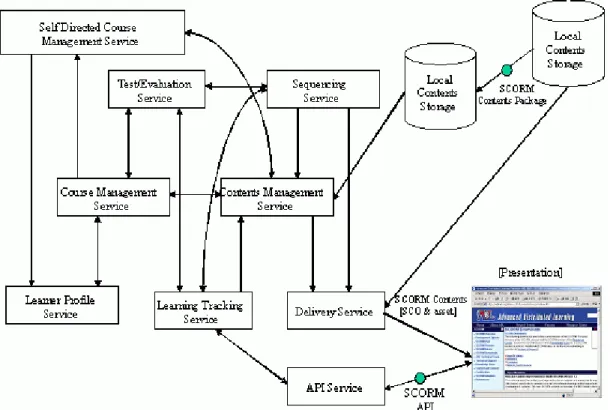
(2) Int. Computer Symposium, Dec. 15-17, 2004, Taipei, Taiwan.. employees face: For example, employees can set their own time for education which makes it a proactive learning experience. Many researches done on this subject and numerous case studies assert that computer network, which has an ability to overcome space and time and help learners exchange information cooperatively, can establish learneroriented educational system.[5,6] Unfortunately, except for the fact that individuals can learn in their home instead of a classroom and set their own time instead of following a prescribed schedule, difference between online education and offline education is minimal. So far, the most common type of online education has targeted only at the majority of people and unilaterally delivers educational information to its learners. However, educational achievement can be possible when contents can be prescribed to meet specific educational needs of an individual.[7,8]. The figure #1 illustrates a SCORM based LMS which is supplemented with the self-leading type of process management service. In fact, the LMS discussed in this paper is based on the implementation of features related to selfleading type of process management service because not all SCORM based LMS share same type of database organization and contents management implementation via meter information. The purpose of this paper is to build a system that can allow learners to choose contents of their educational level, learn to achieve educational goals, and move onto the next level. The system offers detailed information, such as completed courses and prerequisites of lectures that a learner has to know before registering a lecture. Once he selects a subject, the system illustrates subject contents that are categorized by chapter and difficulty. With the given information of the subject, he can confidently select his own contents to be studied. Organization of the proposed system is as follows: 1) DB server which contains SCO information 2) Module which allows administrators and instructors to input detailed contents 3) Webpage module that can illustrate detailed information of each subject and its contents for learners to choose. 4) Module that can organize educational process for each subject according to the specific requirements and needs that a learner requests. 5) Module that can operate in conjunction with LMS and contents for learners to use.. 3. Suggestions and System Requirements As I have presented, the needs for standardization of online education has become increasingly important and SCORM has been positioning itself as the standard of online education. As of now, using search and category functions, reorganization and maintenance of contents became easy, however, service provider organizes contents for his learners to search and register a lecture of their choice. In this paper, I would like to present a solution that can allow learners to choose lecture contents for each subject[9,10].. Figure 1. LMS System Service Diagram. 1073.
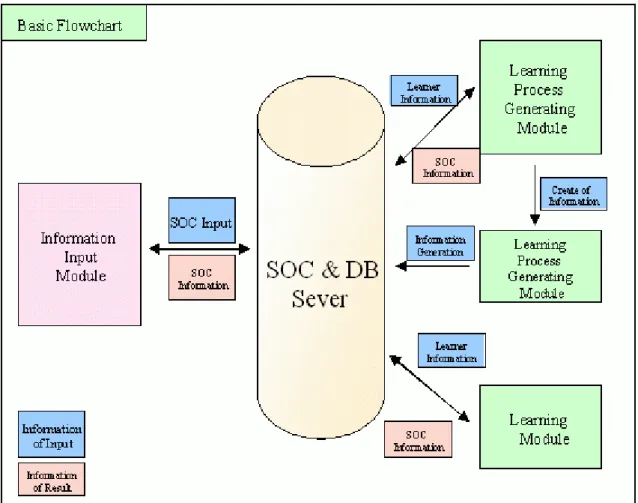
(3) Int. Computer Symposium, Dec. 15-17, 2004, Taipei, Taiwan.. “ Learning Moduleٛ optimally services the selected contents to the learner.[11,12] 4.1 SCO Information Input Module for Administrators and Instructors. Author names and affiliations are to be centered beneath the title and printed in Times 12-point, nonboldface type. Multiple authors may be shown in a two- or three-column format, with their affiliations italicized and centered below their respective names. Include e-mail addresses if possible. Author information should be followed by two 12-point blank lines. This module registers contents of lectures established by LMS administrators or instructors and inputs the registered contents. Detail contents information would possess the following information: learner’s year in school, completed subjects, open lectures, available level, and grades after completion. The sequence the module’s information input, as illustrated in a flowchart of the figure #3, starts off with the page where a learner’s ability is confirmed and available categories, which can be registered, are displayed. For administrators, all available subjects are displayed and for instructors, categories in progress are displayed. When selecting specified category’s subject, administrators and instructors can input or edit detailed information for each chapter. Once the input is completed, information stored in DB is renewed. If there are no errors, the system will direct to the categorical page and if there are errors, the system will direct do the contents registration page.. 4. System Organization As shown in the figure #2, contents information is uploaded using the information input module. Based on the information of the learner in DB server, he can choose contents that the system allows. “Information Input Module”ٛ inputs and edits detailed information of contents in DB server. “ Learner Request Module”ٛ, based on the learner information, shows a list of available subjects to the learner. Then the learner can compose his own contents according to the difficulty level that he chose. “Learning Process Generating Module” generates a learning process for the contents selected by the learner and stores the result in DB server. Lastly,. Figure 2. System Basic Flowchart. 1074.
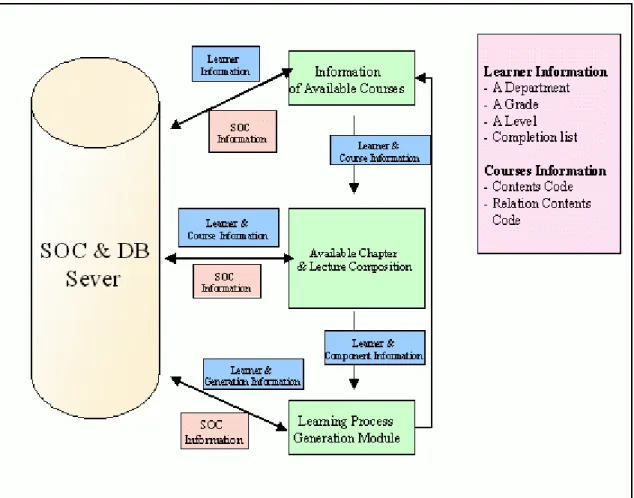
(4) Int. Computer Symposium, Dec. 15-17, 2004, Taipei, Taiwan.. Figure 3. Input Information Module Basic Flowchart selected subject. As a learner completes a course and move on, he will gain points and eventually get to the higher level. Educational competence levels are A, B, C, and D and levels based on occupation are A for professionals, B for students, C and D for others based on their depth of knowledge and job descriptions.. 4.2 SCO & DB Servers SCO & DB servers are database servers that contain required information for the proposed LMS. They basically manage information of contents and 1 Detailed Contents instructors and learners. ○ 2 3 Learners Information, ○ Instructors Information, ○ 4 Information of Available Courses. Information, ○ Detailed contents and information of available courses are shared among instructors because it is not always just one instructor who makes up the entire contents for a course.. 4.3 Learning Process Request Module Learning Process Request Module displays available subject for learners. Once a subject is chosen, the module will show detailed information for each chapter of the contents so that learners can choose that fits his level and complete his registration request. For those who do not want to organize the contents, instructors will determine basic organization contents.. Thus, learners can easily find out about other courses that are complementary to their selected courses. To determine competence level, points are given discriminately based on learner’s occupation, major, depth of knowledge of the. 1075.
(5) Int. Computer Symposium, Dec. 15-17, 2004, Taipei, Taiwan.. Figure 4. Learning Process Application Module Basic flowchart responding time by storing contents information into the registered subject DB, thus, eliminating needs for searching and organizing contents repeatedly. As shown in the picture, Leaning Process Generating Module stores contents information selected on the lecture configuration page. Using the information, the module searches for the requested detailed chapter contents in DB server and generates SQL prompt. If SQL is executed without error, the search is repeated until the selected category is completed.. Learning Process Request Module is activated once a learner requests course registration. Based on the information submitted to DB server, which includes major, year in school, and competence level, the module displays available courses and their information on the “Available Courses Page" and prerequisites for non-available courses. If a course is selected, the learner is taken to the page where available chapters are displayed based on the contents information and his background information. There, only the available courses for his level are displayed for him to choose and organize. Once registered courses are confirmed be the learner, he can call up the subject organization page using information of selected subject and his background information. Based on the detailed contents information received from DB server, Learning Process Request Module generates contents sequence in the order requested by the learner and moves to the “Available Courses Pageٛ after storing the sequence into DB server.. 4.5 Learning Module Learning Module allows learners to take courses by displaying selected lectures. Learning Module displays categorized registered subjects using the learnersٛ information. Once a subject is selected, available lectures are displayed. Lecture window is launched upon completion of lecture selection process.. 5. Conclusion 4.4 Learning Process Generating Module Although a variety of standardization and Learning Management System (LMS) were produced to develop and effectively manage web. Learning Process Generating Module organizes selected categories in order. The module helps the server operate more efficiently and minimizes. 1076.
(6) Int. Computer Symposium, Dec. 15-17, 2004, Taipei, Taiwan.. contents in response to active diffusion of internet application, practical changes to assist online learners are not yet to be found. In this paper, I would like to introduce a LMS that can support self-leading education by providing various types of learners at Virtual University with delicately organized educational contents for maximum efficiency. The system allows a learner to select a lecture or a chapter which has been presorted to meet his educational needs and intellectual ability. The further research areas include the followings: 1) Subdivision of selected educational contens. 2) Restriction on selectable chapters in regards to educational achievement. 3) Reorganization of remaining contents during learning process.. Englewood Cliffs, NJ: Educational Technology Publication. [12] Harasim, L.(Eds.). (1990). Online education : Perspective on a new environment. New York: Praeger.. The features discussed above should assist learners in case they choose difficulty without a full knowledge of their educational ability by allowing them to choose difficulty again according to their ability. Further research on Self-Leading LMS should be done to decide how much subdivision of subject contents should be done to achieve maximum efficiency.. References [1] standard,http://www.onstudy.com/ CyberNews /CyberNews_view.asp?no=56 [2] SCORM, http://www.edupd.com/learn/standard 05.htm [3] XML : my.dreamwiz.com/aphise [4] Long, H. B. and et. al.. Self-directed learning: Research and application. Normanٛ, OK: The Oklahoma Research Center for Continuing Professional and Higher Education, 1992. [5] Flora Chia-I Chang, “Intelligent assessment of distance learning”, Information Sciences, Vol.140 No 1, pp 105-125, 2002. [6] B.Willis, “Effective Distance Education Planning: Lessons Learned, Educational Technology,” Vol.38, No.1, pp.57-59,1998 [7] Barry Kort and Rob Reilly, An Affective Module for an Intelligent Tutoring System,”ITS 2002, LNCS 2363, 2002. [8] Frasson, C et. Al, “LANCA: A distance learning architecture based on networked cognitive agents,” Intelligent Tutoring Systems, pp. 593603, 1999. [9] Critical Business Benefits of an LCMS, LCMS Council Panel at the Online Learning 2002 hall.com. [10] Hall, B., & LeCavalier, J.(2000). E-learning across the enterprise: the benchmarking study of best practices. CA:Brandon-hall.com [11] Banan, B., Miheim, W.D.(1997). Existing webbased instruction courses and their design, in B. H. Khan(Ed). Web-based education. 381-388.. 1077.
(7)
數據

相關文件
The Centre for Learning Sciences and Technologies (CLST), The Chinese University of Hong Kong (CUHK) launched the!. EduVenture ® learning system, which has been well received by
1) Ensure that you have received a password from the Indicators Section. 2) Ensure that the system clock of the ESDA server is properly set up. 3) Ensure that the ESDA server
• 2) Enhancing learning and teaching of fiction and non-fiction through the use of Supported Reading as a teaching strategy and e-Learning resources.. • 3) Exploring
– One of the strengths of CKC Chinese Input System is that it caters for the input of phrases to increase input speed.. The system has predefined common Chinese phrases, such
• One of the strengths of CKC Chinese Input System is that it caters for the input of phrases to increase input speed. The system has predefined common Chinese phrases, such
To cope with these problems, we propose and develop a ubiquitous virtual tutoring assistant system which incorporates a supplement-material base as well as a solution extraction
This study proposed the Minimum Risk Neural Network (MRNN), which is based on back-propagation network (BPN) and combined with the concept of maximization of classification margin
A digital color image which contains guide-tile and non-guide-tile areas is used as the input of the proposed system.. In RGB model, color images are very sensitive
