
Study of some properties of greige cotton fabrics after hot mercerizing
4
0
0
全文
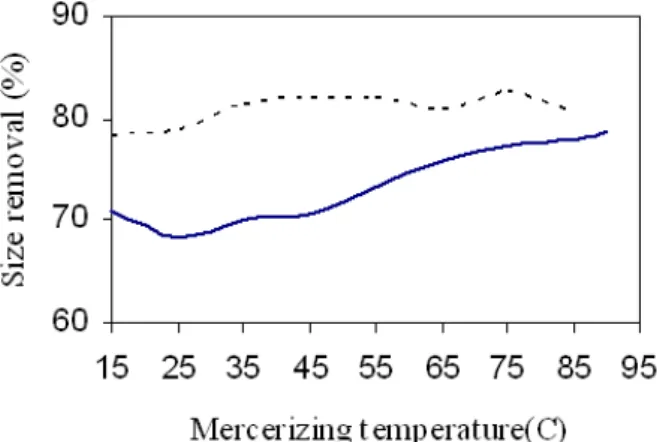
(2) wash.Cotton slack mercerized hot has greater affinity for dyes than cotton slack mercerized cold, but , on the other hand, cotton mercerized under high tension hot has less affinity for dyes than cotton mercerized cold under the same tension.. Where D is starch percentage in the greige cotton fabric and D′ is starch percentage in the mercerized cotton fabric. Measurement of shrinkage The equation 4 was used to calculate shrinkage amount :. Materials and method Fabric: 100% cotton made from 20sNe open end yarns for warp 2 and weft with weight 241 gr / m Caustic soda: laboratory grade caustic soda of 99/5% Purity was used. Dye: Remazol Turquoise Blue G (C.I Reactive Blue21 ) was used. Mercerization frame A square frame of stainless with stenter stainless pins were fixed with screws on the frame strips. The greige cotton fabrics were lightly stretched and fixed on the pins so that there was no chance of slippage of cloth during alkali treatment. The fabric holding frame with another sample in slack state were immersed in to. Shrinkage(%) =. L - L′ L. ×100. (4). Where L and Lَ are the lengths of the fabric before and after slack mercerization , respectively. Results and discussion Weight loss The greige cotton fabrics were mercerized in a constant concentration of caustic soda solution in slack state and under tension within temperature range of 15-90Co during 5 minutes. In Figures 1 and 2,the weight loss and size removal of mercerized the greige cotton farics is plotted against mercerizing temperature.. caustic soda solution (300 gr / lit ). Mercerizing was performed within temperature range of 1590oc during 5 minutes. The mercerized fabrics were then washed with hot and cold water to remove excess caustic soda. Any remaining alkali was neutralized with dilute acetic acid solution, followed by washing with cold water. Bleaching The mercerized samples were bleached with Hydrogen peroxide and caustic soda by exhaustion method. Dyeing The bleached samples when were dyed with Remazol Turquoise Blue G (C.I Reactive Blue21) using Pad – batch method.. Fig. 1. The effect of mercerizing temperature on the fabric weight loss: mercerizing under tension( ), slack mercerizing(-----). Dye uptake measurement The reflectance of dyed samples were measured by Tex- flash reflection spectrophotometer in 16 different wave length. The relevant K/S value of dyeing samples were measured by equation 1. 2. (1) K/S = (1-R) 2R Tensile strength measurement The tensile strength samples were measured by Tensolab tester at 65% RH and 21co using 170 mm as the gauge length and 125 mm/Min as the rate of extension. Measurement of weight loss (WL) The equation 2 was used to calculate WL.. Fig. 2. The effect of mercerizing temperature on the fabric size removal: mercerizing under tension( ), slack mercerizing(---). W – W′ (2) ×100 W Where W and Wَ are the weights of the fabric before and after mercerizing, respectively.. The weight loss may be due to starch and wax removed from fabric. There is a correlation between treatment temperature and weight loss, as well as between the fabric being under tension or slack state and weight loss(figure1and 2). The results show that an increase in mercerizing temperature will increase the weight loss in the fabric. The samples mercerized in slack state have shown more weight loss than the mercerized samples under tension .An increase in mercerizing temperature will decrease the viscosity of caustic soda solution ,so the penetration of caustic soda into the fabric and fibres becomes more rapid thus the more starch and wax can be. WL(%). =. Measurment of size removal The equation 3 was used to calculate size removal Size removal(%)= D - D′. (3).
(3) removed from fabric,therfore weight loss will increase. The greater weight loss in the slack mercerization fabrics than the mercerized samples under tension may relates to the easier penetration of caustic soda into the fabric and spaces between fibres, because warps and wefts are compacted in the mercerized samples under tension. Shrinkage The amount of fabric shrinkage in the warp and weft direction of the mercerizing samples in slack state is shown in Figure3.. Fig. 5. The effect of mercerizing temperature on tensile strength: mercerizing under tension ( ), slack mercerizing (-----). Fig.3.The effect of mercerizing temperature on the fabric shrinkage: weft direction ( ) ,warp direction(------) Although previous works has shown that increasing in mercerizing temperature, decreases the amount of fabric shrinkage, we found that for open-end fabrics, an increase in mercerizing temperature increased shrinkage percentage in the warp and weft direction , that may be also to the greige cotton fabric which was used (Figure3 ). Shrinkage in the warp direction was greater than that of weft direction. Increasing in mercerizing temperature till 65oC the fabric shrinkage increases to a maximum amount and then decreases to some extent. Decrease in shrinkage was observed after 65oC. \Tensile strength The fabrics tensile strength in warp and weft direction after mercerizing is shown in table 1 and Figures 4 and 5. Used fabric has had a tensile strength 29.5 kg in warp direction and 32.5 kg in weft direction.. The tensile strength on the fabric was increased after tension and slack mercerization . The major reasons for the increased strength might include an alleviation of internal stresses and the deconvoluting of the fibres in the fabric during swelling . Table.1:The effect of mercerization temperature strength Tensile Tensile Tensile strength strength strength Treatme warp weft warp nt(Co) direction direction direction Tempera Tension Tension slack ture mercerizin mercerizi mercerizi g ng ng 15 35.7 37 36.23 25 34.4 36.97 35.5 35 34.1 35.87 35.5 45 35.9 37.3 36.2 55 31.7 34 35 65 36.5 36.6 38.6 75 33 32.2 38 85 31 32 35.5 90 29.5 32 33. on tensile Tensile strength weft direction slack mercerizi ng 41 40.7 37.17 37.6 36 41.7 38.7 37.8 35.6. The mercerized samples in slack state showed the greater tensile strength than the mercerized samples under tension . Increasing in mercerizing temperature will increase tensile strength to a maximum amount in 65oC and then decreases to some extent(table 1). Increase in tensile strength can relates to the easier penetration caustic soda into fibres .. Fig. 4. The effect of mercerizing temperature on tensile strength: mercerizing under tension ( ), slack mercerizing (-----). Dye uptake The greige cotton fabric was mercerized and then bleached by hydrogen peroxide and caustic soda and then dyed by reactive dye. Figure 6 demonstates the dye uptake of the mercerized samples against inceasing temperature.The samples were compared with bleached and nonmercerized cotton dyed fabrics. Dye uptake after mercerization has increased than nonmercerized fabrics..
(4) Fig. 6. The effect of mercerizing temperature on uptake:slack mercerizing ( ), mercerizing under tension (-----) There was further increase in dye sorption on mercerized samples under tension at 35oC and 65oC and dye sorption above 65oC was decreased(Fig. 6). There was further increase in dye sorption on slack mercerized samples at 25oC and then dye sorption decreased. Figure 6 indicates that until 65oC the slack mercerized samples show higher dye sorption than the mercerized samples under tension and above 65oC, the mercerized samples under tension show higher dye sorption than the slack mercerized samples. Conclusion The greige cotton fabrics were treated with caustic soda solutions at different temperatures, under tension and relaxed conditions. The samples mercerized in slack state showed greater weight loss and tensile strength than the mercerized samples under tension. By increasing mercerizing temperature rate of shrinkage in the warp and weft direction increases on the other hand shrinkage in the warp direction was higher than that of weft direction. The results show that the dye uptake on mercerized samples increased than nonmercerized fabrics and there was further increase in dye sorption on slack mercerized samples at 25C° and on mercerized samples under tension at 35C°and 65C°. The results indicate that till 65C°the slack mercerized fabrics show higher dye uptake than the mercerized samples under tension and above 65C the mercerized fabrics under tension showed higher dye up take than the slack mercerized samples. References [1] Duckworth and Rusznak, proc. Loth IFA TCC congress, Barcelona, May 1975. [2] Duck wokth, and L.M.wrennall, J.S.D.C, November 1977, P:407-412. [3] Burkitt ,succ symposium, Zurich, 1973. [4] Niaz Ahmed and K.D.Tahir, Textile Horizons, February 1985, P:20-21..
(5)
數據
相關文件
substance) is matter that has distinct properties and a composition that does not vary from sample
These strategies include hands-on and minds-on exploratory activities that allow students to integrate and apply knowledge and skills, sustain their interests in science
Then, we tested the influence of θ for the rate of convergence of Algorithm 4.1, by using this algorithm with α = 15 and four different θ to solve a test ex- ample generated as
Particularly, combining the numerical results of the two papers, we may obtain such a conclusion that the merit function method based on ϕ p has a better a global convergence and
Then, it is easy to see that there are 9 problems for which the iterative numbers of the algorithm using ψ α,θ,p in the case of θ = 1 and p = 3 are less than the one of the
We investigate some properties related to the generalized Newton method for the Fischer-Burmeister (FB) function over second-order cones, which allows us to reformulate the
In addition , from the result of The Manpower Utilization Survey and Family Income and Expenditure Survey, this study has shown that the minimum wages hike has a greater
This study, analysis of numerical simulation software Flovent within five transient flow field,explore the different design of large high-temperature thermostat room
