科技部補助專題研究計畫成果報告
期末報告
無序關聯性系統的大規模計算模擬
計 畫 類 別 : 個別型計畫 計 畫 編 號 : MOST 104-2112-M-004-002-執 行 期 間 : 104年08月01日至105年10月31日 執 行 單 位 : 國立政治大學應用物理研究所 計 畫 主 持 人 : 林瑜琤 計畫參與人員: 碩士班研究生-兼任助理人員:張太乙 碩士班研究生-兼任助理人員:張鎮宇 碩士班研究生-兼任助理人員:柯志緯 大專生-兼任助理人員:林源青 報 告 附 件 : 移地研究心得報告 出席國際學術會議心得報告中 華 民 國 106 年 01 月 31 日
中 文 摘 要 : 在多自旋耦合極強極限下,均質J-Q鏈的基態將自發轉變成一價鍵固 態。我們設計一針對J-Q鏈的強無序重整化群法(SDRG)用以探討耦合 無序對自發性價鍵固態的影響。我們的結果顯示無序價鍵固態裂成 交錯的二聚區間,成無晶形的價鍵固態,激發旋子位於疇壁。這無 晶形價鍵固態與無序海森堡鏈的基態同為所謂的無序單態相態。 中 文 關 鍵 詞 : 無序系統,無序單態基態,關聯函數,玻璃態
英 文 摘 要 : The ground state of a J-Q chain in the absence of disorder and in the limit of strong multi-spin (Q) couplings is a valence-bond solid (VBS) with spontaneous dimerization. We introduce a strong-disorder renormalization group
(SDRG) scheme to study the effect of quenched bond randomness on J-Q chains. Our results show that the
random VBS state breaks into alternating dimerized domains with singlets formed between spinons localized
at domain walls. This amorphous valence-bond solid at long distances is asymptotically a random-singlet state,
similar to the ground state of the random Heisenberg chain. 英 文 關 鍵 詞 : disordered systems, random-singlet ground state,
Large-scale numerical simulations of disordered and
correlated matter
Yu-Cheng Lin
January 30, 2017
1
Research results
Results accomplished under this project are summarized below:
1.1
Properties of the random-singlet phase
Logarithmic corrections to the power-law decaying spin correlations
We use unbiased zero-temperature quantum Monte Carlo (QMC) simulations to study the antiferromagnetic S = 1/2 Heisenberg chain with random couplings, calculating disorder-averaged spin and dimer correlations. Surprisingly, in light of the large number of previous
studies and the widely accepted notion that the r−2 asymptotic form, predicted by the
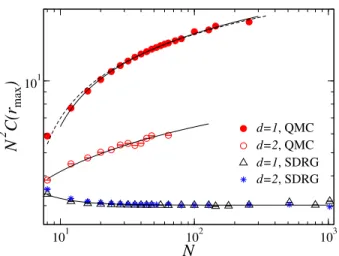
strong-disorder renormalization group (SDRG) analysis, for the mean spin-spin correlations is exact [1], our QMC results show that the SDRG method misses universal multiplicative logarithmic (log) corrections to the power-law decays (see Fig. 1). By studying different contributions to the spin-spin correlation functions in QMC calculations in the VB basis, we find that the log corrections arise from a contribution that is completely missing in the simple singlet-product ground state resulting from the SDRG method.
The approximate ground state resulting from the SDRG is described by a single set of
bipartite valence bonds, |ψ0i = |vi, with no bonds crossing each other, while the ground
state projected out by the QMC method is a superposition of VB states,
|ψ0i =
X
v
αv|vi , (1)
with non-negative coefficients αv that are determined stochastically. The matrix elements
needed hv0|Si· Sj|vi for computing the correlation function in the valence-bond basis are
finite only if sites i and j belong to the same loop in the transition graph of the overlap
between |vi and |v0i. In Fig. 2 we illustrate two different types of one-loop structures,
corresponding to |vi 6= |v0i and |vi = |v0i, in the transition graph of the overlap hv0|vi. A
loop of type (b), which is the only kind of loop appearing in an overlap hv|vi between same 1
101 102 103 N 101 N 2 C(r max ) d=1, QMC d=2, QMC d=1, SDRG d=2, SDRG
Figure 1: The correlation functions at the largest distance rmax = N/2 of the random
Heisenberg chain of length N , multiplied by N2, shows the presence of a multiplicative
logarithmic correction to the 1/N2 scaling for the QMC results, which increases with
dis-tance. The correction for the SDRG results shows a small enhancement for very small N and fast convergence to a constant, implying a small conventional subleading power-law correction. From Ref. [2].
(a)
(b)
Figure 2: Two different types of loop structures in the transition graph of the overlap
between two VB states |vi (upper, black bonds) and |v0i (lower, red bonds). The gray and
white sites belong to two different sublattices. Type (a) indicates the case where |vi 6= |v0i
and type (b) is a single-bond structure with |vi = |v0i. The correlation C(|i − j|) for any
pair of spins (i and j) located in the same loop is a finite constant. From Ref. [2].
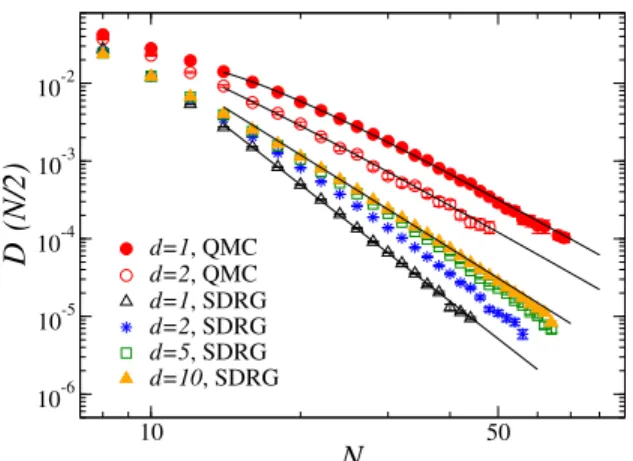
10 50 N 10-6 10-5 10-4 10-3 10-2 D * (N/2) d=1, QMC d=2, QMC d=1, SDRG d=2, SDRG d=5, SDRG d=10, SDRG
Figure 3: SDRG and QMC results for dimer correlations of the random-J model with
different disorder parameters d. The fitting forms are D∗(r) = αr−4+ βr−5 (SDRG) and
D∗(r) ∝ r−4ln(r/r0). From Ref. [2].
states (as in the SDRG ground state), contains only two sites in different sublattices sepa-rated by an odd number of lattice spacings. A loop of type (a) can have arbitrarily many sites greater than two. Thus the spin correlation function C(r) for even r is determined solely by loops of type (a).
The results are published in Ref. [2]. Dimer correlations
We have also investigated the dimer-dimer correlation function of the ground state of the random Heisenberg chain (the random-singlet state), which to our knowledge had not been previously considered, neither in SDRG nor QMC calculations. We have found numerically
that the SDRG dimer-dimer correlations decay as D∗(r) ≈ r−4; here D∗(r) is the staggered
dimer correlation function. The QMC results are very well accounted for by a multiplicative
log D∗(r) ∝ r−4lnσd(r/r
0), with σd ≈ 1 (s. Fig. 3) [2]. The asymptotic r−4 decay of the
dimer correlation in the random-singlet (RS) state has been also tested by the principal investigator in the random XX chain using the mapping into a free fermion problem, which is also in an RS phase; the results are to be published.
1.2
Amorphous valence-bond solid
A chain, called the Q chain, described by
HQ = −
N
X
i=1
QiPi,i+1Pi+2,i+3Pi+4,i+5, (2)
where Qi > 0 and Pi,j is a singlet projector on two spins i, j, is a valence-bond solid (VBS)
at zero temperature when the system is clean (Qi ≡ Q ∀i). The Q chain combined with
Figure 4: Qualitative AVBS ground state of an S = 1/2 spin chain. The gray and orange circles represent the two sublattices of the bipartite lattice. The short valence bonds (red and blue thick lines) form ordered domains, between which spinons localize. In the ground state the spinons freeze pairwise into long-bond singlets (indicated by the arches).
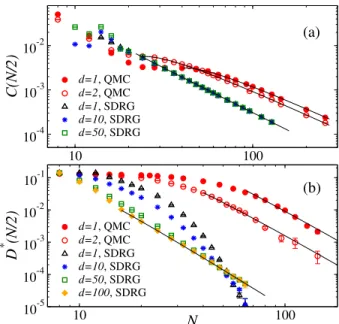
10 100 10-4 10-3 10-2 C(N/2) d=1, QMC d=2, QMC d=1, SDRG d=10, SDRG d=50, SDRG 10 N 100 10-5 10-4 10-3 10-2 10-1 D * (N/2) d=1, QMC d=2, QMC d=1, SDRG d=10, SDRG d=50, SDRG d=100, SDRG (a) (b)
Figure 5: SDRG and QMC results for the spin (a) and dimer (b) correlations in the random-Q model. The functional forms fitted to the data (curves shown) are the same as in the corresponding cases in Fig. 1 and Fig. 3.
the Heisenberg coupling J (> 0),
HJ = −
N
X
i=1
JiPi,i+1, (3)
undergoes a transition to the standard critical antiferromagnet at J/Q ≈ 6 [3]. The
dimer-ization transition is in the same universality class as that in the well-studied J1-J2
Heisen-berg chain.[5, 6, 7] An important question is how disorder affects such a transition and the VBS state. In the latter, one can expect an amorphous VBS (AVBS) with alternating do-mains of the two different dimerization patterns (which differ by a translation of one lattice unit), and a simple valence-bond picture suggests that the domain walls between these do-mains should contain S = 1/2 spin degrees of freedom—localized spinons—corresponding to long valence bonds between different domain walls as illustrated in Fig. 4.
The generalization of the SDRG to the random-Q model (2) with three singlet projectors
(also called Q3 interactions) is non-trivial, as the multi-spin interaction generates various
terms of the forms Pi,i+1Pi+2,i+3 (Q2 interactions) and Pi,j (J interactions) under SDRG,
with several different cases in the perturbative treatment of the decimated operators. The principal investigator worked out the completely new scheme for the SDRG of the J-Q model. The technical details of the method is described in Ref. [2].
Our SDRG and QMC results show consistently that both the random-J and the random-Q models are asymptotically governed by the RS fixed point. Thus, in a J -Q model, we do not expect any phase transition as a function of the ratio J/Q, unlike the clean system where there is a dimerization transition of the same universality class as
in the J1-J2 Heisenberg chain [3, 4]. Although there is no phase transition in the sense
of asymptotic, the AVBS can still be considered as a state of matter different from the Heisenberg-RS, because it possesses a length-scale—that of VBS domains (see Fig. 5(b))— which is not present at the RS fixed-point alone, but which can be made arbitrarily large by tuning interactions in the AVBS state.
The physics of the VBS and AVBS also applies to spin chains coupled to phonons. In the classical limit, any spin-phonon coupling leads to dimerization (the spin-Peierls distortion), while at finite phonon frequency a critical coupling is required [8, 9, 10]. The AVBS state we have identified and characterized in Ref. [2] should be relevant to
quasi-one-dimensional spin-phonon materials, e.g., CuGeO3 [11] and TiOCl [12]. RS scaling due to
localized spinons should be detectable using NMR [13, 14], and it would then be desirable to also calculate temperature dependent magnetic properties.
1.3
Transport modeling
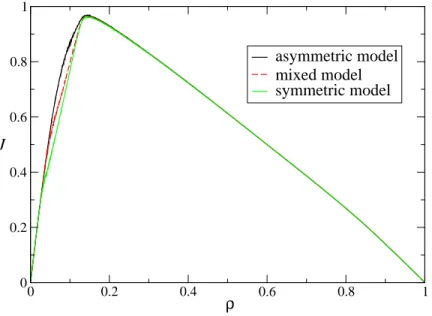
In this subproject we applied the study of disordered interacting systems to problems in our daily lives. We have simulated highway traffic flow problems using cellular automaton models [15]. One of our main results is that for three-lane the asymmetric lane change rule in general leads to a higher flow than the symmetric lane change rule, or a mixed lane change rule which is used in Taiwan (see Fig. 6). Here by the so-called asymmetric lane change rule vehicles have to drive on the right lane (the default lane) except when overtaking overtaking/passing slower vehicles; in this system middle-lane ”hogging” is prohibited. By the mixed rule only the left lane is the passing lane, whereas the middle lane and the right lane are regarded as two symmetric lanes.
This subproject is interdisciplinary research aimed at providing guidance directed at those involved in designing highway transportation systems. From the point of view of physics, jamming process is a kind of phase transition, with similarities to a glass transition which remains challenging [16].
References
[1] D. S. Fisher, Phys. Rev. B 50, 3799 (1994).
[2] Y.-R. Shu, D.-X. Yao, C.-W. Ke, Y.-C. Lin, and A. W. Sandvik, Phys. Rev. B 94, 174442 (2016).
0 0.2 0.4 0.6 0.8 1 ρ 0 0.2 0.4 0.6 0.8 1 J asymmetric model mixed model symmetric model
Figure 6: A fundamental density-flow diagram for the asymmetric, symmetric and mixed three-lane models.
[3] A. Banerjee and K. Damle, J. Stat. Mech.: Theor. Exp. 2010, P08017 (2010). [4] Y. Tang and A. W. Sandvik, Phys. Rev. Lett. 107, 157201 (2011).
[5] I. Affleck, Phys. Rev. Lett. 55, 1355 (1985).
[6] K. Nomura and K. Okamoto, Phys. Lett. A 169, 433 (1992). [7] S. Eggert, Phys. Rev. B 54, R9612 (1996).
[8] A. W. Sandvik and D. K. Campbell, Phys. Rev. Lett. 83, 195 (1999). [9] G. S. Uhrig and H. J. Schulz, Phys. Rev. B 54, R9624 (1996).
[10] H. Suwa and S. Todo, Phys. Rev. Lett. 115, 080601 (2015).
[11] M. Hase, I. Terasaki, and K. Uchinokura, Phys. Rev. Lett. 70, 3651 (1993).
[12] J. Zhang, A. W¨olfel, M. Bykov, A. Sch¨onleber, S. van Smaalen, R. K. Kremer, and
H. L. Williamson, Phys. Rev. B 90, 014415 (2014). [13] T. Shiroka et al., Phys. Rev. B 88, 054422 (2013). [14] T. Shiroka et al., Phys. Rev. Lett. 106, 137202 (2011).
[15] K. Nagel and M. Schreckenberg, Journal de Physique I. 2 2221 (1992). [16] B. Giulio, Nature Physics, 3 222 (2007).
2
Graduate students supervision
One master’s thesis supported by this project grant has been published online at http://thesis.lib.nccu.edu.tw/:
• Random singlets in an amorphous valence-bond solid: a strong-disorder renormaliza-tion group study, June. 2016, Chih-Wei Ke
Another thesis under this project studies jamming transition in traffic flow, being carried out by a student with bachelor degrees in computer science at NCCU.
STATPHYS26 satellite meeting:
Renormalization Group Theory of Disordered Systems,
Ecole Normale Supérieure, Paris, July 25-27, 2016
In addition to the main event of STATPHYS26, a series of satellite meetings was held in that period preceding and following the conference. The satellite meeting on Renormal-ization Group Theory of Disordered Systems was closely related to the main theme of this project. Therefore, I applied for attending this satellite meeting after the main conference. The talks arranged in this meeting were of excellent quality. I was in particular inter-ested in generalizations of the strong-disorder renormalization group (SDRG) to dynamics and energy excitations. In addition to the workshop, I discussed with some participants intensively about our resent research results. In particular, I started to write a draft of a paper on quench dynamics of disordered quantum spin chains, which studies the dynamics of the order parameter; my co-author of the paper Ferenc Iglói was one of the speakers for the workshop. Below I include the abstract of the paper:
By means of free fermionic techniques combined with multiple precision arithmetic we study the time evolution of the average magnetization, m(t), of the random transverse-field Ising chain after global quenches. We observe different relaxation behaviors for quenches starting from different initial states to the critical point. Starting from a fully ordered
initial state, the relaxation is logarithmically slow described by m(t) ∼ lnat, and in a
finite sample of length L the average magnetization saturates at a size-dependent plateau
mp(L) ∼ L−b; here the two exponents satisfy the relation b/a = ψ = 1/2. Starting from
a fully disordered initial state, the magnetization stays at zero for a period of time until
t = td with ln td∼ Lψ and then starts to increase until it saturates to an asymptotic value
mp(L) ∼ L−b
0
, with b0 ≈ 1.5. For both quenching protocols, finite-size scaling is satisfied
in terms of the scaled variable ln t/Lψ. Furthermore, the distribution of long-time limiting
values of the magnetization shows that the typical and the average values scale differently and the average is governed by rare events. The non-equilibrium dynamical behavior of the magnetization is explained through semi-classical theory.
This paper has been online published in arXiv:1611.09495, and will appear in New Journal of Physics.
RENORMALIZATION GROUP THEORY OF DISORDERED SYSTEMS
Room: Conf. IV, 2nd floor
Physics Department of the Ecole Normale Superieure 24 rue Lhomond, Paris
Monday 25: Functional RG for random systems, random manifolds, avalanches
9:30 - 10:15 T. Giamarchi -- Thermal effects for disordered systems
10:15 - 11:00 P. Le Doussal Functional Renormalisation Group and Avalanches
11:00 - 11:30 COFFEE BREAK
11:30 - 12:15 K. Wiese Non-Conventional Fixed Points in the RG of Disordered Systems and
Sandpiles.
12:15 - 14:00 LUNCH BREAK
14:00 - 14:45 M. Tissier -- Nonperturbative approach to the Random-Field Ising Model
14:45 - 15:30 I. Balog -- Hysteresis transition in the Random field Ising model
15:30 - 16:00 COFFEE BREAK
16:00 - 16:45 A. Fedorenko -- Classical and quantum dynamics of random field systems
16:45 - 17:30 G. Pruessner -- Field Theory of the Manna Model
17:30 - 18:15 T. Vojta -- Infinite-noise criticality: Nonequilibrium phase transitions in
fluctuating environments
Tuesday 26: RG for spin and structural glasses
9:30 - 10:15 M. Moore -- Do the de Almeida-Thouless and Gardner replica symmetry
breaking transitions exist in three dimensions?
10:15 - 11:00 G. Parisi -- Fat Diagrams
11:00 - 11:30 COFFEE BREAK
11:30 - 12:15 F. Ricci-Tersenghi -- Critical properties of Ising and XY models on random
graphs
12:15 - 14:00 LUNCH BREAK
14:00 - 14:45 M. Angelini -- Real space Renormalization Group for Spin-Glasses:
Migdal-Kadanoff vs Topological expansion
14:45 - 15:30 P. Urbani -- The Gardner transition in finite dimensions
15:30 - 16:00 COFFEE BREAK
16:00 - 16:45 C. Cammarota Few NPRG steps forward on the way for a theory of glass
16:45 - 17:30 S.Yaida -- A nontrivial critical fixed point for replica-symmetry-breaking
transitions
17:30 - 18:15 S. Franz -- Interfaces and Renormalization Group in Disordered Dyson Lattices
Wednesday 27: RG for out-of-equilibrium systems
9:30 - 10:15 J. Sethna -- Bifurcation theory and the renormalization group: Nonlinear scaling
for logarithms, resonances, and exponentials
10:15 - 11:00 L. Canet -- Spatiotemporal velocity-velocity correlation function in fully
developed turbulence
11:00 - 11:30 COFFEE BREAK
RG for quantum disordered systems, Anderson and many body localisation, Bose glass
11:30 - 12:15 G. Refael -- Strong disorder Wegner flow and 1d localization transitions
12:15 - 14:00 LUNCH BREAK
14:00 - 14:45 F. Igloi -- Random quantum systems with long-range interactions
14:45 - 15:30 I. Gruzberg -- Multifractality and scaling dimensions at Anderson transitions:
exact results.
15:30 - 16:00 COFFEE BREAK
16:00 - 16:45 M. Tarzia -- Critical properties of Anderson localization in high-dimension
16:45 - 17:30 R. Vasseur -- Renormalization group approaches for many-body localization
and eigenstate phase transitions
19:30 CONFERENCE DINNER & CONCERT Bellevilloise
26th IUPAP International conference on Statistical Physics,
STATPHYS26, 2016
First I would like to acknowledge the financial support from the Ministry of Science and Technology (Grant No. MOST 104-2112-M-004-002), which enabled my participation in STATPHYS26 held in Lyon (France) from July 18 to 22, 2016.
My talk entitled ”Properties of the random-singlet phase: from the disordered Heisenberg chain to an amorphous valence-bond solid” was contributed to Session: Quantum fluids and condensed matter. I presented results from my recent study, in collaboration with colleagues at SYSU (Guangzhou, China) and BU (Boston, USA), on the random J-Q chain, using a strong-disorder renormalization group (SDRG) method and ground-state quantum Monte Carlo (QMC) simulations. The QMC simulations demonstrate logarithmic corrections to the power-law decaying correlations obtained with the SDRG scheme. The same asymptotic forms apply both for systems with standard Heisenberg exchange and for certain multispin couplings leading to spontaneous dimerization in the clean system. We show that the logarithmic corrections arise in the valence-bond (singlet pair) basis from a contribution that cannot be generated by the SDRG scheme. In the model with multispin couplings, where the clean system dimerizes spontaneously, random singlets form between spinons localized at domain walls in the presence of disorder. This amorphous valence-bond solid is asymptotically a random-singlet state and only differs from the random-exchange Heisenberg chain in its short-distance properties. Our results have published in: Phys. Rev. B 94, 174442 (2016), after the conference.
The conference STATPHYS attracted 1300 participants with more than 50 nationalities. The pressure on selected oral presentations was high. My presentation has become the only one oral presentation from Taiwan.
My talk slides are included in this report.
After this main conference in Lyon, I attended a satellite meeting on Renormalization Group Theory of Disordered Systems held in Paris.
Ju ly 19, 2016 / S ta tP hys 26 / L yo n
Properties of the random-singlet phase
from the disordered Heisenberg c
hain to an amorphous
va
len
ce
-b
on
d s
oli
d
Y u-Cheng L in / N at io nal Cheng chi U niv ers it y / T aiwan P ro p er ties o f th e r an d o m -s in g let p h as e: f ro m th e d is o rd er ed Heis en b er g ch ain to an am o rp h o u s v alen ce-b o n d s o lid arXiv :1603.04362 Co llab orat ors : C h ih -W ei K e (N at io nal Cheng chi U niv ers it y, T aiwan) Y u -R o n g S h u , Dao -Xin Y ao (S un Y at -S en U niv ers it y, China ) A n d er s W . S an d v ik (B os to n U niv ers it y, U SA ) ✤RG
p
ro
ced
ur
e fo
r
str
ong-disor
der RG
str ong es t c oup ling ef fec tiv e c oup ling H = X i J i ~S i ·~S j Rand om -s ing let s tat e: a no n-c ro ss ing v alenc e-b ond s tat e ⌦ ˜J = JJ 0 2⌦ < ⌦ D as g up ta, M a(1980)random-singlet state
✤F
ix
ed
-p
oint
d
is
trib
ut
io
n o
f
✤N
um
b
er o
f ac
tiv
e s
p
ins
˜J P ( ˜J)= ˜J 1 +1 / = ln( ⌦ ), ⌦ = m ax { ˜J} !1 ˜J P ( ˜J) n ⌦ ⇠ 1 ln 2 ⌦ ` ⇠ ln 2 ⌦ infinit e-rand om nes s D . F is her (1994)random-singlet state
✤U
nc
onv
ent
io
nal d
y
nam
ic
al s
caling
✤M
ean s
p
in-s
p
in c
orr
elat
io
n func
tio
n
⌧ ⇠ exp( p ⇠) z = 1 d y nam ic al ex p onent C (r )=[ h ~S i ·~S i+ r i] av ⇠ n 2 ⌦ C (r ) ⇠ 1 r 2 D . F is her (1994)ener
gy-length scaling
10 -2 10 -1 10 0 n Ω 10 -2 100 10 2 -ln(Ω) ⇠ 1/ p n ⌦`
⇠
ln
2⌦
-400 -300 -200 -100 0 -500 ln( Ω f) 10 -6 10 -4 10 -2 P( ln(Ωf ) ) L = 1024 L = 2048 L = 4096 L = 8192 -6 -5 -4 -3 -2 -1 0 ln( Ω f ) / L 1/2 10 -6 10 -4 10 -2 100 P( ln(Ωf ) / L 1/2 ) L = 1024 L = 2048 L = 4096 L = 8192 infinit e-rand om nes s fix ed p ointvalence-bond (VB) states
✤B
ip
art
it
e V
B
s
tat
e:
a s et o f s ing let s b et ween t wo d if fer ent sub lat tic es o n a b ip art it e lat tic e. ✤V
B
b
as
is
:
ov er -c om p let e & no n-o rt ho g onal |v i = O i,j |( i, j) i |( i, j) i = 1 p 2 (|" i# j i |# i" j i) no t uniq ue A ny S =0 wav e func tio n: | i S =0 = X v ↵ v |v i, (↵ v > 0) i jexpectation values
h |O | i h | i = P vv 0↵ v 0 ↵ v hv 0 |O |v i P vv 0 ↵ v 0 ↵ v hv 0 |v i E xp ec tat io n v alue o f an o b serv ab le in a V B s tat e O v erlap num b er o f lo op s in t he o v erlap d iag ram N : hv 0 | |v i hv 0 |v i hv 0 |v i =2 N N/ 2expectation values
h |O | i h | i = P vv 0↵ v 0 ↵ v hv 0 |O |v i P vv 0↵ v 0 ↵ v hv 0 |v i E xp ec tat io n v alue o f an o b serv ab le in a V B s tat e O v erlap hv 0 |v i =2 N N/ 2 num b er o f lo op s in t he o v erlap d iag ram N : Two -s p in c orr ec tio n i j hv 0 | ~S i ·~S j |v i = ( ± 3 4 hv 0 |v i, 0 , i j ✤Sing
let
p
ro
jec
to
r:
valence-bond pr
ojector QMC
1 2 hO i = h I |H m OH m | I i h I |H 2 m | I i |GS i =l im m !1 H m | I i P ij = 1 4 I ~S i ·~S j H = X ij J ij P ij S. L iang (1990); A . S and v ik (2005)valence-bond pr
ojector QMC
T ian h e-2log-corr
ection to C(r)
!
in t he Rand om -S ing let S tat e 10 100 L 10 -4 10 -3 10 -2 10 -1 C(L / 2) d=1 , QMC d=2 , QMC d=1 , SDRG d=2 , SDRG QMC SD RG C (r ) ⇠ 1 r 2 C (r ) ⇠ ln a (r ) r 2 a ⇡ 0. 5 D . F is her (1994) ⇡ (J )= 1 d J 1 /d 1 , for 0 <J 1 C (|i j|)=( 1) |i j| h ~S i ·~S jilog-corr
ection to C(r)
!
in t he Rand om -S ing let S tat e 10 100 1000 L 10 1 L2C(L / 2) d=1 , QMC d=2 , QMC d=1 , SDRG d=2 , SDRG QMC SD RG C (r ) ⇠ ln a (r ) r 2 a ⇡ 0. 5 J. Ho y os , et . al (2007) C (r ) ⇠ 1 r 2 ✓ 1+ r r 0 r ◆ ⇠ ✓ 1+ A L ↵ ◆ ⇡ (J )= 1 d J 1 /d 1 , for 0 <J 1 C (|i j|)=( 1) |i j| h ~S i ·~S j i ⇠ p ln( L /B )inside
QMC Q M C/S D RG C (|i j|)=( 1) |i j| h ~S i ·~S ji 3 4 i j i j |v i i j 3 8 |v i hv 0 | |v i hv 0 | 3 16 hv |dimer corr
elation function
B i ⌘ ~S i ·~S i+1 i i +1 j j +1 (a) i i +1 j j +1 (b) D (|i j|)= hB i B ji i i +1 j j +1 (c) i i +1 j j +1 (d) 9 16 3 16 16 3 9 32 QMC Q M C/S D RG Q M C/S D RG Xdimer corr
elation function
!
in t he Rand om -S ing let S tat e 10 100 L 10 -6 10 -5 10 -4 10 -3 10 -2 10 -1 D*(L / 2) d=1 , QMC d=2 , QMC d=1 , SDRG d=2 , SDRG d=5 , SDRG d=10 , SDRG D ⇤ (r )= D (r ) 1 2 D (r 1) 1 2 D (r + 1) ( 1) r r D ⇤ (r ) ⇠ ln b (r ) r 4 QMC b ⇡ 1 SD RG D ⇤ (r ) ⇠ 1 r4JQ chain
s
✤T
he JQ
3c
hain:
✤T
he “c
lean” c
as
e:
sp o n tan eo u s lat tic e s y m m et ry b reak ing when J i ⌘ J ,Q i ⌘ Q , 8i Q /J & 0. 1645 Q /J liq uid lik e V B s olid (Q /J ) c H JQ 3 = X i J iP i,i +1 X i Q iP i,i +1 P i+2 ,i +3 P i+4 ,i +5 J i,Q i > 0, 8i
JQ chain
s
✤T
he JQ
3c
hain:
✤W
it
h
b
ond
rand
om
nes
s:
Q /J rand om s ing let p has e H JQ 3 = X i J iP i,i +1 X i Q iP i,i +1 P i+2 ,i +3 P i+4 ,i +5 J i,Q i > 0, 8i
?
SDRG for the
random
JQ chain
Q Q Q/ 16 Q/ 4 hv 0 |Q PP 0 P 00 |v 0 i 1s t c orr ec tio n Q Q 0 Q Q 0 Tr unc at io n o f c oup ling sSDRG for the
random
JQ chain
2nd c orr ec tio n G enerat io n o f ef fec tiv e c oup ling s Q Q 0 Q 0 J Q 0 Q 0 Q 0 i j ˜J ˜J = 1 32 QQ 0 ⌦ 2QQ 0 X ↵ = x, y ,z hv |S ↵ i S ↵ j |v i X e hv 0 |S ↵ PP 0 |e ih e|PP 0 S 0↵ |v 0 i ⌦ ! or ˜J = 1 32 QJ ⌦SDRG for the
random
JQ chain
2nd c orr ec tio n G enerat io n o f ef fec tiv e c oup ling s Q Q J Q 0 Q 0 Q 0 Q 0 ˜J or ˜J = 1 8 QJ ⌦ ˜J = 1 8 QQ 0 ⌦GS of the random Q chain
!
10 -2 10 -1 10 0n
Ω 10 -2 10 0 10 2-ln(Ω)
random Q-chain random J-chain⇠
1/
p
n
⌦ infinit e-rand om nes s fix ed p oint`
⇠
ln
2⌦
`
⇠
1/n
⌦GS of the random Q chain
!
10 100 L 10 -4 10 -3 10 -2 10 -1 C(L / 2) d=1 , QMC d=2 , QMC d=1 , SDRG d=10 , SDRG d=50 , SDRG sp in c orr elat io n func tio n QMC C (r ) ⇠ ln a (r ) r2 SD RG a ⇡ 0. 5 C (r ) ⇠ 1 r 2GS of the random Q chain
!
10 100 L 10 -4 10 -3 10 -2 10 -1 D*(L / 2) d=1 , QMC d=2 , QMC d=1 , SDRG d=10 , SDRG d=50 , SDRG d=100 , SDRG d im er c orr elat io n func tio n QMC SD RG D ⇤ (r ) ⇠ ln b (r ) r 4 b ⇡ 1 D ⇤ (r ) ⇠ 1 r4 D ⇤ (r )= D (r ) 1 2 D (r 1) 1 2 D (r + 1) ( 1) ramorphous valence-bond solid
G ro und s tat e o f t he rand om Q -c hain A ls o a rand om -s ing let p has econclusions
✤ L og arit hm ic m ult ip lic at iv e c orr ec tio n t o in t he rand om -s ing let (RS ) p has e ✤ D im er c orr elat io n func tio n in t he RS p has e ✤ T he q uant um p has e t rans it io n in t he JQ c hain is d es tro y ed b y s tro ng d is or d er C (r ) ⇠ 1 /r 2 as o p p os ed t o an ad d it iv e c orr ec tio n fo und b y S D RGC
(r
)
⇠
p
ln(
r)
r
2D
(r
)
⇠
ln(
r)
r
4 P ro p er ties o f th e r an d o m -s in g let p h as e: f ro m th e d is o rd er ed Heis en b er g ch ain to an am o rp h o u s v alen ce-b o n d s o lid arXiv :1603.04362 Co llab orat ors : C h ih -W ei K e (N at io nal Cheng chi U niv ers it y, T aiwan) Y u -R o n g S h u , Dao -Xin Y ao (S un Y at -S en U niv ers it y, China ) A n d er s W . S an d v ik (B os to n U niv ers it y, U SA )for mor
e details
科技部補助計畫衍生研發成果推廣資料表
日期:2017/01/25科技部補助計畫
計畫名稱: 無序關聯性系統的大規模計算模擬 計畫主持人: 林瑜琤 計畫編號: 104-2112-M-004-002- 學門領域: 其他凝體-理論無研發成果推廣資料
104年度專題研究計畫成果彙整表
計畫主持人:林瑜琤 計畫編號: 104-2112-M-004-002-計畫名稱:無序關聯性系統的大規模計算模擬 成果項目 量化 單位 質化 (說明:各成果項目請附佐證資料或細 項說明,如期刊名稱、年份、卷期、起 訖頁數、證號...等) 國 內 學術性論文 期刊論文 0 篇 研討會論文 0 專書 0 本 專書論文 0 章 技術報告 0 篇 其他 0 篇 智慧財產權 及成果 專利權 發明專利 申請中 0 件 已獲得 0 新型/設計專利 0 商標權 0 營業秘密 0 積體電路電路布局權 0 著作權 0 品種權 0 其他 0 技術移轉 件數 0 件 收入 0 千元 國 外 學術性論文 期刊論文 1 篇 Physical Review B, 94, 174442(14 pages) (2016) 研討會論文 126th IUPAP International conference on Statistical Physics, (July 18-22, 2016), Lyon, France 約1300與會者,來自臺灣的唯一獲選演 講 專書 0 本 專書論文 0 章 技術報告 0 篇 其他 1 篇 arXiv:1611.09495,
to appear in New Journal of Physics 智慧財產權 及成果 專利權 發明專利 申請中 0 件 已獲得 0 新型/設計專利 0 商標權 0
營業秘密 0 積體電路電路布局權 0 著作權 0 品種權 0 其他 0 技術移轉 件數 0 件 收入 0 千元 參 與 計 畫 人 力 本國籍 大專生 1 人次 碩士生 3 博士生 0 博士後研究員 0 專任助理 0 非本國籍 大專生 0 碩士生 0 博士生 0 博士後研究員 0 專任助理 0 其他成果 (無法以量化表達之成果如辦理學術活動 、獲得獎項、重要國際合作、研究成果國 際影響力及其他協助產業技術發展之具體 效益事項等,請以文字敘述填列。) 本計畫研究結果受邀演講發表於 the 10th
International Conference on Computational Physics, 16-20 Jan 2017, Macao