國立交通大學
科技管理研究所
博士論文
由兵力耗損理論探討近代重大戰役之研究
Extending the Lanchester’s Square Law to Better
Fit the Attrition in the Ardennes Campaign
研 究 生:唐文漢
指導教授:洪志洋
由兵力耗損理論探討近代重大戰役之研究
Extending the Lanchester’s Square Law to Better Fit the
Attrition in the Ardennes Campaign
研究生:唐文漢 Student: Wen-Han Tang
指導教授:洪志洋 Advisor: Chih-Young Hung
國立交通大學
科技管理研究所
博士論文
A Dissertation
Submitted to Institute of Management of Technology College of Management
National Chiao Tung University in partial Fulfillment of the Requirements
for the Degree of Doctor of Philosophy in
Management of Technology May 2006
Hsinchu, Taiwan, Republic of China
由兵力耗損理論探討近代重大戰役之研究
學生:唐文漢 指導教授:洪志洋 教授
國 立 交 通 大 學 科 技 管 理 研 究 所
摘 要
戰爭是人類社會普遍存在的一種現象,戰爭的特質是交戰雙方意志的衝撞。戰爭 是猛烈艱難的工作,危險是其基本的特性。戰爭行為顯而易見的印象是危險,而人類 對此危險的反應是恐懼。因其改變國家之命運與國家間的秩序,對人類社會的影響既 深且鉅,故交戰雙方都希望藉由瞭解敵軍的戰術、戰略層次及作戰目標,而獲取預想 的利益。並試圖為下次作戰找出有利的戰爭條件和方法。 因此中國的孫子兵法始計篇開宗明義就闡述:兵者,國之大事,死生之地,存亡 之道,不可不察也。又云:夫未戰而廟算勝者,得算多也;未戰而廟算不勝者,得算 少也。多算勝少算不勝,而況於無算乎。謀攻篇提及知勝者有五:知可以戰與不可以 戰者勝,識眾寡之用者勝,上下同欲者勝,以虞待不虞者勝,將能而君不缷者勝。此 五者,知勝之道也。故曰:知己知彼,百戰不殆;不知彼而知,己一勝一負;不知彼 不知己,每戰必敗。 克勞塞維茨在戰爭論中曾說:任何理論的主要目的乃在澄清已然困惑不清與糾葛 難解的構想及理念;除非已對一些名詞與構想的意義加以界定,否則無人能在此方面 獲得任何進展。如有人認為上述說明不具任何意義,則其不是全然無法接受理論上的 分析,就是從未接觸到有關戰爭遂行的各種令人困惑而又相互排斥的理念。事實上, 理論固然無法提供解決問題的公式,也不能作為據以找出唯一解決方案的原則,但卻 能使人深入了解各種紛亂的現象與關係,俾將之提升為更高層次的行動範疇。所以對 理念加以釐清、探討與分析,自有其必要性。克勞塞維茨在戰爭論中又說:攻擊和防禦在戰爭是相互作用的狀態和反應。在進攻和防禦之間轉換將有一段時間的間距很難 定義。 人類長久以來一直透過各種技術發展或科學計算,確切解決對戰爭結果的期盼。 不論是實兵對抗操演、賽局理論、傳統沙盤推演、新興科技電腦兵棋模擬與蘭徹斯特 方程式之解析…等均屬之。近代軍事科技最大的成就不是建造出多麼新穎的武器裝 備,而是藉由軟體與硬體的結合,綿密的管理機制,瞭解戰爭與制止戰爭的發生,此 乃科技管理運用於軍事層面最佳管理意涵寫照。 於是本研究根據以上的需求,透過第二次世界大戰著名的阿登戰役為事例,藉由 著名軍事戰略理論引證、相關戰史討論與文獻蒐整後。進一步著手修改蘭徹斯特平方 定律模式。所獲致的成果,除了探討出該模式較符合現代戰爭的型態與精確的交戰雙 方兵力損耗外,更進一步透過實證分析,對於兩軍攻守交替的時間問題,作出較合理 與適切的說明。 關鍵字:孫子兵法、戰爭論、 蘭徹斯特方程式、阿登戰役
Extending the Lanchester’s Square Law to Better
Fit the Attrition in the Ardennes Campaign
Student: Wen-Han Tang Advisor: Dr. Chih-Young Hung
Institute of Management of Technology, National Chiao Tung University
Abstract
The war is the human society universal existence one kind of phenomenon; the war special characteristic is joins battle bilateral will dashing. No matter whether history repeats itself or not, we still can learn a lot of useful lessons from it. People have been interested in studying and analyzing historical warfare for thousands of years.
China's Sun Tzu first chapter said: military action is important to the nation, it is the ground of death and life, the path of survival and destruction, so it is imperative to examine it. The one who figures on inability to prevail at headquarters before doing battle is the one who has the least strategic factors in his side. The one with many strategic factors in his favor wins, the one with few strategic factors in his favor. Observing the matter in this way, I can see who will win and who will lose. The third chapter also said: so it is said that if you know others and know yourself, you will not be imperiled in a hundred battles; if you do not know others but know yourself, you win one and lose one; if you do not know others and do not know yourself, you will be imperiled in every single battle.
The war is the violent difficult work; the danger is its basic characteristic. The average person to the war impression, is similar to the humanity regarding the dangerous response is a fear. Joins battle both sides both to hope the affiliation by the attack enemy troop each kind of different social stratum goal, but gains the expectation the benefit. Since
the humanity has been long-time continuously penetrates each kind of technological development or the science computation, hopes to accurate solution to war result.
General Karl Von Clausewitz says in his book On War that attack and defend are a pair of concepts for mutual action and reaction. He considered that defense is more than passive waiting and resistance. The best defense must include the swift and vigorous assumption of the offense. In the shift between offense and defense is a period of deadlock during which both sides seek to seize a key strongpoint, collect intelligence and set up logistics and draw up the next operation plan. Previous researchers did not consider the deadlock of the shift between attack and defense.
General Karl Von Clausewitz believes that offense and defense in warfare are a state of interaction and response. The transition between offense and defense will have a short span of time difficult to define.
No matter is the real troops maneuvers, the game theory, the tradition war game drill, the hi-tech computer war game simulation and so on is it with Lanchaster equation. In this research, we try to improve Bracken’s and Chen’s work to significantly better fit our extended Lanchester model into the Ardennes Campaign live data. And after revising Lanchester equation, joins battle the bilateral military strength loss besides the discussion, further penetrates the real diagnosis analysis discussion both armies offense and defense in transation question.Realizing that the rapid increase in hi-technology is going to affect warfare, the armed forces are transforming themselves for the digital age. They need analytic tools to help make the best choices possible, and chief among these are good measures of effectiveness that can demonstrate the value of information in terms of military outcomes.
The contemporary greatest military achievement is not to construct the greatest weaponry, but is to affiliate the unification of software and hardware machinery with the
thoughtful management mechanism to prevent the war from happening.This is precisely our diligently goal.
In this research, we try to improve Bracken’s and Chen’s work to significantly better fit our extended Lanchester model into the Ardennes Campaign live data. According to our numerical experimental result, we improved Bracken’s work by 39.26%, and Chen’s work by 19.51%.The contribution of this research is that we propose a much better qualitative analysis model for the explanation of modern combat.
誌 謝
從碩士學位的完成到博士學位的獲得,對我而言,是一段辛苦而漫長的路程,對 於已習慣軍旅生涯的我而言,能夠躋身國內一流學府交通大學科技管理研究所取得博 士學位,甚感幸運。這一路走來雖然艱辛,幸得各方貴人相助,讓我能夠順利畢業, 在此表達我的敬意與謝意。 首先要感謝指導教授洪志洋博士,在這四年博士班進修期間的指導與教誨。同時 也非常感謝所上袁建中老師、曾國雄老師、虞孝成老師、徐作聖老師、劉尚志老師在 企業評價、財務管理、產業分析、科技政策、策略管理、技術預測、創投管理、研究 方法、科技與法律等相關領域之指導,讓我得以窺見科技管理的殿堂。對於我未來在 返回軍事單位,肯定是受益無窮。此外,論文口試階段也勞煩袁建中老師、曾國雄老 師、虞孝成老師給我諸多的引導,使得論文更臻完備。此外雲林科技大學鄭景俗博士, 中央警察大學朱錫琛博士在論文模型架構的建立提供許多指導與建議,使我茅塞頓 開,在此致上最深的謝意。 要從軍中暫時卸下身邊的職務到民間大學全時進修是相當不容易的事,我能夠順 利來到交通大學,非常感謝各級長官的支持讓我得此千載難逢之機。首先,是已卸任 的前陸軍總司令暨國防大學校長陳鎮湘上將以及前陸軍總部武計署署長曾祥穎將軍 的推薦與鼓勵,中科院副院長金壽豐將軍策勵與提攜。國防部所提供之學雜費與學分 費之補助,也讓我在學習時能夠不虞匱乏,免除後顧之憂。 在交通大學科管所求學的四個寒暑裏,暫時脫去了軍服與軍人傳統的價值觀包 袱,重溫學生生活,這是彌足珍貴的經驗。尤其是和許多年輕優秀的同學共同學習使 我能與時俱進,觀念更新。生活與學習中得到眾人之協助與啟發讓我不至於學業進度 落後,諸多先進學長、同學之協助如基生兄、宗耀兄、元惠兄、秋江兄、貴英姊、士 其兄、鴻裕兄、華凱兄、辭修兄、以及才華、仁帥、宗偉、筱琪、雅雯、芃婷、昕翰、 禾友、宜華等人,目前尚在學之博碩班同學如駕人兄、華鼎兄、有恆、楨屏、燕妮、 立翰、家立等人。對於眾人的協助,我由衷表示感謝。 在攻讀博士班這四年間,甘苦參半,雖然獲得全時間進修博士,並晉升上校,但 對內人身罹重病,奔波求醫與住院診治,其所受身心疲痛相當不捨。最要感謝內人菡 如的成全及父母親和岳父母的關懷與文璇、文穎兩位妹妹協力關心照料支持,一雙兒 女德愛與德望的陪伴,讓我精神奕奕、全力以赴,專心於學業,並得以順利畢業。今 學有所成,我將此成果分享與我的家人和朋友及眾多關心我的人。學業已告一段落, 新的職務與考驗即將開始,我將一本初衷,自我惕勵、自強不息,將所學貢獻於社會 國家。謹以此論文獻給所有關心我、幫助我的至親家人、師長、與諸位貴人。 唐文漢 謹誌 交通大學科技管理研究所 95 年 5 月Contents
摘要...i Abstract ...iii 誌謝………...vi Contents………....vii List of Tables…...……….. ………x List of Figures...xi 1. Introduction ………...11.1 Research background and problems………....1
1.2 Research purposes ………3
1.3 Framework and methods ….………4
1.4 Organization of this dissertation ………...5
2. Literature review….………..………...6
2.1 Lanchester equations
.…….
………...62.1.1 Lanchester Square Law………6
2.1.2 Lanchester Linear Law……….7
2.2 Sun Tzu (Art of War)……….………...9
2.2.1 Initial estimations ( Laying plans ) ………..9
2.2.2 Planning offensives ( Attack by stratagem )…….………..10
2.2.3 Military disposition (Tactical dispositions)………10
2.3 On War ………..11
2.3.1 What is War………....11
2.3.2 On the signification of the combat……….12
2.4.1 The concept of game theory………...14
2.4.2 Selecting the Optimal Strategy………...15
2.4.3 The variable knowledge cases ..……….16
2.4.4 Results………18
2.5 The Ardennes: Battle of the Bulge.………...19
2.5.1 Weather and terrain analysis of Ardennes………..19
2.5.2 The term Battle of the Ardennes………...23
2.5.3 The battle of the Bulge remembered………..24
2.6 Concluding remarks………..30
3. Generalized version of Lanchester equations model…………..………..32
3.1 Original formulation of Lanchester’s Square and Linear Law………..32
3.1.1 Lanchester Linear Law………...33
3.1.2 Lanchester Square Law ...………..33
3.1.3 Numerical example………34
3.2 Models of ground combat………...36
3.2.1 Lanchester-type aggregated-force model of conventional ground combat….36 3.2.2 Lanchester’s equations and the structure of the operational campaign: between-campaign effects.……….36
3.2.3 Modeling the mobile land battle: combat degradation and criteria for defeat………..37
3.3 Attrition models………38
3.3.1 Attrition Models of the Ardennes Campaign……….38
3.3.2 New look at the 3:1 rule of combat through Markov Stochastic Lanchester models………39
3.3.3 Lanchester models of the Ardennes Campaign……….40
3.4.1 Special experiments in bio-tech...41
3.4.2 The Lanchester strategy on sales and marketing………43
3.5 Concluding remarks…..………44
4. Model Building and implementation: empirical study..………..46
4.1 The problem of the original Lanchester model………...46
4.2 Bracken’s and Chen’s work can be improved to better fit the attrition in the Ardennes Campaign.………47
4.3 Building a much better qualitative analysis model for the explanation of modern combat………..49
4.4 Empirical study ………..………..52
4.5 Discussion ………54
5. Conclusions and recommendations...………56
5.1 Research finding and concluding remarks………56
5.2 Recommendations……….57
Appendix………59
References ………..60
List of Tables
Table 1. The difference between Offensive and Defensive ……….13
Table 2. The effect of knowledge on Game Outcomes ……….……..18
Table 3. The Ardennes Offensive (The Battle of the Bulge) ..……….………....23
Table 4. The order of battle for period of 16 December 1944 to 2 January 1945………25
Table 5. The Ardennes Campaign (The Battle of the Bulge) ………...30
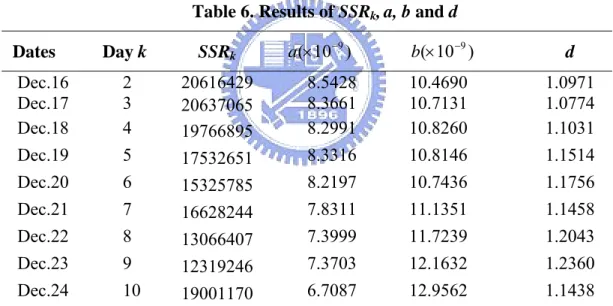
Table 6. Results of SSRk,a, b and d………..48
Table 7. Data on combat forces and losses………...52
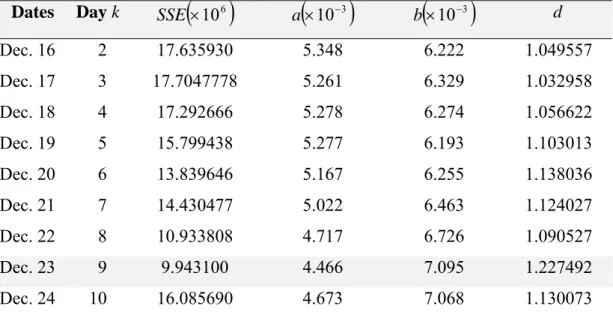
Table 8. Results of SSE, a, b and d ...………...53 Table 9. The sum of squared errors of Bracken’s, Chen and Chu’s, and Hung et al’s….54
List of Figures
Figure 1. The research process and organization of the dissertation ………..5
Figure 2. Game matrix ..….………...15
Figure3. The battle ground of Ardennes ……….20
Figure4. The German offensive and Allies defense …….…….……….……….27
1. Introduction
The greatest military achievement is not to construct the greatest weaponry, but to unify software and hardware machinery with thoughtful management mechanism to prevent the war from happening. This is precisely our diligently goal.
Research background, purposes and methodology are described in this chapter. Additionally, the research process and structure of this dissertation are introduced as followed.
1.1 Research background and problems
China's Sun Tzu([1]; [35]) first chapter said: military action is important to the nation, it is the ground of death and life, the path of survival and destruction, so it is imperative to examine it. The one who figures on inability to prevail at headquarters before doing battle is the one who has the least strategic factors in his side. The one with many strategic factors in his favor wins, the one with few strategic factors in his favor. Observing the matter in this way, I can see who will win and who will lose.
No matter whether history repeats itself or not, we still can learn a lot of useful lessons from it. People have been interested in studying and analyzing historical warfare for thousands of years. Modern warfare analysis has developed many useful models and systematic methods to make more thorough and appropriate explanations of historical combats. However, since those analytic methods were applied from different viewpoints of quantitative versus qualitative, general versus specific, rough versus detailed etc, it becomes quite complicated and difficult to explain well the causes and effects of a historical combat [2] .
Realizing that the rapid increase in information technology is going to affect warfare, the Army is transforming itself for the digital age. It needs analytic tools to help make the best choices possible, and chief among these are good measures of effectiveness (MOEs) that can demonstrate the value of information in terms of military outcomes [3]. Combat models provide information that assists decision-makers in making and justifying decisions that involve the expenditure of billions of dollars and impact many lives. For example, the simulation Concepts Evaluation Model (CEM) was used to give senior Army leadership insight into potential courses of action in the planning of Desert Storm [4].
In December 1944 Adolph Hitler directed an ambitious counteroffensive with the object of regaining the initiative in the west and compelling the Allies to settle for a
negotiated peace. Hitler's generals were opposed to the plan, but the Fuhrer's will prevailed and the counteroffensive was launched on 16 December by some 30 German divisions against Allied lines in the Ardennes region. Allied defenses there had been thinned to provide troops for the autumn defensive. Hitler's intention was to drive through Antwerp and cut off and annihilate the British 21st Army Group and the U.S. First and Ninth Armies north of the Ardennes ([5]; [6]; [7]; [8]).
Aided by stormy weather which grounded Allied planes and restricted observation, the German achieved surprise and made rapid gains at first, but firm resistance by various isolated units provided time for the U.S. First and Ninth Armies to shift against the northern flank of the penetration, for the British to send reserves to secure the line to the Meuse, and for Patton's Third Army to hit the salient from the south. Denied vital roads and hampered by air attack when the weather cleared, the German attack resulted only in a large bulge in the Allied lines which did not even extend to the Meuse River, the Germans' first objective. The Americans suffered some 75,000 casualties in the Battle of the Bulge, but the Germans lost 80,000 to l00, 000. German strength had been irredeemably impaired. By the end of January 1945, American units had retaken all ground they had lost, and the defeat of Germany was clearly only a matter of time. In the east the Red Army had opened a winter offensive that was to carry, eventually, to and beyond Berlin.1
"The Ardennes: Battle of the Bulge", is a typical warfare of offense/defense transition, a number of official histories provide carefully documented accounts of operations during the Ardennes-Alsace Campaign. Allied Army operations are covered in Hugh M. Cole, The Ardennes: Battle of the Bulge [9]; Charles B. MacDonald, The Last Offensive [10]; and Jeffrey J. Clarke and Robert Ross Smith, Riviera to the Rhine [11], three volumes in the United States Army in World War II series. Air operations are detailed in Wesley F. Craven and James L. Cate, eds., Europe: Argument to V-E Day, January 1944 to May 1945 [12], the third volume in the Army Air Forces in World War II series, and the British perspective and operations are covered in L. F. Ellis, Victory in the West: The Defeat of Germany [13]. Among the large number of books that describe the fighting in the Ardennes are Gerald Astor, A Blood-Dimmed Tide [14], John S. D. Eisenhower, The Bitter Woods [15], Charles B. MacDonald, A Time for Trumpets ([16]; [17]), S. L. A. Marshall, The Eight Days of Bastogne [18], Jean Paul Pallud, Battle of the Bulge Then and Now [19], Danny S. Parker, Battle of the Bulge [20], and Robert F. Phillips, To Save Bastogne[21].
Data Memory Systems, Inc. provided a daily record of the Ardennes Campaign of World War II from December 15, 1944 to January 16, 1945. A day by day history of forces and casualties on both sides can then be derived from the database. Moreover, the data contains the daily records for tanks, armored personnel carriers, artillery and personnel ([22]; [23]). Using these useful historical data, Bracken was the first researcher who successfully fitted Lanchester’s models into the daily record of the Ardennes Campaign [24]. He designed an integrated equation which incorporated both the Lanchester square law model and the Lanchester linear law model. Moreover, he uses the sum of squared errors as the performance measurement of fitness when applying the extended Lanchester model to the Ardennes Campaign data. And he takes the exponents in the extended Lanchester equations as parameters to be fitted to the data. Finally, he utilizes a numerical analysis method to generate the minimum sum of squared errors of the extended model. However, Bracken used too many variables in his extended model in solving the problem of which extended Lanchester model is the best to explain the case of the Ardennes Campaign. Since Bracken’s extended model is a generalization of the original Lanchester’s models and is too complicated to get an accurate solution, there is still room left for improvement. Bracken’s work motivated a series of related researches to improve it ([2]; [25]; [26]; [27]; [28]; [29]; [30]).
Recently, Chen and Chu proposed a much more accurate solution by combining the original Lanchester linear law model with Bracken’s tactical factor [29]. Moreover, in that model, they also incorporate a new shift time variable to take account of the situation between attack and defense. Based on this modification, they significantly improved the fitness of the original Lanchester model to the Ardennes Campaign more than Bracken did. And after revising Lanchester equation, joins battle the bilateral military strength loss besides the discussion, further penetrates the real diagnosis analysis discussion both armies offense and defense in turn question.
1.2 Research purposes
According to background and motivation, the multidimensional nature of the concept is not easy to discuss by each part of historian, military personal and mathematician. The purpose of this research is to improve Bracken’s [24] and Chen’s [29] work to get an even more accurate solution in terms of the sum of squared errors.
to improve the original Lanchester model. Moreover, we use the Lanchester square law model instead of the Lanchester linear law model to reflect the fact that the Ardennes Campaign was not an indirect-fire but a direct-fire combat. More accurately speaking, we assume that in the battle, the cross-firings of each side were aimed at the enemy hiding under bunkers or ditches.
Hence intuitively the Lanchester square law model should be better for the explanation of modern warfare. Verified by our numerical experimental result, demonstrated the Allied armies and the German armed force attack with defend in turn time. We hope that through this study can provide some implications and recommendations the Lanchester square law model to improve the aggression and disaggression strategies [2].
1.3 Framework and methods
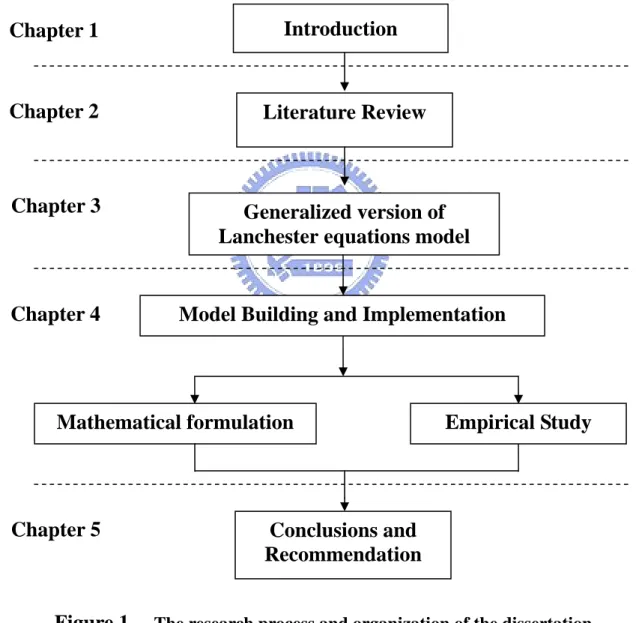
The framework in this research is shown in Figure 1. For evaluation of sustainable development issues using by the Lanchester square law model, The first step is to define the notation of the Blue (i.e., Allied) and the Red (i.e., German) combat forces, the actual loss of Blue (Allied) and Red (German) combat forces, the Allied (Blue) and the German (Red) attrition rate without Bracken’s tactical factor, Bracken’s tactical factor, the last day on which the Germans attack, sum of squared errors.
Mathematical formulation is the second step, we want to select the appropriate analyze approach meeting the relation among criteria and nature of problem and our goal is to find the best fit a, b, d and k, to minimize the sum of the squared errors between the actual and theoretical attrition.
The third step is Proposition and proof of Proposition. The fourth step is numerical example, we may conclude that our result seems close to the real situation in December 1944 and we have a different point of view from Bracken [24] for the military decision makers as follows. The concept of concentration of force to penetrate, seizure of the initiative of attack and the Lanchester square law are still present in the ArdennesCampaign [2].
1.4 Organization of this dissertation
background, purposes, framework and methods are described in Chapter 1. Chapter 2 describes the history of The Ardennes Campaign and articles of military warfare analysis tools. We introduce the stream of its development, planning and some modeling. We summarize some comprehensive generalized version of Lanchester equations model in Chapter 3. Furthermore, following the main stream of evolutionary computation, we introduce mathematical formulation of Lanchester equations and evolutionary algorithms .And one empirical study for seeking the a much better qualitative analysis model for the explanation of modern combat in Chapter 4. Finally, concluding remarks, recommendations and future research are given in Chapter 5.
Figure 1.
The research process and organization of the dissertation2. Literature review
In this section we summarize related methodology and about development issues of military warfare analysis tools. We also want to describe the history of Ardennes Campaign,
Introduction
Literature Review
Generalized version of
Lanchester equations model
Mathematical formulation
Conclusions and
Recommendation
Model Building and Implementation
Empirical Study
Chapter 1
Chapter 2
Chapter 3
Chapter 4
Chapter 5
a partial article from Thomas D. Morgan (LT. Col.USA Ret.) Army magazine Nov. 20042 quoted by us. And cite Sun Tzu Art of War, On War Carl von Clausewitz [31] to discuss the doctrines of military affairs.
2.1 Lanchester equations
3The Lanchester laws are perhaps the best-known models of combat. They were developed by F. W. Lanchester [36] just prior to U.S. involvement in World War I and were first published in his now famous book, Aircraft in Warfare: The Dawn of the Fourth
Arm. In this section, we discuss the Square and Linear law as following:
2.1.1 Lanchester Square Law
The effect of concentrating the force is reflected by the fact that the casualty rate is assumed to depend only on the size of the shooting force. This is due to the firepower delivery available with modern weapons. If we let R and B represent the initial size of the Red and Blue forces (number of units) respectively, and N and M (0 ≤N, M ≤1) be the effectiveness of each Red and Blue unit respectively, the rate at which each of the two forces is depleted is given by the relations
( )
( )
( )
( )
, t Nr dt t db t Mb dt t dr − = − =where r(t) and b(t) represent the Red and Blue force sizes at time t and r(0) = R and b(0) =
B. The attrition to each side depends on the effectiveness of the shooting side’s units and
the remaining size of the shooting force. Dividing the two equations, we get
( )
( )
( )
( )
Nr( )
( )
t . t Mb t db t dr dt t db dt t dr = = Rearranging, we get( ) ( )
r( ) ( )
t dr t . M N t db t b = 2 http://www.ausa.org/pdfdocs/Morgan.pdf 3 http://www.rand.org/publications/MR/MR1155/MR1155.ch4.pdfIntegrating from time 0 to time t, we get
( )
2 2(
( )
2 2)
. R t r M N B t b − = −This formulation allows us to examine the requirements for Blue (or Red) to win. For Blue to win, we must have that at time T, r(t) = 0 and b(t) > 0. Rewriting the above
equation with t = T and solving for b(T), we get
( )
2 2 2 0. f R M N B T b = −Solving the inequality, we get . 2 ⎟ ⎠ ⎞ ⎜ ⎝ ⎛ B R N M f
For Blue to win, the relative effectiveness of the two forces must exceed the square of the initial force ratio.
One type of battle described by a Lanchester square law occurs when both sides can employ constant fractions of their forces and have target-rich environments. The size of the force the friendly commander commits to the battle determines the amount of enemy attrition attained rather than the size of the enemy force committed [3].
2.1.2 Lanchester Linear Law
The linear law reflects the inability, or more accurately the futility, of either side to mass its forces effectively. Lanchester referred to this as a characteristic of ancient warfare: In olden times, when weapon directly answered weapon, the act of defence was positive and direct, the blow of sword or battleaxe was parried by sword and shield. . . . Under [these] conditions, it was not possible by any strategic plan or tactical maneuver to bring other than equal numbers of men into the actual fighting line; one man would ordinarily find himself opposed to one man. Under these conditions, attrition depends solely upon the effectiveness of the individual combatant. Another, more modern interpretation of the linear law is that it represents area fires. That is, we assume that the attacker knows the enemy is located within an area, but that he is unable to target each combatant individually. The best he can do is launch indirect fires into the area. In this case, the effectiveness of the attacker depends not only on the effectiveness of the weapon, but also on the number of attackers (number of weapons), the effectiveness of each attacker, and the number of targets in the area fired upon. Both of these cases result in a linear law. As above, we let M and N be the effectiveness of each combatant, with r(0) = R and b(0) = B, the original size
of the Red and Blue forces. The number of firing opportunities for Blue is proportional to
b(t)r(t), and the number of Red firing opportunities is proportional to r(t)b(t):
( )
(
( ) ( )
)
( )
(
( ) ( )
)
. t b t r N dt t db t r t b M dt t dr − = − =The effectiveness scores refer to the effectiveness of the individual combatant. Dividing the two equations as above, we get
( )
( )
( )
( )
N . M t db t dr dt t db dt t dr = = Rearranging, we get( )
dr( )
t. M N t db =Integrating from time 0 to time t, we get
( )
(
r( )
t R)
. M N B t b − = −For Blue to win, we again must have that at time T, r(T) = 0 and b(T) > 0. Rewriting the above equation with t = T and solving for b(T), we get
( )
N 0.b T B R M
= − f
Solving the inequality, we get . ⎟ ⎠ ⎞ ⎜ ⎝ ⎛ B R N M f
In this case, to win, the effectiveness ratio need only exceed the initial force ratio. In the linear case, the impact of the force size on combat outcome is significantly less than in the square case. The area-fires interpretation results in the following attrition rates:
( )
(
( )
) ( )
( )
(
( )
) ( )
, t b N t r dt t db t r M t b dt t dr − = − =reflecting the effects of force size, weapon effectiveness, and targets available. Here (b(t)M) can be interpreted as the firing effectiveness of Blue and (r(t)N) can be interpreted as the firing effectiveness of Red. Dividing the two equations as above, we get exactly the same results as above.
2.2 Sun Tzu (Art of War)
Sun Tzu [1] one of the earliest great military thinkers who realized that war, a matter of vital importance to the State, demanded study and analysis. His works are the first known attempt to formulate a rational basis for the planning and conduct of military operations. His purpose, according to Samuel B. Griffith [35], was "to develop a systematic treatise to guide rulers and generals in the intelligent prosecution of successful war". Sun Tzu was also convinced that careful planning based on sound information would contribute to speedy victory.4 His partial work was quoted by us to discuss in this article.
2.2.1 Initial estimations ( Laying plans5 )
Sun Tzu said: The art of war is of vital importance to the State. It is a matter of life and death, a road either to safety or to ruin. Hence it is a subject of inquiry which can on no account be neglected. The art of war, then, is governed by five constant factors, to be taken into account in one's deliberations, when seeking to determine the conditions obtaining in the field. These are: (1) The Moral Law; (2) Heaven; (3) Earth; (4) The Commander; (5) Method and discipline. These five heads should be familiar to every general: he who knows them will be victorious; he who knows them not will fail. … Therefore, in your deliberations, when seeking to determine the military conditions, let them be made the basis of a comparison, in this wise: --
(a) Which of the two sovereigns is imbued with the Moral law? (b) Which of the two generals has most ability?
(c) With whom lie the advantages derived from Heaven and Earth? (d) On which side is discipline most rigorously enforced?
The general who loses a battle makes but few calculations beforehand. Thus do many calculations lead to victory, and few calculations to defeat: how much more no calculation at all! It is by attention to this point that I can foresee who is likely to w in or lose.
2.2.2 Planning offensives ( Attack by stratagem6 )
Sun Tzu said: In the practical art of war, the best thing of all is to take the enemy's country whole and intact; to shatter and destroy it is not so good. So, too, it is better to
4 http://www.ndu.edu/inss/siws/intro.html 5 http://www.kimsoft.com/polwar1.htm 6 http://www.kimsoft.com/polwar3.htm
recapture an army entire than to destroy it, to capture a regiment, a detachment or a company entire than to destroy them.
It is the rule in war:
(a) If our forces are ten to the enemy's one, to surround him; (b) If five to one, to attack him;
(c) If twice as numerous, to divide our army into two. (d) If equally matched, we can offer battle;
(e) If slightly inferior in numbers, we can avoid the enemy; (f) If quite unequal in every way, we can flee from him. Thus we may know that there are five essentials for victory: (a) He will win who knows when to fight and when not to fight;
(b) He will win who knows how to handle both superior and inferior forces; (c) He will win whose army is animated by the same spirit throughout all its ranks; (d) He will win who, prepared himself, waits to take the enemy unprepared;
(e) He will win who has military capacity and is not interfered with by the sovereign. Hence the saying: If you know the enemy and know yourself, you need not fear the result of a hundred battles. If you know yourself but not the enemy, for every victory gained you will also suffer a defeat. If you know neither the enemy nor yourself, you will succumb in every battle.
2.2.3 Military disposition (Tactical dispositions7)
Sun Tzu said: The good fighters of old first put themselves beyond the possibility of defeat, and then waited for an opportunity of defeating the enemy. To secure ourselves against defeat lies in our own hands, but the opportunity of defeating the enemy is provided by the enemy himself. Thus the good fighter is able to secure himself against defeat, but cannot make certain of defeating the enemy. Hence the saying: One may know how to conquer without being able to DO it. The consummate leader cultivates the moral law, and strictly adheres to method and discipline; thus it is in his power to control success. In respect of military method, we have, firstly, Measurement; secondly, Estimation of quantity; thirdly, Calculation; fourthly, Balancing of chances; fifthly, Victory. Measurement owes its existence to Earth; Estimation of quantity to Measurement; Calculation to Estimation of quantity; Balancing of chances to Calculation; and Victory to
7
Balancing of chances. A victorious army opposed to a routed one, is as a pound's weight placed in the scale against a single grain. The onrush of a conquering force is like the bursting of pent-up waters into a chasm a thousand fathoms deep.
2.3 On War
Carl von Clausewitz [31], a Prussian military thinker, is widely acknowledged as the most important of the major strategic theorists. Even though he's been dead for over 170 year, he remains the most frequently cited, the most controversial, and in many respects the most modern.
2.3.1 What is war8
We shall not enter into any of the abstruse definitions of War used by publicists. We shall keep to the element of the thing itself, to a duel. War is nothing but a duel on an extensive scale. If we would conceive as a unit the countless number of duels which make up a War, we shall do so best by supposing to ourselves two wrestlers. Each strives by physical force to compel the other to submit to his will: each endeavours to throw his adversary, and thus render him incapable of further resistance. War therefore is an act of
violence intended to compel our opponent to fulfill our will.
If there was only one form of War, to wit, the attack of the enemy, therefore no defence; or, in other words, if the attack was distinguished from the defence merely by the positive motive, which the one has and the other has not, but the methods of each were precisely one and the same: then in this sort of fight every advantage gained on the one side would be a corresponding disadvantage on the other, and true polarity would exist. But action in War is divided into two forms, attack and defence, which, as we shall hereafter explain more particularly, are very different and of unequal strength. Polarity therefore lies in that to which both bear a relation, in the decision, but not in the attack or defence itself.
If the one Commander wishes the solution put off, the other must wish to hasten it, but only by the same form of action. If it is A’s interest not to attack his enemy at present, but four weeks hence, then it is B’s interest to be attacked, not four weeks hence, but at the
present moment. This is the direct antagonism of interests, but it by no means follows that it would be for B’s interest to attack A at once. That is plainly something totally different.
2.3.2 On the signification of the combat9
As war is nothing else but a mutual process of destruction, then the most natural answer in conception, and perhaps also in reality, appears to be that all the powers of each party unite in one great volume, and all results in one great shock of these masses. There is certainly much truth in this idea, and it seems upon the whole to be very advisable that we should adhere to it, and that we should on that account look upon small combats at first only as necessary loss, like the shavings from a carpenter's plane. Still however, the thing is never to be settled so easily.
That a multiplication of combats should arise from a fractioning of forces is a matter of course, and the more immediate objects of separate combats will therefore come before us in the subject of a fractioning of forces; but these objects, and together with them, the whole mass of combats may in a general way be brought under certain classes, and the knowledge of these classes will contribute to make our observations more intelligible.
Destruction of the enemy's military forces is in reality the object of all combats; but other objects maybe joined to that, and these other objects may be at the same time predominant; we must therefore draw a distinction between those in which the destruction of the enemy's forces is the principal object, and those in which it is more the means. Besides the destruction of the enemy's force, the possession of a place or the possession of some object may be the general motive for a combat, and it may be either one of these alone or several together, in which case still usually one is the principal motive.
Now the two principal forms of War, the offensive and defensive, of which we shall shortly speak, do not modify the first of these motives, but they certainly do modify the other two, and therefore if we arrange them in a scheme( seeTable 1 ) they would appear thus:
Table 1. The difference between Offensive and Defensive
Offensive. Defensive.
1. Destruction of enemy's force. 2. Conquest of a place.
3. Conquest of some object.
1. Destruction of enemy's force. 2. Defence of a place.
3. Defence of some object.
These motives, however, do not seem to embrace completely the whole of the subject, if we recollect that there are reconnaissance and demonstrations, in which plainly none of these three points is the object of the combat. In reality we must, therefore, on this account be allowed a fourth class. Strictly speaking, in reconnaissance in which we wish the enemy to show himself, in alarms by which we wish to wear him out, in demonstrations by which we wish to prevent his leaving some point or to draw him off to another, the objects are all such as can only be attained indirectly and under the pretext of one of the three objects specified in the table, usually of the second; for the enemy whose aim is to reconnoitre must draw up his force as if he really intended to attack and defeat us, or drive us off, etc., etc. But this pretended object is not the real one, and our present question is only as to the latter; therefore, we must to the above three objects of the offensive further add a fourth, which is to lead the enemy to make a false move, or, in other words, engage him in a sham fight. That offensive means only are conceivable in connection with this object, lies in the nature of the thing.
On the other hand we must observe that the defence of a place may be of two kinds, either absolute, if as a general question the point is not to be given up, or relative if it is only required for a certain time. The latter happens perpetually in the combats of advanced posts and rear guards.
That the nature of these different intentions of a combat must have an essential influence on the dispositions which are its preliminaries, is a thing clear in itself. We act differently if our object is merely to drive an enemy's post out of its place from what we should if our object was to beat him completely; differently, if we mean to defend a place to the last extremity from what we should do if our design is only to detain the enemy for a certain time. In the first case we trouble ourselves little about the line of retreat, in the latter it is the principal point, &c.
But these reflections belong properly to tactics, and are only introduced here by way of example for the sake of greater clearness. What strategy has to say on the different objects of the combat will appear in the chapters which touch upon these objects. Here we have only a few general observations to make, first, that the importance of the object decreases nearly in the order as they stand above, therefore then, that the first of these objects must always predominate in the great battle; lastly, that the two last in a defensive
battle are in reality such as yield no fruit, they are, that is to say, purely negative, and can, therefore, only be serviceable, indirectly, by facilitating something else which is positive.
2.4 Game theory
The concepts and tools of game theory is a branch of microeconomics. Game theory has been widely used not only in business but also to analyze the effects of selecting alternative strategies to achieve a military objective.
2.4.1 The concept of game theory
For games of opposed interests, the basic concepts of maxmin and equilibrium strategies are defined and illustrated. Moving to general noncooperative games, the concepts of Stackelberg equilibrium and disequilibrium are presented in a duopoly game, and two logically consistent foundations for the competitive solution are given. The credibility of threats is discussed, and perfect equilibrium defined. Gaming is used by researchers interested in how people learn and play games and by other analysts interested in exploring strategies and policies, as a vehicle for helping understand complex issues [33].
People learn from gaming by designing games, playing them, or analyzing game results. Unlike many other techniques of analysis, gaming is not a solution method. The output of a good game is increased understanding. Gaming can be used along with other methods in conducting a study. Regardless of whether gaming achieves the rigor early proponents sought, it appears to have continuing value [34].
Game theory has been widely used to analyze the effects of selecting alternative strategies to achieve a military objective. In two-person zero-sum games, i.e., a payoff to player 1 is a loss to player 2, both players have several alternative strategies they may pursue and, although each is aware of the strategies available to his opponent, neither is aware of the strategy his opponent will select. Therefore each player may select a strategy that will maximize his minimum payoff. Such a player will hedge against the likelihood that his opponent will select the strategy that results in the worst payoff. The effects of knowing about an opponent’s strategy makes game theory an excellent place to start a discussion of the effects of information on combat outcomes (payoffs). We do this by allowing each of the players (actually, “sides” in a battle) to possess varying amounts of relevant information about the strategy his opponent will select, and then we measure the
effect this has on the outcome of the game [3]. In essence, we are postulating varying levels of KB and KR. We have designed four games in which the amount of information possessed by each side (KB and KR) is allowed to vary. Side 1’s information might be thought of, by analogy, as comparable to that available to the U.S. Army in
• The current force, the Army of Excellence (AOE) (Game 1); • Army XXI (Game 2); and
• Army After Next3 (AAN) (Games 3 and 4).
In addition to four different assumptions about the information available to both sides, we considered three cases of dimensionality with respect to the number of strategies or choices available to both sides. We allow each side three, five, or ten choices. (This feature of the game has some intuitive relationship with warfare, where the value of intelligence relates to the degrees of freedom available to opposing sides, which are usually rather limited.) All the games have the structure depicted in Figure 2 have choices i = 1, 2, . . . , m and j = 1, 2, . . . , n, respectively. For each pair of choices there is a payoff ai,j Side 1 receives ai,j
( )
( )
j strategies Side a a a a a a a a a m i strategies Side n m m m n n 2 2 1 1 . 2 . 1 . . 2 2 . 2 1 . 2 . 1 2 . 1 1 . 1 ⎥ ⎥ ⎥ ⎥ ⎦ ⎤ ⎢ ⎢ ⎢ ⎢ ⎣ ⎡ L M M M M L L MFigure2. Game Matrix
and Side 2 loses ai,j. Side 1 therefore wishes to maximize the payoff and Side 2 wishes to
minimize the payoff. This leads Side 1 to pursue what is referred to as a “maximin” strategy and Side 2 to pursue a “minimax” strategy.
2.4.2 Selecting the Optimal Strategy
Side 1’s optimal strategy, i*, is found by first computing, for each of his possible choices i, the worst outcome (the outcome that would come about if Side 2 made the best choice consistent with Side 1’s having chosen i). We call that worst outcome ai, min, which is given by
( )
. min , min , i j i a a =Side 1’s most conservative choice, *
i , is the one that maximizes ai,min. That is, he chooses
the row for which ai,min is largest:
(
)
. max ,min min max, i i a a =His payoff will then be at least as good as amax,min. For Side 2, we reverse the process. Side
2’s optimal strategy, *
j , is found by first computing, for each of his possible choices j, the
best outcome (the outcome that would come about if Side 1 made the best choice consistent with Side 2’s having chosen j). We call that the worst outcome, amax j.. It is
given by
( )
. max . . max i j i j a a =Now Side 2’s most conservative choice, *
j , is the one that minimizes amax j. That is, he
chooses the column for whichamax j. is smallest:
(
)
. min max, max min, j j a a =His payoff will then be at least as good as amax,min.
2.4.3 The variable knowledge cases
We might think about war abstractly as follows. In any given battle, Side 1’s choice of strategies will have some effect on the outcome, as will Side 2’s. Depending on the circumstances of battle (force ratios, terrain, etc.), the strategies may make more or less difference. How, then, do we think about the value of information? As an abstraction, we can consider a vast array of battles in which strategies have very different consequences for the outcomes. We can then ask how much value information would have, on average, over that vast array of battles. This is indeed what we have calculated. For each of 1,000 different battles we generated a payoff matrix as in Figure 2, using random numbers between 0 and 100. We then made various assumptions about how much knowledge each side had about the payoff matrix. Each side then selected strategies based on that knowledge. We did this first assuming that the sides had three strategies each; we repeated the work with five and ten strategies. In the discussions below, we refer to the payoff matrix depicted in Figure 2 as A.
• Game 1: current force (AOE) (both sides have correct information).
matrix A. Both sides have the same information about payoffs but are ignorant about each other’s choices. Neither has superior knowledge. This can be thought of as the case in whichKB =KR and Γ=1.
• Game 2: Army XXI (Side 1 has correct information and Side 2has incorrect
information).
Side 1 has correct knowledge of all the values of A = A1, and Side 2 has a completely
incorrect understanding of the payoff matrix. We simulate this by providing Side2 with a
payoff matrix, A = A2, composed of a second set of random numbers between 0 and 100. Therefore Side 2 will make decisions based on erroneous information. Although purely an abstraction, this could describe a situation in which Army XXI with superb information fights an enemy who not only lacks valid information but is thoroughly confused. This can be thought of as the case in which Blue (Side 1) has information superiority, i.e.,
. 1 f f K and Γ
KB R
• Game 3: AAN (Side 1 has correct information, Side 2 has correct information, and
Side 1 knows Side 2’s choice).
Side 1 and Side 2 have correct knowledge of the values of A, as in Game 1. Side 2
chooses his minimax strategy j* from the correct matrix A. Side 1, however, knows the choice Side 2 makes, and rather than choose his maximin strategy (i*), he focuses only on the payoffs corresponding to the minimax choice of Side 2 and maximizes his
payoff. This simulates the case in which Side 1 has perfect intelligence and, as a result, another kind or higher level of information superiority. Although Side 2’s basic information in this case (as opposed to Game 2) is not bad, it is clearly inferior to Side 1’s.In this case, we have again thatKB fKR and Γf1. , but now Γ is significantly
greater than 1.
• Game 4: AAN (Side 1 has correct information, Side 2 has incorrect information, and
Side 1 knows Side 2’s choice).
In the fourth game Side 1 has correct knowledge of all the values of A = A1 and Side 2 has a completely incorrect payoff matrix A = A2 composed of a second set of random numbers between 0 and 100, as in Game 2. Side 2 chooses his minimax strategy, j*, from the incorrect information in A2. Side 1 knows the choice of Side2.
the minimax choice of Side 2 from the incorrect information and makes his choice from the correct matrix, A1. Side 1 has perfect information (maximum knowledge). He may even have established this position by actively ensuring (through offensive information operations) that Side 2 has bad information. Thus, Side 1 enjoys not only information superiority but also information dominance, i.e., KB fδB and KB f KR.
2.4.4 Results
Table 2summarizes the results of the four games. In each case, three different sets of strategies, or game sizes, were involved. The entries in the table can be thought of as percentages reflecting the likelihood that Side 1 will be successful given the relative knowledge between the two sides.
Table 2. The effect of knowledge on Game Outcomes
Game Size Game 1 Game 2 Game 3 Game 4
3*3 50 63 58 75
5*5 50 61 65 83
10*10 49 59 75 91
It is important to note that the table entries do not reflect the likelihood that Side 1 will experience a successful combat outcome, but rather the degree to which relative knowledge contributes to Side 1’s successful outcome: relative force ratios, weapon system effectiveness, and other measures discussed later contribute as well. A score of 90, for example, means that relative knowledge contributed 90 percent to Side 1’s successful outcome, whereas it contributed only 10 percent to Side 2’s successful outcome. The actual outcome is not of interest here, just the contribution of knowledge. The games reflect the effect of knowledge on the likelihood of a successful outcome. Beginning with Game 1, we see that, as predicted, when neither side enjoys information superiority, the likelihood of winning is even—that is, the contribution of knowledge to winning is even. This seems to hold regardless of the number of strategies available to each side. This also applies to Game 2, with Side 2 possessing erroneous information about the outcomes. The pattern appears to change, however, for Games 3 and 4. There appears to be a greater advantage to Side 1 when the number of strategies increases. This phenomenon is easy to explain based on the structure of the game. Side 2’s selections in both games approach random choices, where the probability of selecting any of the s strategies is 1/ s. Therefore, the likelihood of
succeeding is greater for smaller strategy sets. What is not clear from all this is whether the seeming advantages associated with information superiority and large strategy sets is applicable to real-world engagements. What is missing is some understanding of the relative importance of the choices being made.
2.5 The Ardennes: Battle of the Bulge
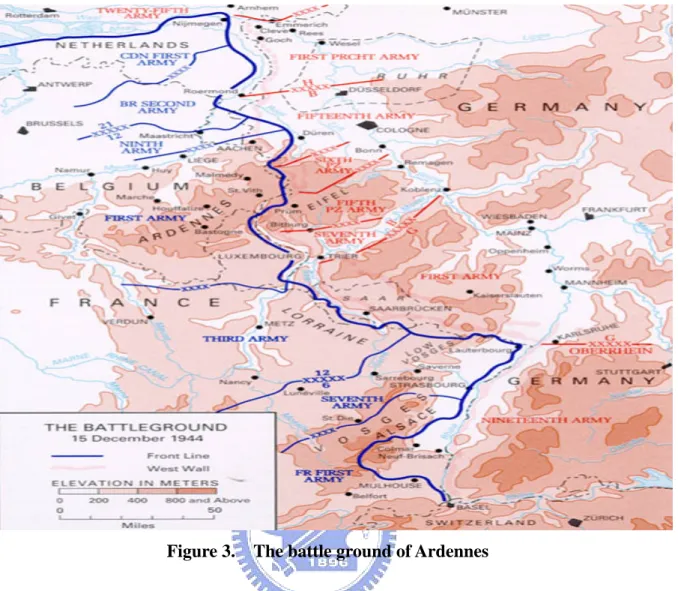
Battle of the Bulge was the story of how the high command, American and British, reacted to defeat the German plan once the reality of a German offensive was accepted. But most of all it is the story of the American fighting man and the manner in which he fought a myriad of small defensive battles until the torrent of the German attack was slowed and diverted, its force dissipated and finally spent. It is the story of squads, platoons, companies, and even conglomerate scratch groups that fought with courage, with fortitude, with sheer obstinacy, often without information or communications or the knowledge of the whereabouts of friends. In less than a fortnight the enemy was stopped and the Americans were preparing to resume the offensive. The battle ground of Ardennes we may see in Figure 3.10 ([9]; [32]).
2.5.1 Weather and terrain analysis of Ardennes11
Also spelled Ardennes, wooded plateau covering part of the ancient Forest of Ardennes, occupying most of the Belgian provinces of Luxembourg, Namur, and Liège; part of the Grand Duchy of Luxembourg; and the French department of Ardennes. It is an old plateau comprising the western extension of the Middle Rhine Highlands, stretching in a northeast-southwest direction and covering more than 3,860 sq mi (10,000 sq km). Its geological history is complex; as a result of intense folding, faulting, uplifts, and denudations, some older strata of rock have been thrust over younger strata.
The name Ardennes used in a strict sense refers to the southern half of the area, where the elevations range from 1,150 to 1,640 ft [350 to 500 m], though the high point at Botrange, south of Liège, is 2,277 ft. This part consists of sandstone, quartzite, and some slate and limestone. Its rounded summits are separated by shallow depressions containing
10 http://www.army.mil/cmh-pg/brochures/ardennes/p04(map).jpg 11 http://ww2fighters.org/forums/index.php?showtopic=1112
Figure3. The battle ground of Ardennes
peat bogs, from which rise many rivers that cut narrow and sinuous valleys. This High Ardennes form the watershed between rivers flowing north and west to the Meuse River and south and east to the Moselle River. Heavy precipitation, combined with low clouds, fog, and frost, make the uplands distinctly bleak. Although one-half of the area is covered by forest, the thin, acid, and waterlogged soil is generally infertile, supporting only heath. The northern part is much lower, between 655 and 985 ft. Most of the small farmland is under permanent grass for pasture, but there is some cultivation of oats, rye, potatoes, and clover in the valleys. Cattle are raised mainly for dairy production, pigs for the ham that has long been a local specialty of the Ardennes, and sheep for a small wool industry. Cattle hides are processed with the abundant local supplies of tannin from the oak trees. Stone quarrying is widespread, but mining and manufacturing are limited.
Despite a certain raw inhospitality of the area, its economy increasingly depends upon the development of tourism. The Ardennes has one of the lowest population densities of Europe, but it is located in the middle of the heavily populated triangle of
Paris-Brussels-Cologne. Mineral springs at Spa, Belg. (whence the English word spa), have made it a favorite health resort since the 16th century. The lonely forests offer respites for central Europeans from the pressures of the surrounding urbanization. During World Wars I and II, the Ardennes became a battleground, the scene of bitter fighting in 1914, 1918, and 1944.
Terrain
Belgium generally is a low-lying country, with a broad coastal plain extending from the North Sea and The Netherlands and rising gradually into the Ardennes hills and forests of the southeast, where a maximum height of 2,277 feet (694 meters) is reached at Botrange. The main physical regions are the Ardennes and Ardennes foothills; the Anglo-Belgian Basin to the north comprising the Central (Bas) Plateaus, the plain of Flanders (Vlaanderen), and the Kempenland (Campine); and the intrusion of the Paris Basin on the south known as the Côtes Lorraines (Belgian Lorraine). The Ardennes region is part of the Hercynian orogenic belt, which reaches from western Ireland into Germany and was formed during the second half of the Paleozoic Era (roughly 300 to 400 million years ago). It is a plateau cut deeply by the Meuse River and its tributaries. Its higher points have poor drainage and are more favourable for peat bogs and upland mossy ground than for crops. A large depression, known east of the Meuse as the Famenne and west of it as the Fagne, separates the Ardennes from the geologically and topographically complex foothills to the north. The principal feature of the area is the Condroz, a plateau more than 1,100 feet in elevation comprising a succession of valleys hollowed out of the limestone between sandstone crests. Its northern boundary is the Sambre-Meuse valley, which transverses Belgium from south-southwest to northeast. Situated south of the Ardennes and cut off from the rest of the country, Côtes Lorraines is a series of hills with north-facing scarps. About half of it remains wooded; in the south lies a small region of iron ore deposits. A region of sand and clay soils lying between 150 and 650 feet in elevation, the Central Plateaus cover northern Hainaut, Walloon Brabant, southern Flemish Brabant, and the Hesbaye plateau region of Liège. The area is dissected by the Dender, Senne, Dijle, and other rivers that enter the Schelde (Escaut) River; it is bounded on the east by the Herve Plateau. The Brussels region lies within the Central Plateaus. Bordering the North Sea from France to the Schelde, the low-lying plain of Flanders has two main sections. Maritime Flanders, extending inland for 5 to 10 miles (8 to 16 kilometers), is a region of newly formed and reclaimed land (polders) protected by a line of dunes and dikes and
having largely clay soils. Interior Flanders comprises most of East and West Flanders and has sand-silt or sand soils. At an elevation of 80 to 300 feet, it is drained by the Leie, Schelde, and Dender rivers flowing northeastward to the Schelde estuary. Several shipping canals interlace the landscape connecting the river systems. Covered by pasturelands and industry and lying between 160 and 330 feet in elevation, the Kempenland forms an irregular watershed of plateau and plain between the extensive Schelde and Meuse drainage systems.
Weather
Belgium has a temperate, maritime climate predominantly influenced by air masses from the Atlantic. Rapid and frequent alternation of different air masses separated by fronts gives Belgium considerable variability in weather. Frontal conditions moving from the west produce rainy weather, with rainfall heavy and frequent, averaging 30 to 40 inches (750 to 1,000 millimeters) a year. Winters are damp and cool with frequent fogs; summers are rather mild. The annual mean temperature is around 50° F (10° C). Brussels, which is roughly in the middle of the country, has a mean minimum temperature of 31° F (-0.3° C) in January and a mean maximum of 71° F (21.6° C) in July. Regional climatic differences are determined by elevation and distance inland. Farther inland, maritime influences become weaker, and the climate becomes more continental, characterized by greater seasonal extremes of temperature. The Ardennes region, the highest and farthest inland, is the coldest. In winter, frost occurs on about 120 days, snow falls on 30 to 35 days, and January mean minimum temperatures are lower than elsewhere. In summer, the elevation counteracts the effect of distance inland, and July mean maximum temperatures are the lowest in the country. Because of the topography, the region has the highest rainfall in Belgium. In contrast, the Flanders region enjoys generally higher temperatures throughout the year. There are fewer than 60 days of frost and fewer than 15 of snow. On the seacoast these figures are reduced to below 50 and 10, respectively. There are a few hot days, especially on the coast, where the annual rainfall is the lowest in the country. All of Belgium except the Ardennes lies within the zone of broad-leaved deciduous forestation. The dominant tree is the oak; others include beech, birch, and elm. Little remains of the forest that covered this area 2,000 years ago. Most of lowland Belgium is now used for agriculture or human settlement; small clumps of deciduous trees and grasses dominate the remaining open spaces. In the Kempenland, however, significant areas are devoted to planted forests of silver birch and Corsican pine. The Ardennes lies within the zone of
mixed deciduous and coniferous forestation. The area has been heavily logged for centuries.
Hence, little old-growth forest remains. The Ardennes is dominated now by coniferous forests in the higher elevations and by zones of mixed coniferous and deciduous trees, especially beech and oak, in the foothills. Hautes Fagnes, which is located at the northeastern edge of the Ardennes, is covered with peat bogs. Drainage has improved, however, and the area, forested with spruce, is part of a nature reserve.
2.5.2 The term Battle of the Ardennes
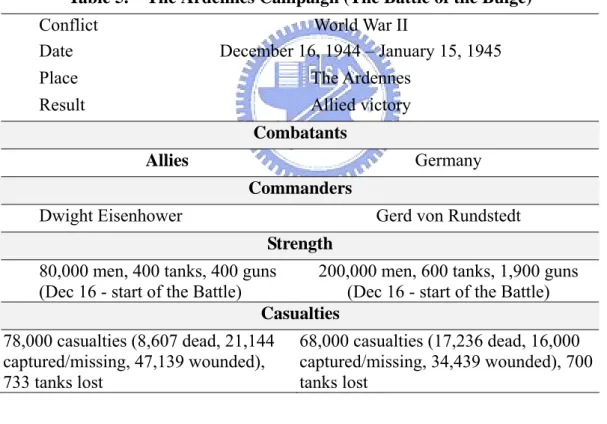
The term Ardennes Offensive (or Battle of the Ardennes) 12 refers to multiple battles throughout history, all of which took part in or around the Ardennes Forest in France and Belgium shown in Table 3.
Table3. The Ardennes Offensive (The Battle of the Bulge)
Conflict World War I World War II World War II
Date August 21-23, 1914 May 10-12, 1940 December 16, 1944 – January 15, 1945
Place The Ardennes The Ardennes The Ardennes Result German victory German victory Allied victory
The Ardennes is a region of extensive forests and rolling hill country, primarily in Belgium and Luxembourg, but stretching into France (lending its name to the Ardennes department and the Champagne-Ardennes region).
The Battle of the Ardennes was one of the opening battles of World War I. It took place from August 21-23, 1914, part of the Battle of the Frontiers. French commander-in-chief Joseph Joffre ordered an attack through the Ardennes forest in support of the French invasion of Lorraine. The French forces consisting of the Third and Fourth Armies, expecting only light resistance ran into a German advance consisting of the German Fourth and Fifth Armies. The initial engagement took place in a heavy fog and the Germans built defensive positions before heavy fighting commenced the second day, The French forces were badly routed by entrenched German machine guns, falling back to Verdun and Sedan.
In World War II, the Battle of France was the German invasion of France and the Low Countries, executed 10 May, 1940 which ended the Phony War. German armored units punched through the Ardennes, outflanking the Maginot Line and unhinging the Allied defenders. Paris was occupied and the French government fled to Bordeaux on 14 June.
Ardennes Offensive, which was actually known to the Germans as Operation Wacht Am Rhein, was also known as Second Battle of the Ardennes and popularly known as the Battle of the Bulge, started in late December 1944 and was the last major German offensive on the Western Front during World War II.
2.5.3 The battle of the Bulge remembered
At 5:30 A.M. Sunday, December16, 1944, all hell broke loose along the lightly defended U.S. sector of the Ardennes Forest on the German-Belgian-Luxembourg border as German Panzers attacked after a short artillery preparation. German tanks, attacking with searchlights glaring, pressed through antitank obstacles along the Siegfried Line while rockets fired from Nebelwerfers screamed overhead.
The American defenses crumbled and two great Panzer armies broke through and headed for the Meuse River and the vital English Channel ports beyond the Meuse. The German attack was a complete surprise to the Allies. Field Marshal Bernard L. Montgomery only the day before had said, “The enemy is at present fighting a defensive campaign ...he cannot stage any major offensive operations.” In December 1944, the victorious Allies were advancing on a wide front toward Hitler’s Third Reich. Except for a temporary setback in Holland in September 1944 (the ill-fated “Bridge Too Far”), Allied forces had pushed Hitler’s once invincible legions behind the fabled West Wall defense of the Siegfried Line. In the north, Field Marshal Montgomery’s armies were advancing on the Upper Rhine and the Ruhr, the industrial heart of Germany. In the center, Gen. Omar Bradley’s 12th Army Group was advancing against the Siegfried Line. Operating as half of Bradley’s army group was the First Army under Lt. Gen. Courtney Hodges, preparing to attack the Roer dams while defending the Ardennes front. Maj. Gen.Troy Middelton’s VIII Corps defended the 80-mile Ardennes front, stretching from Monschau in Germany to Echternach in Luxembourg, with the equivalent of four divisions. Gen. Dwight D. Eisenhower advocated an offensive attitude across his wide front of advance, but he held some sectors with comparatively weak forces to gain strength at his points of attack. The Ardennes sector was known as the“Ghost front.” It was a cold, quiet place where only