DOI: 10.1351/pac200577122083 © 2005 IUPAC
From vinylsilanes to organic/inorganic hybrid
materials*
Tien-Yau Luh
Department of Chemistry and Institute of Polymer Science and Engineering, National Taiwan University, Taipei 106, Taiwan
Abstract: Alternating regioregular silylene-spaced divinylarene copolymers [(donor– SiMe2–)n=1–3-(acceptor–SiMe2)] are synthesized by rhodium-catalyzed hydrosilylation of bis-alkynes with bisvinylic silyl hydrides. Efficient intrachain energy transfer has been ob-served in these copolymers. The intensities of emission profiles depend on the relative ratio of donor-to-acceptor chromophores. The corresponding inorganic/organic hybrid materials are synthesized, and their photophysical properties are described.
Keywords: Vinylsilanes; rhodium-catalyzed hydrosilylation; energy transfer; stereoselective synthesis; light harvesting; photovoltaic applications.
INTRODUCTION
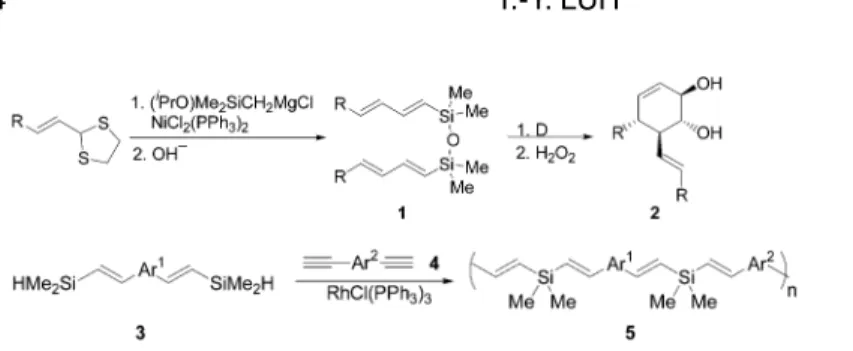
Some 15 years ago, we reported a convenient stereoselective synthesis of vinylsilanes from the corre-sponding benzylic dithioacetals by means of the nickel-catalyzed silylolefination reaction (eq. 1) [1,2]. The substituent(s) on the silicon atom can vary depending on the nature of the silyl-substituted methyl Grignard reagent. Accordingly, the steric environment and the chemical reactivity around the silicon atom can be tuned. For example, the introduction of an isopropoxy group on the silicon atom furnishes a useful entry for the synthesis of a range of silicon-substituted substrates for a variety of applications. This can easily be achieved by silylolefination of benzylic or allylic dithioacetals with (i-PrO)Me2SiCH2MgCl, a stable Grignard reagent having sterically bulky alkoxy substituent [3]. Thus, silyl-substituted dienes 1 has been demonstrated to be a useful intermediate for the synthesis of a vari-ety of highly substituted cyclohexene derivatives 2 (eq. 2) [4]. Alternatively, the silicon–oxygen bond can easily be reduced to give the corresponding silyl hydride 3 [5]. Metal-catalyzed hydrosilation of bis-alkynes 4 using 3 has been demonstrated to be useful for the synthesis of silylene-spaced divinyl-arene copolymers 5 (eq. 3) [5,6]. This account summarizes the recent results from our laboratory on the use of such silylolefination reaction for the synthesis of a range of silicon-containing small molecules, copolymers, and hybrid materials for electroluminescent, light-harvesting, and photovoltaic applica-tions.
*Paper based on a presentation at the 7thIUPAC International Conference on Heteroatom Chemistry (ICHAC-7), Shanghai, China, 21–25 August 2004. Other presentations are published in this issue, pp. 1985–2132.
VINYLSILANES FOR PROGRAMMABLE ELECTROLUMINESCENT DEVICES
As just mentioned, the substituent(s) on the silicon atom of a vinylsilane can be easily tuned by using different kinds of the silyl-substituted Grignard reagents. Thus, the introduction of four phenyl groups in 6 would increase the steric hindrance of the molecule, which may prohibit intermolecular aggrega-tion in the thin film [7]. Compound 6 does not exhibit strong electroluminescence but can serve as a hole-blocking material when sandwiched between the hole-transporting layer consisting of α-NPD and the emitting layer of a thin film of Alq3. The device exhibits blue light emission due to the emission of
α-NPD layer. In the absence of 6, green emission from the Alq3layer is observed. It is noteworthy that
6 has relatively very low Tg(30 °C) which, in general, is not suitable for electroluminescent devices. As a result, after heating the device (60 °C) or providing an electric pulse to the device, the emission color changes from blue to green. This observation suggests that the hole-blocking properties of 6 have been eliminated upon such treatment. These results give a new approach toward a programmable de-vice. Thus, a device constituted of multilayer structure (Alq3/6/α-NPD) is divided into two parts. One part is heated to 60 °C, and the other is insulated with a heating sink. The section having a heating sink remains emitting in blue light, whereas the section treated by heat changes the emission color to green (Fig. 1). It is interesting to note that the performance of the device does not downgrade after such treat-ment. These results have brought another application by employing a very thin film of 6 between the Alq3layer and the α-NPD layer followed by heating or electric pulse. The functioning of these devices appears to be better than that without 6.
(3) (2)
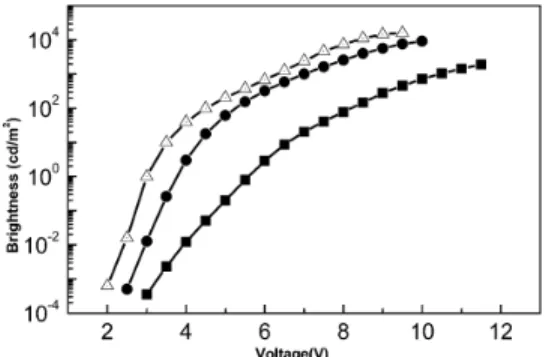
Fig. 1 Electroluminescence of the device: Mg–Ag/Alq3/5/α-NPD/ITO (solid square: prestine; solid circle: after transformation at 60 °C for 3 min or by electric pulse 500 mA/cm2for 3 s).
As shown in Fig. 2, the brightness for the pristine device is 1000 cd/m2(blue emission), whereas that of the heat or electric pulse treated devices exhibit the brightness 10 000 cd/m2(green emission) and the external efficiencies are comparable (1 %). These results suggested that the transformed devices behave as well as the pristine one. Presumably, 6 has been diffused into the Alq3or α-NPD layers to render the interfacial junction fuzzier [8].
LIGHT HARVESTING IN SILYLENE-SPACED COPOLYMERS
Studies on artificial light harvesting using polymeric systems have been extensive [9]. Occasionally, moderate energy-transfer efficiencies are obtained because of aggregation which may result in quench-ing the fluorescence. The silylene moiety has been widely used as an insulatquench-ing spacer to separate chromophores regioregularly in the polymeric backbone [5,10–13]. These silylene-spaced copolymers
5 are readily accessible by rhodium-catalyzed hydrosilylation of bis-alkynes 4 with bis-silylhydrides 3
according to eq. 3 [5,10]. Such a strategy may generate a useful synthesis of a variety of fascinating polymers that have different kinds of regioselective combination of donors and acceptors along the polymer chain. Thus, a series of alternating (donor–SiMe2–acceptor–SiMe2) copolymers has been syn-thesized according to eq. 3. Using chromophores 8 and 9 as a set of example, the emission profiles for a mixture of monomeric chromophores at different concentrations are compared with that of the copoly-mer 7. As can be seen from Fig. 3, energy transfer between the donor chromophores and the acceptor chromophores is much more efficient in the copolymer than in the mixtures of the corresponding monomeric chromophores.
Fig. 2 Voltage-dependent brightness of the device: Mg–Ag/Alq3/6/α-NPD/ITO (solid square: prestine; solid circle: after transformation at 60 °C for 3 min and triangle: by electric pulse 500 mA/cm2for 3 s.
Fig. 3 Emission spectra (λex = 324 nm) of copolymer 6 and a 1:1 mixture of monomers 7 and 8 at different concentrations (a = 1 ×10⁻¹, b = 1 × 10⁻², c = 1 ×10⁻³g/mL).
Intrachain transfer of chiroptical properties in silylene-spaced copolymers has been described [12]. Polymers 10 and 11 are synthesized according to eq. 3. The CD curves shown in Fig. 4a suggested that 10a and 10b are mirror image. It is noteworthy that a higher concentration of the polymers is es-sential to observe CD spectra and aggregation of copolymers may occur at this concentration. At low concentration, the CD intensity is too weak to observe. No CD curves are observed for the correspon-ding monomer 12. The CD spectra for 11a and 11b are shown in Fig. 4b. The CD curves are extended to the longer wavelength region due to the absorption of the second terphenylene–tetravinylene chromo-phore in 11. In order to examine that the chiroptical properties are indeed transferred intramolecularly, the CD properties of a mixture of copolymers 10a and 13 are examined. Even at very high concentra-tion, the CD profile is essentially the same as that of 10a, no extension to longer wavelength being ob-served. No interchain transfer of chiroptical properties between 1a and 3 would occur under these con-ditions.
The [(donor–SiMe2)n–acceptor–SiMe2] copolymers 14–16 (where n = 1–3 have been synthesized from the corresponding bis-alkynes 17 and 18 (eqs. 4 and 5) according to eq. 3. The fluorescence spec-tra of copolymers 14–16 (λex = 300 nm, the absorption maximum for the donor chromophore) are shown in Fig. 5. It is clear that the intensity of the emission profiles increases with increasing ratio of the donor chromophore against the acceptor chromophore [12]. The efficiencies of energy transfer for
14 and 15 are nearly quantitative, and that of 16 is over 90 %. It is noteworthy that the distances
be-tween the donor chromophores and the acceptor chromophore in 14 and 15 are the same, whereas those in 16 are different. Such discrepancy may result in different efficiencies in energy transfer in these poly-mers. Upon excitation at 360 nm (λmaxfor the acceptor chromophore), the emission spectrum of 16 is also shown in Fig. 3 for comparison. The intensity of this latter emission is apparently lower than that excited at 300 nm. These results clearly indicate that the light harvesting plays an important role to en-hance the emission intensity [13].
Fig. 4 (a) CD curves of 10a (solid line) and 10b (dashed line) (1.5 g/L in chloroform), and the UV–vis spectrum of 10a (dotted line). (b) CD curves of 11a (solid line) and 11b (dashed line) (1 g/L in chloroform), and the UV–vis spectrum of 11a (dotted line).
LIGHT HARVESTING IN SILICON-CONTAINING ORGANIC/INORGANIC HYBRID MATERIALS
As described in the previous section, efficient intrachain energy transfer between chromophores can occur in silylene-spaced divinylarene copolymers. It is envisaged that incorporation of such chromo-phores covalently bonded to an inorganic silica matrix to disperse the donor and acceptor species may (4)
(5)
also facilitate inter-chromophore energy transfer. Since the vinylsilane moiety (e.g., 19) can easily be generated by the olefination of benzylic dithioacetals (eqs. 1 and 2) [1,2], attempts to polymerize 19 under various conditions are unsuccessful. Intriguingly, dimeric cyclophanes 20 are obtained in moder-ate to good yield (eq. 6) [14]. Presumably, the isopropoxy group is less reactive and the reaction be-comes more selective to give 20.
Replacement of the isopropoxy group in 19 into a more reactive and less hindered alkoxy group is desirable. The synthesis involves a conversion of isopropoxysilanes 15 into the more reactive ethoxysilanes 16 via silyl hydrides (eq. 6) [13]. It is interesting to note that the substrates contain dou-ble bond and palladium is an active catalyst for hydrogenation of doudou-ble bonds. Under the reaction con-ditions, one mole of hydrogen is generated, which can add to the double bond. In order to avoid this side reaction, addition of norbornadiene can efficiently trap the hydrogen generated and ethoxyslianes thus obtained are used for the preparation of hybrid materials 17 (eq. 7) [14].
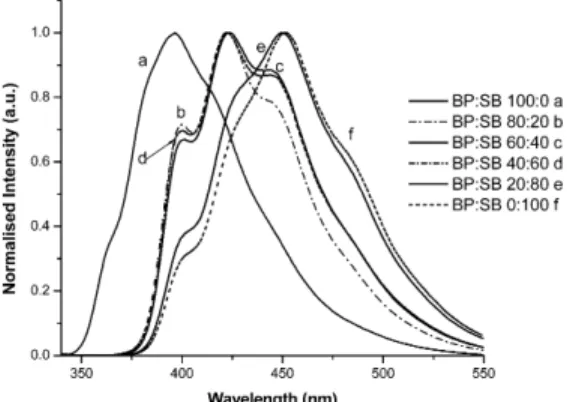
Bisethoxysilanes 21 readily form organic/inorganic hybrid materials upon treatment with tetraethoxysilane in the presence of Bu4NF. Accordingly, hybrid materials 22 containing more than one kind of chromophores can be obtained by this strategy. A representative cartoon is shown in eq. 8. The ratio of donor and acceptor chromophores can be tuned, and the emission profiles are shown in Fig. 6.
As can be seen from Fig. 6, the emission profile 22 having 100 % donor chromophore exhibits structureless spectrum, presumably due to aggregation. Similar aggregation profiles are observed when the mole fraction of the acceptor chromophore exceeds 80 %. Efficient energy transfer apparently oc-curs in these hybrid materials having different ratios of donor and acceptor chromophores ranging from 80:20 to 40:60. No excimer-like emission is observed in these mixed hybrid materials. It seems likely that the acceptor chromophores are segregated nicely and the donor and acceptor chromophores are dis-tributed homogeneously in this hybrid system. Preliminary examination also shows that the energy transfer in these hybrid materials also occur quite efficiently (>80 %).
(6)
(7)
CONCLUSION
We have demonstrated a convenient synthesis of a range of silicon-containing conjugated chromophores from the corresponding benzylic dithioacetals. The silicon moieties have been shown to serve as a steric bulky substituent in small molecules, an insulating spacer in polymers, and a three-dimensional frame-work in hybrid materials. These materials have been demonstrated to exhibit unique optoelectronic properties and can be used in electroluminescence, light-harvesting models. The potential use of these materials for photovoltaic and other applications is in progress.
ACKNOWLEDGMENTS
The author wishes to thank his coworkers, whose names are shown in the references, for their valuable contributions to this work. Thanks are also due to the National Science Council and the Ministry of Education of the Republic of China for support.
REFERENCES
1. (a) Z.-J. Ni and T.-Y. Luh. J. Org. Chem. 53, 2129, 5582 (1988); (b) Z.-J. Ni, P.-F. Yang, D. K. P. Ng, Y.-L. Tzeng, T.-Y. Luh. J. Am. Chem. Soc. 112, 9356 (1990); (c) Z.-J. Ni and T.-Y. Luh. Org. Synth. 70, 240 (1991).
2. For reviews, see: T.-Y. Luh. Acc. Chem. Res. 24, 257 (1991); Pure Appl. Chem. 68, 105 (1996). 3. K. Tamao, N. Ishida, Y. Ito, M. Kumada. Org. Synth. 69, 96 (1990).
4. R.-M. Chen, W.-W. Weng, T.-Y. Luh. J. Org. Chem. 60, 3272 (1995).
5. (a) R.-M. Chen, K.-M. Chien, K.-T. Wong, B.-Y. Jin, T.-Y. Luh, J.-H. Hsu, W. Fann. J. Am. Chem. Soc. 119, 11321 (1997); (b) R.-M. Chen and T.-Y. Luh. Tetrahedron 54, 1197 (1998).
6. For a review, see: T.-Y. Luh, R.-M. Chen, T.-Y. Hwu, S. Basu, C.-W. Shiau, W.-Y. Lin, B.-Y. Jin, C. C. Hsu. Pure Appl. Chem. 73, 243–246 (2001).
7. C. C. Wu, C. W. Chen, Y. T. Lin, H.-L. Yu, J.-H. Hsu, T.-Y. Luh. Appl. Phys. Lett. 79, 3023 (2001).
8. C.-W. Chen, T.-Y. Cho, C. C. Wu, H.-L. Yu, T.-Y. Luh. Appl. Phys. Lett. 81, 1570 (2002). 9. (a) M. A. Fox. Acc. Chem. Res. 25, 569 (1992); (b) S. E. Webber. Chem. Rev. 90, 1469 (1990);
(c) M. Nowakowska, P. V. Foyle, J. E. Guillet. J. Am. Chem. Soc. 115, 5975 (1993); (d) K. Hisada, S. Ito, M. Yamamoto. Langmuir 11, 996 (1995); (e) X. Schultze, J. Serin, A. Adronov, J. M. J. Fréchet. Chem. Commun. 1160 (2001); (f) D. M. Russel, C. A. Arias, R. H. Friend, C. Silvia, C. Ego, A. C. Grimsdale, K. Müllen. Appl. Phys. Lett. 80, 2204 (2002).
10. Y.-J. Cheng, T.-Y. Hwu, J.-H. Hsu, T.-Y. Luh. Chem. Commun. 2336 (2002). Fig. 6 Emission profiles of 17 having different ratios of donor and acceptor chromophores.
11. T.-Y. Hwu, S. Basu, R.-M. Chen, Y.-J. Cheng, J.-H. Hsu, T.-Y. Luh. J. Polym. Sci., Part A: Polym. Chem. 41, 2218 (2002).
12. Y.-J. Cheng, H. Liang, T.-Y. Luh. Macromolecules 36, 5921 (2003). 13. Y.-J. Cheng and T.-Y. Luh. Chem. Eur. J. 10, 5361 (2004).
14. S. Sudhakar and T.-Y. Luh. J. Org. Chem. 67, 6860 (2002).
15. S. Sudhakar, G. H. Lee, Y. Wang, J.-H. Hsu, T.-Y. Luh. J. Organomet. Chem. 646, 167 (2002). 16. S. Sudhakar and T.-Y. Luh. J. Org. Chem. 67, 6860 (2002).
17. S. Sudhakar, S. Sudhakar, C.-H. Chen, C.-L. Lin, M.-Y. Yeh, K.-Y. Liu, T.-Y. Luh. Unpublished results.