394 IEEE COMMUNICATIONS LETTERS, VOL. 4, NO. 12, DECEMBER 2000
Modeling Mis-Routing Calls Due to User Mobility in
Wireless VoIP
Ai-Chun Pang, Phone Lin, and Yi-Bing Lin
Abstract—This letter proposes an analytic model to study the
mis-routing problem caused by user mobility in a wireless VoIP system. We derive the probability that there are mis-routed calls when a subscriber moves from IP network to the GSM network. Our study indicates that if the user residence times in GSM loca-tion areas, inter-call originaloca-tion times and the inter-call delivery times are of the same order, then the mis-routing effect can not be ignored.
Index Terms—GSM, mis-routing, user mobility, wireless VoIP.
I. INTRODUCTION
S
UPPORTING telephony services over IP network is a promising trend in telecommunication business. Telephony services over IP network or the so called voice over IP (VoIP) can provide subscribers low cost telephony services. Thus, in-corporating VoIP services into the existing telecommunication systems is essential. In particular, integrating mobile phone services with VoIP becomes an important issue, which has been intensively studied [1], [2].Telecommunications and Internet Protocol Harmonization over Network (TIPHON) specifies the mechanism (i.e., a
me-diation gatekeeper) to provide the service control functions for convergence of IP networks, mobile networks, fixed wireless network, and the public switched telephone network (PSTN). Several scenarios are defined in TIPHON to illustrate different ways of integrating IP and mobile networks. In this paper, we use GSM as an example to describe a TIPHON mobile/IP integration, where the mobile signaling protocol is GSM MAP described in [3].
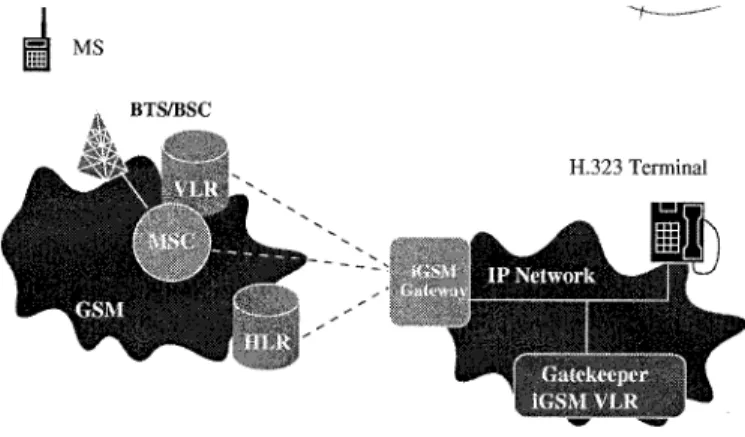
This TIPHON scenario is called iGSM [4] and its architecture is illustrated in Fig. 1. In this figure, iGSM gateway performs the conversion between GSM MAP and H.323 family proto-cols, and iGSM VLR (Gatekeeper) records location information as the visitor location register (VLR) in GSM network. iGSM supports user mobility for GSM subscribers to access VoIP ser-vices. By using various types of terminals, user mobility allows a user to move around the service area without losing contact with the system. That is, a GSM subscriber is able to keep the same identity to receive the service even if he/she changes the
Manuscript received July 21, 2000. The associate editor coordinating the re-view of this letter and approving it for publication was Prof. I. S. Venieris. This work was supported in part by MOE Program of Excellence Research under Contract 89-E-FA04-4, CCL/ITRI under Contract 2-10B, FarEastone, NSC, and the Lee and MTI Center for Networking Research, NCTU.
The authors are with the Department of Computer Science and Information Engineering, National Chiao Tung University, Hsinchu, Taiwan, R.O.C. (e-mail: [email protected]).
Publisher Item Identifier S 1089-7798(00)11514-5.
Fig. 1. The iGSM architecture.
terminal type from the GSM mobile station (MS) to the H.323 terminal. In Fig. 1, the incoming calls (call deliveries) are routed to the GSM MS when the person is in the GSM network (using GSM MS). On the other hand, the calls are routed to the H.323 terminal when the person is in the IP network (using H.323 ter-minal). We note that to make iGSM work, GSM periodic regis-tration must be disabled for the iGSM subscribers. Otherwise, if an iGSM subscriber forgets to turn off the GSM MS when the subscriber switches to an H.323 terminal, the registration record of the H.323 terminal will be over-written by the periodic reg-istration operation of the GSM MS.
To support user mobility, the subscriber needs to explicitly perform registration to inform the system which location area (LA) the MS resides when the subscriber changes the terminal. If the subscriber forgets to take this action, call deliveries to the subscriber may be mis-routed. This problem exists for all ap-proaches based on the concept of universal personal
telecommu-nications [5]. The mis-routing problem occurs in the following
scenario.
Step I [Fig. 2(a)]: The subscriber is in the GSM LA A and the home location register (HLR) indi-cates that the person is in LA A. The sub-scriber then moves to the IP network (LA B) without turning off the GSM MS.
Step II [Fig.
2(b)]: The subscriber registers to IP network. After registration, the HLR record is mod-ified and ’s record in VLR A is removed.
Step III [Fig.
2(c)]: The subscriber moves back to the GSM MS at LA A. Since the GSM MS is still on, the subscriber does not notice that an
PANG et al.: MODELING MIS-ROUTING CALLS DUE TO USER MOBILITY IN WIRELESS VOIP 395
Fig. 2. Mis-routing in user mobility.
explicit registration is required. Thus, the HLR indicates that the subscriber is still in LA B.
At this point, the subscriber is in LA A. However, the in-coming calls to the user (without explicit registration) are mis-routed to LA B until one of the following events occurs.
Case 1) The subscriber originates a call. In this case VLR A finds that the VLR record for the subscriber does not exist. VLR A will ask the MS to perform a reg-istration operation as described in the VLR failure restoration procedure [3]
Case 2) The subscriber moves to another LA in the GSM network. Registration is automatically initiated by the GSM MS.
To avoid mis-routing calls, the H.323 terminal may be de-signed with appropriate SIM slot. In this approach, the service provider requests that the SIM card must be inserted in the H.323 terminal when it is in use, and be removed when the sub-scriber moves back to the GSM MS. By doing so, mis-routing will not occur when switching from the H.323 terminal to the GSM MS. However, from an engineering and marketing study conducted by a GSM service provider, we found that hardware modifications to H.323 terminals will seriously increase the cost of iGSM, which is not commercially feasible. The only solution is to keep operator related confidential information (including SIM) in the H.323 gateway.
In this paper, we propose an analytic model to study mis-routing due to user mobility in iGSM. The purpose of this study
is to investigate how serious mis-routing will be if the subscriber does not perform an explicit registration.
II. THEANALYTICMODEL
This section proposes an analytic approach to model mis-routing due to user mobility in iGSM. We derive the probability Pr[ ] that there are mis-routed calls when a subscriber moves from IP network to the GSM network as follows.
Let call originations and deliveries be Poisson process. Let and be the inter-arrival times for call originations and de-liveries, respectively. Then and have exponential distribu-tions with rate and . Let be the inter-arrival time for consecutive call deliveries. Then has an Erlang distribution with mean .
Let be the time that the iGSM subscriber stays in an LA. Suppose that is a random variable with a general density func-tion , distribution function and Laplace transform
. Any call deliveries occur during the period
are mis-routed. Let be the number of mis-routed call deliv-eries. Then for ,
396 IEEE COMMUNICATIONS LETTERS, VOL. 4, NO. 12, DECEMBER 2000
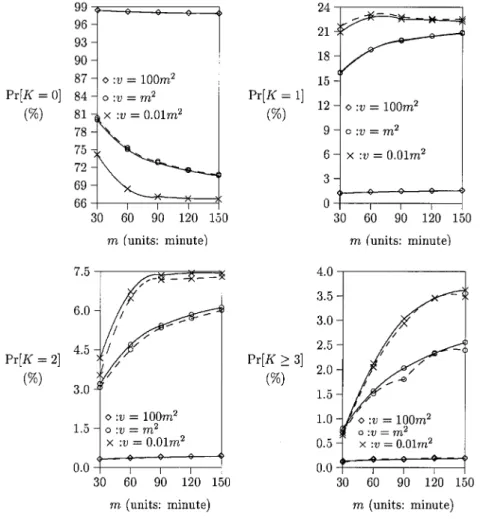
Fig. 3. Mis-routing probabilities (dashed: simulation; solid: analytic analysis).
where by convention [6] and For , we have
(2)
where .
If has a Gamma distribution with mean and variance , then
and
(3)
III. NUMERICALRESULTS
This section investigates the performance of mis-routing of user mobility in iGSM based on the analytic model developed in the previous section. Fig. 3 plots , ,
, and where the call originations occur every 30 minutes and the call deliveries occur every 60 minutes. The user’s LA residence times are assumed to have a Gamma distribution with mean and variance . Gamma distribution is used in our study because this distribution can approximate many other distributions as well as measured data obtained from the mobile network field trials. In Fig. 3, the solid curves are for analytic analysis and the dashed curves are for simulation. It is clear that our analytic analysis is consistent with the simulation results.
The figure indicates that the mis-routing probabilities increase as the variance of the user LA residence time de-creases. The figure also indicates that if the user LA residence times, the inter-call origination times and the inter-call delivery times are of the same order, then the mis-routing effect can not be ignored. Thus, to avoid the mis-routing problem, the iGSM subscribers must be responsible to perform the explicit registration operation. That is, the subscriber should turn off their MS when moving to the IP network. The “turn-off” action results in a detach GSM message to de-register the MS. When the subscriber turns on the MS in the GSM coverage area, an explicit registration is performed, and the person is considered to move back to the GSM network.
It is clear that if the subscribers originate calls much more frequently than receiving calls, then the mis-routing effect is insignificant.
PANG et al.: MODELING MIS-ROUTING CALLS DUE TO USER MOBILITY IN WIRELESS VOIP 397
IV. CONCLUSIONS
This paper proposed an analytic model to investigate the mis-routing problem caused by user mobility in iGSM. The study indicated that the variance of the user LA residence time sig-nificantly affects the number of mis-routed calls to a user. We observed that if the user LA residence times, the inter-call orig-ination times and the inter-call delivery times are of the same order, then the mis-routing effect can not be ignored.
As a final remark, mis-routed calls are not necessarily lost. With call forwarding on no reply, these calls can be forwarded to an appropriate destination or mailbox.
ACKNOWLEDGMENT
The authors would like thank the two anonymous reviewers. Their comments have significantly improved the quality of this letter.
REFERENCES
[1] ETSI, “Telecommunications and internet protocol harmonization over networks (TIPHON): Description of technical issues,” ETSI, Tech. Rep. TR 101 300 V1.1.5, 1998.
[2] O. Granberg, “GSM on the net,” Ericsson Rev., vol. 4, pp. 184–191, 1993.
[3] ETSI/TC, “Mobile applications part (MAP) specification, version 4.8.0,” ETSI, Tech. Rep. Recommendation GSM 09.02, 1994. [4] H. C. H. Rao, Y.-B. Lin, and S. L. Chou, “iGSM: VoIP service for mobile
network,” IEEE Commun. Mag., to be published.
[5] ITU-T, “Operations and quality of service universal personal telecom-munications (UPT),” ITU-T, Tech. Rep., 1993.
[6] Y.-B. Lin and P. Lin, “Performance modeling of location tracking sys-tems,” ACM Mobile Computing and Communications Rev., vol. 2, no. 3, pp. 24–27, 1998.