1106 JOURNAL OF DISPLAY TECHNOLOGY, VOL. 10, NO. 12, DECEMBER 2014
Low-Power Displays With Dye-Doped Bistable
Chiral-Tilted Homeotropic Nematic Liquid Crystals
Yun-Han Lee, Kuan-Chung Huang, Wei Lee, and Chao-Yuan Chen
Abstract—Energy-efficient display has been drawing much at-tention in recent years due to the prevailing of mobile devices as well as the rising environmental concerns. A chiral nematic system with appropriately configured pre-tilted angle and pitch length is capable of switching between the twist-like and homeotropic-like states with the merit of bistability. Introducing dichroic dyes into this system, we demonstrated a bistable scheme of liquid-crystal display without the need of polarizers.
Index Terms—Liquid crystals (LCs), reflective displays. I. INTRODUCTION
M
OBILE devices, known for their convenience and pow-erful information transfer, are becoming indispensable in the next generation. Currently, most devices like smart phones and pads use liquid crystal (LC) with proper arrange-ment of the color filter and polarizers as display components. While having excellent quality, these light absorbing acces-sories lead to low energy efficiency and, in turn, short battery life. For this reason, different approaches have been proposed, and one of the most successful examples is electrophoretic ink [1], [2]. With the electrical control of two-sided microcapsules, it reaches high contrast, outstanding stability with acceptable response. However, ghost image of such devices makes it necessary to refresh the entire screen in black before carrying out the next frame, hence making it of poor user experience [3]. Well known for its polarizer-free potential, the dye-doped LC display mode, or the guest–host mode [4], [5], exploits the na-ture of molecular aligning and differential absorption. When dyes (guest) are introduced into liquid-crystal systems (host), the dominant axis of absorption is aligned at a certain angle with respect to the liquid-crystal molecular director, and the control of absorption can be achieved through the electrical control of the liquid-crystalline host. Proposed by White and Taylor, a system of highly twist-aligning dye-doped LC can ab-sorb light polarized along all axes, thus eliminating the need Manuscript received June 25, 2014; revised August 13, 2014; accepted Au-gust 16, 2014. Date of publication AuAu-gust 21, 2014; date of current version November 14, 2014. This work was supported by the Ministry of Science and Technology, Taiwan, under 101-2112-M-009-018-MY3, and by the Southern Taiwan Science Park Bureau under 102GE02.Y.-H. Lee and W. Lee are with the Institute of Imaging and Biomedical Photonics, and K.-C. Huang is with the Institute of Photonic Systems, College of Photonics, National Chiao Tung University, Tainan 71150, Taiwan (e-mail: [email protected]).
C.-Y. Chen is with Jiangsu Hecheng Display Technology Company, Ltd., Nanjing 210014, China.
Color versions of one or more of the figures are available online at http:// ieeexplore.ieee.org.
Digital Object Identifier 10.1109/JDT.2014.2350488
of extra polarizers [6]. Recently, Lin et al. suggested a display mode utilizing such mechanism to bistably switch between the uniform lying helix phase and cholesteric phase with properly chosen chiral-dopant concentrations [7]. This method exhibits good contrast ratio (CR), large viewing angle as well as high stability. However, the switching between stable states requires high operation voltage (over 100 ) and thus prevents it from further application.
Another possible candidate for bistable switching display is the bistable chiral-tilted homeotropic nematic (BHN) mode. Utilizing dual-frequency LC, BHN is capable of switching between the tilted homeotropic state (tH) and tilted twist state (tT) when the cell configuration is optimized with around one and the pretilt angle around 70 [8], [9]. While both the tT and tH states can stay at their configurations at zero applied voltage, the other two possible states are the biased twist (bT) and biased homeotropic (bH) states, which are sustainable under biased voltage. Reports of BHN has been focused on its stability [10]–[12], low operation voltage, fast switching, viewing angle as well as detailed energy calculation [13], [14]. In this study, we proposed to introduce dichroic dyes into a BHN system, therefore inducing the bright and dark states for the tH and tT states, respectively. We demonstrated that the bistable switching is applicable though with further improvements needed.
II. EXPERIMENTAL
The dichroic dyes used in this study are AB4, AZO1 and AC1 (NEMATEL), which appear blue, orange and cyan, re-spectively. A mixture of them roughly cover the visible wave-length region. Fig. 1 depicts the transmittance spectra of three 10- m-thick, 360 -twisted antiparallel-aligned cells consisting separately of 0.8-wt% AB4, 0.6-wt% AZO1 and 0.7-wt% AC1 in LC in order to mimic the case in a typical BHN cell.
The dual-frequency nematic LC employed is HEF951800-100 (HCCH) with extraordinary and ordinary indices of
refrac-tion and at 589 nm, 20 C, respectively.
The chiral agent S-811 (Merck) was added to induce a nematic twist configuration with a cell-gap-to-pitch-length ratio
. Pairs of 1.1-mm-thick glass substrates were coated with in-dium-tin oxide (ITO). A mixture of SE-150 (planar-alignment agent, Nissan) and AL-8395 (homeotropic- alignment agent, Daily Polymer) was spin-coated on the ITO substrates, which were subsequently rubbed in antiparallel and assembled to form empty cells of m in gap. The chiral-configured nematic host doped with a mixture of dyes; i.e., AB4, AZO1 and AC1 at concentrations of 0.6%, 0.7%, and 0.6 wt%, respectively, 1551-319X © 2014 IEEE. Personal use is permitted, but republication/redistribution requires IEEE permission.
LEE et al.: LOW-POWER DISPLAYS WITH HOMEOTROPIC NEMATIC LIQUID CRYSTALS 1107
Fig. 1. Transmittance spectra of 360 -twist chiral LC samples doped individ-ually with AB4, AO1 and AC1 at 0.8, 0.6 and 0.7 wt%, respectively, under a 1-kHz voltage of 10 and under zero applied voltage. The cell spacing is 10.0 0.1 m.
Fig. 2. Configurations of BHN molecules in the biased homeotropic (bH), bi-ased twist (bT), tilted homeotropic (tH), and tilted twist (tT) states and the cor-responding appearances of the cell. The switching is indicated by frequency on-sets. The voltage involved is 10 . Photos were taken with a sheet of paper under the dye-doped BHN sample. No modification with any photographic or image processing software is applied.
was then injected into the cell by capillary action. The resulting pretilt angle was 70 measured from the substrate plane.
The transmission spectra were acquired with a high-speed fiber-optic spectrometer (Ocean Optics HR2000 ) in conjunc-tion with a halogen light source (Ocean Optics HL2000). An arbitrary function generator (Tektronix AFG 3022B) was ex-ploited to provide the pulses needed to switch between four states of BHN.
III. RESULTS ANDDISCUSSION
Fig. 2 shows the switching mechanisms of a dye-doped BHN as well as their real appearances in the four states. Applying 10 V at 1 kHz, the system will be held at bH with the highest transmittance. The release of the field leads to the relaxation to the stable tH state, which is of reduced transmittance. A direct switching from the bright tH to bT or tT is not applicable. To
Fig. 3. Transmittance of the dye-doped BHN sample in different states.
promote to the dark bT state from the tH state, a short pulse of 10 V , 1 kHz is needed to first boost the system to the bH state. Immediate agitation by a 10 V , 100 kHz pulse holds the system in the absorbing bT state, and after releasing the field one obtains the tT state with roughly the same absorbance. Detailed switching mechanism and physical explanation can be found in [9]. Fig. 3 shows the transmittance of each state without any polarizer. In the bH state, where dyes are aligned normally to all polarizations, transmittance reaches the maximum. In the voltage-free tH state, however, the chiral-tilted alignment devi-ates from the normal, giving rise to reduced transmittance. In the tT state, the transmittance is further reduced since most of the nematic molecules, as well as dichroic dyes, are aligned in a twist fashion that yields high absorbance. The same holds for the bT state with a slightly increased absorbance for its sup-pressed tilt angle near the surface. This indicates that, with an improved configuration of higher pretilt angle, the transmittance in the bright stable state (tH) can be further improved. As the pretilt angle increases, a higher ratio is required to maintain a bistable system [14]. This can lead to higher absorbance in the dark stable state (tT), for at a higher ratio, one has more fraction of molecules aligning normal to the incident light.
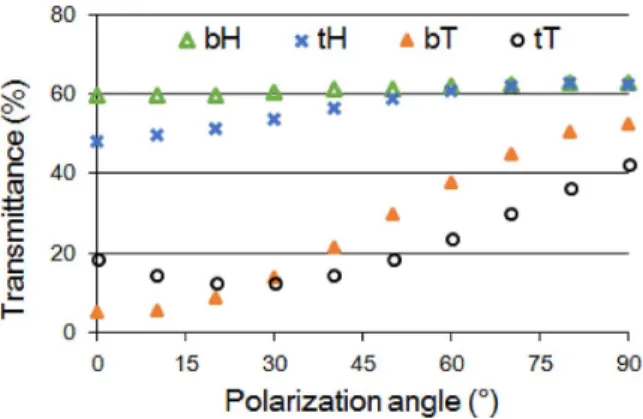
We then investigated the polarization-angle dependence of transmission in the tT and bT states with a linearly polarized light at 500 nm where the orange dye AZO1 has maximal ab-sorbance. At different polarization angles , transmittance at normal incidence is shown in Fig. 4. One can see that, for the bT state, the transmittance has its minimum as the polarization is nearly parallel to the rubbing direction (i.e., ). The transmittance grows with increasing and reaches maximum at near 90 . This can be understood as a result of adiabatic fol-lowing, which is the main mechanism for the prevailing twisted nematic display mode. When a twisted nematic system satisfies the condition [15]:
(1) where and stand for the wavelength, birefringence and cell gap, respectively, the incident polarized light experiences a phase change that gives a net result of an effective rotation in its polarization at a fixed angle to the nematic director. When dye exists in such system, one may separate the incoming polarized light into parallel and perpendicular components with respect
1108 JOURNAL OF DISPLAY TECHNOLOGY, VOL. 10, NO. 12, DECEMBER 2014
Fig. 4. Normalized transmittance varying with the polarization angle of the in-cident light in different states. The transmittance (at nm) is normalized to that obtained when the sample is removed.
to the rubbing direction. Since the maximal absorbance axis of dyes is along the LC director in this work, the parallel compo-nent experiences the maximal absorbance, and the opposite is true for the perpendicular component. In the bT case, the adia-batic following rotates the polarization by 360 while the meso-genic long axis is parallel to the maximal absorption of dye be-cause of the adiabatic following. The maximal absorption thus occurs at 0 . On the other hand, the tilted alignment near the surface in the tT case results in a reduced absorption of dichroic dye as well as a smaller effective birefringence that violates the adiabatic following condition. When the polarization angle is 0 , the weak adiabatic following deviates the polarization from the maximal absorbing axis over the cell, and thus the maximal absorption shifts from 0 . In the bH state, the molecules are aligned nearly normal to the substrate, giving rise to the min-imal absorption. In comparison, the absorption in the tH state is slightly larger, possessing polarization dependency due to the slight tilt of the molecules from the rubbing direction. The dif-ferential absorbance of polarized light suggests that when em-ployed in the reflective mode, the absorbance at twist state can be further enhanced with a wave plate (e.g. a quarter-wave plate) that rotates the polarization so the reflected light may experience the maximal absorbance again.
Next, to evaluated reflective spectra in different states, we placed a mirror behind the sample and measured the reflectance at an incident angle of 5 with results shown in Fig. 5. The behavior mostly agrees to the transmissive case; however, as one can see, the tT state actually has slightly lower reflectance than does the bT state in the blue-to-green spectral region. The average CR between the bistable tH and tT states for 500-nm light is determined to be 3.1.
Based on the fact that the absorption of a dye-doped BHN cell was polarization-dependent, here we demonstrate the possibility to enhance the CR in reflective mode by placing a 5.5- m ho-mogeneous cell between the BHN cell and a mirror. This homo-geneous cell acted as a retarding plate that modified the polar-ization profile of the reflected light to maximize the anisotropic absorption. The homogeneous cell was infiltrated with E7 and the rubbing direction was at 45 with respect to the BHN cell. A 632.8-nm unpolarized laser was used with an angle of inci-dence . The schematic setup is shown in Fig. 6. The CRs
Fig. 5. Reflectance of the dye-doped BHN sample in different states.
Fig. 6. Schematic setup to demonstrate a possible method to enhance the con-trast ratio. The homogeneous LC cell was placed between BHN and the mirror. The rubbing direction was at 45 with respect to BHN cell. The laser wave-length used in the experiment was 632.8 nm. 5 .
Fig. 7. Contrast ratio of the biased states (the reflectivity ratio of bH to bT) and the bistable states (the reflectivity ratio of tH to tT) as a function of the applied voltage across the homogeneous cell as a phase retarder. The contrast ratio was enhanced to 6.6 for the bistable case at 6.50 .
between the biased states (the reflectivity ratio of bH to bT) and the bistable states (the reflectivity ratio of tH to tT) at different applied voltages on the homogeneous cell are shown in Fig. 7. For biased states, the CR was improved to 20.0 at an applied voltage of 5.25 V , while the CR of the bistable states was enhanced to 6.6 at 6.50 V .
IV. CONCLUSION
In summary, a polarizer-free display mode is proposed. We show that by introducing dyes into a dual-frequency chiral LC host with properly tuned pretilt angle and value, a bistable display system can be realized. Such system consists of two stable states, tT and tH, functioning as the dark and bright states, respectively. The other two voltage-sustained states, bH and bT, may be used to increase contrast when necessary. The spectra of these states are presented. The polarization nature of the system was studied as well. We found that the absorption maximum occurs at a larger polarization angle in the tT state whereas it
LEE et al.: LOW-POWER DISPLAYS WITH HOMEOTROPIC NEMATIC LIQUID CRYSTALS 1109
reaches the maximum in the bT state when the polarization of incoming light is parallel to the rubbing direction. This finding can be well explained by the adiabatic following effect. The reflective spectra were measured and a CR of 3.1 was deter-mined. We further demonstrated the possibility to enhance this contrast by using a homogeneous LC cell as a retarding plate to modify the polarization profile. The contrast in the reflec-tive mode can reach 6.5 in a suited setting. The addition of a properly designed wave plate, refined BHN parameters (pre-tilt angle and value), and optimized dye mixtures may also help to improve the contrast. Most essentially, dyes having larger dichroic ratios should be considered to replace those adopted in this work. This study opens the door to a new reflective display mode that features low power consumption due to its character-istic optical bistability.
ACKNOWLEDGMENT
The authors thank Y.-H. Zou for technical assistance in fab-rication of BHN cells, and Prof. J.-S. Hsu for useful discussion.
REFERENCES
[1] O. Isao, “Electrophoretic display device,” U.S. Patent US 3668106 A, Jun. 6, 1972.
[2] B. Comiskey and J. M. Jacobson, “Nonemissive displays and piezo-electric power supplies therefor,” U.S. Patent US 5930026 A, Jul. 27, 1999.
[3] D. Kuo, J. S. Liao, and H. H. Chen, “Electrophoretic display capable of reducing ghost shadows and frame refresh method thereof,” U.S. Patent US 20130044121 A1, Feb. 21, 2013.
[4] G. H. Heilmeier and L. A. Zanoni, “Guest-host interactions in nematic liquid crystals: A new electro-optic effect,” Appl. Phys. Lett., vol. 13, no. 3, p. 91, 1968.
[5] D. L. White and G. N. Taylor, “New absorptive mode reflective liquid-crystal display device,” Appl. Phys. Lett., vol. 45, no. 11, p. 4718, 1974. [6] H. S. Cole and R. A. Kashnow, “A new reflective dichroic
liquid-crystal display device,” Appl. Phys. Lett., vol. 30, p. 619, 1977. [7] C.-T. Wang and T.-H. Lin, “Bistable reflective polarizer-free optical
switch based on dye-doped cholesteric liquid crystal,” Opt. Mater. Ex-press, vol. 1, no. 8, pp. 1457–1462, 2011.
[8] D. W. Berreman and W. R. Heffner, “New bistable liquid-crystal twist cell,” J. Appl. Phys., vol. 52, p. 3032, 1981.
[9] J.-S. Hsu, B.-J. Liang, and S.-H. Chen, “Dynamic behaviors of dual frequency liquid crystals in bistable chiral tilted-homeotropic nematic liquid crystal cell,” Appl. Phys. Lett., vol. 89, p. 051920, 2006. [10] J.-S. Hsu, “Stability of bistable chiral-tilted homeotropic nematic liquid
crystal displays,” Jpn. J. Appl. Phys., vol. 46, no. 11, pp. 7378–7381, 2007.
[11] C.-Y. Wu, Y.-H. Zou, I. Timofeev, Y.-T. Lin, V. Y. Zyryanov, J.-S. Hsu, and W. Lee, “Tunable bi-functional photonic device based on one-dimensional photonic crystal infiltrated with a bistable liquid-crystal layer,” Opt. Express, vol. 19, no. 8, pp. 7349–7355, 2011.
[12] Y.-C. Hsiao, Y.-H. Zou, I. V. Timofeev, V. Y. Zyryanov, and W. Lee, “Spectral modulation of a bistable liquid-crystal photonic structure by the polarization effect,” Opt. Mater. Express, vol. 3, no. 6, pp. 821–828, 2013.
[13] B.-J. Liang, J.-S. Hsu, C.-L. Lin, and W.-C. Hsu, “Dynamic switching behavior of bistable chiral-tilted homeotropic nematic liquid crystal displays,” J. Appl. Phys., vol. 104, p. 074509, 2008.
[14] B.-J. Liang and C.-L. Lin, “Crucial influence on range in bistable chiral tilted-homeotropic nematic liquid crystal cells,” J. Appl. Phys., vol. 102, p. 124504, 2007.
[15] P. Yeh and C. Gu, “Jones matrix method,” in Optics of Liquid Crystal Displays, 2nd ed. Hoboken, NJ, USA: Wiley, 2009, pp. 211–214.
Yun-Han Lee was born in 1989. He received
the M.S. degree in physics from National Taiwan University, Taipei, Taiwan, in 2013, and is currently working toward the Ph.D. degree from National Chiao Tung University, Tainan, Taiwan. His research includes the structural analysis of disclination of liquid-crystalline materials and the application of LCs in display technology.
Kuan-Chung Huang was born in 1990. He received
the B.S. degree in photonics from Yuan Ze Uni-versity, Taoyuan, Taiwan, in 2013, and is currently working toward the master’s degree from National Chiao Tung University, Tainan, Taiwan. His research focuses on the application of LCs in energy-saving display technology.
Wei Lee received the M.S. degree in electro-optical
engineering from National Chiao Tung University (NCTU), Taiwan, in 1987, and the Ph.D. degree in physics from the University of Alabama at Birm-ingham, AL, USA, in 1993.
He was a visiting assistant professor of physics and astronomy at the University of Toledo, OH, between 1994 and 1997, visiting professor of optics at CREOL, the College of Optics and Photonics of the University of Central Florida, Orlando, FL, USA, between 2009 and 2010, and a visiting scholar at the L.V. Kirensky Institute of Physics, Krasnoyarsk Scientific Center, Siberian Branch of the Russian Academy of Sciences, Russia, in 2010. Formally affiliated with Chung Yuan Christian University, Taiwan, from August 1997 through January 2012, he is currently the Director of the Institute of Imaging and Biomedical Photonics, College of Photonics, NCTU, and the President of Taiwan Liquid Crystal Society. His primary research interests focus on liquid-crystal (LC) optics and photonics, including LC lasers, photonic crystals with LC defect layers, (nano)composites and suspensions, dielectric and electro-optical properties, advanced LCD devices, and LC immunoassay applications.
Dr. Lee has served on the editorial board for the OSA journal Optical Mate-rials Express since its launch in 2011.
Chao-Yuan Chen received the Ph.D. degree in
electro-optical engineering from National Chiao Tung University, Taiwan, in 2006.
He was a visiting student and postdoctoral fellow in Physics Department, University of California, Berkeley, CA, USA, in 2005 and 2006. He led the 3D technology and total solution team, responsible for 3D optics, product design and system/software solution in AUO (AU Optronics Company,Ltd., Taiwan) between 2007 and 2011. He currently the general manager of Optronics Business Group at HCCH (Jiangsu Hecheng Display Technology Company.), where his group focuses on development of LC mixture and related optical devices.
Dr. Chen is a program sub-committee member of SID (Society for Infor-mation Display), and vice secretary-general of Nanjing FPD industry associa-tion, and program committee member of IDMC (International Display Manu-facturing Conference).