A Development of Personal Health Exercise Chart System
for Home-visit-type Exercise Service
Hirai T.
1), Higashi T.
1), Fukui M.
2), Sagawa S.
2)Ohashi Y.
2), and Ashida N
.
2)1) Osaka University, School of Allied Health Sciences, Faculty of Medicine
2) Koshien University, Department of Medical and Welfare Management
E-mail:[email protected]
Abstract
The super-aging society had come in Japan and healthy improvement support business on exercise instruction has been carried out in trial as care prevention for elderly people. As the problem, it was pointed out that the conventional exercise instruction is limited to continuous use of only the "fine" elderly people who can go to an athletic center such as fitness club. Then, we set up the exercise program at a house. Exercise instructor and dietitian were dispatched to the house of the elderly people who cannot go to an athletic center. The healthy improvement support service which performs exercise and ingestion instruction was developed. Also the computer support system of “Personal Health Exercise Chart” was developed.
1. Introduction
.In the current society, it is necessary to raise the awareness of physical activity and exercise while creating the environments and methods for the purpose of promoting the physical exercise on a day-to-day basis. 1) 2) 3). Concerning personal health databases (PHDB), in the past, we studied the integration of medical information and the multicenter collaboration in handling medical information. 4)5) We have studied the participatory personal healthcare monitoring for the purpose of developing the personal healthcare monitoring system which coordinates with the school health and physical education and the community programs, with the intention of creating the personal healthcare database of the personal physical fitness and healthcare records which suits individual life styles rather than the hospital-centered database of medical records. The elderly do the physical exercise which suits themselves, such as the activities like standing up, walking, and stepping, as well as pedaling a bicycle 1) 2) 3) 6) 7). Their main focus is to compare their newly recorded numeric data with their old numeric data which were recorded before. Therefore, many measurement items are included in a set. In this way, measurement items are being diversified. However, conventional
database systems have difficulties in handling such diversified measurement items. In order to solve this problem, we develop the dynamic database, which converts diversified measurement items into the conventional database configuration and process them.
Since October 2005, we conducted a local-community-based study to find if a home-visit-type exercise guidance program helps elderly people maintain their lives and assure their QOL by themselves, while checking its commercial feasibility. Individual exercise programs were prepared by the fitness exercise instructor who actually provides training in order to support the elderly in their doing exercise at home. This program were started at Sakasegawa district, Takarazuka city, Hyogo, Japan, where has developed from of old as the residential quarter. The subjects were the elderly residents in the Sakasegawa district who were neither covered by long-term care insurance or preventive approaches in long-term care nor participated in fitness club or health club activities. For this program, necessary systems were developed with some modification to the PHDB.
This paper is to introduce the home-visit-type exercise guidance and health management system.
2. Method
Home-visit-type exercise guidance (“Home delivery” fitness club services)
In forming a habit of doing exercise, what becomes inevitable is not to do exercise blindly, but to have the social support which provides appropriate guidance on correct use of muscles with consideration given to individual physical conditions and checks the results of such guidance. In the case of conventional exercise programs where many gather at a fitness facility and do exercise, it is difficult to practically implement the exercise programs which are tailored to individuals. Therefore, we decided to dispatch fitness instructors to individual homes and provide guidance on exercise. Figure 1 shows the outline of this exercise delivery program.
A00731 142
Fig.1. The Outline of Exercise Delivery Program.
Development of the fitness exercise file for home-visit guidance
In forming a habit of doing exercise, it is important for an individual to set the target by him or herself, improve self-efficacy, and perform self-monitoring. From this viewpoint, an individual was required to keep records on the fitness exercise file by him or herself.
The teaching textbook of main exercise menus at home were made and provided. Figure 2 shows some illustrations how to exercise.. The exercise menu fitted to the individuals was selected. At the beginning, visiting about three times per week instruction and check of whether to perform the right motion are scheduled and later, the visiting became 1-2 instruction per week. Creation of the health exercise chart of home exercise instruction In order to learn a exercise custom, aims are set up by itself, self-effect is heightened and it is important to carry out self monitoring.
Then, health exercise chart was described by himself. It is aware of its health condition by comparing with one's it, and he is conscious of future health. The test-of-physical-strength-and-fitness item (although it has not resulted in what was standardized, and standardization -- a universal thing --) performed now Moreover, the measurement item united with the special feature of the person himself/herself was put in a database, and we registered as many the measurement items and the newly devised measurement items reported by literature as possible, and decided to choose the measurement item which suited itself.
Fig. 2. Muscle training menu at a house: The squat using a ball (standup), leg extension , leg curl, stretching, tiptoe raising, back kick, pose etc.
System requirement for home-visit type exercise service
To record electronically such various items, which are deferent one by one. Personal health exercise chart (Modified PHDB) was created for the items which are currently measured in physical fitness measurement (those which are already standardized, those which are common but yet to be standardized, and items suitable for individual qualities) and the measurement items which have already been reported in papers and newly developed were added as many as possible, so that the items suitable for individuals can be selected. Also, it contains management system such as scheduling and accounting function for supporting this service.
3. Result
Community-based experiment for commercialization
The participants of the experiment was eventually comprised of 15 people in total, 14 elderly people ages 53 to 88 and 1 female in her thirties. 5 participants selected (1) to do exercise alone at home and 12 participants selected (2) to do exercise with his or her
A00732 143
friend(s) at the his or her home or his or her friend’s home. One participant of each group gave up in midway, and 15 participants continued until the program finished.
System construction
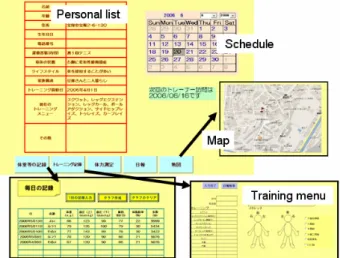
In this experiment, Excel 2003 VBA(visual basic for application) was used to develop the systems, and all books and sheets could be opened from the sheet 1 of the first book to be used (health management system See figure 1).
fig. 1. Start view of the Personal health exercise chart.
(1) Personal list
One book is assigned for a participant. In a book, sheets were prepared for basic information (personal information about a participant, such as the name, age, and address), Self-monitoring (1) (weight, blood pressure, pulse, body fat percentage, and pedometer record), Self-monitoring (2) (training records), physical fitness measurement results, daily reports (written by a trainer who visits the participant), and maps. Trainers check basic information and daily reports to grasp physical condition of participants. Participants enter information about his or her physical information and workouts that they did by themselves for self-monitoring. Physical fitness measurement results include pictures and videos. Pictures and videos are used to help participants grasp their physical changes by checking their pictures and videos. When trainers visit participants, trainers enter information about the workouts done on the day in addition to the muscles which were stretched, so that other trainers can check the content of the previous exercise when they visit next time. From a personal file, plans can be checked and a reservation for a next visit of a trainer can be made. Maps are prepared because trainers need them to visit individual residences. Those maps can be printed out. (2) Training menu
This is to explain the training menu that a participant actually goes through. Videos are prepared so that participants can watch actual workouts.
(3) Physical fitness measurement
Periodical physical fitness measurements were carried out to check physical changes of participants. The average results of Japanese people can be checked for measurement items.
(4) Schedule
A book was prepared for all trainers to enter their schedules. When a particular date is selected on Sheet 1, it shows the schedule of all trainers on the day. Other sheets except sheet 1 are used for individual trainers so that a trainer can use one sheet to check and update his or her schedule.
(5) Commodity control
Some participants purchase balance balls and dumbbells for them to do exercise at home. Such equipment was sold through us, therefore, the sheet to issue a receipt was prepared.
(6) Trainer list
The list of the addresses of the participants with the names of the trainers who visit them.
(7) Map
The map to show the homes of the participants that trainers visit. It can be printed out, marking individual participants’ residents.
(8) Accounting
The list to check if a participant pays the fee.
fig. 4 Job flow of the Personal health exercise chart
4. Discussion
It seems that precise exercise by instruction and support system corresponding to every elderly people can be taken with this system and the broader customers who need continuous healthy improvement activities are attained. It is said that 10% of local elderly people are "Shutting Oneself Up." Before long, 60 to 70 percent, although everyday life has become independent mostly, it is called what is depended on psychology, society, and an environmental agent. Although this exercise program is not performing health enhancement positively among the elderly people to whom this type shuts itself up and the large majority (90%) of elderly people and elderly people becomes independent, it is aimed at what it is
A00733 144
interested in health and has uneasiness in the future. This social experiment is aimed at investigating how much potential demands such a candidate's excavation method and contents of service have.
Even among the elders, some participate in a full marathon race, and some of those who have neither disturbances nor disorders have problems in walking even several meters. In this way, physical capabilities of the elders vary greatly among individuals, which means age-based criteria are meaningless. As declines in physical strength and capability greatly vary among individuals, they need to be grasped as personal aging phenomena instead of performing a cross-sectional analysis. It is necessary to create the environments where the elders appropriately make physical fitness motions, express them numerically, and compare them with his or her past records, so that they can acknowledge their current health and physical conditions and raise the awareness about future health and physical conditions.
5. References
[1] Ota M.,okufuji T.,Ikeda M.;Aged people and physical fitness, JCSM, p549-554,2003
[2] Nishijima N.;New physical fitness, JCSM,20, p53-64 [3] Tanaka K., Nakamura Y., Akutsu T.;physical fitness for middle and elder ,JCSM,20,p201-210 2003
[4] 2003Hasegawa T., Ashia N., et al; Design
Philosophy of Personal Health DataBase (First report) , 17th JCMI vol17 p422-423 Nov.,1997
[5] Hasegawa T., Ashia N., et al; Design Philosophy of Personal Health DataBase (Second report) , 18th JCMI vol18,p362-363 1998
[6] Sagawa S., Ashida N. et al; Follow up the personal changes in wemen's fitness due to aging (Japanese), 21th Bulletin of Osaka university medical college p83-90, 1993.
[7] Umeda N.,Shigematsu R.,et al;Pysical fitness in olderadult with low ,middle and high body mass index J.J.Phys.Educ.Hlth.SportSci.47 p439-450, 2002 [8] Ashida N., Higashi T., Kubota H. et al.: The Dynamic Database Model Supporting Greatly Varied Items for the Continuous Monitoring of Physical Fitness and Healthcare, JKS Medical Informatics
2003,9,2,p327-330
[9] Ashida N., Kubota H. et al.:, Construction of an individual participation type physical strength healthy data management system (Japanese) Japan Journal of Medical Informatics,23 (Suppl.),p734-737,2003
[10] Ashida N., Hirai T., et al.: Educational Campaign of Continuous Exercise from Children to Elderly
People.(Japanese). Bulletin of Koshien University College of Contemporary Business Administration,32,1-6,2004
[11] Okada R., Takashima N., Ashida N. and Higashi T.,: Comparison of martial art wrestlers in their shapes -judo, wrestling, and sumo-, 2nd International Judo Federation Symposium, Sept.2005 Cairo
A00734 145