行政院國家科學委員會專題研究計畫 成果報告
國際企業系統效益與問題分析
計畫類別: 個別型計畫 計畫編號: NSC93-2416-H-004-006- 執行期間: 93 年 02 月 01 日至 93 年 07 月 31 日 執行單位: 國立政治大學資訊管理學系 計畫主持人: 尚孝純 報告類型: 精簡報告 處理方式: 本計畫可公開查詢中 華 民 國 93 年 11 月 4 日
國際企業系統效益與問題分析 -
國際企業營運架構與企業系統營運架構相互配適對總部與
分支單位之效益與問題分析研究
尚孝純
本專案目的在分析國際企業營運架構與企業系統營運架構相互配適在總部與各 分部間之效益影響。國際企業系統整合全球資源並適應各區域獨特需求設計不同 流程。跨國企業安裝國際企業系統,期望提升全球作業能力。但是由於總部與各 分公司資料與流程龐大複雜,維繫企業系統安裝營運與企業全球營運架構相互配 適以滿足總部與各分公司期望的利益是管理者極重要之挑戰。本計畫參考 Javenpaa and Ives’ (1993)之資訊系統對 Bartlett and Ghoshal (2002)之國際企業營運架構相互配適架構,加入 Shang and Seddon (2002) 對企業系統效益與問題分析的五個面向,設計完整之國際企業營運架構與企業系 統營運架構相互配適與相關總部與各分部間效益問題分析研究架構。經過個案研 究瞭解分析跨國企業在安裝國際企業流程整合系統前後營運架構與企業系統營 運架構相互配適之狀況及影響,提出提升國際企業流程整合效益的可能假設。主 要研究發現包含: 1. 國際企業營運架構與企業系統營運架構相互不配適依然可順利安裝並達期 望效益; 如果國際企業營運架構與企業系統營運架構在安裝企業系統後相 互配適。 2. 國際企業藉安裝企業系統可促發營運架構轉型。 3. 國際企業安裝企業系統安裝較順利; 如果能配合執行流程再造。 本專案透過深入個案分析,瞭解國際企業系統效益產生過程,提出可能假設與建 議。期望有助未來對國際企業流程整合系統的研究,並幫助企業有效瞭解國際企 業營運架構與企業系統營運架構相互配適之關係與管理增進國際企業系統管理 成效。 關鍵詞:國際企業系統, 企業系統營運架構相互配適, 企業流程整合, 國際企 業系統, 電子企業系統,企業資源規劃,資訊系統效益
Applying Enterprise Systems in International Business Operations:
The Benefits and Problems of Fit in International Enterprise Systems
Implementation
Shari S. C. ShangAbstract
Enterprise systems (ES) support international operations in both global integration and local adaptability. Due to the complexity of data and processes in head offices and in different subsidiaries, maintaining a fit between international business operations and a multi-site system configuration has become one of the most critical aspects of ES implementation. This research strives to create an in-depth understanding of the benefits and problems of fit in international enterprise systems in both head offices and local business units. By means of case stud y of four international organizations this study intends to assess the alignment between international organizational operations and enterprise systems configuration. Different aspects of the impacts on both head office and local units are then analyzed. Major findings are:
l A misfit between international ES configuration and business operation can still
lead to successful implementation and beneficial system utilization if the after- implementation business operation fits the ES operation.
l ES can be applied by international enterprises to transform the global operation. l International ES implementation can run smoother if BPR is applied.
It is hoped that a broad-scope, multi-dimensional impact analysis of international ES fit could provide a useful approach for understanding the various consequences of ES fit in international business operations.
Keywords : international business operations, enterprise systems, IS fit, enterprise systems benefits
Research motivation and research objectives
Enterprise systems (ES) support international operations in both global integration and local adaptability. They not only simulate the business environments of many countries but also transform their process information into consolidated reports to head office (King & Sethi 1999). Many organizations wishing to improve their international operations have ventured in search of the most suitable International Enterprise System package. Due to the complexity of the data and processes of head office and of different subsidiaries, maintaining a fit between international business operations and a multi-site system configuration has become one of the most important aspects of ES implementation (Markus et al., 2000; Stedman, 2000; Laboza, 1998; Lai, 2001). However, it is hard to tackle these challenges without a full understanding of the consequences on stakeholders of the implementation of such a complex system in all business areas. Head offices need to understand the different local effects on total business operations, and local offices need to be aware of their contribution to global efficiency and the possible tradeoffs between global control and local response.
Studies on IS fit (Reich and Benbaset 1996; Brown and Magill 1994; Henderson and Venkatraman, 1993; Leifer 1988, Venkatraman 1989, Das et al. 1991, Iivari 1992, Lee et al. 1992 ) and global IS fit (Peterson, 2001; Jarvenpaa et el., 1993, Tractinsky and Javenpaa 1995) have presented useful frameworks for classifying and assessing the fit of an information system, assuming fit will lead to performance improvement. However, neither the broad consequences nor the various stakeholders’ views have been empirically tested. However, previous ES studies have revealed that strategic and managerial benefits such as global consistency, efficient resource control, or improved decision- making are planned or realized mostly by the central offices of international businesses (Stahl, 2003; Newing, 2000; Mitchell, 1999). But operational and organizational problems such as loss of customer responsiveness, increased customization costs, or conflicts within the local environment have also been noted (Feeny and McMullen, 1999; Vernon, 1999; Rutherford, 2001). It seems that the lack of a complete overview of the multiple impacts of international enterprise systems can lead to misguided ES implementation.
To fill the gap between the assumption of fit benefits from ES implementation and the actual impacts of ES fit, this project attempts to create in-depth understanding of the benefits and problems arising from fit in international enterprise systems in both head offices and local units.
Key research questions are:
l What is the impact of fit between international operation and ES operation? l How can organizations reduce conflicts between head office and local business
unit in managing the fit between international operation and ES operation?
l
By applying Javenpaa and Ives’ (1993) framework of IT fit to Bartlett and Ghoshal‘s international business structures (2003) and Shang and Seddon’s (2002) framework of ES impacts, this study plans a detailed case analysis of eight international businesses to assess the alignment between the international organizatio nal operations and
enterprise systems configuration. Different aspects of the impacts are then analyzed to develop deeper and more complete understanding of the impacts of international ES fit. It is hoped that this broad-scope, multi-dimensional benefit analysis of
international ES fit can provide a useful approach for understanding the various consequences of different forms of fit between international practice and system configuration, and assist business managers to develop more effective strategies fo r maximizing benefits from their investment in international enterprise systems.
Literature review
International business operations
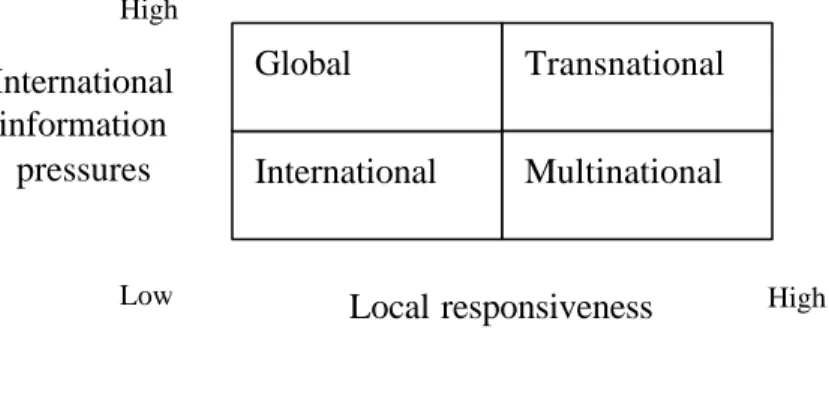
International business operations are activities undertaken by a multi- national company outside its domestic base. Different ways of achieving balance between the pressures for international integration and local responsiveness indicate different requirements for sharing and processing information. Four distinct strategies (depicted in figure 1) for managing organizations across borders have been identified (Bartlett and Ghoshal, 1998; Bartlett and Ghoshal, 2002): multinational, international, global and transnational.
The global orientation firm has a strong focus on seeking global efficiency through consistent operations and centralized world resource management while the multinational orientation firm is characterized by strong national bases, which results in conceding substantial autonomy in decision making to foreign subsidiaries.
International orientation describes firms whose strategic focus is on worldwide diffusion, which gives local units a large degree of discretion in adopting and modifying headquarter’s products, but these local units are also dependent on the parent for new products and technological know-how. The decision- making structure of an international company is less decentralized than that of a multinational company, but more than that of a global company.
Transnational orientation typically involves firms concerned with attaining global efficiency and flexibility, and promoting communication and organizational learning among business units. The country units serve both independent local needs and interdependent global needs.
Information Systems of International Business Operations
The organizational characteristics of centralization, dispersal, and coordination are differently reflected in various kinds of international IT operations (Ives and
International Global Transnational Multinational International information pressures Local responsiveness Low High High
Jarvenpaa 1991, Sambamurthy and Zmud, 1999; Rebstock and Selig, 2000) and management (Broadbent and Butler, 1997). Patterns of global information system implementation have been found to be aligned with international business operation strategies.
In a centrally coordinated business structure, IT is also globally centralized. Local autonomy appears to be a moderating variable, as can be seen from the differences in the IS characteristics of global and parent-child firms (Ives and Jarvenpaa 1991). Firms with a global business orientation focus on customer services and cost advantages and centralize their assets and management on a global basis.
Firms with multinational orientation tend to build up independent IT operations in their subsidiaries. Application portfolios bear little resemblance to one another and contain few common systems.
Transnational firms aim to achieve global flexibility, efficiency, and the transfer of learning across business units. This is made possible by the worldwide integration of information and core business processes. Innovation and individual excellence are promoted and reengineered for worldwide application. More joint headquarter-subsidiary activities are noted than in the other kind of operations.
The strategic focus of international orientation is the adoption of parent company policies and practices in a mixed centralized/decentralized structure, based on core competencies. These firms may have several global systems, but those systems are likely to be locally tailored and running under the control of the subsidiary. The IT relationship between the subsidiaries and headquarters is characterized by interpersonal contacts, cooperation, and shared planning. It may also extend to seeking volume discounts or site licenses from vendors.
Enterprise systems implementation in international operation
Enterprise systems, from vendors such as SAP, PeopleSoft, and Oracle, integrate enterprise information, including financial, human resources, logistics and marketing information, throughout and across organizations, creating single data repositories that feed information into applications supporting several or all business functions of multiple sites. With systems linked, one data entry can then be accessed by anyone anywhere across borders and worldwide resources can be centrally managed (Davenport, 1998, Deloitte Consulting, 1998).
Since ES vendors design software to function in different countries they also have staff in these countries who are knowledgeable and accessible. The functionality of enterprise systems is evolving with regular upgrades and constantly advanced technologies. Implementing enterprise systems in complex and geographically dispersed orga nizations involves difficult, possibly unique, technical and managerial choices and challenges (Markus et al., 2000). A multi-site ES implementation has at least four different levels: business strategy, software configuration, technical platform, and management execution. Successful multi-site ERP implementation involves a consistent arrangement between business components and system configurations on all these levels
Research framework
As depicted in figure 2, this study tried to assess the fit between international operations and enterprise system configuration with related impacts on both head office and local units to be examined.
Figure 2: The impact of fit between international business operations and ES configuration
The concept of ‘fit’ expresses the idea that the object of design must match its context in order to be effective (Iivari 1992, Venkatraman 1989). Fit has been defined as the degree to which the needs, demands, goals, objectives, and/or structure of one component are consistent with the needs, demands, goals, objectives, and structure of another component (Nadler & Tushman, 1980). Because of its completeness and relevance to the study Javenpaa and Ives’s framework of examining fit between international business operations and IS configuration will be applied and modified according to the special characteristics of enterprise systems to assess the fit between international business operations and ES configuration, and Shang and Seddon’s enterprise systems benefit framework will be applied in order to assess the consequent benefits and problems comprehensively.
International business operations
The international business operation variables are designed to capture the four structure models of Bartlett and Ghoshal (2002). This will be reflected in the business structure and the locus of organizational decision-making.
Business structure. This is looked at to understand which of the alternative structures
most closely resembles a firm’s corporate approach to operating in a foreign or global market.
Locus of organizational decision making. This section assesses the relative influence
of the subsidiary versus headquarters on six activities: (1) introducing a new product, (2) changing an existing product, (3) changing a production process, (4) restructuring the subsidiary organization, (5) recruiting subsidiary senior management, and (6) developing career plans for senior management in subsidiaries.
Enterprise systems configuration
Firms reporting that they build IT configurations according to their international business structure can be characterized along five dimensions [12]: the locus of ES
Fit International
business operation
Enterprise systems configuration
Impacts on head office
decision making, the number of common systems, the mode of operation, the
development approach, and the reporting structure. Since enterprise systems provide the flexibility of supporting dynamic control and decentralization capabilities in an international operation, a similar approach can also be applied to ana lyzing the
consistency between international operations and ES configuration. The detailed items of these dimensions are modified according to the processing nature of the enterprise systems.
ES systems operations
Interviewees will be asked to identify the firm’s ES operations approach in international operations.
Locus of ES decision making. This section assesses the autonomy of foreign
subsidiaries regarding the following ES implementation decisions: (1) ES selection, (2) operating systems, (3) hardware, (4) database, (5) staffing of senior ES positions, (6) configuration standards, tools & methodologies, (7) implementation of partner selection, (8) project goals and scope, (9) implementation strategy (big bang, phased..), (10) delivery dates, (11) selection of empowered decision makers, and (12) fulltime employment of the best staff.
Common systems. This is designed to understand the range of scope of global
standard data and processes.
Management of ES operations. This is designed to understand the degree of control
each local unit has over their enterprise systems.
Development approach. This is to analyze the control and involvement of global and
local resources in the ES configuration.
ES reporting relationship. This item assesses the reporting design/format? of senior
subsidiary IT managers to the headquarter’s IT head.
The hypothesized relationships between the dimensions of ES configurations and international business operations are listed in Table 1.
Table 1: The relationships between the dimensions of ES configurations and international business operations (adopted from Javenpaa and Ives 1993 )
ES dimensions Multinational Global International Transnational Locus of ES decision-making (decentralized) ++ -- ++ +/- Common systems (number of) -- ++ ++ ++ Mode of operations (decentralized) ++ -- ++ +/- ES reporting (decentralized) ++ -- ++ - Development approach (decentralized) ++ -- ++ +/-
++: very high; +: high; --: very low; - : low; -/+: joint/combination of centralized/decentralized
The impacts of enterprise systems on head office and local units
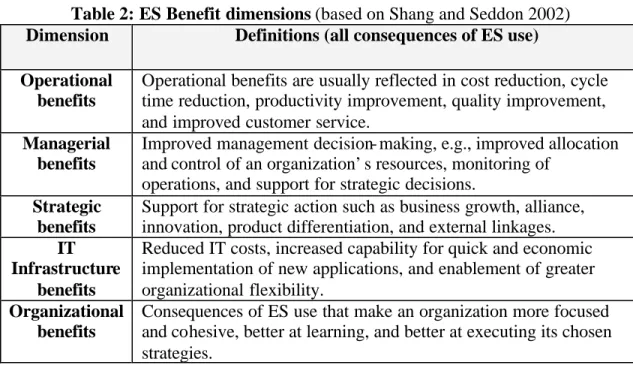
In order to assess the impacts of international ES fit in diverse dimensions Shang and Seddon’s (2002) ES benefit framework is applied for its comprehensiveness. This framework (Table 2) was proposed by reviewing and consolidating the literature on IS benefits, tested and enriched by reviewing 233 Web-published ES cases, and verified by directly contacting 34 cases. The result was a modified ES benefit framework with a detailed list of 89 benefit items obtainable from ES use (a detailed list of ES benefit items is given on the first author’s website)
Table 2: ES Benefit dimensions (based on Shang and Seddon 2002) Dimension Definitions (all consequences of ES use) Operational
benefits
Operational benefits are usually reflected in cost reduction, cycle time reduction, productivity improvement, quality improvement, and improved customer service.
Managerial benefits
Improved management decision- making, e.g., improved allocation and control of an organization’s resources, monitoring of
operations, and support for strategic decisions. Strategic
benefits
Support for strategic action such as business growth, alliance, innovation, product differentiation, and external linkages. IT
Infrastructure benefits
Reduced IT costs, increased capability for quick and economic implementation of new applications, and enablement of greater organizational flexibility.
Organizational benefits
Consequences of ES use that make an organization more focused and cohesive, better at learning, and better at executing its chosen strategies.
Research methodology
International business operations are an area with multiple participants where different perceptions need to be verified and synthesized, which necessitates dynamic exploration into each different situation. Since survey results cannot present an objective and complete view of ES impacts, meticulous data collection in the presence of the researcher during the data collection process is considered essential: to clarify concepts and to ensure that the understanding of the concepts involved is consistent and precise across the subjects.
Based on the concept of international IS fit and ES benefits which is described in the previous section a questionnaire was designed to collect detailed information on the international ES practice. The seven-page questionnaire is listed in appendix 1. After a pre-test with three business managers of international enterprises, some questions were modified to capture proper answer. The main change made to this questionnaire is to add two additional columns describing the international practice before and after the ES implementation.
Detailed data collection was conducted with four major international business operations. Data were collected from two types of enterprise system users of both headquarters and a core local unit: from major process managers and the ES project
managers. Business managers are to provide information of business operations and business benefits and problems while ES managers were asked to provide information on the ES configuration and ES impact on the IT infrastructure. The data collection was executed under the control of researchers. Although the research framework provided an articulated questionnaire for data collection, open questions were asked with detailed case examples in order to build support for selected statements and to verify the linkage between the fit variables and consequent changes in performance. The fit of international ES was assessed and supported with analyzed case examples. The related impacts were then reviewed and described with supporting case data as well. Tables and graphs were used to consolidate findings and form patterns of the impacts of ES fit on both headquarters and local units.
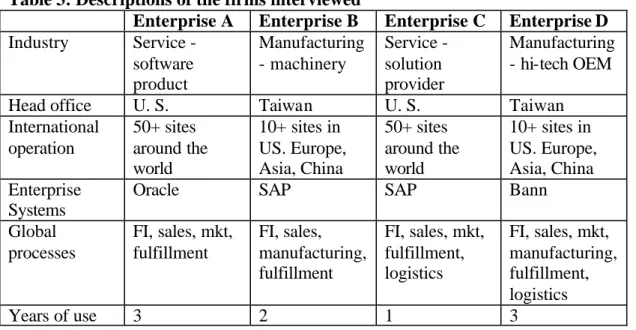
Table 3: Descriptions of the firms interviewed
Enterprise A Enterprise B Enterprise C Enterprise D Industry Service - software product Manufacturing - machinery Service - solution provider Manufacturing - hi-tech OEM
Head office U. S. Taiwan U. S. Taiwan
International operation 50+ sites around the world 10+ sites in US. Europe, Asia, China 50+ sites around the world 10+ sites in US. Europe, Asia, China Enterprise Systems
Oracle SAP SAP Bann
Global processes FI, sales, mkt, fulfillment FI, sales, manufacturing, fulfillment FI, sales, mkt, fulfillment, logistics FI, sales, mkt, manufacturing, fulfillment, logistics Years of use 3 2 1 3
Research results
The research result is summarized in Table 4. As shown in this table, all the companies show a misfit between international operation and ES implementation. However, it is important to note that 1) these organizations had all achieved the expected benefits from this misfit ES, 2) and they all have transformed their international operation into an operation that fits the ES operation.
Company A is headquartered in the United States and provides software products to local units around the world. Before the ES implementation, local business units managed marketing strategies, material procurement, and human resources. After the ES implementation, the organization became a global firm with the head office
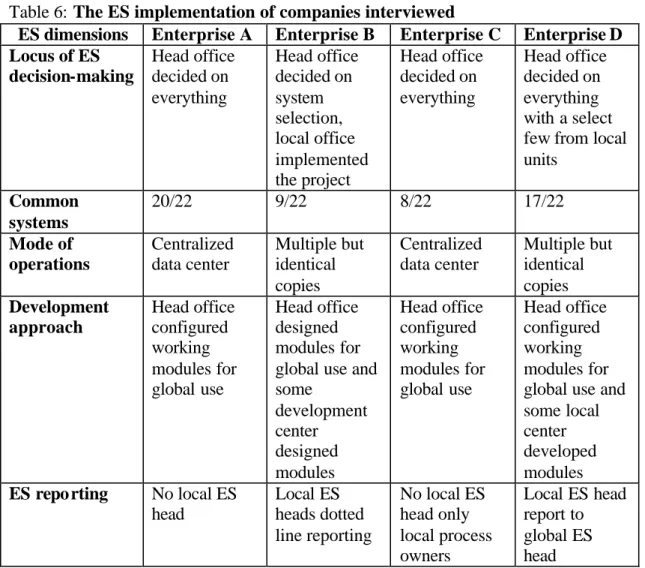
controlling all resource management decisions including local hiring. The Oracle ERP system was configured to turn all the resource controls over to the head office (Table 6). The dramatic change was implemented to remove all local data centers and to centralize the database at the head office. The entire system was completely configured and maintained by the head office.
Table 4: International operations and ES implementation in the four cases
Enterprise A Enterprise B Enterprise C Enterprise D International
operation before ES
International Multinational International International
ES
implementation
Global International Global Global/ transnational International
operation after ES
Global International Global Global/ transnational BPR implemented No Planned after ES implementation Organizational restructured and process redesigned Reorganized worldwide structure and processes Impacts on head office and local business units (Head office/ Local business unit)
Operational 3/2 2/2 3/3 5/5 Managerial 4/1 3/3 3/3 5/5 Strategic 1/0 1/1 2/2 5/4 IT infrastructure 5/2 2/2 3/2 5/5 Organizational 3/-1 1/0 3/3 3/2 Description of impacts on head office l Reduced cost and time l Increased control l Large IT savings l Changed work pattern l Some cost savings l Improved global control l Built external links l Increased IT capability l Reduced process time and costs l Increased resource management flexibility l Increased global visions l Large cost savings l Reduced cycle time l Strategic WW supply chain l Large IT savings l Common vision Description of impacts on local unit l Increased costs and work time l Reduced responses to local needs l Reduced IT costs l Local work- around strategies l Improved productivity l Better resource control l Support business alliance l Improved productivity l Support frequent but smooth business changes l Increased global teamwork l Reduced costs
and cycle time
l Improved
resource management
l Reduced IT
costs
After two years, the head office identified several areas that showed great
improvements: cost reduction, cycle time reduction in critical decision making, and quick and easy resource allocation. However, local business units had a different view of the system. They thought the integrated system had not yet created any savings but only extra work and delayed decisions on resource utilization.
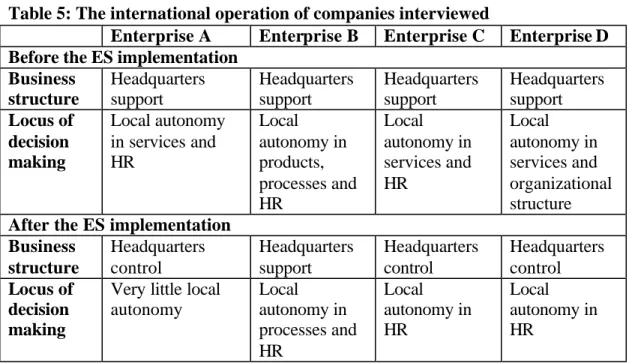
Table 5: The international operation of companies interviewed
Enterprise A Enterprise B Enterprise C Enterprise D Before the ES implementation
Business structure Headquarters support Headquarters support Headquarters support Headquarters support Locus of decision making Local autonomy in services and HR Local autonomy in products, processes and HR Local autonomy in services and HR Local autonomy in services and organizational structure After the ES implementation
Business structure Headquarters control Headquarters support Headquarters control Headquarters control Locus of decision making
Very little local autonomy Local autonomy in processes and HR Local autonomy in HR Local autonomy in HR
Company B is an international provider of heavy electronic motors, headquartered in Taiwan with marketing and service subsidiaries in Australia, Asia, the United States, Europe, and China. The U.S. subsidiary was purchased ten years ago from a major electronics companies. This local unit ran its own factory with full decision- making power in marketing, processes and resource management. SAP was chosen to implement a world standard process infrastructure with some major modules developed in the head office and implemented and maintained by the local unit. Because the local unit remains autonomous in resource management, there is little resistance from the local unit and benefits of better information management was shared across head and local offices. However, to increase the collaborative work between head and local units company C is planning a process redesign program to increase world integration.
Company C’s head office is in the United States and with regional offices in Europe and Asia. This company provides global system integration solution to Fortune 500 customers around the world. The implementation of ERP was well-planned two years before the system was implemented. It was a centralized process with the head office studying global and local needs and developing key components for regional offices. The regional offices then distributed the modules together with process education packages to local units. It was a phased implementation with financial and fulfillment modules implemented first. During the time of system configuration in the head office, many program changes were implemented in the regional offices to assist local units in its transfer from non-global-standard processes into global-consistent processes. From accumulated experiences of process redesign in different local units, issues were identified and solved, and some procedures were modified to make room for local responsiveness. The benefits were high and consistent among head and local units.
Company D’s head office is in Taiwan, and it has subsidiaries in Europe, the US, and Asia. It provides a global end-to-end network of design, manufacturing and service operations to ICT (Information, communication and technology) companies.
Table 6: The ES implementation of companies interviewed
ES dimensions Enterprise A Enterprise B Enterprise C Enterprise D Locus of ES decision-making Head office decided on everything Head office decided on system selection, local office implemented the project Head office decided on everything Head office decided on everything with a select few from local units Common systems 20/22 9/22 8/22 17/22 Mode of operations Centralized data center Multiple but identical copies Centralized data center Multiple but identical copies Development approach Head office configured working modules for global use Head office designed modules for global use and some development center designed modules Head office configured working modules for global use Head office configured working modules for global use and some local center developed modules ES repo rting No local ES
head Local ES heads dotted line reporting No local ES head only local process owners Local ES head report to global ES head
The main goal was to centralize the global resources including material, products and design, and customer knowledge while coordinating processes among subsidiaries. Because many design projects were conducted among several subsidiaries and
manufactured in different factories, the system was built to accommodate the network linkage among the worldwide points. Although it was a lengthy and complicated job to restructure the subsidiaries, 12 factories in Europe were consolidated into 4 sites with design and manufacturing work allocated in different sites, with constant communication and persistent support from executives the project was implemented on time and within budget. It took more than a year to fine tune the system and to gain benefits. The results show that both head office and local units appreciated the
benefits gained from the worldwide integrated system and the organization was able to accomplish more work for more customers.
Discussion
With further analysis on the pattern of ES configuration and international operation and related results of the case studied, a few propositions were formed from this study:
l A misfit between international ES configuration and business operation can still lead to successful implementation and beneficial system utilization if the after-implementation business operation fits the ES operation.
As presented in Table 4 the misfit is noted between the organizational operation and ES implementation in the four firms. These firms have all implemented the systems on schedule and achieved benefits. It is understandable that the different aspects of business benefits and problems can not be compared among companies. Business results in this study were assessed based on the companies’ planned goals and a comparison of the performances before and after the system
implementation. No major failure was noted in these four firms and results were apparent and reflected in both public documents and transcript of interviews.
From the findings of this study, the time point of assessing the fit can affect the evaluation of fit. Most studies examined IT fit after the system was impleme nted and suggested fit between international operation and system implementation in the planning stage. However, in most cases the structure of international operation in the planning stage may not be the one the organization wishes to maintain. The modifications usually occur during the process change. Besides, the business operation could be dynamically affected after the implementation and use of a new system that is not fit results in instability. Contrary to the conventional wisdom of IT fit for success, this study provides a different view of IT fit that it is a constantly changing balance between the enterprise systems and the business operation. Assessment of different time points can have different perception of the fit. Maintaining ES fit is therefore a dynamic job with different business drives considered.
l ES can be applied by international enterprises to transform the global operation.
Although limited to four companies the study results display a pattern that organizations applied the ES to transform the organizational structure to either better resource-controlled or process-coordinated operation. Enterprise systems in these firms provided complimentary information and consolidated processes in the international operation so that the information flows globally, decisions are made effectively and operations run collaboratively. With the complimentary support of this globally integrated system the head offices are able to change the work
pattern of international practice and build infrastructure for a more globally- linked organization. An enterprise system with its nature of information integration and level- modularization can be used as an enabler for global business transformation.
l International ES implementation can run smoother if BPR is applied.
Based on the analysis of the business results of the four international enterprises, company A suffered more than the other firms due to the conflicts between head and local offices. The differences of ES imple mentation seem to be the change in management.
Company A, changing from international to global, did not streamline the
processes with local units and these units lost previous flexibility in responding to environment needs. Company B did not change the structure greatly, and the local units maintained a certain degree of autonomy. Therefore, both head office and local units perceived similar benefits and problems. However, the BPR plan is to gain more synergy between the office in the US and Taiwan. Whereas the restructured worldwide processes in Company C had already been in practice
before the ES was in use. There was little resistance from the local business units and benefits were perceived consistently between head office and local units.
In the case of Company D the transformation from international operation to a globally-controlled and locally- networked organization has already been planned for years. Before the system was configured, the streamlined and enhanced processes, which strengthened the linkage among head office and local business units, had already been in practice for half a year. The ES implementation went smoothly and aligned opinions about benefit achievement were noted in both head office and the local business units.
Learning from the four cases, a well-planned process redesign with consideration of local adaptation during ES implementation is one of the critical factors for a beneficial international ES implementation.
Conclusion
This research project endeavored to provide insightful understanding of the management of international enterprise systems. Its aim is to investigate various aspects of the impacts of enterprise system fit on international business operations.
The key finding is that a misfit between the international operation and ES operation can still lead to great success if a) the ES is applied to transform the international operation and b) a well-planned process change was implemented in local business units before the systems was in use. Contrary to the general understanding that a fit between international operation and IS implementation can lead to implementation success, results of this study revealed that a misfit between the international operation and ES operation could bring even more benefits. A well-planned organizational restructuring process and process change program in preparing local units for the new processes is the key for international ES success.
Different types of international ES fit and misfit have different influences on the different areas of running a bus iness in both the head office and local units. For example, in a globally-controlled firm, operational performance in the head office may be achieved because of tight control over local resources, while managerial performance in local units could be reduced due to a delay in response to local requests when local competition increases. On the other hand, a strategic drive for global competition could be enhanced through the collaboration of
inter-organizational operations, with extra efforts in managing the increased
negotiation power from local units in transnational-oriented firms. Meanwhile global information could enhance knowledge sharing among local units, with supplemental support for international and multinational firms to transform themselves into transnational-oriented organizations. An ES fit could bring benefits as well as problems in different business areas in the operation of international business.
The value of the study should be to assist business managers in diagnosing fit between international business operations and ES configuration with an insightful
understanding of possible tradeoffs between the performance of head office and local needs. It is hoped that the accumulated intelligence of international ES management results can build up deep knowledge of the management of international enterprise systems and provide useful guidance to managers of international enterprise systems.
References
Bartlett, C. A. and Ghoshal, S. Transnational management: text, cases, and readings in cross-border management, Boston Irwin, 1992.
Bartlett, C. A. and Ghoshal, S. Managing Across Borders: The Transnational Solution, Harvard Business School Press, Boston, 1998.
Broadbent, M. and Butler, C. "Managing Information Technology Infrastructure Capability for International Business Operations," Pacific Asia Conference on Information Systems, Brisbane, Australia, 2-5 April 1997.
Brown, C.V. and S.L. Magill, "Alignment of the IS functions with the enterprise," MIS Quarterly, 1994. 18(4): p. 371.
Ciborra, C. and Braa, K. "The control devolution: ERP and the side effects of globalization" Database for Advances in Information Systems, (32: 4), 2001, 34-46.
Clemmons, S. and Simon, S. j. "Control and coordination in global ERP
configuration," Business Process Management Journal, (7: 3), 2001, pp. 205-215.
Das, S.R., S.A. Zahra, and M.E. Warkentin, "Integrating the Content and Process of Strategic MIS Planning with Competitive Strategy," Decision Sciences, 1991. 22(5): p. 953.
Davenport, T. H. (2000). Mission Critical: Realizing the Promise of Enterprise Systems, Boston, Massachusetts: Harvard Business School Press
Davenport, T., Harris, J. and Cantrell, S. (2002). The Return of Enterprise Solutions: The Director's Cut, Accenture, October 14
http://www.accenture.com/xd/xd.asp?it=enweb&xd=_isc\iscresearchreportabstract _174.xml
Deloitte Consulting (1998). "ERP's Second Wave -- maximizing the value of
ERP-Enabled Processes," New York: Deloitte Consulting ISBN 1-892383-42-X http://www.dc.com/obx/pages.php?Name=dr_strategy_crossind#
Eisenhardt, K.M. (1989). “Building Theories from Case Study Research”, Academy of Management Review, 14: 4: 532-550.
Feeny, D. and McMullen, G. "Is standardised global IS worth the bother?" Financial Times, Mar 1 1999, pp. 3.
Finnegan, P. and Longaigh, S. N. "Examining the effects of information technology on control and coordination relationships: an exploratory study in subsidiaries of pan- national corporations," Journal of Information Technology, 17, 2002. HBR (2003). "C hapter 4 Electronic Business Systems" in
http://harvardbusinessonline.hbsp.harvard.edu/b01/en/files/academic/OBrien_ MIS_map.pdfEllis, K. "Sharing best practices globally," Training, (38: 7), 2001, pp. 32-38.
Henderson, J.C. and N. Venkatraman, "Strategic alignment: Leveraging information technology for transforming organizatio ns," IBM Systems Journal, 1993. 32(1): p. 4.
Iivari, J., "Organizational Fit of Information Systems," Journal of Information Systems, 1992. 2(1): p. 3-29.
Ives, B. and Jarvenpaa, S. L. "Applications of Global Information Technology: Key Issues for Management," MIS Quarterly, March 1991, pp. 33-49.
Jarvenpaa, S.L. and B. Ives, "Organizing for global competition: The fit of information technology," Decision Sciences, 1993. 24(3): p. 547. Kay, E. "Going global with ERP," Datamation, July 1, 1998.
King, W. R. and Sethi, V. "An Empirical Assessment of the Organization of Transnational Information Systems," Journal of Management Information Systems, (15: 4) 1999, pp. 7-28.
Laboza, S. "CIO Forum: Lessons from ERP," Information Week, Sep. 14 1998. Lai, V. S. "Issues of international information systems management: a perspective of
affiliates," Information & Management, (38: 4), 2001, pp. 253 - 264.
Leifer, R., "Matching Computer-Based Information Systems with Organization," MIS Quarterly, 1988. 12(1): p. 63.
Markus, L. ; Tanis, C. and Fenema, P. C. v. "Multiside ERP implementation," Communication of the Association for Computing Machinery, (43: 4), 2000, pp. 42-46.
Mitchell, L. "Shorten your sales cycle," InfoWorld, (21: 13), 1999, pp. 70-75. Nadler, D. and M.L. Tushman, "A congruence model for diagnosing organizational
behaviors," in Resource book in macro organizational behavior, R. Miles, Editor. 1980, Goodyear: Santa Clara, CA. p. 30-49.
Newing, R. "Global manufacturer takes 'best-of-breed' approach," Financial Times, Jul 19 2000, pp. 8.
Peterson, R.R. "Configurations and coordination for global information technology governance: Complex designs in a transnational European context," in
Proceedings of the 34th Hawaii International Conference on System Sciences, IEEE. 2001. Hawaii.
Pinkus, A. "Think global, act local: The key to international ERP," SunServer, (14: 6), June 2000, pp. 8-13.
Rebstock, M. and Selig, J. G. "Development and Implementation Strategies for International ERP Software Projects," European Conference for Information Systems, Vienna, 2000.
Reich, B.H. and I. Benbasat, "Measuring the Linkage Between Business and Information Technology Objectives," MIS Quarterly, 1996. 20(1): p. 55-81. Rutherford, B. A. "ERP: A change in attitude to the grand theory?," Accounting &
Business, (4: 1), 2001, pp. 25-26.
Sambamurthy, V. and R.W. Zmud, "Arrangements for Information Technology
Governance: A Theory of Multiple Contingencies," MIS Quarterly, 1999. 23(1): p. 261-290.
Shang, S. and Seddon, P. (2000) "A Comprehensive Framework for Classifying the Benefits of ERP Systems," Proceedings of the 2000 Americas Conference on Information Systems (AMCIS), Long Beach, California, August 10-13. Shang, S. and Seddon, P.B. (2002). Assessing and Managing the Benefits of
Enterprise Systems: the Business Manager’s Perspective, Information Systems Journal, 12: 271-299.
Shang S. and Seddon, P.B. (2003a). A Framework for Assessing and Managing the Benefits of Enterprise Systems: the Business Manager’s Perspective. In ERP: The Quiet Revolution? Shanks, G., Seddon, P. and Willcocks, L. (eds.), Cambridge University Press.
Shang S. and Seddon, P.B. (2003b). “The Risks of Changed Processes with Enterprise Systems” Proceedings of the 14th Australasian Conference on Information Systems (ACIS), Perth, Australia, November 28.Spitze, J. "Inside a global systems failure," CIO, (14: 8), 2001, pp. 62-64.
Stahl, S. "P&G nurtures its homegrown staff," InformationWeek, 928, 2003, pp. 6. Stedman, C. "Move to Single Global ERP System No Easy Job," Computer World,
Tractinsky, N. and S.L. Jarvenpaa, "Information systems design decisions in a global versus domestic context," MIS Quarterly, 1995. 19(4): p. 507.
Venkatraman, N., "The Concept of Fit In Strategy Research: Toward Verbal And Statistical Correspondence," Academy of Management, 1989. 14(3): p. 423. Vernon, M. "Challenge to older isolationist business culture," Financial Times, Dec
Appendix 1: the research questionnaire
A Study on the Impacts of the Fit of Enterprise Systems on
International Organization Operations
Section One: assessing the fit
Organizational configuration
Business structureIn general, which of the following statements do you believe best describes the business unit’s approach to operating in foreign or global markets today (check the most appropriate choice):
A B i. Local Autonomy – Foreign subsidiaries operate autonomously. ii. Headquarters Support – Foreign subsidiaries operate rather
autonomously but are critically dependent on headquarters for new processes, new products, or know how.
iii. Headquarters Control – Worldwide activities are closely managed through central control from headquarters.
iv. Worldwide Integration – Global activities are integrated through close interdependence and mutual cooperation among headquarters and foreign subsidiaries.
In general, which of the following statements do you believe best describes the business unit’s approach to operating in foreign or global markers today (check the most appropriate choice):
Locus of decision making
What do you believe is the level of foreign subsidiary autonomy (for major subsidiaries) for the following types of business decisions (circle the number that reflects the level of subsidiary autonomy)?
A B i. Introduction of a new product
ii. Minor but significant modification of an existing product iii. Modification of a production process
iv. Restructuring of the subsidiary organization which involves creation or abolition of departments
v. Recruitment and promotion to positions just below that of the subsidiary general manager
International enterprise systems configuration
Enterprise systems operationWe have found that one of the following four descriptions usually roughly describes the global IT approaches of many of the firms in our preliminary study. Please read the four brief descriptions and consider which best describes your firm.
a. Independent enterprise system operations – Although the firm may recently have attempted to operate on a more global basis, enterprise system responsibility has remained within individual country units and extended solutions have evolves independently. Different countries have different enterprise systems and there is little or no sharing of applications between headquarters and foreign subsidiaries, although there may be similar business operations. There is little or no contact among systems professionals across national boundaries.
b. Headquarters’ driven global enterprise system – Senior management has recognized the potential for system efficiencies across nationa l boundaries. Systems configured for the United States have been modified for foreign subsidiaries. Over time, there may be a growing recognition that the businesses are more varied across national boundaries that what was initially anticipated. c. Intellectual cooperation enterprise systems – Corporate management recognizes
that there is an opportunity to share but has discovered severe barriers to developing global integrated enterprise system. Although some application modules may be jointly configured, most are configured locally or regionally after examining the firm’s processes in other parts of the world. Foreign and headquarters’ system management personnel communicate frequently, and view this exchange as mutually beneficial.
d. Integrated global enterprise systems – A compelling business need–for instance, global customers or interdependent manufacturing–has forced corporate and subsidiary management to agree on the need for fully or partially integrated systems or databases for key business processes. Bo th foreign subsidiary and headquarters information systems personnel frequently travel abroad. Hardware and systems solutions are moving towards a consistent worldwide architecture.
__ Which of the above (a, b, c, or d) best describes this business unit’s current approach towards international enterprise systems?
Locus of enterprise systems decision making
For each of the enterprise systems (ES) areas listed on the left, please circle the
category that best matches the business unit’s typical approach at decision making and implementation across national boundaries.
Headquarters’ Decision & Implementation Headquarters’ (HQ)Decision, & Local Implementation Joint Decision between HQ and locals, & Local Implementation
Some Advice form HQ, but Local Decision & Implementation ES Selection 1 2 3 4 Operating System 1 2 3 4 Hardware 1 2 3 4 Database 1 2 3 4 Staffing senior ES positions 1 2 3 4 Configuration standards, tools & methodologies
1 2 3 4
Implementation partner selection
1 2 3 4
Project goals and scope 1 2 3 4 Implementation strategy (big bang, phased..) Deliverable dates 1 2 3 4 Empowered decision makers 1 2 3 4 Fulltime best people 1 2 3 4
Common Systems – data
For which of the following entities have you built global databases to assist in coordinated global business management? Check all that apply.
Product/services Suppliers
Parts/supplies
Employees/human resources Raw materials
Projects (e.g. R&D, new products/services) Distribution (tracking shipments)
General ledger
Corporate investments Equipment & facilities Dealers
Contracts Budgets
Office paperwork
Other
Common Systems – processes
For which of the following processes have you configured globally to assist in coordinated global business management? Check all that apply.
Planning Finance Manufacturing Engineering
Sales Order Processing Human resources Payroll
Asset management Project management Forecasting
Master production scheduling Inventory
Bills of material
Material requirements planning Purchasing and receiving Shop floor control
Order entry and sales management Distribution requirements planning Logistics management
Business analysis User interfaces
Other
The enterprise system and database (Circle the number that most closely
approximates your situation; leave blank if no global systems or databases exist within the core business unit):
i. Are run (or operated) from one centralized data center only
Never 1 2 3 4 5 Always
ii. Are run using multiple but identical copies in several data centers serving different countries
Never 1 2 3 4 5 Always
iii. Are run using locally tailored copies in data centers serving different countries
Never 1 2 3 4 5 Always
iv. Are under the total control of local operations
Never 1 2 3 4 5 Always
Configuration Approach
How commonly do you use the following approaches for developing the international enterprise systems?
i. Configure the working modules for global use
Never 1 2 3 4 5 Always
ii. Identify “best in firm” processes and configure for global use
Never 1 2 3 4 5 Always
iii. Use of a multinational design and user team posted to the design location, perhaps for an extended stay
Never 1 2 3 4 5 Always
iv. Modularized process configuration, with modules designed and
developed in development centers around the world
Never 1 2 3 4 5 Always
ES Reporting Relationship
How does the ES manager in foreign subsidiaries relate to the headquarter’ ES head (typically)?
i. No formal and little informal relationship
iii. Dotted line reporting relationship
iv. Matrix (dual and formal) reporting relationship v. Foreign ES heads report to corporate ES head(s)
Contingency Variables i. Quality of ES vendor support Poor 1 2 3 4 5 Excellent Ii Quality of implementation partners Poor 1 2 3 4 5 Excellent
iii. Senior management
support
Poor 1 2 3 4 5 Excellent
iv. Subsidiary Resistance High 1 2 3 4 5 low
v. IT management support Low 1 2 3 4 5 High
vi. Pressure for Economies
of Scale in Systems
Not important
1 2 3 4 5 Strategically
Section Two
Benefits and problems in head office and local units
Please fill the blank with a number ranking between -5 to 5 and provide
financial figures or examples for this ranked dimension.
-5 big loss in comparison with the system implementation before -3 negative impact in comparison with implementation before 0 no change before and after the system implementation
3 some improvements in comparison with the system implementation before 5 great improvement in comparison with the system implementation before
Dimensions Sub dimensions Head office Local
branch 1. Operational Cost reduction
Cycle time reduction Productivity improvement Quality improvement
Customer services improvement 2. Managerial Better resource management
Improved decision making and planning
Performance improvement 3. Strategic Support for business growth
Support for business alliance Building business innovations Building cost leadership
Generating product differentiation Building external linkages
4. IT Infra -structure Building business flexibility for current and future changes IT costs reduction
Increased IT infrastructure capability
5. Organizational Changing work patterns Facilitating Business learning Empowerment
Self evaluation
A comparison of research results between the research proposal and the research report
The research proposal sought to do an in-depth case study to understand:
1) the benefits and problems of an international enterprise system in both head office and local business units
2) how can conflicts between head office and local business unit be managed?
After reviewing related literature on international information system implementation an understanding was formed that the fit between international operation and ES operation seem to be one of the main reasons for system success. This study then decided to shift to a more focused study on the benefits and problems of the fit of the international ES implementation. Q uestions asked were then changed to the similar pattern as:
1) the benefits and problems of an international enterprise system fit in both head office and local business units?
2) how can conflicts between head office and local business unit be managed?
By applying this refined approach, benefits and problems of the head and local offices were still reviewed and possible reasons for achieving these benefits and reducing problems were analyzed. The research results have provided more focused
propositions on international ES implementation and use.
Research contribution
The instrument designed in this study can assist business managers in diagnosing fit between international business operations and ES configuration with an insightful understanding of possible tradeoffs between the performance of head office and local needs. It is hoped that the accumulated intelligence of international ES management results can add to the knowledge of the management of international enterprise systems and provide useful guidance to managers of international enterprise systems. The finding of the beneficial side of misfit in ES implementation provides a different view of fit where the time point of the assessment is a critical factor in managing the ES implementation. The enablement of an ES in the international enterprises
transformation is another important finding that highlights the complimentary and supplemental role of ES in international operation.
A part of this research has been accepted by WEB 2004 -- A Pre-ICIS Workshop AIS: Washington D. C., U.S.A., Dec. 11 -12.
Shang, S. and Lo, Y. “The Impacts of Fit in Enterprise Systems on the Operations of International Organizations” The Third Workshop on e-Business (WEB 2004) -- A Pre-ICIS Workshop AIS : Washington D. C., U.S.A., Dec. 11 -12.
More papers are planned in discussing 1) the fit management of an international enterprise system, 2) the benefits and problems of international enterprise systems in head and local offices.
Appendix 2:
the paper to be published in WEB 2004The Impacts of Fit in Enterprise Systems on the Operations of
International Enterprises
Shari Shang
Department of Management Information Systems, National Cheng-Chi University, Taiwan
Louis Y. S. Lo
Department of Management Information Systems, National Cheng-Chi University, Taiwan [email protected]
Abstract
Enterprise systems (ES) support international operations in both global integration and local adaptability. Due to the complexity of data and processes in head offices and in different subsidiaries, maintaining a fit between international business operations and a multi-site system configuration has become one of the most critical aspects of ES implementation. This research strives to create an in-depth understanding of the benefits and problems of fit in international enterprise systems in both head offices and local business units. By means of case study of eight international organizations this study intends to assess the alignment between international organizational operations and enterprise systems configuration. Different aspects of the impacts on both head office and local units are then analyzed. It is hoped that a broad-scope, multi-dimensional impact analysis of international ES fit could provide a useful approach for understanding the various consequences of ES fit in international business operations.
Keywords : international business operations, enterprise systems, IS fit, enterprise systems
benefits
1. Introduction
Enterprise systems (ES) support international operations in both global integration and local adaptability. They not only simulate the business environments of many countries but also transform their process information into consolidated reports to head office [1]. Many organizations wishing to improve their international operations have ventured in search of the most suitable International Enterprise System package. Due to the complexity of the data and processes of head office and of different subsidiaries, maintaining a fit between international business operations and a multi-site system configuration has become one of the most important aspects of ES implementation [2-4]. However, it is hard to tackle these challenges without a full understanding of the consequences on stakeholders of the implementation of
such a complex system in all business areas. Head offices need to understand the different local effects on total business operations, and local offices need to be aware of their contribution to global efficiency and the possible tradeoffs between global control and local response.
Studies on IS fit [5-10] and global IS fit [11-13] have presented useful frameworks for classifying and assessing the fit of an information system, assuming fit will lead to performance improvement. However, neither the broad consequences nor the various stakeholders’ views have been empirically tested. However, previous ES studies have revealed that strategic and managerial benefits such as global consistency, efficient resource control, or improved decision-making are planned or realized mostly by the central offices of international businesses [14-16]. But operational and organizational problems such as loss of customer responsiveness, increased customization costs, or conflicts within the local environment have also been noted [17, 18]. It seems that the lack of a complete overview of the multiple impacts of international enterprise systems can lead to misguided ES implementation.
To fill the gap between the assumption of fit benefits from ES implementation and the actual impacts of ES fit, this project attempts to create in-depth understanding of the benefits and problems arising from fit in international enterprise systems in both head offices and local units. By applying Javenpaa and Ives’ framework of IT fit [12] to Bartlett and Ghoshal‘s international business structures [19] and Shang and Seddon’s framework of ES impacts [20], this study plans a detailed case analysis of eight international businesses to assess the alignment between the international organizational operations and enterprise systems configuration. Different aspects of the impacts are then analyzed to develop deeper and more complete understanding of the impacts of international ES fit. It is hoped that this broad-scope, multi-dimensional benefit analysis of international ES fit can provide a useful approach for understanding the various consequences of different forms of fit between international practice and system configuration, and assist business managers to develop more effective strategies for maximizing benefits from their investment in international enterprise systems.
2. International business operations
International business operations are activities undertaken by a multi-national company outside its domestic base. Different ways of achieving balance between the pressures for international integration and local responsiveness indicate different requirements for sharing and processing information. Four distinct strategies (depicted in figure 1) for managing organizations across borders have been identified [19]: multinational, international, global and transnational.
The global orientation firm has a strong focus on seeking global efficiency through consistent operations and centralized world resource management while the multinational orientation firm is characterized by strong national bases, which results in conceding substantial autonomy in decision making to foreign subsidiaries.
International orientation describes firms whose strategic focus is on worldwide diffusion, which gives local units a large degree of discretion in adopting and modifying headquarter’s products, but these local units are also dependent on the parent for new products and technological know-how. The decision-making structure of an international company is less decentralized than that of a multinational company, but more than that of a global company. Transnational orientation typically involves firms concerned with attaining global efficiency and flexibility, and promoting communication and organizational learning among business units. The country units serve both independent local needs and interdependent global needs.
3. Information Systems of International Business Operations
The organizational characteristics of centralization, dispersal, and coordination are differently reflected in various kinds of international IT operations [21-23] and management [24]. Patterns of global information system implementation have been found to be aligned with international business operation strategies.
In a centrally coordinated business structure, IT is also globally centralized. Local autonomy appears to be a moderating variable, as can be seen from the differences in the IS characteristics of global and parent-child firms [21]. Firms with a global business orientation focus on customer services and cost advantages and centralize their assets and management on a global basis.
Firms with multinational orientation tend to build up independent IT operations in their subsidiaries. Application portfolios bear little resemblance to one another and contain few common systems. International Global Transnational Multinational International information pressures Local responsiveness Low High High
Transnational firms aim to achieve global flexibility, efficiency, and the transfer of learning across business units. This is made possible by the worldwide integration of information and core business processes. Innovation and individual excellence are promoted and reengineered for worldwide application. More joint headquarter-subsidiary activities are noted than in the other kind of operations.
The strategic focus of international orientation is the adoption of parent company policies and practices in a mixed centralized/decentralized structure, based on core competencies. These firms may have several global systems, but those systems are likely to be locally tailored and running under the control of the subsidiary. The IT relationship between the subsidiaries and headquarters is characterized by interpersonal contacts, cooperation, and shared planning. It may also extend to seeking volume discounts or site licenses from vendors.
4. Enterprise system implementation in international operations
Enterprise systems, from vendors such as SAP, PeopleSoft, and Oracle, integrate enterprise information, including financial, human resources, logistics and marketing information, throughout and across organizations, creating single data repositories that feed information into applications supporting several or all business functions of multiple sites. With systems linked, one data entry can then be accessed by anyone anywhere across borders and worldwide resources can be centrally managed [25].
Since ES vendors design software to function in different countries they also have staff in these countries who are knowledgeable and accessible. The functionality of enterprise systems is evolving with regular upgrades and constantly advanced technologies. Implementing enterprise systems in complex and geographically dispersed organizations involves difficult, possibly unique, technical and managerial choices and challenges [2]. A multi-site ES implementation has at least four different levels: business strategy, software configuration, technical platform, and management execution. Successful multi-site ERP implementation involves a consistent arrangement between business components and system configurations on all these levels
5. Research framework
As depicted in figure 1, this study tries to assess the fit between international operations and enterprise system configuration with rela ted impacts on both head office and local units to be examined.
Figure 1: The impact of fit between international business operations and ES configuration
The concept of ‘fit’ expresses the idea that the object of design must match its context in order to be effective [26]. Fit has been defined as the degree to which the needs, demands, goals, objectives, and/or structure of one component are consistent with the needs, demands, goals, objectives, and structure of another component [27]. Because of its completeness and relevance to the study Javenpaa and Ives’s framework of examining fit between international business operations and IS configuration will be applied and modified according to the special characteristics of enterprise systems to assess the fit between international business operations and ES configuration, and Shang and Seddon’s enterprise systems benefit framework will be applied in order to assess the consequent benefits and problems comprehensively.
5.1 International business operations
The international business operation variables are designed to capture the four structure models of Bartlett and Ghoshal [19]. This will be reflected in the business structure and the locus of organizational decision-making.
Business structure. This is looked at to understand which of the alternative structures most
closely resembles a firm’s corporate approach to operating in a foreign or global market.
Locus of organizational decision making. This section assesses the relative influence of the
subsidiary versus headquarters on six activities: (1) introducing a new product, (2) changing an existing product, (3) changing a production process, (4) restructuring the subsidiary organization, (5) recruiting subsidiary senior management, and (6) developing career plans for senior management in subsidiaries.
Fit International
business operation
Enterprise systems configuration
Impacts on head office