國 立 交 通 大 學
管 理 學 院
企業管理碩士學位學程
碩 士 論 文
全球在地化行銷策略實務探討: 越南星巴克之個案研究
A Case Study of Glocalization Practices in Marketing Strategy of
Starbucks in Vietnamese Coffee War
研 究 生:阮胡玉 指導教授:黃仕斌
A Case Study of Glocalization Practices in Marketing Strategy of
Starbucks in Vietnamese Coffee War
研 究 生:阮胡玉 Student: Ho-Ngoc Nguyen
指導教授:黃仕斌 Advisor: Prof. Shihping Kevin Huang
國 立 交 通 大 學 管理學院
企業管理碩士學位學程 碩 士 論 文
A Thesis
Submitted to Master Degree Program of Global Business Administration College of Management
National Chiao Tung University In partial Fulfillment of the Requirements
For the Degree of Master
In
Business Administration
July 2014
Hsinchu, Taiwan, Republic of China 中華民國 103 年 7 月
Abstract
With the rapid dynamic economic growth, Vietnam has been becoming a potential target for international companies to look for great business opportunities. Starbucks, the US giant coffee retailer, started to invest in this emerging market to expend its chains in the South East Asian countries. However, the chance is also a big challenge due to the unique and special Vietnamese coffee culture, which is a big barrier for any firms to penetrate in the market. In this research, the Marketing Segmentation (STP) and the Marketing Mix 4Ps’ were employed as analysis tools to investigate the glocalization practices that helped Starbucks adapt itself to the Vietnamese coffee culture in order to maintain the dominant in the global world. Since Starbucks first debuted in Feb 2013, it is too early to figure out exactly whether it could get the success in this competitive market. Nevertheless, Starbucks’ effort in the global strategic plan and local marketing activities could be a good example and potential model for other global companies who are planning to enter the Vietnamese market in the future. This could bring a win-win value exchange to both companies and Vietnamese economy.
Acknowledgement
Firstly, I would like to send my great thanks to Professor Shihping Kevin Huang for his supervision and ardor. Due to his patience and encouragement, I get much more confidence to finish this study. Also, my sincere gratitude is devoted to the committee members, Dr. Chih-Hsuan Wang and Dr. 黃啟 瑞 for their valuable and constructive suggestions. During the writing progress, I would like to acknowledge Mrs. Beverly Tolbert for her spelling correction which made the content go smoothly. Moreover, my gratefulness is also sent to Ms. Thanh, R&D manager of Starbucks Vietnam, for giving me a wonderful opportunity to investigate Starbucks operations and business activities. Finally, my deepest gratitude goes to my family and my girlfriend for their love to me. Without their support, this study would have never been possible.
Table of Contents
Abstract …………..………..………..…………... i
Acknowledgement…………..………..………..…………... ii
Table of Contents…………..………..………..…………...iii
List of Tables ………..………..………..……….. vi
List of Figures………..………..………..……… vii
I. Introduction……….. 1
1.1 Research Background………... 1
1.2 Research Objectives and Purposes…………... 2
1.3 Research Methodology... 2
1.4 Literature Review of Methodology ………... 3
1.4.1 Marketing Segmentation (STP) strategy ... 3
1.4.2 The Marketing Mix (4P’s) strategy ... 5
1.5 Research Frameworks... 7
II. The Case Study... 9
2.1 The Debut of Starbucks to Vietnamese Market and Early Responses………... 9
2.2 The Vietnamese Coffee Culture and Consumers’ Behavior……... 10
2.2.1 History of Vietnamese Coffee Culture... 10
2.2.2 Special Culture in Making and Drinking Coffee... 12
2.3.1 Overview of Starbucks…... 15
2.3.2 Starbucks’ Expansion into Vietnamese Market ………... 17
2.3.3 The Main Competitors ...………... 18
III. Adaption of Starbucks in Vietnam... 19
3.1 The Segmentation (STP) strategy... 19
3.1.1 Identify Relevant Segment ... 19
3.1.2 Select Target Segment ... 21
3.1.3 Develop Positioning Strategy ... 21
3.2 The Marketing Mix (4Ps)... 22
3.2.1 Product... 22
3.2.2 Price... 23
3.2.3 Place ... 25
3.2.4 Promotion ... 26
3.3 Is Starbucks Successful in the Marketing Strategy?... 26
IV. Surveys and Interviews... 30
4.1 Purposes and Methodology... 30
4.2 Summary of responses ... 31
V. Conclusions and Recommendations... 34
5.1 Conclusions ... 34
5.2 Recommendations ... 34
Appendix ... 39 1 Surveys ... 39 2 Summary of results ... 41
List of Charts and Tables
Chart 1: Starbucks’ visit frequency-customers’ responses... 31 Chart 2: Reasons of choosing Starbucks-customers’ responses... 32 Chart 3: Suggested price of a basic coffee cup-customers’ responses... 33 Table 1 Satisfaction levels in term of coffee quality, other drinks and food, location and
decoration, service quality, innovation and promotion, and price-customers’
List of Figures
Figure 1 The segmentation, targeting, and positioning process 4
Figure 2 The Marketing Mix 4P’s Model 6
Figure 3 The China and Asia Pacific president John Culver, spoke during the opening
ceremony of the first Starbucks store in Vietnam 9
Figure 4 The CEO Dang Le Nguyen Vu of the biggest domestic coffee producer Trung Nguyen argued about Starbucks’ debut in Vietnamese market. 10 Figure 5 Arabica and Robusta production of the world in 2011. 11 Figure 6 The common way and tools to make traditional Vietnamese coffee. 12 Figure 7 Sweetened condensed milk is usually added into the Vietnamese traditional coffee.
13 Figure 8 Chatting and relaxing in chaotic street-side cafes is the most common way of
Vietnamese people 14
Figure 9 Survey results of reasons for drinking coffee of Vietnamese people 15
Figure 10 Preference towards coffee drinking frequency 15
Figure 11 The distribution of Starbucks’ stores in the world 16 Figure 12 The growth of Starbucks retail stores, data in 2012 17 Figure 13 Starbucks’ waiters and waitresses welcomed customers on its debut in Ho Chi
Minh City 17
Figure 14 Starbucks’ main competitors and market shares 18 Figure 15 Customers stood in very long lines day and night in front of the first store 20 Figure 16 The typical features of a “yuppy” in modern life 21
Figure 17 Once entering Starbucks’ store, taking pictures with logo or cup is the first priority
of these young Vietnamese “yuppies” 22
Figure 18 Starbucks’ original flavors and new flavors to adapt the local tastes 23 Figure 19 The price of a basic cup of Starbucks coffee in different countries 24 Figure 20 The first store is at the best location for business in Ho Chi Minh City 26 Figure 21 The 8th Starbucks store in Pandora City shopping mall 27
Figure 22 Starbucks’ moon cake 28
Figure 23 Design, decoration, ambiance and innovative products bring customers to
I. Introduction
1.1 Research Background
Nowadays, many companies competing for business worldwide are moving beyond global marketing and in many cases, the term “glocalization” has been commonly mentioned and focused on for the strategic activities of marketing (Svensson, 2002). This term describes individuals, groups, organizations, products or services that reflect both global and local standard. Some researchers mentioned it is somewhat similar to internationalization (Kolter, 2004).
Globalization has received an increasing amount of interest of both academic researchers and practitioners. In the conference on "Globalization and Indigenous Culture" in 1997, Roland Robertson said that glocalization means the simultaneous in both trends and practices. Or, to put it another way, it describes the response of company in the local conditions with its own global standards. In the business world, the idea of glocalization is applied to the marketing of products and it affects all parts of the marketing mix, including the way products and brands are presented. Keegan (1989) mentions about two motivations for a firm in globalization: one is bringing opportunities the growth and expansion, and the second is the needs of survive. To him, the failure may make companies lose the domestic markets, and also kicked away by other global competitors.
This model in marketing describes both relationship and adequacy of the standardization and adaptation in business (Robertson, 1995). What glocalization theoretically mentions is that a product or service has more chances to achieve the success when it is adapted to the targeted market or local (Robertson, 1994). Khondker (2004) also proposes that the process of glocalization can be meaningful only when it involves at least one element related to local culture.
McDonald is a very good example of globalization while the restaurant changes the menu in order to appeal to local palates (Turner, 2003). In France, using Asterix the Gaul, a popular French cartoon character, McDonald replaced its familiar Ronald McDonald. For the promotions in Korea, McDonald tried to make Korean-style hamburgers such as ‘Kimchi burger’ to satisfy the local consumers (Turner, 2003).
1.2 Research Objectives and Purposes
After the Innovation reform period in mid-1980s, Vietnam has become one of the fastest growing countries which is potential targeted market for international companies to invest. According to the Vietnam Economic Times (2013), Vietnam was a top agricultural exporter and attractive country for foreign investment in Southeast Asia, lead by its two biggest investors Taiwan and the U.S.A.
As mentioned in 1.1, glocalization has been recognized and evaluated by many researchers and practitioners. However, there are very few studies that focus on the conceptual framework and working methods of the application of glocalization at present, especially in Vietnam, a country with long history of very special coffee culture. Therefore, the purpose of this research is to describe how glocalization in Starbucks’ marketing strategy was applied in Vietnam and suggests the application as a model for other foreign retailers. The study shows how a company has gone through implementing glocalization and suggests some theoretical as well as practical implications of adopting a glocalization strategy. This is done with the hope that it may provide an alternative business solution in which the company and customers can achieve a win-win value exchange together.
1.3 Research Methodology
In this thesis, a qualitative case study approach was carried out in order to evaluate the full view of glocalization and how one of the biggest coffee retailers in the world, Starbucks, applied glocalization principles to the intrencheded coffee culture and the dynamics of the Vietnamese market.
One of the most difficult parts of doing this case is the lack of the evidence, as there is a lack of official financial data released and the short period to date of the actual investment time period. Another obstacle is the need for efficient analysis tools to use for the model. Starbucks just entered the Vietnamese market in February 2013 and it is impossible to get any financial statements from them. Hence, having a general analytic strategy becomes the most important aspect of evidence analysis (Yin, 2002).
According to Saunders et al. (2000), there are four data collection methods, including: secondary data, observation, interviews and questionnaires. Secondary data can provide a useful source for research questions to be answered. In order to meet the research objective,
secondary data adopted from Starbucks Vietnam has been applied in this study. Those secondary data include news articles, blogs, financial sites, company websites, and industry presentations for data relating to the case study. I decided to choose Marketing Segmentation (STP) strategies and the Marketing Mix (4P’s) to be employed as analysis methods in this study. Besides, the interviews and surveys taken by customers in Starbucks’ stores in Ho Chi Minh City during the Chinese New Year 2014 period were collected as evidence and giving Starbucks some recommendation for further development.
1.4 Literature Review of Methodology 1.4.1 Marketing Segmentation (STP) strategy
A market is simply a group of potential consumers sharing a common need (Kotler, 1991). Market segmentation centers on the assumption that customers demonstrate heterogeneity in their product preferences and buying behavior (Green, 1977). Market segmentation may also lead to competitive advantage (Porter, 1985). The process of market segmentation has other advantages in that it achieves a better understanding of customer needs and decision criteria (Wind, 1978). Organizations using this enhanced customer knowledge will be able to match the requirements of the customer with a firms’ offerings (McDonald & Dunbar, 1995).
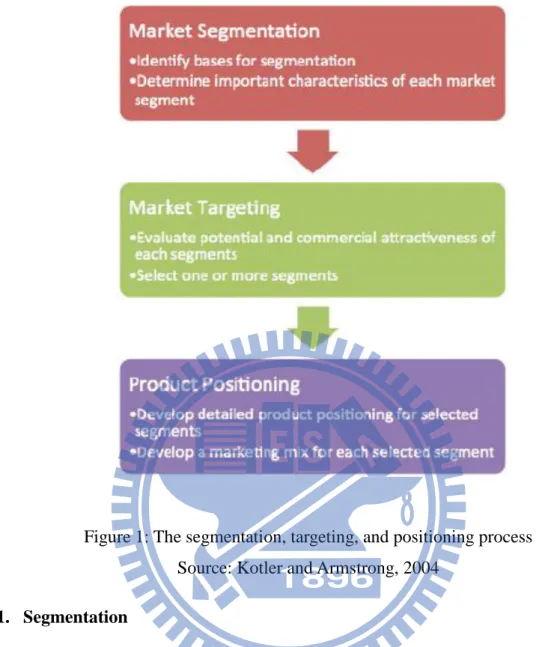
Businesses from all industry sectors use market segmentation in their marketing and strategic planning (Wind, 1978). Market segmentation is, in fact, part of a broader strategic concept in modern marketing that is effected through so-called marketing STP (segmenting, targeting, positioning). As illustrated in Figure 1, each stage of the STP model is a set of actions (Kotler and Armstrong, 2004). Segmentation clusters customers to similar groups by their wants and needs. In targeting, marketers determine one or two groups for their marketing approaches.
Figure 1: The segmentation, targeting, and positioning process Source: Kotler and Armstrong, 2004
1. Segmentation
In the marketing mix strategy, the task of segmentation is choosing one or more market segments in which the firm or company can target (Jobber, 2004). There are three broad groups of consumer segmentation criteria: behavioral, psychographic, and profile variables. A clear choosing segmentation may lead to more satisfied customers while offering practitioners a number of clear benefits including the understand of customer needs, resource allocation, market opportunities and positioned marketing programs (Kotler, 2004).
2. Targeting
The target market is the part of the available market that the company chooses to pursue within the chosen segment (Kotler, 1991). The process of selecting among available segments will frequently revolve around an assessment of the value of the various segments and the
degree of fit with an organization’s marketing activities (Wind, 1978). When selecting a target market segment, there are two important factors need to be considered:
All features and attractiveness of the segment such as size, growth rate, competition, brand loyalty, market shares, sales potential, profit margin, etc.
Suitability of market segments to the firm: resources, capital investment, channels, etc.
3. Positioning
Positioning is a concept in marketing firstly introduced by Jack Trout (1969) and then popularized by him and co-authors. In Kotler’s (2004) definition, positioning is the task of designing a company's offering and image so that they occupy a meaningful and distinct competitive position in the targeted customers' minds. Percy (1993) stated that positioning provides a central link between the brand, its core benefits and the market.
1.4.2 The Marketing Mix (4P’s) strategy
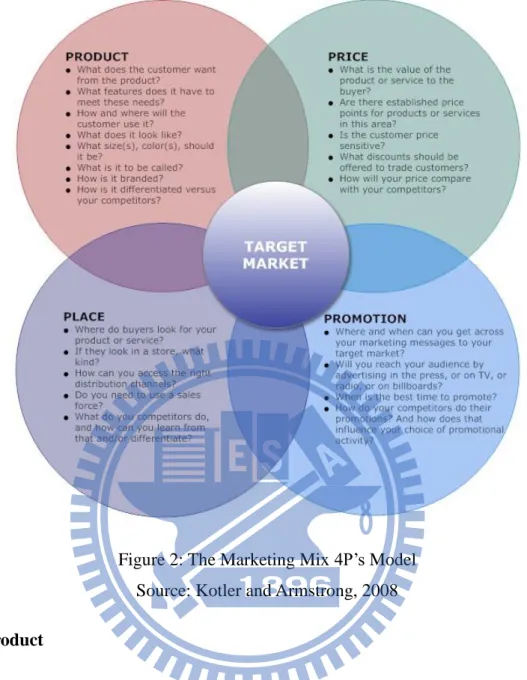
Proctor (2000) suggests that it is important to realize that a marketing mix strategy of any company can have one major function, that is, strategic communication of the organization with its customers. The marketing mix is an imperative concept in modern marketing which composed of four elements as product, price, place, and promotion which shown in figure 2 below:
Figure 2: The Marketing Mix 4P’s Model Source: Kotler and Armstrong, 2008
1. Product
Lazer (1971) argued that product is the most important elements which the company or firm has to consider. Product or service is the linkage between company and customer. A bigger productive capability or service quality can improve the ability in consumer’s relationship. Moreover, product is the first priority to determine and influence other elements of the marketing mix. There are three levels of a product, including the core product offering, the actual product, and the augmented product (Kotler and Armstrong, 2008).
2. Price
Generally, consumer is often sensitive to price discounts and special offers. Price still has an irrational side that is, for some people, expensive must be good. Setting price is a critical issue, not simple at all. In addition, it is related to targeted customers segment and where the
company wants to set product position. Pricing also affects other marketing factors such as product, distribution channels, and promotion schemes.
3. Place
The place element of the marketing mix is defining how and where the product is being sold. It is crucial for a company to meet its overall marketing objectives through efficient and effective distribution. In other words, the company must be able to distribute the product to the customer at the right place, at the right time, and in the right quantity.
Place, under marketing mix, is not only the place where the product is placed, but also involves all activities performed by the company to ensure the availability of the product to the targeted customers (Kotler & Armstrong, 2008). As shown in Figure 2, placement decisions include channels, locations, inventory, transportation, and logistics.
4. Promotion
Promotion includes all communication and selling activities to induce future prospects to buy the product. Kotler and Armstrong (2008) argue that promotion means activities that communicate the merits of the product and persuade target customers to buy it. The best way to understand promotion is through the concept of the marketing communication process.
Promotional strategy comprises all the methods employed through a marketing approach, including the communication mix of advertising, sales promotion, public relations, personal selling, and direct marketing. It represents all of the communications that a company may use in the marketplace. A good promotion strategy can stimulate consumer behavior, which is one of the determinant motivations of consumption.
1.5 Research Framework
This thesis is structured as below:
(1) Chapter I firstly presents the basic concept of glocalization, the objectives and purposes followed by the research methodology. The rest of chapter reviews some previous studies including both general theories and practices in the marketing strategy such as Market Segmentation (STP) and the Marketing Mix (4P’s).
(2) Chapter II illustrates the Vietnamese coffee culture and industry followed by a brief description of Starbucks status in the market. To begin with, the chapter discusses the debut of Starbucks in the Vietnamese market and some early responses. Next, the Vietnamese coffee culture, market characteristics and consumers’ behavior are also presented. Finally, this chapter gives an overview of Starbucks and their penetration into the Vietnamese market in 2013. The current stages of Starbucks in Vietnam with the main coffee competitors are also mentioned.
(3) Chapter III deals with the analysis of the glocalization practices in the marketing strategy of Starbucks in Vietnam. The Market Segmentation (Segmentation, Targeting, and Positioning) strategies and the Marketing Mix (4P’s) will be utilized as analytical tools in order to better understand and evaluate these practices.
(4) Chapter IV shows the basic results of interviews and surveys about customer’s satisfaction collected in Starbuck’s stores in Ho Chi Minh City. These also give Starbucks recommendation for their future development.
(5) Chapter V presents conclusions and suggests further research.
II. The Case Study
2.1 The Debut of Starbucks to Vietnamese Market and Early Responses
Hong Kong Maxim’s group has been an important force behind the growth of Starbucks in Asia. Starbucks leadership stated it “is proud to be partnering with Hong Kong
Maxim’s Group to Enter Vietnam” (Amcham Vietnam, 2013). The first store is scheduled to
open in early February 2013 in Ho Chi Minh City. The move represents an expansion of the long-term relationship between Starbucks and the Hong Kong Maxim’s Group.
Figure 3: The China and Asia Pacific president John Culver, spoke during the opening ceremony in Ho Chi Minh City on Friday, Feb 1, 2013.
Source: Amcham Vietnam, 2013
In the responses to this penetration of the giant, the domestic producers leading by the biggest retailer Trung Nguyen Corp. stated that: “Starbucks doesn’t sell coffee” (Figure. 4). Those companies believe people go for Starbucks just want to show the modern styles which means the tendency may survive in the short-term only. Their targeted customers are the real coffee lovers who prefer enjoying the local strong states (Global Coffee Review, 2013).
Figure 4: The CEO Dang Le Nguyen Vu of the biggest domestic coffee producer Trung Nguyen argued about Starbucks’ debut in Vietnamese market.
Source: Global Coffee Review, 2013
Similarity, some customers who were at the debut in Ho Chi Minh City said they got the interest of the brand, location and design more than the taste of coffee (CNN Travel, 2013). Moreover, in the interviews with few customers in the Chinese New Year 2014, they also preferred to local coffees’ taste for the real enjoy. “Starbucks somehow is a kind of water with sugar and coffee smell. I think local customers in over 25 years old or middle age may not come here for drinking coffee”, said by Ms. Truong Hong Giang-26 years old, DHL staff-one of regular Starbucks’ customers I met during that time.
2.2 The Vietnamese Coffee Culture and Consumers’ Behavior 2.2.1 History of Vietnamese Coffee Culture
Coffee is a globally recognized commodity but because a suitable climate is required for production, it is locally produced in the tropics, such as South East Asia, including Vietnam. Being introduced by French missionaries in the 19th century, between 1865 and 1866, the first
the government established coffee plantations in the Central Highlands, so-called Tay Nguyen. After socio-economic changes by the government in the 1986 “Great Innovation”, small-scale coffee-holder production was stimulated in the small farms. Moreover, rising prices on international markets for coffee have stimulated increases in production of coffee in Vietnam from that moment (The Vietnamese Coffee, 2013).
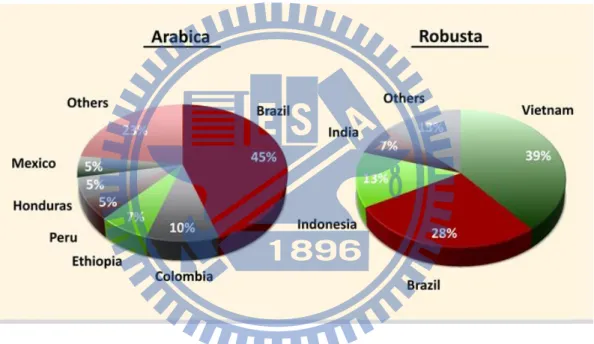
As a consequence of increases in coffee production, the country is now the second largest coffee exporter in the world (Financial Time, 2013). Coffee produced here is mostly Robusta, serving major markets for blending. However, the government currently reports to be encouraging the production of Arabica as a way of adding to the value of the coffee produced (Anthony, 2007).
Figure 5: Arabica and Robusta production of the world in 2011. Source: Vicofa, 2013
The Vietnam Coffee And Cocoa Association (VCACA) was created from previous unofficial association in 1990 under the control of the Ministry of Agriculture to manage the production, export and pricing in the whole country (Vicofa 2013). Domestic consumption of coffee is small compared to what is exported and most coffee-producing companies concentrate on production for export only (The Wall Street Journal, 2013). However, beyond production there is potential for developing the domestic coffee market as seen as the rise of the local Trung Nguyen coffee chain in Vietnam and the surrounding countries. Trung Nguyen Corporation is one of the major players in the Vietnamese coffee business and is fostering the
2.2.2 Special Culture in Making and Drinking Coffee
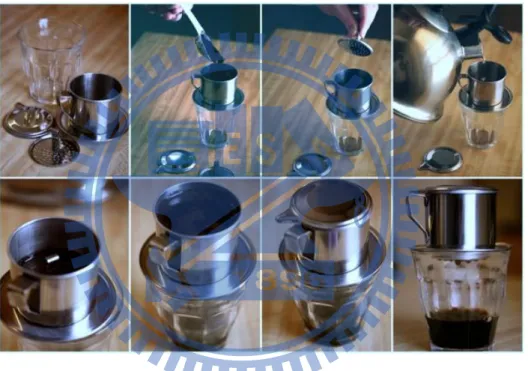
The local coffee lovers often use a tool called “phin” means coffee filter. This is a simple metal strainer composed of a cap, press and chamber. A spoon of coffee powder is filled in the bottom of chamber and pressed down firmly by a press before adding few drops of boiling water. The liquid slowly penetrates through the press, the chamber, and drops into the cup below. Following the sequence, more hot water is added to fully extract the flavor and caffeine from the coffee powder, resulting in a dark black and thick liquid, as shown in figure 6 below. The coffee liquid can be enjoyed in hot or cold by adding some ice cubes, so call Vietnamese iced coffee or “cà phê đá” (The Vietnamese Coffee, 2013).
Figure 6: The common way and tools to make traditional Vietnamese coffee. Source: The Vietnamese Coffee, 2013
Beside the iced coffee, local people also add a few spoons of condensed milk in order to make coffee sweetened or fat. In this case, the condensed milk is added into the bottom of the glass before the coffee powder is placed on top, then drinkers use a spoon to stir the glass to mix the ingredients (Figure 7). This style is called iced coffee with milk, or “cà phê sữa đá”, one of the local favorites, and can be drunk in both hot and cold form (The Vietnamese Coffee, 2013).
Figure 7: Sweetened condensed milk is usually added into the Vietnamese traditional coffee. Source: The Vietnamese Coffee, 2013
In drinking coffee styles, local people prefer the opened environment in which makes the difference with other countries’ styles that would love to enjoy the drinks with air conditioner (Lee, 2010). Depend on the capacity of budget, local drinkers can choose the location in the wide range from street coffee to garden coffee. They can start up a new day by a coffee cup in the morning or getting more energy for their afternoon shift with one more cup in lunch break. Young people also gather with friends and family at night to socialize, chat or even discuss about politics and daily news.
Figure 8. Chatting and relaxing in chaotic street-side cafes is the most common way of Vietnamese people
Source: Lee, 2010
2.2.3 Consumer’s Habit and Behavior
Strong coffee taste and smell: as described above, the traditional coffee is a very thick liquid with high content of caffeine leading to strong taste and smell. Moreover, in some local reports, researchers figure out that the traditional making coffee way may lead to a high content of caffeine which could make drinkers addicted (Ipsos Agribusiness, 2013).
Reason of drinking coffee: Drinking coffee seems to be a habit for local people while chatting, relaxing and having fun time with friends and family. Besides, in some scientific research, the high content of caffeine in the local coffee is one of the top reason for the consistent habit of consumption along with the added benefit of helping people be alert, awake to ready for work (Ipsos Agribusiness, 2013).
Figure 9: Survey results of reasons for drinking coffee of Vietnamese people Source: Ipsos Agribusiness, 2013
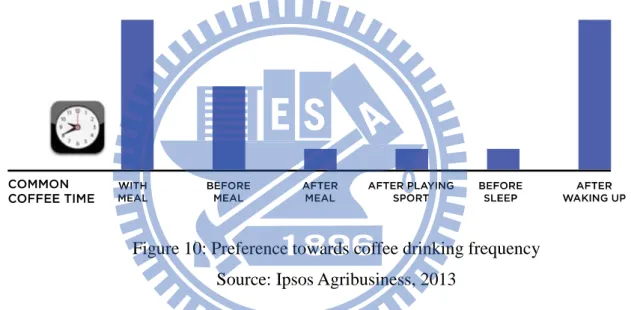
Time: The reasons for coffee consumption seems to fit with time most local people drink coffee; after waking up or before/during meals (Ipsos Agribusiness, 2013).
Figure 10: Preference towards coffee drinking frequency Source: Ipsos Agribusiness, 2013
2.3 Starbucks and the Expansion into Vietnamese Market 2.3.1 Overview of Starbucks
Starbucks is the US top 1 coffee retailer in over the world. It was originally named Pequod and was created by three partners Jerry Baldwin, Zev Siegl, and Gordon Bowker in Washington, 1971. According to Starbucks profile (2014), the current chairman, president and chief executive officer is Howard Schultz who won the “Business Person of the Year” by Fortune Magazine in 2011. Nowadays, Starbucks have connection with millions of customers every day with exceptional products and more than 19,000 retail stores in over 60 countries (UW Business School, 2003).
Figure 11: The distribution of Starbucks’ stores in the world Source: Starbucks profile, 2014
Since its inception, Starbucks has been focusing on the product’s quality and customer satisfaction. The Starbucks’ marketing strategies of “the finest coffee cup” or “the third place” are very popular in both academic research and practices followed by many organization and research institute (UW Business School, 2003). By maintaining this images Starbucks achieved lot of recognition and awards, such as “No. 1 Best Coffee,” in the Fast Food and Quick Refreshment categories by Zagat’s Survey of National Chain Restaurants in 2009‐ 2011; one of the “World’s 50 Most Innovative Companies” in 2012 or one of “The 100 Best Companies to Work For” by Fortune in many years 1998–2000, 2002–2012 (Starbucks Vietnam, 2014).
Figure 12. The growth of Starbucks retail stores, data in 2012 Source: Starbucks, 2012
2.3.2 Starbucks’ Expansion into Vietnamese Market
Naturally, in order to maintain the growth, Starbucks’ senior executives tried to look for the chances to expand internationally. Through Maxim’s Group, a Hong Kong subsidiary, Starbucks signed a license agreement for the Vietnamese market with Vietnam Coffee Concepts Ltd. (Vietnamfranchises, 2013).
The opening ceremony of the first Starbucks store in Vietnam, in Ho Chi Minh City was held on Friday, Feb 1, 2013. Since Vietnamese market is quite crowded, this presented a daunting challenge for the Starbucks team, as this South East Asian country is the world’s second largest coffee producer and there are small coffee shops on every corner in addition to several dozen local franchises.
2.3.3 The Main Competitors
Before Starbucks entered the crowded Vietnamese market, the market leader was the biggest domestic producer Trung Nguyen Corp. which handled approximately a quarter of shares (26.3 %). The second and third top producer was the government corporation Vinacafé and international giant Nestlé with the market shares were 22.8 % and 21.7 %, respectively. Other main business players were Rock Café, MacCoffee, Passiona and Highland Coffee within the market shares less than 10 % (Ipsos Agribusiness, 2013).
Figure 14: Starbucks’ main competitors and market shares
III. Adaption of Starbucks in Vietnam
Will Starbucks success in Vietnam with the big barrier of long history and deep coffee culture? We can only wait and see, but I think Starbucks has a good chance as people in this part of the world tend to gravitate towards American brands whereas in China and other ASEAN countries where they prefer tea, this might not be the case. Vietnamese people already love coffee or even have a strong addiction to coffee. Starbucks just has to sell them on the “coffee experience” that is the reason they can charge so much for a cup of coffee all over the world.
The following subsections will discuss the concept of glocalization in the marketing strategy of Starbucks in Vietnam. As stated in the research methodology, the analytic tools will be (1) STP strategies and (2) the Marketing Mix 4Ps’.
3.1 The Segmentation (STP) strategy 3.1.1 Identify Relevant Segment
Research has shown that most companies take a loss on serving the majority of their customers, while a small number of high-value customers often account for the majority of the profit (Jobber, 2004). Therefore, to segment the market in order to target the customers who bring the higher and more stable profit is very important for the market strategy. The company needs to evaluate the market segments and decide which one to serve in order to target the right segment for growth.
As mentioned in chapter 2, before Starbucks entered into Vietnam, there were many competing brands of coffee retailers already. The most significant players in the Vietnamese market included both domestic and international brands in which Trung Nguyen is the biggest domestic one and Nestle is the largest and the most well-known international conglomerate followed by Rock Café, MacCoffee, Passiona and Highland Coffee. At that time, the foreign brands were unable to beat the major domestic brands in the low-price range because they had less powerful distribution networks and also failed to cater to local people’s tastes and the additional obstacle of the high price of raw materials lead to unreasonable menu prices (The Vietnamese Coffee, 2013).
day or night time, lot of early customers visited the store for the first experience in the most famous international coffee brands even if the price was not really acceptable to all of them (The Wall Street Journal, 2013).
Figure 15: Customers stood in very long lines day and night in front of the first store. Source: Starbucks Vietnam, 2014
Having identified the optimum segmentation, the next task of the marketing strategy is choosing the segments to be targeted (Wind, 1978). Starbucks chose “yuppies”, the well-paid young middle-class professional working a city job and having a luxurious lifestyle (Wikipedia definition), as the main target in the market. These people pay more attention to quality and want to enjoy indulgent lifestyles.
Figure 16: The typical features of a “yuppy” in modern life. Source: Google
3.1.3 Develop Positioning Strategy
According to the analysis in the subsections above, and the images that Starbucks has been building in all stores over the world, the key to Starbucks’ success seems to be its positioning strategy as a luxury brand. This positioning strategy has been attracting yuppies to its stores by giving them the satisfaction of having a “higher status” and more “modern” lifestyle than others who do not drink Starbucks. That explains why there were so many young people who came to the Starbucks’ debut and it also explains why they were more focused on taking beautiful pictures with any thing related to the Starbucks’ logo rather than trying the taste of drinks.
Figure 17: Once entering Starbucks’ store, taking pictures with logo or cup is the first priority of these young Vietnamese “yuppies”
Source: Google
3.2 The Marketing Mix (4Ps) 3.2.1 Product
In the marketing strategy of product, the adaptation is critically needed for the difference in local tastes and customs (Kotler and Armstrong, 2008). Therefore, Starbucks also needed to adjust its menu to Vietnamese traditional tastes to satisfy the local customers’ many needs and demands.
Focusing on this, Starbucks not only kept its famous “standby” flavors such as Frappuccino or Espresso beverages, but also brought in new flavors to adapt to the local people; they began to serve “cà phê sữa đá”, the local variation of iced coffee with sweetened condensed milk.
Figure 18: Starbucks’ original flavors and new flavors to adapt the local tastes Source: Google
Starbucks included on its menu the usual bakery items like muffins, cakes and blended-frozen coffee drinks which were first introduced to Vietnamese customers by Highland Coffee. In addition, it also associated the brand with special significant holidays, such as Valentine Day, Woman’s Day, Mid-Autumn Festival and Christmas. It treats these special occasions as good opportunities to promote the product. For example, Starbucks latched on to the traditional Mid-Autumn Festival which is very important to Vietnamese people and used it for a marketing opportunity. On this particular Asian holiday, usually the family members will gather together and share moon cakes on that day. Starbucks’ moon cake, a unique and premium gift, has become the preferred choice in this occasion.
3.2.2 Price
Setting the price of a product is not a simple task at all (Rossiter & Percy, 1997). It requires the company to do careful strategic planning. Decisions need to be made about what a company wants to achieve. Premium pricing is often used for products with a perceived high status. Customers have an expectation of premium quality on high-priced products, which are assumed to have greater worth than their actual monetary value. Making the most of high pricing is a practice intended to exploit the inclination for consumers to assume that expensive items represent exceptional quality and thus to create the aspiration to own.
A high price can spur more interest among affluent people (Kotler, 1991). Following this rule prestige pricing, Starbucks has been using the premium price to attract the targeted consumers. Starbucks understood that customers would prefer to buy a premium priced product
markets, Starbucks believed the premium price can be a beautiful jewelry to show the success and status of buyer. These are quite true for the Vietnamese culture which has been deeply influenced by China over its long history.
Regularly, a traditional black or milk coffee cup costs in the range of 10,000 - 30,000 VNĐ (Vietnamese currency), equal to $0.5 - $1.5 (Vietnamfranchises, 2013), depending on the location is inside a café with air conditioner or outside a garden café or street café. How about Starbucks’ price? On average, a basic coffee cup of Starbucks in Vietnam may cost in the range of 90,000 - 150,000 VNĐ, equal to $4.5 - $7.5 that is approximately 6 times higher than the local price. Comparing with Starbucks’ prices in global, the one in Vietnamese market is in the similar range of very top developed countries such as Russia or Switzerland (Figure 18).
Figure 19: The price of a basic cup of Starbucks coffee in different countries Source: Wall Street Journal, 2013
One of the earliest customers in the debut, Truong Hong Giang who was mentioned in the previous chapter said: "I often come here 4-5 times per week to meet my clients thanks to the
customer Ho Diem Xuyen, a student in her fourth years of college, who regularly visits once a week also states: “I often choose green tea smoothie or other drinks, rather than coffee but I
think the price here is too high, that why I often visit Starbucks once a week only”. Those quotes
imply that Starbucks’ pricing may need to be reviewed to adapt to the local income structure. This will be discussed in detail in the next chapter.
3.2.3 Place
Under the Marketing mix, place not only is where the product is placed, but also is how all those business activities can be structured to ensure the availability of the product to the targeted customers (Kotler & Armstrong, 2004). In the study of supply chain dynamics, it includes channels, locations, inventory, transportation, and logistics. The place or placement is where the company is able to distribute the product to the customer at the right time and in the right quantity (Trout, 1969).
As other chains all over the world, Starbucks has its own standard when choosing a place to open a new store. Unlike the Vietnamese traditional coffee shops, Starbucks stores are located in premium and primary spots in the busy city areas that are populated by other luxury brands. Prime streets or malls where young adults tend to hang out or socialize are its priority for a new store in the network. The first Starbucks store was located in the most beautiful and premium place in District 1, Ho Chi Minh City where foreigners and oversea Vietnamese often frequent or work in the big buildings surrounding the shopping mall and trade center. The subsequent stores of its chain in Ho Chi Minh City are also located in similar locations with the most traffic and people from this demographic.
Figure 20: The first store is at the best location for business in Ho Chi Minh City Source: Google
3.2.4 Promotion
Unlike the above three elements of the marketing mix, promotion is not really focused much on strategy. It is not because Starbucks disregards it. The reason is that its brand name was already familiar having been shared profusely by customers via social networks and online communication apps such as Facebook, Line or Viber. When the brand was strengthened, it does not need to continuously advertise any more. By focusing on building the images as a luxury brand, the company can gain free publicity at the same time. Before February 2013, local people may just talk about Highland Coffee or the special frozen coffee of Coffee Bean and Tea Leaf. However, after the opening of the first Starbuck’s store, the images of Starbucks can be seen and the Starbucks’ name can be heard anywhere and at any time.
3.3 Is Starbucks Successful in the Marketing Strategy?
As briefly discussed in the previous sections, it is hard to answer questions with regard to marketing strategy as Starbucks is even still in the process of building the brand in this unique coffee culture. Time will give us the answer but maybe not in the near future.
Constructing images of luxury brands always takes longer as it involves time to educate customers and fain recognition from the public. However, based on the observable efforts of the Starbucks team so far, it appears that they have been successful at temporary sidestepping the traditional US image of being a premium brand to position itself as the deliverer of a uniquely luxurious culinary experience in the mind of Vietnamese consumers. The following section will summarize successful adaptation practices for glocalization in its marketing strategy.
(1) The success of building subsequent stores of its chain in Ho Chi Minh City
When the initial ideas of this thesis began at the end of the year 2013, only 3 Starbucks stores were located in Ho Chi Minh City and there was a rumor of its failure in this challenge market (The Vietnamese Coffee, 2013). However, Starbucks successfully introduced the 8th store at Pandora City shopping mall on July 5th 2014 (Starbucks Vietnam, 2014) which the CEO Howard Schultz ever mentioned in his interview in the debut at the first store in Feb 2013.
Figure 21: The 8th Starbucks store in Pandora City shopping mall Source: Google
Moreover, Starbucks is planning to move its chain to the capital Hanoi. In stead of building stores one by one as in Ho Chi Minh City, it may introduce a series of subsequent simultaneously stores in the capital city in a big event which well be held on July 19th
Starbucks fans in the Facebook page of Starbucks in Vietnam (https://www.facebook.com/starbucksvietnam).
(2) Innovative products with images of intimacy and fancy creations
To maintain the brand’s affinity, one of the most effective ways of promoting products is to objectively observe the living circumstances of customers in close proximity. In this respect, Starbucks observed Vietnamese culture, consumer trends and their seasonal demands to create blockbuster products. Since the debut in 2013, Starbucks has continued to engage in the launching of new products and fancy creations with specialty Vietnamese flavors to increase brand shares, such as café sữa đá.
Starbucks also caters to Vietnamese customs, and adds the connotations of happiness and blessing in traditional festivals. For example, aiming at the gift market of the Mid-Autumn Festival, Starbucks created its own special moon cake, available for 500,000 ($25) per set of 4 pieces (Starbucks Vietnam, 2014). Though the price is relatively high, its unique combination of great-taste and chic appearance has been a great match and immediately became a hot seller in Vietnam.
Figure 22: Starbucks’ moon cake Source: Google
Customer experience is a key factor for companies to use in building loyalty to brands, channels, and services. An increasing number of companies are aware of the importance of their customers, and they realize that their growth and profitability are being determined by the ability to retain customers and to recruit new ones.
Starbucks stores provide consumers with the ultimate shopping experience through a focus on sophisticated design, relaxing ambiance, and innovative product offerings. It helps Starbucks continuously cater to its niche segment of the affluent that are willing to pay the extra premium for this high grade of service. In Vietnam, a competitive global market, understanding, creating, and enhancing a superior customer experiences seem to be the central objectives for these kinds of companies.
Figure 23: Design, decoration, ambiance and innovative products bring customers to Starbucks, not only coffee
IV. Surveys and Interviews
4.1 Purposes and Methodology
As described in Research Methodology part of Chapter 1, beside the analytic tools, I also used surveys and interviews for customers’ satisfaction levels as additional evidence to evaluate the current status of Starbucks. Due to the time limit of my vacation in the Chinese New Year 2014 in Vietnam, I randomly chose the available customers who were in Ho Chi Minh’s stores on two Sundays, January 26th
and February 9th, corresponding to the period before and after New Year.
In order to get more responses from customers, the surveys were designed in brief with reasonable contents in total of ten questions. The first two questions asked customers about the frequency and reasons of choosing Starbucks. The next six ones evaluated the satisfaction in the term of coffee quality (taste), other drinks and food, location and decoration, service quality, innovative products and promotion and price. Then the last two questions invited customers to suggest the price of a basic coffee cup for Starbucks to adjust, together with the customers’ average income/expense to help Starbucks figure out the customer segment. The content of ten questions are listed below:
(1) How often do you come to Starbucks? (2) Why (did) do you choose Starbucks?
(3) How is your satisfaction of Starbucks’ coffee?
(4) How is your satisfaction of other Starbucks’ drinks and food? (5) How is your satisfaction of Starbucks’ location and decoration? (6) How is your satisfaction of Starbucks’ service quality?
(7) How is your satisfaction of Starbucks’ innovative products and promotion? (8) How is your satisfaction of Starbucks’ price?
(10) How much is your monthly income (or expense)?
The detail of surveys in both Vietnamese and English are attached in the Appendix part in the end of thesis.
4.2 Summary of responses
After two Sundays working on distributing and collecting surveys, I generally got in total of 68 responses from approximately three hundred available customers in the first store and third store in Ho Chi Minh City.
For the first question about the frequency in Chart 1, there is 53% responses for 2-5 times of monthly visit who are considered as regular customers. The most surprised observation is 43% of responses said that they just came to Starbucks on that day which means there were more and more new customers continuing join to Starbucks community. The rest of 3% of responses could be Starbucks’ fans or so-called Starbucks addicts.
Chart 1: Starbucks’ visit frequency-customers’ responses.
For the second issue of reason choosing Starbucks, I compared the responses with Starbucks’ global marketing strategies in term of brand, place, service, innovation and promotion, community & partnership (UW Business School, 2003). The details are listed as below:
• Innovation (13%)
• Perfect Cup of Coffee (10%) • Customer Satisfaction (10%)
• Starbucks Community & Partnership (9%)
From the results shown in Chart 2, the three most preferred reasons of choosing Starbucks is brand (37%), place (21%) and innovation and promotion (13%). The highest percentage in brand explained why 43% of new customers (as shown in Chart 1) still come to Starbucks stores for a try of the No. 1 global coffee retailer.
Chart 2: Reasons of choosing Starbucks-customers’ responses.
The responses of the following six questions were summarized in Table 1 with the increase of satisfaction level from strongly disagree to strongly agree. Corresponding to analysis in Chapter 3 and responses of the first two questions, Starbucks seem to do well in their marketing strategies of location (81% agree), service (64%) and innovation and promotion (27%). Conversely, customers may not come to stores for coffee quality or food which was shown in only 35% and 29% of responses satisfied the coffee and food quality. The most critical finding here is the pricing strategy that got too much unsatisfied level of 75%. This issue may need to be adjusted or considered more in development plan when Starbucks expend the network to Ha Noi City or the whole of Vietnam.
Table 1: Satisfaction levels in term of coffee quality, other drinks and food, location and decoration, service quality, innovation and promotion, and price-customers’ responses.
In order to give Starbucks feedbacks for further expansion in Vietnam, the last two questions not only figure out the customer segment by average income/expense but also suggest the price of a basic cup which is more reasonable with the local incomes. As shown in Chart 3, 48% and 30% responses would love the price in the range of 1.25-2.5 $ and 2.5-3.75 $, respectively. This suggested price is somehow comparable with Starbucks price in Taiwan and other South East Asian countries such as Singapore and Malaysia.
Chart 3: Suggested price of a basic coffee cup-customers’ responses.
The detail of summary are recorded in an excel file and attached in the Appendix part in the end of thesis.
V. Conclusions and Recommendations
5.1 Conclusions
Vietnam, with its dynamic economic growth and increasing number of those with disposable incomes as an emerging market, provides a great opportunity for international brands. This study has showed that Starbucks, with the flexibility and adaptation to the Vietnamese coffee culture, generated perpetual profits and maintained its competition in the global world.
Since the debut in Feb 2013, Starbucks has won large numbers of customers, and has been regarded as a premium coffee brand. The observations from both analytic tools in Chapter 3 and surveys and interviews in Chapter 4 showed that Starbucks somehow is doing well in their own marketing strategies in the term of brand, location, innovation and service quality. With successful adaption in this, it has become the symbol of high-quality and modern life.
However, with the expansion of network to the whole Vietnam in the near future, Starbucks may need to consider about pricing issue which is highly recommended to reduced by most of customers. Keeping a balance consideration between global strategies and marketing activities in local, Starbucks will achieve local customers while maintaining its own uniform culture.
5.2 Recommendations
The Marketing Segmentation Strategies and the Marketing Mix were employed as an analysis method in this research. The overall model of this framework is internally consistent and well-structured, converting strategies and implementations into a tightly-linked, step-by-step execution. Consequently, whenever facing a glocalization process issue, this framework could provide a systematic marketing philosophy for a global company. Further, future studies requiring an effective methodology would do well to apply the technique from this study to examine glocalization. Finally, Starbucks’ success could be a good example and potential model for other foreign retailers such as McDonald’s, who are planning to penetrate the Vietnamese market in the near future.
References
(1) Amcham, V., “Starbucks to open its 1st Vietnam cafe in Ho Chi Minh City in February”, Amcham Vietnam, 2013.
(2) An, N. T., “Living history Vietnamese Coffee”, Vicofa, 2013.
(3) Anthony, M., Diversification by smallholder farmers: Viet Nam Robusta Coffee, Agriculture Management, 2007.
(4) Dahringer, L.D., Muhlobacher, H., International Marketing: A Global Perspective, MA: Addison-Wesley, 1991.
(5) Dibb, S. et al, Marketing: Concepts and Strategies, (5th ed.), Houghton Mifflin, 2005. (6) Doyle, P., “Value-based marketing”, Journal of Strategic Marketing, 8(4), pp. 299-311,
December 2000.
(7) Foglio, A., Stanevicius, V., “Scenario of glocal marketing as an answer to the market globalization and localization. Part I: Strategy scenario and market”, Vadyba Management, 1(10), pp. 26-38, 2006.
(8) Hiam, A., Schewe, C.D., Segmentation, targeting, positioning: the portable MBA in Marketing, New York: John Wiley & Sons, pp. 203-234, 1992.
(9) Hooley, G., Positioning in Marketing Theory, London, Thomson Learning, pp. 181-205, 2000.
(10) Ingleby, J., Globalisation, glocalisation and mission, Transformation, 23(1), pp. 49–53, 2006.
(11) James, D., “Strategy: local Coke”, Business Review Weekly, September 2001. (12) James, H., “Starbucks Brings Its Culture to Vietnam”, The Wall Street Journal,
2013.
(13) Jobber, D., Principles and Practices of Marketing, (10th ed.), McGraw Hill UK, 2004.
(14) Keegan, W.J., Global Marketing Management, New Jersy: Prentice-Hall, 1989. (15) Khondker, H.H., “Glocalization as globalization: Evolution of a sociological
concept”, Bangladesh e-Journal of Sociology, 1(2), pp. 1-9, 2004.
(16) Kotler, P., Armstrong, G., Principles of Marketing, (10th ed.), New Jersey: Pearson, 2004.
(17) Kotler, P., Marketing Management: Understanding the critical role of marketing in organizations and society, (7th ed.), New Jersey: Prentice-Hall, 1991.
(18) Kotler, P., “Atmospherics as a marketing tool”, Journal of Retailing, 49(4), pp. 48-64, 1973.
(19) Kotler, P. et al, Marketing for Hospitality and Tourism, (4th ed.), New Jersey: Pearson International, 2006.
(20) Kraidy, M. M., “Hybridity in cultural globalization”, Communication Theory, pp. 316–339, 2002
(21) Kraidy, M.M., From imperialism to glocalization: A theoretical framework for the information age, Westport, CT: Cyberimperialism Praeger Publishers, 2001.
(22) Lazer, W., Marketing Management: A Systems Perspective, New York: John Wiley & Sons., 1971.
(23) Lee, J, Coffee Culture, Destinations and Tourism, Business & Economic, 2010. (24) Levitt, T., The globalization of markets. Harvard Business Review, pp. 2-20, 1983. (25) McDonald, M., Dunbar, I., Market Segmentation, Basingstoke: Macmillan Press
Ltd, 1995.
(26) Piercy, N.F., Morgan, N.A., “Strategic and operational market segmentation: a managerial analysis”, Journal of Strategic Marketing, 1, pp. 123–140, 1993.
(27) Porter, M.E., Competitive Advantage, New York: Free Press, 1985.
(29) Reynolds, T.J., Gutman, J., “Laddering theory, method, analysis, and interpretation”, Journal of Advertising Research, February/March, pp. 11-31, 1998.
(30) Ries, A., Trout, J., Positioning, The battle for your mind, New York: McGraw-Hill, 1981.
(31) Robertson, R., “Globalisation or glocalisation?”, Journal of International Communication, 1(1), pp. 33–52, 1994.
(32) Robertson, R., Glocalization: Time-space and homogeneity-heterogeneity, (M. Featherstone, S. Lash & R. Robertson), Global Modernities, London: Sale, pp. 524-552, 1995.
(33) Robertson, R., Glocalization, (R. Robertson, J. A. Scholte), Encyclopedia of Globalization, New York: Routledge, pp.524-552, 2007.
(34) Robertson. R., “Comments on the global triad and glocalization”, Globalization and Indigenous Culture Conference, Kokugakuin University, Tokyo, 1997.
(35) Rossiter, J., Percy, L., Advertising Communications and Promotion Management, Boston: Mc Graw-Hill, 1997.
(36) Saunders, M.N.K. et al, Research methods for business students, (2nd ed), Harlow: Financial Times, 2000.
(37) Sean, T. N., “Starbucks coming to Vietnam”, Vietnamfranchises, January 2013. (38) Shamsuddoha, M., Globalization to glocalization: A conceptual analysis, University
of Chittagong, December 2008.
(39) Starbucks Vietnam, “Starbucks company profile”, 2014.
(40) Svensson, G., “Beyond global marketing and the globalization of marketing activities”, Management Decision, 40(6), pp. 574 – 583, 2002.
(41) Suresh K., “Starbucks Corporation: Competing in a Global Market”, UW Business, April 2003.
(43) Tam, T. T., “Indochina coffee explorer”, The Vietnamese Coffee, 2013.
(44) Tiplady, R., World of Difference: global mission at the pic’n’mix counter, Paternoster Press, September 2003.
(45) Trout, J., “"Positioning" is a game people play in today’s me-too market place”, Industrial Marketing, 54(6), pp. 51–55, 1969.
(46) Turner, B. S., “McDonaldization: Linearity and Liquidity in Consumer Cultures”, American Behavioral Scientist, 47, pp. 137-153, 2003.
(47) Wind, Y., “Issues and advances in segmentation research”, Journal of Marketing Research, 15(3), pp. 317–337, 1978.
(48) Yan, W., “Starbucks boldly debuts in coffee-mad Vietnam”, Financial Time, January 2013.
(49) Yin, R.K., Case Study Research: Design and Methods, (3rd ed.), London: Sage Publications, Inc., 2002.
Appendix
Khảo sát về mức độ hài lòng của khách hàng với
Starbucks Việt Nam
10 câu hỏi ngắn đánh giá mức độ hài lòng cơ bản của khách hàng đối với Starbucks ở Việt Nam, các anh chị và các bạn vui lòng bớt chút thời gian, chỉ với 1 phút thôi, để giúp Ngọc làm khảo sát nhỏ cho báo cáo luận văn thứ 5 tuần sau nha (31/7/2014). Cảm ơn mọi người rất nhiều :)
1. Trung bình bạn đến cà phê Starbucks bao nhiêu lần mỗi tháng? Nếu chưa đến bao giờ thì cứ chọn 0 nhé.
How often do you go to Starbucks?
1 2-5 6-10 11-20 Trên 20 lần
2. Lý do chính bạn đến Starbucks? Hoặc bạn sẽ đến Starbucks vì lý do nào? (Có thể chọn nhiều option khác nhau)
Why did (do) you choose Starbucks?
Cà phê Starbucks ngon-delicious coffee
Các thức uống khác và thức ăn ngon-other delicious drinks and food
Địa điểm và trang trí đẹp, wifi miễn phí và không gian thoải mái-good location, nice decoration and atmosphere
Phục vụ chu đáo tận tình-quality of service
Nhiều thức uống mới, khuyến mãi sáng tạo-innovation products and promotion Đơn giản là vì đó là thương hiệu Starbucks-because it is Starbucks
Starbucks mang đến đẳng cấp cho mình (hoặc đến để bằng bạn bằng bè)-higher status, modern and stylish
Other:
3. Mức độ hài lòng về chất lượng cà phê ở Starbucks?
How is your satisfaction of Starbucks' coffee?
Rất không hài lòng-strongly disagree Không hài lòng-disagree
Bình thường-normal Hài lòng-agree
Rất hài lòng-strongly agree
4. Mức độ hài lòng về các thức uống và sản phẩm khác ở Starbucks?
How is your satisfaction of other Starbucks' drink and food?
Rất không hài lòng Không hài lòng Bình thường Hài lòng Rất hài lòng
Rất không hài lòng Không hài lòng Bình thường Hài lòng Rất hài lòng
6. Mức độ hài lòng về phong cách phục vụ ở Starbucks?
How is your satisfaction of Starbucks' service quality?
Rất không hài lòng Không hài lòng Bình thường Hài lòng Rất hài lòng
7. Mức độ hài lòng về những sản phẩm mới (ví dụ cà phê sữa đá phong cách Việt Nam hoặc bánh trung thu) và khuyến mãi ở Starbucks?
How is your satisfaction of Starbucks' innovation products and promotion?
Rất không hài lòng Không hài lòng Bình thường Hài lòng Rất hài lòng
8. Mức độ hài lòng về giá cả ở Starbucks?
How about your satisfaction of Starbucks' price?
Rất đắt Đắt
Bình thường Hài lòng Rất hài lòng
9. Theo bạn, giá một ly Starbucks trung bình khoảng bao nhiêu là hợp lí? (Hiện tại giá 1 ly cà phê rẻ nhất ở đấy là khoảng 80.000 VNĐ)
How much do you suggest the price of a basic coffee cup of Starbucks?
Ít hơn 25.000 VNĐ 25.000-50.000 VNĐ 50.000-75.000 VNĐ 75.000-100.000 VNĐ Trên 100.000 VNĐ
10. Vui lòng cho biết thu nhập bình quân (hoặc chi tiêu bình quân) mỗi tháng của ban
How much your monthly income (or expense)?
Ít hơn 5.000.000 VNĐ 5.000.000-10.000.000 VND 10.000.000-20.000.000 VND 20.000.000-25.000.000 VND