國 立 交 通 大 學
電控工程研究所
碩士論文
實體化遊戲互動介面之協同設計
Towards the Design of Coordinated Tangible Devices
研 究 生:吳思穎
Student: Shih-Ying Wu
指導教授:黃育綸 博士
Advisor: Dr. Yu-Lun Huang
中華民國九十九年七月
實體化遊戲互動介面之協同設計
Towards the Design of Coordinated Tangible Devices
研 究 生:吳思穎 Student: Shih-Ying Wu 指導教授:黃育綸 博士 Advisor: Dr. Yu-Lun Huang
國 立 交 通 大 學 電控工程研究所
碩士論文
A Thesis
Submitted to Institute of Electrical Control Engineering
College of Electrical Engineering
National Chiao Tung University
in partial Fulfill of the Requirements
for the Degree of
Master
in
Institute of Electrical Control Engineering
July, 2010
Hsinchu, Taiwan, Republic of China
實體化遊戲互動介面之協同設計
學生:吳思穎
指導教授:黃育綸 博士
國 立 交 通 大 學電控工程研究所碩士班
摘
要
圖形化使用者介面(Graphical User Interface, GUI)讓人們可以透過滑鼠來與數位資訊 互動,而不需要記憶特殊的控制指令。然而,這樣的操作方式與一般人們的生活方式 並不相同。因此使用者介面(Tangible User Interface, TUI)的概念因應而生。透過緊 密結合的實體物體與數位資訊,提供一個更為友善的互動方式:使用者能以更簡單及 更直覺的方式來完成他們想做的事情。 本論文延伸實體使用者介面的概念,為多實體裝置的協同動作建立一個系統架 構。我們將這套架構應用在一般的網路麻將上,開發出一套新玩法的網路麻將。透過 系統的協同機制,使用者所有的遊戲操作都與一般現實生活中一樣,無需再學習新的 操作方法,也能透過系統與遠端的其他玩家一同進行遊戲。
Towards the Design of Coordinated Tangible Devices
Student: Shih-Ying Wu
Advisor: Dr. Yu-Lun Huang
Institute of Electrical Control Engineering
National Chiao Tung University
Abstract
Computer-Human interaction studies the interaction between a user and a computer. The
traditional computer-human interaction solutions, including the command line interface (CLI)
and graphical user interface (GUI), provide user interaction with a computer through a
keyboard or a mouse. However, such interfaces are non-intuitive since the manipulation may
be inconsistent with human daily life. In recent years, a new user interaction using tangible
user interface (TUI) was proposed to solve the above inconsistence. The goal of TUI is to
augment the real physical world by seamlessly coupling digital information to physical objects
and environments, and provide a better user-friendly interface. In this paper, we adopt the
concept of TUI and design a model to cooperate multiple tangible devices for a networked
game. In our implementation, multiple tangible devices are installed at the client sides, which
is then divided into two parts: a worker and a messenger. The worker thread deals with the rule
of game, while the messenger helps to map the relationships between a virtual identity and a
physical tangible devices. We ultimately implement the proposed model with a networked
mahjong game (QKMJ). With our implementation, players can play the game easily and
誌謝
本論文能順利完成,首先要感謝我的指導老師,黃育綸博士,在這兩年中認真和 耐心地教導我,培養我正確的研究方法,尤其是在任何事情的完整性、邏輯性等,讓 我受益匪淺。此外,老師更在硬體設備方面鼎力襄助,採購許多實作上所必要的硬 體,讓我能安心地完成這篇論文及實作。 再來要感謝蔡欣宜學姊,在碩二與學姊同寢期間,不論是生活、論文研究及寫作 各方面都受到學姊的照顧和幫忙。還要感謝陳柏廷學長的提點,讓我能以更流暢的方 式完成我的論文。還有宛真、雅萱、虹君、廷芳、佳旻,從大學時期就讓我擁有許多 美好回憶。當然還有RTES的大家,創造出輕鬆的研究環境,讓我在作實作與寫論文之 外,亦添增了許多歡樂。此外要特別感謝晉澤,協助我一一修正口試報告的不足之 處,讓我能順利完成口試,在我面臨低潮時給予我支持及鼓勵,陪我走過人生的重要 關卡。最後,感謝家人及朋友們的支持,讓我的求學生涯一路順遂,並期許自己在將 來能更加精進。Contents
摘要 i Abstract ii 誌謝 iii Table of Contents iv List of Figures viList of Tables vii
Chapter 1 Introduction 1
1.1 Computer-Human Interfaces . . . 1
1.1.1 CLI . . . 1
1.1.2 GUI . . . 2
1.1.3 TUI . . . 3
1.2 Existing Tangible Games . . . 3
1.3 Motivation . . . 4
Chapter 2 Releted Work 5 2.1 Wii . . . 5
2.2 Emotion Teaser . . . 6
2.3 Siftable . . . 6
Chapter 3 Coordinating Model 8 3.1 System Architecture . . . 8
3.3 System Sequence Flow . . . 12
Chapter 4 Mahjong Game 14 4.1 Preliminaries . . . 14 4.1.1 Game Terminology . . . 14 4.1.2 Game Rules . . . 17 4.2 QKMJ . . . 19 Chapter 5 Prototype 21 5.1 Hardware . . . 21 5.2 Sofeware . . . 24 Chapter 6 Conclusion 36 References 37
List of Figures
1.1 traditional peripheral . . . 2
3.1 Traditional Model v.s Proposed Model . . . 9
3.2 The Detail Schematic Diagram of a Client . . . 10
3.3 The transmitting flow between worker and tangible devices . . . 13
4.1 MJ game board . . . 15
4.2 MJ tiles . . . 15
4.3 MJ Melds . . . 16
4.4 Preliminary of QKMJ . . . 20
5.1 Tangible Device (Mahjong Tile) - Combination of MSP-EXP430F5438 and CC2500. . . 22
5.2 Axes of Acceleration Sensitivity . . . 23
5.3 Output Response vs. Orientation to Gravity . . . 23
5.4 Judge Mechanism - Normal Mode . . . 26
5.5 Judge Mechanism - Bid Mode : Basic Processing Logic Schema . . . 27
5.6 Judge Mechanism - Bid Mode : Convergence by Valid MessagesWhen this . 30 5.7 Inconsistency of Ordering . . . 34
List of Tables
4.1 MJ terms . . . 17
5.1 TMJ Notation . . . 28
5.2 Valid Messages for Judge Mechanism in Bid Mode . . . 28
5.3 State Definition of Tangible Tile . . . 32
5.4 Action Definition of Tangible Tile . . . 33
Chapter 1
Introduction
This chapter introduces the design of computer-human interfaces for networked games.
We also discuss the existing games using tangible devices that offer a more friendly interface
to users interacting with a computer.
1.1
Computer-Human Interfaces
The Computer-Human interface (CHI) is the system that provides users with interaction
between humans and computers. CHI is composed of several input devices supplying the users
to operate the computer and output peripherals supplying the computer to show the results.
The interaction model of CHI is composed of a series of request-response transactions. These
transactions can be realized by different types of requests and responses, which contributes
different types of CHI.
The following are the most common of several types of public, including Command-Line
User Interface (CLI), Graphical User Interface(GUI). Then, we take a brief description of
Tangible User Interface(TUI).
1.1.1
CLI
The Command-Line Interface (CLI) is a mechanism supporting interaction between a user
Figure 1.1: traditional peripheral
(CLIs) have been widely deployed to a variety of applications. With such an interface, textual
commands with special vocabularies typed from a keyboard are sent to the computing unit.
These textual commands are treated as requests from a user. Similarly, textual responses are
printed on the screen to tell the users the computational results, in response to the requests.
1.1.2
GUI
By leveraging the advantages of graphic technologies, the Graphical User Interface (GUI)
is used to provide a more user-friendly interface when interacting with a computer [1, 2]. The
first generation of GUI was set by Xerox Star workstation in 1981 [3]. The Xerox Start
workstation introduced the first GUI operating system. Windows, Icons, Menus and Pointing
device (also known as WIMP interfaces [4]) are used to support commands to open and delete
a file. People interacts with the computers through GUI near 30 years. The expression of a
GUI request is more friendly than that of CLI. In addition to a keyboard, a mouse is adopted as
one of the input devices when adopting GUI as the computer-human interface. With the
comprehensive input devices, users can directly operate their computer without special
commands. When applying GUI, the response of an application can be either graphical or
1.1.3
TUI
Figure 1.1 shows the traditional peripherals we used to interact with a computer. The
traditional input devices include a keyboard and a mouse while a monitor is used as an output
device. Such a design has relatively remained unchanged for the past 40 years. However, such
a design is non-intuitive since a user has to learn another input method, inconsistent with
human daily life, to interact with his computer.
In 1997, Hiroshi Ishii and Brygg Ullmer proposed an interactive conception named
Tangible User Interfaces (TUIs) as a new type of CHI [5]. The goal of TUI is to augment the
real physical world by seamlessly coupling digital information to everyday physical objects
and environments to narrow the gap between virtual world and reality . That is to say the input
devices are no longer limited to keyboard or mouse, and the output device is not just monitor.
With such an interface, users can easily and intuitively manipulate what they want to do.
1.2
Existing Tangible Games
In recent years, there have been numerous papers to discuss tangible user interfaces from a
variety of perspectives after tangible user interface published in 1997 [5, 6]. In 2006, Nintendo
Wii [7] has published with its action-detecting controller, Wii Remote. This is an innovative
device to replace traditional input peripherals, but keeping a monitor as its output peripheral.
For intuitive operation, in 2007, Chia Han Tsai proposed an Emotion Teaser [8] composed of a
LED panel as a output device and a mercury switch as a input device. However, thid device is
just designed for a special game. In 2009, David Merrill proposed Siftable[9] with firmware
1.3
Motivation
In this paper, we propose a model cooperating multiple active tangible devices for a
networked game. In our design, multiple tangible devices are installed at the client sides to
support tangible user interfaces. Then, we revise the client sides to deal with the changes of
extrinsic multiple tangible devices. We ultimately realize the proposed model with the
implementation of a network mahjong game, QKMJ.
The remainder of this paper is organized as follows. Section 2 introduces the existing
researches supporting tangible user interface. Section 3 describes the background of our
implementation. Section 4 presents the proposed model and Section 5 discusses the our
Chapter 2
Releted Work
There have been numerous papers to discuss tangible user interfaces from a variety of
perspective [10, 11, 12] after tangible user interface published in 1997 [5, 6]. Among
numerous tangible user interface applications, we introduce some of them in the following:
Wii, Emotion Teaser, and Siftables.
2.1
Wii
In 2006, Nintendo [13] introducted a new game concept which involved focusing on a
new form of user interaction to community. That is the well-known home video game console,
wii [7].
The particular feature of wii is the operational method of its wireless controller, wii
remote. This is an innovative device to replace traditional input peripherals [14]. The user can
use wii remote as a handheld pointing device and the movement of this user on wii remote can
be detected in three dimensions.
The principle of movement-detecting work is a combination of built-in accelerometers and
infrared detection. This infrastructure can used to detect the action and sense position of wii
remote in 3D space. With this infrastructure, a user can control the game instinctively.
The data transmission between wii and wii remote applies Bluetooth wireless
communicate with seven decives, and now, wii can support at most four wii remote at the same
time .
2.2
Emotion Teaser
Emotion teaser is proposed by Chia Han Tsai in 2007 [8]. This system adopts the concept
of tangible user interface, and it is a wireless control system. The purpose of Emotion Teaser is
to transform human emotions into multimedia animation of digital contents. The user
expresses he/she emotions through shaking an emotion teaser device intuitionally, and shares
with each other's emotions through multimedia animation of digital contents.
The Emotion Teaser device is the characteristic of this system. In addition to a input
peripheral with a mercury switch, the Emotion Teaser device is a kind of output peripheral
through subjoining a LED panel to it. Therefore, the interaction between the user and digit
content is more direct than before.
Unlike wii, Emotion Teaser adopts another wireless protocol, ZigBee[16], for data
transmission. The usage of ZigBee enables the system to communicate with more devices than
one of Bluetooth, which is bounded with seven devices.
2.3
Siftable
In Feb of 2007, David Merrill, Jeevan Kalanithi, Pattie Maes proposed Siftable in an early
stage [17]. Siftables are the sets of the cookie-sized computers with motion and neighber
sensing, graphical display and wireless communication. Accelerometers is applied to detect
the motion while the infrared detection in all four directions is applied to sense neighber.
mature event-driven operating system [18]. David Merrill developed the firmware running on
the computering unit on the Siftable, the ASCII language specification for basic remote
control, and the Python API for developing application to interact with Siftables.
Several Siftables applications are published in these years: Telestory, Color Pouring,
Scraboggle, ...etc. Seth Hunter and Katya Popova created Telestory[19], a language-learing
application designed to teach vocabulary to children. The child places the Siftable showing the
dog next to the Siftable showing the cat ,then dog and cat display adjacent in the large screen.
Jeavan Kalanithi created Color Pouring that allows pouring a color from one Siftable to
another adjacent one by tilting the Siftable to the side of adjacent one. Scaboggle is a
word-finding game. Each Siftable in this game shows an alphabetic character, and user spell
words by placing Siftables into contiguous rows or columns. Motion detecting is characteristic
Chapter 3
Coordinating Model
3.1
System Architecture
This section discusses the model we proposed to manipulate multiple active tangible
devices for a networked program.
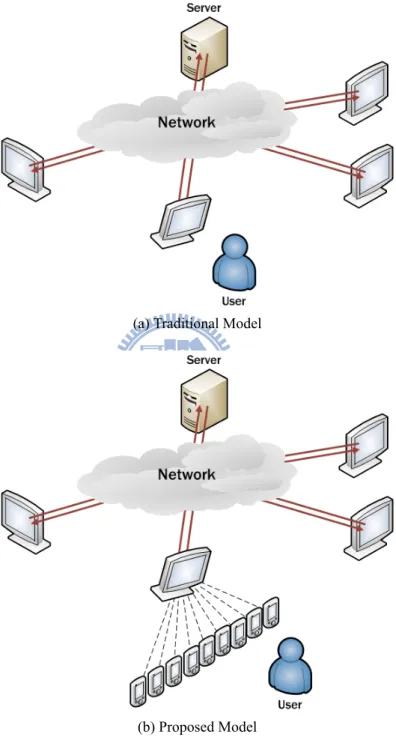
Figure 3.1a shows the traditional model of a networked program. Such a model consists of
one connection, one server and several clients. Each computing unit ( either a server or a client
) communicates with each other through the connection. Figure 3.1b shows the proposed
model that can be used to coordinate multiple tangible devices. In such a design, multiple
tangible devices are installed at the client sides to support tangible user interfaces.
Comparing the two above models, in addition to an external connection between the game
client and the server, multiple network connections are required among the game client and
tangible devices. To distinguish the two types of connections, the former connection is named
as an external connection while the latter ones are named as internal connections, which help
forward messages between the game client and the tangible devices.
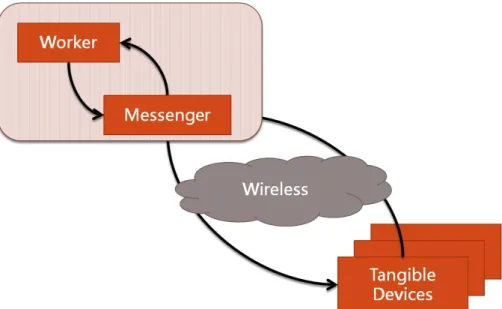
In our design, we divide the client into two components: a worker thread and a messenger.
The worker thread deals with the rule of program, and the messenger copes with the translation
between the worker thread and the tangible devices, as illustrated in Figure 3.2. Such a design
(a) Traditional Model
(b) Proposed Model
Figure 3.2: The Detail Schematic Diagram of a Client
proposed model can communicate with others using either the traditional model or the
proposed model.
3.2
System Components
Consequently, the proposed model consists of the following components: an external
connection, a server, a client consisting of multiple tangible devices, a worker thread, a
messenger, and multiple internal connections.
• External Connection
As mentioned above, the external connection between the server and the client helps
forward messages between the two parties. Similar to other networked programs, the
external connection can be realized by a heterogeneous network, either wired or wireless.
• Server
The server of a distributed program is able to communicate with multiple clients through
the external connection, the server of a distributed program may remain unchanged
when supporting tangible interfaces. Only revisions on the game client, consisting
multiple tangible devices, a worker thread, a messenger and multiple internal
connections, should be made.
• Client
The client consist of several components, including multiple tangible devices, a worker
thread, a messenger, and multiple internal connections:
– Tangible Devices
Tangible devices, interacting with users, can be used to replace the input
peripherals, such as a keyboard, a mouse, etc. The tangible devices help detect user
behaviors and actions, and respond the actions to the worker thread via the internal
connections. A tangible device is composed of a sensor and a computing unit. If
image display is required, the tangible device may optionally be equipped with a
display panel. The sensor detects the motion of the tangible devices while the
computing unit copes with several control commands to either control the display
panel or respond the user behaviors to the client.
– Worker Thread
The worker thread mainly executes the processes running on the client. As
mentioned above, to support tangible user interface, the traditional input peripherals
of the client are replaced with one or more tangible devices. To communicate with
these tangible devices, the client needs to execute a mechanism to coordinate the
tangible devices and analyze the messages responded by the tangible devices.
A component of the client. Literally, the messenger is a forwarder in the proposed
model. The messenger is responsible for transmitting commands and receiving
responses to and from tangible devices. The messenger also help mapping the
relationships between the virtual identities and the physical tangible devices.
• Internal Connection
Contrast with the external connection, an internal connection exists between a messenger
and a tangible device. Unlike the external connection, the internal connections are
normally realized by wireless networking technologies, including 802.11, ZigBee, etc.
3.3
System Sequence Flow
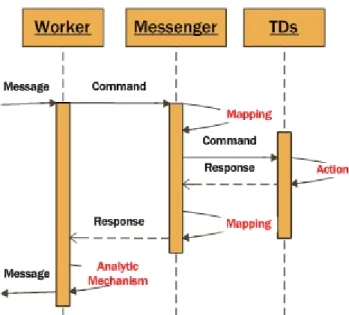
Finally, we introduce the basic transmitting flow between worker and tangible devices as
shown in Figure 3.3. When the worker receives a message, the demand for user behavior, from
server or other clients, it has to send a command to some specific tangible devices to obtain
user behavior. However, the command is not sent to some specific tangible devices directly,
and it is sent to the messenger first. When the messenger receives the command form worker,
it analyzes the command. Then, the messenger obtains the receivers, the actual specific
tangible devices, via mapping relationship and delivers the command to the receives.
On the other hand, When the tangible device detects user behaviors and actions, it must to
respond the user behaviors to the worker. And similarly, the response is not sent to the worker
directly, sent to the messenger. Then, the messenger obtains the corresponding virtual identity,
which is well recognized by the worker, through mapping relationship. Finally, the messenger
forwards the response to the worker, and the worker analyzes the response(s) to get a
Figure 3.3: The transmitting flow between worker and tangible devices
We summary the system sequence flow in following steps, and step 2, 4, 5, 6 must be
customized for different applications.
1. Worker sends the command to messenger.
2. Messenger analyzes the command to obtain the mapped receiver(s).
3. Messenger delivers the command to the mapped receiver(s).
4. Tangible Device detects user behavior and sends the response to messenger.
5. Messenger analyzes the response to obtain the corresponding virtual identity.
Chapter 4
Mahjong Game
4.1
Preliminaries
In this section, we epxplain the main parts of terminology and rule of mahjong game used
in our implementation [20, 21].
4.1.1
Game Terminology
First, we introduce the terms used to explain our implementation: realizing a networked
mahjong(MJ) to support TUI through our proposed model. It is helpful for basic understanding
to begin with a rough classification, so we sort the terms of MJ into 5 categories: process, role,
entity, meld, and operation.
MJ Process
MJ is a kind of draw-and-discard game. The basic action, named turn, is to draw a tile
from draw pile and discard one to discard pile. A player in turn is called dealer.
MJ Role
Four players form a MJ game board, sitting around a square table (as shown in Figure
Figure 4.1: MJ game board
Figure 4.2: MJ tiles
right side is Previous Player (PP)/Next Player (PN), and the player is Opposite Player(PO)
when sitting opposite. Eg. in Figure 4.1, player D is PP of player A, player A is PN of player
D, and player B is PN of player A.
MJ Entitiy
We bring to the notice of terms about MJ entity, called tile in general. The content of a tile
is rather like a standard deck of card, and it is composed of different suit and value. There are
five suits in MJ game: Numbers, Stones, Bamboos, Wind, Dragon, and just the first three suits
have value, running from 1 to 9. Figure4.2 shows the tiles mentioned above, and the quantity
(a) Pair Set (b) Pong Set
(c) Kong Set (d) Sheung Set
Figure 4.3: MJ Melds
MJ Meld
Term meld is used to represent the combination of multiple tiles, and there are four melds
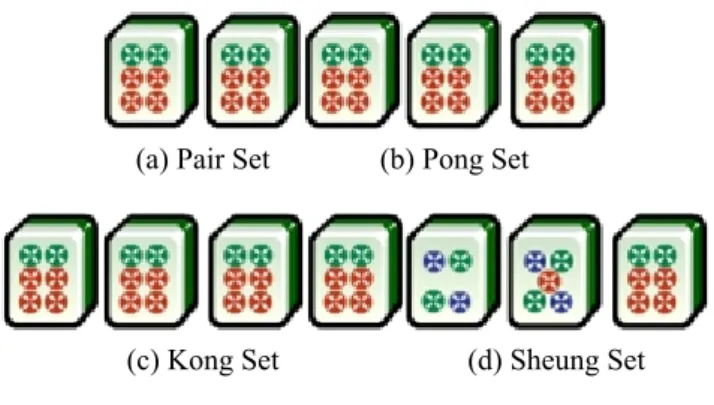
used in MJ game: pair set, pong set, kong set and sheung set. Actually, pair set, pong set and
kong set are similar melds with the same kind of tiles, but the quantity of these sets is different:
two tiles for pair set , three tiles for pong set, and four tiles for kong set. Sheung set is only
with the same suit, but value in a row. Example for four melds is revealed in Figure 4.3.
MJ Operation
Operation, the remaining category is discussion of some operations differing from the
basic operation, drawing and discarding. There are four operations used in MJ: Pong, Kong,
Sheung and Concealed-Kong. The first three is the operation of how to get a tile discarded by
other players, while the last one is the self-completed operation. We explain these operations
in two aspects: when a player can do and how a player do the operation.
First, a player can do Pong/Kong when other player discards a tile to which he/she has
two/three ones identical, i.e these three/four tiles make Pong/Kong Set. Sheung only be
declared off the discard of previous player, and he/she must have two tiles to make it a Sheung
Set. However, only dealer can declare Concealed-Kong when having four identical tiles
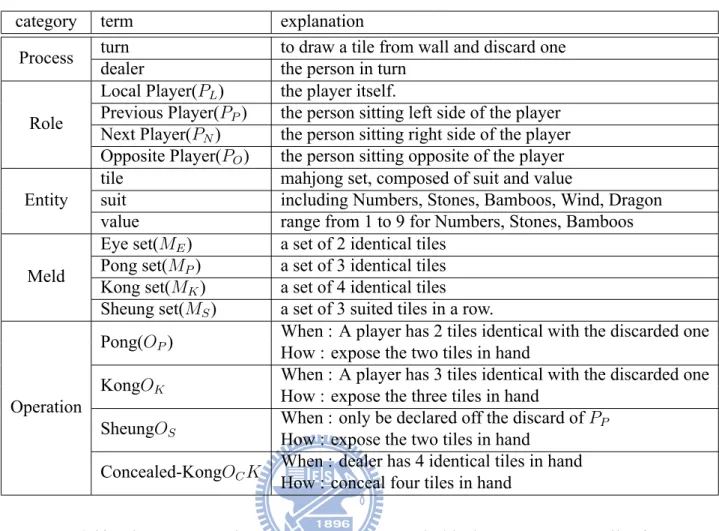
Table 4.1: MJ terms
category term explanation
Process turn to draw a tile from wall and discard one dealer the person in turn
Role
Local Player(PL) the player itself.
Previous Player(PP) the person sitting left side of the player
Next Player(PN) the person sitting right side of the player
Opposite Player(PO) the person sitting opposite of the player
Entity
tile mahjong set, composed of suit and value
suit including Numbers, Stones, Bamboos, Wind, Dragon value range from 1 to 9 for Numbers, Stones, Bamboos
Meld
Eye set(ME) a set of 2 identical tiles
Pong set(MP) a set of 3 identical tiles
Kong set(MK) a set of 4 identical tiles
Sheung set(MS) a set of 3 suited tiles in a row.
Operation
Pong(OP)
When : A player has 2 tiles identical with the discarded one How : expose the two tiles in hand
KongOK
When : A player has 3 tiles identical with the discarded one How : expose the three tiles in hand
SheungOS
When : only be declared off the discard of PP
How : expose the two tiles in hand Concealed-KongOCK
When : dealer has 4 identical tiles in hand How : conceal four tiles in hand
Second, if a player want to do Pong, Kang or Sheung, he/she has to expose two tiles for
Pong or Sheung and three tiles for Kong, and these tiles cannot be used anymore in this game.
A player conceals four tiles to indicate these tiles is non-use ones for Concealed-Kong.
MJ terms mentioned above are summarized in Table 4.1.
4.1.2
Game Rules
Each player has sixteen tiles in hand at beginning. A player on turn draws a tile and then
discards one in hand. The Goal of MJ game is to make six melds within one ME.
Manipulating mode
Normal mode When it turns to the local player, the manipulating mode is automatic translated to normal mode. There are two operational steps in normal mode. The first step in
normal mode is that the local player must draw a tile from wall. However, there are at least one
option and at most four options the local player can select to execute in second step.
On the whole, discarding a tile in hand is the option that always can be selected without
any constraints and it be known as the basic operation in MJ game. The remaining three
options can be selected by the local player under some constraints. Exposing a tile in hand as
Kong also named Plus-Kong(OP K) is the option that if the local player has done OP in this
game with a kind of tile and he/she has the fourth of that particular tile in hand.
Concealed-Kong mentioned in 4.1.1 is the third option. Then, if the local player selected
Plus-kong or concealed-kong, he/she has to draw another tile as the first step of new cycle in
normal mode. Finally, winning this game, OW the last option can be selected when the local
player has six melds within one ME regardless of exposed or in-hand.
Bid mode If other player(except the local player) discarded a tile which the local player could use to complete a meld and want to do it, then the bid mode is triggered. There are at
least one up to four options the local player can select : Sheung, Pong, Kong, winning this
game, all of these options also called bid operation. If the local player selects Sheung / Pong /
Kong, it means the player should do OS / OP / OK , then he/she should discard another tile in
hand to accomplish the steps of bid mode. Therefore, the next default dealer is PN of the local
player. On the other hand, if the local player selects winning this game, this game is over.
However, if a discarded tile was bid by more than one player, the priority ordering from high to
4.2
QKMJ
In this section, we introduce the mahjong game on which our implementation is based.
QKMJ, a kind of Taiwan Mahjong game, is proposed by Shian Yow Wu [22] in 1994. It is a
networked game based on client-server model running on unix platform. The user interface of
QKMJ is command-line interface.
In our implementation, we focus on how to support multiple tangible devices on game
procedure, so we describe previously how to start a MJ game board in the following. There are
three phases before user starts a MJ game: Initial phase, Join phase, Game phase, as shown in
Figure 4.4.
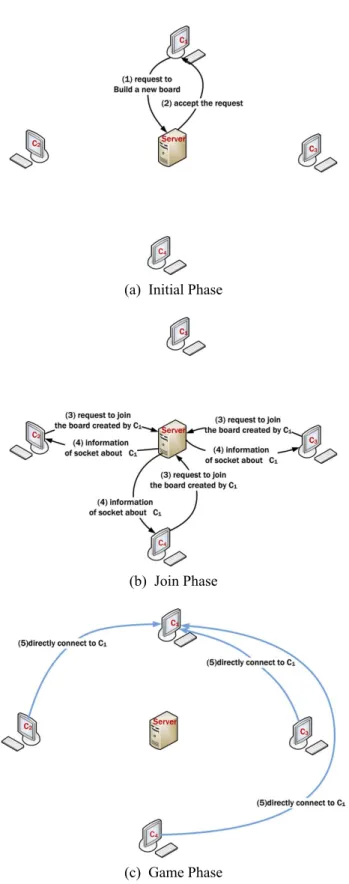
In initial phase, A player ( C1 ) sends a request to game server in order to build a new
game board. The game server accepts the request and records the socket information of C1 as
illustrated in Figure 4.4a. Then, other players can get message about the above game board
from game server, and they can send request to server to join the game board built by C1.
When the server receives the joining request by other player, it sends the socket information of
C1 to the demander as shown in Figure 4.4b. Therefore, the other player can directly
communicate with C1. After gathering four players including C1 shown in Figure 4.4c, the MJ
(a) Initial Phase
(b) Join Phase
(c) Game Phase
Chapter 5
Prototype
In this chapter, we use a networked mahjong game, QKMJ, to implement our model, and
we name it with Tangible Mahjong (TMJ). The following discusses TMJ with two aspects:
hardware and software.
5.1
Hardware
We have mentioned in section 3.1 what kind of hardware requirement we need. Then, we
introduce our development platform in this section.
Game Server
The architecture of game server remain unchanged as described in section 3.1. The
operating environment of our TMJ is like one of QKMJ, running on unix platform. Hence, the
game server of TMJ applies a person computer, whose operating system is Ubuntu9.10.
Game Client
Computer Unit
A person computer is applied to process the worker thread in our implementation and a
Figure 5.1: Tangible Device (Mahjong Tile) - Combination of MSP-EXP430F5438 and CC2500.
Tangible Devices
According to the requirement of tangible device mentioned in section 3.1:sensor, panel
and wireless transmission, an experiment board, MSP-EXP430F5438 [23] is applied to address
these requirement. Although this experiment board itself is no wireless transmitting capability,
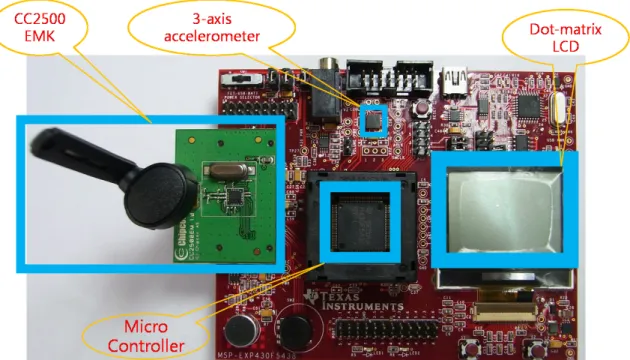
it has a wireless solution : its wireless kit - CC2500 [24]. Finally, a MJ tile is the combination
of MSP-EXP430F5438 and CC2500 (as shown in Figure 5.1).
The develop platform for MSP-EXP430F5438 is Code Composer Studio(CCS) v4, an
Integrated Development Environment(IDE) running on Microsoft Windows 7/Vista/XP. We
use the free version of CCS v4, has 16kB code size limited for MSP-EXP430F5438.
• The sensor we used within MSP-EXP430F5438 is 3-Axis Accelerometer, and its model
is ADXL335. The Data Sheet of ADXL335[25] provides some information and
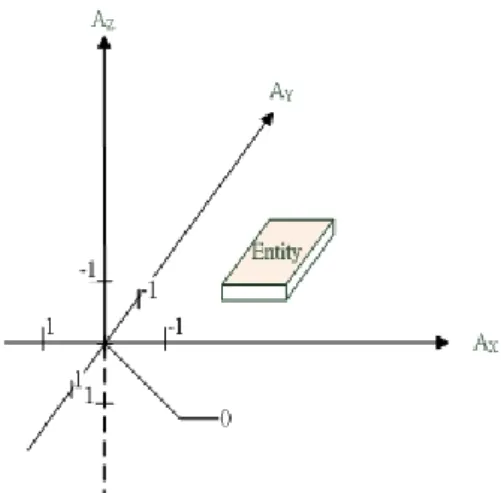
schematic diagram: it uses a single structure for sensing the X-axis, Y-axis and Z-axis1
Figure 5.2: Axes of Acceleration Sensitivity
Figure 5.3: Output Response vs. Orientation to Gravity
as shown in Figure 5.2.
The values of axis scale are meaningless but the relative of these values is meaning. The
output response is proportional to acceleration along the sensitivity axis, even if the
tangible device is static, the gravity still makes no-zero output response (as shown in
Figure 5.3 ). For convenience, we define the output response of these three axes as a
three-dimension(3D) vector(X, Y, Z).
• The model of built-in panel is HD66753. It is a Hitachi dot-matrix LCD with a
resolution of 138*110, 4-level grayscale pixels.
5.2
Sofeware
We introduce our sofeware prototype for TMJ in this section.
Game Server
The game server of our TMJ is the same with that of QKMJ.
Worker of Game Client
The worker in our TMJ is based on the game clinet in QKMJ. However, we modify it, so it
can communicate with tiles through messenger and has ability to analyze messages from tiles.
Due to two manipulating mode in mahjong game, we divide the analysis into two portions :
Judge Mechanism in normal mode and in bid mode.
Judge Mechanism - Normal Mode
As mentioned in 4.1.2, there are 2 operational steps in normal mode. The first step is fixed
operation, drawing a tile from wall, so if the local player do action draw (defined in 5.2) on a
tile, the worker can directly determine correctly the operation the local player do. However,
the player has at most 4 options in second step, so we must to design a operation-judging
mechanism for the worker (Figure 5.4) to assist us to determine the operation correctly.
Notice: the assumption of Figure 5.4 is that the local player had completed the step 1 of
normal mode, ie. drawing a tile from wall.
Before the local player acts on tile(s), to reset the counters is necessary and to check2
whether the local player can do OW or OCK to set the corresponding flag(s)3. These flags will
2The corresponding constraints are described in 4.1.2. 3It's meaningless to check the flag of O
P K in advance, because this operation is decided based on the content
assist us in operation-judging period. On the other hand, by observing actions of each
operation, we discover the action of OCK is conceal (defined in 5.2) and all the one(s) of OW,
OP K and discard are filp (defined in 5.2). As a result, the worker can preliminary distinguish
whether the local player want to do OCK.
When the local player do action conceal on a tile with state in-hand (defined in 5.2), the
worker will receive a corresponding response message form the tile. Then, it increases counter
if the flag of OCK is set and the content of the concealed tile is valid for OCK (shown in Figure
5.4 as the conditional expression : " Correspond with OCK? " ). When the number of counter
equals 4, OCK is the operation the local player do, and the operation-judging work finish.
However, when the local player do action flip on a tile with state in-hand, the worker
cannot distinguish what the local player want to do only by a flip-reporting message.
Therefore, some conditionals are applied to assist us to determine which operation is correct.
We discover the number of manipulated tiles of the possible operation OW is different than
OP K or Discard. The number of manipulated tiles of operation OW must larger than 2, but the
one of the last two is 1. It means that the worker not only receives the flip-reporting message
one time if the local player want to do OW. As a result, the worker prior considers whether the
flag of OW is set (shown in Figure 5.4 as the conditional expression :" Correspond with OW? "
).
If the flag of OW is not set, then the operation the local player want to do only remain 2
possibilities: OP Kor Discard. Therefore, the worker considers the content of this flip tile, if
the tile meets the constraints of OP K: the content of the tile is the same as the one of the
exposed pong meld (shown in Figure 5.4 as the conditional expression : " Correspond with
OP K? " ), the worker can get a conclusion that the OP K is the operation the local player do,
Figure 5.4: Judge Mechanism - Normal Mode
On the other hand, if the flag of OW is set, there are still 3 possibilities of the operation.
Nevertheless, another counter be applied to record the number of flip-reporting message(s), if
the worker just receive a message now, timer will be applied to assist judging operation: when
the worker receives another flip-reporting message in the limited period, it can determine the
OW is the operation the local player do, and the operation-judging work finish. However, if the
worker receive the Timeout-reporting message, it means the OW is not the one, so the
approach for not setting flag of OW will be applied to cope this situation.
Judge Mechanism - Bid Mode
We analyzed the bid mode in 4.1.2, so we know that the bid mode not always be triggered
every time. Therefore, the worker have to judge whether the local player wants to bid the
discarded tile, and a timer is applied to assist the worker to understand the intention of the local
Figure 5.5: Judge Mechanism - Bid Mode : Basic Processing Logic Schema
that the local player intents to bid the discarded tile, and vice versa. Then, after the worker
accounts the local player's intention to bid the discarded tile, the operation-judging mechanism
in bid mode is triggered.
Figure 5.5 shows the processing logic of the operation-judging mechanism after it receives
a flip-reporting message. First, it checkes whether the message is valid for one of the bidding
operations the local player allowed to do. (We will discuss what is valid later) The message
will be ignored if it's invalid. But, if it's valid, the worker subsequently checkes whether the
valid messages collected so far ( in this judging-operation period) meet the constraints of a
specific bidding operation. If these messages meet the constraints, the worker can get a
conclusion that this specific bidding operation is that the local player want to execute, then the
operation-judging mechanism terminated. However, if these messages don't meet the
constraints, this operation-judging mechanism still works until it receives enough
constraint-meeting messages.
Before we discuss which message is valid for operation-judging process, we list TMJ
notations used in Table 5.1.
Table 5.1: TMJ Notation
Notation Definition
Ti Single tile
STi Suit of Ti
V Ti Value of Ti
Γact Set of act tiles in this period
∆T A limited time
∆t The time between detecting active tiles
Table 5.2: Valid Messages for Judge Mechanism in Bid Mode
ID Schema Conditional Handling
V M 1 FOS 1= 1∩ ST i = STbid ∩ 0 < |V Ti− V Tbid| ≤ 2 FOP = 0, FOK = 0, Γact+ + V M 2 FOS = 1 ∩ Γact = 1∩ (Ti, Tact, Tbid)∈ MS FOP = 0, FOK = 0, Γact+ + V M 3 FOP = 1∪ FOK = 1 FOS = 0 Γact+ + V M 4 ∆t≥ ∆T end of judging V M 5 FOW = 1 ∩ / ∈ (V M1, V M2, V M3, V M4) end of judging 1 FO
j = 1 represents that the flag of Ojis set, and vice versa.
whether the message is valid. A total of the valid messages is five, and each of them has
corresponding conditional listed in Table 5.2.
Among these valid messages, the judging basis of V M 4 is timeout, while the ones of
others are contents or number of active tiles. There are 2 situations that we apply timer to
assist judging operation. First, the flag of OW is set and the flag of OP or OKor OS is set.
Second, Both the flag of OP and OK are set.
Like judge mechanism in normal mode, we check whether the local player can do
operation, OS, OP, OKand OW, then setting the corresponding flag(s). We use a circle symbol
including some of operations (as illustrated in Figure 5.6 ) to represent a kind of situation that
flags of these operations are set.
Figure 5.6 shows all the situations of judging procedure of the operation-judging
situations at beginning are listed on the left of Figure 5.6a. If a valid message appears, the
worker executes the corresponding handling also listed in Table 5.2. With these handling, the
quantity of possible operations decreases gradually. However, even if one possible operation is
remained, the operation-judging mechanism keeps working until receiving enough valid
messages to meet the corresponding constraints.
The scenario of first valid message adopted by the worker is illustrated in Figure 5.6a.
Obviously, for most of situations on the left, the valid message reduces the possible operations.
However, the quantity of valid message is insufficient, so operation-judging mechanism
continues to work.
Similarly, the scenario of second, third, and forth valid message adopted by the worker are
illustrated in Figure 5.6b, Figure 5.6c, and Figure 5.6d. We paint the circle symbol with
colorful background to represent the worker ends judging operation, and combine these
scenarios into Figure 5.6e.
Tangible Entity of Game Client
We define some terms to explain our design in tangible entity(tile). And these terms can
be divided into two categories:State and Action .
• State
Despite many kinds of tile state in real mahjong:in player's hand, exposed, concealed,
discarded and in draw pile, some states have the same characteristics. Therefore,
because of integrating some of tile states, we don't need to define 5 kinds of state, only
needing 3 kinds of game state for tangible tile: None, In-hand, Fixed.
(a) 1st valid action (b) 2nd valid action (c) 3rd valid action (d) 4th valid action
(e) A combination of (a)˜(d)
Figure 5.6: Judge Mechanism - Bid Mode : Convergence by Valid Messages
If a tile is discarded or in draw pile, we will say the state of the tile is None. When
a tile is in draw pile, it is no need to display the tile's image on panel of tangible
entity, but it needs to sense the action on the tile and needs to receive the control
message through the wireless transmission. On the other hand, after a tangible tile
is discarded by local player, we can reuse it as a waiting-drawn tile, i.e. tile in draw
pile. That is why we integrate these two states in real mahjong as one state in our
TMJ.
– S2: In-hand
If a tile is in player's hand, we will say the state of the tile is In-hand. When a
tangible tile is in local player's hand, it is fundamental to display the tile's image, so
the player can manipulate specific tile directly. Since action on tile may occur, it
needs sensor to sense the action and needs to return message of the action through
the wireless transmission. Therefore, all functionality the tangible tile has is turned
on.
– S3: Fixed
If a tile is exposed or concealed , we say the state of the tile is Fixed. After a
tangible tile is exposed by local player, the action on the tile is no longer
meaningful, so we can turn off sensor until this game over. Despite of no active
message having to return, it must keep wireless transmission to receive the control
message. In order to remind local player what he/she exposed, it is necessary to
display the tile's image. The same scenario can be applied to a concealed tile,
hence, we coordinate these two states in real mahjong as one state in our TMJ.
Table 5.3: State Definition of Tangible Tile
Panel Sensor Wireless
None X O O
In-Hand O O O
Fixed O X O
• Action
According to Operation of MJ mentioned in Section 4.1.1, we discover just some action
types make sense for mahjong game, and we distinguish these actions into 3 types: draw,
flip, conceal. Then, we obtain the different 3D vector made by 3-Axis Accelerometer
between before and after action.
– A1: Draw
In real world, when a player needs to draw a tile, the action he/she does is turning a
face-down tile to face him/her. At this moment, if the drawn tile is our tangible tile,
we can discover a change of 3D vector output by sensor from (0, 0,−1)
(face-down) to (1, 0, 0) or (−1, 0, 0) or (0, 1, 0) or (0, −1, 0)(player-faced). The reason of producing 4 results is that the tile has 4 sides that can be used as shaft. By
comparing with the before-action vector and 4 after-action vectors, we can
generalize a conclusion: the key to this action is a change of Z, but changes of X
and Y are useless, then we use vector (×, ×, 0) to represent. As a result, if a 3D vector is changed from (0, 0,−1) to (×, ×, 0), we define this action as Draw. – A2: Flip
In real world, when a player wants to discard or expose a tile, the action he/she
does is turning a tile faced him/her to face up. At this moment, if the drawn tile is
our tangible tile, we can discover a change of 3D vector output by sensor from
Table 5.4: Action Definition of Tangible Tile
Action Change of 3D vector Schematic diagram
Draw (0, 0,−1) −→ (×, ×, 0)
Flip (×, ×, 0) −→ (0, 0, 1)
Conceal (×, ×, 0) −→ (0, 0, −1)
Table 5.5: Action on Tile vs. Tile State
Draw Flip Conceal
None O X X
In-Hand X O O
Fixed X X X
O : meaningful X : pointless
We already recognized that why a tile has 4 kinds of before-action vector, and by
comparing these vectors, we generalize the same conclusion with Draw: the key to
this action is a change of Z, but changes of X and Y are useless. As a result, if a
3D vector is changed from (×, ×, 0) to (0, 0, 1), we define this action as Flip. – A3: Conceal
If local player wants to do OCK, the action he/she does is turning a tile faced him/
her to face down. We discover this action is action draw in reverse order, so a
change of 3D vector output by sensor is also in reverse order. As a result, if a D
vector is changed from (×, ×, 0) to (0, 0, −1), we can define this action as Conceal.
The action definition mentioned above are summarized in Table 5.4.
Acturally, not all of the action makes sense for each tile's state. For example, it's pointless
to do action draw on a tile with state In-hand, or to do action Flip on a tile with state None, etc.
(a) Before Reordering
(b) After Reordering
Figure 5.7: Inconsistency of Ordering
Messenger of Game Clinet
The messenger in our TMJ is a component we installed to supporting Tangible User
Interface. As mentioned in 3.2, the assignment of the messenger is transmitting commands and
receiving reports to and from tangible devices. However, there exists inconsistency between
the serial number in the worker and multiple tangible devices, because the serial number may
be reordered for game logic.
We illustrate the inconsistent situation in Figure 5.7. Figure 5.7a shows the tiles before
reordering. For game logic, it is necessary to reorder these tiles since the tile numbered 17
disrupts the tiles ordering. The effect of reordering is shown in Figure 5.7b. As a result, the
Figure 5.8: Mapping Table
For correct transmitting, we design a mapping table as shown in Figure 5.8 for the
Chapter 6
Conclusion
This thesis adopts the conception of Tangible User Interface. We propose a model
cooperating multiple active tangible devices for a networked game. In such a design, multiple
tangible devices are installed at the client sides. We revise the client sides, including worker
and messenger, to deal with the above changes. The worker deals with the rule of game, while
the messenger help convert the relationships between the the virtual identities and physical
tangible devices identities. With the proposed model, we ultimately realize networked tangible
mahjong game (TMJ) based on QKMJ, and an user of TMJ can play the networked mahjong
game with others using either QKMJ or TMJ. With the cooperating system, users can easily
References
[1] D. R. Olsen, Jr. and E. P. Dempsey, ''Syngraph: A graphical user interface generator,''
SIGGRAPH Comput. Graph., vol. 17, no. 3, pp. 43--50, 1983.
[2] N. Watanabe, Y. Igarashi, and M. Hanaki, ''Applying a 3-D-GUI to a distributed network
management system,'' Selected Areas in Communications, IEEE Journal on DOI
-10.1109/49.842987, vol. 18, no. 5, pp. 715--722, 2000. [Online]. Available:
10.1109/49.842987
[3] D. C. Smith, C. Irby, R. Kimball, and E. Harslem, ''The star user interface: an overview,''
in Proceedings of the June 7-10, 1982, national computer conference. Houston, Texas:
ACM, 1982, pp. 515--528. [Online]. Available:
http://www.guidebookgallery.org/articles/thestaruserinterfaceanoverview
[4] A. Taylor, ''WIMP interfaces,'' CS6751 Topic Report: Winter, vol. 97, 1997. [Online].
Available: http://www.cc.gatech.edu/classes/cs6751_97_winter/Topics/dialog-wimp/
[5] H. Ishii and B. Ullmer, ''Tangible bits: towards seamless interfaces between people, bits
and atoms,'' in Proceedings of the SIGCHI conference on Human factors in computing
systems. Atlanta, Georgia, United States: ACM, 1997, pp. 234--241.
[6] H. Ishii, ''Tangible bits: beyond pixels,'' in Proceedings of the 2nd international
conference on Tangible and embedded interaction. Bonn, Germany: ACM, 2008, pp.
xv--xxv.
[8] C. H. TSAI, ''Implementation of emotion teaser using zigbee wireless system,'' Master's
thesis, Department of Electrical Engineering National Cheng Kung University, Tainan,
Taiwan R,O,C, 2007. [Online]. Available: http:
//etdncku.lib.ncku.edu.tw/ETD-db/ETD-search-c/view_etd?URN=etd-0828107-170424
[9] D. J. Merrill, ''Interaction with embodied media,'' Ph.D. dissertation, Massachusetts
Institute of Technology, 2009.
[10] H. Ishii, ''Tangible Bits: Designing the Seamless Interface between People, Bits, and
Atoms,'' in Proceedings of the 1st International Symposium on Mixed and Augmented
Reality. IEEE Computer Society, 2002, p. 199.
[11] T. Hosokawa, Y. Takeda, N. Shioiri, M. Hirano, and K. Tanaka, ''Tangible design support
system using rfid technology,'' in Proceedings of the 2nd international conference on
Tangible and embedded interaction. Bonn, Germany: ACM, 2008, pp. 75--78.
[12] K. P. Fishkin, ''A taxonomy for and analysis of tangible interfaces,'' Personal Ubiquitous
Comput., vol. 8, no. 5, pp. 347--358, 2004.
[13] ''Nintendo. official website.'' [Online]. Available: http://www.nintendo.co.jp/
[14] J. Bernardes, R. Nakamura, D. Calife, D. Tokunaga, and R. Tori, ''Integrating the Wii
controller with enJine: 3D interfaces extending the frontiers of a didactic game engine,''
Comput. Entertain., vol. 7, no. 1, pp. 1--19, 2009.
[15] ''Bluetooth official website.'' [Online]. Available: http://www.bluetooth.com/
[16] ''Zigbee alliance.'' [Online]. Available: http://www.zigbee.org/
in TEI '07: Proceedings of the 1st international conference on Tangible and embedded
interaction. New York, NY, USA: ACM, 2007, pp. 75--78.
[18] A. Ananthaswamy, ''Computing becomes child's play,'' The New Scientist, vol. 201, no.
2696, pp. 18 -- 19, 2009. [Online]. Available: http:
//search.ebscohost.com/login.aspx?direct=true&db=ulh&AN=36646853&site=ehost-live
[19] S. Hunter, J. Kalanithi, and D. Merrill, ''Make a Riddle and TeleStory: designing
children's applications for the siftables platform,'' in Proceedings of the 9th International
Conference on Interaction Design and Children. Barcelona, Spain: ACM, 2010, pp.
206--209.
[20] ''Mahjong introduction.'' [Online]. Available:
http://www.mahjonged.com/chinese_rules.html
[21] ''Mahjong game.'' [Online]. Available: http://en.wikipedia.org/wiki/Mahjong
[22] ''QKMJ.'' [Online]. Available: http://www.csie.nctu.edu.tw/~sywu/qkmj.html
[23] ''MSP-EXP430F5438.'' [Online]. Available:
http://focus.ti.com/docs/toolsw/folders/print/msp-exp430f5438.html
[24] ''Data sheet of CC2500.'' [Online]. Available: http://www.ti.com/lit/SWRS040
[25] ''ADXL335.'' [Online]. Available: