國立交通大學
科技管理研究所
碩士論文
氫能源的現況與展望
The Status and Trend of Hydrogen Energy
研究生: 裘惟立
指導教授: 虞孝成 教授
The Status and Trend of Hydrogen Energy
研究生: 裘惟立 Student: Willie Chiu
指導教授: 虞孝成 教授 Advisor: Dr. Hsiao-Cheng Yu
國立交通大學
科技管理研究所
碩士論文
A Thesis
Submitted to the Institute of Management of Technology College of Management
National Chiao Tung University in partial fulfillment of the requirements
for the Degree of
Master of Business Administration
September 2008
Hsinchu, Taiwan, Republic of China
The Status and Trend of Hydrogen Energy
研究生: 裘惟立 Student: Willie Chiu
指導教授: 虞孝成 教授 Advisor: Dr. Hsiao-Cheng Yu
國立交通大學
科技管理研究所
摘要
能源是經濟的基礎。石化能源在近代發展迅速,也造成了許多問題,尤其是石化 能源的有限資源和環境影響。1970 年代已經歷過油價的上漲,現在有限的石油 資源和石油需求增加又再一次的造成了高油價。排放二氧化碳所造成的全球暖化 影響了我們的環境。解決這些問題須要尋找新的替代能源。氫做為替代能源可以 解決這些問題。氫和燃料電池在這會做不同關點的探討。The Status and Trend of Hydrogen Energy
Student: Willie Chiu Advisor: Dr Hsiao-Cheng Yu
Institute of Management of Technology National Chiao Tung University
Abstract
Energy is one of the fundamental building blocks for our economy. Through out the history, rapid advances in energy sector only occurred in the past two centuries. Fossil fuel energy appeared in 20th century dominated through out the century and continued into 21st century. Two main issues of fossil fuel energy are the finite resources and the impacts on our environment. Fossil fuel will eventually faces depletion as we continue to harvest resulting consequences in energy supply reduction and zero production of oil related products such as plastics. In 1970s, high oil prices made people realized their energy dependency. In 2007, oil prices raised even higher than 1970s, but not due to decrease in oil production. Carbon dioxide emission is tide with global warming and climate changes. This is an environmental problem caused by using fossil fuel energy resulting severe weather conditions. To find resolutions to these problems, alternative energy and renewable energy are being researched. Hydrogen energy as an alternative energy is one possible resolution. Different aspects of hydrogen energy and fuel cell presented in this paper allow us to have a better insight on the possibilities of hydrogen energy.
Acknowledgements
I appreciate and thanks toward people who helped and assisted during the thesis process to complete of this thesis paper. Professor Hsiao Cheng Yu helped me a lot in this process. National Chiao Tung University and Institute of management of Technology provided a great academic environment for me. My family also supported me during this time as well.
Willie Chiu September 2008
Contents
Chinese Abstract i English Abstract ii Acknowledgement iii List of Figures viChapter 1 Overview 1
1.1 Environmental Issues 2 1.2 Climate Changes 31.3 An Alternative Energy: Hydrogen 5
Chapter 2 Hydrogen Technology 11
2.1 Hydrogen Production 11
2.1.1 Production through Current Sources 11 2.1.2 Production through Renewable Sources 14 2.2 Hydrogen Storage 22
2.2.1 Air Compression Storage 23 2.2.2 Cryogenic Storage 24 2.2.3 Metal Storages 25 2.3 Hydrogen Distribution 26
2.3.1 Pipeline Distribution 26 2.3.2 Ground Distribution 27
Chapter 3 Fuel Cells 29
3.1 Fuel Cell Overview 29
3.1.1. General Fuel Cell Mechanism 30 3.1.2. Types of Fuel Cells 31
3.2 Fuel Cell for Stationary Usages 35 3.3 Fuel Cell for Transportation Usages 36 3.4 Fuel Cell for Portable Usages 37
Chapter 4 Industry Application Development, Demonstrations and
Cases 39
4.1 Industry Application Development 39
4.2 Hydrogen Energy Demonstration Projects 42 4.2.1 California Fuel Cell Partnership 43
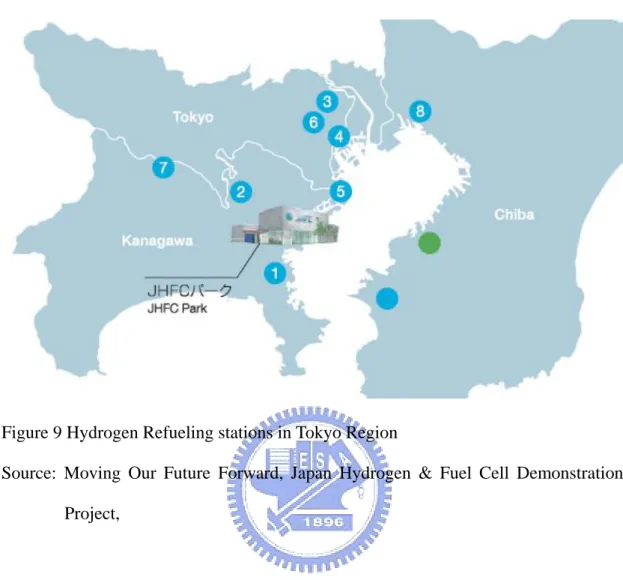
4.2.2 Japan Hydrogen & Fuel Cell Demonstration Project 45 4.3 Iceland’s Efforts in Hydrogen Energy 47
Chapter 5 Issues, Challenges, and Discussions 51
5.1 Hydrogen Safety Issues 51 5.2 Challenges and Barriers 53
5.2.1 Hydrogen Infrastructure 53 5.2.2 Fuel Cell Technologies 56 5.3 Government Policies 57
5.4 Public Perceptions 59
5.5 International Organizations in Hydrogen Energy 62
Chapter 6 Recommendations and Conclusion 65
6.1 Recommendations 65 6.2 Conclusion 66
List of Figures
Figure1 Summary of hydrocarbons and their applications comparing to hydrogen 7 Figure 2 General process flow of renewable hydrogen electrolysis production 22 Figure 3 General fuel cell working process 31
Figure 4 Summary of automobile companies’ fuel cell vehicles 41
Figure 5 Location of the hydrogen and fuel cell demonstration projects 43 Figure 6 CaFCP Full Member List as of 2008 44
Figure 7 Hydrogen refueling stations in California 45 Figure 8 Companies Involved in JHFC 46
Chapter 1 Overview
Energy is one of the most important sources in the history of human development since their relation is directly linked together. Energy was defined in the eighteenth century as the ability to do work. Work is the amount of effort put into a task. Even before the existence of definition, energy had been used by human to perform task. The primary energy source in the ancient time was the muscle power from human or animal, wind, fire, and water. Muscle power was used in variety tasks such as building houses and farming. Wind was used for windmill and to sail boats, water was used in watermills, and fire on woods was used for heating and cooking purposes.
Energy and ways of utilization started to develop in the 1800. Steam engine was invented by Watt and later applied into ships or steamboat, railways, and motors. Steam engines become widespread in Europe and U.S. and were the biggest energy utilization method. Moreover, one of the fossil fuel energy sources was commonly used in this time, which was coal, prospering the coal mining and other coal related industries. Later, the introduction of combustion engine proved to be superior then steam engine. Thus, steam engine gradually phased out.
As combustion engine spread widely, especially the introduction of diesel engine in the late 1800s stimulated development of automobile, the demand of petroleum started and continued to the current days. During the process of searching and extracting crude oil, people noticed another fossil fuel energy source called natural gas. In the early time of crude oil extraction, natural gas had little use. Thus, burning them was the way to handle this gas. In the mid 20th century, people started using natural gas for space heating and become one of our energy sources.
1.1 Environmental Issues
Coal, petroleum and natural gas are the three fossil fuel energy commonly used today. They brought us the convenience and improved our well being especially in the developed nations. However, issues arouse when using these resources and their impact on the environment is one of the major issues. Although coal usage dropped drastically after mid 20th century, coal caused a lot of problems environmentally. Coal is considered a dirty energy due to the experiences learned in the early time uses, from mining, handling and burning of coal. When burnt, hazard gases are produced such as smoke, tar, soot, SO2, CO2 and NO2…etc. When it was widely used in cities, it caused
smog and fog. This situation was well known in early London, causing many respiratory diseases. As a result, regulation on air quality was introduced during the coal period to reduce the smoke problem. This is not a problem anymore as coal is not used widely nowadays as it was replaced by natural gas for space heating purpose.
Petroleum and natural gas are currently utilize the most and are cleaner than coal. Still, petroleum combustion causes many environment concerns. Hot topics on being green or being environmental friendly, arose in the early 21st century due to the concern of consequences. When oil is burnt in a power plant to produce electricity, several byproducts are also formed, including carbon dioxide, carbon monoxide, sulfur dioxide, nitrogen oxide, and mercury compounds. All of these had consequences, directly or indirectly, toward environment and human health.
Sulfur dioxide aggravates respiratory and cardiovascular diseases, making difficulty in breathing to asthma patients. It is also a source of acid rain formation, which can damage trees, building, and affect our water sources. Sulfur dioxide can travel for long distances that impact wider area, thus become a global problem without country boundary restriction. Nitrogen oxides result in the formation of ground level photochemical ozone, or smog, this is a hazardous condition as it causes
respiratory problems. Nitrogen oxides cause formation of acid rain, react to form other chemical that affect respiratory system and water sources. Similar to sulfur dioxide, nitrogen oxides pass through long distances and require regional attention rather than local.
Road vehicle were the main causes of carbon monoxide and have serious health impact. With high concentration level, it is poisonous to human, affect heart disease, and central nervous system. Mercury compounds are heavy metals highly toxic to human through inhaling or intake from mouth. A wide range of symptom when inhaled includes, not limited to, tremor, nerve related problems, impaired cognitive ability, kidney problems, respiratory problems, and death. All of these problems have been reduced by technology research and governmental regulation. However, complete reductions are not possible thus leaving these byproducts in existence. Moreover, potential mechanical failures in reduction methods add greater pollutants into the air. Besides the health concerns due to these pollutants, some of them cause climate change that result in global worming.
1.2 Climate Changes
Intergovernmental Panel on Climate Change, or IPCC, defined climate change as changes in average or variability of climate state in a period of time, decades or longer. The cause of climate change can be natural activities or human activities. Currently, we are more concerned with the human activities since possible regulation and reduction methods serve promising resolutions.
During the period of 1995 to 2006, temperature are recorded as warmest since 1850. The rate of temperature increased in recent 50 years with an average of 0.13 °C per decade. This rate is faster than 100 years period with overall average of 0.74°C, or 0.074 °C per decade. Temperature increases faster in the North Artic region, land and
ocean also showed increase in the temperature. Although unclear in whether the raise in sea level is due to natural variation or a long term trend, sea level raised faster in recent 10 years compared to time period of 50 years. Recent 10 years average of 3.1 mm per year compared to 1.8 mm per year of 50 years time period. Ice region and frost land also decreased recently. More frequent activities of cyclone in the North Atlantic region are also observed (Climate Change 2007, 2007).
There are many causes of climate change, either naturally or due to human activities. Green house gas is one of the important factors, having high influences on the radiative forcing, a measure on the balance of entrance and exit of energy in Earth atmosphere through absorption and emissions of radiation. Therefore, different amounts of green house gases alter the energy balance of atmosphere, resulting climate changes in temperature aspect. Within all the green house gases, carbon dioxide is created the most by human activities, contributing to 77% of green house gases and faster emission rate in the recent years. These emissions were coming from mostly industrial activities, energy sectors, and transportations. In 2004, within all types of the green house gases created by human activities, 56% were carbon dioxide due to fossil fuel usage. Besides carbon dioxide, methane, nitrous oxides, and halocarbons are all green house gases caused by human activities and all of them have increased compare to earlier records. Overall, IPCC statistical analysis supported that a likelihood of positive relation between human activities and global warming (Climate Change 2007, 2007).
Despite the effort to control and mitigate the green house gases emissions, the emissions continued to rise and fossil fuel continued to dominate in the near future. This results a temperature rise of 0.2 °C per decade. If climate change continues, different impacts are likely to occur around the world. Ecosystem structure might change and possible regional shift might occur. The result is negative impact on
animal diversity. Crop productivity can increase or decrease depending on the region. Colder region has higher crop productivity while warmer region decrease in productivity. Costal areas are very likely to face coast corrosion and flood due the rising sea level. This affects society in costal area, making them vulnerable to economy changes and production that dependent on climate (Climate Change 2007, 2007).
Rain precipitation and heat wave frequency increases, causing various problems such as crops damages, changes in water quality, and increasing water demand…etc. Climate changes also impact on wide population’s health. Malnutrition, injury, and death increases when extreme weather condition occurs more frequently. Colder area benefited from decrease in cold climate related injuries or death; however, the overall health consequences are negative. All in all, climate changes impact our world and human being in various ways, and people started to be aware of such issues. International organization and resources are invested into these matters to seek out accurate information and develop mitigate methods as responses. While effort of reducing negative environment impact from the use of energy is necessary, the problems are only mitigated, not solved. Therefore, finding alternative renewable energy and new energy structure are as important. With massive R&D investment involved, different renewable energy possibilities are being investigated and people view hydrogen as an ideal element to form a new energy structure (Climate Change 2007, 2007).
1.3 An Alternative Energy: Hydrogen
Hydrogen is the most abundant and lightest element in the universe. This element does not commonly occur by its own, but combined with other elements forming different compounds since hydrogen is high reactive. When by its own, its
physical state at one atmospheric pressure is gas with two hydrogen atoms together forming H2. As of hydrogen abundance, it makes up three quarters of universe. The
Milky Way galaxy and stars were formed by hydrogen gas when rotating and compressed by gravitational forces. Besides gas, hydrogen occurs in wide range of compounds such as water, hydrocarbon, organic matters, and acids…etc.
Hydrogen was first noticed by Theophrastus Bombastus von Hohenheim (1493-1541), an alchemist and physician in the Renaissance period. When doing reaction with acid and metal, he found a gas released. Then in 1766, British scientist Henry Cavendish identified hydrogen in its distinct property, and flamed this gas yielding water, led the understanding of water composition from hydrogen and water. First hydrogen balloon was introduced in 1783, and in 1788, this gas was being named as hydrogen from Greek word hydro and genes meaning water and born of. In the 1800s, electrolysis and fuel cell effects were discovered. The separation of water into hydrogen and oxygen then combined the two gases to form water. With continuous research and findings in this area, hydrogen was forecasted as energy of the future in late 1800s and 1900s.
Before realizing the potential of hydrogen roles in energy, it has been used in different industries. Chemical production is common when hydrogen used to produce ammonia, methanol, hydrogen peroxide and many other chemicals. Hydrogen is used in the production of plastic related product, used in the production process of glasses, electronics and metals. Lastly, hydrogen usage in space program as space shuttle rocket fuel is also well known.
Hydrogen exists in many different compounds, including current major energy source fossil fuel. Chemically known as hydrocarbons, these compounds contain hydrogen and carbons. After the distillation of crude oils by breaking them into components, hydrocarbons are formed with different hydrogen to carbon ratio. CxHx
is a way to represent hydrocarbons, where the subscript x represents the different numbers of carbon and hydrogen within a hydrocarbon. High hydrogen to carbon ratio has lower numbers of carbon compare to low hydrogen to carbon ratio. Therefore, this ratio determined whether hydrocarbons are considered clean or not.
In an environmental standpoint, the higher the hydrogen to carbon ratio is, the cleaner the hydrocarbons can reach. By combusting lower portion of carbon in fossil fuel, there will be less carbon dioxide emitted into the air resulting decreases in green house gas and climate changes. From the ratio prospective, fossil fuel gases or natural gases are the cleanest energy when combusted as they have higher ratios. Here are the chemical symbols for those gases listed from higher ratios to lower ratios, methane CH4, ethane C2H6, propane C3H8, and butane C4H10. From here, we can see that
methane has the highest ratio and considered to be cleanest fossil fuels. However, carbon component still exist producing carbon dioxide. If we can remove the carbon part from hydrocarbons, then no carbon dioxide would be formed during the combustion process. Figure 1 listed out the carbon numbers of hydrocarbons, their names, and applications. Notice pure hydrogen is not considered as hydrocarbons, however, by listing it into the figure allowed a comparison of carbon numbers (Dell, R.M., 2004).
Carbon Numbers Common Name Applications 0 Hydrogen Industries usage, potential
energy usage 1-4 Natural gases Liquefied petroleum gas 5-8 Petroleum Vehicles fuel 7-11 Naphtha Organic chemicals 10-16 Kerosene Jet fuel 14-20 Diesel oils Diesel fuels 20-50 Lubricating oils Wax, lubrication
20-70 Fuel oils Ships, factories, heating Above 70 Bitumen and others Roads pavement
Figure1 Summary of hydrocarbons and their applications comparing to hydrogen
There are two energy accounts that supplied desired energy to people. One of them is energy saving account and the other one is energy income account. The energy from saving account is fossil fuel that took years of formation from decayed organic matters under the earth surface. The energies of income account are various current energies happening around the world such as wind, sun radiation, water, and tidal that unlike fossil fuel energy, can not be stored through natural processes. Just recently, more people started to exploit the energy current account from solar energy, wind and water current. However, major energy source we uses are still coming from the energy saving accounts (Hoffman, Peter, 2001).
As an analogy, a son received a great fortune accumulated by his parents and ancestors, so he has an abundant storage account. He can still choose to work and earn money, so that his current account is active. However, the effort of using current account is much greater than exploiting the storage account. Similarly, exploiting energy current account requires greater efforts than using fossil fuels. Moreover, people could not find efficient ways to exploit and store those energies in the past. Recently, more ways of exploiting current energy has been introduced and generally known as renewable energy that turns wind, solar, water current into electricity. Therefore, converting these current energies into usable energy (electricity) becomes feasible with continuous research and development. However, there is still a storage problem due to the property of electricity, where we have to consume it instantly when being produced. Most renewable energies provide fluctuating and random energy supplies. For example, electricity generated by wind requires the flow of air, if
the air is stable, then we have no electricity to use. To solve the unpredictable patterns of energy supply from renewable energy, we need to store the energy. Technology of storing electricity in large quantity is still very limited. Hydrogen, then, can be a natural storing element that is possible to solve the storage problem.
A problem related to the energy saving account is energy security. Using the analogy above, if the son continues to use his saving account, then he will eventually use up all his wealth and consequently suffers for money resource. Same applied to energy as we will harvest all the stored energy leaving people to suffer in lack of energy. Moreover, some of the energy supplier countries were political unstable, adding more risk in the market. Energy security issue was noticed early as oil depletion is not a hard concept to grasp.
This issue becomes more serious recently due to the dynamic situation. In 2008, news on crude oil price breaking historical record high becomes more common. People questioned on the supply and demand of crude oil. OPEC stated that current quantity of oil supplied can meet the demand; the rise in price is due to market speculation. Another perspective argued that the oil demands are rising due to the fast economic growth in some developing countries such as China and India. Unlike environmental problem caused by energy, rising oil price impacted regular people’s life in a direct way through the prices increased in daily goods and petroleum for car. Hydrogen has the potential to be part of future energy system that discards fossil fuel energy and relies on renewable energy sources.
Hydrogen is not an energy source, instead acts as an energy carrier. Our energy sources are coming from primary energy such as fossil fuels or woods. Hydrogen as a carrier is a secondary energy. Another well known secondary energy is electricity. We can not directly harvest electricity from the natural. Instead, we use primary energies to produce electricity, for example, burning fossil fuel in a power plant. Hydrogen, too,
have to be manufactured from primary energy sources, currently, natural gas are used the most to produce hydrogen. However, manufacture hydrogen can come from wide range of primary sources, giving countries more chances in producing their own energy compare to currently only few countries has fossil fuel resources (Hoffman, Peter, 2001).
In summary, ideal hydrogen production using renewable sources does not produce carbon dioxide that influences global warming, serve the purpose of storage and transfer as an energy carrier, and a possible replacement of fossil fuel. In the earlier vision, hydrogen can be burnt similar to fossil fuel in a combustion engine. Just recently, rapid advancement in fuel cell technologies turned people’s attention away from the combustion methods. Fuel cells become a popular topic serving the function of engine in transportation, producing only little pollutants from some of the fuel cells. In the future, advancement in fuel cell using pure hydrogen as a fuel will produce zero carbon dioxide emission or other pollutants.
Hydrogen economy is a term refers to a society that uses hydrogen as their main energy resources. An ideal hydrogen economy can be pictured as using renewable energy sources such as solar energy or wind energy through water electrolysis splits water into hydrogen and oxygen. Then hydrogen will be used in different sectors like transportation, commercial, residential, and stationary powers without the environmental problems caused by the current fossil fuels. Moreover, the finite resources will not be applicable toward hydrogen energy (The Hydrogen Economy: A non-technical review, 2006).
Chapter 2 Hydrogen Technologies
2.1 Hydrogen Production
2.1.1 Production through Current Sources
Current and near future production of hydrogen will rely on the primary energy source, mostly fossil fuel especially natural gas. Renewable resources and nuclear power as energy sources still have technological and social opposition problems. Therefore, fossil fuel because of higher availability, cost advantage, and convenience is still the practical way of producing hydrogen energy. During the production process, carbon dioxide is emitted and possible ways to reduce them do exist.
Natural gas is being used widely to produce hydrogen currently. Through the process of steam reforming and water-gas shift, hydrogen can be produced most efficiently. Since methane is the major feedstock in producing hydrogen through steaming reforming, SMR or steam methane reforming is commonly used in describing this process. In chemical reactions, natural gas methane combined with water to form hydrogen. Here are the equations:
Steam reforming CH4 + H2O → 3H2 + CO
Water-gas shift CO + H2O → H2 + CO2
In the first equation, synthesis gas is generated as a mixture of hydrogen and carbon monoxide. Besides hydrogen, synthesis gas can be prepared to produce other
chemicals such as ammonia, methanol, and other organic chemicals. Water-gas shift combine carbon monoxide and water to produce extra hydrogen. This reaction process requires intensive energy, operating at 850 °C to 950 °C and high pressure. Thus, require high fuel usage and decrease the efficiency of hydrogen production plus carbon dioxide emission. There are 4 mole of hydrogen produced during the processes and the efficiency can reach 60% to 70% (Dell, R.M., 2004).
Another way of hydrogen production using natural gas is partial oxidation. The reaction combines a fuel such as natural gas with oxygen or steam to produce hydrogen and carbon monoxide. Here is the equation.
CH4 + O2 → 2H2 + CO2
This is an exothermic reaction meaning no extra external generated heat. Reaction can go with or without catalysis. Without catalysis, it requires higher temperature environment about 1100 °C to 1500 °C and can use heavy oils to generate hydrogen. With catalysis, temperature drop to 600°C to 900°C, but usually use light hydrocarbon (with less carbon) in the reaction. If pure oxygen is used in the reaction, it requires extra infrastructure to store the oxygen. On the other hand, if using air, nitrogen will dilute the products, requiring larger air purification system (Hydrogen Production and Storage, 2006).
Stem iron process is an old practice and serve as another way of producing hydrogen using iron oxide. There are multiple steps process, requires high temperature, and additional steps in stem reforming. Thermal decomposition thermally breakdown fossil fuel into carbon and hydrogen, the carbon during the process become carbon black through a very high temperature of 1400 °C. This process was intended to produce carbon black and hydrogen as byproduct. Carbon
black is used in the tire, rubber, ink, paint…etc (Dell, R.M., 2004).
A Norway company Kvaerner Engineering invented a process using natural gas to manufacture hydrogen and carbon black called Kvaerner process. This process uses hot plasma to break down natural gas at temperature of 1600 °C. Company claimed to have very high conversion rate from natural gas to hydrogen and carbon black with low required energy input. They also claimed that any kind of fossil fuel can be decomposed using this method, but natural gas production cost the least. As Norway as many oil fields with existence of natural gases, it’s not hard to imagine one of the reason Kvaerner Engineering invented the method (Hoffman, Peter, 2001).
Coal is another primary energy source to generate hydrogen through the gasification processes, which is an old practice for coal processing. This process is considered as clean coal technology through improvements in handling the waste products. When coal is supplied with air, the reaction will produce carbon monoxide. This can then further processed to form hydrogen (Dell, R.M., 2004). Another gasification method is to supply with steam and water-gas reaction occurred as following chemical reaction:
C + H2O → CO + H2
Then with water-gas shift reaction generating more hydrogen.
CO + H2O → H2 + CO2
Since there is a cheaper and cleaner option for making hydrogen from the natural gas described above, gasification method becomes less used. However, if the demand for hydrogen increases for energy uses, then various methods of producing it from
primary energy sources need to be considered. After the gasification process, synthesis gas temperature is around the range of 540 °C to 1040 °C and the besides desired hydrogen, other various containments are formed such as HCl, H2S,
HCN…etc. To remove these containments in scrubbing process, synthesis gas temperature is lowered to 22 °C. Then the gas is reheated to 315 °C to 371°C in WGS reactor to perform water gas shift shown in the equation above. After, to obtain hydrogen, gas separation from CO and CO2 are performed. Then final removal of
containment in hydrogen gases to meet the requirements of usage (Dell, R.M., 2004).
2.1.2 Production through Renewable Sources
Water is an abundant resource existed on earth. With its chemical structure of H2O, it can be a source to produce hydrogen by splitting the hydrogen and oxygen
apart. One of the ways is through electrolysis process. Around 1800s, after the electrical battery, electrolysis was discovered by William Nicholson and Sir Anthony Carlisle. An industry based on electrolysis grew in the 1920s, and then gradually replaced by steam methane reforming as it is a cheaper way of producing hydrogen (Romm, Joseph J, 2004).
Although hydrogen production from natural gas dominated the hydrogen market, electrolysis industry still exist to meet the high purified hydrogen requirements in the demand market since electrolysis can produce 99.9995% purity of hydrogen and oxygen. Also, as natural gas gradually increase in price, the electrolysis option returned into production for price consideration. The industry tends to exist in places where the price of electricity is cheap, such as Canada with good hydropower resources to produce electricity.
two electrodes, one positive and one negative. Positive electrode is known as anode, which is responsible for oxidation reaction. While cathode, the negative electrode is where reduction reaction taking place at. To separate water, the two electrodes are immersed into water and apply direct current. Then the gaseous oxygen occurs on the anode and gaseous hydrogen occurs on the cathode. Ideally, voltage of 1.229V is required to split water at 25 °C with 1 atmospheric pressure. However, in reality it may take more to split the water due to the electrical losses, For example, ohm resistive losses on the electrode or over potential at the positive and negative electrodes. Early electrolysis has electricity to hydrogen efficiency of around 60%. Current large commercial electrolysis cells can reach 75%, and smaller cell with best practice can reach 85% (Dell, R.M., 2004).
Extra infrastructures are needed for commercial production. A system to convert alternating current to direct current and connection to the electrodes are required. The hydrogen and oxygen produced must be collected through pipelines. Heat removal and drying gas system need to be implemented. There are two types of commercial electrolyzer, one is unipolar known as tank type and the other one is bipolar known as filter press.
Unipolar electrolyzer is designed with alternating anode and cathode with separator in a pool of electrolyte, potassium hydroxide is a common type. The advantages of unipolar electrolyzer are its relatively cheaper, fewer parts for construction, and easier for maintenance. On the other hand, it cannot sustain high temperature due to its structure and require more space for installation. Bipolar electrolyzer has a positive side and a negative side in one electrode. Each side is faced to a different cell. Space requirement for bipolar electrolyzer is smaller and can withstand higher temperature, but harder maintenance and construction sophistication are the drawbacks. Due to the material handling difficulties, a new method for
electrolyzer using solid polymer electrolyte was introduced by General Electric Company. The conversion efficiency is similar to the traditional electrolyzer, however, at high pressure, it can generate more efficiently with less cost. It is also more responsive to abrupt change in power supply, making it reliable for safety application such as oxygen generation in space and nuclear submarine (Kroposki, B. et al., 2006) Utilizing multiple renewable energy sources to decompose water into hydrogen is an ideal clean picture for future energy structure. Electrolysis requires electricity in the form of direct current, and this electricity can be produced by renewable energy sources. By combining electricity generation part and hydrogen production part, an ideal picture of hydrogen economy system is formed. With previous discussion on electrolysis, here are brief discussions on some of the renewable energy sources for electricity generation.
Water usage existed for a long time dating back to the Roman period. It also played an important role during the industrial revolution in Britain. Hydroelectricity was first built in Wisconsin, USA with output of 12 kW followed by increased construction around the world since then. There are two major systems of hydroelectricity depending on the electricity output. Large output capacity is around MW to GW, this system usually involved large civil engineering works on dam construction, and the source of water from high altitude mountains and reservoirs. Smaller output capacity ranging from kW to MW often does not require the construction of dam, but employ a process of diversion using water flow. The sources of water are coming from river flow in altitude difference terrains, such as mountain or falls (Dell, R.M., 2004).
Hydraulic head is a key component in a hydroelectricity system that creates altitude difference. Examples of hydraulic head can be dam, reservoir, or smaller structures utilizing river water flow. Depending on the placement of hydraulic head,
potential power generation is different. Hydraulic head in the higher altitude have higher potential than the lower altitude ones. Another component is powerhouse that utilizes the water source to generate electricity. In a powerhouse, water turbine, generator, and system of transferring water into the house called penstock are required. Water flow control system need to be implemented to manage the inflow and outflow of water. Water flow is a very important factor in hydroelectricity; therefore this system is mostly employed in countries with suitable mountainous terrains.
Tidal energy is also a renewable energy related to water, but somewhat different from hydro energy as energy is obtained through the rise and fall of ocean level. The natural mechanism behind tidal energy and hydro energy is different. Hydro energy depends and the water evaporation and precipitation, transferring water from low altitude ground to high altitude mountain region. Ocean movement in tidal energy is caused by the gravitational forces from the moon. During full and new moon, the ocean level movements are the strongest, while in first and last quarters of moon cycle has a smaller tide. Tidal movement also occurred around 12 hours each day providing potential energy generation (Dell, R.M., 2004).
Range of area is a key factor that determines the amount of energy produced by tide. So placing barrage in the junction parts of river and ocean is suitable. Incorporating reversible turbines, the rise and fall of tide can be captured as potential energy around 3 to 5 hours. Then the electricity generated can be feed into electrical grid or to produce hydrogen through electrolysis of water. There are many structures around the world to exploit the tidal energy, for example, in France, Canada, China, and Russia.
Marine currents are caused by the tidal movement and can be a potential renewable energy source. Slower currents cannot be used to generate electricity, but strong marine currents are ideal in capturing the energy. Underwater turbines are
installed in the flow of currents with diameter up to 20 meter. The turbine is attached with a generator to produce electricity. Since the power of water flow is strong, the turbine must be designed to withstand such flow. Depending on the size of turbine design, additional support and material strengthen is required. This is a relatively new technology with little experiences that poses some difficulty for countries to construct such scheme. However, the construction is more economical then tidal energy or hydro energy, which requires building dams or barrages.
Another type of energy related to water is wave. As wind blow on the ocean surface, waves are created and travels toward shoreline. Waves carry a lot of energy that can be potentially harvested, estimating of 1000 TWh per year in the European shore. The system to convert wave energy can be placed in three general locations, shoreline, near shore, and off shore. Shoreline and near shore location are being researched the most since the proximity of the system influences the maintenance and installation efforts. The first wave energy system called oscillating water column is suited for shoreline with hollow structure. This created a space filled with air with Well turbine between the air flows, generating electricity as turbine connected to a generator. Another shoreline system is called Tapchan. This structure consists of narrowing channel and reservoir. Channel allows wave to splash into and transfer them into reservoir. Reservoir stores this water and directs them into turbine to generate electricity. Offshore systems are currently under development, allowing further potential to harvest the wave energy (Dell, R.M., 2004).
Wind energy has been used in human history for a long time especially for irrigation system and grain grinding. Historical records have shown the usage of wind through windmills in Persia and Europe in the early time. Holland further developed the use of windmills to drain water out in order to use the remaining land. As steam engine invented, windmills soon been replaced by it. However, as more advancement
into electricity usage, wind energy was back into people’s eyes as it can generate electricity. The system was first invented in early 1900s and continues in advancement toward currently known wind turbines system.
Traditional wind turbines have three blades and a horizontal axis design, following a box called Nacelle connected behind. Within the Nacelle is gearbox and generator that turn wind kinetic energy into electricity. Wind turbines are connected together to form wind farm. To prevent the interruption between each turbine, turbines installation is spaced 5 to 10 rotor diameters. The energy wind provided is about three folds in relation with wind speed. Thus, an increase in wind speed can dramatically increase the energy collection.
Several considerations need attention when installing the wind farm. Wind turbine currently can be operated at a range of wind speed between 4 to 20 ms-1, any speed out of the range cannot be captured by the wind turbines. The height above the ground should also be considered when installing wind turbine as wind speed is slower at the ground level. Another issue is the existence of wind. Wind occurrence can be due to season changes, time bases, altitude, location, and terrain. Turbulence also occurs to disrupt the energy generation efficiency as the blade faces multiple pressures. Buildings, hills, and trees…etc are some of the reasons for turbulence. Therefore, careful analyses including the above parameters are needed before the actual installation.
Notice current wind farm is usually built inland. Another alternative for harvesting wind energy is by building wind turbines off shore. The wind is usually stronger off shore with wider open space, would not interfere with local residents’ life, and reduce the use of land resources on the continent. However, the cost and maintenance is high. Denmark, Sweden, and United Kingdom have all built this type of off shore wind farm and expected to grow in the future (Ivy, Johanna, 2004).
Solar energy is one of the most important resources on earth and consider as an unlimited resources given that sun will function long enough that poses no concern currently. Ideally, the energy provided by sun is more than enough to meet the current energy demand worldwide. However, we still cannot efficiently collect solar energy. Energy produced by sun through fusion reaction can be divided into heat and light and we can utilize this energy directly on heating purpose or generate electricity from the sun light(Hoffman, Peter, 2001).
Discovered in 1800s, Edmund Becquerel, a French physicist found out when semiconductor materials receive sun light, it will produce low DC electricity. Albert Einstein further explained such effects and become the current photovoltaic technology. Photovoltaic literally means light electricity as photo is light in Greek and volt represents a pioneer in electricity named Alessandro Volta. Different types of silicon materials can be used in photovoltaic cells, such as crystalline, gallium arsenide, cadmium telluride and organic compounds…etc. When n-type semiconductor and p-type semiconductor are brought together with one receiving the light, a voltage is developed between the two semiconductor junctions, creating electricity known as photovoltaic effect. Generally, phosphorous is put onto a p-type semiconductor forming an n-type layer. Then above n-type layer is an anti reflection coating to form a common solar cell. Low voltage is generated through these cells of about 0.6V. Therefore, multiple cells are packed together to form a solar panel that generate greater voltage output for practical uses.
For further application and practical uses, solar panels need to be connected and arranged in a parallel way. Combined with other support system to fully utilize solar energy, this system is called solar array. Some of the support systems include inverter, transformer, electricity storage devices, and control system on energy flow. Also, a tracking system is important in solar array as daily sun movement and seasonal
changes affect the amount of energy collected by solar panel. By tracking the sun movement, solar panel should be arranged from horizontally to degree of tilting depending on the needs. The arrangement should also take into the consideration of energy demand fluctuation, for example, constant demand yearly or various demands as season changes.
Recent conversion rate from sunlight to electricity is about 18% to 25% depending on the types of silicon used in solar panel. Some of the factors affecting conversion rate includes light wavelength, recombination, temperature, resistance, and sunlight reflection. The wavelength of light affects the amount of electron flows in the band gap, since only certain wavelength of light provide enough energy to the silicon, conversion rate becomes low as other wavelength cannot be utilize in silicon. An estimation of 55% waste occurs due to this result. Reflection is another factor, simply because when reflecting sunlight off the solar panel, the light reflected cannot be utilized for electricity generation. Due to the materials property in solar panel, light cannot be fully absorbed. Therefore, to increase the efficiency, a triple junction and multi-junction solar panels are introduced with different silicon materials combined to absorb wider range of light wavelength. Recent conversion rate can reach above 40%, however, this type of panel is expensive which process improvement and production growth might solve the issue. Besides traditional silicon materials, organic photovoltaic devices and dye-sensitized solar cells are under development. There are also other ways of using solar energy such as photo thermal, photo electrochemical, and solar decomposition through bacteria to generate hydrogen other than electrolysis. These methods are still being researched while electrolysis can be readily available. If successful, they would serve as another opportunity for the renewable energy in solar sector (Dell, R.M., 2004).
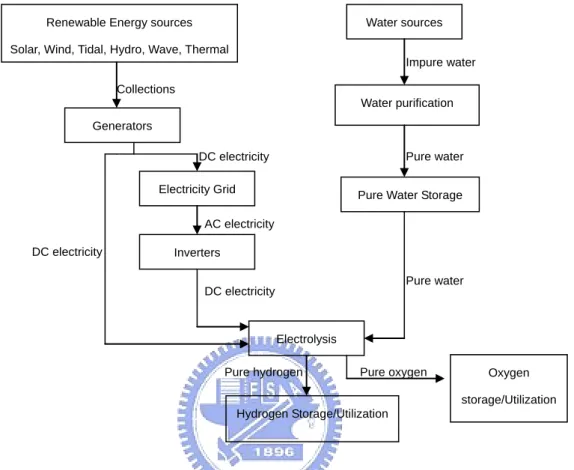
electrolysis processes, we can have a pollution free infrastructure of hydrogen production. Figure 2 shows a general process flow of clean hydrogen production.
Figure 2 General process flow of renewable hydrogen electrolysis production
This is a process flow diagram using electricity from renewable energy sources and electrolysis of water to produce hydrogen. Due to the electrolysis requirements, water should be purified for the uses. Electricity generated thorough renewable energy is transferred directly for electrolysis uses or feed into electricity grid system for both electrolysis and electricity demand. Then, the pure hydrogen product is manufactured to store or for immediate usages (Kroposki, B. et al, 2006).
2.2 Hydrogen Storage
As an energy carrier, hydrogen by itself acts as a chemical storage device for
Water purification system
Deionization, osmosis Renewable Energy sources
Solar, Wind, Tidal, Hydro, Wave, Thermal
Pure Water Storage Electricity Grid Generators Inverters Electrolysis Hydrogen Storage/Utilization Water sources Collections DC electricity DC electricity AC electricity DC electricity Impure water Pure water Pure water Oxygen storage/Utilization Pure hydrogen Pure oxygen
energy. Although with a potential to replace current fuels, unlike fossil fuel or natural gas, hydrogen due to its properties requires dedicated research and technology to store it. In this section, types of hydrogen storage and some of the methods of storing hydrogen will be discussed.
There are several purposes for hydrogen storages, resulting in different types of storage needs. Large quantity hydrogen stationary storage is needed mostly for centralized hydrogen production plant where large quantity of hydrogen is produced for no immediate uses. This is also critical for energy security and emergency at national level. Small quantity hydrogen stationary storage is demanded by industrial plant using hydrogen in their production process or backup, and hydrogen refueling stations for vehicles based on fuel cell engine or other related hydrogen utilization vehicles. The stationary storage may be less restrictive in requirements than storage for vehicle purposes. Besides stationary storage types, storage for mobile purpose should be developed. Large mobile hydrogen storage system is mostly used for hydrogen transportation by land, on ocean and in air. Small mobile hydrogen storage system is similar to current vehicles gasoline tank, where the primary purpose is an energy reservoir for transportation to travel a desired long distances.
With multiple methods of storing hydrogen, the new ones are still in development phase while others exist in the commercial market. With common pressure and room temperature, pure hydrogen is in the form of gas. 1 kg of hydrogen takes about 11 m3 of area. So the criteria of hydrogen storage density should be on temperature, pressure, gravimetric, hydrogen repulsion, and reversibility.
2.2.1 Air Compression Storage
hydrogen, withstanding pressure up to 20 MPa, causing a relative low density in hydrogen storage; with composite materials, cylinder can stand pressure up to 70 MPa. This composite cylinder is usually made of carbon fiber shell that has lighter mass, however, compressing hydrogen in such high pressure requires extra energy. The volume of composite tank is still large if trying to apply to vehicles with appropriate hydrogen density (Hydrogen Production and Storage, 2006).
Another way is using glass micro sphere, filling in hydrogen operating at 35 Mpa to 70 Mpa and temperature of 300 °C. Then the glass sphere is cooled and placed into vehicle vessel and reheat to 200 °C to 300 °C releasing the hydrogen for energy uses. However, this way have many difficulties needed to resolve. For all compression storage, electricity consumption to maintain pressure at 20 Mpa requires about 7% of hydrogen energy content. Energy demand rises with higher compression. Also, cylinders design is not compact as single container that limited the vehicles’ driving distances (Hydrogen Production and Storage, 2006)
2.2.2 Cryogenic Storage
Liquid is a possible hydrogen physical state under cryogenic condition with temperature about - 253°C. Hydrogen can also be injected into other liquids that are able to store. Cryogenic hydrogen in liquid state is usually referred as liquid hydrogen, LH2. It has a density of 80 kg m-3, giving a much higher density then at gaseous state
of 30 m-3. Although liquids are generally easier to transport than gas, liquid hydrogen might poses some problem due to its liquid existence at extremely low temperature, resulting a need in good storage equipment. Even with insulation, liquid hydrogen can only stored within few days. Moreover, the cost of liquefying hydrogen requires large energy input, equivalent about 30% of the liquid hydrogen produced. Currently,
transportation and usage of liquid hydrogen existed in nuclear power plant and space program. For liquid hydrogen to become a method of storage, further improvement on efficient liquefying procedure, better insulation, and ways to capture the boiled hydrogen is required to make liquefied hydrogen in the hydrogen economy theme (Hydrogen & Fuel Cell: Review of National R&D Program, 2004).
2.2.3 Metal Storages
Hydrogen can also be stored in solid state, but not by pure hydrogen as it requires even lower temperature than liquid hydrogen. By combining hydrogen and metals to form metal hydrides, an alternative method for hydrogen storage is formed. The metal should be able to absorb and release hydrogen during storage and demand cycle without deteriorating the metals. There are many types of metal suitable for absorbing hydrogen to for hydride, including elemental metals, alloys, intermetallic compounds, and complex hydrides. Alloys and intermetallic compounds are studied the most. Some of the criteria for selecting alloys as follows: hydrogen reversibility, temperature, pressure range, reaction kinetics, stability, and hydrogen cycles. With these conditions, a good metal hydride storage should have high hydrogen proportion, safe of air exposure or other hazardous condition, process of releasing hydrogen should be under a similar earth temperature and pressure environment (Prospects for Hydrogen and Fuel Cells, 2005).
Metal hydrides are performing chemisorption as hydrogen atoms bond to the metals. Another way of hydrogen interaction with materials is physisorption or hydrogen interacts and stores on the high surface area of the materials that are usually carbon or boron nitride nanostructures. Due to the weak bonding of physisortpion between hydrogen and nanostructures, the required pressure and temperature are less
than chemisorption. Carbon nanofiber and nanotubes can hold some quantity of hydrogen, but previous reports on the capability of holding large quantity was viewed as error measurements. Other high surface area materials include zeolites, metal oxide framework, and clathrates hydrates that are capable of storing hydrogen in very low temperature. Further research in this area needs to be conducted in order to determine their potential as hydrogen storage methods (Zuttel, Andreas, 2007).
Chemical hydrides can serve as hydrogen storage devices. They are reactive to water and thermal energy in releasing hydrogen. Some of the water reactive chemical hydrides are LiH, NaH, MgH2. Example of the chemical equation for LiH is
LiH + H2O →H2 + LiOH
Some of chemical hydrides releasing hydrogen through thermal decomposition are ammonia borane and other ammonia borane family. Chemical hydrides have high storage ability, but the release of hydrogen is irreversible reaction. Therefore, after they release the hydrogen, the byproduct needs to reprocess in the factory to generate back to hydride (Hydrogen & Fuel Cell: Review of National R&D Program, 2004).
2.3 Hydrogen Distribution
2.3.1 Pipe Distribution
Hydrogen distribution becomes important when production of hydrogen in remote areas with long distances to destination result in difficulty to supply to the end users. One of the options to send gaseous hydrogen is through pipeline. This method already existed in the current time and can be dated back to early 1900. In Germany,
pipelines are established for chemical processes. Made out of bitumen, plastic, s, the length of pipeline grew from initial of 24 km to a network of 210 km pipeline with few that crosses Rhine River. As a whole, the length of hydrogen pipeline in North America is about 700 km and Europe with 1500 km with materials based on steel and carbon steel. The major organizations using current systems are chemical companies and scientific research centers such as national laboratory or NASA.
This is currently the economic way of transferring hydrogen. However, still there are issues related to pipeline distribution. The construction of new pipeline is expansive and current existence of hydrogen pipeline is relatively small compare to natural gas pipelines. Using current natural gas pipeline system causes problem as the pipeline are not design for hydrogen uses, especially in its material due to the attack from hydrogen and pressure. Since hydrogen has low volumetric density, requirements to pressure them in pipeline and re-pressure is needed for a given distance causing energy loss and increase costs. Also, the flow rate has to be faster with energy requirement about 4.6 times comparing to natural gas in order to provide the same amount of energy from natural gas. Therefore, transferring hydrogen for a long distance through pipeline is not economical compare to natural gas pipeline. Hydrogen leakage detection and prevention system should also be developed due to the hydrogen property that is prone to leak. Similar to other hydrogen technologies, further research into hydrogen pipeline distribution are required for an economic acceptable way transferring hydrogen to refueling station and end users (Winter, Carl-Jochen, 1988).
2.3.2 Ground Distribution
to the hydrogen storage technology. Currently, hydrogen can be transferred as compressed air. However, this method is expensive and can only travel a short distance of about 300 kilometers. Hydrogen metal storages are possible to travel on truck. Since this method did not exist in the past, further research into the development and feasibility are needed (Hydrogen Distribution and Delivery Infrastructure, 2008).
Liquid hydrogen has been demanded in nuclear energy sector use in nuclear bubble chambers, space program…etc. Therefore, transportation of liquid hydrogen existed. The process of liquefying hydrogen is expensive, consuming large amount of energy. Current large cryogenic hydrogen production requires 36 MJel per kilogram of hydrogen, with prediction of energy requirement reduced to 26.5 MJel per kilogram of hydrogen. The current energy input is about 31% of produced hydrogen energy content. With decrease in energy requirement, energy input is 21% of liquid hydrogen output (Hydrogen Distribution and Delivery Infrastructure, 2008).
Also, depending on the electricity efficiency during the liquid hydrogen production, this might further increase the energy input. For example, 50% electricity efficiency raises 21% to 42% of hydrogen energy output. Liquid hydrogen is produced as a very low temperature of -253 °C, it will boil off to gaseous hydrogen if temperature is not maintained. Liquid hydrogen transportation requires energy to maintain the low temperature, good insulators, and a system to recapture the boiled off hydrogen for uses in truck or ships when transferring the hydrogen. Overall, if research continues to improve the production process, the cost could be reduced with benefits of economies of scale providing the opportunities for hydrogen distribution system(Dell, R.M., 2004).
Chapter 3 Fuel Cell
3.1 Fuel Cell Overview
Fuel cell becomes a well known term in recent year due to its potential of replacing traditional combustion engine. Fuel cell can convert the fuel into electricity which can be used in wide range of applications. The discovery of fuel cell effect dated back to around 1839, when Sir William Groove discovered the electricity generation through reversing water electrolysis. In 1889, Charles Langer and Ludwig Mond tried to create such effect and termed their system fuel cell. Then in 20th century, further development in fuel cell continues. In 1950s, NASA developed fuel cell system that can generate electricity and applied to space mission in 1960s. In late 20th century, energy issues arose causing acceleration in fuel cell research in search for possible resolution.
Benefits of fuel cells are low impact on environment, high efficiency in energy power, high reliability, low noise during operations, and wide range of potential applications. Fuel cell, depending on the fuel used, can be low to zero carbon dioxide emission. When fueled with pure hydrogen, the products are electricity, water and heat. With hydrocarbon fuel, low carbon dioxide emission existed. Compare to other traditional method of generating electricity such as burning fossil fuel, the efficiency of energy conversion is relatively high with about 40% to 50% for fuel to electricity. Unlike combustion engine with mechanical movements, the operations of fuel cell create no noise providing a pleasant sound volume environment. With high reliability and high power quality, fuel cell can serve as power backup in organization preventing any harm caused by power shortage. Besides power backup, there are
multiple applications for fuel cell in stationary, transportation, and small mobile devices (Fuel Cell 2000, 2008).
3.1.1 General Fuel Cell Mechanism
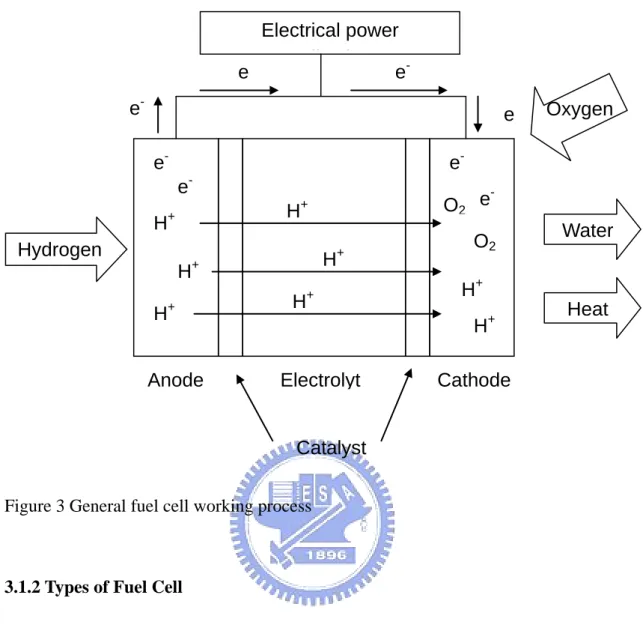
Fuels for fuel cell are not necessarily hydrogen. It can be other high hydrogen concentration matters. Pure hydrogen, however, provide more advantages to fuel cell in generating electricity with greater efficiency and less harm toward environment. By supplying hydrogen and oxygen, fuel cell creates electricity and water. Fuel cell has two electrodes, a negative anode and a positive cathode. Between the electrodes is electrolyte. Hydrogen is supplied to anode and oxygen supplied to cathode. Hydrogen through chemical reaction and catalyst is split into proton and electron. Electrons passed through circuit creating electricity while protons passed through electrolyte reunite with electrons, and combined with oxygen in the cathode to form water with heat. Figure 3 shows what was described graphically (Rayment, Chris, 2003).
Figure 3 General fuel cell working process
3.1.2 Types of Fuel Cell
Different types of fuel cells existed with varying operating temperature, pressure, fuel used, materials and their design. There are generally six major types of fuel cell design introduced as follows.
Alkaline Fuel Cell
Alkaline fuel cell abbreviated as AFC, was the first available fuel cell technology and with portability. The biggest application of this type of fuel cell was in space program for water and electricity generation purposes. Potassium hydroxide is used as electrolyte in AFC, and the electrode are made of less precious metals giving an advantage over other fuel cell. Some of the materials of electrode can be sintered
Hydrogen H+ H+ H+ e- e- e- e - e - e-
Anode Electrolyt Cathode
e Catalyst Oxygen Electrical power applications H+ H+ H+ H + H+ O2 O2 e- e- Water Heat
nickel, Raney metals, and rolled electrode. Operating temperature is in the range of 100 °C to 250 °C, but through advancement, it reduced to the range of 23 °C to 70 °C. Due to the chemical reaction in alkaline fuel cell, they have high efficiency about 60%. However, it can be easily poisoned by carbon dioxide, requiring usage of pure oxygen that results a less favored condition for applications operating in regular environment. The purification of oxygen is costly, and the available operation hours of 8,000 hours might not meet the demand for large scale usage of 40,000 hours, adding more disadvantages to ACF (Prospects for Hydrogen and Fuel Cells, 2005).
Direct Methanol Fuel Cell
Direct methanol fuel cell (DMFC) is relatively new as it was developed during the 1990s. Unlike other types of fuel cell, the fuel requirement is methanol following the name of the fuel cell. When supplied methanol entered to anode with presence of water, it separates into hydrogen ion, electron and carbon dioxide. The disadvantages of DMFC are low efficiency, low power density, and the methanol fuel is toxic. The efficiency rate is in the range of 15% to 20%. Through further development, DMFC efficiency might improve toward 40%. The operating temperature range is between 50 °C to 120 °C. Due to its small and medium physical size and low temperature operation, potential commercial application on mobile power supply for cell phone and notebook computer is currently under research in some manufactures (Prospects for Hydrogen and Fuel Cells, 2005).
Proton Exchange Membrane Fuel Cell
Proton exchange membrane fuel cell is also known as polymer electrolyte membrane fuel cell (PEMFC) or polymer electrolyte fuel cell (PEFC). Instead of using electrolyte solution, PEMFC uses polymer electrolyte that is solid and immobile.
Nafion is the most popular polymer electrolyte produced by Dupont. The fuels for PEMFC are hydrogen and air containing oxygen, with water formed after the process. Some of the advantages include low operating temperature of about 80 °C, quick start up time, high power density with small physical volumes, and manufacture ease due to solid polymer electrolyte compare to liquid solution electrolyte. Disadvantages can be expensive platinum metal used as catalyst that is vulnerable to carbon monoxide. PEM fuel cell is one the best potential fuel cell for uses in vehicles and transportation due to the advantages mentioned. It can also be used in stationary powers giving a possibility in mass commercialization (Rayment, Chris, 2003).
Phosphoric Acid Fuel Cell
As named, phosphoric acid fuel cell (PAFC) uses phosphoric acid as electrolyte and platinum catalyst operating at around 150°C to 220°C. With around 200 units used mostly in stationary power, this fuel cell is considered a mature type as it was the first commercialized fuel cell. One of the advantages of this fuel cell is its high efficiency up to 85% combining the electricity and heat created for uses. If only electricity is utilized, the efficiency dropped to about 40%. Another advantage is its relative high tolerance to impurity compared to PEMFC so less requirement in designing system preventing impurities. On the other hand, precious metal platinum as catalyst making this fuel cell costly. Given a fixed size, PAFC is less powerful than other types of fuel cell, resulting large volume and size design. The large size of PAFC then is used mostly as stationary power applications(Prospects for Hydrogen and Fuel Cells, 2005).
Molten Carbonate Fuel Cell
gas as its fuel. Unlike other fuel cell, molten mixtures used in electrolyte with two carbonate salts, lithium carbonate with potassium carbonate or sodium carbonate. This fuel cell operates at high temperature around 650 °C, allowing it to use natural gas directly without extra fuel processing. Natural gas due to heat decomposes into hydrogen internally serving as fuel for MCFC. MCFC has high efficiency rate about 60%, when combined with heat utilization, it can reach up to 85%. However, because of its high temperature, durability is lessened. Also, it would take a long start up time to reach the required temperature, making it suitable for constant operations instead of short consecutive power generation. In an environmental perspective, the emission of carbon dioxide is another disadvantage requiring emission capturing system for an extra cost (Hydrogen & Fuel Cell: Review of National R&D Program,2004).
Solid Oxide Fuel Cell
Solid Oxide Fuel Cell (SOFC) uses ceramic compounds with a solid physical state in electrolyte. This fuel cell’s efficiency in generating electricity is up to 70%, the highest efficiency in all major fuel cell types. With cogeneration by using both electricity and heat produced from SOFC, efficiency reaches 85%. SOFC operates at high temperature around 800 °C to 1000 °C contributing to both benefits and drawbacks. One of the benefits operating at this temperature is saving the material cost of expensive metal catalyst. Moreover, the extreme hot environment allows fuel to be reformed within the fuel cell saving the cost from external fuel production. Besides, SOFC is more tolerable to sulfur and carbon monoxide. The disadvantages are slow startup time, good method of keeping the high temperature environment, and economical materials that can be durable in such temperature(Hydrogen & Fuel Cell: Review of National R&D Program,2004).
3.2 Fuel Cell for Stationary Usages
Primary purposes of stationary fuel cells application is for power and heat generation. When combined heat and power generation with proper usage, a high efficiency rate of 85% making a good justification of using stationary fuel cell system. Due to these characteristic, stationary fuel cells apply to power generation and power backup in various places and remote places. Some of the fuel cells suitable for stationary applications are PAFC, PEMFC, MCFC, and SOFC. Stationary fuel cells provide power for residential uses and various commercial uses such as in hospital, office building, and schools. An important feature fuel cell has in stationary energy sector is distribution generation (Fuel Cell 2000,2008).
A general term refers to the on-site or near-site power generation to power consumption places is called distribution generation system. Fuel cells can be one of them as it can be placed in proximity of demanded unit such as school or residential building. Distribution generation systems have some benefits compared to traditional electric grid in supplying electricity. The long distances of electricity transfers in electric grid system have energy loss potential due to various reasons such as weather condition and grid system condition. Distribution generation reduces all of this potential risks loss due to the closer installation to power demand units. Distribution generation also provide a more reliable energy system as electric grid system may experiences small to large area failure due to natural disasters, accidents, or strategic attacks. Fuel cell serves as distribution generation system is designed in a modular way. Modular arrangement allows additional fuel cells add into the system compare to inflexible large power plant, providing benefits of better energy rush demand control, easier energy demand development planning, and preinstalled capability (Pehnt, Martin, 2008).