National Chiao Tung University
交通大學
Department of Applied Chemistry
應用化學系博士班
PhD Thesis
博士論文
Studies towards the Synthesis of Fused, Linear and Angular
Heterocyclic Small Molecular Libraries on Soluble Support as
Novel Cancer Therapeutics
Student 研究生:Barnali Maiti
Advisor 指導教授:Prof. Chung-Ming Sun, 孫仲銘教授
Studies towards the Synthesis of Fused, Linear and Angular
Heterocyclic Small Molecular libraries on Soluble Support as
Novel Cancer Therapeutics
Student: Barnali Maiti
Advisor: Prof. Chung-Ming Sun
A Thesis
Submitted to Ph.D Program
Department of Applied Chemistry
College Of Science
National Chiao Tung University
In Partial Fulfillment of the Requirements
For the Degree of Doctor of Philosophy
In
Applied Chemistry
July 2011
Studies towards the Synthesis of Fused, Linear and Angular
Heterocyclic Small Molecular libraries on Soluble Support as
Novel Cancer Therapeutics
Student
:
Barnali Maiti Advisor
:
Prof. Chung-Ming Sun
Ph. D. Program, Department of Applied Chemistry
National Chiao Tung University
ABSTRACT
A novel ionic liquid supported, synthetic protocol has been developed toward the
synthesis of tetrahydro-β-carboline oxo and thio hydantoin analogs, dihydro-quinazolines and tetrahydro-quinazolines analogue by the use of focused microwave irradiation on ionic liquid support. For the first time we have developed the synthesis of tetrahydro-β-carboline oxo and thio hydantoin analogs in environmentally benign media on ionic liquid support.
In a study aimed at developing a novel concise approach to the
benzimidazole-pyrrolo[1,2-a]quinoxaline and benzimidazole-pyrrolo[1,2-a]quinoxalinone core of medicinal interest, a SNAr/Pictet-Spengler reaction and partial nitro group reduction/SN2
N H N N O X R3 H R2 R1 X=O,S N N R1 O O H3C N HN R2 R3 N N R1 O O N N O O R2 N N R1 O O N N R2 N H R3 O H HO HO O HO N N R1 NHR2 O O N H N R1 R2 O O
reaction has been identified that gives the direct access to the target compound on soluble polymer support under focused microwave irradiation. Pictet-spengler cyclisation, partial nitro group reduction and SN2 reaction has been identified to developed for the medicinally important core of benzimidazole-pyrrolo[1,2-a]quinoxaline and benzimidazole-pyrrolo[1,2-a]quinoxalinone analogs.
A novel, convergent, and expedient general approach for the synthesis of the benzimidazole-imidazo[1,2-a]-pyridine has been described by a Ugi multicomponent reaction in neat condition under focused microwave irradiation.
It has long been recognized that andrographolide and its analogs has anti-inflammatory and anti-cancer agent’s properties. Based on different biological properties of andrographolide we have synthesized andrographolide analogs and checked their bioassay.
ACKNOWLEDGEMENT
First, I would like to thank my Advisor, Professor Chung-Ming Sun, who has given me the opportunity to carry out PhD research in his esteemed research group and share my knowledge with others. The PhD dissertation which I able to finish because of his tremendous encouragement, support and guidance in every step. I would like to thank my all senior and junior lab members of the Prof. Sun group who made this time so special for me. Thanks to advisor Prof. Wen-Sheng Chung, Prof. Kwok Kong Tony Mong, Prof. John Shih-Chng Chung for their valuable coursework teaching and suggestion towards me. Many thanks to our collaborator Prof. Shu-Ling Fu, Prof. Min-Liang Kuo for checking the biological screening for the synthesized compounds library for possible cancer therapeutics. Big thanks to Kaushik, for his tremendous inspiration and help to carry out the PhD research. My very special thanks to my parents whom I owe everything I am today. There unwavering faith and confidence in my abilities and in me is what has shaped me to be the person I am today. Lastly, I would like to thank my family member sister, brother and grandmother, have done their best to understand what I’ve been doing for the past four years. Finally, I would like to take the opportunity to thank all of secondary school, senior secondary school, and college and university teachers. Because of their teaching and guidance, I am here today.
DECLARATION
I, Barnali Maiti, declare that the thesis entitled “Studies towards the
Synthesis of Fused, Linear and Angular Heterocyclic Small Molecular
libraries on Soluble Support as Novel Cancer Therapeutics”
I confirm that:
This work was done wholly or mainly while in candidature for a research degree at this University;
Where I have consulted the published work of others, this is always clearly attributed;
Where I have quoted from the work of others, the source is always given. With the exception of such quotations, this thesis is entirely my own work;
I have acknowledged all main sources of help;
Where the thesis is based on work done by myself jointly with others, I have made clear exactly what was done by others and what I have contributed myself;
TABLE OF CONTENTS
Abstract………...i Acknowledgements...iii Declaration...iv Table of contents ...v List of Figures………....xi List of Schemes……….xiii List of Tables………xxChapter One: Ionic Liquid Supported Synthesis of Hydantoin Fused
Tetrahydro-β-carbolines in Green Media and Dihydroquinazoline and
Tetrahydroquinazolins in Organic Media under Microwave Irradiation
1.0. Introduction...11.1. Green Chemistry for Sustainable Development...2
1.2. Different definition of Green Chemistry………... ...3
1.3. The Twelve Principles of Green Chemistry………...4
1.4. Montreal Protocol……….7
1.5. Solvent-free synthesis………...8
1.6. Water, the Unique Reaction Medium………...8
1.6.1. Introduction………...8
1.6.3. Microwaves chemistry in aqueous medium?... ….10
1.6.4. How does aqueous microwave chemistry expedite organic synthesis?.... ….11
1.6.5. Microwave assisted coupling reactions in water medium………..11
1.7. The use of aqueous microwave chemistry for drug discovery………...15
1.8. Introduction on ionic liquid………19
1.8.1. History of Ionic Liquid………. ….21
1.8.2. Designer green solvents………..21
1.8.3. Ionic Liquid for the synthesis of heterocyclic Organic compound………22
1.8.4. The use of Ionic-Liquid as catalyst………....24
1.8.4.1. Cross coupling Reaction………...24
1.8.4.2. Knoevenagel Condensation/Robinson Annulations……… ....25
1.8.4.3. Diels-Alder Reaction………. …..26
1.8.4.4. Olefin Epoxidation………...26
1.8.4.5. Friedlander Synthesis………....27
1.8.4.6. Ring Closing Metathesis………...27
1.8.4.7. Diol/Carbonyl Protection………...28
1.8.4.8. Swern Oxidation………...28
1.8.5. The use of Ionic-Liquid as Supported Catalysis……….. …...29
1.8.6. The use of Ionic-Liquid as Supported Reagents……… ….30
1.8.7. Ionic-Liquid-Supported Synthesis of Small Molecules and Combinatorial Synthesis………. ……31
1.9.1. Reaction mechanism………40
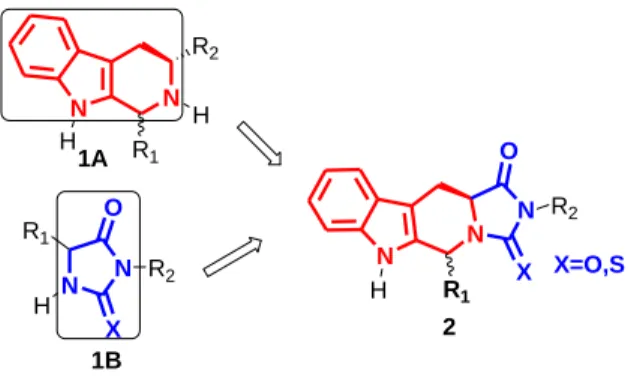
1.10. Tetrahydro-β-carbolines and its hydantoin derivatives, importance and synthesis………..42
1.11. Chemical methods for synthesizing Hydantoin Analogs Tethered with Tetrahydro-β-Carbolines………. …....44
1.12. Results and Discussions……….. …....49
1.13. Dihydro and Tetrahydroquinazoline derivatives and its importance and synthesis……….. ………....58
1.14. Chemical methods for synthesizing Dihydro and Tetrahydroquinazoline Derivatives………. ………...59
1.15. Results and Discussion………...62
1.16 Conclusion………...70
1.17. General Methods………...71
1.18. Experimental Section………. …...72
1.19. References……….. …...97
Chapter Two Novel Approach Toward Synthesis of Skeletally Diverse
Benzimidazole-pyrrolo[1,2-a]quinoxaline
by
S
NAr/Pictet-Spengler
Reaction and
Benzimidazole-(alkyloxy)-4-oxo-4,5-dihydropyrrolo[1,2-a]quinoxalin by Partial Nitro Group Reduction Reaction.
2.0. Introduction………...1072.1. Different Causes Cancer………....108
2.1.2.Genetic factor leads to cancer……….108
2.2. Metastatic Cancer ………109
2.3. What is tumor angiogenesis………...109
2.4. The angiogenesis signaling cascade……….110
2.5. The VEGF ligand is the predominant regulator of tumor angiogenesis………...111
2.6. VEGF………...112
2.7. VEGF receptors………. ……….113
2.8. The strategies for inhibiting the VEGF pathway……….114
2.8.1. Extra cellular targeting of the VEGF ligand……….114
2.8.2. Intra cellular targeting of the VEGF receptor………...115
2.9. Lymphangiogenesis………...115
2.10. How cancer can be treated……….116
2.11. Small molecules as Cancer Inhibitor………...117
2.11.1 Gefitinib……….117
2.11.2. Erlotinib hydrochloride ………...117
2.11.3. Sunitinib ………...118
2.11.4. Sorafenib………...118
2.11.5. lapatinib………...119
2.12 .Protein Lysine Methyltransferase G9a Inhibitors ………...119
2.13. Soluble Polymer Supported Organic Synthesis………...121
2.13.1. Application and recent development of polyethylene glycol as Soluble support in organic synthesis………122
2.14. Pyrrolo[1,2-a]quinoxalines its importance and synthesis ……….127
2.15. Various method of preparation of Pyrrolo[1,2-a]quinoxalines derivatives ………...128
2.16 Results and Discussions……… ………….134
2.17. Pyrrolo[1,2-a]quinoxalinones its importance and synthesis………..132
2.18 Result and Discussion ………156
2.19 Conclusion………..163
2.20. General remarks..………...164
2.21. Experimental Section ………165
2.22 References………...206
Chapter Three: Synthesis of Skeletally Diverse
benzimidazole-imidazo[1,2-a]-pyridine via Ugi-Multicomponent Reaction in Neat
Condition
3.0. Multicomponent Reactions………...2153.1. History and Types Multicomponent Reactions………216
3.2. Nature of multicomponent reaction ………...217
3.3. Strecker amino acid synthesis………...217
3.3.1. Reaction Mechanism ………...218
3.4. Biginelli Reaction………...218
3.5. Passerini reation ………....219
3.6. Ugi Reaction ………...221
3.6.1. Ugi-Diels-Alder reaction ………222
3.6.2. Ugi-Smiles reaction ………223
3.6.3. Ugi-Buchwald-Hartwig reaction………...224
3.6.4. Ugi-Heck reaction ………...224
3.7. Solvent-free synthesis………225
3.8. Benzimidazole-Imidazo[1,2-a]pyridine, importance and synthesis…………...228
3.9. Chemical methods for synthesizing imidazo[ 1,2-a]pyridines………...230
3.10. Result and Discussion ………....235
3.11 Conclusion………243
3.12 Experimental section………245
3.13 References………269
Chapter Four : Synthesis of Chemically Modified Andrographolide
analogs for suppression of NF-κB Activation,TNF-alpha and NO
Expression
4.0. Andrographolide and Andrographolide analogues its importance and synthesis ………..2744.1. Medicinal use ………...274
4.2. Anti-inflammatory………...275
4.3. Anti-cancer……….. ………...275
4.4. Anti-diabetic agents………....276
4.5. Antiviral ………...276
4.7. Application of andrographolide and its analogs for potential targets ………281 4.8. Conclusion………. 4.9. Experimental Section ………289 4.10 References………...287 APPENDIX...A-V
LIST OF FIGURES
Figure 1.0 Sources of production of pollutions………....1 Figure 1.1. Mechanism of Aqueous Microwave Chemistry………...10 Figure 1.2. Types of cations and anions in ionic liquids………....20 Figure 1.3. Ionic-liquid-supported synthesis: (a) catalyst; (b) reagent; (c) substrate.24 Figure 1.4. Conceptual Derivation of New Scaffold ………43 Figure 1.5. Representative Examples of Biological Active Hydantoin Analogs Tethered with Tetrahydro-β-Carbolines………...43 Figure 1.6. Stepwise Monitoring towards the Formation of Tetrahydro-β-carboline Fused Oxo and Thio Hydantoin Analogues on Ionic Liquid Support in CDCl3
as solvent at 25 0C. ………..54 Figure 1.7. Some Important NOE Interactions in 6l trans Isomer………...57 Figure 1.8. Representative examples of biologically active quinazoline derivatives..59 Figure 1.9. Stepwise formation of the ionic liquid bound intermediate in CDCl3 at 250C 9i. ………....66 Figure 2.0. Defination of Cancers………...107 Figure 2.1. Malignant Vs Benign tumors,………...109
Figure 2.2. Tumor Angiogenesis……….110
Figure 2.3. The angiogenesis signaling cascade ………111
Figure 2.4. VEGF ligand for tumor angiogesis………...112
Figure 2.5. VEGF ligand and receptors………...114
Figure 2.6. Angiogenesis and lymphogenesis………...116
Figure 2.7. Histone K methylation………...120
Figure 2.8. BIX 01294 is a selective histone methyl transferase inhibitor…………...120
Figure 2.9. Different Soluble Supports used in Small Molecule Organic Synthesis..122
Figure 2.10. Different PEG Soluble Supports………...122
Figure 2.11. Representative examples of biologically active pyrrolo[1,2-a]quinoxalines. ……….128
Figure 2.12. Stepwise Monitoring towards the Formation of Benzimidazole-pyrrolo[1,2-a]quinoxaline on PEG Support in CDCl3 as solvent at 25 0C. ………....146
Figure 2.13. ORTEP diagram of compound 10h and 10g………148
Figure 2.14. Representative examples of biologically active pyrrolo[1,2-a]quinoxalineone………..152
Figure 2.15. Stepwise Monitoring towards the Formation of Benzimidazole-alkoxy-pyrrolo[1,2-a]quinoxalineone on PEG Support in CDCl3 at 25oC………..160
Figure 2.16. X-ray crystallographic structure of of the Benzimidazole-Pyrrolo[1,2-a]quinoxalineone 21k……… .163
Figure 3.0 Diagram of Multicomponent Reaction ……….216
Figure 3.1. Representative examples of biologically active Imidazo[1,2-a]pyridine and benzimidazole compound………....229
Figure 3.2 Stepwise formation of compound 2 to 10g in CDCl3 as solvent at 25 0C 239
Figure 3.4 ORTEP diagram of compound 10c. ……….239
Figure 4.0. Andrographolide plant ……….274
LIST OF SCHEMES
Scheme 1.0 Suzuki cross Coupling reaction in water………...12Scheme 1.1. Vanelle et al .Suzuki cross coupling reaction in water………...12
Scheme 1.2. Zhu et al .Suzuki cross coupling reaction in water………....13
Scheme 1.3. Leadbeater et al .Heck cross coupling reaction in water………...13
Scheme 1.4. Larhed et al .Heck cross coupling reaction in water……….13
Scheme 1.5. Eycken et al . Stille cross coupling reaction in water………...14
Scheme 1.6. Arfan et al . Stille cross coupling reaction in water……….14
Scheme 1.7. Eycken et al . Stille cross coupling reaction in water………...14
Scheme 1.8. Pironti et. al. used the microwave assisted reaction for beta-Hydroxy sulfides………….. ……….16
Scheme 1.9. Verma et. al. used the microwave assisted reaction for Heterocyclic analogs ………...16
Scheme 1.10. Grotli et. al. used the microwave assisted reaction in water for the synthesis of spiro-2,5 diketopiperazines or Heterocyclic analogs………..17
Scheme 1.11. Kidwai et. al. accomplished the synthesis of benzopyrano[4,3-c]pyrazoles using the microwave assisted reaction in water……….17
Scheme 1.12. Tu et. al. developed the multicomponent synthesis of Indenoquinoline using the microwave assisted reaction in water……….18
Scheme 1.13. Zang et. al. has accomplished the synthesis bioactive heterocyclic
derivatives using microwave irradiation ………18
Scheme 1.14. Mechanistic pathway in Cross coupling reaction……… …25
Scheme 1.15. Palladium catalysed Heck arylation. ………25
Scheme1.16. Knoevenagel Condensation in ionic liquid medium………...26
Scheme 1.17. [2+4] Diels alder reaction using ionic liquid as a solvent……….26
Scheme 1.18. Olefin Epoxidation using ionic liquid as solvent………...26
Scheme 1.19. Friedlander Synthesis in ionic liquid medium. ...27
Scheme 1.20. Ring closing metathesis in ionic liquid medium. ……….27
Scheme 1.21. Carbonyl group protection in ionic liquid medium ………..28
Scheme 1.22. Swern oxidation using ionic liquid tethered dimethyl sulfoxide……..28
Scheme 1.23. Phosphonium salts catalyses the organic reaction ………...29
Scheme 1.24. Ionic liquid supported catalyst ………...29
Scheme 1.25. Catalytic activity of Ionic liquid supported catalyst. ………30
Scheme 1.26. IL-supported catalysts for the ring-closing metathesis (RCM) of olefins.30 Scheme 1.27. Tosylation of ketones using ionic-liquid as supported reagents ……....31
Scheme 1.28. IL supported synthesis of small molecules……….32
Scheme 1.29. Ionic Liquid supported synthesis of H……….. 33
Scheme 1.30. Ionic liquid supported Diels-Alder reaction ………...34
Scheme 1.31. Ionic Liquid Supported Suzuki coupling reactions………....34
Scheme 1.32. Ionic Liquid Supported synthesis of small library of 4-thiazolidinones.35 Scheme 1.33. Ionic liquid supported synthesis of Leu5-enkephalin……….35
Scheme 1.35. Synthetic cycle of oligonucleotides ………..37
Scheme 1.36. Synthetic cycle of tetrahydropyrano and tetrahydrofuranoquinolines. 37 Scheme 1.37. Synthesis of pyran derivatives……….. 38
Scheme 1.38. 3,4-dihydropyrimidin-2-(1H)-ones (DHPMs). ……….38
Scheme 1.39. Typical Pictet-Spengler Reaction………. 39
Scheme 1.40. Mechanism of Pictet-Spengler cyclisation………... 40
Scheme 1.41. Pictet-Spengler Reaction used for the synthesis of Tetrahydroisoquinoline derivatives ………41
Scheme 1.42. N-acyliminium ion mediated Pictet-Spengler cyclisation. …………...41
Scheme 1.43. Traceless synthesis of diketopiperizine fused tetrahydro-β-Carbolines on solid phase by Ganesan’s ………...44
Scheme 1.44. Ganeshan’s method of traceless synthesis of hydantoin fused tetrahydro-β-Carbolines on solid phase………...45
Scheme 1.45. Meldel’s method of traceless synthesis of tetrahydro-β-Carbolines on solid phase………. .46
Scheme 1.46. Youn’s method for the synthesis of tetrahydro-β-Carbolines and isoquinoline………. .46
Scheme 1.47. Sun’s method for the synthesis of hydantoin fused tetrahydro-β-Carbolines on Polyethylene glycol as soluble support………. .47
Scheme 1.48. Sun’s method for the synthesis of hydantoin fused tetrahydro-β-Carbolines on Fluorous tagged as support………..48 Scheme 1.49. Synthesis of hydroxyl ethyl methyl imidazolium tetrafluoroborate 1c49 Scheme 1.50. Ionic Liquid Supported Synthesis of Hydantoin Fused
tetrahydro-β-Carbolines. ……….50
Scheme 1.51. Saito’s Carbodiimide-Mediated Synthesis of Dihydroquinazolines….60 Scheme 1.52. Hulme’s solution phase approach to Dihydroquinazolines………60
Scheme 1.53. Patil’s gold (I)-catalyzed synthesis of tetrahydroquinazoline derivatives.61 Scheme 1.54. Microwave assisted synthesis of dihydroquinazoline derivatives by Prajapati………... 61
Scheme 1.55. Ionic liquid supported synthesis of o-phenylenediamine. ………...63
Scheme 1.56. Microwave Assisted Synthesis of Dihydroquinazoline synthesis…... 63
Scheme 1.57. Microwave Assisted Synthesis of Tetrahydroquinazoline synthesis…...64
Scheme 1.58. General plausible mechanism towards the formation of Dihydroquinazoline Derivatives on ionic liquid support……… 65
Scheme 2.0 Asymmetric hydroxylation using PEG supported catalyst ………124
Scheme 2.1. Grubbs catalyst in PEG support ………124
Scheme 2.2. PEG supported IBX reagent ……….125
Scheme 2.3. Synthesis of sulfonamide in PEG support. ………...126
Scheme 2.4. Synthesis of peptide by PEG support. ………..126
Scheme 2.5. Synthesis of guanidine and urea functional group ………....127
Scheme 2.6. Synthesis of pyrrolo[1,2-a]quinoxalines………129
Scheme 2.7. Synthesis of pyrrolo[1,2-a]quinoxalines by Campiani ………129
Scheme 2.8. Synthesis of pyrrolo[1,2-a]quinoxalines by Vidaillac………... ...130
Scheme 2.9. Synthesis of pyrrolo[1,2-a]quinoxalines by PtBr2 catalysed reaction by Patil ………...130
Scheme 2.11. Synthesis of pyrrolo[1,2-a]quinoxalines by Au catalysed reaction….. ..131 Scheme 2.12. Synthesis of pyrrolo[1,2-a]quinoxalines by Au catalysed reaction…….132 Scheme 2.13. Synthesis of indolo-fused pyrazino-/diazepinoquinoxalinones on PEG support ………...133 Scheme 2.14. Synthesis of benzimidazole linked indolo-benzodiazepine/quinoxaline on PEG support………133 Scheme 2.15. PEG supported synthesis of o-phenylenediamine 4. ………134 Scheme 2.16. Mechanism of formation of compound 2 on soluble support ………..135 Scheme 2.17. Mechanism of formation of compound 4 on soluble support………. 136 Scheme 2.18. PEG supported synthesis of o-nitrofluoro benzimidazol derivatives 6.137 Scheme 2.19. Mechanism of formation of compound 5 on soluble support ………..138 Scheme 2.20. Mechanism of formation of compound 6 on soluble support ………..139 Scheme 2.21. Retrosynthetic pathway for the synthesis of
pyrrolo[1,2-a]quinoxalines ………
………….139
Scheme 2.22 Acid catalyzed Pictet-Spengler cyclization……….. 142 Scheme 2.23. Novel microwave assisted polymer supported approach for the
synthesis of benzimidazole-pyrrolo [1,2-a] quinoxalines……….. 143 Scheme 2.24. Plausible Pictet-Spengler like cyclization mechanism
towards the formation of pyrrolo[1,2-a]quinoxalines 9 on polymer support. ………144 Scheme 2.25. Novel microwave assisted polymer supported approach
for the synthesis of benzimidazole-indolo [1,2-a] quinoxalines. ………...150 Scheme 2.26. Synthesis of benzimidazole-pyrrolo[1,2-a]quinoxalines
via metal-mediated one-pot domino reactions………. 151
Scheme 2.27. Synthesis of benzimidazole-pyrrolo[1,2-a]quinoxalinones Gullion…153 Scheme 2.28. Synthesis of benzimidazole-pyrrolo[1,2-a]quinoxalinones by Varvounis……….. 153
Scheme 2.29. Synthesis of pyrrolo[1,2-a]quinoxalinones by Beccalli………. 154
Scheme 2.30. Synthesis of pyrrolo[1,2-a]quinoxalinones via Ullmann coupling methods by Ma………..155
Scheme 2.31. Novel Microwave-Assisted Polymeric Approach to Benzimidazole-Pyrrolo [1,2-a] quinoxalines………..157
Scheme 2.32. Partial Nitro reduction to Benzimidazole-N-hydroxypyrrolo[1,2-a]quinoxalineone 19 ………158
Scheme 3.0 Strecker amino acid synthesis…………..………...217
Scheme 3.1. Mechanism of strecker amino acid synthesis………. ..218
Scheme 3.2. Biginelli multicomponent reaction ………...219
Scheme 3.3. Passerini multicomponent reaction ………..220
Scheme 3.4. Mechanism of passerini multicomponent reaction ………..220
Scheme 3.5. Ugi multicomponent reaction………221
Scheme 3.6. Mechanism of Ugi multicomponent reaction………222
Scheme 3.7. Example of Ugi Diels-Alder reaction………223
Scheme 3.8. Example of Ugi-Smiles reaction………223
Scheme 3.9. Example of Ugi-Buchwald-Hartwig reaction………224
Scheme 3.10. Example of Ugi-Heck reaction. ………...225
Scheme 3.12. Solvent free synthesis of 3,4-dihydropyrimidinones………226
Scheme 3.13. Solvent free synthesis of Glassier reaction. ………227 Scheme 3.14 Solvent free synthesis of SnAr reaction. ………..228 Scheme 3.15. Solvent free synthesis of imidazo[ 1,2-a] annulated pyridines,
pyrazines and pyrimidines derivaties by Verma ………..230 Scheme 3.16. Preparation imidazo[1,2-a]pyridine library on a solid support ……..231 Scheme 3.17. Preparation imidazo[1,2-a]pyridine library by Ireland ………...231 Scheme 3.18. Zhuang et. al. methods for the synthesis of imidazo[1,2-a]pyridine Library………. ..232 Scheme 3.19. Preparation imidazo[1,2-a]pyridine library by Masquelin…………...232 Scheme 3.20. Preparation imidazo[1,2-a]pyridine library by Guwiffier …………...233 Scheme 3.21. Preparation imidazo[1,2-a]pyridine library by Kamal………...233 Scheme 3.22. Preparation imidazo[1,2-a]pyridine library by DiMauro ………234 Scheme 3.23. Preparation imidazo[1,2-a]pyridine library by Kianmeh………….. ..235 Scheme 3.24 General strategy of microwave assisted synthesis of substituted
o-phenylene diamine………...236 Scheme 3.25. General strategy of microwave assisted synthesis of substituted
benzimidazole-imidazo[1,2-a]-pyridine………..237 Scheme 3.26. Plausible mechanism towards the formation of amide bonds……. ...238 Scheme 3.27. Plausible Ugi like reaction mechanism towards the formation of
benzimidazole-imidazo[1,2-a]-pyridine………...241 Scheme 4.0. Synthesis of diacetylated andrographolide analog ………...277 Scheme 4.1. Synthesis of 3,19-Isopropylideneandrographolide analog …………....278
Scheme 4.2. Synthesis of andrographolide analog ………...278 Scheme 4.3. Synthesis of dehydrated andrographolide analog………. ....279 Scheme 4.4. Synthesis of epoxy substituted andrographolide analog ………...279 Scheme 4.5. Synthesis of tri and diacetyled andrographolide analogs 17 and 18...280
LIST OF TABLES
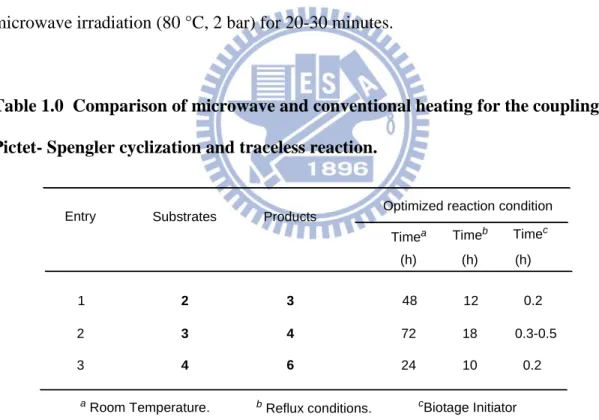
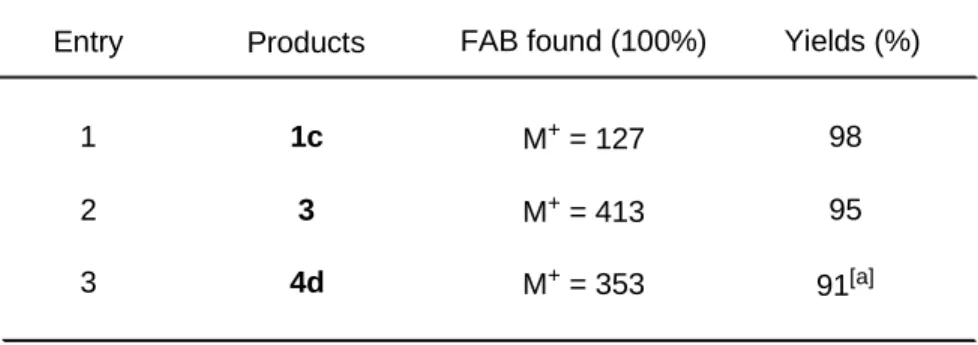
Table 1.0 Comparison of microwave and conventional heating………...51 Table 1.1. Mass Spectral Study of Ionic-Liquid Supported Intermediates………...55 Table 1.2. Microwave Assisted, Ionic-Liquid Supported Synthesis of Tetrahydro-β-carboline hydantoin and thio hydantoins (6a-6n)………...56 Table 1.3. Comparison of Microwave and Conventional Heating………67 Table 1.4. Mass Spectral Study of Ionic-Liquid Supported Intermediates………...68
Table 1.5. Microwave Assisted, IL Supported Synthesis of Di-hydroquinazolines Tetrahydroquinazolines (13a-q)……….69 Table 2. 0. VEGF family and its receptors along with functions……….113 Table 2.1. Reaction optimization for the SNAr reaction of pyrrole………..142 Table 2.2. Synthesis of benzimidazole-pyrrolo[1,2-a]quinoxaline
derivatives (10a-10r)………...148 Table 2.3. Synthesis of benzimidazole-pyrrolo[1,2-a]quinoxalinone derivatives (21a-21o)……….162 Table 3.0 Synthesise of Benzimidazole- Imidazo[1,2-a]pyridine in neat condition under microwave irradiation………...242 Table 4.0 Tabular form of Andrographolide analogs………281
Chapter One
Ionic Liquid Supported Synthesis of Hydantoin Fused
Tetrahydro-β-carbolines in Green Media and Dihydroquinazoline and
Tetrahydroquinazolins in Organic Media under Microwave Irradiation
1.0 Introduction
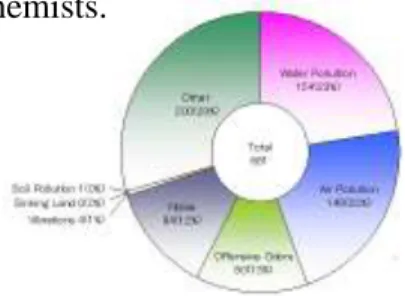
The twenty-first century presents us with numerous interconnected challenges like the relationship between industry and natural system amongst one of them. Industrial measures have conventionally gone hand-in-hand with material processes that cause peril to the health of people and other living beings, both in the immediate present (e.g. environment destruction, toxic pollutants,) and in the future (e.g. persistent toxicants, climate change) as showin Figure 1.0. Generally, this has been the result of a tendency to neglect the context of industrial operations within the bigger systems of ecology and society.1-2 As chemists, we should be prepare to tackle this problem. The sciences of chemistry locate to contribute critical tools for redesigning environmental construction. New resources and technologies for industrial and consumer uses are routinely urbanized on the molecular level by chemists.
Figure 1.0 Sources of production of pollutions. Courtesy. “White Paper on Environment
Simultaneously we should think about toxicity, safety, environmental providence and lifecycle along with function. To develope new substances and technologies we should think about how much it is environment friendly and how much it is cost effective. Also we should learn how to eradicate waste before it is generated, by developing materials that are integrated into material cycles by plan.3 Green chemistry is now a days highly applicable research areas that have a enormous prospective for beneficial impact in human society since common consumer products increasingly being concerned as health hazards and with global chemical production taking place on the scale of billions of tons per year.4-5
1.1. Green Chemistry for Sustainable Development
In this new century, it has been well known that sustainable growth is the keystone of different scientific progress. By converting old technologies into new clean processes and by designing latest products with new eco-compatible processes are the key challenges of chemical sciences. In order to stop problems in the future, green chemistry, is the new direction of chemistry, whose endeavor is to correct everything nearby practices.6-7 The most important environmental organization, heavy industry and the world of chemistry in broad-spectrum, are developing and following ways focused on particular strategies for pollution avoidance. Green chemistry basically refers to the new sustainability precedence in technological and scientific innovation, on the basis of general rules stressing the need to discard harmful products and processes. Some strategies which can be adopted are
2. Minimisation of power consumption, e.g. at ambient temperature and pressure. 3. Use of raw materials taken from renewable resources.
4. Whenever feasible, substitution of old compounds with others which maintain their functional efficiency while reducing their toxic impact on the environment and human health.8-11
1.2. Different definition of Green Chemistry
Green Chemistry is the design of chemical products and processes that reduce or eliminate the use and subsequent generation of hazardous substances in reaction pathway. Green Chemistry relies on a set of 12 principles that can be used to design or re-design molecules, materials and chemical transformations to be safer for human health and the environment.
The basic philosophy of Green chemistry is that research, techniques and the end results of studies should be as ecologically sound as possible. This field looks at the protection of natural possessions, the environmental impact and the prevention of ecological problems. Moreover, this chemistry is entirely different from environmental chemistry, which is the chemical study of the natural environment.
Green chemistry, also called sustainable chemistry, that support the design of products and processes which reduce the use and generation of hazardous substances. Green chemistry applies to organic chemistry, inorganic chemistry, biochemistry, analytical chemistry, and even physical chemistry. While green chemistry seems to focus on industrial applications, it does apply to any chemistry choice.
Green chemistry applies across the life cycle of a chemical product, including its design, manufacture, and use.12-13
1.3. The Twelve Principles of Green Chemistry
Prevent Waste
To resist pollution prevention, the chemist is to redesign the chemical transformations in order to minimize the generation of hazardous waste. By preventing waste generation, we can minimize hazards substances associated with waste storage, transportation and treatment.
Maximize Atom Economy
Atom economy is a concept, developed by Prof. B. M. Trost of Stanford University that evaluates the efficiency of a chemical transformation. Similar to a yield calculation, atom economy is a ratio of the total mass of atoms in the desired product to the total mass of atoms in the reactants. In order to minimize waste, we need to redesign efficient chemical transformations which maximize the incorporation of all starting materials used in the process into the final product.
Design less Hazardous Chemical Synthesis
Wherever practicable, synthetic methodologies should be designed to use and generate substances that possess no toxicity to human health and the environment. The goal is to use less hazardous reagents whenever possible and design processes that do not produce hazardous by-products. This principle focuses on choosing reagents that pose the least risk and generate only benign by-products.
Design Safer Chemicals and Products
Chemical products should be designed to affect their desired function while minimizing their toxicity. Toxicity and ecotoxicity are properties of the product. New products can be designed that are inherently safer, while highly effective for the target application. In academic labs this principle should influence the design of synthetic targets and new products.
Use Safer Solvents/Reaction Conditions
The use of auxiliary substances such as solvents, separation agents should be made unnecessary wherever possible when used. Solvent use leads to considerable waste. Reduction of solvent volume or complete elimination of the solvent is often possible. In cases where the solvent is needed, less hazardous replacements should be employed. Purification steps also generate large amounts of solvent and other waste.
Increase Energy Efficiency
Energy requirements of chemical processes should be recognized for their environmental and economic impacts and could be designed for ambient temperature and pressure, so that energy costs associated with extremes in temperature and pressure are minimized.
Use Renewable Feedstocks
Whenever possible, chemical transformations should be designed to utilize raw materials and feedstocks that are renewable. Examples of renewable feedstocks include agricultural products or the wastes of other processes. Examples of depleting feedstocks include raw materials that are mined or generated from fossil fuels (petroleum, natural gas or coal).
Avoid Chemical Derivatives
Use of blocking groups such as protection/deprotection, and temporary modification of physical/chemical processes should be minimized or avoided if possible, because such steps require additional reagents which can generate waste. More selective synthetic transformations will eliminate or reduce the need for protecting groups. In addition, alternative synthetic sequences may eliminate the need to transform functional groups in the presence of other sensitive functionality.
Use Catalysts
As we know that catalytic reagents are superior to stoichiometric reagents which can serve several roles during a transformation. They can enhance the selectivity of a reaction, reduce the temperature of a transformation, enhance the extent of conversion to products and reduce reagent-based waste.
Design for Degradation
Chemical products should be designed so that at the end of their function they break down into innocuous degradation products of hazardless substances and do not persist in the environment.
Analyze in Real-Time to Prevent Pollution
It is always important to monitor the progress of a reaction for completion or to detect the formation of any unwanted by-products. Whenever possible, analytical
methodologies should be developed and used to allow monitoring and control to minimize the formation of unnessery by-products.
Minimize the Potential for Accidents
One way to minimize the potential for chemical accidents is to choose reagents and solvents that minimize the potential for explosions, fires and accidental release. So finally, the condesed principles of green chemistry. Twelve principles of green chemistry written in the form of a mnemonic PRODUCTIVELY14-16
P-Prevent wastes
R-Renewable materials
O-Omit derivatization steps
D-Degradavle chemical products
U-Use safe synthetic methods
C-Catalytic reagents
T-Temperature pressure ambient
I-In-press monitoring
V-Very few auxiliary substances
E-E factor, maximize feed in product.
L-Low toxicity of chemical products
Y-Yes, it is safe.
1.4. Montreal Protocol
The Montreal practice has forced many industries and organizations to reconsider their chemical processes, due to the adverse environmental impact caused by the use of volatile organic solvent, by endowing into a clean technology that reduces waste and by-products from an industrial process to a smallest amount.17-22
There appears to be four main alternative strategies
(1) solvent-free synthesis
(2) The use of water as a solvent
(3) The use of supercritical liquids as solvents (4) The use of ionic liquids as solvents
1.5. Solvent-free synthesis
It has been perceived that evading the use of volatile organic solvents in organic synthesis can reduce the environmental contamination and even be more convenient than using solvent-based synthesis. Since we are living in society, so we should more aware of the environmental impact of human activity, and accordingly of the need to develop cleaner and extra energy-efficient technologies for organic synthesis. It has been recognised that the large-scale use of volatile organic solvents in synthesis has significant implication for environmental pollution. It has also been thought that „the best solvent when there is no solvent use in the syntheses‟. In spite of the power of this announcement, our use and understanding of solvent-free synthesis, especially where solid starting materials are concerned, has stay behind undeveloped in contrast to solvent based methods. As solvent-free synthesis turn into morewidely examined many people are likely to be impressed at the series of reactions, even among solid starting materials. 23a-b
1.6. Water, the Unique Reaction Medium
Water which is best solvent worn out by nature for biological chemistry. It is noteworthy that until recently in vitro organic synthesis has mainly avoided water and chemists and industries have been searching for suitable organic solvents, for example, the substitute of the previous commonly used benzene with toluene, etc. Organic chemists have been trained in such a manner that little serious consideration was given to water as a useful reaction solvent. This was perhaps partly the result of a combination of fear of the detrimental effects of hydrolysis and the influence of the ancient alchimia, which teaches that reactants must be in solution to produce a chemical reaction. 24
1.6.2. Is water the green solvent?
It is well known that „„green‟‟ solvents refers the goal to minimize the environmental impact resulting from the use of solvents in chemical production, thus recognizing green solvents is a top priority for the organic chemist. Use of no-solvent, i.e. solvent free reactions is another solution, however, this may work for only a few reactions; a lack of reaction medium may lead to overheating of the reaction mixture, in view of the poorly understood heat and mass-transfer issues. Using fluorous and ionic liquids along with aqueous systems and supercritical carbon dioxide, have shaped the main thrust of this progress. Thus, naturally abundant water appears to be a better option because of its non-toxic, non-corrosive and non-flammable nature. Also, water can be contained because of its relatively high vapor pressure as compared to organic solvents, which are favorable traits to render water as a sustainable alternative. 25
1.6.3. Microwaves chemistry in aqueous medium?
It has been observed that when water is rapidly heated to high temperatures under microwave irradiation, it act like a pseudo-organic solvent. Because of the very high heat capacity of water, precise control of the reaction temperature can be achieved efficiently. MW-enhanced chemistry is based on the efficiency of the interaction of molecules in a reaction mixture with electromagnetic waves generated by a „„microwave dielectric effect‟‟. This process mainly depends on the specific polarity of molecules. Since water is polar in nature, it has good potential to absorb microwaves and convert them to heat energy, thus accelerating the reactions in an aqueous medium as compared to results obtained using conventional heating. This can be explained by two key mechanisms: dipolar polarization and ionic conduction of water molecules (Figure 1.1). Irradiation of a reaction mixture in an aqueous medium by MW results in the dipole orientation of water molecules and reactants in the electric field. This causes two distinguishing effects: (i) Specific microwave effect: the electrostatic polar effects which produce the dipole–dipole type interaction of the dipolar water molecules and reactants with the electric field component of MW, resulting in energy stabilizations of an electrostatic nature.26
Figure 1.1. Mechanism of Aqueous Microwave Chemistry. Courtsey. “Polshettiwar, V.;
It is noteworthy to mention that various organic reactions can be conducted in an aqueous medium using MW irradiation, without using any phase-transfer catalyst (PTC). This is because water at higher temperature behaves as a pseudo-organic solvent, as the dielectric constant decreases substantially and an ionic product increases the solvating power towards organic molecules to be similar to that of ethanol or acetone.27-28
1.6.4. How does aqueous microwave chemistry expedite organic synthesis?
MW-assisted chemistry has blossomed into a useful technique for a variety of applications including drug discovery and organic synthesis. Although MW-assisted reactions in organic solvents have developed rapidly, the focus has now shifted to the more environmentally benign methods, which use greener solvents and supported renewable catalysts. There are many examples of the successful application of MW-assisted chemistry to organic synthesis; these include the use of benign reaction media, solvent-free conditions, and the use of solidsupported and reusable catalysts. To illustrate the advantages of aqueous MW chemistry in rapid and greener organic synthesis, we have reviewed some representative reactions/synthetic pathways developed in recent years in aqueous reaction medium using microwave irradiation.29-31
1.6.5. Microwave assisted coupling reactions in water medium
C-C bond forming cross-coupling reactions are one of the most important processes in organic chemistry. The Heck and Suzuki reactions are among the widely used reactions for the formation of carbon–carbon bonds. These reactions are generally catalyzed by
N N NO2 O2S + B(OH)2 Br N N NO2 O2S Pd(PPh3)4, Na2CO3 H2O, MW-105 oC, 1h
soluble palladium (Pd) complexes with various ligands. However, we have observed that the efficient separation and subsequent recycling of homogeneous transition-metal catalysts remains a scientific challenge and an aspect of economical and ecological relevance. Heterogeneous Pd catalyst systems were found to be highly effective in overcoming some of these issues. However, microwave -assisted coupling reactions in aqueous medium is a fascinating choice of chemists.32-34 Leadbeater et. al have accomplished the Suzuki reactions using various biaryl derivatives from aryl halides and phenylboronic acid in aqueous medium using MW irradiation as shown in Scheme 1.0.35
X
R
B(OH)2 +
X= Cl, Br, I R= Me, OMe, COMe
Pd(OAc)2, Na2CO3, TBAB H2O, MW-150 OC, 5 min
R
Scheme 1.0 Suzuki cross Coupling reaction in water.
Similarly, Vanelle et al. has accomplished an aqueous protocol for Suzuki coupling reaction that involves the reaction of heterocyclic imidazo[1,2-a]pyridines with a range of arylboronic acids under MW irradiation conditions as observed in Scheme 1.1.36
Scheme 1.1. Vanelle et al .Suzuki cross coupling reaction in water.
Concurrently, in Scheme 1.2. Zhu et. al. have synthesised the 5-Aryltriazole acyclonucleosides with various aromatic groups on the triazole ring via the Suzuki coupling reaction in aqueous solution by MW irradiation. 37
N N N NH2 O Br O HO + B(OH)2 Pd(PPh 3)4, K2CO3 H2O, MW-120 oC, 15 mins N N N NH2 O O HO Br R +
R-Me, OMe, COMe
Pd, Na2CO3, TBAB H2O, MW-170oC, 10 mins R Br R + O R-Me, OMe, COMe
Pd(OAc)2, dppp, K2CO3 H2O, MW-90 oC, 80 mins OH O R OH H+ R O
Scheme 1.2. Zhu et al .Suzuki cross coupling reaction in water.
With a view to enhance the diversity, Leadbeater et. al. has performed the Heck coupling reaction in water using MW heating with Pd-catalyst in Scheme 1.3.38
Scheme 1.3. Leadbeater et al .Heck cross coupling reaction in water.
Recently, Larhed et. al. has reported the highly regio-selective and fast Pd(0)-catalyzed internal R-arylation of ethylene glycol vinyl ether with aryl halides in aqueous medium under microwave irradiation in Scheme 1.4. 39
N N O Cl Cl Ph4Sn, Pd(PPh3)4 H2O, MW N N O Cl N N O NH2 KMnO4, H2O N NH O MW Br + TBAB, Na2CO3 H2O, MW-175 oC
Similarly, as shown in Scheme 1.5. Eycken et. al. has developed the Stille cross coupling reaction between organo-tin compounds and aryl halides in aqueous medium under MW irradiation. 40
Scheme 1.5. Eycken et al . Stille cross coupling reaction in water.
In this report, Arfan et. al. has developed the MW-Assisted deamination of aryl 3-amino-4(3H)-quinazolinone derivatives in as shown in Scheme 1.6. using potassium permanganate as an oxidant in aqueous medium under microwave irradiation.41
Scheme 1.6. Arfan et al . Stille cross coupling reaction in water.
Analogously, Eycken et. al. has developed the sonogashira cross-coupling reaction as shown in Scheme 1.7. of`terminal acetylenes with aryl or vinyl halides for the creation of carbon–carbon bonds in aqueous medium under MW irradiation. 42
1.7. The use of aqueous microwave chemistry for drug discovery
As we know that human life basically depends upon the drug discovery research to fight against various new diseases. However, current protocols for drug discovery are not sustainable with the adverse environmental impact. In drug discovery a variety of techniques such as combinatorial synthesis, parallel synthesis, and automated medicinal chemistry have been developed to increase the pharmaceutically active chemical entities. Although we have observed that most of these techniques are rapid and productive, they generate significant quantities of chemical waste, forcing us to develop new methods with reduced environmental impact. The use of water as a non-toxic reaction medium, together with the microwave heating appears to be promising and enables greener alternatives to thywart this issue. In both lead identification and lead optimization processes, there is a great demands for new small organic molecules. However, the conventional methods of organic synthesis are too slow to satisfy the demand for generation of such compounds. The combinatorial and automated medicinal chemistry have emerged to meet the ever increasing demands of new compounds for drug discovery. The synthetic chemistry community has been under intense pressure to produce, the important substances required by society in a short span of time with an environmentally benign fashion. One of the alternatives is using MW technology. The efficiency of MW flash-heating has resulted in dramatic reductions in reaction times. which is potentially important in traditional medicinal chemistry for the assembly of heterocyclic systems. As we know that Nitrogen heterocycles are abundant in nature and are of great significance to life because theirimportant bio properties. 43-45
O + HS NaOH/H2O MW S OH tert-ButOOH MW S OH O + S OH O R NH2 + X(CH2)nX K2CO3, H2O MW R N (CH2)n R NH2 X X + K2CO3, H2O MW R N R NHNH2 + X R1 X R2 K2CO3, H2O N N R2 R1 R
In the Scheme 1.8. Pironti et. al. has achieved the synthesis of beta-Hydroxy sulfides and beta-hydroxy sulfoxides by ring-opening of epoxide in aqueous medium.46
Scheme 1.8. Pironti et. al. used the microwave assisted reaction for beta-Hydroxy
sulfides
Similarly, Verma et. al. has accomplished the efficient synthesis of nitrogen-containing heterocycles, such as substituted azetidines, pyrrolidines, piperidines, azepanes, N substituted 2,3-dihydro-1H-isoindoles, 4,5-dihydropyrazoles, pyrazolidines, and 1,2-dihydrophthalazines, in a basic aqueous medium using MW in Scheme 1.9.47-49
Scheme 1.9. Verma et. al. used the microwave assisted reaction for Heterocyclic
analogs
Likewise, Grotli et. al. has accomplished an efficient synthesis of spiro-2,5 diketopiperazines (spiro-DKPs) by cyclization of Boc-protected dipeptides containing
BocHN O COOMe n m H2O, MW 160 oC, 10 mins N H H N O O n m O O OH + O H H2O MW O O O PhNHNH2.HCl K2CO3, H2O, MW O O N N
spiro-amino acids using MW heating in water in Scheme 1.10. 50
Scheme 1.10. Grotli et. al. used the microwave assisted reaction in water for the
synthesis of spiro-2,5 diketopiperazines or Heterocyclic analogs.
In Scheme 1.11. Kidwai et. al. has accomplished benzopyrano[4,3-c]pyrazoles by heterocondensation reaction between in situ generated 3-arylidene- 2,4-chromanediones and N-substituted hydrazine in water as a solvent under MW irradiation conditions 51
Scheme 1.11. Kidwai et. al. accomplished the synthesis of benzopyrano[4,3-c]pyrazoles
using the microwave assisted reaction in water.
Similarly, Tu et. al. has developed the synthesis of Indenoquinoline derivatives via three-component reaction between aldehydes, 1,3-indanedione and enaminones in aqueous medium in Scheme 1.12. 52
H O X HN N O H2N + O O O + H2O MW N H O HN N O H2N O X X=H,4-Cl, 4-br, 4-F, 4-Me 2-Cl, 2NO2 O O + S CHO + O HN p-TSOH/H2O MW N O O S S N Cl + SO2Na R O2N H2O, MW 100 oc, 30 mins S N O2S O2N R
R=H, Me, OMe, F,Cl, Br etc
Scheme 1.12. Tu et. al. developed the multicomponent synthesis of Indenoquinoline
using the microwave assisted reaction in water.
In Scheme 1.13, Zang et. al. has accomplished the synthesis of a series of related furo[30,40:5,6]pyrido[2,3-d]pyrimidine derivatives by three-component reactions between an aldehyde, 2,6-diaminopyrimidine-4(3H)-one, and tetronic acid/indane-1,3-dione, without using any catalyst53 and sulfonyl derivative of benzothiazole was using MW heating.54
Scheme 1.13. Zang et. al. has accomplished the synthesis bioactive heterocyclic
1.8. Introduction on ionic liquid
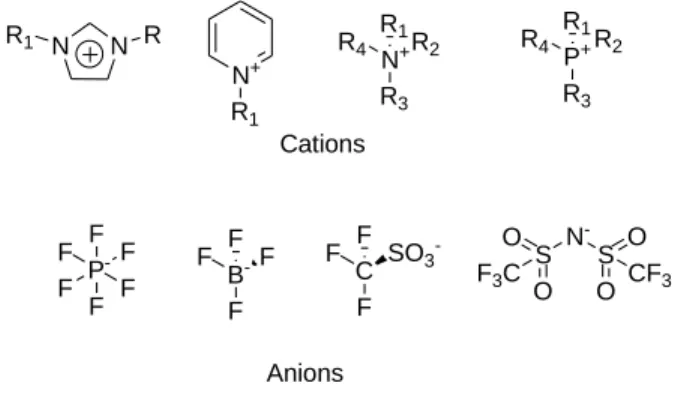
It has been established view that the melting points of salts are very high such as sodium chloride melts at 800°C. However, It has been found that there is a group of salts with melting points below 100 °C, are referred to as ionic liquids (ILs). Room-temperature ionic liquids (RTILs) are ILs with melting points at or below ambient temperature. The cationic parts of the majority ionic liquids are organic moieties such as imidazolium, N-alkylpyridinium, tetraalkylammonium, and tetraalkylphosphonium ions. The anionic parts preserve organic or inorganic and include such entities as a number of halides, nitrate, acetate, hexafluorophosphate (PF6), tetrafluoroborate (BF4), trifluoromethylsulfonate (OTf), and bis(trifluoromethanesulfonyl)imide (NTf2). Ionic liquids are liquids composed completely of ions as shown in Figure 1.2. . In the past two decades, ionic liquids have been widely used as “green solvents” replacing traditional organic solvents for organic synthesis and catalysis. Research in the field of ionic liquids (ILs) has developed exponentially in recent years. The necessaity to have unconventional solvents that are environmentally friendly, and can serve as effective replacement for conventional organic solvents, has driven extra growth. The ionic liquid has recently received more and more attention as eco-friendly reaction media in organic synthesis. There are innummerable reports have published on the potential use of RTILs as „neoteric solvents‟ for various chemical reactions. The use of VOCs poses a risk to those people working in or living close to such processing facilities. In addition VOCs have been greatly concerned in causing changes to the global climate, the formulation of smog as well as being identified as a source of ozone depletion.
N N R R1 Cations Anions N+ R1 N+R2 R3 R4 R1 P+R2 R3 R4 R1 P-F F F F F F B -F F F F C SO3 -F F F S N -S O O CF3 O O F3C
Figure 1.2. Types of cations and anions in ionic liquids
Moreover, ionic liquids possess the following attractive properties
1. They contain a liquid range of 300oC, allowing tremendous kinetic control.
2. They are outstandingly good solvents for a wide range of inorganic, organic and polymeric materials (but, fortunately, they do not dissolve polythene, PTFE or glass): high solubility implies small reactor volumes.
3. They exhibit bronsted, Lewis acidity, as well as super acidity. 4. They have no vapour pressure.
5. Their water sensitivity does not restrict their industrial applications. 6. They are thermally stable up to 200oC.
7. They are relatively cheap, and easy to prepare.
Ionic liquids are emerging as green solvents for chemical processes, because they combine good and tunable solubility properties with negligible vapor pressures and high thermal and chemical stabilities. They are used as reaction media, where they may enhance reaction rates and selectivities.55
1.8.1. History of Ionic Liquid:
The original report of a room-temperature ionic liquid appeared in 1914 with an examination by Paul Walden. By the mid 1990s, the basic understanding of the ionic liquids concept was well known in a narrow scientific community, mostly electrochemists, but this area of esoteric curiosity was of little interest, or too focused, for synthetic industrial applications. However there was a proposal that ionic liquids could be used for green chemistry and industrial chemistry. 56
1.8.2. Designer green solvents:
They are actually designer solvents: either the cation or the anion can be changed, if not at will, then certainly with considerable ease, in order to optimize such phenomena as the relative solubilities of the reactants and products, the reaction kinetics, the liquid range of the solvent, the cost of the solvent, the intrinsic catalytic behaviour of the media, and air-stability of the system. Ionic liquids have the potential to make ideal green solvents as they have negligible vapour pressure and do not evaporate into the atmosphere making them a more environmentally responsible material than traditional organic solvents. They can be recyclable and different combinations of ions make solutions that can dissolve a large range of substances that include coal, plastics, metals and rocks. Ionic liquids are relatively undemanding and inexpensive to manufacture. Ionic liquids can allow easy separation of organic molecules by direct distillation without losing any of the ionic liquid. The liquid range can be as large as 300oC which is higher than that of water and offers the potential for considerable kinetic control of extractive processes.57-58
1.8.3. Ionic Liquid for the synthesis of heterocyclic organic compound
The medicinal chemistry community has been under intense pressure to produce drugs required by society in short periods of time, in an environmentally benign fashion. Because of high molecular complexity in drug discovery processes accompanied by time constraints, the primary driver of pharmaceutical green chemistry has become the development of efficient and environmentally benign synthetic protocols. This can be achieved through the proper choice of starting materials, atom economic methodologies with a minimum number of chemical steps, the appropriate use of greener solvents and reagents, and efficient strategies for product isolation and purification. Thus, green chemistry has emerged as a discipline that permitts all aspects of synthetic chemistry. The global need for ionic liquids conventional organic solvents are used in a variety of industrial applications that include the production of pharmaceuticals, the manufacturing of electronic components, the processing of polymers, refrigeration and the synthesis of chemicals which includes Friedel-Crafts reactions, enzyme catalyzed reactions, hydrogenations, benzoylation, Heck reaction, Fischer indole synthesis, etc. RTILs are being looked upon as future commercial solvents. The acidic ionic liquids can act both as catalyst as well as solvent. This dual property of RTIL has turned out to be a boon in itself to carry out a variety of chemical transformations and is aptly given the name „designer solvent.59-60
•Organic chemistry: •Hydrogenation •Hydroformylation
•Alkoxycarbonylation
•Cross coupling (Heck, Suzuki, Negishi, Stille) •Allylic substitution
•Friedel-Crafts alkylation
•Bromination of aromatics/alkynes •Cyclopropanation
•Synthesis of 2,4,5-triaryl imidazoles
•Synthesis of 3,4-dihydropyrimidin-2(1H)-ones •Dimer-/Oligomer-/Polymerization
•Chiral solvent for asymmetric synthesis
Despite all those application now a day‟s ionic liquid are used for the synthesis of new heterocyclic compound. Although there are many publication where ionic liquid was used as a designer green solvent, there are few publication where ionic liquid was used as support. Research in the field where ionic liquid was used as a support is the challenging and one of the hot topics for the medicinal and organic chemist. Supported synthesis is a widely employed technique that has greatly facilitated the synthesis of many compounds and is the critical element behind the explosion in combinatorial synthesis61. In order to circumvent the drawback, most recently ionic liquid has emerged as alternative soluble support for carrying out the organic synthesis of biologically relevant compounds. An attractive feature of ionic liquids is that their solubility can be tuned readily. Therefore, phase separation from organic solvent or aqueous phase is allowed depending on the choice of cations and anions. This suggests the possibility of using these small molecular ionic liquids as soluble supports for organic synthesis. Ionic liquid attached substrates are
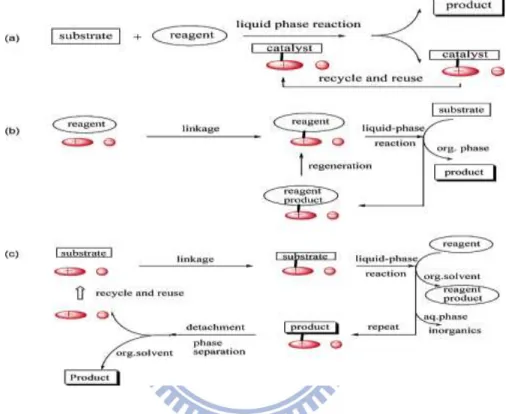
expected to retain their reactivity, as in solution reactions, and allowed the use of conventional spectroscopic analysis such as NMR during the synthetic process. Figure 1.3. shows the use of ionic liquid as catalyst, solvents, and reagents.
Figure 1.3. Ionic-liquid-supported synthesis: (a) catalyst; (b) reagent; (c) substrate
Courtesy. “Miao, W.; Chan, T. H. Acc.Chem.Res. 2006, 39, 897”
1.8.4. The use of Ionic-Liquid as catalyst.
1.8.4.1. Cross coupling Reaction
In 1996, Kaufmann demonstrated the first example in ionic liquid by use of ammonium and phosphonium salts. Under basic conditions, deprotonation and formation of palladium complexes of imidazolium carbenes become facile as shown in Scheme 1.14.62
I COOMe + COOMe (Ph3P)2Pd(OAc)2 Et3N, [BMim][PF6] 1h, 100 0C Pd OAc OAc Ph3P Ph3P Catalyst (4 mol%) Pd P P Ph I BuO Pd P P Ph Pd P Ph I OBu P Ph OBu Pd P I P Pd BuO Ph P P I Ph OBu Ph OBu
Scheme 1.14. Mechanistic pathway in Cross coupling reaction.
In 1999, Seddon found tri-phasic system – organic: product, ionic liquid: catalyst, aqueous: salt which allows catalyst to be recovered and reused. Similar results for Suzuki, Stille, and Negishi (although yield decreases on recycle experiments for Negishi). In 1999, A. J. Carmichael et. al., showed the palladium catalysed Heck arylation in ionic liquid as a solvent as shown in Scheme 1.15.63
Scheme 1.15. Palladium catalysed Heck arylation.
1.8.4.2. Knoevenagel Condensation/Robinson Annulation
In 2001, Morrison et. al. have used the Knoevenagel condensation reactions performed in air without rigorous drying in ionic liquid and the product was extracted with toluene as shown in Scheme 1.16.64
EWG EWG + R H O glycine (0.2 equiv) [hexmim][PF6] 22 h, 45-55 OC EWG R EWG O O + Sc(OTf)3 (0.2 mol%) Solvent O O Solvent Yield (%) Entry 1 CD2Cl2 2 [bmim][PF6] (1 eq)+ CD2Cl2 [bmim][PF6] 3 22 46 >99 R3 R2 R1 (R, R)-jacobsen's Catalyst R4 NaOCl [bmim][PF6]-CH2Cl2 0 OC R2 R1 R4 R3
Scheme1.16. Knoevenagel Condensation in ionic liquid medium.
1.8.4.3. Diels-Alder Reaction
In 2001, Song et.al. have identified that the Diels-Alder reaction can be performed inionic liquid medium. The main advantage was that ionic liquid allows for catalyst recovery, rate acceleration, selectivity enhancement as observed in Scheme 1.17.65
Scheme 1.17. [2+4] Diels-Alder reaction using ionic liquid as a solvent.
1.8.4.4. Olefin Epoxidation
In 2000, Song et. al. carried out the olefin epoxidation using (R,R)-Jacobsen‟s catalyst immobilized in ionic liquid as shown in Scheme 1.18.66
O OMe HO O HO Br Br O O Ru PCy3 Cl Cl N N + PF6- Ru Ph PCy3 PCy3 Cl Cl 1) NaH, iPrI, DMF, 90% 2) Br2, HOAc, CH2Cl2, 98% 3) LiAlH4, THF, 95% 1) Bu3SnCHCH2, Pd(PPh3)4, PhMe, 75% 2) NEt3, MsCl, CH2Cl2 3) LiBr, THF, DMF, 74%-2steps 1) 1-methylimidazole, PhMe 2) HPF6, H2O, 87%-2steps 3) 1, CuCl,CH2Cl2, 78% 1 R O Ru PCy3 Cl Cl N N + PF6 -[bmim][PF6], 60 oC 5 mole% cat 4h R O R1 NH2 + O R3 R2 N R3 R2 R1 [Hbim][BF4] 1.8.4.5. Friedlander Synthesis
In 2003, Palimkar et.al. showed the ionic liquids can be used as reaction medium for the Friedlander quinoline synthesis. Normally this reaction requires common additives such as HCl, H2SO4, PTSA, microwave, ZnCl2/NEt3, and ruthenium or palladium complexes. But using ionic liquids as reaction medium does not require any additives as shown in Scheme 1.19.67
Scheme 1.19. Friedlander Synthesis in ionic liquid medium.
1.8.4.6. Ring Closing Metathesis
In 2003, Audic et.al. have used the ionic liquid in ring ring closing metathesis as shown in Scheme 1.20.68
N + N OH TfO -N N Br OH 1) 2) AgOTf, MeCN N + N OMs TfO -MsCl Cs2CO3 MeCN 1) H2N S NH2 MeCN 2) NaOH/H2O 3) Me2SO4 94% 6 steps No chromatography N + N TfO -S N+ N TfO -S O (COCl)2, NEt3 CH2Cl2/MeCN 78oC H5IO5 98% OH O R1 R2 O HOR3OH [Hmim][BF4] 90oC R 1 R2 O O R3 HN N + Me BF4 -[Hmim][BF4] 1.8.4.7. Diol/Carbonyl Protection
In 2004, He et. al. found that carbonyl functionality in organic molecules can be protected using diol in ionic liquid medium as shown in Scheme 1.2169
Scheme 1.21. Carbonyl group protection in ionic liquid medium.
1.8.4.8. Swern Oxidation
In 2006, Chan et. al. have used the ionic liquid as reaction medium for Swern oxidation as shown in Scheme 1.22. The reaction involves the ionic liquid tethered “dimethyl sulfoxide” which can be prepared with no chromatography and no use of volatile (smelly) organosulfur reagents. The Products separated from ionic liquid by phase extraction with ether.70
H3C OH O H3C OH H3C O O CH3 Ph3P SO3H +H2O + H3C SO3 -Heat N N O O N O X -X = BF4-, PF6 -N N BF4- N N N O N O N BF4 -O O
1.8.5. The use of Ionic-Liquid as Supported Catalysis.
Davis was the first to recognize that functionalized ionic liquids can serve not just as reaction media but as catalyst as well in Scheme 1.23. shows the example of the phosphonium salt catalyzes the formation of esters from alcohols and acids, dehydration of alcohols to ethers, and pinacol rearrangement of vicinal diols. 71-72
Scheme 1.23. Phosphonium salts catalyses the organic reaction
Ionic liquid supported sulfonic acid can catalyse the esterification of aliphatic acids with olefin and hetero-Michael additions. 73 Gao and Bao 74 reported the IL supported 2,2,6,6-tetramethyl-piperidinyloxy (Scheme 1.24.), free radical TEMPO catalysts for the oxidation of alcohols.
Scheme 1.24. Ionic liquid supported catalyst
All the catalysts showed similar activity to that of free TEMPO and could be reused up to many times without loss of activity in Scheme 1.25.
R1 R2 OH R1 R2 O a, b, c (5 mol%)/H2O/30 OC I OAc OAc L N Ts N Ts N Ts N Ts d (2 mol%) [bmim][PF6]/toluene 25/75, 25 OC [bmim][PF6]/CH2Cl2 (1:9 v/v, 0.2 M), 45 OC e (1 mol%) O H Ru X N NPF6 -Cl Cl L d = X = -CH2 -SMeN NMeS e = X = -OCH2CH3 -L =
Scheme 1.25. Catalytic activity of Ionic liquid supported catalyst.
The efficient recycling of IL-supported catalysts suggests that the approach can be useful in metal-catalyzed reactions where the reuse of expensive ligands, metal, or both is critical. In 2003, Guillemine75 and Yao76 reported independently the synthesis of IL-supported catalysts for the ring-closing metathesis (RCM) of olefins (Scheme 1.26.). The IL-supported palladium complex was found to catalyze the Heck reactions with good recyclability of up to 10 cycles.77
Scheme 1.26. IL-supported catalysts for the ring-closing metathesis (RCM) of olefins.
1.8.6. The use of Ionic-Liquid as Supported Reagents.
Synthetic reagents anchored onto ionic liquids can be separated readily from the reaction mixture by simple phase separation after the desired chemical transformation and then be regenerated and reused. Recently it has been observed that the IL-supported hypervalent