UPnP-Based Real Time In Situ Carpool System
Chia-Han Lee
1, Chang-Wu Chen
2, I-Hsuan Peng
2, Yen-Wen Chen
2Department of Computer Science and Information Engineering
1Department of Communication Engineering
2National Central University, Jhong-Li, Taiwan
[email protected], [email protected], [email protected],
[email protected]
Abstract
- Nowadays several wireless technologies have been deployed and getting universal. Therefore it is time to develop human oriented and decent network services for mobile devices so that the applications of wireless technology can be much more significant. On top of network infrastructure, UPnP is an architecture that enables zero-configuration networking and automatic discovery mechanism to bridge the network and devices held by people for service provision. In this paper, we propose a real time and in situ carpool system which is developed by adopting UPnP mechanism. This service is very helpful for the transportation arrangement of commuters in the city with heavy traffic like Taipei. People with this service can subscribe the carpool service on intermediary server before taking the public transportation. The server, which is equipped on the conveyance, will match the commuters, who are on the same conveyance, and to group them for carpool in accordance with their subscription, such as destinations, and notify them. The proposed system can also be networked together for inter-conveyance grouping to achieve more global applications. In addition, the proposed system is planned to integrate with the public transportation dispatching system so that the public conveyance, like bus or taxi, can pick up the grouped people in time.Keywords: UPnP, Carpool, Intermediary.
1. Introduction
Recently wireless technologies, such as WLAN, 3G, B3G, WiMAX, and so on, have remarkable advance and become universal, these mechanisms have been deployed to support various kinds of services over wireless communications [1][2][3]. Generally, the evolution of network architecture tends to a common IP platform with heterogeneous
access technologies. And the development of network services shall consider its applicability in such kind of architecture. Thus, the network infrastructure shall be envisioned to provide as many services as possible. Although the access technologies are heterogeneous, the development of services shall be flexible enough to be adjusted for various wireless technologies and mobile devices. Basically, provisioning of network services and the evolution of communication technology are compensated to each other. The network services, especially some killer applications, can be regarded as the driven for the emerging of communication networks. As several access technologies have been deployed, it is time to put more efforts on the development of new services from human life point of view so that the applications of recent developing communication technologies can be more significant.
UPnP technology, Universal Plug and Play, which runs over network and transport layers, is an architecture that provides flexible and standard based connectivity to existing IP network [4]. It enables zero-configuration networking and automatic discovery mechanism to integrate networks and coordinate devices so that the service can be designed in an interactive manner. The features of UPnP enable seamless proximity networking to transfer control and data traffic among heterogeneous networks. Its architecture is independent of the access technology and, therefore, is suitable for the development of “service aware” applications. The service aware application is defined as a kind of applications that is triggered by automatic service discovery mechanism.
In this paper, we focus on the carpool application that can help people for the arrangement of transportation in daily life, especially in heavy traffic load city like Taipei. The proposed real time and in situ carpool system is developed by adopting UPnP mechanism for
service auto discovery and service matching. Before taking the public transportation, commuters can subscribe the carpool service from the matching server of the proposed system. The matching server, which is equipped on the conveyance, will match the commuters who are on the same conveyance, and group commuters for carpool by way of corresponding their destination or origin area and so on. The system will inform the matching status to the subscribed users for carpool in a real time manner. In addition, the proposed system can communicate with other transportation dispatching system to achieve more advance intelligent transport services.
This paper is organized as follows. In the next section we briefly introduce the UPnP protocol, before proceeding to characterize the detail procedure of our real time and in situ carpool system. In section 3, the implementation of the proposed system and its specific features are described and discussed in detail. Finally, the conclusions and future works of the proposed system are provided in the last section.
2. UPnP Introduction and System
Procedure
First we describe UPnP protocol briefly, and then the detail procedure of our proposed system.
2.1. UPnP introduction
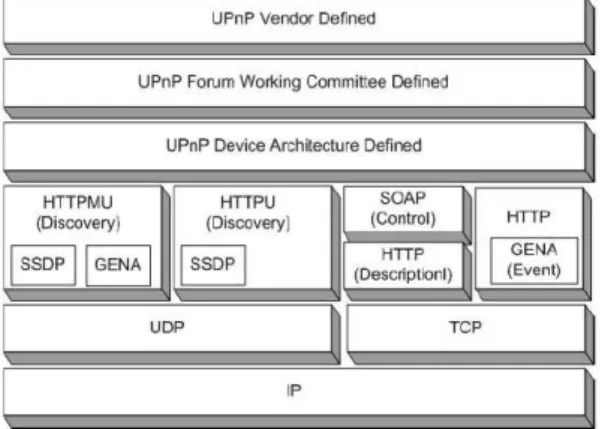
UPnP aims to offer a zero-configuration, invisible networking, and automatic discovery devices from wide range vendors. To support the ability for devices communication with each other, UPnP is designed based on the standard protocol suit TCP/UDP and IP as shown in Figure 1. Besides, it is supporting SSDP(Simple Service Discovery Protocol), GENA(Generic Event Notification Architecture), SOAP(Simple Object Access Protocol) for device discovering, event notification and service subscription.
Figure 1. UPnP stack
The three basic components of UPnP are devices, services and control points. The device component is the container of the services. Service is regarded as the smallest control unit in the UPnP network. And the control point component is a controller capable of discovering and controlling devices discovered. Services can be classified into state table, control server and event server. The state table models the state of the service through state variables and updates them when the state changes. Control server receives action requests issued by the control point, and executes those requests. Then, it updates the state table and returns its response to the requester. Event server publishes events to interested subscribers when the state of the service changes. The operation in UPnP is mainly through the interaction among components. When the device connects to network, it will periodically advertise its existence to control points. After the discovery of the device, control point can access the services provided by the device through its description. Then the control point can get a list of associated services for advanced invoking actions. On the other hand, if a control point connects to the networks, it could also issue a request to search for the existence of devices that are in the same interests. Those messages related to the procedures of discovery and subscriptions are sent by XML which is a kind of structured data into text file. It is used to describe the abilities that devices have, information and services that devices can have, and the states of the devices. Thus, UPnP provides a convenient environment for the development of service auto discovery based applications.
2.2. System procedure
There are two main components in the proposed in situ carpool system. One is the intermediary matching server and the other is mobile device. The matching server is responsible for the matching of requests issued by mobile devices held by users. From the UPnP point of view, the matching server is treated as a device while the mobile device acts as a control point.
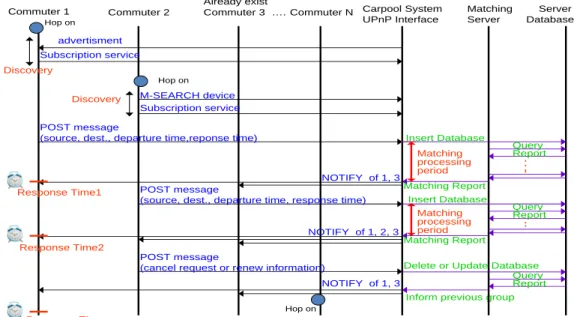
Suppose that people on the same conveyance want to transport to other locations when they get off halfway or arrive at the terminal. First, the proposed carpool system (i.e. the device) will periodically multicast the discovery message, called advertisement, that contains information specific to the carpool matching service to inform the mobile device (i.e. the control point) during the traveling time. When the mobile device receives the advertisement message, it can subscribe the services which the system offers. Alternatively, the
control point applications owned by commuters could also issue the search messages, named M-SEARCH, to search for the existence of the carpool matching system. Upon constructing communication between mobile device and system, commuters can fill out the personal information related to carpooling, such as user’s identification, origination location, destination location, carpool type, time period, etc. through his mobile device. The information will be forwarded to the carpool server which is equipped on the conveyance by POST message for advanced processing.
The matching server will execute a series of actions to select commuters and grouped them by the information they fill out. In addition to constantly processing the task of matching commuters, the NOTIFY message that a request method in UPnP will be sent to the commuters who were grouped for same carpool before the
response time. The number of commuters in one group can be determined by the carpool type (e.g. taxi, public transportation, etc.). Besides, anyone who is in the same group can cancel or modify the service registered by sending proceeding POST messages before the departure time, then the carpool system will NOTIFY the previous grouped commuters that the matching result changed. The message flow of the proposed system is illustrated in Figure 2. In addition, the proposed system can communicate with other transportation dispatching system to provide conveyance to appropriate place in time, for this reason commuters can save their time of calling conveyance.
Due to real time and in situ, the scheme is much considerable and achieving more advance intelligent transport services especially in the city with heavy traffic load.
Carpool System UPnP Interface Matching Server Server Database Commuter 1 Commuter 2 Commuter 3 ….Commuter N
advertisment
POST message
(source, dest., departure time,reponse time)
POST message
(source, dest., departure time, response time) NOTIFY of 1, 3
POST message
(cancel request or renew information)
Matching processing period NOTIFY of 1, 2, 3 Already exist Hop on Hop on Hop on NOTIFY of 1, 3 Subscription service Insert Database Insert Database
Delete or Update Database
Inform previous group Query Report Query Report.. … . Query Report Matching Report Matching Report M-SEARCH device Subscription service Matching processing period Discovery Discovery Departure Time Response Time1 Response Time2
Figure 2. Message flow of proposed system (without detail of UPnP response messages)
3. Implementation of the Real Time
Carpool Matching System
In this section, the basic implementation of the proposed system and its specific features will be firstly described, and then the extension of the basic architecture to a more general model will be illustrated and discussed.
3.1. Implementation of the basic system
In order to provide real time and in situ carpool system, the basic architecture consists of two major components: matching server and control point application. These two applications areimplemented at the device part (i.e. matching server) and the control point (i.e. the mobile device), respectively, and are run over the UPnP environment. The matching server is developed by using libupnp which is portable SDK for UPnP devices on linux [5]. And the design of control point is referred to the MSDN library [6], which is implemented over Windows Mobile operating system.
Figure 3 represents general user interface for the control point application of the proposed system. As shown in the Figure 3., the upper frame indicates the explanations of communications between control point and carpool system, the
following “search” button is designed for user to send the M-SEARCH message for the discovery UPnP devices actively in the UPnP network. At the moment, user can “select” the proposed UPnP Real Time In Situ Carpool System through the combo box, after that, our control point application subscribe the carpool service.
Figure 3. Waiting for matching commuters
After filling out the required information, such as user identification, origination, destination, time period, etc., the POST message will be sent to the matching server for processing and waiting for matching results.
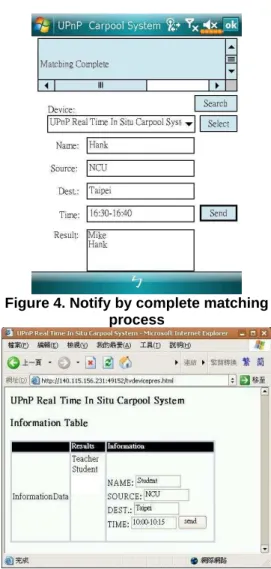
The matching server will continuously handle users’ (or commuters’) information and attempt to match those requests into appropriate groups. Once our system matches commuters who conform to each other’s requirements, the carpool service will send NOTIFY messages to the grouped commuters. The system can optionally allow commuter to set a timestamp to specify the applicable matching time period of his request. His request will not be processed if the specified time period is expired. The response of the notification after matching is shown in Figure 4. The frame of Figure 4 shows that the message of “Matching Complete” is reported to the commuter and the result box shows the commuters whom are grouped together with him.
Besides, we modify the presentation of portable SDK for UPnP devices on linux [5] to achieve the expectation that people can subscribe the carpool service after entering the proposed service URL. Commuter can simply send POST messages to issue their needs for people who are using laptops. The presentation page of this interface is shown in Figure 5.
Figure 4. Notify by complete matching process
Figure 5. Subscription request via HTML format
In addition, the proposed system can be interconnected to each other and interact with other public transportation dispatching system to provide conveyance to appropriate place in time. It will save the waiting time of calling conveyance and will be a very significant advantage for commuters. Due to the needs of real time and in situ characteristics, the proposed architecture shall be considerable and achievable for the cooperation with future advance intelligent transport services especially in the city with heavy traffic. The possible extension of the current system is described in the following.
3.2. Extensions of the basic architecture
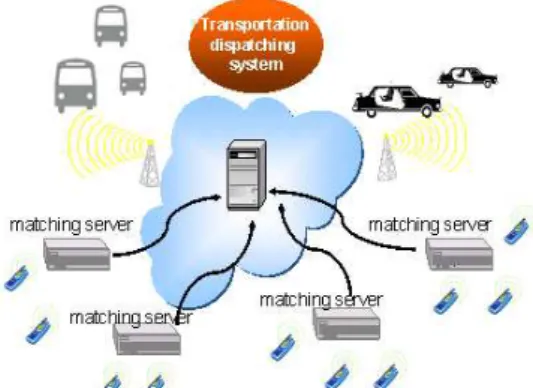
The system architecture, which consists of a matching server and several mobile devices with control point applications, illustrated in previous subsection can be regarded as the basic architecture toward an intelligent transportation system. Due to recent advances in wirelesscommunications, any kind of vehicles can communicate with each other through vehicle communication network. Meanwhile, it also offers a pretty good environment to extend the basic architecture to a more complete carpool service system. A complete carpool system should not limit its ability only to simple type like Mass Rapid Transit and the grouping of users’ transportation information should not be confined to one matching server. Each kind of transportation can not only communicate with each other, but also can share the users’ information. Figure 6. depicts the possible architecture of the complete system. The complete system may be classified into three levels.
The first level is the basic architecture that consists of one matching server and several mobile devices just mentioned in previous subsection. The second level is the interconnection of matching servers. The purpose of the second level is to perform the grouping for inter matching servers users. The third level is to make the cooperation of the carpool groping system with the transportation dispatching systems. The transportation dispatching systems can be classified into different kinds of conveyance, such as taxi dispatching system, public bus dispatching system. The extension of the basic architecture could achieve a more efficient transportation environment.
Figure 6. The proposed systems integrate public transportation dispatching system
4. Conclusions and Future Works
In this paper, we focus on the development of auto discovery and decent based network services for mobile devices so that the applications of wireless technology can be much more significant for human life. The proposed real time in situ carpool system adopts current UPnP mechanism and is independent of underlined communication technologies. Therefore, it is convenient to be deployed in practical environment.Compared to current Web based carpool system [7][8], the proposed system is more practical for use. The web-based approach has to negotiate online users’ requirements and to achieve carpool matching before taking the public in advance. This is not practical because users may not know when he/she will arrive the carpool point due to the changeable traffic condition. However, the proposed system matches the users’ needs in real time and in situ. As users in the same conveyance are considered for grouping, the grouping results will be more effective and useful.
In addition, the proposed basic system can be extended into a three-level architecture to achieve a more powerful intelligent transportation system. By integrating the public transportation dispatching system and carpool system, the public conveyance, like bus or taxi, can pick up the grouped people in time. Furthermore, our proposed scheme can apply on other services in daily life, such as communicate information with shops when strolling around the streets. This paper only proposes the basic architecture and operation scenario of a UPnP based application, more issues, such as scalability, resolution of multiple matching servers discovery, security, etc., shall be deeply studied toward a commercial application. And these issues are under our study.
5. Acknowledgement
This research was supported in part by the grants from National Science Council
(NSC96-2221-E-008-011, and
96-2627-E-008-001).
References
[1] IEEE Std. 802.11, "IEEE Std. 802.11-2007, Part 11: Wireless LAN Medium Access Control (MAC) and Physical Layer (PHY) specifications”, 2007. [2] 3GPP, http://www.3gpp.org/
[3] IEEE Std. 802.16e-2005 and IEEE Std 802.16- 2004/Cor1-2005, “IEEE Standard for Local and Metropolitan Area Networks-Part 16: Air Interface for Fixed Broadband Wireless Access Systems-Amendment for Physical and Medium Access Control Layers for Combined Fixed and Mobile Operation in Licensed Bands and Corrigendum 1”, 2004.
[4] UPnP device architecture version 1.0.1, July 2006. [5] libupnp.org - Developer resources for the portable
UPnP™ library, http://pupnp.sourceforge.net/ [6] MSDN Library - Universal Plug and Play (UPnP),
http://msdn.microsoft.com/en-us/library/aa918994.a
spx
[7] Carpool, http://www.carpool.com.tw/index.php [8] Carpool - RideSearch - Rideshare - Commuter
Social Network, http://www.ridesearch.com