WPM P2.02
AN ARTIFICIAL NEURAL NETWORK-BASED SCHEME
FOR FRAGILE WATERMARKING
Yu-Cheng Fan, Wei-Lung Mao and Hen-Wai Tsao Integrated System Lab
Department of Electrical Engineering and Graduate Institute of Electronics Engineering National Taiwan University, Taipei, Taiwan, 10617, R.O.C.
ABSTRACT I
This paper proposes an artificial neural network based fragile watermarking scheme. Our method can detect tampering, locate where the tampering hac occurred and recognize whaf kind of alteration has occurred. The experimental results have proven that our method is indeed effective.
INTRODUCTION
In this. paper, we propose an artificial neural network-based scheme for fragile watermarking. A fragile watermark is useful in image authentication applications. It can detect slight changes in the image and prevent mark-transfer attacks [I]. In the past, most fragile watermark systems work by inserting watermark data or modifying some coefficients in the host image [2][3][4]. It is suitable to embed some data into the image as a robust watermark that carries proof
of
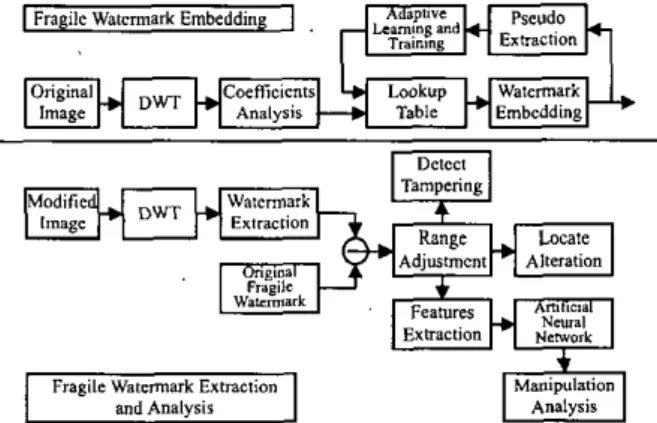
authorship. However,'these fragile watermark systems cannot stand for the features of the image and recognize what kind of modification has occurred. These methods cannot detect all kinds of distortion. Sometimes, these fragile watermarking methods destroy the host images. In order to overcome these problems, we here propose, an "artificial neural network-based fragile watermarking scheme" as shown in Fig. 1. Our method is designed to detect tampering of the host image, locate where the tampering has occurred and recognize what kind of alteration has occurred.FRAGILE WATERMARKING
PROCEDURES
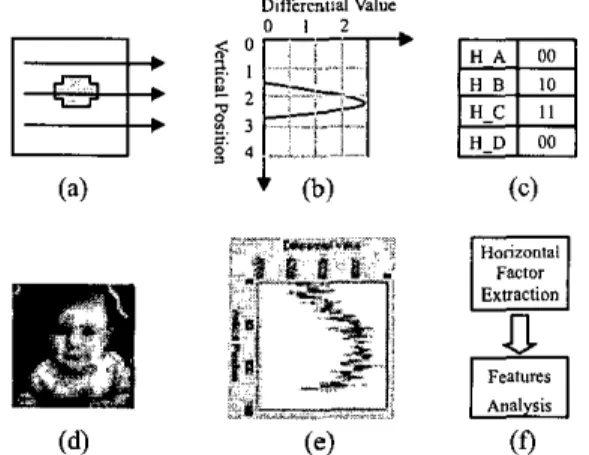
At first, the host image is transformed by the discrete wavelet transform (DWT) to transfer image information from the spatial domain to the wavelet domain. We analyze the coefficients in the highrhigh band after DWT and embed the fragile watermark according to lookup table. The lookup table is base on the image's characteristics. The coefficients in the high frequency range stand for high resolution and represent a subtle difference in the image.When the host image is modified, the slight changes can he detected easily according to analyze of the variations of the fragile watermark. We transform the modified image using DWT and extract the fragile watermark in high-high band. Comparing the extracted fragile watermark with the original fragile watermark, we can find the difference between the host image and modified image. Then we use artificial neural network to recognize what kind of modification has occurred [ 5 ] . We adopt back propagation model as shown in Fig. 2. We get the difference coefficients between the host image and modified image. (Fig. 3) Next, we analyze the horizontal energy distribution, vertical energy distribution, size, histogram variation and similarity. We use these characteristics as the neural network input signals. We use several kinds of modifying forms as output signals. After the initial values are set, the neural network is begun training until find the optimize weights. After the neural network is established, we can use this model to analyze the degree of changes and any modified image what kind of modification has occurred.
0-7803-7721-4/03 $17.00 0 2003 IEEE
210
Fragile Watsrmark Extraclion and Analysii
Fig. 1 Artificial neural network-based fragile watermarking scheme
EXPERIMENTAL RESULTS
In order to prove the ability of the artificial neural network-based fragile watermark, a series of experiments were conducted. (Table 1) This scheme can easy recognize blurred attack, scaling attack, median filtered attack, Gaussian Noise attack and JPEG Compressed. This scheme also can recognize cropping attack, salt and pepper noise attack, slight changes, and so on. The experimental results have proven that our method is indeed effective.
CONCLUSIONS
An artificial neural network-based scheme for fragile watermarking has been developed in this work. This scheme analyzes the coefficients in the high-high band. This fragile watermarking represents the characteristic of the host image. It is easy to detect the slight changes and include the ability to locate and characterize alterations. We
use this artificial neural network model to analyze the degree of changes and any tampered image what kind of alteration has occurred. This is a very convenient and feasible scheme.
ACKNOWLEDGMENT
The authors gratefully acknowledge NSC Chip Implementation Center (CIC), for supplying the SPWKDS software used in the functional simulations.
REFERENCES
[ I ] Ingemar, J. Cox, Matthew
L.
Miller, and Jeffrey A. Bloom, “Digital Watermarking,” San Diego, CA: Academic Press, 2002[Z]
Min Wu, Bede Liu, “Watermarking for image authentication,” Image Processing, 1998. Proceedings.I998 International Conference on, Vol. 2, Oct 1998, pp:
431 -441
[3] Altnrki, F.; Mersereau, R., “Secure fragile digital watermarking technique for image authentication,”
Image Processing, 2001. Proceedings. 200I
International Conference on, Vo1.3, 2001, pp: 1031
-1034
[4]
Fridrich, J.; Goljan, M.; Baldoza, A.C., “New fragile authentication watermark for images,” Image Processing, 2000. Proceedings. 2000 International Conference on, Vol.l,2000, pp: 446 -449[5]
Simon Haykin, “Neural Network: A Comprehensive Foundation,” Prentice Hall Press, 2nd, 1999.Picture Number ‘50
Input Layer I L a y n 2 O”lp“1
n--
-
Attack Type
Scaling Median Gaussian JPEG 9 4 % 1 1 0 0 %
1
9 3 %I
9 5 %1
89%Filtered Noise Compressed
Image cropping
Attask
Salt and pepper
Noise Anack
V-4
Si22 Scaling Alack
Fig2 Back propagation model
of
artificial neural network( 4 (e)
(0
Fig.3 Features extraction and analysis (Horizontal Factor)
(a) .The difference between the host image and modified image :(b) Calculate the horizontal difference value (c) Calculate the horizontal factor (d) Host image after Salt and pepper noise attack (e) Calculate the horizontal difference value,(f) Horizontal factor extraction and features analysis.
Table 1 Attack
recognition summary
(Unit: Recognition Rate %)