行政院國家科學委員會專題研究計畫 成果報告
求解俱 Rectilinear Distances 的 LA 問題新方法之探討
計畫類別: 個別型計畫 計畫編號: NSC94-2213-E-151-009- 執行期間: 94 年 08 月 01 日至 95 年 07 月 31 日 執行單位: 國立高雄應用科技大學工業工程管理系 計畫主持人: 謝廣漢 報告類型: 精簡報告 處理方式: 本計畫涉及專利或其他智慧財產權,2 年後可公開查詢中 華 民 國 95 年 10 月 13 日
行政院國家科學委員會補助專題研究計劃成果報告
求解俱 Rectilinear Distances 的 LA 問題新方法之探討
(A Novel Algorithm for Location-Allocation Problems
with Rectilinear Distances)
計畫類別: 個別型計畫
計畫編號:
NSC 94-2213-E-151-009-
執行期間:
2005.08.01 至 2006.07.31
計畫主持人:
謝廣漢
成果報告類型(依經費核定清單規定繳交):精簡報告
處理方式:二年後可公開查詢
執行單位:
國立高雄應用科技大學工業工程管理系
中 華 民 國 95 年 10 月 12 日
行政院國家科學委員會補助專題研究計畫成果報告
求解俱 Rectilinear Distances 的 LA 問題新方法之探討
(A Novel Algorithm for Location-Allocation Problems
with Rectilinear Distances)
計畫編號:NSC
92-2213-E-151-024-執行期間:2003 年 8 月 1 日至 2004 年 7 月 31 日
主持人:謝廣漢
高雄應用科技大學工業工程與管理系 E-MAIL: [email protected]中文摘要
在本研究中,一種merge-split 的計算架構首度被提出用以解決在以 rectilinear 為距離 量測方法下之 uncapacitated location-allocation (LA)的問題.在提出的方法中,merge-split 的計算架構是用來做為跳離局部解(local optima escapology)的數學運作工具.基於僅變更 部份局部解的數值,在搜尋空間中保留可能有效的局部解資訊, merge-split 的計算架構可 以非常有效的加速最佳解之搜尋速度.在本研究中,merge-split 計算架構被植入一現存的 方法中用以評估與展示其效能.實驗結果顯示出經過整合後的新方法,不論在所求得解的 品質上與求解的速度上皆表現出優異能力.在本計劃中,密集且眾多的實驗被執行用以比 較本計畫所提出的方法與其他方法之優劣.II
Abstract(英文摘要)
In this study, a merge-split computing scheme is introduced first time to solve uncapacitated location-allocation problems with rectilinear distances. In the proposed algorithm, merge-split scheme is used as a local optima escapology method which alters small part of current local optima to retain potential useful portion of information in the search space. By treating location-allocation problems as clustering problems, the proposed merge-split scheme could speed up the process of optimal search considerably. To evaluate the proposed merge-split scheme, it is embedded in an existing method. The experimental results show that the integrated method is excellent in terms of quality of solution and speed of computation. Intensive comparisons between proposed method and other methods are included in this research.
1. Introduction
Given an optimization criterion and a set of customers (demand centers) with known demands, the location-allocation (LA) problem is to select the locations of a number of supply centers to serve customers, and to decide the corresponding allocation of the customers to supply centers. The recent rapid growth of demand for supply chain management, which can decrease the total cost, while improve the quality of goods and services of various organizations, has drawn significant research attention. As an important part of supply chain management, the LA problem is related to the facility management service, logistics and distribution, order entry and customer service operations. Therefore, it should be indicated much more than before for organizations to improve their competitive advantage [1].
In solving the LA problem, the costs of transportation between customers and supply centers are proportional to an appropriately determined distance (e.g. the Euclidean or rectilinear distance). The location of supply centers and the allocation of customers to supply centers must be considered simultaneously. The capacities of supply centers in LA problems can either be fixed or treated without any limitation if the capacity of each supply center can be adjusted according to the amount of allocated service demands of customers, which are referred to as capacitated and uncapacitated problems, respectively. In this research, in order to tackle the problem arising in the context of a large number of urban location problems and facilities location problems within a factory [2,3], the rectilinear distance is adopted for distance measurement and the criterion is to minimize the total weighted distances between supply centers and customers. The following formulation is used to illustrate this kind of problem:
Minimize
∑∑
= = = M j N i i j i ijDd w X Z 1 1 ) , ( φSubject to:
∑
for i=1,...,N;= = M j ij Z 1 1 ; } 1 , 0 { ∈ ij Z
where φ is the total cost per unit time;
Xi=(xi,yi), i=1,...,N, are N known points, representing customer locations, on a
planar coordinate system;
wj=(aj,bj), j=1,…,M, are M unknown points, representing locations of supply
centers, and can be located anywhere on the planar coordinate system;
Di, i=1,..,N, are the frequency of service demands per unit time for N
; ,..., 1 , ,..., 1 for otherwise; , 0 ; center supply to assigned is customer if , 1 M j N i j i Zij = = ⎩ ⎨ ⎧ = j i j i i j X x a y b w
d( , )= − + − is the rectilinear distance between location of
supply center, wj, and customer loction, Xi.
2. Literature Review and Research Objectives
According to Cooper [4], when number of supply centers and number of customers are large, LA problems are difficult combinatorial optimization problems. He developed an exact solution procedure [5] and two heuristic methods [6] to solve these problems. The methods developed so far for location-allocation can be classified into three categories: Branch and Bound Algorithms (BBA) [7,8]; combinatorial optimization techniques [1,9-12]; and specially designed algorithms [2,13-15]. However, most of these approaches mentioned, exact solution and heuristic methods, for solving large LA problems using rectilinear distances are either time consuming or provide only local optimal solutions. Therefore, a demand of good method in term of quality of solution and speed of computing is obvious. In this research, a novel technique, merge-split scheme, is introduced for solving discrete uncapacitated LA problems. By utilizing the proposed merge-split scheme in a modified ALA procedure, the proposed method can deal with large LA problem (500 customers, up to 10 supply centers) efficiently.
3. Proposed Methods
By integrating the proposed merge-split scheme with a modified ALA based method proposed by Hsieh and Tien[15], a new algorithm, merge-split ALA (MSALA), is addressed in this research.
The structure for utilizing proposed MSALA algorithm can be illustrated as
[
]
W C W M X output input output Input i ⎥ → → → ′ ⎦ ⎤ ⎢ ⎣ ⎡ → ( or ) MSALA function generating solution Initial ) and ( ,where W is the initial set of locations of supply centers, W={wj, for ∀j=1,..,M}; W ′ is the set of locations of supply centers after MSALA;
C is the initial set of allocations of customers,C ={ci∈{1,2,..,M}, for ∀i=1,..,N}.
The merge-split scheme is a local optima escapology method. Since it only alters part of the locations of supply centers, usually small part, it may retain useful portion of information represented by current local minima in the search space. By this idea, the merge-split scheme may improve the search speed by not totally abandoning current solution.
ALA is a simple iteration procedure. Start with an initial set of suppliers (W), allocate each customer to the closest supply center (yielding C), and then recalculate the locations of supply centers (W). By using new locations of suppliers, customers are re-allocated (C). This ( ) cycle is repeated until the allocation or cost in two successive iterations remains unchanged. Comparing to popular overall methods (e.g. genetic algorithms and simulated annealing methods), ALA method have great advantage of fast convergency. By integrating the merge-split scheme into a modified ALA based method proposed by Hsieh and Tien[15], a new merge-split ALA (MSALA) algorithm can be constructed with both fast convergency and efficient escaping from local minima.
...
W C W → →
The main ideas of the modified ALA method proposed by Hsieh and Tien[15] can be briefly illustrated by a plan of three levels of efficient adjustments of allocations of customers as well as locations of supply centers. These three levels of adjustments are listed below.
Level 1―adjustment of a customer: given a cluster, the nearest outside customer, who is determined by the distance between the supply center of given cluster and the outside customer, is included into the given cluster.
Level 2―djustment of the location of a supply center: given a cluster, the supply center is move to the next candidate location along one of the four directions, right, left, upper or lower.
Level 3―brutal updating new obtained solution for the subsequent iterations regardless of the improvement.
Normally, the search process utilizes level 1 adjustment only. Level 2 adjustment is triggered for reinforcement if a local/global optimal solution cannot be improved within M iterations (in the work of Hsieh and Tien[15]). It should be noted that the process of M iterations of level 1 adjustment is a testing procedure for including M nearest outside customers into M corresponding given clusters. If current solution cannot be improved within M2
iterations (specified by Hsieh and Tien[15]), the level 3 adjustment is launched and the solution is forced to updated and used as an input for the next iteration.
In the proposed MSALA algorithm, the merge-split scheme is used to replace the level 3 adjustment shown in Hsieh and Tien[15] to provide more efficient escapology from local optima. In addition, the lunching schedule of merge-split scheme is also modified as a variable, L, instead of the fixed M2 to suit different size of supply centers. The proposed MSALA can be illustrated
Figure 1 Flow chart of proposed MSALA method
4. Performance of the Proposed Method
The proposed method is implemented using MatLab version 7.0 with six test problems in interpreted mode. In the six problems, five are existing test problems, problem 1 (N=30) were generated by Love and Morris [16]. Problem 2 (N=20), problem 3 (N=35), and problem 4 (N=100) were generated by Love and Juel [14]. Problem 5 (N=150) was generated by Liu and
et al. [9]. Problem 6 (N=500) is a new problem created in this research. The x-coordinates,
y-coordinates as well as demands in problem 6 are all integers and generated from a uniform distribution over a range of [0,10000]. By these six problems, evaluating trends in performances of the proposed method and other methods as problem size increases will become possible. Of these six test problems, the optimal solutions of the first three problems are known, whereas the optimal solutions of remaining problems are unknown. All experiments were run
on a Pentium-4 3.1 GHz based PC with 520MB RAM.
To show the performance of proposed MSALA method, a modified ALA based method proposed by Hsieh and Tien[15], denoted as HTALA, is also tested for comparison purpose. The HTALA method is one of the most powerful methods existing. In HTALA, everything remains unchanged except self-organizing feature maps method, which is used as an initial solution generating function in original work of Hsieh and Tien[15], is replace by K-means method. The data in Table 1 compare the results from the proposed MSALA method and HTALA for problems 1-5.
As shown in Table 3, MSALA outperforms HTALA in almost every aspect. Within very short time limits (10 second), the proposed MSALA method demonstrates an impressive capability by achieving 100% of getting known best solution for every problem shown in Table 3. Especially, regarding the cases that HTALA fails to achieve 100% of getting know best solution, MSALA is much faster than HTALA by referring to the mean run time for getting best solution.
Table 1: Results using MSALA and HTALA for problem 1 to problem 5
(stop time=10 sec.)
MSALA (n=2, L=2*M) HTALA No. of test prob. Prob.
size Known best sol. Mean run time for Kmean % of getting known best sol. Mean run time for getting best sol. Max. run time for getting best sol. (all within) % of getting known best sol. Mean run time for getting best sol. Max. run time for getting best sol. % of worst sol. away from known best sol. 1 M=2 N=30 516254969 0.213 100 0.278 0.317 100 0.290 0.436 0 2 M=3 N=20 140236644 0.211 100 0.353 1.004 100 0.369 1.201 0 3 M=2 N=35 598084656 0.219 100 0.352 0.691 100 0.448 1.032 0 M=2 N=100 1583327772 0.218 100 0.306 0.419 100 0.401 0.938 0 M=3 N=100 1234118203 0.224 100 0.421 3.644 100 0.881 5.105 0 M=4 N=100 1060697798 0.227 100 0.505 1.692 98 2.249 8.987 5.8×10⁻² 4 M=5 N=100 919515658 0.229 100 1.246 8.861 79 3.272 8.753 1.8×10⁻¹ M=2 N=150 2515820112 0.222 100 1.163 4.757 100 2.378 7.387 0 M=3 N=150 1998514195 0.223 100 0.446 0.801 100 0.754 2.486 0 M=4 N=150 1715275017 0.229 100 0.676 1.941 99 2.666 9.194 9.6×10⁻¹ 5 M=5 N=150 1487070093 0.230 100 1.339 4.959 93 2.621 9.959 8.0×10⁻² Note: 1. Percentage of worst solution away from optimal solution is defined as [(worst solution/optimal
solution)-1]×100%.
2. The mean run time for getting best solution of MSALA and HTALA includes corresponding mean run time of K-means.
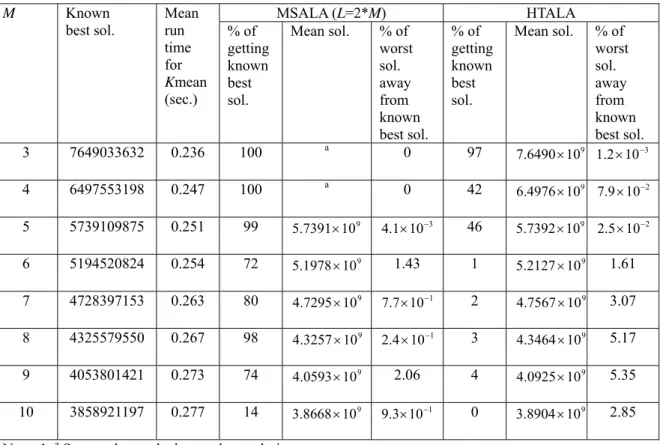
To manifest the performance of MSALA for solving large problems, test problem 6 is created in this research. It is tested with large M setting (up to M=10) and the best solutions obtained in this research are listed in Table 2. In addition, the comparison results between MSALA and HTALA for problem 6 are also provided in Table 2. By observing datum, the advantages of using MSALA shown in Table 2 are even more evident than those shown in Table 1. Especially, when M is greater than or equals to 4, MSALA far exceeds HTALA in performance regarding every comparison criterion.
Table 2 Results using MSALA and HTALA for problem 6 (stop time 20 sec.)
MSALA (L=2*M) HTALA
M Known
best sol. Mean run time for Kmean (sec.) % of getting known best sol. Mean sol. % of worst sol. away from known best sol. % of getting known best sol. Mean sol. % of worst sol. away from known best sol. 3 7649033632 0.236 100 a 0 97 7.6490×10⁹ 1.2×10⁻³ 4 6497553198 0.247 100 a 0 42 6.4976×10⁹ 7.9×10⁻² 5 5739109875 0.251 99 5.7391×10⁹ 4.1×10⁻³ 46 5.7392×10⁹ 2.5×10⁻² 6 5194520824 0.254 72 5.1978×10⁹ 1.43 1 5.2127×10⁹ 1.61 7 4728397153 0.263 80 4.7295×10⁹ 7.7×10⁻¹ 2 4.7567×10⁹ 3.07 8 4325579550 0.267 98 4.3257×10⁹ 2.4×10⁻¹ 3 4.3464×10⁹ 5.17 9 4053801421 0.273 74 4.0593×10⁹ 2.06 4 4.0925×10⁹ 5.35 10 3858921197 0.277 14 3.8668×10⁹ 9.3×10⁻¹ 0 3.8904×10⁹ 2.85 Note: 1. a Same value as the known best solution.
2. Percentage of worst solution away from optimal solution is defined as [(worst solution/optimal solution)-1]×100%.
3. Each result are obtained based on 100 runs.
5. Conclusions and Self-Evaluations
A novel merge-split ALA method is proposed in this research. In addition, an extensive empirical study is also presented to evaluate the performance of the proposed method. From the experimental results, for various test problems show in this research, the proposed method outperforms the modified ALA method proposed by Hsieh and Tien[15], which is known not only as a fast heuristic for large problems but also as one with a high probability of finding optimal solutions, yielding high quality solutions and with efficient computation.
Regarding these research achievements, we would like to submit it to an international journal for publication.
6. References
1. Brimberg J, Hansen P, Mladenović N, Taillard ED. Improvements and comparison of heuristics for solving the uncapacitated multisource weber problem. Operations Research 2000;48:444-60.
2. Francis RL, White JA. Facility layout and location-An analytical approach. Englewood Cliffs: Prentice-Hall, 1974. p.212.
3. Sherali AD, Shetty CM. The rectilinear distance location-allocation problem. AIIE Transactions 1977;9(2):136-43,.
4. Cooper L. Location-allocation problems. Operations Research 1963;11:331-43.
5. Cooper L. The transportation-location problems. Operations Research 1972;20:94-108. 6. Cooper L. Heuristic methods for location-allocation problem. SIAM Review 1964;6:37-53. 7. Kuenne RE, Soland RM. Exact and approximate solutions to the multisource weber problem.
Mathematical Programming 1972;3:193-209.
8. Marucheck AS, Aly AA. An efficient algorithm for the location-allocation problem with rectangular regions. Naval Research Logistics Quarterly 1981;28:309-23.
9. Liu C-M, Kao R-L, Wang A-H. Solving location-allocation problems with rectilinear distances by simulated annealing. Journal of the Operational Research Society 1994; 45:1304-15.
10. Gamal MDH, Salhi S. Constructive heuristics for the uncapacitated continuous location-allocation problem. Journal of the Operational Research Society 2001;52:821-29. 11. Houck CR, Joines JA, Kay MG. Comparison of genetic algorithms, random restart and
two-opt switching for solving large location-allocation problems. Computers Operations Research 1996;23:587-96.
12. Righini G., A double-annealing algorithm for discrete location/allocation problems. European Journal of Operational Research 1995;86:452-68.
13. Lozano S, Guerrero F, Onieva L, Larraneta J. Kononen maps for solving a class of location-allocation problems. European Journal of Operational Research 1998;108:106-17. 14. Love RF, Juel H. Properties and solution methods for large location-allocation problems.
Journal of the Operational Research Society 1982;33:443-52.
15. Hsieh KH, Tien FC, Self-organizing Feature Maps for Solving Location- allocation Problems with Rectilinear Distances, Computers & Operations Research 2004;31:1017-1031.
16. Love RF, Morris JG.. A computation procedure for the exact solution of location-allocation problems with rectangular distances. Naval Research Logistics Quarterly 1975;22:441-53.