Efficient formulation for band-structure calculations of two-dimensional phononic-crystal plates
Jin-Chen Hsu and Tsung-Tsong Wu*Institute of Applied Mechanics, National Taiwan University, Taipei 106, Taiwan
共Received 2 June 2006; published 6 October 2006兲
Based on Mindlin’s plate theory and the plane wave expansion method, a formulation is proposed to study the propagation of Lamb waves in two-dimensional phononic-crystal plates. The method is applied to calculate the frequency band structure of a square array of crystalline gold cylinders in an epoxy matrix with a finite thickness. It is found that complete frequency band gaps for Lamb waves between different pass bands are opened up by tuning thickness of the phononic-crystal plate. The influence of plate thickness on the width of complete frequency band gap is calculated and discussed as well; the existence of frequency stop bands is sensitive to the variation of the thickness of the plate. Finally, we note that the proposed method provides a concise and efficient way in analyzing the frequency band structures of phononic-crystal plates in lower bands. DOI:10.1103/PhysRevB.74.144303 PACS number共s兲: 63.20.⫺e, 43.20.⫹g, 43.40.⫹s, 46.40.Cd
I. INTRODUCTION
Propagation of acoustic waves in the periodic structures called phononic crystals has received much attention in the last decade.1,2 The possibility of achieving a complete fre-quency band gap, which can forbid the propagation of acous-tic waves with any polarization and wave vector, suggests the possible applications of phononic structures as perfect acoustic mirrors, filters, and high efficiency waveguides. Most of the studies concerning phononic crystals focused on investigation of the bulk acoustic waves,3–7and parts of them reported on the acoustic waves localized at the surface of two-dimensional, semi-infinite phononic crystals.8–11 Re-cently, some studies show that another worthwhile subject regarding phononic crystals would be the acoustic wave propagating in a finite thickness plate. Zhang et al.12 pro-posed experimental results of the Lamb wave band gap in the phononic crystals created on thin plates. In their paper, mul-tiple frequency band gaps and narrow pass band within cer-tain frequency band gaps were observed. Sainidou and Stefanou13studied the guided and quasiguided elastic waves in a glass plate coated on one side with a period monolayer of spheres, immersed in water. Researches to study elastic waves in phononic structures with finite thickness, however, remain still little so far.14–16Among the limited existing lit-erature, plane wave expansion 共PWE兲 method is one of the common methods used to analyze this kind of problems. Si-galas and Economou16 proposed the classical plate theory based PWE method to calculate the frequency band struc-tures of elastic waves in thin plates with periodically placed inclusions. In their analysis, the thickness/lattice-spacing ra-tio共h/a兲 and frequency must be kept in very low ranges to hold the assumptions of classical plate theory. Otherwise, considerable deviations would emerge because the shear de-formations of bending of the plate are ignored in the classical plate theory. As the value h / a and frequency increase, the full three-dimensional共3D兲 PWE method should be consid-ered. The full 3D PWE method, however, requires a huge computation time as a large number of the plane waves were adopted. The dramatic increasing of computation time origi-nates from the procedure for calculating the stress-free boundary-condition determinants in the full 3D PWE model.
This inevitable drawback restricts the choices of material contrast of the constituents of the phononic crystal, or quali-tative descriptions can only be offered because a small num-ber of plane waves, such as 49 or less, were considered in most literature.
The purpose of this paper is to calculate and discuss the characteristics of Lamb waves in phononic-crystal plates. To overcome the convergence and large computation time prob-lems in using the full 3D PWE method, we developed an efficient formulation based on Mindlin’s plate theory. Our method shows excellent performance for the cases of phononic-crystal plates composed not only of small but also of large material mismatch 共mass density and elastic stiff-ness兲 of the constituents. Furthermore, the proposed formu-lation gives explicit physical meaning to identify the polar-izations of waves such as flexural, extensional, face-shear, and thickness-shear vibrations in the thin plates.
This paper is organized as follows. In Sec. II, we briefly review the essential of Mindlin’s plate theory and derive the PWE method based on Mindlin’s theory. In Sec. III, we em-ploy the method developed by us to analyze and discuss the acoustic waves propagating in phononic-crystal plates com-posed of crystalline gold and epoxy. Finally, some conclu-sions are given in Sec. IV.
II. FORMULATION
In this section, we summarize Mindlin’s plate theory17,18 and derive an improved plane-wave-expansion formalism by combining with Mindlin’s theory to analyze the waves propagating in phononic-crystal plates.
A. Mindlin’s plate theory
Consider a plate with thickness h whose material proper-ties are homogeneous along the thickness direction. We set up the coordinates as follows. Let the x3axis be the thickness
direction and directed downward. The x1-x2plane rests in the
middle plane of the plate, and the plate surfaces are at x3
= ± h / 2. The components of displacement uj,共j=1,2,3兲, are
uj共x1,x2,x3,t兲 =
兺
n=0
⬁
x3nu共n兲j 共x1,x2,t兲
= u共0兲j 共x1,x2,t兲 + x3uj共1兲共x1,x2,t兲 + ¯ , 共1兲
where u共n兲j is called the nth order component of the displace-ment field. Basically, the zeroth order and the first order terms represent the fundamental modes of the elastic waves in plates 共extensional, face-shear, flexural, thickness-shear and thickness-twist modes兲, and the higher order terms are their overtones. Substitution of the series expression for uj
into the variational principle gives the equations of motion of order n by Tij,i共n兲− T3j共n−1兲−
兺
m=0 ⬁ Hnmu¨j共m兲= 0, 共2兲 where Tij共n兲⬅冕
−h/2 h/2 x3nTijdx3, Hnm⬅冦
hm+n+1 2m+n共m + n + 1兲, m + n even 0, m + n odd.冧
共3兲 In Eq.共3兲, Tij are the components of Cauchy stress tensor,andis the mass density. The nth order components of strain Sij共n兲and stress Tij共n兲can be written as
Sij共n兲= 1 2关ui,j 共n兲+ u j,i 共n兲+共n + 1兲共␦ 3jui共n+1兲+␦3iuj共n+1兲兲兴, 共4兲 Tij共n兲= cijkl
兺
n=0 ⬁ HnmSkl共n兲, 共5兲where␦ijis Kronecker delta, and cijklis the elastic stiffness.
For truncation of the series, only the zeroth and first order components of stress and strain will be retained. By follow-ing Cauchy’s procedure,19 u3共1兲 is neglected for the free de-velopment of the strain S33共0兲共=u3共1兲兲 by setting T33共0兲= 0 in the zeroth order stress. The condition T33共0兲= 0 permits the elimi-nation of S33共0兲from the zeroth order stress, with the result
Tij共0兲= hgijklSkl共0兲, 共6兲
where the modified elastic stiffness
gijkl= cijkl− cij33c33kl/c3333. 共7兲
Similarly, all three terms u共2兲j are neglected for the free de-velopment of the strain S3j共1兲by setting T3j共1兲= 0. The first order stress, therefore, can be written as
T␣共1兲= 1 12h 3␥ ␣S共1兲; ␣,,,= 1,2, 共8兲 where ␥␣= cofactor兩s兩s ␣兩 ␣兩 , 兩s␣兩 =
冨
s1111 s1122 2s1112 s2211 s2222 2s2212 2s1211 2s1222 4s1212冨
, 共9兲 and s␣is the elastic compliance. As the final step in the process of truncation, the strains S13共0兲and S23共0兲are replaced by1S13 共0兲and
3S23
共0兲in the equations of motion, where 1and3
are correction factors which may be used to adjust the thickness-shear vibrations. In the case of monoclinic symme-try material, the correction factors are given by18
12=2/12,
32=12关c3333+ c2323−
冑
共c3333− c2323兲2+ 4c23232 兴/2g2323.共10兲 Substitution of Eqs.共6兲 and 共8兲 into Eq. 共2兲, one can obtain the two-dimensional coupled equations of motion of the plate with retaining zeroth and first order terms.
B. PWE method for phononic-crystal plate
According to Mindlin’s plate theory for monoclinic sym-metry material summarized in the first part of Sec. II, the equations of motion for plate with retaining zeroth and first order terms can be expanded as follows:
x1关g11u1,1 共0兲+ g 12u2,2共0兲+3g14共u3,2共0兲+ u2共1兲兲兴 + x2关1c56共u3,1 共0兲 + u1共1兲兲 + c66共u2,1共0兲+ u1,2共0兲兲兴 =u¨1共0兲, x1 关1c56共u3,1共0兲+ u共1兲1 兲 + c66共u2,1共0兲+ u1,2共0兲兲兴 + x2 关g12u1,1共0兲 + g22u2,2共0兲+3g24共u3,2共0兲+ u2共1兲兲兴 =u¨2共0兲, x1 关12c55共u3,1共0兲+ u1共1兲兲 +1c56共u2,1共0兲+ u1,2共0兲兲兴 + x2 关3g14u1,1共0兲 +3g24u2,2共0兲+32g44共u3,2共0兲+ u2共1兲兲兴 =u¨3共0兲, h3 12 x1关␥11u1,1 共1兲+␥ 12u2,2共1兲兴 + h3 12 x2关␥66共u2,1 共1兲+ u 1,2 共1兲兲兴 − h关1 2 c55共u3,1共0兲+ u1共1兲兲 +1c66共u2,1共0兲+ u1,2共0兲兲兴 = h3 12u¨1 共1兲, h3 12 x1关␥66共u2,1 共1兲+ u 1,2 共1兲兲兴 + h3 12 x2关␥12u1,1 共1兲+␥ 22u2,2共1兲兴 − h关3g14u1,1共0兲+3g24u2,2共0兲+3 2 g44共u3,2共0兲+ u2共1兲兲兴 =h 3 12u¨2 共1兲. 共11兲
In the above expressions, Voigt’s notation has been used. Equations 共11兲 are valid for an inhomogeneous plate, in which the material properties vary periodically in the x1-x2
plane. Now, consider an infinite two-dimensional phononic-crystal plate as shown in Fig.1. The displacement field in a periodic medium must satisfy the Bloch theorem. Therefore, in two-dimensional case, the zeroth and first order compo-nents of displacement field can be expressed as
ui共0兲共r,t兲 =
兺
G ei共k·x−t兲共eiG·xA G i兲, i = 1,2,3, u␣共1兲共r,t兲 =兺
G ei共k·x−t兲共eiG·xBG␣兲, ␣= 1,2, 共12兲where r =共x1, x2, x3兲=共x,x3兲 is the position vector, is the
angular frequency, k =共k1, k2兲 is the Bloch wave vector in the
surface Brillouin zone 共SBZ兲, and G=共G1, G2兲 is the
two-dimensional reciprocal lattice vector. AGi and BG␣ are corre-sponding Fourier coefficients of the zeroth and first order components of displacements, respectively. The periodicity of the structure implies that the material properties f共x兲 may all be expanded in the Fourier series
f共x兲 =
兺
G
fG· eiG·x, 共13兲
where f共x兲 is either one of , gpq,␥pq, 1c56, 12c55, 3g14,
3g24, or32g44. We note that the Fourier coefficients of those
material properties are obtained either by Laurent’s rule or by inverse rule according to the procedure of Fourier factor-izing a product of two piecewise smooth, bounded, periodic functions. These rules are adopted in this paper for achieving a best convergence. The detailed description about Fourier factorization can be found in Refs. 20and 21. Substituting Eqs.共12兲 and 共13兲 into Eq. 共11兲, we obtain a system of equa-tions in the matrix form
冢
MG,G11 ⬘ MG,G12 ⬘ M13G,G⬘ MG,G14 ⬘ MG,G15 ⬘ M21G,G⬘ MG,G22 ⬘ M23G,G⬘ MG,G24 ⬘ MG,G25 ⬘ M31G,G⬘ MG,G32 ⬘ M33G,G⬘ MG,G34 ⬘ MG,G35 ⬘ M41G,G⬘ MG,G42 ⬘ M43G,G⬘ MG,G44 ⬘ MG,G45 ⬘ M51G,G⬘ MG,G52 ⬘ M53G,G⬘ MG,G54 ⬘ MG,G55 ⬘冣冢
AG1⬘ AG2⬘ AG3⬘ BG1⬘ BG2⬘冣
⬅ M ·冢
AG1⬘ AG2⬘ AG3⬘ BG1⬘ BG2⬘冣
= 0 共14兲While the summation of Eqs.共12兲 and 共13兲 are truncated up to n in practice, Eq.共14兲 is reduced to a 5n⫻5n matrix. Each submatrix MG,Glm ⬘,共l,m=1–5兲, which are functions of eigen-frequency, Bloch wave vector k, reciprocal lattice vector
G, and Fourier coefficients fG, is a n⫻n matrix. The explicit expressions of the matrix components are listed and ex-plained in the Appendix. As a result, the eigenfrequency of the phononic plate mode can be solved by setting
det共M兲 = 0. 共15兲
Once the eigenfrequency k
n
is obtained from Eq. 共15兲 for specific Bloch vector k in nth band, the relative amplitude of displacements of the eigenmode can also be solved accord-ingly by substituting the specific value ofk
n
into Eq.共14兲. III. NUMERICAL RESULTS
In this section, we use the proposed method to calculate the frequency band structures of the phononic-crystal plates illustrated in Fig.1. In the system, the crystalline gold 共Au兲 belonging to cubic system serves as the filling material, and epoxy serves as the host material. For comparison purpose, the frequency band structure of the Au/Epoxy plate with thickness h = 0.25a are first calculated using the full 3D PWE method14,22 and Mindlin’s theory based PWE method, re-spectively. The crystalline Au cylinders are arranged as square lattice embedded in the Epoxy host as depicted in Fig. 1. The lattice spacing and the radius of the cylinders are denoted by a and r, respectively, and the filling fraction is F =r2/ a2= 0.283. The material constants used in the calcu-lations are = 19300 kg/ m3, c
11= 19.25⫻1010N / m2, c12
= 16.3⫻1010 N / m2, and c
44= 4.24⫻1010 N / m2 for
crystal-line gold23 and = 1180kg/ m3, c
11= 7.58⫻109N / m2, and
c12= 4.42⫻109N / m2, for epoxy. Figure 2 displays the
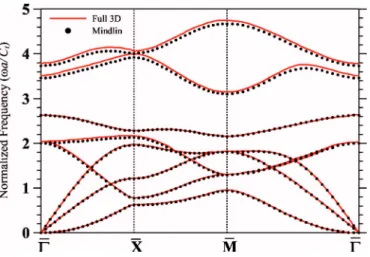
fre-quency band structure of the Au/Epoxy phononic-crystal plate, solid lines represent the results obtained by using the full 3D PWE method, and dots denote the results calculated by using Mindlin’s theory based PWE method. Due to the large computation time required for the full 3D PWE method, the number of plane waves is restricted to 81. We note that the CPU times to calculate the frequency band structure along the boundary of the irreducible part of the FIG. 1. 共Color online兲 Top view and cross-section of an infinite
two-dimensional phononic-crystal plate.共a兲 Square lattice and the corresponding first SBZ.共b兲 Cross section cutting along the dashed lines in共a兲.
first SBZ共40500 grid points are included兲 are about 250 h for the full 3D PWE method and only 2 h for Mindlin’s theory based PWE method with 81 plane waves on a per-sonal computer equipped with Intel Pentium4 CPU of 2.80 GHz and 512 MB memory. In the figure, we observe that the two methods result in good agreement of numerical results. The maximum difference is about 1.6% at eighth band in the calculated interval of normalized frequency. An-other indispensable observation in Fig.2 is that there is no missing frequency band in the calculated frequency range for this case. However, Mindlin’s theory with retaining zeroth and first order terms in Eq. 共1兲 includes only five plate modes. If higher frequency ranges are considered, those higher plate modes and good accuracy will not be preserved. Therefore, the frequency ranges and the thicknesses of the phononic-crystal plates must be adequately restricted when Mindlin’s plate theory based PWE method is used. From the above analysis, the PWE method based on Mindlin’s theory exhibits satisfactory accuracy and less computation time. These results suggest that the proposed method can serve as a quick and good predicting tool in the design of a phononic-crystal plate in lower bands.
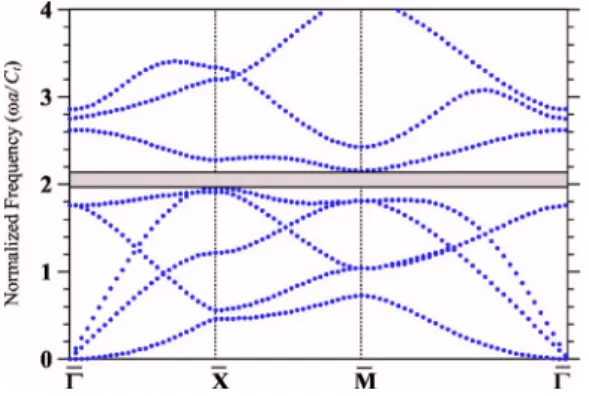
Moreover, good convergence of the numerical results should be obtained by implementing the calculations with a large number of plane waves when a phononic-crystal plate consisting of materials with large contrast is analyzed. 81 plane waves used in the calculations of Fig.2do not provide satisfactory convergence. The full 3D PWE method, how-ever, applied to the phononic-crystal plate problem is not practical for computation time consideration when the num-ber of the plane waves is large. Therefore, with Mindlin’s theory based PWE method, 441 plane waves are used to recalculate the dispersion relations of our example, and the result is shown in Fig.3. In the figure we can observe that a complete frequency band gap exists between the sixth and
seventh frequency bands, and extends in normalized fre-quency from 2.62 to 3.03. The ratio of gap width to midgap frequency, therefore, is⌬/m= 14.6% for the first complete
frequency band gap. We note that the transmission properties for phononic-crystal plate are unobtainable by our means. However, justification of frequency band gaps of phononic-crystal plates from the transmission properties is needed for an approach to reality or experiment. Also, the complete fre-quency band gaps for the structures of phononic-crystal plates with finite width, similar to a strip structure, demand for further examination with involving the edge conditions. Other methods such as finite-difference time-domain method and multiple-scattering theory24 should be suitable to calcu-late the transmission properties of Lamb waves in both of the plate structures.
Furthermore, in the phononic-crystal plate, the frequency band structure could be quite different from that of an infinite phononic crystal for bulk waves because the waves confined in the finite thickness plate result in an acute dispersion ef-fect in low frequency region by supporting the flexural and thickness-shear vibrations. Therefore, the ratio h / a can be another one of influential parameters on opening the com-plete band gap and band shifting in the frequency band struc-ture of a phononic-crystal plate. Figure 4 shows the fre-quency band structure corresponding to the phononic-crystal plate with a smaller thickness h = 0.175a; other parameters employed in the calculations are remained unchanged. In Fig.4 another complete frequency band gap in this thinner phononic-crystal plate is found, and the ratio of gap width to midgap frequency is⌬/m= 9.3%. Comparing Fig.4with
Fig. 3, we find that the complete frequency band gap be-tween sixth and seventh frequency bands is closed, and an-other complete frequency band gap is opened up between fifth and sixth frequency bands, and in the lower frequency range, by tuning down the thickness of the phononic-crystal plate. In others words, for the case of Au/Epoxy phononic-crystal plate, wider and higher complete frequency band gap is obtained in a thicker phononic-crystal plate, and lower complete frequency band gap can be created in a thin phononic-crystal plate.
Figure 5 displays the thickness dependence of the first complete frequency band gap width in the Au/Epoxy FIG. 2. 共Color online兲 Band structure of the infinite
two-dimensional phononic-crystal plate with square lattice. The plate consists of crystalline Au cylinders and epoxy. The filling fraction and plate thickness are F = 0.283 and h = 0.25a, respectively. Results are obtained by using the full 3D PWE method共solid lines兲 and by using Mindlin’s theory based PWE method共dots兲. 81 plane waves are used in the calculations. The quantity Ct is transverse wave velocity of epoxy given by
冑
c44/.FIG. 3. 共Color online兲 Band structure of the infinite two-dimensional phononic-crystal plate calculated with 441 plane waves. The plate is composed of a square array of Au cylinders embedded in epoxy. The filling fraction is 0.283, and the thickness is 0.25a.
phononic-crystal plate. The filling fraction is set at F = 0.283. In the thin plate region 共h/a艋0.20兲, we find that complete frequency band gaps exist between the fifth and sixth frequency bands sustains a short thickness/lattice-spacing range, ⌬h/a⬵0.075, and closes down when the thickness h艋0.125a or h艌0.20a. The local maximum band gap width takes place at h = 0.175a. In the thicker plate re-gion共h/a艌0.20兲, the complete frequency band gaps appear between the sixth and seventh frequency bands and lie in the relatively higher frequency regions; the frequency band gap width increases progressively with the increase of thickness when h艌0.20a.
It is understood that the formation of wide frequency band gaps for bulk acoustic waves propagating in the infinite phononic crystals originates from the interaction between the rigid-body resonances of individual fillers and waves propa-gating in an effective homogeneous medium, and the coales-cence with the Bragg gaps.25,26 Correspondingly, in a phononic-crystal plate, hybridization of the rigid-body reso-nance of the individual circular Au plates with the
propaga-tion in the effective homogeneous medium corresponding to the periodic plate results in the complete frequency band gap of Lamb waves to exist. Change in the thickness of the plate dramatically changes the scattering properties of the indi-vidual circular plates and thus their resonances; therefore, the frequency band structure of the phononic-crystal plate is sen-sitive to the variation of the thickness. Eventually, the eigen-frequencies of resonance states can be shifted by tuning the thickness of the plate to create complete frequency band gaps between different frequency bands as we have shown in Figs. 3and4.
IV. CONCLUSION
Based on Mindlin’s plate theory and the plane wave ex-pansion method, we have studied the propagation behavior for the lower bands of Lamb waves in two-dimensional phononic-crystal plates consisting of square array of crystal-line gold cylinders in the epoxy matrix. The secular equa-tions for calculating the frequency band structures and vibra-tion modes have been derived, and the explicit expression for each component in the equation has also been given. The numerical results are compared with those obtained from full 3D PWE method, and complete frequency band gaps for Lamb waves in the Au/Epoxy phononic-crystal plate have been found. Numerical results also show that the complete frequency band gaps between different pass bands can be created by tuning the thickness of the plates. We find that the complete frequency band gap opens up in a small range of thickness for thin plate, and then temporarily closes down until another frequency band gap between higher frequency bands opens up in the thicker plate range. The eigenfre-quency of the resonance state depends significantly on the plate thickness; the frequency band gap width and location, therefore, are influenced by the chosen thickness.
ACKNOWLEDGMENT
The authors gratefully acknowledge the financial support from the National Science Council, Taiwan共Grant No. NSC 94-2212-E-002-040兲.
APPENDIX
For convenience, we define five parameters as the prod-ucts of correction-factor and material property as follows:
K156=1c56, K314=3g14, K324=3g24,
R155=12c55, R344=32g44.
The expressions of elements of the submatrices MG,Glm ⬘ in matrix M are MG,G11 ⬘=2G−G⬘−共G1+ k1兲共G1
⬘
+ k1兲gG−G⬘ 11 −共G2+ k2兲共G2⬘
+ k2兲cG−G⬘ 66 , MG,G12 ⬘= −共G1+ k1兲共G2⬘
+ k2兲gG−G⬘ 12 −共G2+ k2兲共G1⬘
+ k1兲cG−G⬘ 66 , FIG. 4. 共Color online兲 Band structure of the infinitetwo-dimensional phononic-crystal plate calculated with 441 plane waves. The plate is the same as for Fig.3, but the thickness is changed to 0.175a.
FIG. 5. 共Color online兲 The width of the complete frequency band gap over midgap frequency for the phononic-crystal plate of Au cylinders in epoxy as a function of the thickness. The filling fraction is set at 0.283.
MG,G13 ⬘= −共G1+ k1兲共G2
⬘
+ k2兲KG−G⬘ 314 −共G2+ k2兲共G1⬘
+ k1兲KG−G⬘ 156 , MG,G14 ⬘= i共G2+ k2兲KG−G⬘ 156 , MG,G15 ⬘= i共G1+ k1兲KG−G⬘ 314 , MG,G21 ⬘= −共G1+ k1兲共G2⬘
+ k2兲cG−G66 ⬘ −共G2+ k2兲共G1⬘
+ k1兲gG−G⬘ 12 , MG,G22 ⬘=2G−G⬘−共G1+ k1兲共G1⬘
+ k1兲cG−G⬘ 66 −共G2+ k2兲共G2⬘
+ k2兲gG−G⬘ 22 , MG,G23 ⬘= −共G1+ k1兲共G1⬘
+ k1兲KG−G⬘ 156 −共G2+ k2兲共G2⬘
+ k2兲KG−G⬘ 324 , MG,G24 ⬘= i共G1+ k1兲KG−G156 ⬘, MG,G25 ⬘= i共G2+ k2兲KG−G⬘ 324 , MG,G31 ⬘= −共G1+ k1兲共G2⬘
+ k2兲KG−G⬘ 156 −共G2+ k2兲共G1⬘
+ k1兲KG−G314 ⬘, MG,G32 ⬘= −共G1+ k1兲共G1⬘
+ k1兲KG−G⬘ 156 −共G2+ k2兲共G2⬘
+ k2兲KG−G⬘ 324 , MG,G33 ⬘=2G−G⬘−共G1+ k1兲共G1⬘
+ k1兲RG−G155 ⬘ −共G2+ k2兲共G2⬘
+ k2兲RG−G344 ⬘, MG,G34 ⬘= i共G1+ k1兲RG−G⬘ 155 , MG,G35 ⬘= i共G2+ k2兲RG−G⬘ 344 , MG,G41 ⬘= − ih共G2⬘
+ k2兲KG−G⬘ 156 , MG,G42 ⬘= − ih共G1⬘
+ k1兲KG−G⬘ 156 , MG,G43 ⬘= − ih共G1⬘
+ k1兲KG−G⬘ 155 , MG,G44 ⬘=h 32 12 G−G⬘− h3 12共G1+ k1兲共G1⬘
+ k1兲␥G−G⬘ 11 − h 3 12共G2+ k2兲共G2⬘
+ k2兲␥G−G⬘ 66 − hRG−G155 ⬘, MG,G45 ⬘= −h 3 12共G1+ k1兲共G2⬘
+ k2兲␥G−G⬘ 12 −h 3 12共G2+ k2兲共G1⬘
+ k1兲␥G−G⬘ 66 , MG,G51 ⬘= − ih共G1⬘
+ k1兲KG−G314 ⬘, MG,G52 ⬘= − ih共G2⬘
+ k2兲KG−G⬘ 324 , MG,G53 ⬘= − ih共G2⬘
+ k2兲RG−G344 ⬘, MG,G54 ⬘= −h 3 12共G1+ k1兲共G2⬘
+ k2兲␥G−G⬘ 66 −h 3 12共G2+ k2兲共G1⬘
+ k1兲␥G−G⬘ 12 , MG,G55 ⬘=h 32 12 G−G⬘− h3 12共G1+ k1兲共G1⬘
+ k1兲␥G−G⬘ 66 − h 3 12共G2+ k2兲共G2⬘
+ k2兲␥G−G⬘ 22 − hRG−G344 ⬘*Corresponding author. Email address: [email protected] 1M. S. Kushwaha, P. Halevi, L. Dobrzynski, and B.
Djafari-Rouhani, Phys. Rev. Lett. 71, 2022共1993兲.
2M. M. Sigalas and E. N. Economou, J. Sound Vib. 158, 377 共1992兲.
3J. O. Vasseur, P. A. Deymier, B. Chenni, B. Djafari-Rouhani, L. Dobrzynski, and D. Prevost, Phys. Rev. Lett. 86, 3012共2001兲. 4S. Yang, J. H. Page, Z. Liu, M. L. Cowan, C. T. Chan, and P.
Sheng, Phys. Rev. Lett. 93, 024301共2001兲.
5A. Khelif, M. Wilm, V. Laude, S. Ballandras, and B. Djafari-Rouhani, Phys. Rev. E 69, 067601共2004兲.
6L. Feng, X.-P. Liu, Y.-B. Chen, Z.-P. Huang, Y.-W. Mao, Y.-F. Chen, J. Zi, and Y.-Y. Zhu, Phys. Rev. B 72, 033108共2005兲.
7I. E. Psarobas, N. Stefanou, and A. Modinos, Phys. Rev. B 62, 278共2000兲.
8Y. Tanaka and S. I. Tamura, Phys. Rev. B 58, 7958共1998兲. 9T.-T. Wu, Z.-C. Hsu, and Z.-G. Huang, Phys. Rev. B 71, 064303
共2005兲.
10T.-T. Wu, Z.-G. Huang, and S. Lin, Phys. Rev. B 69, 094301 共2004兲.
11J.-C. Hsu and T.-T. Wu, IEEE Trans. Ultrason. Ferroelectr. Freq. Control 53, 1169共2006兲.
12X. Zhang, T. Jackson, E. Lafond, P. Deymier, and J. Vasseur, Appl. Phys. Lett. 88, 041911共2006兲.
13R. Sainidou and N. Stefanou, Phys. Rev. B 73, 184301共2006兲. 14M. Wilm, S. Ballandras, V. Laude, and T. Pastureaud, J. Acoust.
Soc. Am. 112, 943共2002兲.
15J.-J. Chen, K.-W. Zhang, J. Gao, and J.-C. Cheng, Phys. Rev. B
73, 094307共2006兲.
16M. M. Sigalas and E. N. Economou, J. Appl. Phys. 75, 2845 共1994兲.
17R. D. Mindlin, J. Appl. Phys. 22, 316共1951兲. 18R. D. Mindlin, Q. Appl. Math. 19, 51共1961兲.
19A. L. Cauchy, Exercises de mathématiques共Chez De Bure Frères, Paris, 1826–1830兲, Vol. 4, p. 1; Oeuvres Ser. 2 共1891兲, Vol. 19, p. 9.
20Y. Cao, Z. Hou, and Y. Liu, Phys. Lett. A 327, 247共2004兲.
21L. Li, J. Opt. Soc. Am. A 13, 1879共1996兲. 22J.-C. Hsu and T.-T. Wu, J. Mech.共to be published兲.
23D. Royer and E. Dieulesaint, Elastic Waves in Solids I 共Springer-Verlag, Berlin, 2000兲.
24I. E. Psarobas, N. Stefanou, and A. Modinos, Phys. Rev. B 62, 5536共2000兲.
25R. Sainidou, N. Stefanou, and A. Modinos, Phys. Rev. B 66, 212301共2002兲.
26H. Zhao, Y. Liu, G. Wang, J. Wen, D. Yu, X. Han, and X. Wen, Phys. Rev. B 72, 012301共2006兲.