1
行政院國家科學委員會專題研究計畫成果報告
二苯乙烯光酸催化反應研究
Acid-Catalyzed Photochemistr y of Stilbene Compounds
計畫編號:NSC 89-2113-M-002-049-
執行期限:89 年 08 月 01 日至 90 年 07 月 31 日
主持人:台灣大學化學系 何東英
中文摘要 研究二苯乙烯衍生物及類似物在酸催化下 之光化學反應。當此類化合物以含有過量氯化氫之 乙月青為溶劑進行光化學反應時,分別可得 1,3,4-三 氫菲-3-酮之產物及其各種類似物,此種與酸有關之 光化學反應之反應機構包含了順反異構化作用,酸 催化[1,9]氫位移,酸催化水解及酸催化[1,3]氫位 移。當溶劑中所含之氯化氫分子為一當量時,此類 化合物則反應產生 4-芳香基丁-3-烯-2-酮及其類 似物,此時反應機構為順反異構化作用,[1,9]氫位 移,開環反應及丁二烯醚之水解作用。此種反應不 但產率高且產物單純,而且利用酸濃度的變化能控 制光化學反應的路徑,極具實用價值。 關鍵詞:二苯乙烯類化合物,水解反應,光轉位反 應。 Abstr actPhotolysis of 4-methoxystilbene derivatives and analogues in acetonitrile with exceeded hydrochloric acid affords 1,3,4-trihydrophenthren-3-one and its analogues in good yields. Photolysis of 4-methoxystilbene derivatives and analogues in acetonitrile with one equate hydrochloric acid gives 4-arylbut-3-en-2-one and derivatives in good isolated yields
.
Changing the concertration of hydrochloric acid can control these two reaction pathwaysKeywor ds:
Stilbenes, Photorearrangement, Hydrolysis.
Intr oduction
The final course of a photochemical reaction is sometimes sensitive to its environments. The factors include irradiation wavelengths1, physical restraint to motion2, solvents3, temperature4 and magnetic field5. Recently, the research on the external effects of an acid on the pathways of a photochemical reaction has become increasingly important.6,7,8 The presence of an external acid can even switch the eventual product of mesityl cyclohexanecarboxylate from that of decarboxylation to transesterification completely.7
We have recently shown an interesting photo-rearrangement reaction of styrylthiophene and styrylfuran.3f This novel reaction occurs through a series of processes trans-cis isomerization, conrotatory photocyclization, an apparent [1,9]H shift and cycloreversion. The sulfur and oxygen atoms of the heterocyclic rings have played a vital role of such reaction. Their electron-donating characteristics through resonance interactions increased its basicity of the remote carbon to initiate an apparent [1,9]H shift.
For the inactive stilbene systems without an electron donating group, it is possible to activate this photochemical reaction by the aid of an external protic acid. We now wish to report a perfect control of the nature of the final product in such photochemical
X R X R CH2Cl2 (1) hv X = O, S
2 reactions by adjusting the concentration of the protic acid.
Results
Irradiation of a degassed acetonitrile solution containing 5×10⁻³ M p-methoxy-trans-stilbene 1a and 0.5 M hydrochloric acid with a Rayonet apparatus at 350 nm for 43 hours, then the solvent is evaporated and the acid is removed to obtain 1,2,4-trihydrophenanthren-3-one 2a as the sole isolated product. The compound 2a9 shows 1H NMR
at δ 3.94 (singlet; Ar-CH2-CO), 3.26 (triplet, J = 6.9 Hz; CO-CH2-CH2-Ar) and 2.73 (triplet, J = 6.9 Hz; CO-CH2-CH2-Ar), and shows 13C NMR at δ 210.1 (C=O) corresponding to the data reported in the literature.10Similarly there is one product isolated by
Scheme 1. Photorearrangement of Compounds 1a-1d.
Table 1. The Yields of the Reactions for Compounds.
irradiating p-methoxy-styrylaromatics 1b−1d in the
presence of hydrochloric acid (Scheme 1). Most of the reactions are with complete conversion. The isolated yields are very good (Table 1).
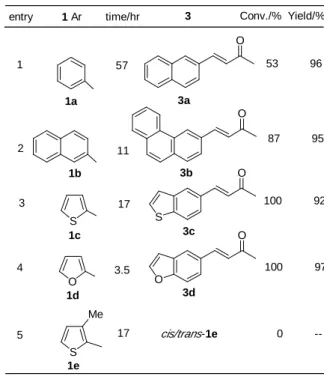
Irradiation of a degassed acetonitrile solution containing 5×10⁻³ M p-methoxy-trans-stilbene 1a and
5×10⁻³ M hydrochloric acid with a Rayonet apparatus at 350 nm for 57 hours, then the solvent is evaporated and the acid is removed to obtain 4-(nathphen-2-yl)-trans-but-3-en-2-one 3a as the sole isolated product. The compound 3a11 shows 1H NMR
at δ 7.59(d, J = 16.1 Hz, 1H), 6.69(d, J = 16.1 Hz, 1H), 2.36(s, 3H), and shows 13C NMR at δ 198.1 ppm
corresponding to the data reported in the literature.12 Similarly there is one product isolated by irradiating
p-methoxy-styrylaromatics 1b−1d in the presence of
hydrochloric acid (Scheme 2). Most of the reactions are with complete conversion. The isolated yields are very good (Table 2).
Scheme 2. Photorearrangement of Compounds 1a-1d.
Table 2. The Yields of the Reactions for Compounds.
O O O S O O 2b 2d 2c 2a 1a 1b O 1d S 1c entry 1 Ar 1 2 4 3 time/hr 2 43 50 3.5 17 Conv./% Yield/% 52 96 100 90 100 98 100 95 S Me 1e cis/trans-1e 5 17 0 --Ar OMe hv 0.5 M HCl CH3CN 1a-1d 2a-2d Ar OMe hv 0.005 M HCl CH3CN 1a-1d 3a-3d 1a 1b O 1d S 1c entry 1 Ar 1 2 4 3 time/hr 3 57 11 3.5 17 Conv./% Yield/% 53 96 87 95 100 97 100 92 S Me 1e 5 17 0 --S O O O O O 3a 3b 3c 3d cis/trans-1e
3 Since compound 1d is the most sensitive to changes in concentration of hydrochloric acid, the photolysis was carried out in six different acid concentrations (Table 3). In intermediate acid concentration, both products 2d and 3d were observed. At low acid concentration, 3d was the major product. As the acid concentration was increased to 0.026 M,
2d and 3d were of equal yields. At 0.11 M the only
product observed became 2d. A plot of product yields of 2d and 3d against the changing hydrochloric acid concentrations in acetonitrile was obtained (Figure 1).
Table 3. The Yields of Competing Pathways for 1d.
Yield, % react HCl (M) t (hr) Convn % 2d 3d 1da (0) 3.5 --e 0 0 1da (0.0026) 3.5 100 0 100 1da (0.0053) 3.5 100 4 96 1da (0.011) 3.5 100 13 87 1da (0.026) 3.5 100 51 49 1da (0.053) 3.5 100 79 21 1da (0.11) 3.5 100 100 0
Figur e 1. The Yields of Competing Pathways for 1d.
Discussion
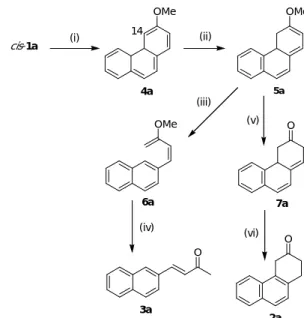
In order to explain the product dependence on, and a remarkable tuning process by acid concentration, a reasonable reaction mechanism is proposed with competing processes (Scheme 3). The reaction starts
Scheme 3. Mechanism of Photorearrangements.
(i) photocyclization; (ii) acid-catalyzed rearrangement [1,9]H shift; (iii) ring-opening; (iv) hydrolysis; (v) hydrolysis; (vi) acid-catalyzed rearrangement [1,3]H shift.
from irradiating p-methoxy-trans-stilbene 1a to isomerize to cis-1a. The ensuring well-known 6e-conrotatory electrocyclization reaction yields the dihydrophenanthrene intermediate 4a. This is followed by an acid-catalyzed reaction that is equivalent to [1,9] hydrogen shift to intermediate 5a, possibly by protonation at the carbon 14 of 4a since PM3 calculation indicated that carbon 14 of 4a bears a partial negative charge of c.a. –0.428. For the intermediate 5a, two competing reaction paths are possible. One is a six-electron ring-opening reaction to form product 3a; the other is an acid-catalyzed hydrolysis of methyl cyclohexadienyl ether to produce product 2a. Because the rate of hydrolysis increases as the concentration of acid is increased, it is reasonable that the rates of these two reactions become competitive when the acid is in the range from 0.0025 M to 0.5 M. Approximately, the rate constant of hydrolysis (kh) is forty times larger than that of
0 20 40 60 80 100 0 0.01 0.02 0.03 0.04 0.05 0.06 [HCl](M) (%) OMe O O hv CH3CN 0.5M HCl hv CH3CN 5 x 10⁻³M HCl O O O 1d 3d 2d OMe OMe OMe O O O 3a 2a cis-1a 4a 6a 7a 5a (i) (ii) (iii) (iv) (v) (vi) 14
4 ring-opening (ko) at the acid concentration of 0.026M. Because the khvalue would increase with increasing acid concentration, the smaller kh in the low acid concentration and the higher kh in the high acid concentration will result in the high selectivity between product 2a and 3a. The acid catalyzed [1,9] hydrogen shift step is an essential process which is shown by the fact that compound 1e with a methyl substituent at the 3-position of the thiophene ring prevent the [1,9] hydrogen shift thus stop the photoreaction completely and the only photoreaction is trans-cis isomerization of 1e.
In conclusion, we have demonstrated an interesting photochemical system that is sensitive to the acid concentration. Different reaction products can be obtained quantitatively by simply adjusting the acid concentration. Competiting ring opening and hydrolysis processes are believed to be the reason for the highly selective process. Since the hydrolysis process is sensitive to the acid concentration, compounds 1a-1d become unique examples of photochemical sensors sensitive torward acid concentrations. It also should be mentioned that the results described here is equivalent to trapping of an reaction intermediate (5a) by acid, a situation analogues to the recent interesting report on a hindered ester.7
Refer ences
(1) Turro, N. J.; Ramamurthy, V.; Cherry, W.; Farneth W. Chem. Rev. 1978, 78, 125.
(2) Ramamurthy, V.; Venkatesan, K. Chem. Rev. 1986, 86, 433
(3) (a) Saito, M.; Kamei, Y.; Kuribara, K.; Yoshioka, M. J. Org. Chem. 1998, 63, 9013–9018. (b) Lewis, F. D.; Cohen, B. E. J. Phys. Chem. 1994, 98, 10591–10597. (c) Nakayama, T.;
Hamana, T.; Miki, S.; Hamanoue, K. J. Chem. Soc., Faraday Trans. 1996, 92, 1473–1479. (d) Inoue, H.; Sakurai, T.; Hoshi,
T.; Ono, I.; Okubo, J. J. Phys. Org. Chem. 1992, 5, 355–360. (e)
Schultz, A. G. Acc. Chem. Res. 1983, 16, 210–218. (f) Wu,
J.-Y.; Ho, J.-H.; Shih, S.-M.; Hsieh, T.-L.; Ho, T.-I. Org. Lett. 1999, 1, 1039.
(4) (a) Huyser, E. S.; Neckers, D. C. J. Org. Chem. 1964, 29, 276.
(b) Pappas, S. P.; Pappas, B. C.; Okamoto, Y.; Sakamoto, H. J. Org. Chem. 1988, 53, 4404. (c) Bryce-Smith, D.; Gilbert, A. J. Chem. Soc., Chem. Commun. 1968, 19.
(5) (a) Turro, N. J.; Kraeutler, B. Acc. Chem. Res. 1980, 13, 369. (b)
Turro, N. J.; Gratzel, M.; Braun, A. M. J. Am. Chem. Soc. 1980, 92, 712. (c) Turro, N. J. Pure. Appl. Chem. 1981, 53, 259. (d)
Turro, N. J. Proc. Natl. Acad. Sci. USA. 1983, 80, 609. (e)
Turro, N. J.; Paczkowski, M. A.; Wan, P. J. Org. Chem. 1985, 50, 1399.
(6) (a) Hoffmann, N.; Pete, J.-P. Tetrahedron Lett. 1998, 39, 5027.
(b) Hoffmann, N.; Pete, J.-P. J. Org. Chem. 1997, 62, 6952. (c)
Hoffmann, N.; Pete, J.-P. Tetrahedron Lett. 1996, 37, 2027. (d)
Umbricht, G.; Hellman, M. D.; Hegedus, L. S. J. Org. Chem. 1998, 63, 5173. (e) Schulta, A. G.; Anotlinakis, E. G. J. Org. Chem. 1996, 61, 4555.
(7) Mori, T.; Wada, T.; Inoue, Y. Org. Lett. 2000, 2, 3401
(8) Ho, T.-I.; Ho, J.-H.; Wu, J.-Y. J. Am. Chem. Soc. 2000, 122,
8575.
(9) Spectral data for compound 2a: 1H NMR (300 MHz, CDCl3) δ 7.86-7.81 (m, 2H), 7.73 (d, J = 8.4 Hz, 1H), 7.56-7.45 (m, 2H),
7.33 (d, J = 8.4 Hz, 1H), 3.94 (s, 2H), 3.26 (t, J = 6.9 Hz, 2H),
2.73 (t, J = 6.9 Hz, 2H). 13C NMR (75 MHz, CDCl3) δ 210.1, 133.2, 132.4, 131.4, 128.7, 128.2, 127.1, 126.5, 126.5, 125.4, 122.3, 40.4, 38.8, 29.6.
(10) Manitto, P.; Monti, D.; Speranza, G. J. Org. Chem. 1995, 60,
484−485.
(11) Spectral data for compound 3a: 1H NMR (300MHz, CDCl3): δ 7.94 (s, 1H), 7.87-7.82 (m, 3H), 7.67 (d, J = 16.2 Hz, 1H), 7.67 (dd, J = 8.8,1.5 Hz, 1H), 7.54-7.48 (m, 2H), 6.83 (d, J = 16.2Hz, 1H), 2.42 (s, 3H). 13C NMR (75MHz, CDCl3): δ 198.31, 143.45, 134.29, 133.24, 131.88, 130.27, 128.74, 128.51, 127.76, 127.33, 127.21, 126.74, 123.45, 27.55.
(12) B. Unterhalt and U. Pindur, Arch. Pharm. (Weinheim Ger.), 1973, 306, 813.