• 沒有找到結果。

Nitric oxide production and blood pressure reduction during hemodialysis

N/A
N/A
Protected

Academic year: 2021

Share "Nitric oxide production and blood pressure reduction during hemodialysis"

Copied!
29
0
0

加載中.... (立即查看全文)

全文

(1)

Nitric oxide production and blood pressure reduction during hemodialysis

Chiz-Tzung Chang

1,2

, Ming-Hui Chien

3

, Kai-Liang Yang

4

, Chien-Chih Yu

3

, Jing-Fang

Hsu

5

, I-Kuan Wang

1,2

, Paik-Seong Lim

6

, Chiu-Ching Huang

1,2*

1. Division of Nephrology, China Medical University Hospital, No.2, Yu-Der Rd,

Taichung, Taiwan 40447

2. College of Medicine, China Medical University, No.91, Hsueh-Shih Rd,

Taichung. Taiwan 40402

3. School of Pharmacy, China Medical University, No.91, Hsueh-Shih Rd,

Taichung, Taiwan 40402

4. Department of Public Health, China Medical University, No.91, Hsueh-Shih Rd,

Taichung, Taiwan 40402

5. L5 Research Center, China Medical University, No.2, Yu-Der Rd, Taichung,

Taiwan 40447

6. Tungs’ Taichung MetroHarbor Hospital, No. 699, Sec 8, Taiwan Blvd, Taichung,

Taiwan 43435

Running title: Nitric oxide and intradialytic hypotesnion

*Address for correspondence author

Chiu-Ching Huang M.D. Division of Nephrology, China Medical University Hospital,

2-Yu-Der Rd, Taichung, 40447

Tel: 886-4-22052121 Ext 7387 , Fax:886-4-22331691, E-mail:[email protected]

(2)

Aim: A decrease of systolic blood pressure in excess of 20 mmHg during

hemodialysis treatment (IDD) is common for hemodialysis patients. Intradialytic

hypotension (IDH) is symptomatic IDD by definition. Overproduction of nitric oxide

(NO) is a possible cause of IDD. Dialysate nitrate and nitrite amount can be used as

an indicator of intradialysis NO production. Our aim was to find the predictor of NO

production in IDD patients.

Methods: Partial dialysate samples were collected during the whole hemodialysis

session and total dialysate nitrate and nitrite amount was measured to assess the

association of intradialysis NO production with blood pressure change.

Results: There were 31 IDD patients and 71 patients who did not develop IDD

(NIDD) included in the study. Among the IDD patients, 13 were IDH patients with a

mean systolic blood pressure lower than that of the other 18 symptomless IDD

patients (96.6±3.4 mmHg vs 125.0±3.8 mmHg, p<0.001). The median value of NO

production was higher in the IDD than in the NIDD patients (447.7 g vs 238.8 g,

p<0.001). The NO production correlated linearly with blood pressure reduction

(R=0.487, p<0.001). The multivariate analysis showed that NO production was

positively associated with predialysis systolic blood pressure.

(3)

Conclusion: No production during hemodialysis was higher in IDD than in NIDD

patients. IDH often occurred when systolic blood pressure was reduced to below 100

mmHg. The amount of NO produced during hemodialysis, which may be associated

with predialysis systolic blood pressure, can be used to predict intradialysis blood

pressure decrease.

Key words: hemodialysis, intradialytic hypotension, nitric oxide, partial dialysate

(4)

Background

Intradialytic blood pressure decrease is common in hemodialysis patients. While

systolic blood pressure decrease of ≥ 20 mmHg during hemodialysis (IDD) can be

symptomless for some patients, others experience symptomatic IDD—also known as

intradialytic hypotension (IDH)—through muscle cramps, dizziness, headaches,

nausea, and vomiting

1

. Although dialysis techniques have improved significantly over

the years, hemodialysis patients still frequently suffer from IDD complications,

including life-threatening sequelae such as myocardial ischemia, cerebral vascular

accident, and syncope

2

. Multifactorial mechanisms are likely to lead to IDD,

including: fluid removal during dialysis and accompanying hemodynamic

consequences, e.g. hypovolemia; or decrease in circulating filling pressure and

cardiac output

3

. It was previously thought that fluid removal during dialysis and

accompanying hemodynamic consequences such as hypovolemia, or decrease in

circulating filling pressure and cardiac output were important factors contributing to

IDH

4

. However, inappropriately low peripheral arterial resistance contributes to IDD

5

.

Beasley and Brenner suggested that nitric oxide (NO), a potent endogenous

vasodilator, caused intradialytic blood pressure reduction

6

. NO production increases

(5)

significantly during HD

7-14

, resulting in significant and rapid vasodilatation and

hypotension.

Formed via NO synthase (NOS), NO undergoes a short half-life and rapidly

metabolizes to nitrate and nitrite—markers of NO production—and increase in

concentration in IDD patients

15

. Indeed, previous studies show that plasma total

nitrate and nitrite concentration was higher in IDD patients than those without

(NIDD) during dialysis

10, 14

. However, only a few papers studying intradialytic blood

pressure changes have measured dialysate concentrations of nitrate and nitrite at

discrete time points during HD

9

. In the present study, we continuously collected

partial dialysates during the entire dialysis sessions and measured total dialysate

nitrate and nitrite concentrations. Clinical and biochemical parameters of each patient

were measured and compared to NO production levels to detect possible predictors of

NO production and IDD.

(6)

Methods

Subjects: The study was approved by the China Medical University & Hospital

Research Ethics Committee (reference number: DMR100-IRB-039). Uremia patients

undergoing hemodialysis therapy for over 6 months at the China Medical University

Hospital were included in this study. All patients underwent a 4-hour hemodialysis

session using a single-use dialyzer equipped with high-flux high-performance

polysulfone or low-flux polysulfone. The dialyzer sizes were categorized as small,

medium and large according to membrane surface area (<1.8, 1.8-2.0, >2.0 m

2

,

respectively). We employed a bicarbonate-based dialysate at a flow rate of 500

ml/min. Blood pressure was measured before, after, and every 30-minute interval in

between HD sessions. For each patient before hemodialysis, we also measured

complete blood count, biochemistry, electrolytes, ferritin, iPTH and hs-CRP

(high-sensitivity CRP) levels.

Partial dialysate collection: The method of partial dialysate collection was adapted

from the technique described by Garred et al. with some modifications

16

. The

dialysate was drained from the suitable connector designed for dialysate collection

from the FMC 4008 B machine (Fresenius, Bad Homburg, Germany). A constant

(7)

ultrafiltration rate was maintained to ensure precise proportioning between dialysate

flow and draining sample rates. The effluent collected was stirred, mixed and

weighed. The product of total dialysate flow, ultrafiltration flow rate, and duration of

treatment time gave the total volume of effluent drained from the dialysis machine.

We multiplied partial dialysate nitrate and nitrite concentrations by the total effluent

volume to obtain the total nitrate and nitrite amount removed during the 4-hour

dialysis session.

Measurement of total nitrate and nitrite concentration: The total dialysate nitrate

and nitrite concentration of was determined using the Merckoquant 10020 Nitrate

Test Kit (Merck, Damstadt, Germany) consisted mainly of a test strip with two

reaction zones. One end of the strip contains a reducing reagent that converts nitrate

to nitrite. An acid buffer converts nitrite into nitrous acid, which diazotizes aromatic

amines (e.g., sulfanilic acid). The diazotized sulfanilic acid couples with

N-[naphthy(1)]-ethylene to produce a red-violet dye. The other end of the strip is the

reaction zone for nitrite. We obtained total sample nitrate and nitrite concentration

through comparing the color of the strip to a standard color chart. The color intensity

is proportional to nitrate concentration, calibrated by an ion chromatography method

(8)

as described in manufacturer’s manual.

Statistical analysis

We performed a t-test to compare clinical and biochemical parameters of the IDD and

NIDD groups. The resulting data were expressed as mean ± SEM (standard error

mean). For non-normality numerical parameters, we used Mann-Whitney tests, of

which the results were expressed as medians with quartiles in parentheses.

Additionally, we conducted chi-square tests for categorical parameters and ANOVA

tests for multiple groups. Linear regression and multiple regression analysis

articulated the association between different variables and NO production. We used

95% confidence interval.

(9)

Results:

In total, 102 patients were included in the study, among whom 71 did not have

systolic blood pressure reduction above 20 mmHg (NIDD) and 31 had a decrease of

blood pressure in excess of 20 mmHg (IDD). Thirteen of the 31 patients with IDD had

symptoms associated with blood pressure decrease (IDH), another 18 did not have

subjective discomfort. Blood pressure reduction of the 13 IDH patients (47.2±3.8

mmHg) was not significantly different from that of the 18 symptomless IDD patients

(41.6±3.0mmHg) (p=0.209). IDH patients’ SBP tended to drop below 100 mmHg

(96.6±3.4 mmHg) while symptomless IDD patients experience nadir intradialytic SBP

above 100 mmHg (125.0±3.8 mmHg) (p<0.001).

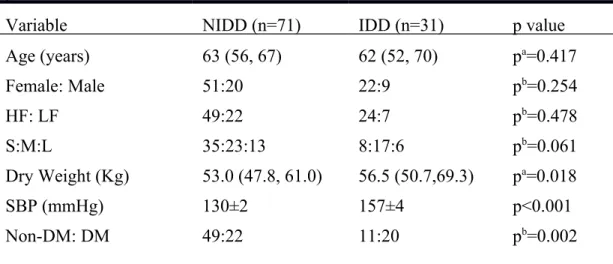
Sex, age, and artificial kidneys used were similar between NIDD and IDD groups.

The proportion of patients with diabetes mellitus (DM) was higher in the IDD group

(20/31 vs 22/71, IDD vs NIDD, p=0.002). The median dry weight was higher in the

IDD group (56.5 kg vs 53.0 kg, IDD vs NIDD, p=0.018). Mean ultrafiltration (UF)

volume and predialysis systolic blood pressure were higher in the IDD than in the

NIDD group (3.0±0.2L vs 2.2± 0.1L, IDD vs NIDD; p<0.001 and 157±4 mmHg vs

130± 2 mmHg, IDD vs NIDD; p<0.001, respectively). The blood count, biochemical

(10)

parameters, and KT/V were not significantly different between IDD and NIDD (Table

1). The median value of NO production in the IDD group was significantly higher

than in NIDD patients (447.4μg vs 238.8μg, IDD vs NIDD; p<0.001, Mann-Whitney

test) (Figure 1 A). The amount of NO production correlated linearly with blood

pressure drop (R=0.278, p=0.005) (Figure 1 B). Within the 31 IDD patients, 13 of

those exhibiting IDH produced intradialytic NO (450.3±58.8 μg) not different from

the amount 18 symptomless IDD patients produced (469.8±47.8μg) (p=0.800).

As there were significant differences in the proportion of DM patients and size of

artificial kidneys used between IDD and NIDD groups, we compared the effects of

these variables on NO production. The effects of other variables on NO production

were also analyzed. The median values of NO production were similar between

females and males (279.2μg and 329.1μg; female vs male, p=0.332). The median

values of NO production between the DM and non-DM patients showed no significant

differences (375.4μg and 264.6μg, DM vs non-DM; p=0.068). In addition, neither

high-flux nor low-flux artificial kidney used affected the NO production (p=0.277).

However, artificial kidney size (small, medium, or large) was significantly associated

with NO production (p<0.001). When material and size of the artificial kidney were

(11)

considered, the results of the two-Way ANOVA analysis revealed that artificial

kidney was not significantly associated with intradialytic NO production (p=0.277)

(Table 2).

After excluding significant associations of the aforementioned non-numerical factors

and NO production, we analyzed the correlations between numerical factors with NO

production. Linear regression analysis showed that dry weight (p=0.039),

ultrafiltration volume (p=0.018), and predialysis systolic blood pressure (p=0.033)

were significantly associated with NO production. Blood count, biochemical

parameters, ferritin, iPTH and Hs-CRP were not significantly correlated with

intradialytic NO production (data not shown).

Of the 102 study recruits, 23 patients (all in the NIDD group) had an increase in

intradialytic blood pressure. We excluded these 23 patients from the remaining

analyses and conduct a subgroup analysis of the other 79 patients. There were 48

patients with intradialytic blood pressure reduction between 0 and 20 mmHg

(subgroup NIDD-1) and the remaining 31 patients had blood pressure decrease of

over 20 mmHg (IDD). Blood count, biochemistry, iPTH, ferritin, and Hs-CRP were

not significantly different between NIDD-1 and IDD (data not shown). The median

(12)

age and sex ratios were also not different between these 2 subgroups. The proportion

of DM patients was higher in the IDD subgroup than in the NIDD-1 one (20/31 vs

13/48, IDD vs NIDD-1; p=0.002). The median dry weight was higher in the IDD

group than in the NIDD-1 one (56.5 kg vs 52.2 kg, IDD vs NIDD-1; p=0.014). Mean

predialysis systolic blood pressure and ultrafiltration volume were also higher in the

IDD group (157± 4 mmHg vs 130±3 mmHg; p<0.001 and 3.0±0.2L vs 2.3±0.1L;

p=0.002, respectively). The median NO production of IDD patients was greater than

that of NIDD-1 ones (447.4μg vs 177.7μg; p<0.001)(Table 3). Linear regression

analysis for the 79 patients revealed a strong association between NO production and

blood pressure reduction (R=0.487, p<0.001) (Figure 2). Similar to results of the

aforementioned univariate linear regression analysis from the total 102 study subjects,

only dry weight, ultrafiltration volume and systolic blood pressure significantly

correlated with NO production in the 79 NIDD-1and IDD patients in univariate study

(data not shown). We further analyzed these factors with a multiple linear regression

model. When DM was adjusted, the effect of ultrafiltration volume on the amount of

NO production became borderline [beta= 0.296 (-0.240, 8.472) p=0.051]. Dry weight

was not significantly associated with NO production either [beta=0.200 (-5.901,

(13)

0.117), p=0.184]. Only predialysis systolic blood pressure could significantly predict

NO production [beta=0.307 (0.170, 0.411). p=0.034] (Table 4).

Of the 79 subjects with intradialytic blood pressure reduction, ROC (receiver

operating characteristic) curve study revealed a cut-off NO production amount of

338.9μg can predict IDD with a sensitivity of 79.2% and a specificity of 74.2%.

(14)

Discussion:

The present study, 79 (77.4%) out of 102 study subjects showed intradialytic blood

pressure reduction. There were 31 (30.3%) IDD and 13 (12.7%) IDH patients. When

intradialytic systolic blood pressure dropped below 100 mmHg, hemodialysis patients

were more likely to have symptoms related to hemodialysis-associated blood pressure

reduction. The amount of intradialytic NO is positively correlated with reduced

intradialytic blood pressure, and is affected by systolic blood pressure before HD

session initiation, indicating that NO might have an important role regulating blood

pressure during HD.

Nitric oxide synthase (NOS) uses L-arginine as a substrate to synthesize nitric oxide

17

.

There are 3 kinds of NOS: endothelial NOS (eNOS), neuronal NOS (nNOS) and

inducible NOS (iNOS). In most cases during hemodialysis, eNOS and iNOS regulate

hemodynamic changes. However, given that it takes NOS 6 hours to induce RNA

synthesis and protein formation, iNOS most likely will not lead to IDD within a

4-hour dialysis session

18

. Therefore, eNOS is most likely to regulate blood pressure

during hemodialysis

19

. Blood pressure decreases when eNOS activates and NO is

subsequently produced. It was thought there were three possible ways to enhance

(15)

eNOS expression: increase NOS substrates, decrease eNOS inhibitors, or increase

NOS activators. First, however, previous studies have shown that NOS substrate

L-arginine concentration in plasma decreased during HD

20

. Therefore NOS substrate

concentrations cannot take part in the pathogenic mechanism of intradialytic blood

pressure drop. Secondly, we know that HD can significantly reduce plasma ADMA

(asymmetric dimethylarginine), an important endogenous NOS inhibitor

21

. However,

an acute reduction of ADMA level has no significant effect on NO-dependent

vasodilatation or IDD

22

. Therefore decreasing eNOS inhibitors is not a likely

mechanism either. Finally, increasing eNOS activators is a more probable pathogenic

mechanism leading to IDH. Additionally, extracorporeal circulation of blood during

HD may stimulate eNOS activation and NO release by blood cells

19

.

The mechanisms leading to blood cell eNOS activation are not clear. It has been

proposed that peripheral blood monocytes contacting bioincompatible membranes can

lead to production of proinflammatory cytokines such as IL-1 and TNF-. In turn,

these cytokines induce blood cell or endothelial cell eNOS activation and nitric oxide

formation

6

. High-flux membranes with better biocompatibility induce less

proinflammatory substances and theoretically induce less NO production

23

. However,

(16)

our results demonstrated that there was no difference in NO production between

high-or low-flux dialyzer. Previous rephigh-orts have also shown that dialyzer membranes have

no effects on the occurrence of intradialytic hypotension

24

. Uremic DM patients have

higher proinflammatory serum cytokine or CRP levels than non-DM patients

25

. There

was no significant difference of NO production between the DM and non-DM

patients. There was also no significant difference in CRP levels between IDD and

NIDD groups. Therefore, inflammation cannot completely explain the IDD seen in

our patients.

Several studies have demonstrated that interdialysis weight gain (IDWG) is associated

with intradialytic hypotension and cardiovascular mortality. High IDWG leads to high

predialysis blood pressure and IDH

2,26

. Moreover, IDWG determines the ultrafiltration

volume and our data showed that this volume was linearly correlated with NO

production in univariate regression analysis, although the effect of ultrafiltration

volume on NO production became more tenuous after multivariate analysis with

adjustment for DM (p=0.051). Currently, the effects of ultrafiltration volume on NO

production are unclear. Higher blood pressure and greater fluid removal may lead to a

higher dialyzer transmembrane pressure and affect blood hemodynamic changes. As

(17)

high blood pressure and high ultrafiltration cause higher vascular shear force, high

shear stress can either induce activation of endothelial mechanosensor or platelet

serotonin secretion to enhance NO production

27-30

.

Conclusion

Our study demonstrated that symptomatic IDD or IDH tended to occur in

hemodialysis patients with systolic blood pressure under 100 mmHg. The amount of

intradialytic NO production during hemodialysis, can be a predictor of IDD.

Predialysis systolic blood pressure may be associated with intradialytic NO

production.

Acknowledgements

This work was supported by China Medical University Hospital, Taiwan (CTC

100-014 to Chiu-Ching Huang).

Competing interests

(18)

References:

1.

Schreiber MJ, Jr. Setting the stage. Am J Kidney Dis. 2001; 38: S1-S10.

2.

Shoji T, Tsubakihara Y, Fujii M, Imai E. Hemodialysis-associated hypotension

as an independent risk factor for two-year mortality in hemodialysis patients.

Kidney Int. 2004; 66: 1212-20.

3.

Jost CM, Agarwal R, Khair-el-Din T, Grayburn PA, Victor RG, Henrich WL.

Effects of cooler temperature dialysate on hemodynamic stability in "problem"

dialysis patients. Kidney Int. 1993; 44: 606-12.

4.

Daugirdas JT. Dialysis hypotension: a hemodynamic analysis. Kidney Int. 1991;

39: 233-46.

5.

Rosa AA, Fryd DS, Kjellstrand CM. Dialysis symptoms and stabilization in

long-term dialysis. Practical application of the CUSUM plot. Arch Intern Med.

1980; 140: 804-7.

6.

Beasley D, Brenner BM. Role of nitric oxide in hemodialysis hypotension.

Kidney Int Suppl. 1992; 38: S96-100.

7.

Amore A, Bonaudo R, Ghigo D, Arese M, Costamagna C, Cirina P, et al.

Enhanced production of nitric oxide by blood-dialysis membrane interaction. J

(19)

8.

Kang ES, Acchiardo SR, Wang YB, Tevlin MT, Hughes T, Cardoso S.

Hypotension during hemodialysis: role for nitric oxide. Am J Med Sci. 1997;

313: 138-46.

9.

Martensson L, Hegbrant J, Thysell H. Generation of nitrate during dialysis as a

measure of nitric oxide synthesis. Artif Organs. 1997; 21: 163-7.

10. Nishimura M, Takahashi H, Maruyama K, Ohtsuka K, Nanbu A, Hara K, et al.

Enhanced production of nitric oxide may be involved in acute hypotension

during maintenance hemodialysis. Am J Kidney Dis. 1998; 31: 809-17.

11. Noris M, Benigni A, Boccardo P, Aiello S, Gaspari F, Todeschini M, et al.

Enhanced nitric oxide synthesis in uremia: implications for platelet dysfunction

and dialysis hypotension. Kidney Int. 1993; 44: 445-50.

12. Rysz J, Luciak M, Kedziora J, Blaszczyk J, Sibinska E. Nitric oxide release in

the peripheral blood during hemodialysis. Kidney Int. 1997; 51: 294-300.

13. Yokokawa K, Mankus R, Saklayen MG, Kohno M, Yasunari K, Minami M, et

al. Increased nitric oxide production in patients with hypotension during

hemodialysis. Ann Intern Med. 1995; 123: 35-7.

14. Lin SH, Chu P, Yu FC, Diang LK, Lin YF. Increased nitric oxide production in

hypotensive hemodialysis patients. Asaio J. 1996; 42: M895-9.

(20)

15. Coll E, Larrousse M, de la Sierra A, Collado S, Jimenez W, Cases A. Chronic

hypotension in hemodialysis patients: role of functional vascular changes and

vasodilator agents. Clin Nephrol. 2008; 69: 114-20.

16. Garred LJ, Rittau M, McCready W, Canaud B. Urea kinetic modelling by partial

dialysate collection. The International journal of artificial organs. 1989; 12:

96-102.

17. Aslam S, Santha T, Leone A, Wilcox C. Effects of amlodipine and valsartan on

oxidative stress and plasma methylarginines in end-stage renal disease patients

on hemodialysis. Kidney Int. 2006; 70: 2109-15.

18. Tota B, Quintieri AM, Angelone T. The emerging role of nitrite as an

endogenous modulator and therapeutic agent of cardiovascular function. Curr

Med Chem. 2010; 17: 1915-25.

19. Fischer UM, Schindler R, Brixius K, Mehlhorn U, Bloch W. Extracorporeal

circulation activates endothelial nitric oxide synthase in erythrocytes. Ann

Thorac Surg. 2007; 84: 2000-3.

20. Mangoni AA, Hewitson CL, Woodman RJ, Whiting MJ, McAteer-Carr B,

Barbara JA. Symmetric dimethylarginine is an independent predictor of

intradialytic hypotension. Am J Hypertens. 2008; 21: 955-9.

(21)

21. Eiselt J, Rajdl D, Racek J, Siroka R, Trefil L, Opatrna S. Asymmetric

dimethylarginine in hemodialysis, hemodiafiltration, and peritoneal dialysis.

Artif Organs. 2010; 34: 420-5.

22. Engelberger RP, Teta D, Henry H, De Senarclens O, Dischl B, Liaudet L, et al.

Haemodialysis acutely reduces the plasma levels of ADMA without reversing

impaired NO-dependent vasodilation. Clin Sci (Lond). 2009; 117: 293-303.

23. Uda S, Mizobuchi M, Akizawa T. Biocompatible characteristics of

high-performance membranes. Contrib Nephrol. 2011; 173: 23-9.

24. Skroeder NR, Kjellstrand P, Holmquist B, Kjellstrand CM, Jacobson SH.

Individual differences in biocompatibility responses to hemodialysis. The

International journal of artificial organs. 1994; 17: 521-30.

25. Chen HY, Chiu YL, Hsu SP, Pai MF, Lai CF, Yang JY, et al. Elevated

C-reactive protein level in hemodialysis patients with moderate/severe uremic

pruritus: a potential mediator of high overall mortality. Qjm. 2010; 103: 837-46.

26. Flythe JE, Brunelli SM. The risks of high ultrafiltration rate in chronic

hemodialysis: implications for patient care. Semin Dial. 2011; 24: 259-65.

27. Vessieres E, Freidja ML, Loufrani L, Fassot C, Henrion D. Flow (shear

stress)-mediated remodeling of resistance arteries in diabetes. Vascular pharmacology.

(22)

2012; 57: 173-8.

28. Hsieh HJ, Liu CA, Huang B, Tseng AH, Wang DL. Shear-induced endothelial

mechanotransduction: the interplay between reactive oxygen species (ROS) and

nitric oxide (NO) and the pathophysiological implications. Journal of biomedical

science. 2014; 21: 3.

29. Borgdorff P, Fekkes D, Tangelder GJ. Hypotension caused by extracorporeal

circulation: serotonin from pump-activated platelets triggers nitric oxide release.

Circulation. 2002; 106: 2588-93.

30. Heo KS, Fujiwara K, Abe J. Disturbed-flow-mediated vascular reactive oxygen

species induce endothelial dysfunction. Circ J. 2011; 75: 2722-30.

Table 1. The comparison of clinical and biochemical parameters of hemodialysis

patients

Variable

NIDD (n=71)

IDD (n=31)

p value

Age (years)

63 (56, 67)

62 (52, 70)

p

a

=0.417

Female: Male

51:20

22:9

p

b

=0.254

HF: LF

49:22

24:7

p

b

=0.478

S:M:L

35:23:13

8:17:6

p

b

=0.061

Dry Weight (Kg)

53.0 (47.8, 61.0)

56.5 (50.7,69.3)

p

a

=0.018

SBP (mmHg)

130±2

157±4

p<0.001

(23)

UF (L)

2.2±0.1

3.0±0.2

p<0.001

Hematocrit (%)

31.7±0.5

32.3±0.6

p=0.555

Platelet (10

3

/L)

173.0±11.4

186.5±11.8

p=0.418

WBC (10

3

/L)

6563±246

7190±498

p=0.439

Albumin (g/dL)

3.9±0.1

4.0±0.1

p=0.497

BUN (mg/dL)

78.2±3.0

77.6±4.1

p=0.897

Creatinine (mg/dL)

KT/V

10.6±0.6

1.59±0.11

10.7±0.6

1.50±0.18

p=0.818

p=0.538

GPT (IU/L)

17.5±1.2

17.6±3.2

p=0.907

Cholesterol (mg/dL)

164.4±5.7

168.1±7.8

p=0.721

Triglyceride (mg/dL)

141.0±16.8

159.0±19.0

p=0.482

Calcium (mg/dL)

9.7±0.2

9.6±0.2

p=0.240

Phosphate (mg/dL)

5.6±0.2

5.8±0.3

p=0.438

Sodium (meq/L)

135.5±0.4

135.2±0.5

p=0.569

Potassium (meq/L)

4.9±0.1

5.0±0.1

p=0.909

Ferritin (ng/L)

485 (277, 621)

361 (124, 520)

p=0.482

iPTH (ng/L)

142.1 (61.4, 360.5) 93.4 (43.4,364.4)

p=0.645

NO production (μg)

238.8 (84.9, 392.0) 447.4(318.5,578.6

)

p

a

<0.001

NIDD: patients with a decrease of intradialytic systolic blood pressure less than 20

mmHg; IDD: patients with a decrease of intradialytic systolic blood pressure over 20

mmHg; HF, high-flux; LF, low-flux; S,M,L, small, medium, or large size artificial

kidney; SBP, pre-dialysis systolic blood pressure; UF, ultrfiltration volume

a: Mann-Whitney test data expressed as median (25%, 75%); b: chi-square test

Table2. The effects of characteristic variables on NO production in the 102 study

subjects

Variable

NO production (μg)

p value

Female: Male

279.2 (114.9, 451.4) 329.1 (166.9, 453.2)

0.322

a

DM: non-DM

375.4 (166.9,502.7): 264.6 (118.4,428.6)

0.068

a

High flux: Low Flux

319.9 (178.7, 467.9) : 279.2 (127.9. 431.3)

0.277

a

Small, Medium, Large

220.6±24.3: 309.8±35.6: 461.7±36.5

<0.001

b

(24)

Material: high flux or low flux membrane

(25)

XTable 3. The demographic data of the two subgroups of the 79 patients with

intradialytic blood pressure reduction

Variables

NIDD-1 (48)

IDD (31)

p value

Age (years)

64 (56, 74)

62 (52,70)

p

a

=0.698

Female: male

38:10

22:9

p

b

=0.574

Non-DM:DM

35:13

11:20

p

b

=0.002

SBP (mmHg)

130±3

157±4

p<0.001

UF amount (L)

2.3±0.1

3.0±0.2

p

c

=0.002

Dry weight (Kg)

52.2 (47.4,60.8)

56.5(50.7,69.3)

p

a

=0.014

NO production (μg)

171.7(173.3,316.2) 447.4(318.5,578.6

)

p

a

<0.001

NIDD-1: patients with an intradialytic blood pressure reduction between 0 to 20

mmHg; SBP: pre-dialysis systolic blood pressure; UF: ultrafiltration volume

a : Mann-Whitney test ; b: chi-square test; c: t-test

(26)

Table 4. The coefficient of multiple regression analysis of variables associated with

intradialytic blood pressure reduction in the 79 NIDD-1 and IDD patients after adjust

for DM

Beta

p

Constant

0.001

UF

0.296 (-0.240, 8.472)

0.051

Dry weight

0.200 (-5.901, 0.117)

0.184

SBP

0.307 (0.170, 0.411)

0.034

NIDD-1: patients with an intradialytic systolic blood pressure reduction between 0 to

20 mmHg; IDD: patients with an intradialytic systolic blood pressure decrease over

20 mmHg; Beta: standardized coefficient; UF: ultrafiltration volume; SBP:

pre-dialysis systolic blood pressure

(27)

g

m

m

H

g

(B)

R=0.278, p=0.005

(A)

NIDD

IDD

0 200 400 600 800 1000

g

0

200 400 600 800 1000

-80

-60

-40

-20

0

20

40

60

(28)

0

200 400 600 800 1000

-80

-60

-40

-20

0

20

g

m

m

H

g

R=0.487, p<0.001

Figure legends:

(29)

patients with intradialytic blood pressure reduction more than 20 mmHg (IDD) and

patients without IDD (NIDD). (A) The median value of NO production of the 31 IDD

patients was higher that of the other 71 NIDD. (B) NO production linearly correlated

with systolic blood pressure reduction in the 102 study subjects.

Figure 2. The linear regression analysis of the NO production with blood pressure

changes in patients with intradiaysis blood pressure reduction. NO production was

linearly correlated with intradialytic blood pressure drop in patients with intradialytic

blood pressure reduction (n=79, R=0.487, p<0.001)

數據

Table 1. The comparison of clinical and biochemical parameters of hemodialysis  patients

參考文獻

相關文件

Seals, if any, essential for sealing the pressure sensing element, and in direct contact with the process medium, made of or protected by aluminum, aluminum alloy, aluminum

Under the pressure of the modern era is often busy with work and financial resources, and sometimes not in fact do not want to clean up the environment, but in a full day of hard

If we recorded the monthly sodium in- take for each individual in a sample and his/her blood pressure, do individuals with higher sodium consumption also have higher blood

Based on the forecast of the global total energy supply and the global energy production per capita, the world is probably approaching an energy depletion stage.. Due to the lack

In order to assess and appreciate the results of all these studies, and to promote further research on the Suan Shu Shu, an international Symposium was held on August 23-25

 Promote project learning, mathematical modeling, and problem-based learning to strengthen the ability to integrate and apply knowledge and skills, and make. calculated

In this way, the philosophy of tea giving with life cultivation of his personal characteristics, with fl esh and blood, and with wisdom and sadness and the course of Buddhist

The person making the measurement then slowly lowers the applied pressure and listens for blood flow to resume. Blood pressure sure pulsates because of the pumping action of the