ColorCocktail: an Ontology-Based Recommender System
Yu-Hsin Chen
Ting-hsiang Huang David Chawei Hsu Jane Yung-jen Hsu
[email protected] [email protected] [email protected] [email protected]
Department of Computer Science and Information Engineering National Taiwan University, Taiwan
Abstract
Cocktails are popular in a wide variety of social func-tions. Given the diverse selection of ingredients and preparation, there are often fitting choices that match the mood or spirit of any given moment. On the other hand, specifying the ideal drink can pose a challenge for the average person without detailed knowledge about cocktails. In this paper, a novel recommender system, “ColorCocktail” , is proposed to help people choose cocktails in accordance with their current mood and preferences, which are specified by checking a few gen-eral characteristics. In particupar, this research explores using colors as an abstract representation of personal emotions. The ColorCocktail system performs ontolog-ical reasoning using a knowledge base containing the cocktail ontology. Combined with commonsense rea-soning for affect sensing from colors, the system is able to make intelligent recommendations through an intu-itive interface.
Introduction
This research explores the role of ontology and common-sense knowledge in supporting natural human-computer in-teraction. The task of selecting cocktails to match personal mood and preferences is used as a motivating example.
Cocktails are popular in a wide variety of social gath-erings, ranging from formal wedding ceremonies to casual parties. A ‘cocktail’ is commonly known as an iced drink of wine or distilled liquor mixed with flavoring ingredients, usually one or more of a liqueur, fruit, sauce, honey, milk or cream, spices, etc. Cocktails became popular from 1920 and continuously evolve for decades. People are fascinated with the variety of dazzling colors and attractive tastes. A great choice of cocktail can enhance the experience of spe-cial moments in people lives. However, finding the right drink can be a big challenge for the average person without detailed knowledge about cocktails. People usually take the easy way out by going for known popular choices or rec-ommendations from the bartender. Wouldn’t it be nice to have an intelligent recommender system that can help a per-son make the wise choice according to her current mood and preferences?
Copyright c 2007, American Association for Artificial
Intelli-gence (www.aaai.org). All rights reserved.
This paper presents “ColorCocktail”, a cocktail recom-mendation system that helps people identify the ideal drink based on a few general characteristics specified by the user. Besides the basic ingredients, ColorCocktail considers the mutual influence between the taste of a drink and a person’s mood. In particular, this research explores using colors as an abstract representation of personal emotions reflected in the current mood. For example, one draws some colors on the screen as shown on the left in Figure ??. ColorCocktail analyzes the colors to find the cocktail, shown on the right, with the matching taste and aura.
Figure 1: Specification of mood as colors.
Detailed knowledge about cocktails has been represented as a cocktail ontology. ColorCocktail performs ontological
reasoning based on such a taxonomic classification in
find-ing the recommendations. In addition, commonsense
rea-soning is used to link the intuitive specification of colors
with personal emotions in order to provide a natural interac-tive recommendation process.
The rest of this paper is organized as follows. We start by surveying related work in recommender systems, human taste perception, as well as color and emotion. We then present the ColorCocktail system architecture together with more detailed descriptions of the cocktail ontology, user in-terface, and the reasoning component in the prototype sys-tem. Finally, we discuss some preliminary findings from testing the ColorCocktail prototype system for cocktail rec-ommendations and suggest several important issues for fu-ture research.
Related Work
To design a good cocktail recommendation system, we need to explore related research in the areas of recommender
sys-tems, human perception, especially taste and flavor. In addi-tion, the study of colors and their relationship with emotions.
Recommender System
Recommender systems are popular in nowadays. When you are surfing the online bookstore Amazon.com, the bookstore will give you some popular books recently and some book you may interested in. The ”new” books are shown around your current view. Another example often occurs in the su-permarket. Because you have the member of the super mar-ket, every time before paying up, you show your card to the cashier and the system records the goods you bought. Next time when you go shopping, it will provide a personal shop-ping list with special discount for you.
These kind of recommender systems are base on the his-torical data and the product rating. The system analyzes what the user bought before, what they viewed before, and how they rated the products. The most common method is collaboration filtering. After the analysis, collaboration filtering recommender system differentiates from one user profile to another to determine what to recommend. This ap-proach will suffer from the problem of data sparseness and the first rate problem.
Another way to build a recommender system is content-based. By comparing the representation of content con-tained in an item, the content-based method provide recom-mendations for users. This kind of recommendation need more effort on extract the content of items. Users of the sys-tem do not need to give great feed back. In the meanwhile, fewer interaction between the system and the user.(?)
Taste and Flavor
Taste is another important issue in our work. In the basic
wine tasting procedure, tasting, bouquet and color are im-portant features. We try to import the knowledge of wine into the system.
From the view of physiology, taste buds on the tongue let human beings have the gustatory perception. There are around ten thousand taste buds in human’s mouth. Most of the taste buds are on and around the tiny bumps on the tongue. They look like little red dots, or raised bumps. Every taste bud detects five primary tastes including sour, sweet, bitter, salty and umami(salts from certain acid). Via these little sensors, human can sense the taste of the food.
In addition to taste, human perception also includes ol-faction, vision, etc. If you get a running nose, you lose your olfaction temporary. Everything you eat will be pretty bland though your gustation still work. Furthermore, color of the foods is the first impression for the people. In the procedure of wine evaluation, color is also the first impression too. In many commercial Web site, the properties are already avail-able.1
Color and Emotion
Mood and emotion are considered in the system. We are trying to add more human factors to the system and make
1
http://www.wines.com/index.html
the recommender system better. There exists many mod-els about human emotion in psychology. The PAD emotion model is one of them. The generality of the PAD emotion model has three dimensions: pleasure, arousal, and domi-nance. Kinds of emotion states can be classify into different categories.
In the work done by Patricia Valdez and Albert Mehra-bian (?), they try to find out the relationship between color and emotion. This is what we want to add to our system. Though, color just can partially represent the mood state of human, we use color to stand for the mood state to approach the problem.
System Architecture
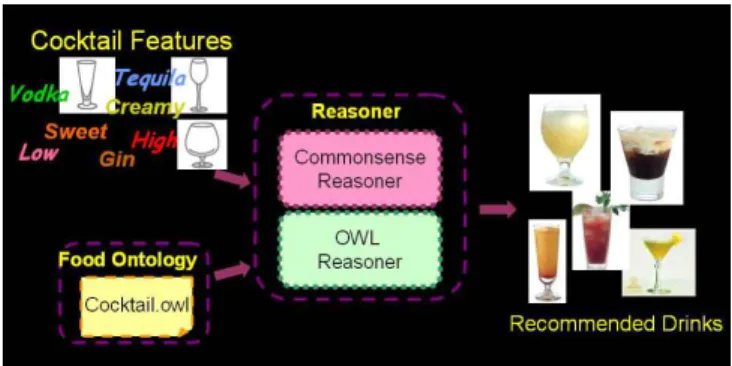
Be a recommending system, this cocktail recommender’s ar-chitecture is similar to other recommending system. It has user choice and cocktail’s ontology as inputs, some recom-mending cocktails as output, and DL reasoner as its informa-tion inference engine. (Please see Figure ??) Commonsense reasoning is the future work in our system.
Figure 2: Architecture
The Cocktail Ontology
To be a good cocktail recommender. The first thing we need to have is the knowledge about cocktail. Cocktail is any of various alcoholic beverages consisting usually of brandy, whiskey, vodka, or gin combined with fruit juices or other liquors and often served chilled.2
For getting the characteristic of the cocktails, we clas-sify cocktails and build up the ontology. For example,“Blue Hawaii”, which has a formal name and standard instructions to make, consists of light rum, pineapple juice, and cura-cao. So it can be classified to the class of Named-Cocktail. Named-Cocktail inherits from class Cocktail with the base wine properties. Furthermore, color and taste are the char-acteristics of cocktail. So “Blue Hawaii” is a named cocktail based on light rum with a flavor of light sweet and little sour. Besides colors, flavors and base wine, glass shape and alcohol volume are important issue of cocktail. Different shapes of glasses make different impressions on human be-ings. This is the reason why we use glass shape to classify cocktails. Alcohol volume is due to the ingredients of cock-tail. It is reflected by mouth feel.
2
To construct the ontology of cocktail, we refer to some popular commercial Web site such as www.wines.com to get some basic classification. And we use Protege to con-struct the ontology (?). A snapshot of the cocktail ontology is show in Figure ??.
Figure 3: A Part of the Ontology
User Interface
The inputs are including base wine, flavor, glass shape, al-cohol volume and the scene(aura). We give seven base wines, which are beer, brandy, gin, rum, tequila, vodka, and whiskey. These are the most common wines using in the cocktail. Users can choose the wine which they have at that comment; users can also choose the one they want to have a try. Flavor depends on individual. It reflects the personal preference and mood. Girls may like a beverage with sweet and sour, but boys may not like sour very much. A man to be crossed in love is heartbroken, and therefore wants a glass of bitter cocktail to reflect his sadness. The choice of glass shapes is similar to the choice of base wine. As for the alcohol volume, It depends on the user’s demand. For ex-ample, if you are going to drive, you’d better drink cocktail with non-alcohol.
The input of scene and mood is a more tricky. In the ini-tial design of this cocktail recommending system, we want to use a free drawer to let user daub. But we are still try-ing to find out how to map a daub to mood. To approach the problem, we choose color standing for personal mood and environmental aura. Color has long been used to de-scribe certain emotions and behavior. ”I was so mad I all I could see was red”, ”Dan is having a blue day”, ”She’s just green with envy”, or ”He’s too yellow to ever stand up for himself”. In these situations red is used to describe anger, blue sadness, green envy, and yellow cowardliness. Ergo, we not only use them to describe how we feel, but the asso-ciation between color and emotion becomes interwoven into
symbolic meaning (?). So the input of color can reflect the emotions of human. And we will use this to help the recom-mendation.
From the user inputs to the recommended results, we have shown the inputs, ontology, and the reasoner. Now, it is time to give you the drinks.
Figure 4: The ColorCocktail Interface
The system ColorCocktail is not a bartender robot to make drinks for you. But our goal is that people can easily use the system and get information from it. As the result, when system shows the recommended cocktails on the screen, detailed instructions and history about the cocktail will be shown too. User can see the picture of the cocktail, try to make the cocktail himself, and know more about the cock-tail.
Reasoner
Since our data set uses OWL for representing cocktail ontol-ogy. RACER is the DL reasoner used in the ColorCocktail recommendation system. RACER is one of the fastest OWL reasoner available.(?) In ColorCocktail system, it is used as description logic reasoner for a query of recommended cocktails. The ColorCocktail system takes the cocktail pref-erence from the user inputs. All of the prefpref-erences are used as the input of the DL reasoner. In the whole process of DL reasoning, the equivalent class describes the properties of the cocktails according to the preferences is built on the run
time first and then the reasoner does the taxonomy classifica-tion to get the suitable cocktails from the data set. The Col-orCocktail system takes the inferred instances of this equiva-lent class as the final recommendation, presenting the image and direction about recommended cocktails for a user.
We use RACER as our DL reasoner, moreover, we want to add common sense (?) and use common sense reasoning to enhance the system. Due to the natural relationship between emotion and common sense, we think that more complicated analysis can be done and the system should give a better result. This part of work is still on going. We may leave it as future work.
Preliminary Results and Future Work
After the ColorCocktail system has been preliminary work, we ask people try to use the recommender in a free way. All of them feel very interesting in such kind of system. One of the user said that she would like to use it when having a party next time and she did not need to think everything need by herself without good suggestion. She thought that the recommender can save time for preparing the foods and drinks. Furthermore, she would want the system to know the foods that she would cook, then gave her some suggestion on the beverages, especially the cocktails. Another user told us that he was boring to wait the system result showing up. The procedure of computing took too long time. He would prefer a more fast system with the closed result. The third user said that she was not familiar with wines and cocktails, so she had no idea about the accuracy of the system. But she said that this system can gave her new choice of beverage when she was going to drink something. She could know the relationship and some history of cocktails from the system, so she could try to make some different order.From the study above, the pros and cons of the work is shown. Recommending cocktail for people is a good idea because of the lack of knowledge about the drink itself. Peo-ple need suggestions in many situation; cocktail choice is a good application. In addition, the friendliness and easiness are the basic requirements. Most users do not like a fancy-looked system with complicated operation. So, we are trying to make a more intuitive user interface.
On the other hand, ColorCocktail still need to be im-proved. The processing time is the first issue. Users do not have patience to wait, so we need to control the procedure time. ColorCocktail takes too long time to give a recom-mend. We’d better reduce the computational time.
Besides the ‘named’ cocktails, there are still many excel-lent cocktails without names. The kind of cocktails are pro-vided occasionally. Bartenders give customers the recom-mendation by both their cocktail knowledge and their expe-rience. We want to add the experience to the ColorCocktail system. The experience representation is formal, so we need commonsense reasoning to help us to convert user. User can interact with the system intuitively. Also, commonsense rea-soning can be used in suggestion inference.
We want have more feed back about the system, hence we will put the work on Web. For catch the sight of people, interface will be enhanced. Also, we will try to make the system more conveniently and intuitively.
Acknowledgements
First of all, the authors would like to express their thanks to the members of the Intelligent Agents Lab at National Tai-wan University. They have many made valuable suggestions for the design and implementation of the prototype system. This research is sponsored in part by a grant from Intel and the National Science Council of Taiwan (NSC94-2218-E-002-057).