
Embedding Quadtrees into Hypercubes
10
0
0
全文
(2) Embedding Quadtrees into Hypercubes Abstract The quadtree is useful data structure for a variety of image processing. In this paper, we propose two simple but effective methods for embedding quadtrees into hypercubes. First, we embed a complete quadtree of height h into a (3(h-1)+4)-dimensional hypercube, or into a smaller incomplete hypercube which comprises a (3(h-1)+3)-dimensional hypercube and a (3(h-2)+4)-dimensional hypercube. This embedding preserves the adjacency of the complete quadtree, while the second method does not. The second method is to embed a complete quadtree of height h into an incomplete hypercube of the same node size with the congestion 2 and the dilation is at most 3. Keywords: Embedding, Complete quadtrees, Hypercubes. 1. Introduction The hypercube is one of the most popular architectures of parallel machines. The structure of the hypercube presents a rich interconnection topology, a symmetric structure, and a low diameter. It can simulate many computational structures with only small constant factor slowdown, such as array, binary tree and mesh of tree [1]. It also contains many computational structures, such as meshes and rings. While two consecutive dimensional hypercubes leave a large gap. To overcome this restriction, incomplete hypercubes provide more flexibility in the size [2, 3]. An incomplete hypercube can be obtained from a complete hypercube where some nodes/links fail. Over the years, many algorithms have been designed to embed quadtrees into a hypercube [4-8]. The quadtree is an efficient data structure to represent binary image data [9]. The root of the quadtree represents the entire structure to represent binary image data. The root of the quadtree represents the entire image data, and each internal node has four sons, each son representing a quadrant of its parent node. Since the structure of the quadtree is easy to implement, it is a very useful data structure for a variety of image processing. Ho and Johnsson [4] have shown a complete quadtree of height h (h≧0), which has (4h+1-1)/3 nodes, can be embedded into a (2h+1)-dimensional hypercube with dilation 2, and a specific algorithm to do the embedding has been studied in [5]. Stout [6] has described how to embed a complete quadtree into a hypercube. Yang and Lee 2.
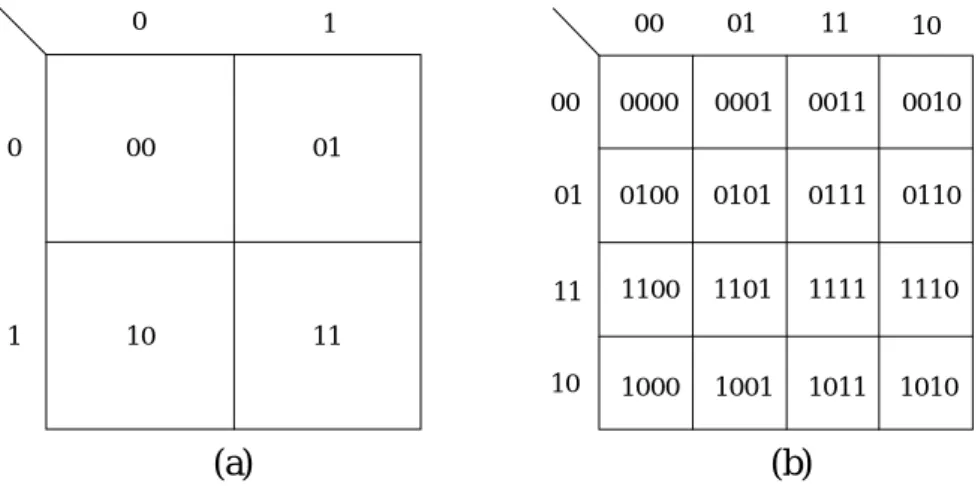
(3) [7] have introduced an efficient algorithm to construct a quadtree in a hypercube. In this paper, first, we present how to embed a complete quadtree into a hypercube, or into a smaller incomplete hypercube, so that the adjacency of the complete quadtree is preserved. Next, we present an algorithm to embed a complete quadtree into an incomplete hypercube with dilation 3, congestion 2 and expansion 1. The remainder of this paper is organized as follows. In Section 2, we introduce the notations and definitions for embedding, In Section 3, we present an algorithm to embed a complete quadtree into a hypercube, or into a smaller incomplete hypercube. In Section 4, an algorithm is given to embed a complete quadtree into an incomplete hypercube with the same node size. In Section 5, we summarize the results.. 2. Preliminaries A complete quadtree of height h is a rooted quadtree. The root the complete quadtree is on level 0, four nodes on level 1, 4i nodes on level i, etc., and we let QTh denote the complete quadtree of height h with (4h+1-1)/3 nodes. We denote the n-dimensional hypercube with 2n nodes as Hn. These nodes of Hn are labeled {0, 1, …, 2n-1} with binary number. Two nodes in the hypercube are linked with an edge if their binary numbers differ by a single bit. The Hamming distance is the number of different bits between two nodes. If a hypercube misses some certain nodes, it is called an incomplete hypercube [2, 3]. Let IH(n1, n2, …, nk) denote the incomplete hypercube which comprises k complete hypercubes: Hn1, Hn2, …, Hnk, where nj>ni≧0, for j<i≦k. To conveniently describe the embedding, we can partition a hypercube into four sub-hypercubes by the leftmost two bits of the hypercube, and the binary numbers of the leftmost two bits of the four sub-hypercubes correspond to 00, 01, 11 and 10 (see Figure 1 (a)). Each node of a sub-hypercube has an edge to link a node of adjacent sub-hypercube; the leftmost and the rightmost sub-hypercubes are adjacent, likewise, the top and the bottom sub-hypercubes are adjacent. Similarly, a hypercube can be partitioned into sixteen sub-hypercubes by the leftmost four bits of the hypercube, and the binary numbers of the leftmost four bits of the sixteen sub-hypercubes correspond to 0000, 0001, …, 1111 (see Figure 1(b)). Each node of a sub-hypercube has an edge to link a node of adjacent sub-hypercube.. 3.
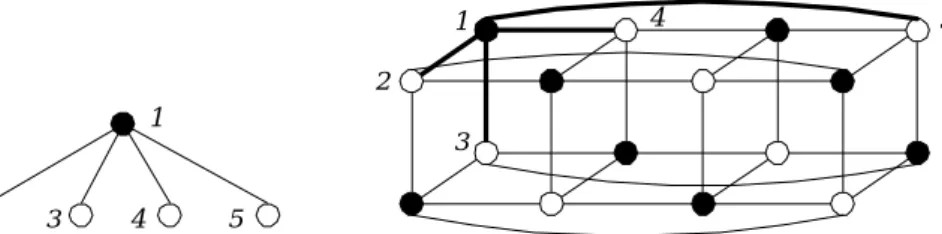
(4) 0. 1. 0. 1. 00. 01. 10. 00. 01. 11. 10. 00. 0000. 0001. 0011. 0010. 01. 0100. 0101. 0111. 0110. 11. 1100. 1101. 1111. 1110. 10. 1000. 1001. 1011. 1010. 11. (a) (b) Figure 1. A hypercube is partitioned to four or sixteen sub-hypercubes. In one-to-one node embedding of a graph G into a graph H, the dilation of an edge in G is the length of embedded path in H. The dilation of an embedding is the maximum dilation over all edges in G. The congestion of an edge in H is the number of edges of G that are embedded using the same edge of H. The congestion of an embedding is the maximum congestion over all edges in H. The expansion of an embedding is the ratio of the number of node in H to the number of nodes in G. Hence, it has to be considered the tradeoff among the dilation, the congestion and the expansion of an embedding.. 3. Embedding complete quadtrees into hypercubes with dilation 1 In this section we show how to embed QTh into a hypercube, or into a smaller incomplete hypercube, while the adjacency of QTh is preserved. Theorem 1. QTh (h≧1) can be embedded into a (3(h-1)+4)-dimensional hypercube. Proof. We prove the theorem by induction on h. Hypothesis: QTh-1 can be embedded into a (3(h-2)+4)-dimensional hypercube. Basis step (h=1, 2): When h=1, QT1 can be embedded directly into H4 as show in Figure 2. When h=2, we partition H7 into 16 sub-hypercubes H3’s. Since a tritree of height 1 can be embedded into H3 as shown in Figure 3, and each node of sub-hypercube H3 has an edge to link a node of another adjacent H3, we can embed QT2 into H7 (see Figure 4).. 4.
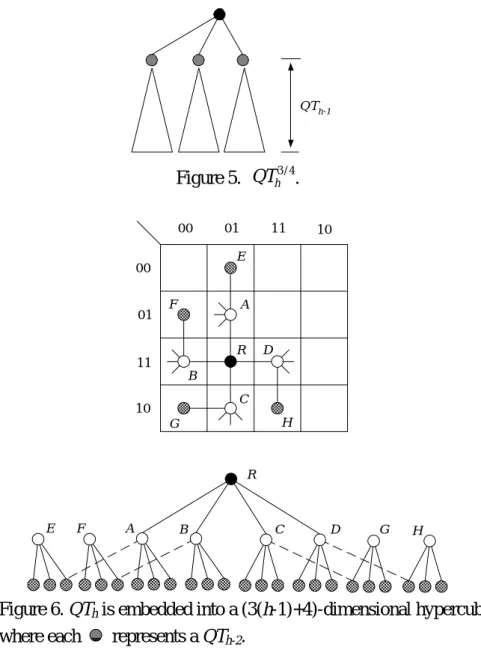
(5) 4. 1. 5. 2 1. 3 2. 3. 4. 5. Figure 2. QT1 is embedded into H4. The embedded QT1 is depicted by the solid lines in H4.. 4. 1 2. 1. 3 2. 3. 4. Figure 3. A tritree of height 1 is embedded into H3. 00. 01. 11. 10. 00. 01. r. r 11. 10. Figure 4. QT2 is embedded into H7. 3/ 4 Induction step: we denote QTh as the induced graph of QTh by deleting a 3/ 4 QTh-1 from itself (see Figure 5). Then we can construct QTh −1 in a ((3(h-2)+4-1)dimensional hypercube. Moreover, we partition the (3(h-1)+4)-dimensional hypercube into 16 sub-hypercubes H(3(h-2)+3)’s by the leftmost four bits of the hypercube. Each 3/ 4 H(3(h-2)+3) contains a QTh −1 . Now, we embed QTh into the (3(h-1)+4)-dimensional hypercube as Figure 6 shows. Let the root of QTh be embedded into sub-hypercube R, and two adjacent sub-hypercubes A and E embed QTh-1 by linking the root of QTh3−/14 in sub-hypercube A to a subtree QTh-2 of QTh3−/14 in sub-hypercube E. Likewise, two adjacent sub-hypercubes B and F (C and G, D and H) can embed QTh-1. The embedding works because of the symmetry of the hypercube. Thus QTh can be. embedded into the (3(h-1)+4)-dimensional hypercube.. 5. □.
(6) QT h-1. 3/ 4 Figure 5. QTh .. 00. 11. 10. E. 00. 01. 01. F. A. R. D. 11 B C. 10. H. G. R. E. F. A. B. C. D. G. H. Figure 6. QTh is embedded into a (3(h-1)+4)-dimensional hypercube, where each represents a QTh-2. By the preceding construction, the embedded complete hypercube H3(h-1)+4 can be reduced to a smaller incomplete hypercube. Corollary 1. QTh (h≧1) can be embedded into IH(3(h-1)+3, 3(h-2)+4).. □. 4. Embedding quadtrees into incomplete hypercubes with expansion 1 We have show that a complete quadtree can be embedded into hypercube, or into a smaller incomplete hypercube, with dilation 1 and congestion 1 in the previous section. In this section we discuss how to embed a complete quadtree into an incomplete quadtree into an incomplete hypercube with the same node size (expansion 1), considering the dilation and the congestion when doing the embedding. 6.
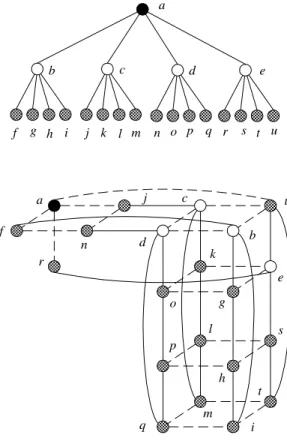
(7) Here, denote IH(n1, n2, …, nk) as an incomplete hypercube, which can be obtained by deleting the largest 2n1-(2n2 + … + 2nk) nodes (in binary number) and their neighboring edges from an (n1+1)-dimensional hypercube. Theorem 2. QTh (h≧1) can be embedded into IH(2h, 2(h-1), …, 2, 0) with dilation 3, congestion 2 and expansion 1. Proof. We prove the theorem by induction on h. Stronger Hypothesis: QTh-1 can be embedded into IH(2(h-1), 2(h-2), …, 2, 0) with dilation 3, congestion 2 and expansion 1, and the dilation is equal to 2 for embedding the edges between level h-2 and level h-1 of QTh-1. Basis step (h=1 and h=2): When h=1, we can embed QT1 into IH(2, 0) with dilation 2 and congestion 2 (see Figure 7), since the dilation of edge (a, d) in QT1 is 2 and the congestion of either edge (a, b) or edge (a, c) is 2 in IH(2, 0). Thus the dilation is equal to 2 for embedding the edges between level 0 and level 1.. a. c. a b. b. c. d. d e. e. Figure 7. QT1 is embedded into IH(2, 0) with dilation 2 and congestion 2. When h=2, there are 42 leaf nodes, so we have to add H4 to IH(2, 0). H4 can be partitioned into four sub-hypercubes by the leftmost two bits of H4, hence, the binary numbers of the leftmost two bits of the four sub-hypercubes correspond to 00, 01, 11 and 10. We can construct four H2’s from these four sub-hypercubes to make the binary numbers of the rightmost two bits of each H2 the same. We use Figure 8 to describe how to embed QT2 into IH(4, 2, 0). Figure 8 illustrates the embedding of QT2 into IH(4, 2, 0). The four H2’s comprise respectively the nodes (b, g, h, i), (u, e, s, t), (c, k, l, m) and (d, o, p, q). Each leaf node of QT1 in IH(2, 0) has an edge to link a node of an H2, such as leaf nodes f, j, n and r linking respectively nodes b, c, d and e. We take leaf nodes f, j, n and r of QT1 in IH(2, 0) as leaf nodes of QT2, nodes b, c, d and e as the parents of the nodes (f, g, h, i), (j, k, l, m), (n, o, p, q) and (r, s, t, u). The congestion of the edges which link IH(2, 0) and H4, such as edges (b, f), (c, j), (d, n) and (e, r), is 2. The dilation of edges between 7.
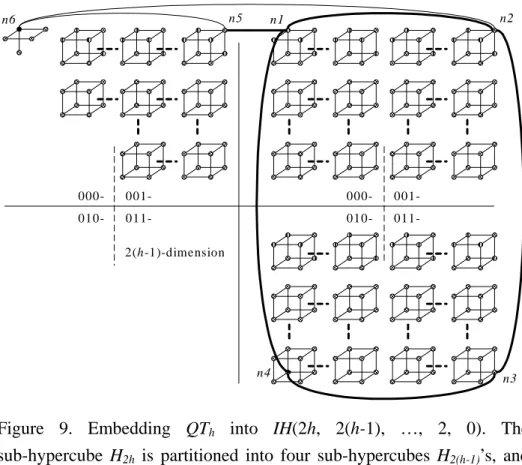
(8) level 0 and level 1 increases by 1, compared to the dilation of the edges between level 0 and level 1 for embedding QT1 into IH(2, 0), such as the dilation of edge (a, b), (a, c), (a, d) and (a, e) become 2, 2, 3 and 2, respectively. Therefore, QT2 can be embedded into IH(4, 2, 0) with dilation 3, congestion 2 and expansion 1, and the dilation is equal to 2 for embedding the edges between level 1 and level 2 of QT2. a. c. b. f. g h i. j k l m. d. e. n o p q r. s t u. c. j. a f n. u b. d. k. r. e g. o l. s. p h t q. m i. Figure 8. QT2 is embedded into IH(4, 2, 0). Four H2’s, depicted respectively by solid lines, are constructed from H4 in IH(4, 2, 0). Induction step: There are 4h nodes which are added to QTh-1 as the leaf nodes of QTh, thus we have to add H2h to IH(2(h-1), …, 2, 0). Likewise, using the approach of basis step, we partition H2h into four sub-hypercubes by the leftmost two bits of H2h to construct 22(h-1) H2’s, and the binary numbers of the rightmost 2(h-1) bits of each H2 are the same. Each leaf node of QTh-1 in IH(2(h-1), …, 2, 0) has an edge to link a node of an H2 in H2h, since leaf nodes of QTh-1 are embedded into either the nodes of H2(h-1) in IH(2(h-1), 2(h-2), …, 2, 0) or the adjacent nodes of H2(h-1) in IH(2(h-2), …, 2, 0), and the binary numbers of the rightmost 2(h-1) bits of both the adjacent nodes are the same. We take leaf nodes of QTh-1 as leaf nodes of QTh and the nodes, which are adjacent with leaf nodes of QTh-1, of H2h as the parents of leaf nodes of QTh. We use Figure 9 to show how to embed QTh into IH(2h, 2(h-1), …, 2, 0).. 8.
(9) Figure 9 illustrates the embedding of QTh into IH(2h, 2(h-1), …, 2, 0). We label the nodes of IH(2h, 2(h-1), …, 2, 0) by 2h+1 bits and partition IH(2h, 2(h-1), …, 2, 0) into eight sub-hypercubes by the leftmost three bits of the incomplete hypercube. Hence, the eight sub-hypercubes can be labeled as 000, 001, 011, 010, 100, 101, 111 and 110. Let n1, n2, n3 and n4 construct H2 from these four sub-hypercubes 101, 100, 110 and 111 in H2h. If a leaf node of QTh-1 is embedded into n5 in the sub-hypercube 001, we take n5 as leaf node of QTh and n1 as the parent of n5, n2, n3 and n4. Similarly, if a leaf node of QTh-1 is embedded into n6 in the sub-hypercube 000, n6 has an edge to link n2 because of the symmetry of the hypercube. We take n6 as leaf node of QTh and n2 as the parent of n6, n1, n4 and n3. By using the same method, we take the remaining leaf nodes of QTh-1 as leaf nodes of QTh and their adjacent nodes in H2h as the parents of leaf nodes of QTh.. n5. n6. n2. n1. 000-. 001-. 000-. 001-. 010-. 011-. 010-. 011-. 2(h-1)-dimension. n4. n3. Figure 9. Embedding QTh into IH(2h, 2(h-1), …, 2, 0). The sub-hypercube H2h is partitioned into four sub-hypercubes H2(h-1)’s, and the bold lines depict an H2 from these four H2(h-1)’s. The dilation of the edges between level h-2 and level h-1 of QTh increases by 1, compared to the dilation of the edges between level h-2 and level h-1 for embedding QTh-1 into H(2(h-1), …, 2, 0), while the congestion of the edges between IH(2(h-1), …, 2, 0) and H2h is held on 2. Therefore, QTh can be embedded into IH(2h, 2(h-1), …, 2, 0) with dilation 3, congestion 2 and expansion 1, and dilation is equal to 9.
(10) 2 for embedding the edges between level h-1 and level h of QTh.. □. 5. Conclusions We have presented two simple but effective algorithms for embedding quadtrees into hypercubes. First, we have shown hat a complete quadtree of height h (h≧1) can be embedded into a (3(h-1)+4)-dimensional hypercube, or into a smaller incomplete hypercube IH(3(h-1)+3, 3(h-2)+4), so that the adjacency of the complete quadtree is preserved. Then a complete quadtree of height h can be embedded into an incomplete hypercube IH(2h, 2(h-1), …,2 ,0) with expansion 1, congestion 2 and dilation 3.. Reference 1. T. Leighton, Introduction to parallel Algorithms and Architectures: Array, Tree, 2. 3. 4. 5.. 6. 7. 8.. 9.. Hypercubes (Morgan Kaufmann, Reading, MA,1992). H. P. Katseff, Incomplete Hypercubes, IEEE Trans Computer 37 (1988) 604-608. N. F. Tzeng, H. L. Cheng and P. J. Chuang, Embeddings in Incomplete Hypercube, Proc. of Int. Conf. on Parallel Processing 3 (1990) 335-339. C. T. Ho and S. L. Johnsson, Dilation d Embedding of a Hyper-Pyramid into a Hypercube, Proc. of the Supercomputing’89 (1989) 294-303. N. Krishnakuma, V. G. Hegde and S. S. Iyengar, Fault Tolerant Based Embedding of Quadtrees into Hypercubes, Proc. of Int. Conf. on Parallel Processing 3 (1991) 244-249. Q. F. Stout, Hypercubes and Pyramids, Pyramidal Systems for Computer Vision, (Springer-Verlag, 1986) 75-89. S. N. Yang and R. R. Lee, IEEE Region 10 Conference, Tencon 92 11th-13th (1992) 131-135. F. Dehne, A. G. Ferreira and A. Rau-Chaplin, Efficient Parallel Construction and Manipulation of Quadtrees, Proc. of Int. Conf. on Parallel Processing 3 (1991) 255-262. H. Samet, The Quadtree and Related Hierarchical Data Structures, Computing Surveys 16 (1984) 187-260.. 10.
(11)
數據

+3
相關文件
– The The readLine readLine method is the same method used to read method is the same method used to read from the keyboard, but in this case it would read from a
• If a graph contains a triangle, any independent set can contain at most one node of the triangle.. • We consider graphs whose nodes can be partitioned into m
In the hydrologic cycle, water from oceans, lakes, swamps, rivers, plants, and even you, can turn into water vapor. Water vapor condenses into millions of tiny droplets that
• A knock-in option comes into existence if a certain barrier is reached?. • A down-and-in option is a call knock-in option that comes into existence only when the barrier is
• A knock-in option comes into existence if a certain barrier is reached.. • A down-and-in option is a call knock-in option that comes into existence only when the barrier is
The PROM is a combinational programmable logic device (PLD) – an integrated circuit with programmable gates divided into an AND array and an OR array to provide an
To look at the most appropriate ways in which we should communicate with a person who has Autism and make it.. applicable into our day to
We showed that the BCDM is a unifying model in that conceptual instances could be mapped into instances of five existing bitemporal representational data models: a first normal
