
Dynamic Optimization for IEEE 802.11 DCF Access Method over Noisy Channels
5
0
0
全文
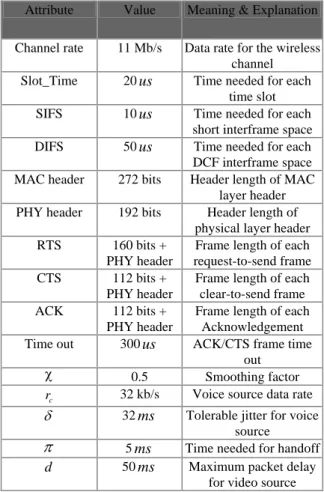
(2) Int. Computer Symposium, Dec. 15-17, 2004, Taipei, Taiwan.. lost due to collision, not by frame loss. Consequently, when a timer goes off, it exponentially increases backoff parameter value and retransmits the data frame less vigorously. The idea behind this approach is to alleviate the probability of collision. Unfortunately, wireless transmission links are noisy and highly unreliable. The proper approach to dealing with lost frames is to send them again, and as quickly as possible. Extending the backoff time just makes matters worse because it brings bandwidth wastage. Although in the past there were adequate discussions on issues about DCF and the performance thereof, there were few papers on the relationship between backoff parameters and channel bit error rate (BER). In fact, as disclosed by research conducted in the past [1]-[3], the performance of DCF will be significantly affected by channel BER in the wireless channels. That is, the proper choice of the CW parameter values has substantial influence on the network performance. In this paper, we attempt to identify the relationship between backoff parameters and channel BER and put forth a pragmatic problem-solving solution. The proposed distributed adaptive contention window mechanism not only dynamically expands and contracts the contention window size according to the current network contention level and channel BER, but also provably optimal in that it achieves optimal channel utilization for IEEE 802.11 DCF access method. The proposed scheme is performed at each station in a distributed manner, and it can be implemented in the present IEEE 802.11 standard with relatively minor modifications. In addition to theoretical analysis, simulations are conducted to evaluate the performance scheme. The performance of our design is examined in detail. As it turns out, our design indeed provides a remarkable improvement in a heavy load and error-prone WLANs environment especially when the bit error rate is severely degraded. The remainder of this paper is organized as follows. In Section 2, we describe the proposed scheme in detail. Simulation and experimental results are reported in Section 3. Section 4 concludes this paper.. end of each transmission time. However, such a common heuristic would conduct the size of contention window to fluctuate rapidly between expansion and contraction. To avoid this undesirable behavior, each station runs the algorithm to estimate the optimal contention window size, and use the following formula to update its contention window:. New_CW =χ⋅ Current _CW+ (1−χ) ⋅ Estimate_Optimal_CW where χ ∈ [ 0,1] is a smoothing factor. Finally, instead of using the backoff time generation function defined in the IEEE 802.11 standard, we refine the backoff time generation function as ⎢ ranf () ⋅ 2 ⎢⎡log( New _ CW )⎥⎤ ⎥ ⋅ tslot to complete our scheme. ⎣. ⎦. 3. Simulations Results Our simulation model is built using the Simscript tool [13]. Performance is measured in terms of the throughput, the average access delay, the dropping probability, the offer-load, among others. The default values used in the simulation are listed in Table I. The values for the simulation parameters are chosen carefully in order to closely reflect the realistic scenarios as well as to make the simulation feasible and reasonable.. Table 1. Default attribute values used in the simulation. Attribute. Value. Channel rate. 11 Mb/s. Slot_Time SIFS DIFS MAC header PHY header RTS. 2. Proposed Scheme. CTS. An analytical model has been proposed in [4] and [6], which analyze the performance of DCF without BER and frame loss in the WLANs. Here we extend the analytical model for the above purpose. Our scheme is also based on the results of the capacity analysis model of the IEEE 802.11 protocol originally proposed in [1] and [8] as well as the concept introduced in [5] and [7]. A natural strategy for expansion and contraction is to allocate a new contention window size at the. ACK Time out. χ rc. δ. π d. 430. Meaning & Explanation. Data rate for the wireless channel 20 us Time needed for each time slot 10 us Time needed for each short interframe space 50 us Time needed for each DCF interframe space 272 bits Header length of MAC layer header 192 bits Header length of physical layer header 160 bits + Frame length of each PHY header request-to-send frame 112 bits + Frame length of each PHY header clear-to-send frame 112 bits + Frame length of each PHY header Acknowledgement 300 us ACK/CTS frame time out 0.5 Smoothing factor 32 kb/s Voice source data rate 32 ms 5 ms 50 ms. Tolerable jitter for voice source Time needed for handoff Maximum packet delay for video source.
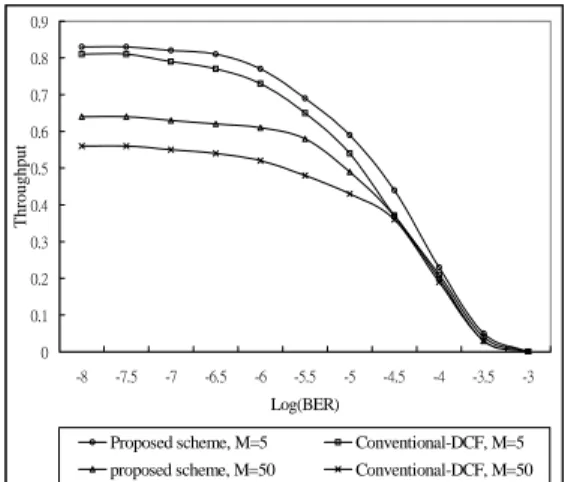
(3) Int. Computer Symposium, Dec. 15-17, 2004, Taipei, Taiwan.. buffer W. 1 frame 16 slots. m. 6. number of error transmissions. Conversely, number of stations only marginally affects frame drop probability for proposed scheme.. Size of buffer for frames Minimum contention window size Maximum backoff stages. 1.2 1. Dropping probability. In what follows, the performances of the proposed scheme and the conventional IEEE 802.11 DCF protocol are compared based on simulations. Figures 1, 2, and 3 show the effect of channel BER by plotting throughput (average bandwidth utilization), frame drop probability, and average frame delay for two representative network sizes (M=5 and 50). As illustrated in Figure 1, the performance of conventional DCF access method was severely degraded when the channel BER increased, but the performance of proposed scheme was satisfactory all the time until the channel BER approximates to 10−5 . In fact, we believe that it is almost impossible to increase the probability of success of transmitting a frame excepting frames fragmentation or FEC (Forward Error Control) in an extremely noisy wireless environment.. 0.8 0.6 0.4 0.2 0 -8. -7.5. -7. -6.5. -6. -5.5. -5. -4.5. -4. -3.5. -3. Log(BER). Proposed scheme, M=5. Conventional-DCF, M=5. proposed scheme, M=50. Conventional-DCF, M=50. Fig. 2. Dropping probability against channel BER, for M=5, and 50 respectively.. 600. 0.9 500. Ave. access delay [ms]. 0.8 0.7. Throughput. 0.6 0.5 0.4. 400 300 200. 0.3 100. 0.2 0.1. 0 -8. 0 -8. -7.5. -7. -6.5. -6. -5.5. -5. -4.5. -4. -3.5. -7.5. -7. -6.5. -6. Log(BER). Proposed scheme, M=5. Conventional-DCF, M=5. proposed scheme, M=50. Conventional-DCF, M=50. -5.5. -5. -4.5. -4. -3.5. -3. Log(BER). -3. Proposed scheme, M=5. Conventional-DCF, M=5. proposed scheme, M=50. Conventional-DCF, M=50. Fig. 1. Throughput against channel BER, for M=5, and 50 respectively.. Fig. 3. Average access delay against channel BER, variance=363.65 (proposed scheme, M=5), 561.25 (conventional-DCF, M=5), 29410.25 (proposed scheme, M=50), and 30325.49 (conventional IEEE 802.11, M=50). Figure 2 presents the frame drop probability as a function of the channel BER. We can see that although there is not much difference in the values of the performance measures when BER is low, however, the proposed scheme provides better performance than the conventional DCF access method when the channel BER increased. For voice and video traffic, the allowable loss probability is about 10−2 [14] and 10−3 [15], respectively. With this criterion, the proposed scheme can tolerate a BER of 10−6 . This simulation result reveals that the proposed scheme is appropriate for transmitting high priority real-time traffic such as voice and video traffic in real-time applications. However, the frame drop probability shows a sharp rise as the BER higher than 10−4 for both schemes due to the increased. As mentioned earlier, in the noisy and highly unreliable wireless environments, the proper approach to dealing with lost frames is to send them again, and as quickly as possible. Extending the backoff time just makes matters worse because it brings bandwidth wastage. In other words, in an environment full of noise and susceptible to interference, the size of CW should not increase with the number of times packets are sent all over again. Hence, we might have an intuition that CW should be inversely proportional to BER. As a matter of fact, as discovered by our research, the initial size of CW should be marginally positively correlated with BER. In Figure 3, we prove that our hypothesis, a relatively large size of CW is recommended in a high-BER environment, is true. As shown in the figure, with the conventional DCF access method,. 431.
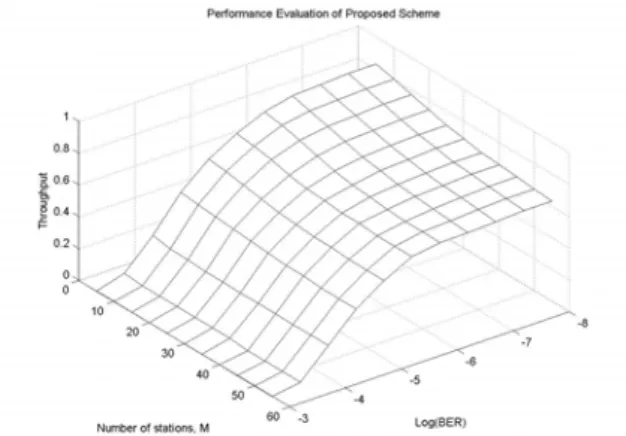
(4) Int. Computer Symposium, Dec. 15-17, 2004, Taipei, Taiwan.. the average access delay increases with channel BER, whereas the increase is moderate if our method is adopted. The increasing frame access delay could result from either retransmitted frames in conventional DCF access method or relatively large size of CW in proposed scheme. However, please note that it will reach a maximum value and then decreases gradually and finally drops to 0 as the simulation outcome obtained in [1]. The reason is that when channel BER is high enough to result in a significant increase in the drop probability, for example, higher than 10−4 , frame delay starts decreasing since the long delays of dropped frames do not contribute to the average frame delay. Thus, the low frame access delay values at high BER concern only a small number of successfully received frames due to high drop probability and, therefore, have a very small significance.. collision but also frame loss. When the sender is unable to discriminate the cause of the frame loss, the performance of DCF access method is significantly affected by the channel BER. In this paper, we attempt to identify the relationship between backoff parameters and channel BER and put forth a pragmatic problem-solving solution. The proposed distributed adaptive contention window mechanism not only dynamically expands and contracts the contention window size according to the current network contention level and channel BER, but also provably optimal in that it achieves optimal channel utilization for IEEE 802.11 DCF access method. The proposed scheme is performed at each station in a distributed manner, and it can be implemented in the present IEEE 802.11 standard with relatively minor modifications. Through extensive simulations, we have demonstrated a satisfactory performance of our proposed scheme in a quantitative way. It shows that the proposed scheme has proven it satisfactory superiority in most of the cases. Notable is the remarkable improvement in congested and noisy wireless environments, even with fairly numerous stations.. References 1. P. Chatzimisios, A. C. Boucouvalas, and V. Vitsas, "Influence of channel BER on IEEE 802.11 DCF, " Electronics letters, vol. 39, issue 23, pp. 1687-1689, 2003. 2. Z. Tang, Z. Yang, J. He, and Y. Liu, "Impact of Bit Errors on the Performance of DCF for Wireless LAN, " Proc. of International Conference on Communications, Circuits and Systems, and West Sino Expositions, vol. 1, pp. 529-533, 2002. 3. F. Eshghi and A. K. Elhakeem, "Performance Analysis of Ad Hoc Wireless LANs for Real-Time Traffic, " IEEE Journal on Selected Area of Communications, vol. 21, no. 2, pp. 204-215, Feb. 2003. 4. G. Bianchi, "Performance Analysis of the IEEE 802.11 Distributed Coordination Function," IEEE Journal on Selected Area of Communications, vol. 18, no. 3, pp. 535-547, Mar. 2000. 5. L. Bononi, M. Conti, and E. gregori, "Runtime Optimization of IEEE 802.11 Wireless LANs Performance, " IEEE Transactions on Parallel and Distributed Systems, vol. 15, no. 1, pp. 66-80, Jan. 2004. 6. F. Calì, M. Conti, and E. Gregori, “Dynamic Tuning of the IEEE 802.11 Protocol to Achieve a Theoretical Throughput Limit,” IEEE/ACM Transactions on Networking, vol. 8, no. 6, Dec. 2000, pp. 785-799. 7. F. Calì, M. Conti, and E. Gregori, "IEEE 802.11 Protocol: Design and Performance Evaluation of an Adaptive Backoff Mechanism," IEEE Journal on Selected Area of Communications, vol. 18, no. 9, pp. 1774-1786, Sep. 2000. 8. L. Alcuri, G. Bianchi, and I. Tinnirello, "Occupancy Estimation in the IEEE 802.11 Distributed Coordination Function," Proc. of ICS2002, 2003, Hualien, Taiwan.. Fig. 4. Throughput versus channel BER and number of stations.. Figure 4 shows the value of the channel BER and the number of stations versus the throughput for the proposed scheme. As the analytical results, it illustrated that the throughput of our scheme is not affected by the channel BER between 10−8 to 10−5 , but decreases greatly when the channel BER grows to 10−4 . Besides, the throughput of our scheme changes little when the number of stations, M , changes. This indicates that, although the proposed scheme has proven it satisfactory superiority in most of the cases, it provides a remarkable improvement over congested and noisy wireless environments.. 4. Conclusions The backoff parameters in IEEE 802.11 DCF access method are far from the optimal setting in heavy-load and error-phone WLANs environment. First, this strategy incurs a high collision probability and channel utilization is degraded in bursty arrival or congested scenarios. Besides, in the noisy and highly unreliable wireless environment, an unacknowledged frame could result from not only. 432.
(5) Int. Computer Symposium, Dec. 15-17, 2004, Taipei, Taiwan. 9. D. J. Deng and R. S. Chang, “A Priority Scheme for IEEE 802.11 DCF Access Method,” IEICE Trans. Commun., vol. E82-B, no. 1, pp. 96-102, January 1999. 10.R.O. LaMaire et al., "Wireless LANs and Mobile Networking: Standards and Future Directions," IEEE Commun. Mag., vol. 34, no. 8, pp. 86-94, Aug. 1996. 11.B. P. Crow, I. Widjaja, J. G. Kim, and P. T. Sakai, “IEEE 802.11 Wireless Local Area Networks,” IEEE Commun. Mag., vol. 35, no. 9, pp. 116-126, Sep. 1997. 12.Wireless Medium Access Control and Physical Layer WG, IEEE Draft Standard P802.11, "Wireless LAN," IEEE Stds. Dept, D3, Jan. 1996. 13.CACI Products Company, Simscript II.5, California 92037, Sep. 1997, http://www.caciasl.com/. 14.D. J. Goodman and S. X. Wei, "Efficiency of packet reservation multiple access," IEEE Trans. on Vehicular Technology, vol. 40, no. 1, pp. 170-176, Feb. 1991. 15.D. Raychaudhuri and N. D. Wilson, "ATM-Based Transport Architecture for Multiservices Wireless Personal Communication Network," IEEE Journal on Selected Areas of Communications,. vol. 12, no. 8, pp. 1401-1414, Oct. 1994.. 433.
(6)
數據
相關文件
The formation mechanism has been studied in this work through dynamic light scattering method which can get information about growth and distribution curve of particle size in
We do it by reducing the first order system to a vectorial Schr¨ odinger type equation containing conductivity coefficient in matrix potential coefficient as in [3], [13] and use
Promote project learning, mathematical modeling, and problem-based learning to strengthen the ability to integrate and apply knowledge and skills, and make. calculated
Wang, Solving pseudomonotone variational inequalities and pseudo- convex optimization problems using the projection neural network, IEEE Transactions on Neural Network,
Microphone and 600 ohm line conduits shall be mechanically and electrically connected to receptacle boxes and electrically grounded to the audio system ground point.. Lines in
In the work of Qian and Sejnowski a window of 13 secondary structure predictions is used as input to a fully connected structure-structure network with 40 hidden units.. Thus,
Biases in Pricing Continuously Monitored Options with Monte Carlo (continued).. • If all of the sampled prices are below the barrier, this sample path pays max(S(t n ) −
– If all the text fits in the view port then no scroll bars will be visible If all the text fits in the view port, then no scroll bars will be visible
