Efficient white-light-emitting diodes based on poly( N -vinylcarbazole) doped with blue
fluorescent and orange phosphorescent materials
Ping-I Shih, Ching-Fong Shu, Yung-Liang Tung, and Yun Chi
Citation: Applied Physics Letters 88, 251110 (2006); doi: 10.1063/1.2214141
View online: http://dx.doi.org/10.1063/1.2214141
View Table of Contents: http://scitation.aip.org/content/aip/journal/apl/88/25?ver=pdfcov Published by the AIP Publishing
Articles you may be interested in
High-efficiency and color-stable white organic light-emitting devices based on sky blue electrofluorescence and orange electrophosphorescence
Appl. Phys. Lett. 92, 083301 (2008); 10.1063/1.2883935
Highly efficient solution processed blue organic electrophosphorescence with 14 lm W luminous efficacy Appl. Phys. Lett. 88, 243512 (2006); 10.1063/1.2212060
Poly( N -vinylcarbazole) doped with a pyrazoloquinoline dye: A deep blue emitting composite for light-emitting diode applications
J. Appl. Phys. 99, 024505 (2006); 10.1063/1.2162268
White organic light-emitting diode comprising of blue fluorescence and red phosphorescence Appl. Phys. Lett. 86, 113507 (2005); 10.1063/1.1879108
Blue phosphorescent dye as sensitizer and emitter for white organic light-emitting diodes Appl. Phys. Lett. 85, 5403 (2004); 10.1063/1.1827326
This article is copyrighted as indicated in the article. Reuse of AIP content is subject to the terms at: http://scitation.aip.org/termsconditions. Downloaded to IP: 140.113.38.11 On: Thu, 01 May 2014 01:56:36
Efficient white-light-emitting diodes based on poly
„N-vinylcarbazole… doped
with blue fluorescent and orange phosphorescent materials
Ping-I Shih and Ching-Fong Shua兲
Department of Applied Chemistry, National Chiao Tung University, Hsinchu, Taiwan 300, Republic of China
Yung-Liang Tung and Yun Chi
Department of Chemistry, National Tsing Hua University, Hsinchu, Taiwan 300, Republic of China 共Received 25 January 2006; accepted 18 May 2006; published online 21 June 2006兲
We have fabricated polymer white-light-emitting devices possessing a single emitting layer containing a hole-transporting host polymer, poly共N-vinylcarbazole兲, and an electron-transporting auxiliary, 2-共4-biphenylyl兲-5-共4-tert-butylphenyl兲-1,3,4-oxadiazole, doped with a blue-light-emitting amino-substituted distyrylarylene fluorescent dye and an orange-light-emitting osmium phosphor. The doubly doped device exhibited an intense white emission having Commission Internationale de l’Eclairage coordinates of 共0.33, 0.34兲, a high external quantum efficiency of 6.12% 共13.2 cd/A兲, and a maximum brightness of 11 306 cd/m2. The color
coordinates remained unchanged over a range of operating voltages, even at luminance as high as 1⫻104cd/ m2. © 2006 American Institute of Physics. 关DOI:10.1063/1.2214141兴
White organic light-emitting diodes共WOLEDs兲 have at-tracted considerable attention because of their potential ap-plications in solid-state lighting and in back panel lighting for liquid crystal displays.1,2 Among these devices, white OLEDs based on polymers共PLEDs兲 are of particular interest because they can be fabricated through spin casting—a po-tentially less expensive process than high-vacuum deposition,3–5which is used commonly for small molecules. Various approaches toward realizing white PLEDs have been described.6–12Single emissive layers of dye-doped polymers can be tailored, through suitable control of the doping level, to generate a composed white emission.6–9 This use of single-layer polymer blends results in devices having simple structures and, therefore, it is an attractive option for low-cost, large-area fabrication.
Because they can harvest both singlet and triplet exci-tons, electroluminescent共EL兲 devices based on phosphores-cent dyes often exhibit higher quantum efficiencies than those based on fluorescent dyes. Indeed, typical electrophos-phorescent devices were prepared through doping of iridium complexes into polymeric hosts such as poly共 N-vinylcarbazole兲 共PVK兲.13Although many green- and red-emitting phosphorescent materials have been synthesized,14,15 authentic blue-emitting phosphors for OLEDs are notably rare; furthermore, blue-emitting phos-phors demand a host material possessing a wide band gap to prevent backward energy transfer from the dopant to the host, thereby creating a hurdle for the design of white PLEDs.16On the other hand, the combined use of blue fluo-rescent and orange phosphofluo-rescent dyes may provide a suit-able solution to these problems and affording white PLEDs with high efficiency and excellent stability.
In this letter, we report the fabrication of white PLEDs through the doping of blue fluorescent and orange phospho-rescent dyes into a PVK host polymer blended with 30 wt % of 2-共4-biphenylyl兲-5-共4-tert-butylphenyl兲-1,3,4-oxadiazole 共PBD兲,13
for which PVK has a reasonable film-forming
abil-ity, a high glass-transition temperature, a wide energy gap, and a high hole mobility.17 Moreover, 4 , 4
⬘
-bis关2-兵4-共 N , N-diphenylamino兲phenyl其vinyl兴biphenyl 共DPAVBi兲 was selected because of its intense blue fluorescence and impres-sive performance when applied to OLEDs.18In addition, we employed the osmium complex 关Os共bpftz兲2共PPh2Me兲2兴关Os共bpftz兲, where bpftz is 3-trifluoromethyl-5-共4-tert-butyl-2-pyridyl兲triazolate兴 as the complementary phosphorescent dye. This triazolate based complex Os共bpftz兲 showed intense orange luminescence in degassed CH2Cl2 solution 共max
= 603 nm兲 and had an exceedingly short emission lifetime 共= 972 ns兲.19
Because triplet excitons tend to relax more slowly and are easily affected by the triplet-triplet annihila-tion, phosphors that exhibit short triplet lifetimes are most desired to minimize these problems. Furthermore, for their application to light-emitting devices, it is imperative that all materials should be of ultrahigh chemical purity. Both of our selected emitting dyes, DPAVBi and Os共bpftz兲, can be puri-fied readily through a process of recrystallization followed by sublimation. They disperse well into the PVK host, form-ing good films when spin coated, as is evident from our atomic force microscopy共AFM兲 measurements 共vide infra兲. Figure 1 illustrates the structural drawings of relevant materials that were used in this study. The device
configura-a兲Electronic mail: [email protected] FIG. 1. Chemical structures of PVK, DPAVBi, and Osmatic illustration of the device configuration used in this study.共bpftz兲 and a sche-APPLIED PHYSICS LETTERS 88, 251110共2006兲
0003-6951/2006/88共25兲/251110/3/$23.00 88, 251110-1 © 2006 American Institute of Physics This article is copyrighted as indicated in the article. Reuse of AIP content is subject to the terms at: http://scitation.aip.org/termsconditions. Downloaded to IP:
tion consists of indium tin oxide 共ITO兲/ poly共styrenesulfonate兲-doped poly共3,4-ethylenedi-oxythiophene兲 共PEDOT兲 共35 nm兲/polymer blend 共50–70 nm兲/1,3,5-tris共N-phenylbenzimidazol-2-yl兲benzene 共TPBI兲 共30 nm兲/Mg:Ag 共100 nm兲/Ag 共100 nm兲; the fabri-cation and characterization of this white-light EL device were conducted using procedures similar to those reported in literature.20 Figure 2 displays EL spectra of devices fabri-cated using DPAVBi and Os共bpftz兲-doped PVK-PBD as the emitting layers, for which the doping concentrations were 1.0 and 0.1 mol %共relative to PVK monomer units兲, respec-tively. The EL spectrum of the DPAVBi-doped device exhib-ited a maximum intensity at 465 nm that is associated with blue emission from the DPAVBi dopant; its maximum exter-nal quantum efficiency 共ext兲 was 2.29% 共3.90 cd/A兲. For
the Os共bpftz兲-doped device, we observed an orange emission 共peak maximum at 602 nm兲 with theextdata being as high
as 18.7%共45.0 cd/A兲.
Figure 3 presents the photoluminescence 共PL兲 and EL spectra of the white-light-emitting device incorporating an emitting layer comprising 1 mol % DPAVBi and 0.04 mol % Os共bpftz兲 in the PVK-PBD host. In the PL spectrum, the efficient energy transfer from the excited host to dyes results in a combination of blue emission from DPAVBi and orange emission from Os共bpftz兲, respectively. The intensity of the
former overwhelms that of the latter, owing to the remark-ably low doping concentration of Os共bpftz兲. In contrast, the EL spectrum of this blend exhibits two well balanced com-ponents of blue and orange emissions. We attribute the dra-matic differences observed in the PL and EL spectra to a charge trapping effect.21,22According to the energy level dia-gram共inset of Fig. 2兲, Os共bpftz兲 can serve as an effective site for direct charge trapping, giving orange emission from the triplet state of Os共bpftz兲, which is the main factor responsible for the observed EL. Consequently, the EL spectrum displays a dual emission comprising both blue fluorescence from DPAVBi and orange phosphorescence from Os共bpftz兲, result-ing in an apparent white color. The inset of Fig. 3 displays the Commission Internationale de l’Eclairage共CIE兲 coordi-nates of the blended device together with those of the blue-共DPAVBi doped兲 and orange-emitting 关Os共bpftz兲 doped兴 de-vices. According to the CIE diagram, the emissions of the blue- and orange-emitting devices are located at共0.13, 0.24兲 and共0.58, 0.41兲, respectively, while that of the doubly doped device occurs precisely at the central white region 共0.33, 0.34兲. It is noted that the blue component in the EL spectrum is slightly redshifted and broadened when compared with the PL spectrum. This may be due to the spectral overlap of each individual blue and orange emissions. In addition, the exci-plex formation in the emitting layer may also induce the bathochromic shift in emission profiles.23,24
The main drawback for the display or illumination ap-plications of white PLEDs formed using dye-doped polymers as an active layer is their color instability. Gratifyingly, the CIE coordinates of this white-light-emitting device change only slightly from 共0.33, 0.34兲 at 9.0 V 共2.95 mA/cm2,
366 cd/ m2兲 to 共0.33, 0.32兲 at 15.0 V 共125 mA/cm2,
9124 cd/ m2兲, i.e., these coordinates are quite insensitive to current density and brightness, and maintain very close to the pure white CIE coordinates of共0.33, 0.33兲. This remarkable color stability is attributed to the short triplet excited lifetime of Os共bpftz兲 共ca. 1.0s兲, which may prevent saturation of the lightly doped orange phosphor and suppress unwanted triplet-triplet annihilation under a high excitation density. Another possible factor of color instability is the phase sepa-ration in the polymer blend.12,25Remarkably, the AFM image indicates that no phase separation occurred in our doubly doped PVK film, for which the root-mean-square surface roughnesses of the PVK-PBD blend and doubly doped films were 0.23 and 0.29 nm, respectively. These AFM data con-firm the existence of very little, if any, phase separation or dye aggregation occurred within the blended PVK system; therefore, our white PLED exhibits high color stability.
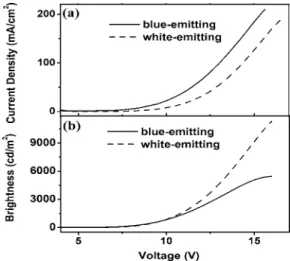
Figure 4 displays a comparison between the device char-acteristics of the blue and white PLEDs. The current density-voltage 共I-V兲 characteristics shifted to higher voltages after introducing Os共bpftz兲 into the blue-emitting 共DPAVBi doped兲 device 关Fig. 4共a兲兴 because Os共bpftz兲 provides effec-tive trapping sites for holes when doped into PVK. This re-sult is consistent with the direct charge trapping mechanism that we proposed earlier. Figure 4共b兲 displays the luminance-voltage 共L-V兲 characteristics of the blue and white PLEDs, giving luminances of 5451 and 11 306 cd/ m2 at 16 V, re-spectively. According to the plots of external quantum effi-ciency and luminance effieffi-ciency共LE兲 versus current density 共Fig. 5兲, the maximum values of ext and LE of the
blue-emitting device were 2.29% and 3.90 cd/ A, respectively. The introduction of the orange phosphor Os共bpftz兲 into the FIG. 2. EL spectra of devices formed using DPAVBi共1 mol %兲 or
Os共b-pftz兲 共0.1 mol %兲: PVK-PBD as the emitting layer. Inset: energy level dia-gram for the devices having the configuration ITO/PEDOT/Blend/TPBI/Mg:Ag.
FIG. 3. PL共excited at 300 nm兲 and EL spectra of the doubly doped device at an applied voltage of 9 V. Inset: CIE color coordinates of the EL emis-sions from the DPAVBi-doped, Os共bpftz兲-doped, and doubly doped devices.
251110-2 Shih et al. Appl. Phys. Lett. 88, 251110共2006兲
This article is copyrighted as indicated in the article. Reuse of AIP content is subject to the terms at: http://scitation.aip.org/termsconditions. Downloaded to IP: 140.113.38.11 On: Thu, 01 May 2014 01:56:36
blue-light-emitting 共DPAVBi doped兲 device resulted in the white PLED with further improved efficiency; the maximum values ofextand LE are as high as 6.12% and 13.2 cd/ A at
a current density of 0.92 mA/ cm2 and a brightness of 122 cd/ m2, respectively. When we increased the luminance
of our white PLED up to 1⫻103cd/ m2共at ca. 11 mA/cm2兲,
the corresponding EL efficiency remained above 11 cd/ A. The performance of this white-light-emitting device is among the best reported to date for WOLEDs based on a single emitting layer of polymer blends.6,7,11,25
In summary, we have fabricated a highly efficient, color-stable white-electrophosphorescent device through incorpo-ration of a blue fluorescent dye and an orange osmium phos-phor into a nonconjugated polymer blend共PVK-PBD兲. This doubly doped device exhibited a pure white-light emission having CIE coordinates of共0.33, 0.34兲, a high external quan-tum efficiency of 6.12% 共13.2 cd/A兲, and a maximum
brightness of 11 306 cd/ m2. Even when the brightness was increased up to 1⫻104cd/ m2, we observed only a slight
shifting in the CIE coordinates from 共0.33, 0.34兲 to 共0.33, 0.32兲. The quantum efficiency of this white PLED is higher than those of previously reported devices containing dual phosphorescent dopants.6 Moreover, our present approach should be valuable for solid-state lighting applications be-cause of the simple device architecture and the promise of low-cost manufacturability.
The authors thank the National Science Council of Tai-wan of the Republic of China for financial support.
1J. Kido, M. Kimura, and K. Nagai, Science 267, 1332共1995兲.
2S. Tasch, E. J. W. List, O. Ekström, W. Graupner, G. Leising, P.
Schlich-ting, U. Rohr, Y. Geerts, U. Scherf, and K. Müllen, Appl. Phys. Lett. 71, 2883共1997兲.
3G. Lei, L. Wang, and Y. Qiu, Appl. Phys. Lett. 85, 5403共2004兲. 4Y. Zhang, G. Cheng, Y. Zhao, J. Hou, and S. Liu, Appl. Phys. Lett. 86,
011112共2005兲.
5G. Cheng, Y. Zhang, Y. Zhao, and S. Liu, Appl. Phys. Lett. 88, 083512
共2006兲.
6I. Tanaka, M. Suzuki, and S. Tokito, Jpn. J. Appl. Phys., Part 1 42, 2737
共2003兲.
7J. H. Kim, P. Herguth, M.-S. Kang, A. K.-Y. Jen, Y.-H. Tseng, and C.-F.
Shu, Appl. Phys. Lett. 85, 1116共2004兲.
8Q. Xu, H. M. Duong, F. Wudl, and Y. Yang, Appl. Phys. Lett. 85, 3357
共2004兲.
9B. Hu and F. E. Karasz, J. Appl. Phys. 93, 1995共2003兲.
10Y. Xu, J. Peng, Y. Mo, Q. Hou, and Y. Cao, Appl. Phys. Lett. 86, 163502
共2005兲.
11X. Gong, W. Ma, J. C. Ostrowski, G. C. Bazan, D. Moses, and A. J.
Heeger, Adv. Mater.共Weinheim, Ger.兲 16, 615 共2004兲.
12G. Tu, Q. Zhou, Y. Cheng, L. Wang, D. Ma, X. Jing, and F. Wang, Appl.
Phys. Lett. 85, 2172共2004兲.
13X. Yang, D. Neher, D. Hertel, and T. K. Däubler, Adv. Mater.共Weinheim,
Ger.兲 16, 161 共2004兲.
14S. Lamansky, P. Djurovich, D. Murphy, F. Abdel-Razzaq, H. E. Lee, C.
Adachi, P. E. Burrows, S. R. Forrest, and M. E. Thompson, J. Am. Chem. Soc. 123, 4304共2001兲.
15A. Tsuboyama, H. Iwawaki, M. Furugori, T. Mukaide, J. Kamatani, S.
Igawa, T. Moriyama, S. Miura, T. Takiguchi, S. Okada, M. Hoshino, and K. Ueno, J. Am. Chem. Soc. 125, 12971共2003兲.
16Y. Kawamura, S. Yanagida, and S. R. Forrest, J. Appl. Phys. 92, 87
共2002兲.
17J. Kido, K. Hongawa, K. Okuyama, and K. Nagai, Appl. Phys. Lett. 63,
2627共1993兲.
18C. Hosokawa, H. Tokailin, H. Higashi, and T. Kusumoto, J. Appl. Phys.
78, 5831共1995兲.
19Y.-L. Tung, Ph.D. thesis, National Tsing Hua University, 2005. 20H.-J. Su, F.-I. Wu, Y.-H. Tseng, and C.-F. Shu, Adv. Funct. Mater. 15,
1209共2005兲.
21F.-C. Chen, S. C. Chang, G. He, S. Pyo, Y. Yang, M. Kurotaki, and J.
Kido, J. Polym. Sci., Part B: Polym. Phys. 41, 2681共2003兲.
22Y.-Y. Noh, C.-L. Lee, J.-J. Kim, and K. Yase, J. Chem. Phys. 118, 2853
共2003兲.
23A. C. Morteani, P. K. H. Ho, R. H. Friend, and C. Silva, Appl. Phys. Lett.
86, 163501共2005兲.
24M. Li, W. Li, L. Chen, Z. Kong, B. Chu, and B. Li, Appl. Phys. Lett. 88,
091108共2006兲.
25H. A. A. Attar, A. P. Monkman, M. Tavasli, S. Bettington, and M. R.
Bryce, Appl. Phys. Lett. 86, 121101共2005兲. FIG. 4. Plots of共a兲 current density and 共b兲 luminance as functions of the
applied voltage for both the blue and white PLEDs.
FIG. 5. Plots of external quantum efficiency and luminance efficiency as functions of current density for both the blue and white PLEDs.
251110-3 Shih et al. Appl. Phys. Lett. 88, 251110共2006兲
This article is copyrighted as indicated in the article. Reuse of AIP content is subject to the terms at: http://scitation.aip.org/termsconditions. Downloaded to IP: 140.113.38.11 On: Thu, 01 May 2014 01:56:36