Effect of Surface Passivation Removal on Planarization
Efficiency in Cu Abrasive-Free Polishing
J. Y. Fang,a,
*
M. S. Tsai,bB. T. Dai,bY. S. Wu,a,**
and M. S. Fenga aInstitute of Materials Science and Engineering, National Chiao Tung University, Taiwan b
National Nano Device Laboratories, Hsinchu 30050, Taiwan
Selective removal of surface passivation on protruded Cu film is a critical factor of Cu planarization. For a stress-free Cu abrasive-free polishing共Cu AFP兲 process, due to the lack of mechanical abrasion by abrasives, a polishing pad is used instead of abrasives to remove surface passivation during Cu planarization. Thus, the planarization efficiency in Cu AFP relates to the efficiency of surface passivation removed by a pad. Comparing Cu oxides with a non-native Cu-BTA共Cu-Benzotriazole兲 mono-layer used as surface passivation, this study found that an oxide-free Cu surface should be required in Cu AFP. When Cu oxides function as surface passivation in Cu AFP, they are removed with greater difficulty by a pad resulting in low planarization efficiency. Contrary to Cu oxides, high planarization efficiency can be obtained with non-native Cu-BTA as surface passivation in Cu AFP.
© 2005 The Electrochemical Society. 关DOI: 10.1149/1.2128100兴 All rights reserved.
Manuscript submitted April 7, 2005; revised manuscript received August 16, 2005. Available electronically November 22, 2005.
In a damascene chemical mechanical polishing共CMP兲 process, selective removal of surface passivation on protruded metal film is a critical factor of metal planarization. In Kaufman’s model of metal CMP, a metal film is oxidized with oxidizers resulting in the forma-tion of metal oxide on a metal surface during polishing.1 In this case, metal oxide functions as surface passivation to reduce metal corrosion at the recess area. After selective removal of protruded metal oxide with mechanical abrasion by abrasives, the underlying metal is oxidized as metal oxide again leading to effective removal of protruded metal film. Consequently, global metal planarization can be obtained. However, the abrasives used to remove metal oxide would result in some mechanical damages in metal CMP, such as film peeling and scratches.
In recent years, in order to reduce mechanical damage, Cu abrasive-free polishing共Cu AFP兲 was developed as an alternative to Cu CMP for Cu planarization. In Kondo’s study of Cu AFP, it was demonstrated that Cu planarization could be addressed without me-chanical abrasion by abrasives.2 In that case, a polishing pad was used instead of abrasives for selective removal of surface passiva-tion on protruded Cu film. After effective removal of surface passi-vation with soft friction from a pad, an oxidizer is able to corrode the underlying Cu. But contrary to protruded Cu, there is no me-chanical abrasion to remove surface passivation on recess Cu. Thus, due to great inhibition of passivation, the Cu removal at the recess region would be ineffective. Consequently, global Cu planarization is obtained due to effective removal of protruded Cu and great in-hibition of surface passivation at recess Cu. Based on the above, the efficiency of surface passivation removed with a pad is a critical factor of planarization efficiency in Cu AFP. Even if different sur-face passivation has similar inhibition, their different removal effi-ciency on protruded Cu film would lead to a significant difference in planarization efficiency.
In order to verify the above viewpoint, in this study a non-native Cu-BTA共Cu-Benzotriazole兲 adlayer was used to compare with Cu oxides as surface passivation in Cu AFP. Based on the Pourbaix diagram, while Cu planarization is carried out with alkaline slurries, native Cu oxides would form on a Cu surface as surface passivation.3In contrast, a Cu surface is oxide-free during polishing in acid slurries. However, effective removal of Cu oxides requires great mechanical stress. In order to address stress-free Cu planariza-tion, Cu AFP slurries are preferred to be kept in acid. Therefore, in this study, 1.1 M HNO3functioned as an oxidizer in order to keep a Cu AFP slurry in acid. BTA functioned as a corrosion inhibitor to form non-native Cu-BTA passivation through BTA molecules com-plex with Cu+.4 Contrary to non-native Cu-BTA, Cu oxides were
used as another surface passivation in Cu AFP. By adding hydrogen peroxide共H2O2兲 in HNO3solution, a Cu surface would be oxidized
as Cu oxides during polishing.
Experimental
A patterned wafer with varying feature size patterns was used to evaluate the planarization efficiency of AFP slurries. The patterned wafer was prepared with a 150-mm-diam p-type silicon,共100兲 ori-entation wafer. After a standard RCA clean, 800-nm-thick SiO2was thermally grown on the silicon substrate in the furnace. Then, the thermal SiO2laid on the silicon substrate was patterned with various feature sizes共500, 300, 200, 150, 100, 50, 20, 10 m兲. By means of sputtering, a multilayer of 50-nm-thick tantalum under 1700-nm-thick Cu film was deposited on the patterned SiO2wafer. The
origi-nal step height between protruded spaces and recess trenches was about 800 nm, by means of a surface profiler共Tencor P-10兲
A Cu blanket wafer was used to evaluate the static Cu etch rate and Cu removal rate in AFP slurries. The blanket Cu wafer was prepared with a p-type,共100兲 orientation Si wafer. The Si wafer was used as the base on which 0.2-m-thick SiO2was thermally depos-ited followed by a 50-nm-thick sputtered layer prior to depositing 1000-nm-thick Cu as the top.
A CMP machine共Westech model 372M兲, consisting of a circular polishing platen mounted with a Rodel IC 1400 K grooved共made of polyurethane impregnated polyester兲 pad, was used for the polishing process. The down force and back pressure were fixed at 3 and 0 psi, respectively. The rotating speeds of platen and carrier were 55 and 60 rpm, and the flow rate of slurry was 150 mL/min. In this study, Cu removal rate was evaluated with a four-point probe by measuring the change in Cu sheet resistance before and after polishing. How-ever, for Cu patterned wafer polishing, the Cu removal at protruded spaces of various feature scales was hard to exactly evaluate with today’s technology. Thus, the Cu removal in Cu patterned wafer polishing was estimated by measuring the variation of Cu sheet resistance at the blanket area on a Cu patterned wafer before and after polishing.
All polishing experiments were carried out with a new polishing solution comprised only of chemical agents such as oxidizer and corrosion inhibitor, but no abrasives. In this study, 1.1 M HNO3 solution containing 20M BTA was used as an AFP slurry in order to form non-native Cu-BTA passivation on a Cu surface during pol-ishing. In 1.1 M HNO3solution, a 0.05 pH value helps keep the Cu
surface oxide-free, which is necessary for BTA to form Cu-BTA complex. On an oxide-free Cu surface, Cho’s study indicated that Cu-BTA complex would vertically stack on a Cu surface as passi-vation against HNO3corrosion.5
Contrary to non-native Cu-BTA, in this study, Cu oxides were
*Electrochemical Society Student Member. **Electrochemical Society Active Member.
Journal of The Electrochemical Society, 153共1兲 G44-G46 共2006兲 0013-4651/2005/153共1兲/G44/3/$20.00 © The Electrochemical Society, Inc.
G44
) unless CC License in place (see abstract). ecsdl.org/site/terms_use
address. Redistribution subject to ECS terms of use (see 140.113.38.11
used as another surface passivation in Cu AFP. By adding 0.5 vol % H2O2in 1.1 M HNO3solution, H2O2can decompose OH− to
oxi-dize a Cu surface as Cu oxides, as shown below6 H2O2+ 2e−→ 2 OH−
Cu + OH−→ Cu共OH兲 + e−, 2Cu共OH兲 ↔ Cu2O + H2O Cu + 2 OH− → Cu共OH兲
2+ 2e−, Cu共OH兲2↔ CuO + H2O
However, the inhibition of Cu oxides against HNO3 corrosion
was not as effective as Cu-BTA. In order to maintain the two kinds of surface passivation to have similar inhibition, 1 mM BTA was added in 1.1 M HNO3solution containing 0.5 vol % H2O2to
for-mulate an AFP slurry. Consequently, the pH value of an AFP slurry containing H2O2was about 0.05, which was the same as that of 1.1 M HNO3 solution containing 20M BTA. Furthermore, an AFP slurry containing H2O2 had a static Cu etch rate of about
122 nm/min. The static Cu etching rate in 1.1 M HNO3 solution containing 20M BTA was about 107 nm/min.
Electrochemical analysis was used to observe Cu corrosion be-havior in Cu AFP solution. All measurements were performed with an EG&G potentiostat model 273 with a rotating working electrode of 99.9% Cu, an AgCl reference electrode, and a Pt counter elec-trode.
Results and Discussion
For a stress-free Cu AFP process, selective removal of surface passivation on protruded Cu film could be carried out with a polish-ing pad. After selective removal of surface passivation on protruded Cu film with a pad, the underlying Cu corroded by oxidizers results in Cu planarization, as shown in Fig. 1.2However, this study found that the efficiency of surface passivation removed by a pad strongly depends on the characteristic of surface passivation. Indeed, even if different surface passivation has similar inhibition to reduce Cu cor-rosion at recess trenches, a difference in the efficiency of passivation removed on protruded spaces would lead to significantly different planarization efficiency in Cu AFP.
In this study, 1.1 M HNO3 solution containing 20M BTA is
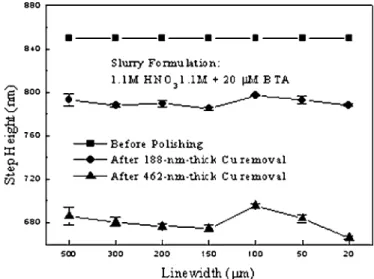
used as an AFP slurry for Cu patterned wafer polishing. After 462-nm-thick Cu removal, the step height reduction of various feature Cu lines can be above 155 nm, as shown in Fig. 2. In this case, effective Cu planarization is supposed due to high Cu-BTA removal efficiency at protruded spaces and great Cu-BTA inhibition at recess trenches. Based on Pourbaix diagram, 1.1 M HNO3solution has a 0.05 pH value to keep the Cu surface oxide-free during polishing.3 By means of AC impedance, due to an oxide-free Cu surface, the
charge-transfer resistance in 1.1 M HNO3 solution is almost
ne-glected, as shown in Fig. 3. On an oxide-free Cu surface, BTA molecules complex with Cu+ onto a Cu surface to form a Cu-BTA
passivation layer against HNO3corrosion. In Cho’s study, FI-STM 共field ion–scanning tunneling microscope兲 images showed that Cu-BTA passivation was a monolayer with an orderly stack on an oxide-free Cu surface.5Because Cu-BTA passivation is a monolayer, this study supposes that a polishing pad could effectively remove the Cu-BTA passivation on protruded spaces. The Cu static etch rate in 1.1 M HNO3solution can be above 330 nm/min. However, in the
addition of 20M BTA, Cu-BTA monolayer forms on an oxide-free Cu surface leading to an increase in charge-transfer resistance from 0 to 1400⍀. Then, static Cu etch rate is reduced from 330 to 120 nm/min. In other words, the formation of Cu-BTA passivation on a Cu surface can effectively reduce Cu corrosion at recess trenches.
Contrary to non-native Cu-BTA, another surface passivation used in Cu AFP is composed with Cu oxides and Cu-BTA. In this case, an AFP slurry is formulated with 1.1 M HNO3, 1 mM BTA,
and 0.5 vol % H2O2. For Cu removal with an AFP slurry containing
H2O2, a Cu surface is not oxide-free during polishing. 0.5 vol % H2O2 can decompose OH− to oxidize a Cu surface as Cu oxides
during polishing.6 By means of X-ray photoelectron spectra, the
Figure 1. Mechanism of the Cu AFP technique. Figure 2. Effective Cu planarization with an AFP slurry formulated with 1.1
M HNO3and 20M BTA.
Figure 3. Charge-transfer resistance of the Cu surface in 1.1 M HNO3 so-lution with increasing BTA concentration.
G45
Journal of The Electrochemical Society, 153共1兲 G44-G46 共2006兲 G45
) unless CC License in place (see abstract). ecsdl.org/site/terms_use
address. Redistribution subject to ECS terms of use (see 140.113.38.11
surface passivation in an AFP slurry containing H2O2is composed of Cu oxides and Cu-BTA, as shown in Fig. 4. Moreover, in an AFP slurry containing H2O2, the static Cu etch rate is about 122 nm/min and close to it in 1.1 M HNO3solution with 20M BTA. For Cu
patterned wafer polishing with AFP slurries, due to the lack of me-chanical abrasion by abrasives, Cu removal at recess trenches de-pends on chemical formulation of AFP slurries. Therefore, similar Cu etch rate indicates that the effect of Cu removal at recess trenches on planarization efficiency in two AFP slurries can also be supposed almost the same.
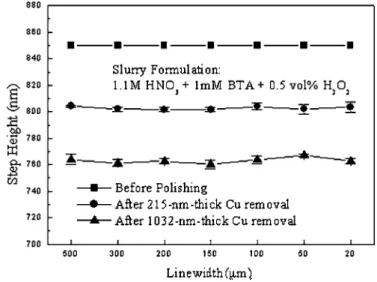
However, even though the surface passivation in two AFP slur-ries has similar inhibition to reduce Cu removal at recess trenches, their different removal efficiency on protruded spaces leads to a significant difference in planarization efficiency in Cu AFP. For Cu patterned wafer polishing with an AFP slurry containing H2O2, after
1032-nm-thick Cu removal, the step height reduction of various fea-ture Cu lines is still less than 100 nm, as shown in Fig. 5. Based on the Cu AFP model of Kondo, the planarization efficiency in Cu AFP strongly depends on the inhibition of surface passivation at recess trenches and selective removal of surface passivation on protruded spaces.5 Because the effect of Cu removal at recess trenches on planarization efficiency in two AFP slurries is supposed the same, a difference in planarization efficiency should be due to different re-moval efficiency of surface passivation on spaces. In an AFP slurry containing H2O2, surface passivation is composed with Cu-BTA and
native Cu oxides. However, effective removal of metal oxide needs strong mechanical stress. Hence, the reduction of planarization effi-ciency should be due to hard removal of Cu oxides by a pad. Oth-erwise, it can be observed that the pattern effect in an AFP slurry containing H2O2is slight, as shown in Fig. 5. That is a significant
phenomenon to signify that low planarization efficiency is due to ineffective removal of Cu oxides. In a Cu damascene process, Cu
planarization suffers from the problem of pattern effect due to Cu removal rate proportional to effective local pressure. While the pas-sivation removal is ineffective by a pad, it can be supposed that no mechanical abrasion contributed to Cu removal rate. Hence, Cu re-moval rate would strongly depend on Cu corrosion and Cu rere-moval becomes pressure-independent. Consequently, patter effect is ne-glected and the step height reduction at all feature scales is similar. Based on the above, when surface passivation on protruded spaces cannot be effectively removed, the underlying Cu film cannot be corroded by HNO3leading to lower planarization efficiency. Indeed,
an oxide-free Cu surface is necessary in Cu AFP. Furthermore, the surface passivation used in Cu AFP should be required to have high removal efficiency by a polishing pad.
Conclusions
For a Cu AFP process, a Cu surface should be oxide-free during polishing. When Cu oxides are used as surface passivation in Cu AFP, their hard removal by a polishing pad would result in low planarization efficiency. In order to obtain high planarization effi-ciency, the surface passivation used in Cu AFP should be required to have high removal efficiency by a polishing pad.
National Chiao Tung University assisted in meeting the publication costs of this article.
References
1. F. Kaufman, D. Thompson, R. Broadie, M. Jaso, W. Guthrie, D. Pearson, and M. Small, J. Electrochem. Soc., 138, 3460共1991兲.
2. S. Kondo, N. Sakuma, Y. Homma, Y. Goto, N. Ohashi, H. Yamaguchi, and N. Owada, J. Electrochem. Soc., 147, 3907共2000兲.
3. M. Pourbaix, Lectures on Electrochemical Corrosion, Plenum Press, New York 共1976兲.
4. Y. Jiang and J. B. Adams, Surf. Sci., 529, 428共2003兲.
5. K. Cho, J. Kishimoto, T. Hashizume, H. W. Pickering, and T. Sakurai, Appl. Surf.
Sci., 87/88, 380共1995兲.
6. R. Subramanian and V. Lakshminarayanan, Corros. Sci., 44, 535共2002兲.
Figure 4. X-ray photoelectron spectra of the Cu surface after polishing with
an AFP slurry containing H2O2.
Figure 5. Cu patterned wafer polishing with an AFP slurry containing H2O2.
G46 Journal of The Electrochemical Society, 153共1兲 G44-G46 共2006兲
G46
) unless CC License in place (see abstract). ecsdl.org/site/terms_use
address. Redistribution subject to ECS terms of use (see 140.113.38.11