Polyimide on Its Second Harmonic Generation
Character
istics
CHI-JUNG CHANG,' WHA-TZONG WHANG,'** JUNG-YAW HUANG,2 CHUENG-LIANG LIAO,' and JONQ-MIN LIU3
'Institute of Material Science and Engineering and *Institute of Electro-Optical Engineering, Chiao Tung University, and 3Material~ Research Laboratories, ITRI, Hsin Chu 300, Taiwan, Republic of China
SYNOPSIS
In situ second harmonic generation (SHG) observation of PMDA-ODA-DR1 polyimide films prepared by different preparative procedures were studied to understand the effects of the residual acid and the imidization byproduct and the extent of imidization on the SHG characteristics of the PMDA-ODA-DR1 polyimides. PMDA-ODA-DR1 polyimides with or without removal of salt were also investigated to study the influence of remaining triethyl hydrogen ammonium chloride salt on the SHG characteristics and reliability of the polymers. A blue shift in the UV/vis spectrum during poling was observed for the low- temperature-baked film, but did not occur for the high-temperature-baked film. Both high- temperature imidization and removal of the byproduct organic salt did not only improve the poling efficiency of PMDA-ODA-DR1 polyimide as a SHG material, but also slowed down the relaxation of the film and made the film more reliable. 0 1995 John Wiley & Sons, Inc.
I
NTRODUCTI0
NSecond-order nonlinear optical (NLO) polymers are one of the most promising materials with potential applications in optical information processing and telecommunications.'S2 Such materials also exhibit large susceptibilities and versatility of molecular structure
modification^.^
There are presently many types of NLO polymeric materials, with the following three kinds being the most popular: (1) guest-host materials? (2) linear polymers covalently attachedwith NLO chromophores? and (3) crosslinked
polymers covalently functionalized with NLO chro- m o p h o r e ~ . ~ . ~ - ' ~ The NLO chromophore covalently bonded onto the polymer chain has been used to im- prove the stability of the NLO characteristics by a slowing down of its relaxation of the orientation.20.21
* To whom correspondence should be addressed.
Journal of Applied Polymer Science, Vol. 56, 1625-1634 (1995)
0 1995 John Wiley & Sons, Inc. CCC 0021-8995/95/121625-10
In situ second harmonic generation (SHG) ob-
servation is a useful tool for studying the NLO properties of the polymer under the poling process. It may also be used to study the variation of NLO characteristics of the polymer upon simultaneous
reaction under poling. As has been demonstrated by
Wu et al.,738 polyamic acid doped with a nonlinear chromophore can be imidized during poling. Stahelin et a1.I' showed that the poling process is a physical and chemical process because the imidization si- multaneously involves the evolution of water and the formation of imide groups with the reduction of the amic acid group. During the poling process, the residual solvent in the polymer also gradually gases out from the polymer under heating. It has been confirmed that such water evolution resulted in an increase in conductivity of the film and reduced the effective electric field for poling. The SHG signal dropped during the heating procedure of the poling process until 150°C because of a decrease of the ef- fective applied field. The SHG characteristics and relaxation properties of the guest-host polyimide
NLO have been extensively studied, but few studies on the preparation and SHG properties of the chro- mophore chemically bonded polyimide are reported. In this study, we focused on the preparative pa- rameters essential for the development of DR1 (dis- persed red 1; an NLO organic compound) chemically bonded polyimide with good optical properties. There are some difficulties in preparing this type of NLO polyimide which displays stable NLO char- acteristics even at elevated temperature (122°C). Also, the poling process, accompanied by heating and cooling, caused dynamic structural changes in
the polyimide. Thus, in situ observation was used
to characterize the dynamic nonlinear optical prop- erties of the polyimide. Its decay behavior at elevated temperature and its SHG signal response speed, with or without removal of the organic salt before the in situ poling, were used to study the influence of hy- drogen chloride-amine salt on those SHG proper-
ties. In addition, a biexponential a p p r ~ x i m a t i o n ~ ~ - ~ ~ with long-time relaxation and short-time relaxa-
tion was modeled to predict the SHG stability of the PMDA-ODA-DR1 polyimide at elevated tem- perature.
EXPERIMENTAL
Preparation of the Polyamic Acid (PAA)-DR1
4.4'-Diamino diphenyl ether (ODA) was dissolved in N-methylpyrrolidone (NMP) and then pyromellitic dianhydride (PMDA) was added to the solution. Af- ter no solid PMDA was found in the solution, the mixture was further stirred at room temperature
under nitrogen atmosphere for 1 more h. The solid
content of the PAA solution was 5 wt %. Thionyl chloride, with a 15% molar ratio relative to the car- boxylic acid, was then added dropwise into the PAA solution kept in an ice bath. The resulting solution was further stirred for 2 more h for the reaction. The excess thionyl chloride and the byproduct hy-
drogen chloride in the PAA solution were removed
by vacuum pumping. DR1 was purified by recrys- tallization from ethanol. The purified DR1, with a
10% molar ratio relative to the original carboxylic acid, was dissolved in NMP and then added dropwise into the acid chloride containing the PAA solution. The mixture was stirred for 24 h at room tempera- ture. Triethylamine was then added into the polymer solution to neutralize the byproduct hydrogen chlo- ride. Polymer solutions both with or without trieth- ylamine were prepared for study.
Preparation of Three Types of Polyimide-DR1 Films
The PAA-DR1 solution was coated on the surface of clean I T 0 glass. The film was dried a t 80°C for
1 h (soft bake) in a vacuum oven, then imidized by
two different procedures-First type: The film was imidized a t 150°C for 5 h; and second type: besides the low-temperature baking, the polymer film was further heated at 200°C for 1 h (high-temperature baking). The third type of polyimide-DR1 film was prepared by immersing the high-temperature-baked film in deionized water for 5 h to remove the organic salt. The third type of polyimide film was then vac- uum-dried at 150°C overnight.
Second Harmonic Generation (SHG) Study In Situ Poling SHG Study
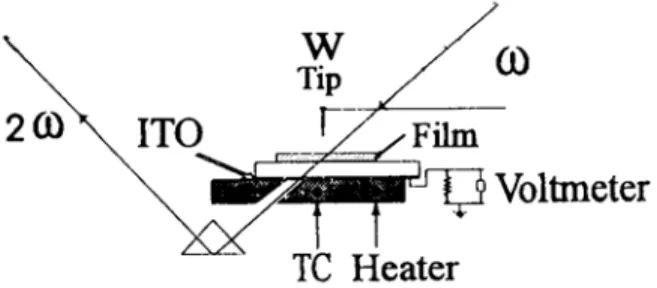
The NLO signals during poling were measured in
situ by the setup reported by Liao et al.25 shown in
Figure 1. The light source used as the fundamental
light is a Q-switched Nd : YAG laser operating a t 1.064 pm. The transmitted beam was passed through colored glass filters and an interference filter to re- move all traces of the fundamental light before the second harmonic signal at 532 nm was detected with a photomultiplier detector. A reference signal was generated using SHG from a quartz crystal. The sample was poled in a temperature-controllable chamber with an optical window. The temperature was gradually raised to slightly above the
Tg
of the polymer film for several minutes. It was then grad- ually cooled down to room temperature before the electric field was removed.Figure 1 Experimental setup for the in situ measure- ments of the second harmonic intensity and temperature of polymer films during the corona poling process. W tip, tungsten tip; TC, thermocouple; ITO, indium tin oxide film.
Decay Studies of SHG Signal on PMDA-ODA-DR1 Polyimide Film
Decay of the SHG signal was measured both at room
temperature and elevated temperature.
Decay at Room Temperature
The decay of the SHG signal at room temperature
was observed through the UV absorption change.15 Assuming that the predominant second-order po- larizability tensor component (/3zzz) is parallel to the molecular dipole (p), the dipole can be related to an order parameter ( 9)1915-16:
9 = (3(c0s28) - 1)/2
where
()
is the expected value, and 8, the angle be-tween the molecular dipole moment ( p ) and the ap- plied electric field ( E ) . If the transition dipole mo- ment is parallel to p, it followss the equation
9 = 1 - AJAO
where A. is the absorbance of the nonpolarized film, and Al, the absorbance of the polarized film mea- sured with the optical electric fields polarized per- pendicular to the plane of the film. The absorbance of the film decreased after poling. The lower the A,/ Ao, the higher the order parameter.
Meanwhile, 8 approached zero as the order pa-
rameter became higher, i.e., the molecular dipole moment got closer to the applied electrical field. The decay of the order parameter is an indication of the decay orientation at room temperature.
Decay at Elevated Temperature
To compare the difference between the relaxation behavior of the high-temperature-baked film and the low-temperature-baked film, the decay of the align- ment at elevated temperature was measured. The polyimide film was obtained as in the room-tem- perature decay study, except that it was heated a t the desired temperature for the decay study. The desired temperature was chosen as the temperature
at which the SHG signal reaches a plateau during
the cooling procedure. For the decay behavior of an
NLO polymer, a biexponential model has been
p r ~ p o s e d ' ~ - ~ ~ of the following form:
in which long-time relaxations are characterized by
r2, and short-time relaxations, by 71. As illustrated
by Torkelson et a1.,2z the SHG intensity decay is a combined measurement of the surface charge decay and the loss of chromophore orientation due to mo- bility and local free volume of the polymer matrix. The relaxation time 7 2 may be related to the chro-
mophore mobility in the polymer matrix. By curve fitting, the coefficient "A" and both characteristic relaxation times, 71 and 7 2 , were calculated to un-
derstand the different relaxation behaviors of var- ious types of PMDA-ODA-DR1 polyimides.
RESULTS AND DISCUSSION
The DSC diagram of the PMDA-ODA-DR1 poly- mer imidized at two different temperatures is shown in Figure 2. The glass transition temperature
(T,
= 150°C) of PMDA-ODA-DR1 polyimide baked at
150°C is lower than that
(T,
= 165°C) of the poly- imide baked at 200OC. It is well knownz6 that under the same imidization time polyamic acid imidized at lower temperature will have a lower degree of im- idization than that imidized at higher temperature. Therefore, it is reasonable to surmise that the lowerTg
of the polymer PMDA-ODA-DR1 imidized a t150°C resulted from the lower degree of imidization. On the other hand, the glass transition temperature
(T,
= 165°C) of the PMDA-ODA-DR1 imidized at200°C is much lower than that
(T,
> 300OC) of PMDA-ODA imidized under the same imidization condition. This much lowering of theT,
in DR1- polyimide may be due to the lowering in the number of imide rings on the main chain and the presence of longer spacer units between the imide rings.The UV/vis spectrum changes of the low-tem- perature-baked and high-temperature-baked films, measured before and after poling, are shown in Fig- ures 3 and 4, respectively. The UV/vis spectrum shifting of these two types of polyimide upon poling was quite different. In the case of the low-temper- ature-baked film, the wavelength of maximum ab- sorption (Amax) shifted from 509 to 486 nm upon poling. The blue shift of the absorption band was attributed to the structure change resulting from the imidization reaction during the poling process. Be- fore the poling process, there were some hydrogen- bond interactions between the residual carboxyl groups of PAA and the lone-pair electrons on the nitrogen atom of DR1. Such interaction may hinder the resonance among the lone-pair electrons on the nitrogen atom of DR1 and the ?r electrons on the
I z I I I t I I I
50 70 90 110 130 150 170 190 210 2 0
Temperature
(k)
Figure 2baked film.
DSC diagram of (a) low-temperature-baked film and (b) high-temperature-
benzene ring and the diazo bond. During the poling process, more acid groups reacted with amide groups of the low-temperature-baked polyimide to form imides. Therefore, the resonance among the lone-
pair electrons on the nitrogen atom of DR1 and the
?r electrons on the benzene ring and the diazo bond
became more significant, resulting in lowering the energy level of the ground state of DR1 in the low- temperature-baked polyimide upon poling, enlarging
the energy gap between the ground state and the excited state.
The influence of imidization during poling on the low-temperature-baked film was remarkable. Therefore, the blue shift in the UV/vis absorption spectra is significant in Figure 3, while the UV/vis
spectra of the high-temperature-baked film illus- trated in Figure 4 shows a negligible blue shift after poling. The imidization extent of the high-temper-
2
I
400 500 600 700
Wavelength (nrn) Figure 3
film (a) before poling and (b) after poling.
UV/vis spectra of the low-temperature-baked
400 500 600 700
Wavelength (nrn) Figure 4
film (a) before poling and (b) after poling.
ature-baked film was relatively higher than that of the low-temperature-baked film. Further imidization during poling was less remarkable, so the change in the resonance and the hydrogen-bonding interaction attributed to the change of the molecular structure became negligible.
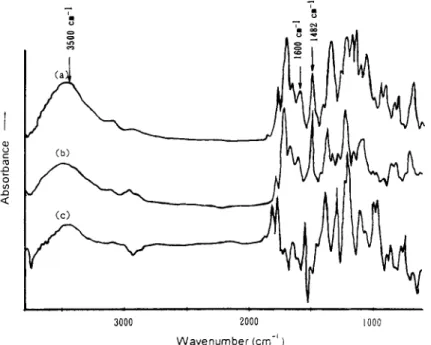
Figure 5 shows the FTIR spectra of the PMDA- ODA-DR1 polyimide without treating with trieth- ylamine before and after poling. The benzene ring absorption at 1600 cm-' is an invariant peak during
the poling treatment. The N - H absorbance should
decrease after the imidization reaction because the
N-H functional groups should be converted to
imide groups. To the contrary, the N - H absorption a t 3400-3500 cm-' increased after poling. Mean- while, the diazo absorption at 1482 cm-' decreased after poling. Primarily, this was probably due to the reaction between the residual hydrogen chloride and the diazo bond under the high temperature and high electric field during the poling process. Such a re-
action resulted in the formation of - NH - NH -
functional groups and the destruction of the N = N
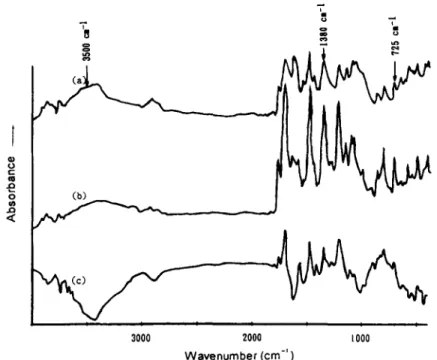
groups. It disrupted the structure of the NLO chro- mophores and led to the insignificant SHG intensity. For PMDA-ODA-DR1 polyamic acid, treated with triethylamine to neutralize the residual hydro- gen chloride after polymerization, the FTIR spectra of the polymer film baked at 15OoC is shown in Fig- ure 6. Both the cyclic imide ring bending absorption
peak at 725 cm-' and the imide ring C
-
N stretch- ing absorption peak at 1380 cm-' increased afterpoling. The N-H absorption peak a t 3400-3500
cm-l decreased after poling, due to the formation of imide groups during the poling process.
In Situ SHC Measurement
In Figure 7, the SHG signal of the low-tempera- ture-baked film increased due to the electric field- induced alignment a t the initial poling state. The SHG signal started to drop as the poling temper- ature reached 50"C, dropped to zero a t about
lOO"C, and remained zero during the latter heating process. Similar phenomena were observed in the
in situ poling and imidization process of the dye- doped polyimide film mentioned by Stahelin et a1.l' during the poling period between room tem- perature and 150°C. Stahelin et al. showed the SHG variation observed during poling as being in- terpreted by the change of the applied poling field limited by the leakage current. Such an interpre- tation agrees with the phenomena observed in this study. The decrease in the SHG signal resulted from the decreased effective electric field applied on the film and was attributed to the water evo- lution-induced increasing conductivity, as the im- idization extent of the low-temperature-baked polyimide film was relatively low before poling.
3000 2000 1000
Wavenumber (cm-' )
Figure 6
(without tertiary amine treatment); (c) c = b - a.
3000 zoo0 I000
Wavenumber (cm-'1 Figure 6
(with tertiary amine treatment); (c) c = b - a.
FTIR spectra of the low-temperature-baked film (a) before and (b) after poling
Therefore, the low-temperature-baked polyimide film can be imidized further and evolve water and residual NMP during poling. Such evolution, to- gether with increase in mobility of the ions a t higher temperature, increased the conductivity of the film and decreased the effective applied electric field. After the sample had been held a t 18OoC for 15 min and then cooled to room temperature with the electric field still on, the SHG signal of the sample started to increase during cooling. The
SHG signal reached a maximum value a t about
4OoC, then began to decrease with decreasing
0 50 100 150 200 250
Temperature
('C)
Figure 7 In situ SHG intensity of the low-temperature- baked film vs. poling temperature a t heating and cooling in the poling process.
temperature. In our other studyz5 on the PMDA- DR19 NLO polymer, a similar phenomenon was observed. The phenomenon was well explained by the model calculation of the elastic interaction of the NLO chromophore with the polymer chain be-
low and above
Tg.
The elastic constant of the in-teraction below
Tg
is much greater than that a ttemperatures above
Tg.
The orientation of theNLO chromophore a t temperature below
Tg
ismore strongly restricted by the polymer chain than above
Tg.
Therefore, even if the electric field isstill on, the SHG signal intensity of the NLO chromophore chemically bonded polymers de- creases because the chromophore orientation is restricted by the polymer chain a t temperatures
below
Tg.
Figure 8 shows the SHG signal of the high-tem-
perature-baked film during heating and cooling in the poling process. This film had a higher imidiza- tion extent than did the low-temperature-baked film.26 Fewer functional groups of the high-temper- ature-baked film could be imidized further in the poling process and, hence, a lesser amount of water was evolved during poling. Therefore, the effective electric field on the film was less affected by heating under the poling process. As the temperature in- creased upon poling, the NLO chromophore on the polymer chain became more easily aligned under the electric field, resulting in the SHG signal increasing
Temperature ( " C )
Figure 8 I n situ SHG intensity of the high-temperature- baked film vs. poling temperature at heating and cooling in the poling process.
during the heating process of the poling. After the film was held at 200°C for 10 min, the SHG signal decreased due to Brownian motion at high temper- ature. On cooling, the SHG signal first increased, reached a maximum, and then decreased. We attri- bute the increase of the SHG signal a t the beginning of the cooling procedure to the decrease in the extent of Brownian motion. At about 115"C, the SHG sig- nal reached its maximum value. Then, the SHG sig- nal decreased as the poling temperature decreased. It may be due to the elastic interaction of NLO
chromophores with the polymer chains, as we have explained above. The in situ SHG behavior of the salt-removed PMDA-ODA-DR1 polyimide film is shown in Figure 9. The signal behaved like that of the high-temperature-baked film without water-im- mersion treatment except that the SHG signal reached its maximum value at a lower temperature during the heating step and the percentage drop of the SHG signal at room temperature was less during the cooling procedure. After being washed with wa- ter, the concentration of hydrogen chloride-amine salt in the PMDA-ODA-DR1 polyimide film should be much less than that in the polymer film before washing. It is reasonable to infer that a t the same working voltage (or applied voltage) the effective electric field across the former film is higher than that across the latter. This may be the reason why the SHG signal reaches its maximum at lower tem- perature upon heating and the SHG signal drop is less upon cooling.
Decay of SHG Signal
The UV/vis absorption spectrum of low-tempera- ture-baked PMDA-ODA-DR1 polyimide film is a
I . ~ . ~ ' T ' r n ' i
0 50 100 150 200 250
Temperature ( " C )
Figure 9 I n situ SHG intensity of the water-immersion- treated film vs. poling temperature a t heating and cooling in the poling process.
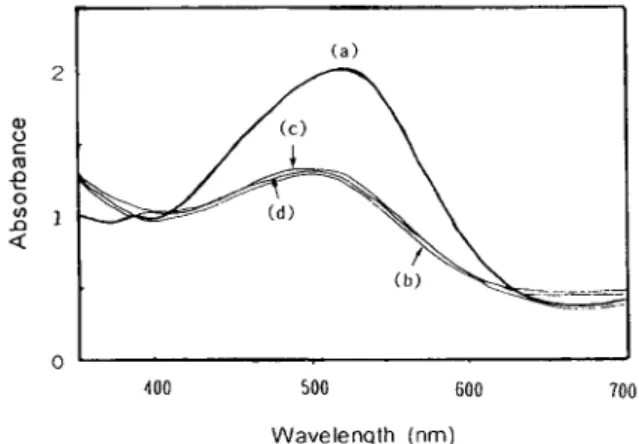
function of poling time as shown in Figure 10. The spectrum shifted significantly after poling, but re- mained almost the same in the later test. To study the decay behavior of the polyimide film at room temperature after poling, the order parameter of the polyimide was calculated from the absorbance of the baked film as a function of time in Figure 11. The normalized order parameter
[a(
t)/a(O)] was also plotted to illustrate the SHG decay a t room tem-perature. The order parameter dropped 4.5% over
25 min after poling and remained almost constant later on over 10 days.
Although the SHG signal was stable a t room temperature, it is still necessary to study the decay behavior a t elevated temperature in order to know the reliability of the materials. Two different decay behaviors of the high-temperature-baked film and the low-temperature-baked film were inves-
I
do0 saa 600 700
Wavelength (nm)
Figure 10 UV/vis spectra of the low-temperature-baked film measured (a) before poling, (b) right after poling, (c) 12 h after poling, and (d) 120 h after poling.
0 50 100 150 200 250 Time (hour)
Figure 11 Decay of the order parameter calculated from the changes of UV/vis absorbance of the low-temperature- baked film.
tigated by studying the decay of the in situ SHG
signal a t elevated temperature. A biexponential
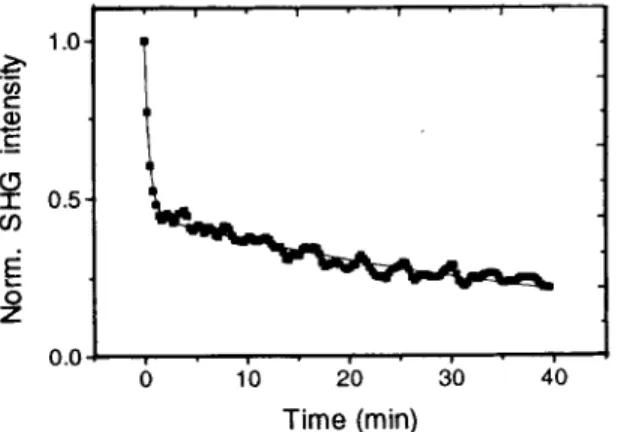
approximation22 was made to fit the decay of the SHG signal a t elevated temperature with short- time relaxation characterized by r 1 and long-time relaxation by 7 2 , as explained previously. The sur- face charge decay was related to the short-time relaxation, and the orientational mobility of the chromophore was related t o the long-time relax- ation.
The SHG signal decay of the low-temperature- baked polyimide film, the high-temperature-baked polyimide film, and the salt-removed polyimide film measured a t elevated temperature are shown in Figures 12-14, respectively. The weighing factor
A of short-time relaxation and the relaxation times r 1 and r 2 derived from curve fitting of Figures 12- 14 with a biexponential approximation model" are listed in Table I. The influence of short-time re-
0 10 20 30 40
Time (min)
Figure 12 Decay of the SHG intensity of the low-tem- perature-baked films at elevated temperature (measured a t 85°C).
V."
.
6
.
io
' 40 . 60 8-0Time (min)
Figure 13 Decay of the SHG intensity of the high-tem- perature-baked films a t elevated temperature (measured a t 122°C).
laxation was relatively more important for the low- temperature-baked film than t h a t for either the high-temperature-baked film or the salt-removed film because the weighing factor ( A = 0.33) of the
first film was higher than that of the latter two films (0.10 and 0.12, respectively). The normalized SHG intensity of the low-temperature-baked film dropped to 0.22 after being kept at 85°C for 40
min. The high-temperature-baked film was more stable than was the low-temperature-baked film
even a t a temperature as high as 122°C. It drop-
ped to 0.5 after being held a t 122°C for 65 min. In addition, there was no sharp initial drop of the SHG intensity. Such an increase in stability resulted from an increasing extent of imidi- zation.
Both the relaxation times r1 and r 2 of the salt- removed film (8.78 min, 7.3 h) were larger than those of the high-temperature-baked film without
1
E
0 Z 0.0' I I 0 20 40 60 Time (min)Figure 14 Decay of the SHG intensity of the water- immersion-treated films a t elevated temperature (mea- sured a t 122°C).
Table I The Coefficient and the Characteristic Relaxation Time of Three PI Films
Low-temperature-baked High- temperature-baked Water-immersion-treated
Film Film Film
A r 1 (min) 7 2 (h) Test temp ("C) 0.33 0.52 1.83 85 0.10 5.18 4.12 122 0.12 8.78 7.30 122
salt removal (5.18 min, 4.125 h). In addition, the normalized SHG signal dropped to 0.6 after being kept a t 122°C for 60 min. The relaxation time in- dicated that the salt removal from the film made the film more reliable. The elimination of the salt from the PMDA-ODA-DR1 polyimide might reduce the plasticization and slow down the ori- entation relaxation. Therefore, more reliable PMDA-ODA-DR1 film could be obtained by high- temperature imidization and removal of the by- product organic salt.
CONCLUSION
The effects of triethylamine, baking temperature, and salt removal on the SHG characteristics of the NLO chromophore chemically bonded PMDA- ODA-DR1 polyimide films have been studied. The addition of triethylamine in the PAA solution did promote the SHG characteristics of the resulting polyimide film. The polyimide film baked a t high temperature showed a higher SHG signal inten- sity, larger relaxation times 71 and r2, and a lower weighing factor A of the short time relaxation r 1 than did the polyimide baked a t low temperature. The high-temperature-baked polyimide film with salt removal may even further improve the SHG characteristics. The salt-removed polyimide film displayed an even higher SHG intensity, a lower temperature for maximum SHG signal intensity during the poling process, even higher relaxation times r 1 and r 2 , and a comparable weighing fac- tor A of the short-time relaxation when the above-mentioned high-temperature-baked poly- imide was immersed in water to dissolve out the salt.
According to these studies, a proper preparation process for the NLO chromophore chemically bonded PMDA-ODA-DR1 polyimide can be de- signed to obtain high SHG intensity and high SHG stability.
The authors acknowledge the financial support from the National Science Council of R.O.C. under Grant No. NSC 82-0208-M009-035.
REFERENCES
1. D. S. Chemla and J . Zyss, Eds., Nonlinear Optical
Properties of Organic Molecules and Crystals, Academic
Press, New York, 1987.
2. D. J. Williams, Ed., Nonlinear Optical Properties of Organic and Polymeric Materials, ACS Symposium
Series 233, American Chemical Society, Washington, DC, 1983.
3. M. Chen, L. Yu, L. R. Dalton, Y. Shi, and W. H. Steier,
Macromolecules, 24, 5421 (1991).
4. H. L. Hampsch, J. Yang, Gik, Wong, and J. M. Tor- kelson, Macromolecules, 21, 526 (1988).
5. J. R. Hill, P. Panties, F. Abbasi, and P. Hodge, J.
Appl. Phys., 64, 2749 (1988).
6. L. Li, J. Y . Lee, Y. Yang, J. Kumar, and S. K. Tripathy,
Appl. Phys. B, 53, 279 (1991).
7. J. Wu, J. Valley, S. Ermer, E. Binkley, J. Kenney, G. Lipscomb, and R. Lytel, Appl. Phys. Lett., 58, 225 (1991).
8. J. Wu, E. Binkley, J. Kenney, R. Lytel, and A. Garito, J. Appl. Phys. 69, 7366 (1991).
9. M. Stahelin, D. M. Burland, M. Ebert, R. D. Miller, B. A. Smith, R. J. Twieg, W. Volksen, and C. A. Walsh,
Appl. Phys. Lett., 61, 1626 (1992).
10. M. Stahelin, C. A. Walsh, D. M. Burland, R. D. Miller, R. J. Twieg, and W. Volksen, J. Appl. Phys., 73,8471 (1993).
11. P. Kitipichai, R. L. Peruta, G. M. Korenowski, and G. E. Wnek, J. Polym. Sci. Part A Polym. Chem., 31,
1365 (1993).
12. H. Nagumori, K. Kajikawa, H. Takezoe, A. Fukuda, S. Ukishima, M. Tijima, Y. Takahashi, and E. Fukada.
Jpn. J. Appl. Phys., 31, 553 (1992).
13. J. Jerphagnon and S. K. Kurtz, J. Appl. Phys., 41(4),
1667 (1970).
14. M. Eich, A. Sen, H. Looser, H. C. Bjorklund, J. D. Swalen, J. J. Twieg, and D. Y. Yoon, J. Appl. Phys., 66, 2559 (1989).
15. S. Hu, G. 0. Carlisle, and D. R. Martinez, J. Muter. Sci. Lett., 1 1 , 794 (1992).
16. A. Knoesen, N. E. Molau, D. R. Yankelevich, M. A. Mortazavi, and A. Dienes, Znt. J . Nonlinear Opt. Phys.,
1 , 73 (1992).
17. M. Eich, B. Reck, D. Y. Yoon, C. G. Willson, and G.C. Bjorklund, J. Appl. Phys., 6 6 , 3241 (1989).
18. J. Park, T. J. Marks, J. Yang, and G. K. Wong, Chem. Muter., 2 , 229 (1990).
19. L. Yu, W. Chan, S. Dikshit, E. Bao, Y. Shi, and W. H. Steier, Appl. Phys. Lett., 6 0 , 1655 (1992).
20. K. D. Singer, S. J. Lalama, and J. E. Sohn, Proc. SPZE Znt. Soc. Opt. Eng., 5 7 8 , 130 (1985).
21. G. R. Meredith, J. G. Vandusen, and D. J. Williams,
Macromolecules, 15,1385 (1982).
22. H. L. Hampsch, J. Yang, G. K. Wong, a nd J. M. Torkelson, Macromolecules, 2 3 , 3 6 4 0 (1990).
23. M. A. Hubbard, N. Minami, Ciye, T. J. Marks, J. Yang, and G. K. Wong, Proc. SPIE Int. SOC. Opt Eng., 9 7 1 ,
136 (1988).
24. D. R. Dai, T. J. Marks, J. Yang, P. M. Lundquist, and G. K. Wong, Macromolecules, 23,1891 (1990).
25. C. L. Liao, J. Y. Huang, C. J. Chang, and W. T. Whang, t o appear.
26. Y. K. Lee and J. D. Craig, in Polymer Materials for Electronic Applications, ACS Symposium Series 184, American Chemical Society, Washington, DC, 1982, pp. 107-121.
Received July 8, 1994 Accepted August 29, 1994