Preparation and mechanical properties of nitrile butadiene
rubber/silicate nanocomposites
Wei-Gwo Hwang
a, Kung-Hwa Wei
a,*, Chang-Mou Wu
ba
Department of Materials Science and Engineering, National Chiao Tung University, Hsinchu 30049, Taiwan, ROC
b
Department of Aeronautical Materials, Aeronautical Systems Research Division, Chung-Shan Institute of Science and Technology, Taichung 40407, Taiwan, ROC
Received 9 June 2003; received in revised form 26 April 2004; accepted 7 May 2004 Available online 19 June 2004
Abstract
Elastomer nanocomposites consisting of nitrile butadiene rubber (NBR) latex and layered silicates are prepared by a modified latex shear blending process aided with ball milling. The mode of dispersion of layered silicates in NBR is partially exfoliated and intercalated when the concentration of layered silicates is below 7.5 wt%, as evidenced by transmission electron microscopy and X-ray diffraction results. The tensile and tear mechanical properties are much higher than that of neat NBR. Specifically, the tensile and tear mechanical properties of the NBR/layered silicates increase by 200 and 60%, respectively. The decomposition temperature of the nanocomposites increases slightly. q2004 Elsevier Ltd. All rights reserved.
Keywords: Layered silicates; Elastomer nanocomposite; Mechanical properties
1. Introduction
Layered silicates/polymer nanocomposites combine the easy processing of polymers with the strength of nanometer-sized layered silicates having one dimension about 1 nm. These nanocomposites can exhibit synergistic properties from individual components without causing large detri-mental effect to their original properties by incorporating only a small percentage of layered silicates, thus providing a new technological and economic route for the production of potentially valuable materials. Nylon 6-silicate is the first example of such a hybrid composite [1]. Other polymer-layered silicate nanocomposites, involving materials such as polyimide[2 – 4], polyurethane[5 – 7], polyolefins [8 – 10], polyisoprene rubber[11]and silicone elastomer[12], have also been reported recently.
Only a few cases of elastomer nanocomposites consisting of various rubbers and layered nano-silicates have ever been reported [13 – 15]. Different methods of intercalation of layered silicates, such as melt intercalation, in-situ polym-erization and latex shear blending methods, have been adopted to prepare the elastomer nanocomposite.
Specifi-cally, some organo-modified silicate reinforced elastomer nanocomposites, obtained from a melt intercalation method, have been reported by the high shear force generated in a plasticorder or a twin-screw extruder[15 – 22]. For instance, ethylene propylene diene methylene linkage rubber-clay hybrid has been prepared successfully by melt mixing of EPDM and organophilic clay in a plasticorder followed by vulcanization process [16]. On the other hand, a shear blending process on elastomer latex produces a poor intercalation and dispersion morphology of silicate layers [23 – 26].
Nitrile butadiene rubber (NBR), in the solid or latex state, is one of the most widely used, commercialized and mass-productive elastomers that is manufactured mostly by the emulsion polymerization method. In the present study, NBR/silicate nanocomposites are prepared using a modified latex shear blending method. The source of layered silicate utilized in this study is Naþ-montmorillonite (MMT), which consists of a lamellar structure that is constructed from an octahedral alumina sheet sandwiched between two tetra-hedral alumina sheets. The surfaces of these silicate layers contain negative charges with strong van der Waals interaction forces that are balanced by Naþcations absorbed on the near- surface to compensate for the net negative charge. When the inorganic layered silicates are dispersed in
0032-3861/$ - see front matter q 2004 Elsevier Ltd. All rights reserved. doi:10.1016/j.polymer.2004.05.040
www.elsevier.com/locate/polymer
* Corresponding author. Tel.: þ886-35-731871; fax: þ886-35-724727. E-mail address: [email protected] (K.H. Wei).
water, the interlayer spacing largely expand due to hydrogen bonding, which enables relatively larger-sized molecules, such as surfactants, to penetrate into their galleries[27 – 29]. Then, the enlarged galleries could allow even larger molecules to diffuse and intercalate into the interlayer space. NBR/silicate nanocomposites could not be easily prepared by melt intercalation as a result of the poor miscibility of NBR with layered silicates. In the present study, a new intercalation process is used to produce nanocomposites by shear blending of nitrile latex with surfactant-treated hydrophilic layered silicates, and the resulting mechanical properties of these nanocomposites are investigated.
2. Experimental section 2.1. Materials
Nitrile butadiene rubber latex (NBR latex, Nancar 1052) containing 31 – 33% acylonitrile was obtained from Taiwan Nancar Co. Ltd., with a solid content of about 27%. Clay Swy-2 (Wyoming Naþ-montmorillonite, i.e. Naþ-MMT), having a cationic exchange capacity (CEC) of 76.4 mequiv./100 g, was provided from the Clay Minerals Depository at the University of Missouri, Columbia, MO. Aromatic polyglycol ether (Emulvin W), a nonionic emulsifier acting as a emulsifying, stabilizing and wetting agent for latexes, was acquired from Mobay Co. Ltd. Other ingredients, such as the surfactant (sodium salt of methylene-bis-naphthalene sulphonic acid), dispersing agent and curing agent were supplied from a local agency (R.T. Vanderbilt Co. Ltd., Taiwan).
2.2. Latex blending and sample preparation
The last number behind the sample notation, NX-, stands for different content of layered silicates, which was added to NBR latex. For example, NX-0 is neat NBR, and NX-10 contains 10 wt% layered silicates in NBR. Typical indus-trial formulations were used in this study. A mixture of Naþ -MMT, dispersing agent, emulsifier, potassium hydroxide (electrolyte) and deionized water was placed in a ball-mill tank to produce a homogeneous, swelled and intercalated layered silicate solution. The cure agents, including 0.5 phr (parts per hundred rubber) sulfur and proper amounts of accelerator, zinc oxide, oleic acid, dispersing agent, emulsifier, and potassium hydroxide, were also mixed and prepared as a slurry at the same time. Subsequently, each clay solution was individually added to the nitrile butadiene rubber latex and blended for 48 h to form a homogeneous latex composite. Then, each batch of curing slurry was added to the latex composite and blended an additional 48 h. Afterward, each batch of latex composite was poured directly into a flat plate vessel, dried for 24 h in a 50 8C hot air oven, washed with water and cured for 4 h at 110 8C to
obtain a rubber slab. Each slab was controlled to an approximate thickness of 1 mm.
In the present study, a well-dispersed layered silicate water slurry was prepared by mechanical ball milling of an emulsified solution with an adjustment of its pH value. Then, it was blended with the prepared nitrile latex, using normal stirring for a proper period of aging time. It was found that most of the homogeneous nanocomposite latexes were stable even after one month when stored at room temperature.
2.3. Characterization
Wide-angle X-ray diffraction (XRD) measurements were carried out with a Mac Science M18 X-ray diffractometer. The X-ray beam was produced by nickel-filtered Cu Ka radiation with wavelengthl¼ 0:154 nm operated at 30 kV and 25 mA. The diffraction curves were obtained within the range of scattering angles ð2uÞ of 2 – 108 at a scan rate of 18/min. The TEM used is a JEOL JEM 2000FX electron microscope operating with an acceleration voltage of 100 kV. Ultrathin sections of the cured samples were microtomed using Leica Ultracut Uct into about 100-nm thick slices with a diamond knife; subsequently, a layer of carbon was deposited onto these slices and placed on 400 mesh copper nets. Thermogravimetric analysis (TGA) of each sample was carried out under nitrogen purge in a Perkin – Elmer TGA-7. About 10 mg of cured sample was heated from 50 to 700 8C at 10 8C/min. Both the tensile and tear strength of the cured rubber slab were tested on a MTS tensile tester, Sintech 1-D, according to the ASTM standard D412-97 method, die C and D624-95 method, die B, respectively.
3. Result and discussion
Fig. 1shows the X-ray diffraction curves for the cured NBR/silicate nanocomposites. The X-ray diffraction peaks at 2u¼ 6:84; 2.73, 2.63 and 2.658 represent the diffraction
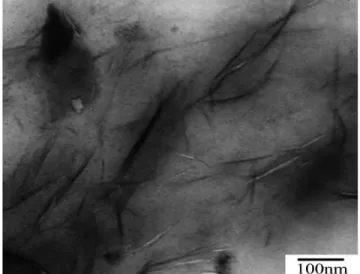
of the (001) crystal surface of layered silicates in the nanocomposites, corresponding to d-spacings of 1.29, 3.23, 3.36 and 3.33 nm, respectively. This indicates that a relatively large gallery expansion in layered silicates has been obtained in the case of NX-3, NX-5 and NX-7.5. For the NX-5 sample, the major peak appears around 2.638, and a blurred peak appears at about 3.338 (2.65 nm), which might be caused by non-uniform expansion of layered silicates. For the NX-7.5 sample, other than the diffraction of X-ray by the (001) plane at about 2u¼ 2:658; another strong diffraction peak can be observed at about 5.368 (1.65 nm). This probably indicates that there has a bimodal structure for layered silicates in NBR when the amount of layered silicates is over 5 wt%. Fig. 2 presents TEM micrographs of the dispersion of nanometer-sized layered silicates in the NBR film. Single silicate layer in the rubber
W.-G. Hwang et al. / Polymer 45 (2004) 5729–5734 5730
matrix and a few multi-layer bundles in the case of NBR containing 3 and 5 wt% layered silicates can be found in Fig. 2(a) and (b). In both cases, the exfoliated layered silicates, where the interlayer d-spacing was larger than 3.2 nm, can be observed; whereas, in Fig. 2(c), the dispersion of silicates in NBR can be found to actually adopt a bimodal structure, consisting of both intercalated and exfoliated states. This reveals that a higher silicate loading would lead to poorer dispersion and more aggregated bundles in the rubber film. A critical concen-tration of 7.5 wt% layered silicate in NBR/silicate nano-composites can be utilized to exert the exfoliated nanocomposite using the modified latex shear blending method. The results of the TEM analysis correspond to those of the X-ray analysis quite well. Hence, based upon the results of XRD and TEM, it is likely that in the nanocomposites of NBR with silicate concentrations between 3 and 7.5 wt%, exfoliated and partially intercalated layered silicates coexist.
The stress – strain curves of these crosslinked NBR/sili-cate nanocomposites are shown in Fig. 3. At low strains, these materials behave similarly, but the tensile modulus of NX-7.5 increases dramatically at high strains, which is different from that of neat NBR (NX-0). The low strain behavior results from somewhat low sulfur content (low crosslink density). The addition of nano-silicate can enhance the tensile modulus of NBR. It can also be reasonably assumed that the dramatic increase in stress of NX-7.5 in the high strain region results from the effect of molecular chain orientation and the resultant orientation of
Fig. 1. X-ray diffraction patterns for layered silicate (Naþ-MMT) and for NBR/silicate nanocomposites.
Fig. 2. TEM micrographs of NBR/silicate nanocomposites containing 1, 3, 5 and 7.5 wt% layered silicates.
layered silicates brought about by the rubber molecular orientation.
The effects of layered silicates content on the tensile and tear mechanical properties of the crosslinked NBR/silicate nanocomposites are illustrated inFigs. 4 and 5. The tensile strength increases by more than 100%, with a slight effect on the elongation, and the tear strength also increases considerably for these NBR/silicate nanocomposites, com-pared to neat NBR. The tear properties of these crosslinked NBR/silicate nanocomposites display the similar trend to that of their tensile mechanical properties. Additionally, the tensile strengths at 500% elongation (M500, engineering modulus) of the NBR/silicate nanocomposites are also much higher than that of neat NBR. The engineering modulus is an indicator of the stiffness of the rubber compounds. The tensile and tear strengths of the NBR/ silicate nanocomposites increase with the amount of layered silicates up to 7.5 wt%, but decrease at 10 wt% concen-tration. The maximum increases in the tensile and tear strength are about 200 and 60%, respectively. It can therefore, be concluded that tensile and tear properties of NBR can increase dramatically with a layered silicates content up to 7.5 wt% using a modified shear blending system, where the molecular chain motion of NBR into the galleries of largely exfoliated nano-silicate platelets pre-pared by a ball milling process. Second, exfoliated layered silicates with finer dispersion can be established with the assistance of small molecular, non-ionic and ionic surfac-tants and through the use of high shear forces in the ball milling process.
Schematic drawings of the ball milling and latex blending mechanism are provided in Schemes 1 and 2, respectively. InScheme 1, the intergallery space of layered silicates in water is largely expanded since the appearance of the silicate solution is homogeneous and transparent. Then, the ball milling process generates a proper shear force to delaminate the layered silicate and allow the surfactant
Fig. 3. Typical stress – strain behavior of various NBR/silicate nanocomposites.
Fig. 4. Curves of tensile properties versus layered silicate content (wt%) of NBR/silicate nanocomposites. (a) Tensile strength (b) M500 (engineer modulus).
Fig. 5. Curves of tear strength versus layered silicate content (wt%) of NBR/silicate nanocomposites.
W.-G. Hwang et al. / Polymer 45 (2004) 5729–5734 5732
molecules to move into the interspace of layered silicate. In Scheme 2, after mixing with the rubber latex, the emulsified and well-expanded layered silicates can allow the elastomer molecular chains to diffuse and intercalate into the silicate galleries. After coagulating, nearly exfoliated and partly intercalated elastomer nanocomposite can form.
Thermal degradation temperatures (at 5% weight loss) of NBR/silicate nanocomposites also increase with the content of layered silicates. Fig. 6 gives a detailed thermal gravimetric analysis of neat NBR and two nanocomposites. In addition to improving the initial decomposition tempera-ture, the weight loss due to the thermal pyrolysis of NBR is nearly constant, until a temperature of about 450 8C is reached. At higher temperature, the layered silicates inhibit
weight loss in NBR. This is possibly due to the presence of layered silicates dispersed homogeneously in the NBR matrix that could extend the total immigration out-paths of small molecules, as well as inner volatiles, and would reduce the permeability of oxygen into the bulk of the nanocomposite. Therefore, it could inhibit the occurrence of NBR chain scission and improve the thermal stability.
4. Conclusion
NBR/silicate nanocomposites, with a mostly exfoliated and partially intercalated coexisting structure, were success-fully prepared by ball milling of surfactant-treated layered
Scheme 1. Formation of exfoliated layered silicates.
silicates in emulsified solution, followed by latex shear blending. The tensile mechanical properties and tear strengths of these nanocomposites increase with the amount of layered silicates, as compared to that of neat NBR. Additionally, these nanocomposites display higher thermal stabilities than neat rubber.
Acknowledgements
We appreciate the financial support provided by the Ministry of Economic Affairs through Project 92FCA12V and the National Science Council through Project NSC91-2120-M-009-001.
References
[1] Usuki A, Kawasum M, Kojima Y, Fukushima Y, Okada A, Kurauchi T, Kamigaito O. J Mater Res 1993;8:1179 – 84.
[2] Tyan HL, Liu YC, Wei KH. Chem Mater 1999;11:1942 – 7. [3] Agag T, Koga T, Takeichi T. Polymer 2001;42:3399– 408. [4] Jiang LY, Leu CM, Wei KH. Adv Mater 2002;14:426– 9. [5] Chen TK, Tien YI, Wei KH. Polymer 2000;41:1345– 53. [6] Tien YI, Wei KH. Macromolecules 2001;34:9045– 52. [7] Ma J, Zhang S, Qi Z. J Appl Polym Sci 2001;82:1444– 8.
[8] Kawasumi M, Hasegawa N, Kato M, Usuki A, Okada A. Macromolecules 1997;30:6333– 8.
[9] Passaglia E, Bertuccelli W, Ciardelli F. Macromol Symp 2001;176: 299 – 315.
[10] Manias EA, Touny L, Wu KE, Strawhecker BL, Chung TC. Chem Mater 2001;13:3516– 23.
[11] Vu YT, Mark JE, Phom LH, Engelhardt M. J Appl Polym Sci 2001; 82:1391 – 403.
[12] Kwan KS, Harrington DA, Moore PA, Hahn JR, Degroot JV, Burns GT. Rubber Chem Technol 2001;71:630– 43.
[13] Kim JT, Oh TS, Lee DH. Polym Int 2003;52(7):1058 – 63. [14] Kim JT, Oh TS, Lee DH. Polym Int 2003;52(7):1203 – 8.
[15] Varghese S, Karger-Kocsis J. J Appl Polym Sci 2004;91(2):813 – 9. [16] Usuki A, Tukiguse A, Kato M. Polymer 2002;43:2185– 9.
[17] Nah C, Ryu HJ, Han SH, Rhee JM, Lee MH. Polym Int 2001;50: 1265 – 8.
[18] Chang YW, Yang Y, Ryu S, Nah C. Polym Int 2002;51:319 – 24. [19] Joly S, Garnaud G, Ollitrault R, Bokobza L. Chem Mater 2002;14:
4202 – 8.
[20] Wang Z, Pinnavaia T. J Chem Mater 1998;10:3769– 71.
[21] Chen TK, Tien YI, Wei KH. J Polym Sci: Chem 1999;37:2225– 33. [22] Akelah A, Moet A. J Appl Polym Sci 1994;55:153– 72.
[23] Wang Y, Zhang L, Tang C, Yu DJ. Appl Polym Sci 2000;78:1879– 83. [24] Xiong M, Wu L, Zhou S, You B. Polym Int 2002;51:693 – 8. [25] Zhang L, Wang Y, Wang Y, Sui Y, Yu D. J Appl Polym Sci 2000;78:
1873 – 8.
[26] Wu YP, Zhang LQ, Wang YQ, Liang Y, Yu DS. J Appl Polym Sci 2001;82:2842– 8.
[27] Strawhecker KE, Manias E. Chem Mater 2000;12:2943 – 9. [28] Yui T, Yoshida H, Tachibana H, Tryk DA, Inoue H. Langmuir 2002;
18:891 – 6.
[29] Kim YK, Choi YS, Wang KH, Chung IJ. Chem Mater 2002;14:4990 –5. Fig. 6. Comparative TGA results (5% weight loss decomposition
temperature, Td; 8C) of NBR/silicate nanocomposites with neat NBR.
W.-G. Hwang et al. / Polymer 45 (2004) 5729–5734 5734