Observation of laser transverse modes analogous to a SU
„2… wave packet of a quantum
harmonic oscillator
Y. F. Chen*
Department of Electrophysics, National Chiao Tung University, 1001 TA Hsueh Road, Hsinchu 30050, Taiwan, Republic of China Y. P. Lan
Institute of Electro-Optical Engineering, National Chiao Tung University, Hsinchu, Taiwan, Republic of China 共Received 18 March 2002; revised manuscript received 22 July 2002; published 21 November 2002兲 We report the generation of a new type of laser transverse mode that is analogous to a SU共2兲 elliptical wave packet of a quantum harmonic oscillator. Experimental results show that using a doughnut pump profile to excite an isotropic microchip laser in a spherical cavity can generate the elliptical transverse modes. The formation of elliptical transverse modes is found to be a spontaneous locking process of Hermite-Gaussian modes within the same family. The chaotic relaxation oscillation caused by the interaction of two nearly degenerate elliptical modes is also observed.
DOI: 10.1103/PhysRevA.66.053812 PACS number共s兲: 42.60.Jf, 42.55.Rz, 42.25.Kb, 42.50.Ar
I. INTRODUCTION
It is well known that the paraxial wave equation for the spherical laser resonators has the identical form with the Schro¨dinger equation for the two-dimensional 共2D兲 har-monic oscillator 关1兴. The eigenfunction of the 2D quantum harmonic oscillator can be analytically expressed as Hermite-Gaussian function with Cartesian symmetry共x,y兲 or Laguerre-Gaussian function with cylindrical symmetry (r,) 关2兴. Since the functional forms of the 2D quantum oscillator and the spherical resonators are similar, the higher transverse modes of the spherical resonators can be in terms of the Hermite-Gaussian 共HG兲 modes or the Laguerre-Gaussian 共LG兲 modes. Recently, the pure high-order HG modes and LG modes have been successfully generated from a solid-state laser pumped with a fiber-coupled laser diode 关3–5兴.
The quantum harmonic oscillator is an excellent peda-gogical system to understand the basic properties of quantum mechanics, quantized radiation fields, quantum optics, and the concept of quantum-classical correspondence. Coherent states that were first proposed by Schro¨dinger in 1926 关6兴 have been shown to be very useful in the discussion of quantum-classical correspondence 关7–9兴. Recently, Pollet, Me´plan, and Gignoux关10兴 demonstrated that the wave func-tion of the SU共2兲 coherent state for the 2D quantum har-monic oscillation is particularly simple and well localized on the corresponding classical elliptical trajectory. Mathemati-cally, the SU共2兲 coherent state is a superposition of the HG eigenstates with degenerate eigenvalue. Since output from a well stabilized laser is spontaneously a coherent state, it should be possible to observe the transverse modes within the corresponding SU共2兲 coherent states. So far, however, no experimental evidence exists for the observation of the ellip-tic SU共2兲 modes in laser resonators.
In this work we report the first observation of the lasing in the elliptic SU共2兲 modes in a microchip laser. It is found that generating elliptic SU共2兲 modes requires a large transverse-mode spacing as well as a nearly isotropic stimulated emis-sion in the transverse plane. The experimental results also reveal that an infinitesimal imperfection in the symmetry leads to the elliptic modes near threshold to be the azimuthal standing waves not the azimuthal traveling waves. The for-mation of SU共2兲 coherent mode is found to be a spontaneous process of transverse-mode locking within degenerated mode families. Increasing the cavity Q factor, we observe the double-ring elliptical mode and the chaotic relaxation oscil-lation caused by the interaction of two nearly degenerate elliptical modes.
II. SU„2… COHERENT MODE
The HG eigenmode of the spherical resonator can be ex-pressed as Em,n共x,y兲⫽ 1
冑
2m⫹n⫺1m!n! 1 0Hm冉
&x 0冊
Hn冉
&y 0冊
⫻exp冋
⫺共x 2⫹y2兲 02册
, 共1兲where0 is the laser beam waist. The HG transverse mode can be equivalent to the wave function of the 2D quantum harmonic oscillator using the relationship
02⫽2ប
m, 共2兲
where m is the oscillator mass and is the angular fre-quency.
As in the Schwinger representation of the SU共2兲 algebra, SU共2兲 transverse-mode functions ⌿N(x,y ) in the spherical resonators are formed by the superposition of the degenerate HG eigenmodes EK,N⫺k(x,y ), where K⫽0,1,2,...,N, *Corresponding author. FAX: 共886-35兲 729134. Email address:
⌿N共x,y兲⫽ 1 共1⫹兩兩2兲N/2
兺
K⫽0 N冉
N K冊
1/2 KE K,N⫺k共x,y兲. 共3兲 The parameteris, in general, complex and兩兩2 is the ratio of the mean order of transverse modes in the x and y axes. In the limit→0 共or →⬁), the SU共2兲 transverse-mode func-tion becomes the eigenmode E0,N(x,y ) 关or EN,0(x,y )]. For 兩兩⫽1, the mean order of transverse modes in the x and y axes is equal; therefore, the symmetrical axes of the SU共2兲 transverse pattern are along the diagonal x⫽⫾y. Using the addition formula, Eq.共3兲 can be expressed by the wave func-tion ⌿N共x,y兲⫽ 1冑
2N⫺1N!冉
1⫹2 1⫹兩兩2冊
N/2 1 0 ⫻exp冋
⫺共x 2⫹y2兲 02册
HN冉
&共x⫹y兲 0冑
1⫹2冊
. 共4兲 The dependence of the transverse mode on the parameter can be figured out by using⫽exp(i) and varying the phasefrom 0 to/2, as shown in Fig. 1 for N⫽30. It is seen that the transverse patterns兩⌿N(x,y )兩2for⫽0 and⫽/2 are, respectively, the pure HG and LG modes at an angle /4 with respect to the positive x axis. For 0⬍⬍/2, the trans-verse pattern displays coherent elliptic states at an angle/4 with respect to the positive x axis. The elliptical stationary state illustrates geometrically Bohr’s correspondence prin-ciple: the velocity of the classical particle is at a minimum at the two apogees of the motion, and therefore the transverse pattern has a peak at these points, as in the discussion of Ref. 关9兴. Recently, Allen et al. 关11兴 showed that the orbital angu-lar momentum per photon of an arbitrary normalized mode in the propagation direction共z direction兲 is equal to the ex-pectation value
具
Lz典
, where the operator Lz takes the well-known form ⫺iប(/). With Eq. 共1兲, the orbital angular momentum per photon of the SU共2兲 transverse mode with⌽N⫾共x,y兲⫽ 1
&关⌿N共x,y兲⫾⌿N*共x,y兲兴. 共5兲 Figure 2 depicts the typical transverse patterns for the SU共2兲 elliptical standing waves with N⫽30.
An important property of the Em,n modes is that their frequency depends on the indices m and n via the sum m ⫹n. Equation 共3兲 reveals that SU共2兲 transverse mode is a combination of HG modes of a frequency-degenerate family. The factor k⫽exp(ik) in Eq. 共3兲 corresponds to an addi-tional change of phase for each integer increase in the value of k. Since the special phase locking among the HG modes is needed, the formation of SU共2兲 elliptical mode gen-erally requires the stimulated emission cross section to be transversely isotropic.
III. EXPERIMENTAL RESULTS AND DISCUSSION
More recently, the pure LG modes have been successfully generated by using a doughnut-shaped pump profile to pump an a-cut Nd:YVO4 microchip laser. In the present
experi-ment, we use a c-cut Nd:YVO4 microchip laser to realize the
generation of SU共2兲 elliptical mode. The YVO4 crystal
be-longs to the group of oxide compounds crystallizing in a zircon structure with tetragonal space group. The fourfold symmetry axis is the crystallographic c axis. Perpendicular to this axis are the two indistinguishable a and b axes. The uniaxial Nd:YVO4 crystal shows strong
polarization-dependent fluorescence emission due to the anisotropic crys-tal field. In a Nd:YVO4 crystal, for example, the stimulated
emission cross section parallel to the c axis, 储⫽25
⫻10⫺19cm2, is four times higher than that orthogonal to the c axis,⬜⫽6.5⫻10⫺19cm2, for the emission wavelength at 1064 nm关12兴. A larger stimulated emission cross section, as usual, results in a lower pumping threshold for laser opera-tion. Therefore, the conventional Nd:YVO4 crystals are cut along the a axis, i.e., the so-called a cut, to use the stimulated emission cross section of储to dominate the laser oscillation.
However, the Nd:YVO4 crystal should be cut along the c
axis, i.e., the so-called c cut, to obtain an isotropic stimulated emission cross section in the transverse plane. This is the reason why we use the c-cut crystal instead of the a-cut crystal to implement the generation of the SU共2兲 elliptical mode.
The system schematic and the pump profile in the laser system are shown in Fig. 3. The experimental laser cavity that consists of one planar Nd:YVO4surface, high-reflection
coated at 1064 nm and high-transmission coated at 809 nm for the pump light to enter the laser crystal, and a spherical FIG. 1. The dependence of the SU共2兲 coherent mode on the
output mirror is analogous to the one described in Ref.关5兴. The gain medium in the experiment is c cut 2.0 at. % 1 mm length Nd:YVO4 microchip crystal. The absorption
coeffi-cient of the Nd:YVO4 crystal is about 6 mm⫺1 at 809 nm.
We set up the resonator length to be as short as possible for reaching single-longitudinal mode operation. The total length in the present resonator is⬃2.5 mm. The frequency spacing between consecutive longitudinal modes ⌬L is about 60 GHz. The pump source is a 1-W fiber-coupled laser diode 共Coherent, F-81-800C-100兲 with a 0.1-mm of core diameter. Note that the output intensity profile from an ordinary fiber-coupled laser diode is a top-hat distribution. The top-hat pump profile, as usual, leads to a complicated multitrans-verse HG mode without locking. With the special coupling condition, a fiber-coupled laser diode can have a doughnut output profile. Previously, we used the doughnut pump pro-file to successfully generate the pure LG mode. The present experimental results show that the SU共2兲 coherent modes
cannot be generated without using the doughnut pump pro-file.
Since the SU共2兲 coherent modes are formed by the trans-verse HG mode families of frequency degenerate, the transverse-mode spacing⌬Tplays a crucial role in the gen-eration of the SU共2兲 elliptical modes. For the present cavity, the transverse-mode spacing is given by
⌬T⫽⌬L
冋
1 cos⫺1冉
1⫺ L R冊
1/2册
, 共6兲where R is the radius of curvature of the output coupler. To investigate the influence of ⌬T on the pattern, we use the output couplers with R⫽250, R⫽50, and R⫽10 mm in the present cavity. For ⌬L⫽60 GHz and L⫽2.5 mm, the transverse-mode spacing is found to be 1.9, 4.3, and 10 GHz, respectively, for R⫽250 mm, R⫽50 mm, and R⫽10 mm. Based on the thorough experiments, only the output coupler of R⫽10 mm can lead to the generation of the SU共2兲 ellip-tical coherent mode. In other cases, the output transverse pattern is a complex multitransverse HG mode without lock-ing. The experimental data for the output coupler of R ⫽10 mm will be presented hereafter.
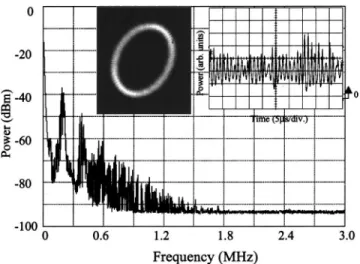
First we used an output coupler with the reflectivity of 98% in the laser resonator. Near lasing threshold, the laser emits a pure high-order SU共2兲 elliptical coherent mode with the standing waves in the azimuthal direction. The order of the elliptical mode can be easily varied by controlling the pump size. The eccentricity of the lasing elliptical mode mainly depends on the spot size and incident angle of the pump beam. The measurement of the optical spectrum evi-dences that the elliptical mode is a single-frequency emis-sion. In other words, the formation of the SU共2兲 elliptical mode can be interpreted as a spontaneous process of transverse-mode locking of the degenerate HG modes. Fig-ure 4 shows two typical experimental results for the near-field transverse pattern on the concave mirror and the power FIG. 2. The typical transverse patterns for the SU共2兲 elliptical
standing waves with N⫽30.
FIG. 3. Schematic of a fiber-coupled diode end-pumped laser; a typical pump profile of a fiber-coupled laser diode away from the focal plane.
spectrum. The elliptical patterns are found to be preserved in free-space propagation. The preservation of the elliptical pat-terns consists of the property that HG modes remain HG filed patterns as they propagate. The power spectra of the free-running elliptical modes, as shown in Fig. 4, display relaxation oscillations. The behavior of the time trace is also shown in the inset of Fig. 4. In class-B lasers, relaxation oscillations arise from the energy coupling between field and inversion because the population inversion population acts as a mean flow. Therefore, the relaxation oscillation is the dy-namic characteristics of the class-B laser in a single-mode operation. From the rate-equations analysis 关13兴, the relax-ation frequency is derived to be fr⫽
冑
2␥储(A⫺1)/(2), whereand␥储 are, respectively, the decay constants of theelectromagnetic field and of the population inversion, A ⫽Pin/ Pth is the amount by which threshold is exceeded.
Using the parameters for the present system (␥储
⬇104sec⫺1,⬇2.5⫻109sec⫺1, and A⬇1.03⬃1.05), the
re-laxation frequency is calculated to be 0.19–0.25 MHz. The range of the calculated relaxation frequency is consistent with the experimental values shown in Fig. 4. Note that the relaxation oscillations play an important role in complex dy-namics when the laser system is operated in multitransverse-mode emission or externally influenced共injection of external light, feedback, modulation of cavity losses兲.
Slightly above lasing threshold, a pair of elliptical modes ⌽N⫹(x,y ) and⌽N⫺(x,y ) is simultaneously emitted with cha-otic dynamics, as depicted in Fig. 5. Note that the elliptical modes ⌽N⫹(x,y ) and ⌽N⫺(x,y ) with the same longitudinal-mode index should be frequency degenerate without any per-turbation. However, there is still a certain astigmatism in the present cavity because of thermal lensing effect in the gain medium. The appearance of dynamic chaos is believed to arise from the interaction of the relaxation frequency and the astigmatism-induced frequency difference between the ellip-tical modes⌽N⫹(x, y ) and⌽N⫺(x, y ). The time trace shown in Fig. 5 reveals that the signal-to-noise ratio is close to unity. A nonlinear system of the Maxwell-Bloch equations关5,14兴 was used to investigate the dynamics of two like modes in a class-B laser. It is found that there is a chaotic set of solu-tions when the astigmatism-induced frequency difference is close to the relaxation frequency. Note that the system of equations for the dynamics of a class-B laser operating in two like modes is similar to the system describing generation of counterpropagating wave in a bidirectional ring class-B laser, as discussed in Refs. 关5,15,16兴. Therefore, the condi-tion for chaotic emission is also predicted in a bidireccondi-tional ring class-B laser关15兴.
The elliptical modes observed so far are linearly polarized along major axis. Increasing the reflectivity of the output coupler to 99%, we observed the appearance of the elliptical modes with the double ring, and the transverse patterns are linearly polarized along the orthogonal major and minor axes. Figure 6 depicts the polarization resolved patterns and the corresponding power spectra near lasing threshold. It can be seen that the transverse patterns of orthogonal polariza-tions have fundamentally different eccentricities. Although the two polarization modes are ideally degenerated in fre-quency, the thermally induced astigmatism may lift the de-generacy. Similar to the dynamics of two like modes in a class-B laser关5,14,17兴, chaos will appear when the frequency difference becomes of the order of the relaxation frequency. Since the corresponding patterns of different polarization are not degenerated in frequency, the total pattern in Fig. 6共a兲 is FIG. 4. Experimental results for the transverse patterns and
power intensity spectra of two SU共2兲 elliptical standing waves near lasing threshold. The time traces are shown in the insets.
FIG. 5. Experimental results for the transverse patterns and power intensity spectra of the elliptical mode at 1.25 times above threshold. The time trace is shown in the inset.
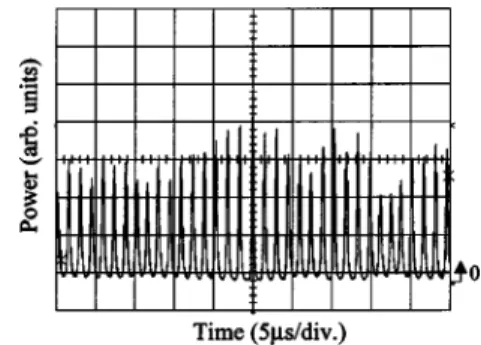
simply a superposition of the intensities in the orthogonal directions of polarization. As shown in Fig. 6, the broadening of the power spectra occurs in the total transverse pattern as well as the linearly polarized part. The typical behavior of the time trace is shown in Fig. 7. The large fluctuation in
time trace indicates that the interaction between the two el-liptical modes leads to the instability.
Finally, it is worthwhile to make a comparison between the present experiment and the experiment of Dingjan, van Exter, and Woerdman 关18兴. Both cases deal with off-axis pumping共a spot in the case of Ref. 关18兴, a ring in the present case兲, and observe single-frequency emission of HG locked modes. The ratio of the transverse frequency spacing to lon-gitudinal frequency spacing⌬T/⌬L is 1/4 in case of Ref. 关18兴; however, it is 1/30 in the present case. The frequency locking in Ref.关18兴 occurs among different transverse orders with the help of different longitudinal orders, while here it occurs within the same family of transverse modes operating in a single-longitudinal mode. Self-organization, resulting from the frequency locking of two different families of trans-verse modes, has also been reported in a CO2 laser关19兴.
IV. CONCLUSIONS
We have experimentally studied the formation of the SU共2兲 elliptical modes in a spherical cavity by using a doughnut pump profile to excite an isotropic microchip laser. The experimental results show that an infinitesimal imperfec-tion in the symmetry leads to the elliptic modes near thresh-old to be the azimuthal standing waves. It is found that the formation of the SU共2兲 elliptical modes is a spontaneous process of transverse-mode locking within almost-degenerated mode families, and a large transverse-mode spacing is essential. Increasing the reflectivity of the output coupler, we observe the appearance of the double-ring ellip-tical mode and a chaotic relaxation oscillation.
ACKNOWLEDGMENT
The authors thank the National Science Council for their financial support of this research under Contract No. NSC-91-2112-M-009-030.
关1兴 H. Kogelnik and T. Li, Appl. Opt. 5, 1550 共1966兲.
关2兴 S. Flu¨gge, Practical Quantum Mechanics 共Springer-Verlag, New York, 1971兲, p. 107.
关3兴 Y. F. Chen, T. M. Huang, C. F. Kao, C. L. Wang, and S. C. Wang, IEEE J. Quantum Electron. 33, 1025共1997兲.
关4兴 H. Laabs and B. Ozygus, Opt. Laser Technol. 28, 213 共1996兲. 关5兴 Y. F. Chen and Y. P. Lan, Phys. Rev. A 63, 063807 共2001兲. 关6兴 E. Schro¨dinger, Naturwissenschaften 14, 644 共1926兲. 关7兴 F. Steiner, Physica B & C 151, 323 共1988兲.
关8兴 W. M. Zhand, D. H. Feng, and R. Gilmore, Rev. Mod. Phys. FIG. 6. Experimental results for the polarization resolved
pat-terns and the corresponding power spectra near lasing threshold.
FIG. 7. The typical behavior of the time trace corresponding to the power spectrum shown in Fig. 6.