Corresponding author: Lin-Li Chang, Department of Microbiology, Kaohsiung Medical University, 100 Shih-Chuan 1st Road, Kaohsiung
807, Taiwan, ROC. E-mail: [email protected]; [email protected] *These two authors have equal contributions to this work.
Received: December 30, 2010; Revised: January 21, 2011; Accepted: February 18, 2011.
2011 by The Chinese Physiological Society and Airiti Press Inc. ISSN : 0304-4920. http://www.cps.org.tw
Potential Role of CCND1 G870A Genotype as a
Predictor for Urothelial Carcinoma
Susceptibility and Muscle-Invasiveness
in Taiwan
Hui-Hui Lin1, 2, Hung-Lung Ke1, 3, Kuang-Hung Hsiao1, 2, Chia-Wen Tsai5, Wen-Jeng Wu3, 4, Da-Tian Bau5, 6, *, and Lin-Li Chang1, 2, *
1Graduate Institute of Medicine, College of Medicine, Kaohsiung Medical University, Kaohsiung 2Department of Microbiology, Kaohsiung Medical University, Kaohsiung
3Department of Urology, Kaohsiung Medical University Hospital, Kaohsiung Medical University,
Kaohsiung
4Department of Urology, College of Medicine, Kaohsiung Medical University, Kaohsiung 5Terry Fox Cancer Research Laboratory, China Medical University Hospital, Taichung
and
6Graduate Institutes of Clinical Medical Science, China Medical University, Taichung
Taiwan, Republic of China
Abstract
The cell cycle regulator cyclin D1 (CCND1) is thought to play a major role in the transition of cell cycle from G1 to S phase. It is known that a common CCND1 G870A genotype is associated with bladder cancer in Japan and China, but not in the Western World. There is neither a report about its role in Taiwan’s population, nor its genetic role of CCND1 G870A in another worldwide urothelial cancer, upper tract urothelial cancer (UTUC). Therefore, we aimed at investigating the role of CCND1 G870A in both bladder cancer and UTUC in Taiwanese cohorts. The CCND1 G870A genotypes of 171 (101 bladder cancer and 70 UTUC) patients and 243 control subjects were determined by PCR-RFLP and their correlation with clinical and histopathological data was evaluated. The genotype analysis results showed that CCND1 GG genotype was associated with a lower risk overall in urothelial (P = 0.008, OR = 0.44, 95% CI = 0.24-0.81) and bladder cancer patients (P = 0.008, OR = 0.34, 95% CI = 0.15-0.76) than those of the AA genotype. In addition, patients carrying the AG genotype had a 0.29-fold lower odds ratio of muscle-invasive cancer procession (95% CI = 0.12-0.70) compared with those carrying the AA genotype in bladder cancer patients. Surprisingly, the GG genotype had a 5.88-fold higher odds ratio of muscle-invasive cancer procession (95% CI = 1.08-32.01) compared with those carrying the AA genotype in UTUC. No association between any CCND1 G870A genotype and higher-grade risk was found. Our results suggest that the G allele of the CCND1 G870A polymorphism may be a potential predictive and prognostic biomarker to distinguish between bladder cancer and UTUC in Taiwan. Key Words: CCND1 G870A, cyclin D1, polymorphism, urothelial carcinoma, bladder cancer, upper
tract urothelial cancer
Introduction
Cancers of the urinary system are among the most frequent malignancies worldwide. Amongst them, kidney and bladder cancers are more common. Renal cell carcinoma (RCC), accounting for the majority of kidney neoplasms, and transitional cell carcinoma (TCC) of the bladder and upper tract, are the fourth most frequent malignancy in males (15). In the West and Taiwan, the incidence ratios for TCC of the pelvis, ureter and bladder, are quite different. It is 3:1:51 in the West and 1:2.08:6.72 in Taiwan (8, 32). Upper tract urothelial cancer (UTUC) is rela-tively rare in the West and the unusually high inci-dences of UTUC in Taiwan make it valuable to study the high prevalence in Taiwan and the comparison of the counterpart findings in Western populations. In Taiwan, the increased incidence of UTUC may be associated with arsenic exposure, smoking, analgesics abuse, occupational carcinogens, hypertension, long standing urinary obstructions, infection and Balkan nephropathy (7, 19-23). A recent study has provided evidence that genetic polymorphisms may also pre-dispose the development of cancer disease (24).
Cyclin D1 (CCND1) is a key regulator of G1-S cell cycle progression; overexpression of cyclin D1 is implicated in the etiology of several cancers including TCC of the bladder (27, 30, 33). In addition, CCND1 was thought to play an important role in the early stage of urothelial tumorigenesis and has been shown to correlate with early recurrence, tumor differentia-tion and clinical outcome in bladder cancer (18, 28). The CCND1 gene is located on human chromosome 11q13. Polymorphism in CCND1 with a common G to A substitution at nucleotide polymorphism G870A in exon 4 of the gene has been described in 1995 (4). In recent years, several studies showed that the
CCND1 870 AA genotype was associated with an
in-creased risk and it has influenced the outcome for bladder cancer (9, 14, 16, 26, 31, 34). However, there is no literature investigating another type of urothelial cancer, UTUC.
Thus, this study aimed at exploring the associa-tion between the CCND1 G870A genotype and the susceptibility of urothelial carcinoma, including both bladder cancer and UTUC, and the correlation of the
CCND1 G870A genotype with clinicopathological
outcomes in Taiwan.
Materials and Methods
Study Population and Clinicopathological Data Collection
A total of 171 (101 bladder cancer and 70 UTUC) patients with TCC were recruited at Kaohsiung
Medical University medical center from Jan 2006 to Dec 2007; all the patients were diagnosed with urothelial cancer by pathologic examination of speci-mens obtained by biopsy or surgical resection. The clinical and histopathologic information and cigarette smoking history were collected from patient charts and pathologic reports. The information was reviewed, and the data were entered into a database. The tumor stage was assigned according to the TNM staging system (12), and the pathologic grade was determined according to the World Health Organization criteria (10). Two hundred and forty-three healthy individuals, who had been matched with the patients by age and admitted to the same hospital for health checkup and had no previous diagnosis of urologic neoplastic disease or other malignancies, were enrolled as controls. However, no information on smoking status was obtained in the control subjects. During the recruitment period, all the subjects enrolled were provided the informed consent and this study was approved by the Human Research Committees of the participating hospitals. This study had also been reviewed by the Institutional Review Board (IRB) of Kaohsiung Medical University with the approval number KMU-IRB-950195.
Genotyping Conditions
Genomic DNA for analysis was extracted from blood specimens using proteinase K digestion fol-lowed by phenol-chloroform extraction as described previously (6). Genotyping for CCND1 G870A of all subjects was carried out by polymerase chain reaction-restriction fragment length polymorphism (PCR-RFLP) assays (1-3). The 167-bp fragments containing the polymorphic nucleotide were amplified using the forward primer 5’-GTGAAGTTCATTTCCAATCCGC-3’ and the reverse primer 5’-GGGACATCACCCTCACTTAC-3’. The following cycling conditions were performed: 5 min of initial denaturation at 95°C, 35 cycles of 30 sec of denaturation at 95°C, 30 sec of annealing at 54°C and 1 min of elongation at 72°C, and 7 min of final extension at 72°C. The PCR products were further digested with HaeIII (New England, Biolabs, Beverly, MA USA), and visualized by ethidium bromide-stained 3% agarose gel electrophoresis under UV light. On digestion with ScrFI, the PCR product arising from the A allele was uncut (167 bp), whereas the G allele was cut into fragments of 145 bp and 22 bp (Fig. 1). Sequences were confirmed by direct sequencing of 10% of the PCR samples, and the results were 100% concordant.
Statistical Analysis
representa-tive of the general population and to exclude the possibility of genotyping errors, the deviation of the genotype frequencies of CCND1 single-nucleotide polymorphisms in the control subjects from those expected under the Hardy-Weinberg equilibrium was assessed using the goodness-of-fit test. Pearson’s Chi-square test or Fisher’s exact test (when the ex-pected number in any cell was less than five) was used to compare the distribution of the CCND1 geno-types between cases and controls. Cancer risk as-sociated with the genotypes was estimated as odds ratio (ORs) and 95% confidence intervals (CIs) using unconditional logistic regression. Data were recog-nized as significant when the statistical two-tailed
P-value was less than 0.05.
Results
The genomic DNA obtained from 171 patients and 243 controls were subjected to genotype analysis
of the CCND1 G870A polymorphism, and the CCND1 G870A genotypes are presented in Table 1. The rationale and electrophoregram of PCR-RFLP of
CCND1 G870A are also presented in Fig. 1. Both
allele distribution frequencies of the patient and the control groups fitted the Hardy Weinberg equilibrium. Compared with the CCND1 G870A AA genotype, patients with the GG genotype tended to have 0.44-fold risk of urothelial cancer (P = 0.008; OR = 0.44, 95% CI = 0.24-0.81). Patients with the AG + GG genotype also had a significant 0.65-fold risk of urothelial cancer compared with individuals with the AA genotype (P = 0.039; OR = 0.65, 95% CI = 0.43-0.98). It seems that the G allele is a protective genetic factor for urothelial cancer. We further divided the patients into bladder cancer and UTUC subgroups and reevaluated their risks of urothelial cancer. In-terestingly, bladder cancer patients with the GG genotype tended to have further lower risk of urothelial cancer (P = 0.008; OR = 0.34, 95% CI = 0.15-0.76) compared with those with the AA type. But this trend was not observed in the UTUC patients (Table 1).
The association of CCND1 G870A genotypes with pathological characteristics in both bladder cancer and UTUC patients is presented in Table 2. The first stratification parameter is the muscle-invasion issue. Clinically, the muscle-invasive and non-muscle invasive types of urothelial cancer, mainly determined by pathological findings, may differ greatly in their etiology and clinical outcomes such as recurrence, progression and patient survival. Take bladder cancer for instance, numerous factors are involved in the recurrence, progression and patient survival rates environmentally and hereditarily (13). However, the genetic factors are largely unknown. Our data showed that when compared with the AA genotype, subjects of the AG genotype were of lower risk for muscle invasiveness (P = 0.009; OR = 0.29, 95% CI = 0.12-0.70) in bladder cancer. On the con-trary, subjects of the GG genotype were of higher risk for muscle invasiveness (P = 0.039; OR = 5.88, 95% CI = 1.08-32.01) in UTUC, also in comparion with the AA genotype (Table 2). Second, patients
Table 1. Characteristics and CCND1 G870A genotypes among bladder cancer, upper tract urothelial cancer cases and healthy controls
CCND1 Control All Cases OR (95% CI) P-value Bladder OR (95% CI) P-value Upper OR (95% CI) P-value
genotype (n = 243) (n = 171) (n = 101) (n = 70)
AA 78 72 1.000 (Ref) 42 1.000 (Ref) 30 1.000 (Ref)
AG 116 79 0.74 (0.48~1.13) 0.189 50 0.80 (0.49~1.32) 0.442 29 0.81 (0.42~1.56) 0.176 GG 49 20 0.44 (0.24~0.81)* 0.008* 9 0.34 (0.15~0.76)* 0.008* 11 0.58 (0.27~1.27) 0.194 AG+GG 165 99 0.65 (0.43~0.98)* 0.039* 59 0.66 (0.41~1.07) 0.107 40 0.63 (0.37~1.09) 0.116 OR: odds ratio, 95% CI: 95% confidence interval, Ref: reference. *: statistical significant
Fig. 1. (a) Restriction map of CCND1 G870A genotypes. On digestion with ScrFI, the PCR product arising from the G allele was cut into fragments of 145 bp and 22 bp, whereas the A allele was the uncut length of 167 bp. (b) Electrophoregram of PCR-RFLP of CCND1 G870A. Lane 1, 50-bp size marker; lane 2, the 167-bp PCR product; lane 3, a case of GA heterozygote; lane 4, GG heterozygote; lane 5, AA homozygote.
Marker 167 bp 145 bp 870 145 bp Genotype PCR GA GG AA 22 bp CCND1 22 bp ScrF1 digestible
Forward primer Reverse primer
(A)
with similar stage but different grades respond to treatment differently (17). Thus, all the patients of the early stage were genotyped and further stratified by their pathological stages and the risk was analyzed. The results showed that in both bladder cancer and UTUC, neither of the genotypes of CCND1 G870A was positively associated with muscle-invasive risk (Table 2).
Discussion
Cyclin D1 plays a critical role in the G1 to S transition phase of the cell cycle progression and is important for regulation of cell proliferation, dif-ferentiation and transcriptional control (29). Although intragenic somatic mutation of cyclin D1 in human diseases is rare, translocation, amplification and/or overexpression of the cyclin D1 gene are frequent events in selected tumor types. In the literature, the poly-morphism in the cyclin D1 locus that may affect splicing has been implicated in increased cancer risk and poor outcome has also been reported (16). Polymorphism in CCND1 with a common G to A substitution at nucleotide 870 in the splice donor region of exon 4 of the gene has been shown to be related with poor pro-gression in urothelial cancer (5, 25). In this study, we hypothesized that the CCND1 G870A polymorphism may be associated with the risk of urothelial cancer, and may be a predictor for cancer diagnosis. In addi-tion, we would be interested to know if the association could be further linked specifically to bladder cancer and/or UTUC. In the results, the GG genotype in CCND1 G870A was associated with a decreased risk for
urothe-lial cancer compared with the AA type. In addition, this was specifically observed in bladder cancer, not in UTUC (Table 1). Furthermore, the AG genotype was an interesting bi-directional predictor for muscle-invasiveness in urothelial cancers. The AG genotype in CCND1 G870A was associated with a decreased risk for muscle-invasive bladder cancer, while in UTUC it was associated with an increased risk for muscle invasion (Table 2). According to the information on the NCBI SNP website, the ratios of the CCND1 G870A allele frequency in populations of Taiwan and China are very similar (G/A = 44.0%/56.0% in our Taiwanese controls and G/A = 45.6/54.4% in China). The A allele seemed to be the major allele in Taiwan and China populations. However, the ratio of allele of the
CCND1 G870A frequency in the Japan population
is G/A = 61.1%/38.9%, quite different from the pre-viously described Asian populations. Interestingly, in Caucasian population, the G/A ratio is 48.3%/ 51.7%, similar to Taiwan and China populations. Therefore, validation of our findings in other popu-lations is warranted to understand the similarity and difference among various ethnic groups. Since the patients of UTUC were not easily collected, and the limited sample size could not exclude the possibility of false positive or false negative findings after the stratification, the potential role for the G allele in
CCND1 G870A as a diagnosis predictor may need to
be clarified in the future with a larger population. In 2002, Wang et al. firstly indicated the possi-bility that the CCND1 870 AA genotype confered elevated risk for bladder cancer in native Japanese people with more pronounced risk among non-smoking
Table 2. Association between different CCND1 G870A polymorphic genotypes and pathological characteristics in urothelial carcinoma
Bladder cancer Upper tract cancer
AA AG GG AA AG GG Stage Non-muscle invasive 20 38 5 17 13 2 Muscle invasive 22 12 4 13 16 9 OR 1 (Ref) 0.29* 0.73 1 (Ref) 1.61 5.88* 95% CI 0.12-0.70* 0.17-3.09 0.58-4.50 1.08-32.01* P-value 0.009* 0.727 0.439 0.039* Grade Lower grade 16 21 5 12 11 3 Higher grade 26 29 4 18 18 8 OR 1 (Ref) 0.85 0.49 1 (Ref) 1.09 1.78 95% CI 0.37-1.97 0.11-2.11 0.38-3.10 0.39-8.09 P-value 0.831 0.460 1.000 0.716
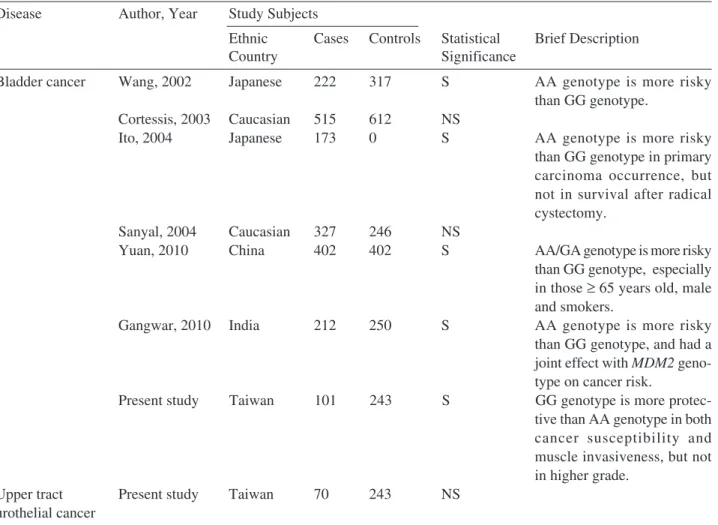
cases and for bladder cancer of higher grades and stages (31). Based on reexamination of their findings, Cortessis and his colleagues had shown negative findings in investigating a Caucasian population in California of USA in the following year (9). In 2004, Ito et al. (teammates of Wang) further examined the influence of CCND1 G870A genotypes on prognostic parameters such as the recurrence of superficial cancer and survival with invasive cancer rate (14). They found that in patients with superficial bladder cancer, the occurrence of primary carcinoma in situ was significantly greater in patients with the AA genotype compared with those with the GA or GG genotypes (14). Almost at the same time, Sanyal and his colleagues conducted a case-control study investigating the roles of genotypes of several genes involved in DNA repair, metabolism and cell cycle regulation in a moderately sized popu-lation of Caucasians. In their study, no significant differences for genotype distributions and allele frequencies of CCND1 G870A between the bladder cancer cases and the controls were observed (26). In
2010, Yuan and his colleagues had collected a moderate size case-control sample population in Nanjing city in China and had examined the contribution of CCND1 G870A genotyping to the etiology of bladder cancer in China (34). In their study, a significantly increased risk of bladder cancer was associated with 1.54-fold increased risk for those with GA/AA genotypes of
CCND1 G870A compared with the GG genotype,
particularly among subgroups of age ≥ 65 years, male smokers. Furthermore, the G870A polymorphism was significantly associated with the risk of developing superficial grade 1 bladder cancer (34). In 2010, Gangwar and his colleagues conducted a similar study in North India and found that the AA genotype of
CCND1 G870A was associated with higher risk in
intermediate bladder cancer stage and in smokers. The combined genotype of MDM2 T309G and CCND1 G870A can be a predictor for bladder cancer risk (11). All the above findings investigated the genetic role of
CCND1 G870A in bladder cancer, but not in UTUC.
In addition, none of them investigatied the Taiwanese
Table 3. Summary of reports investigating the role of CCND1 G870A polymorphic genotypes in urothelial carcinomas
Disease Author, Year Study Subjects
Ethnic Cases Controls Statistical Brief Description
Country Significance
Bladder cancer Wang, 2002 Japanese 222 317 S AA genotype is more risky than GG genotype.
Cortessis, 2003 Caucasian 515 612 NS
Ito, 2004 Japanese 173 0 S AA genotype is more risky
than GG genotype in primary carcinoma occurrence, but not in survival after radical cystectomy.
Sanyal, 2004 Caucasian 327 246 NS
Yuan, 2010 China 402 402 S AA/GA genotype is more risky
than GG genotype, especially in those ≥ 65 years old, male and smokers.
Gangwar, 2010 India 212 250 S AA genotype is more risky
than GG genotype, and had a joint effect with MDM2 geno-type on cancer risk.
Present study Taiwan 101 243 S GG genotype is more protec-tive than AA genotype in both cancer susceptibility and muscle invasiveness, but not in higher grade.
Upper tract Present study Taiwan 70 243 NS
urothelial cancer
population, which is genetically highly homogenous and conserved, and Taiwanese patients suffering from serious bladder cancer and UTUC. The inconsistence among them may mainly be due to different ethnicities in various genetic backgrounds, environmental ex-posures and diet cultures under investigation. All the previous findings together with ours may be taken as a provisional conclusion that the variant 870GA/AA genotypes are associated with an increased risk of bladder cancer in Asians (China, Japan and Taiwan), but not in Caucasians. All the literature investigating the genetic role of CCND1 G870A were summarized in Table 3 for comparison.
Bladder cancer and UTUC can be of two types, the non-muscle invasive and the muscle-invasive types, depending on pathological findings. Recur-rence and progression are the most serious risks following treatment of the former, whereas local invasion and distant metastasis are life-threatening in patients with the latter. It is interesting that the genotype of CCND1 G870A can be a prognosis for both bladder cancer and UTUC in Taiwan but can also predict a different cancer progression outcome for bladder cancer (AG for a lower risk for muscle invasiveness), and UTUC (GG for a higher risk for muscle invasiveness) (Table 2). The limited and not easily collected sample size provided us with the biphasic but interesting results in this pilot study; our results should be re-examined in a larger population for confirmation.
It has been known that the CCND1 870 AA genotype influences the alternatively spliced forms of the CCND1 mRNA and produces variant transcript-b (4). The transcript-transcript-b may have a longer half-life since it lacks the PEST (praline-serine-threonine)-rich region for rapid degradation (25) and, hence, may alter the normal regulation of the cell cycle. Under such circumstances, the CCND1 A allele could exert alterations of the behavior of the cancer cells during different stages of carcinogenesis. In this paper, we found that the CCND1 G870A was asso-ciated with urothelial cancer, and specifically with bladder cancer. In different microenvironments, the overall effects of this subtle polymorphism may cause different muscle-invasive susceptibilities to bladder cancer (protective) and UTUC (risky).
In conclusion, the results of this study suggested that CCND1 G870A GG genotype was positively associated with a lower risk of urothelial cancer, es-pecially with bladder cancer. In addition, AG het-erozygous patients of bladder cancer were of a lower risk and the GG homozygous patients of UTUC were of a higher risk for muscle-invasiveness, respectively. These findings suggested that G allele could be an interesting predictor in lower urothelial, especially bladder, cancer susceptibilities and
muscle-inva-siveness with a biphasic cancer progression in bladder cancer (protective) and UTUC (risky).
Acknowledgment
The work was supported by a grant from the Kaohsiung Medical University Hospital (KMUH 5D-43).
References
1. Bau, D.T., Hsieh, Y.Y., Wan, L., Wang, R.F., Liao, C.C., Lee, C.C., Lin, C.C., Tsai, C.H. and Tsai, F. J. Polymorphism of XRCC1 codon Arg 399 Gln is associated with higher susceptibility to endometriosis. Chinese J. Physiol. 50: 326-329, 2007.
2. Bau, D.T., Tsai, M.H., Huang, C.Y., Lee, C.C., Tseng, H.C., Lo, Y.L., Tsai, Y. and Tsai, F.J. Relationship between polymorphisms of nucleotide excision repair genes and oral cancer risk in Taiwan: evidence for modification of smoking habit. Chinese J. Physiol. 50: 294-300, 2007.
3. Bau, D.T., Wang, H.C., Liu, C.S., Chang, C.L., Chiang, S.Y., Wang, R.F., Tsai, C.W., Lo, Y.L., Hsiung, C.A., Lin, C.C. and Huang, C.Y. Single-nucleotide polymorphism of the Exo1 gene: association with gastric cancer susceptibility and interaction with smoking in Taiwan. Chinese J. Physiol. 52: 411-418, 2009. 4. Betticher, D.C., Thatcher, N., Altermatt, H.J., Hoban, P., Ryder,
W.D. and Heighway, J. Alternate splicing produces a novel cyclin D1 transcript. Oncogene 11: 1005-1011, 1995.
5. Burch, J.D., Rohan, T.E., Howe, G.R., Risch, H.A., Hill, G.B., Steele, R. and Miller, A.B. Risk of bladder cancer by source and type of tobacco exposure: a case-control study. Int. J. Cancer 44: 622-628, 1989.
6. Chang, L.L., Yeh, W.T., Yang, S.Y., Wu, W.J. and Huang, C.H. Genetic alterations of p16INK4a and p14ARF genes in human bladder cancer. J. Urol. 170: 595-600, 2003.
7. Chen, C.J., Hsueh, Y.M., Lai, M.S., Shyu, M.P., Chen, S.Y., Wu, M.M., Kuo, T.L. and Tai, T.Y. Increased prevalence of hyperten-sion and long-term arsenic exposure. Hypertenhyperten-sion 25: 53-60, 1995.
8. Chou, Y.H. and Huang, C.H. Unusual clinical presentation of upper urothelial carcinoma in Taiwan. Cancer 85: 1342-1344, 1999.
9. Cortessis, V.K., Siegmund, K., Xue, S., Ross, R.K. and Yu, M.C. A case-control study of cyclin D1 CCND1 870A—>G polymor-phism and bladder cancer. Carcinogenesis 24: 1645-1650, 2003. 10. Epstein, J.I., Amin, M.B., Reuter, V.R. and Mostofi, F.K. The World Health Organization/International Society of Urological Pathology consensus classification of urothelial (transitional cell) neoplasms of the urinary bladder. Bladder Consensus Conference Committee. Am. J. Surg. Pathol. 22: 1435-1448, 1998. 11. Gangwar, R. and Mittal, R.D. Association of selected variants
in genes involved in cell cycle and apoptosis with bladder can-cer risk in North India population. DNA Cell Biol. 29: 349-356, 1986.
12. Greene, F.L., Page, D.L. and Fleming, I. D. AJCC Cancer Staging
Manual, 6 ed. Springer-Verlag, New York, 2002.
13. Hirao, Y., Kim, W.J. and Fujimoto, K. Environmental factors promoting bladder cancer. Curr. Opin. Urol. 19: 494-499, 2009. 14. Ito, M., Habuchi, T., Watanabe, J., Higashi, S., Nishiyama, H., Wang, L., Tsuchiya, N., Kamoto, T. and Ogawa, O. Polymorphism within the cyclin D1 gene is associated with an increased risk of carcinoma in situ in patients with superficial bladder cancer.
Urology 64: 74-78, 2004.
15. Jemal, A., Tiwari, R.C., Murray, T., Ghafoor, A., Samuels, A., Ward, E., Feuer, E.J. and Thun, M.J. Cancer statistics, 2004.
CA-Cancer J. Clin. 54: 8-29, 2004.
16. Knudsen, K.E., Diehl, J.A., Haiman, C.A. and Knudsen, E.S. Cyclin D1: polymorphism, aberrant splicing and cancer risk.
Oncogene 25: 1620-1628, 2006.
17. Larsson, P., Wijkstrom, H., Thorstenson, A., Adolfsson, J., Norming, U., Wiklund, P., Onelov, E. and Steineck, G. A population-based study of 538 patients with newly detected urinary bladder neo-plasms followed during 5 years. Scand. J. Urol. Nephrol. 37: 195-201, 2003.
18. Lee, C.C., Yamamoto, S., Morimura, K., Wanibuchi, H., Nishisaka, N., Ikemoto, S., Nakatani, T., Wada, S., Kishimoto, T. and Fukushima, S. Significance of cyclin D1 overexpression in transi-tional cell carcinomas of the urinary bladder and its correlation with histopathologic features. Cancer 79: 780-789, 1997. 19. Liaw, K.L., Linet, M.S., McLaughlin, J.K., Yu, M.C., Schoenberg,
J.B., Lynch, C.F., Niwa, S. and Fraumeni, J.F., Jr. Possible relation between hypertension and cancers of the renal pelvis and ureter.
Int. J. Cancer 70: 265-268, 1997.
20. Linet, M.S., Chow, W.H., McLaughlin, J.K., Wacholder, S., Yu, M.C., Schoenberg, J.B., Lynch, C. and Fraumeni, J.F., Jr. Analge-sics and cancers of the renal pelvis and ureter. Int. J. Cancer 62: 15-18, 1995.
21. Mahony, J.F., Storey, B.G., Ibanez, R.C. and Stewart, J.H. Analge-sic abuse, renal parenchymal disease and carcinoma of the kidney or ureter. Aust. N. Z. J. Med. 7: 463-469, 1977.
22. McLaughlin, J.K., Silverman, D.T., Hsing, A.W., Ross, R.K., Schoenberg, J.B., Yu, M.C., Stemhagen, A., Lynch, C.F., Blot, W.J. and Fraumeni, J.F., Jr. Cigarette smoking and cancers of the renal pelvis and ureter. Cancer Res. 52: 254-257, 1992. 23. Mellemgaard, A., Carstensen, B., Norgaard, N., Knudsen, J.B. and
Olsen, J.H. Trends in the incidence of cancer of the kidney, pelvis, ureter and bladder in Denmark 1943-88. Scand. J. Urol. Nephrol. 27: 327-332, 1993.
24. Reznikoff, C.A., Sarkar, S., Julicher, K.P., Burger, M.S., Puthenveettil, J.A., Jarrard, D.F. and Newton, M.A. Genetic alterations and biological pathways in human bladder cancer pathogenesis. Urol. Oncol. 5: 191-203, 2000.
25. Rogers, S., Wells, R. and Rechsteiner, M. Amino acid sequences
common to rapidly degraded proteins: the PEST hypothesis.
Science 234: 364-368, 1986.
26. Sanyal, S., Festa, F., Sakano, S., Zhang, Z., Steineck, G., Norming, U., Wijkstrom, H., Larsson, P., Kumar, R. and Hemminki, K. Polymorphisms in DNA repair and metabolic genes in bladder cancer. Carcinogenesis 25: 729-734, 2004.
27. Sgambato, A., Migaldi, M., Faraglia, B., De Aloysio, G., Ferrari, P., Ardito, R., De Gaetani, C., Capelli, G., Cittadini, A. and Trentini, G.P. Cyclin D1 expression in papillary superficial bladder cancer: its association with other cell cycle-associated proteins, cell prolif-eration and clinical outcome. Int. J. Cancer 97: 671-678, 2002. 28. Shin, K.Y., Kong, G., Kim, W.S., Lee, T.Y., Woo, Y.N. and Lee,
J.D. Overexpression of cyclin D1 correlates with early recurrence in superficial bladder cancers. Brit. J. Cancer 75: 1788-1792, 1997.
29. Stacey, D.W. Cyclin D1 serves as a cell cycle regulatory switch in actively proliferating cells. Curr. Opin. Cell Biol. 15: 158-163, 2003.
30. Suwa, Y., Takano, Y., Iki, M., Takeda, M., Asakura, T., Noguchi, S. and Masuda, M. Cyclin D1 protein overexpression is related to tumor differentiation, but not to tumor progression or prolifera-tive activity, in transitional cell carcinoma of the bladder. J. Urol. 160: 897-900, 1998.
31. Wang, L., Habuchi, T., Takahashi, T., Mitsumori, K., Kamoto, T., Kakehi, Y., Kakinuma, H., Sato, K., Nakamura, A., Ogawa, O. and Kato, T. Cyclin D1 gene polymorphism is associated with an increased risk of urinary bladder cancer. Carcinogenesis 23: 257-264, 2002.
32. Williams, C.B. and Mitchell, J.P. Carcinoma of the ureter—a review of 54 cases. Brit. J. Urol. 45: 377-387, 1973.
33. Yang, C.H., Hung, W.C., Wang, S.L., Kang, W.Y., Chen, W.T., Huang, Y.C., Su, Y.C. and Chai, C.Y. Immunoexpression and prognostic role of hTERT and cyclin D1 in urothelial carcinoma.
APMIS 116: 309-316, 2008.
34. Yuan, L., Gu, X., Shao, J., Wang, M., Zhu, Q. and Zhang, Z. Cyclin D1 G870A polymorphism is associated with risk and clinico-pathologic characteristics of bladder cancer. DNA Cell Biol. 29: 611-617, 2010.