Contents lists available atScienceDirect
Journal of Chromatography A
j o u r n a l h o m e p a g e :w w w . e l s e v i e r . c o m / l o c a t e / c h r o m aUsing the cationic surfactants N-cetyl-N-methylpyrrolidinium bromide and
1-cetyl-3-methylimidazolium bromide for sweeping–micellar
electrokinetic chromatography
Hsiu-Li Su, Min-Tsu Lan, You-Zung Hsieh
∗ Department of Applied Chemistry, National Chiao Tung University, Hsinchu, Taiwana r t i c l e i n f o
Article history:
Received 30 October 2008
Received in revised form 27 April 2009 Accepted 5 May 2009
Available online 12 May 2009
Keywords: Sweeping–MEKC N-cetyl-N-methylpyrrolidinium bromide 1-Cetyl-3-methylimidazolium bromide Benzodiazepines
a b s t r a c t
This paper describes a sweeping–micellar electrokinetic chromatography (sweeping–MEKC) tech-nique for the determination of seven benzodiazepines, using, as sweeping carriers, the ionic liquid-type cationic surfactants 1-cetyl-3-methylimidazolium bromide (C16MIMBr) and
N-cetyl-N-methylpyrrolidinium bromide (C16MPYB). These surfactants resemble the commonly employed cationic
surfactant cetyltrimethylammonium bromide (CTAB), but they provide different separation efficien-cies. We optimized the separation and sweeping conditions, including the pH, the concentrations of organic modifier and surfactant, and the sample injection volume. Adding C16MIMBr or C16MPYB to
the background electrolyte enhanced the separation efficiency and detection sensitivity during the sweeping–MEKC analyses of the benzodiazepines. C16MIMBr enhanced the sensitivity for each
benzo-diazepine 31–59-fold; C16MPYB, 86–165-fold. In the presence of C16MPYB, the limits of detection for the
seven analytes ranged from 4.68 to 9.75 ng/mL. We adopted the sweeping–MEKC conditions optimized for C16MPYB to satisfactorily analyze a human urine sample spiked with the seven benzodiazepines. To
minimize the matrix effects, we subjected this urine sample to off-line solid phase extraction (SPE) prior to analysis. The recoveries of the analytes after SPE were satisfactory (ca. 77.0–88.3%). Our experimental results reveal that the cationic surfactant C16MPYB exhibits superior sweeping power relative to those of
C16MIMBr and CTAB and that it can be applied in sweeping–MEKC analyses for the on-line concentrating
and analyzing of benzodiazepines present in real samples at nanogram-per-milliliter concentrations. © 2009 Elsevier B.V. All rights reserved.
1. Introduction
Ionic liquids (ILs) are a class of nonmolecular ionic solvents with melting points fixed at or below 100◦C. They are called room tem-perature ILs (RTILs) if the melting points of ILs are below room temperature (ca. 25◦C)[1]. ILs usually contain bulky nitrogen- or phosphorous-centered organic cations and inorganic or organic counteranions[2]. ILs can be regarded as designer solvents because the choice of anion and cation affects their properties[3]. Although ILs exhibit many of the properties of conventional organic solvents, including excellent solvation over a wide range of viscosities and temperature[4], their negligible vapor pressure and nonvolatility make them more useful in green chemistry applications[1].
A common feature of ILs involves a charged hydrophilic “head” group and one or more hydrophobic “tails”; such ILs resemble conventional surfactants [5] and, indeed, micelles form in solution when the ILs concentration exceeds the
criti-∗ Corresponding author. Tel.: +886 3 5731785; fax: +886 3 5723764.
E-mail address:[email protected](Y.-Z. Hsieh).
cal micelle concentration (CMC) [6–10]. Bowers et al. reported that ILs based on 1-alkyl-3-methylimidazolium salts behave just like short-chain cationic surfactants in aqueous solution; they used surface tension, conductivity, and small-angle neutron scattering (SANS) measurements to determine the aggrega-tion behavior of 1-butyl-3-methylimidazolium tetrafluoroborate (C4MIMBF4), 1-octyl-3-methylimidazolium chloride (C8MIMCl), and 1-octyl-3-methylimidazolium iodide (C8MIMI)[6]. Baker et al. studied the micellization of a homologous series of N-alkyl-N-methylpyrrolidinium bromides (CnMPYB; n = 10–18) and suggested
that these salts could constitute a new class of surfactants [7]. After Dong et al. studied micelle formation from the long-chain ILs C14MIMBr to C16MIMBr, they concluded that the CMCs of these imidazolium-based systems are considerably lower than those of typical cationic alkyltrimethylammonium (CnTAB)-based
surfac-tants, i.e., they form micelles more readily[10].
Micellar electrokinetic chromatography (MEKC) is a power-ful extension of capillary electrophoresis (CE) that allows the separation of mixtures of uncharged and/or charged compounds [11–13]. ILs have received much attention for their use in separa-tion science, and have been applied in recent years as additives 0021-9673/$ – see front matter © 2009 Elsevier B.V. All rights reserved.
tion and peak efficiency) because of their high conductivity, hydrophobicity, and solvating property [14–16]. Several groups have studied the separation mechanism that occurs in MEKC when ILs are added into the background electrolyte (BGE) containing surfactants. Borissova et al. introduced the surfactant 1-tetradecyl-3-methylimidazolium chloride into the BGE as a pseudostationary phase to successfully separate neutral analytes, such as methyl-resorcinol isomers and other benzene derivatives [15]. From a study of pyrrolidinium-based surfactants in MEKC, Schnee et al. found that the presence of CnMPYB micellar pseudophase
pro-vided highly efficient separations because the interactions of these less-hydrophobic surfactants with polar compounds are stronger than those of cetyltrimethylammonium bromide (CTAB), a commonly employed surfactant[16]. According to these find-ings, imidazolium- and pyrrolidinium-based surfactants appear to have great potential for application in MEKC and other analytical methods.
The rapidity, efficiency, and selectivity of CE make it a suit-able method for separating benzodiazepines. Although several groups have combined MEKC with sodium dodecyl sulfate (SDS) micelles to determine benzodiazepines[17–19], the short optical path length for UV detection usually results in poor sensitivity. Quirino and Terabe developed sweeping–MEKC as an on-line pre-concentration technique that improves the sensitivity of MEKC [20,21]. In sweeping–MEKC, a surfactant is added to the BGE at a concentration above its CMC. The sensitivity enhancement depends upon the analyte’s retention factor, the ratio of the number of solute species in the micellar phase to that in the aqueous phase[22]. The most widely used surfactants in sweeping–MEKC are anionic (e.g., SDS)[23], cationic (e.g., CTAB)[24], nonionic[25], and polymeric [26]surfactants.
In this paper, we report the use of IL-type cationic surfactants as sweeping carriers for the pre-concentration of benzodi-azepines during the sweeping–MEKC process. We investigated 1-cetyl-3-methylimidazolium bromide (C16MIMBr) and
N-cetyl-N-methylpyrrolidinium bromide (C16MPYB) as sweeping cationic surfactants because (i) imidazolium- and pyrrolidinium-based sur-factants both possess favorable micellar properties[7,10]and (ii) of the known IL-type surfactants, they exhibit micelle characteristics most similar to those of the surfactant CTAB (e.g., an ammonium head group and a 16-carbon linear hydrocarbon tail), while dis-playing different separation selectivities when applied to MEKC. We compared C16MIMBr and C16MPYB with CTAB, for their abilities to pre-concentrate benzodiazepines, predicting that these IL-type surfactants would display sweeping powers that would enhance the sensitivity of on-line concentration techniques. To test the sweeping efficiencies of C16MIMBr and C16MPYB, we employed them to determine the optimal separation and sweeping conditions for the analyses of seven benzodiazepines using sweeping–MEKC. We then applied the optimized method to analyze SPE-treated benzodiazepine-spiked human urine samples.
2. Experimental
2.1. Chemicals
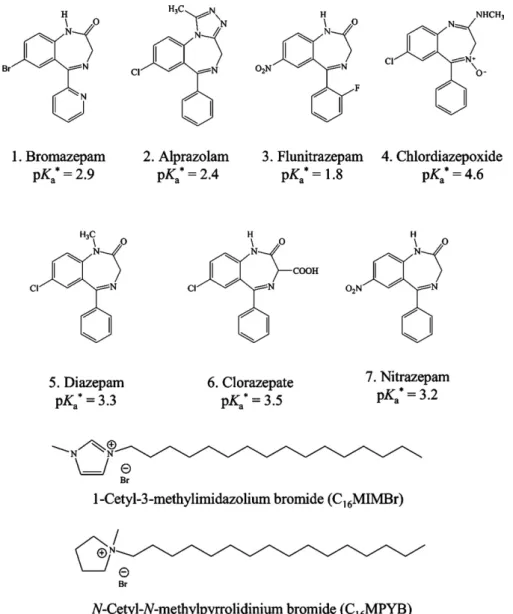
All reagents and chemicals used were of analytical grade. Diazepam (MW = 284.7 g/mol), clorazepate (MW = 408.9 g/mol), chlordiazepoxide (MW = 336.2 g/mol), bromazepam (MW = 316.2 g/mol), nitrazepam (MW = 281.3 g/mol), alprazeolam (MW = 308.8 g/mol), and flunitrazepam (MW = 313.3 g/mol) standards were obtained from Sigma–Aldrich (St. Louis, MO, USA); their chemical structures are presented in Fig. 1. Borax (Na2B4O7·10 H2O), hydrochloric acid (HCl), ammonium hydroxide (NH4OH),
2-Sigma–Aldrich. 1-Methylimidazole (99%), 1-bromohexadecane (C16H33Br, 99%), and 1-methylpyrrolidine (98%) were obtained from Acros Organics (Geel, Belgium). Disodium hydrogenphos-phate (Na2HPO4), cetyltrimethylammonium bromide (CTAB), and sodium hydroxide (NaOH) were acquired from Fluka (Buchs, Switzerland). Methanol was purchased from Echo Chemical (Miaoli, Taiwan). Citric acid was obtained from Merck (Darm-stadt, Germany). Ethyl acetate was purchased from Grand Chemical (Bangkok, Thailand). Dichloromethane was obtained from Tedia (Fairfield, Ohio, USA). Deionized water was puri-fied through a Millipore Milli-Q water system (Milford, MA, USA).
2.2. Apparatus
A Beckman P/ACE MDQ CE system (Fullerton, CA, USA) was used to effect the separations. A diode array detector was employed for detection. Separations were performed in a 50-cm (40 cm effective length)× 50-m I.D. fused silica capillary tube (Polymicro Tech-nologies, Phoenix, AZ, USA). The capillary tube was assembled in the cartridge format. 32 Karat software, running on a personal computer, controlled the P/ACE instrument and data analysis. Prior to actual procedure, the separation capillary was pre-conditioned sequentially with MeOH (10 min), 1 M HCl (10 min), deionized water (2 min), 1 M NaOH (10 min), and then deionized water again (2 min). In between runs of the sweeping–MEKC and MEKC modes, the capillary was flushed with the separation BGE (3 min).
2.3. Synthesis of C16MIMBr and C16MPYB
C16MIMBr was prepared according to Vanyúr’s procedure[27]. 1-Methylimidazole (0.15 mol) was mixed with 1-bromohexadecane (0.15 mol) in toluene for 24 h at 80◦C. The resulting salt was recrys-tallized from EtOAc three times to yield a white crystalline solid, which was dried in a vacuum container for 2 days prior to use. C16MPYB was synthesized using the procedure reported by Baker et al.[7]. A slight molar in excess of 1-bromohexadecane (100 g,
0.33 mol) was stirred in dropwise to 1-methylpyrrolidine (32 mL, 0.31 mol) at 0◦C. After 1 h, the mixture was slowly warmed to room temperature and stirred for an additional 12 h. The result-ing white solid was filtered off usresult-ing a cooled Büchner funnel and washed with cold EtOAc. Residual solvent was removed using rotary evaporation. The product was recrystallized three times more from acetone; the resulting white crystalline power was dried overnight in a vacuum oven at 40◦C. The synthesized C16MIMBr and C16MPYB were analyzed qualitatively using 1H NMR spectroscopy; their structures are displayed inFig. 1.
2.4. Preparing standards and urine samples
Stock standard solutions (1 mg/mL) of the seven benzodi-azepines were prepared in MeOH and refrigerated at 4◦C. Prior to analysis in the sweeping–MEKC mode, the stock solution was diluted with MeOH to 100g/mL. The working standard was then diluted with the 15 mM borate buffer (pH 9.0, 6 mL 0.05 M Na2B4O7·10H2O and 1.1 mL 0.1 M HCl diluted to 20 mL with H2O) to provide a conductivity similar to that of the BGE [15 mM borate buffer (pH 9.0) containing 30% MeOH and 20 mM surfactant] at the desired concentration. For the MEKC mode, the sample was diluted with MeOH to 50g/mL. No filtration was performed for the samples. Calibration curves were obtained after preparing solu-tions of the standards individually at 0.125, 0.25, 0.5, 1.0, 2.0, and 3.0g/mL for C16MIMBr and at 0.03, 0.1, 0.5, 1.0, 2.0, and 3.0g/mL for C16MPYB. Experiments were performed five times at each con-centration. Samples of human urine were collected and frozen at
Fig. 1. Molecular structures of the seven benzodiazepines and cationic surfactants C16MIMBr and C16MPYB.*Values of pKaare those of the conjugate acids of the
benzodi-azepines.
−20◦C; when required for an assay, they were thawed and warmed to room temperature.
2.5. Method procedures
The bare fused silica capillary was conditioned initially using a micellar BGE. In the MEKC procedure, samples were pressure-injected at 3.45 kPa for 3 s. The detection wavelength was set at 230 nm. The separation proceeded with the micellar BGE under a negative applied potential (−25 kV). In the sweeping–MEKC proce-dure, the capillary was initially filled with micellar BGE and then the samples were pressure-injected at 3.45 kPa for 120–420 s. Finally, a negative voltage (−25 kV) was applied to perform the sweeping process.
2.6. Solid phase extraction
Oasis®MCX column-type cartridges were obtained from Waters (Milford, MA, USA). The cartridges (3 mL/60 mg) were first con-ditioned with MeOH (2 mL) and H2O (2 mL). The loading sample was a drug-free urine sample (3 mL) spiked with seven 40L benzodiazepines (5g/mL) and 60 L citric acid/disodium hydro-genphosphate buffer (1 M, 3.2 mL 1 M citric acid and 3.4 mL 2 M
Na2HPO4 diluted to 10 mL with H2O); the pH was ca. 5.0. The concentration of benzodiazepines in the loading sample was 64.5 ng/mL. The column was washed sequentially with 0.1 M HCl (2 mL) and MeOH (2 mL). The elution solution was a mixture of dichloromethane, isopropyl alcohol, and sat. NH4OH (78:20:2, v/v); the mixture was dried in a stream of nitrogen gas[24]. For assaying, the residue was dissolved in a mixture of MeOH (10L) and 15 mM borate buffer (pH 9.0, 190L).
3. Results and discussion
3.1. Sweeping with IL-type cationic surfactants
We employed C16MIMBr and C16MPYB as cationic surfactants for sweeping–MEKC. The sweeping process began by filling the capil-lary with a micelles loaded BGE. A large volume of the analytes, which were prepared in a BGE lacking a cationic surfactant, was injected hydrodynamically into the capillary. When a BGE contain-ing a cationic surfactant fills a capillary column, the capillary walls become dynamically coated with the cation. The electroosmotic flow (EOF) within the capillary is then reversed when a sufficient surfactant concentration is reached. C16MIMBr and C16MPYB form
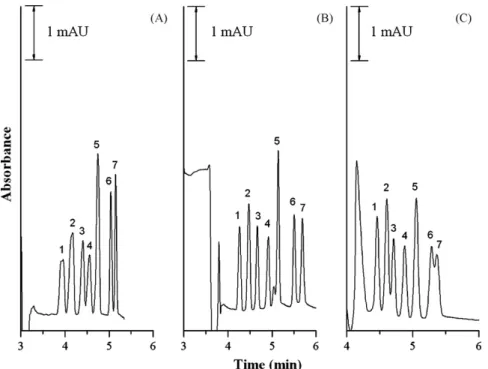
Fig. 2. Effect of (A) 20%, (B) 30%, and (C) 40% MeOH in the BGE on the sweeping–MEKC analyses. Sweeping–MEKC conditions: BGE, 15 mM borate (pH 9.0) containing
20 mM C16MPYB; sample injection at 3.45 kPa for 300 s; sample concentration, 1g/mL in BGE (without C16MPYB); separation voltage,−25 kV; detection at 230 nm; effective
capillary length, 40 cm. Peak identification: (1) bromazepam; (2) alprazeolam; (3) flunitrazepam; (4) chlordiazepoxide; (5) diazepam; (6) clorazepate; (7) nitrazepam. micelles at concentrations greater than 0.61 and 0.83 mM,
respec-tively[16,27]. In other words, when the concentrations of these surfactants were above their CMCs, we applied a reversed polar-ity voltage to perform MEKC sweeping and separation. When the micelles migrated through the sample zone in a direction opposite to that of the EOF, they effectively swept the analytes into a nar-row zone. Finally, the separation was continued and the analytes were carried by the micelles and the EOF to the detector. The suc-cess of the sweeping prosuc-cess relies on strong interactions between the analytes and the cationic surfactant micelles, and the potent interaction enhances the sweeping–MEKC analysis.
3.2. Optimizing sweeping conditions using C16MIMBr and C16MPYB
To obtain good separation and enhancement efficiencies with both C16MIMBr and C16MPYB, we studied the effects of several parameters of the sweeping–MEKC method, including the pH, the concentrations of the organic modifier and surfactant, and the injection time of the sample. Our attempts to optimize each of these conditions are described in detail below.
3.3. Effect of pH and organic modifier
In initial sweeping experiments, we inspected the influence of the BGE at pH 8.0, 9.0, and 10.0, where the analytes possess no net charge thus facilitating favorable interactions with the micelles. For both C16MIMBr and C16MPYB, the analyses of the seven ben-zodiazepines occurred with highest resolution at pH 9.0. Indeed, the analytes were not completely separated at pH 8.0 and 10.0. At pH 8.0–10.0, the changes in pH resulted in minor variations in the EOF, which affected the migration times and peak resolutions. For subsequent experiments, we chose a BGE with a pH of 9.0.
The effect of the organic modifier was the most important factor influencing the separation efficiency of present MEKC technique. In the absence of any organic modifier in the BGE, the seven benzodi-azepines migrated at the same velocity and could not be identified. Fig. 2displays the effect of MeOH in the BGE on the sweeping–MEKC
separation. When we added 20% MeOH to the BGE, the resolution was not ideal; increasing the BGE’s MeOH content to 30% improved the resolution, and lead to complete separation of the analytes. The resolution deteriorated when the BGE contained 40% MeOH. We suspect that the presence of the organic modifier increased the sol-ubility of the hydrophobic solutes in the aqueous phase, thereby affecting the retention factors of the analytes and the resolution of their separation. The optimal separation conditions for the BGEs containing C16MIMBr and C16MPYB were both achieved when 30% MeOH was added.
3.4. Effect of cationic surfactant
To evaluate their sweeping enhancements, we added C16MIMBr and C16MPYB individually to the BGEs at concentrations in the range of 10–40 mM. The analytes were not completely separated at a 10 mM concentration of either cationic surfactant. The best peak enhancement occurred, with no loss of separation efficiency, when the cationic surfactant concentration in the BGE was 20 mM. At 30 mM or greater, the peaks broadened, the resolution decreased, and the signal enhancement did not improve significantly. Sweep-ing occurred when the positively charged C16MIMBr and C16MPYB micelles interacted with the neutral analytes; the EOF migrated toward the outlet and the cationic micelles traveled toward the inlet in the reversed polarity mode. Therefore, an increase in the number of micelles would increase the migration time of the analyte. After comparing the separation efficiencies and peak enhancement fac-tors, we selected cationic surfactant concentrations of 20 mM for both C16MIMBr and C16MPYB.
Increasing the injection time of a sample should theoretically increase the peak signal of the analytes. Note, however, that the introduced volume is limited by the capillary length because a suf-ficient length of the capillary must be left free of sample solution for the separation to proceed after sweeping[28]. In this study, we varied the sample injection time from 120 to 420 s at 3.45 kPa. The peak heights of the seven benzodiazepines all increased until the injection time reached 300 s; beyond that point, the peak height
did not increase further either because of peak broadening or because the baseline separation was destroyed. Thus, the optimal injection time was determined to be 300 s at 3.45 kPa; it provided the highest separation resolution and maximum peak enhance-ment.
3.5. Sensitivity enhancements of C16MIMBr and C16MPYB
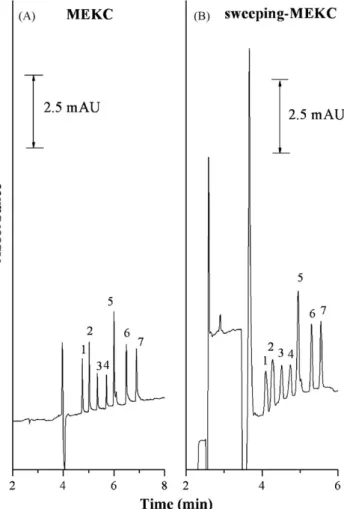
From the studies above, the optimal conditions for perform-ing sweepperform-ing–MEKC involved usperform-ing a 15 mM borate buffer (pH 9.0) containing 30% MeOH and 20 mM C16MIMBr or C16MPYB, with hydrodynamic injection of the sample at 3.45 kPa for 300 s. Figs. 3 and 4display the electropherograms obtained when using C16MIMBr and C16MPYB, respectively, as cationic surfactants in both the conventional MEKC and sweeping–MEKC methods for the analysis of the seven benzodiazepines. The analyte peak inten-sity was indeed enhanced using the sweeping–MEKC method with either C16MIMBr or C16MPYB as surfactant.Table 1reveals that the sensitivity enhancements for the sweeping–MEKC method, relative to conventional MEKC, were improved by factors of 31–59 for C16MIMBr and factors of 86–165 for C16MPYB. We sus-pect that C16MPYB interacts better with the benzodiazepines, thereby achieving its superior sweeping efficiency relative to that of C16MIMBr. We also used CTAB as a reference surfactant to
Fig. 3. Analyses of the seven benzodiazepines using (A) MEKC and (B)
sweeping–MEKC with C16MIMBr as the cationic surfactant. MEKC conditions: BGE,
15 mM borate (pH 9.0) containing 30% MeOH and 20 mM C16MIMBr; sample
injec-tion at 2.07 kPa for 3 s; sample concentrainjec-tion, 50g/mL; injection length, 0.9 mm. Sweeping–MEKC conditions: BGE, 15 mM borate (pH 9.0) containing 30% MeOH and 20 mM C16MIMBr; sample injection at 3.45 kPa for 300 s; sample concentration,
1g/mL in BGE (without C16MIMBr); injection length, 150 mm. Other conditions
were the same as those used to obtainFig. 2.
Fig. 4. Analyses of the seven benzodiazepines using (A) MEKC and (B)
sweeping–MEKC with C16MPYB as the cationic surfactant. MEKC conditions: BGE,
15 mM borate (pH 9.0) containing 30% MeOH and 20 mM C16MPYB; sample
injec-tion at 2.07 kPa for 3 s; sample concentrainjec-tion, 50g/mL; injection length, 0.9 mm. Sweeping–MEKC conditions: BGE, 15 mM borate (pH 9.0) containing 30% MeOH and 20 mM C16MPYB; sample injection at 3.45 kPa for 300 s; sample concentration,
1g/mL in BGE (without C16MPYB); injection length, 150 mm. Other conditions were
the same as those used to obtainFig. 2.
compare the sweeping efficiency with C16MIMBr and C16MPYB. Table 1 lists the optimized sweeping conditions for CTAB; we found that the sensitivity enhancements for the benzodiazepines when sweeping with CTAB were improved by factors of 75–104. Hence, C16MPYB also performed better than CTAB when applied
Table 1
Sensitivity enhancements for C16MIMBr, C16MPYB, and CTAB.
Compounds SEheighta
C16MIMBr C16MPYB CTABb
Bromazepam 35 92 78 Alprazeolam 31 86 75 Flunitrazepam 38 115 86 Chlordiazepoxide 40 122 89 Diazepam 52 127 89 Clorazepate 51 127 92 Nitrazepam 59 165 104 aSE
height: Peak height from sweeping–MEKC/peak height from MEKC× dilution
factor.
bMEKC conditions: BGE, 25 mM borate (pH 9.6) containing 30% MeOH and 50 mM
CTAB; sample injection at 2.07 kPa for 3 s; sample concentration, 50g/mL; injection length, 0.9 mm. Sweeping–MEKC conditions: BGE is the same as MEKC; sample injec-tion at 3.45 kPa for 270 s; sample concentrainjec-tion, 1g/mL in BGE (without CTAB); injection length, 135 mm.
16
and C16MPYB.
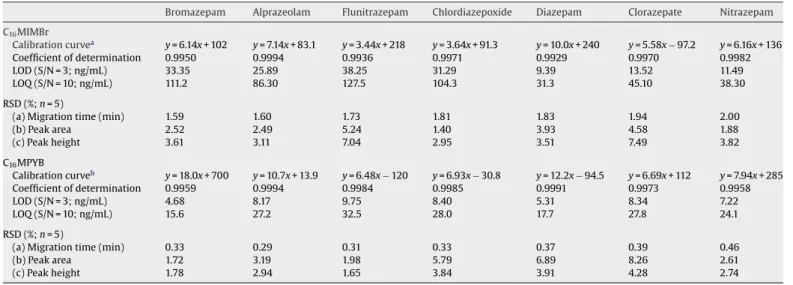
Bromazepam Alprazeolam Flunitrazepam Chlordiazepoxide Diazepam Clorazepate Nitrazepam C16MIMBr Calibration curvea y = 6.14x + 102 y = 7.14x + 83.1 y = 3.44x + 218 y = 3.64x + 91.3 y = 10.0x + 240 y = 5.58x− 97.2 y = 6.16x + 136 Coefficient of determination 0.9950 0.9994 0.9936 0.9971 0.9929 0.9970 0.9982 LOD (S/N = 3; ng/mL) 33.35 25.89 38.25 31.29 9.39 13.52 11.49 LOQ (S/N = 10; ng/mL) 111.2 86.30 127.5 104.3 31.3 45.10 38.30 RSD (%; n = 5)
(a) Migration time (min) 1.59 1.60 1.73 1.81 1.83 1.94 2.00
(b) Peak area 2.52 2.49 5.24 1.40 3.93 4.58 1.88 (c) Peak height 3.61 3.11 7.04 2.95 3.51 7.49 3.82 C16MPYB Calibration curveb y = 18.0x + 700 y = 10.7x + 13.9 y = 6.48x− 120 y = 6.93x− 30.8 y = 12.2x− 94.5 y = 6.69x + 112 y = 7.94x + 285 Coefficient of determination 0.9959 0.9994 0.9984 0.9985 0.9991 0.9973 0.9958 LOD (S/N = 3; ng/mL) 4.68 8.17 9.75 8.40 5.31 8.34 7.22 LOQ (S/N = 10; ng/mL) 15.6 27.2 32.5 28.0 17.7 27.8 24.1 RSD (%; n = 5)
(a) Migration time (min) 0.33 0.29 0.31 0.33 0.37 0.39 0.46
(b) Peak area 1.72 3.19 1.98 5.79 6.89 8.26 2.61
(c) Peak height 1.78 2.94 1.65 3.84 3.91 4.28 2.74
aCalibration line (0.125–3g/mL): peak area (arbitrary units) = slope × concentration (ng/mL) + y-intercept. bCalibration line (0.03–3g/mL): peak area (arbitrary units) = slope × concentration (ng/mL) + y-intercept.
in sweeping–MEKC. This result is similar to that of a previ-ous study in which the interactions of the C16MPYB surfactant with polar compounds were found to be stronger than those of CTAB[16,29]. Therefore, C16MPYB outperforms both C16MIMBr and CTAB in the on-line pre-concentration and analysis of benzodi-azepines.
3.6. Calibration curve and detection limits
Under the optimal conditions, we performed a quantitative anal-ysis (Table 2) to determine the range of linearity, the limits of detection (LODs), and the relative standard deviations (RSDs) of the migration times and peak heights when employing C16MIMBr and C16MPYB as surfactants. For the sweeping–MEKC method using C16MIMBr, the calibration curve was linear from 0.125 to 3.0g/mL; for C16MPYB, the linear range was from 0.03 to 3.0g/mL; over these ranges, the coefficients of determination (r2) were all greater than 0.9929. The LODs [signal-to-noise (S/N) ratio = 3] of the seven analytes ranged from 9.39 to 38.25 ng/mL when using C16MIMBr and from 4.68 to 9.75 ng/mL when using C16MPYB. Our experimen-tal results clearly indicate that sweeping–MEKC using these cationic surfactants provides superior sensitivity and linearity for the deter-mination of benzodiazepine analytes; the use of C16MPYB as the cationic surfactant enhanced the sensitivity and reproducibility rel-ative to those obtained using C16MIMBr.
3.7. Analyzing spiked urine samples using sweeping–MEKC and C16MPYB
Because of its superior sensitivity enhancement, we employed C16MPYB as the cationic surfactant for the sweeping–MEKC anal-ysis of the seven benzodiazepines spiked into a urine sample. We employed SPE prior to performing sweeping–MEKC to eliminate interference from the urine sample and to concentrate the ana-lytes. The resulting electropherogram in Fig. 5 reveals that SPE treatment allowed us to detect the presence of these analytes in urine samples without interference from any unknown compounds. The analytes were identified in terms of their migration times and absorbance spectra. Under the optimized SPE conditions, the recov-eries were 77.0% for bromazepam, 88.3% for alprazeolam, 83.4% for flunitrazepam, 83.6% for chlordiazepoxide, 86.7% for diazepam, 81.7% for clorazepate, and 76.6% for nitrazepam; the
reproducibili-Fig. 5. Sweeping–MEKC electropherogram, recorded using C16MPYB in the BGE, of a urine sample spiked with the seven benzodiazepines. Analysis was performed according to the optimized conditions of the sweeping–MEKC method.*Unknown
peak. Other conditions were the same as those used to obtainFig. 4(B).
ties (RSD; n = 5) of the extractions were 6.8, 4.5, 6.3, 5.2, 4.0, 7.2 and 8.0%, respectively.
4. Conclusions
The IL-type surfactants C16MIMBr and C16MPYB are suit-able sweeping–MEKC additives for the on-line sample pre-concentration and determination of seven benzodiazepines. Under
the optimized separation parameters, the enrichment factors for the seven compounds when using sweeping–MEKC, relative to MEKC, fell within the ranges 31–59 when employing the C16MIMBr surfactant and 86–165 when employing C16MPYB; the enhanced sweeping efficiency of C16MPYB presumably arises from its stronger interactions with these benzodiazepines. The LODs for the seven benzodiazepines when using C16MPYB as the sweeping carrier ranged from 4.68 to 9.75 ng/mL. The reproducibility of this devel-oped sweeping–MEKC method was adequate. We also applied this sweeping–MEKC method—with C16MPYB as surfactant—to the suc-cessful analysis of the seven benzodiazepines in spiked human urine samples after SPE. Therefore, it appears that performing sweeping–MEKC with IL-type surfactants in the sweeping buffer is potentially a new approach toward the on-line concentration and analysis of benzodiazepines present at low nanogram-per-milliliter concentrations in real samples.
Acknowledgment
This study was supported by a grant (NSC 95-2113-M-009-033-MY3) from the National Science Council and by the ATU program of the Ministry of Education, Taiwan, ROC.
References
[1] A. Berthod, M.J. Ruiz-Ángel, S. Carda-Broch, J. Chromatogr. A 1184 (2008) 6. [2] S.A. Shamsi, N.D. Danielson, J. Sep. Sci. 30 (2007) 1729.
[3] J.L. Anderson, D.W. Armstrong, G.-T. Wei, Anal. Chem. 78 (2006) 2893.
[4] S.M. Mwongela, A. Numan, N.L. Gill, R.A. Agbaria, I.M. Warner, Anal. Chem. 75 (2003) 6089.
[5] C. Jungnickel, J. Łuczak, J. Ranke, J.F. Fernández, A. Müller, J. Thöming, Colloids Surf. A: Physicochem. Eng. Aspects 316 (2008) 278.
[6] J. Bowers, C.P. Butts, P.J. Martin, M.C. Vergara-Gutierrez, Langmuir 20 (2004) 2191.
[7] G.A. Baker, S. Pandey, S. Pandey, S.N. Baker, Analyst 129 (2004) 890. [8] Z. Miskolczy, K. Sebök-Nagy, L. Biczók, S. Göktürk, Chem. Phys. Lett. 400 (2004)
296.
[9] I. Goodchild, L. Collier, S.L. Millar, I. Prokeˇs, J.C.D. Lord, C.P. Butts, J. Bowers, J.R.P. Webster, R.K. Heenan, J. Colloid Interface Sci. 30 (2007) 455.
[10] B. Dong, X. Zhao, L. Zheng, J. Zhang, N. Li, T. Inoue, Colloids Surf. A: Physicochem. Eng. Aspects 317 (2008) 666.
[11] M. Molina, M. Silva, Electrophoresis 23 (2002) 3907.
[12] T.J. Pappas, M. Gayton-Ely, L.A. Holland, Electrophoresis 26 (2005) 719. [13] M. Silva, Electrophoresis 28 (2007) 174.
[14] K. Tian, S. Qi, Y. Cheng, X. Chen, Z. Hu, J. Chromatogr. A 1078 (2005) 181. [15] M. Borissova, K. Palk, M. Koel, J. Chromatogr. A 1183 (2008) 192.
[16] V.P. Schnee, G.A. Baker, E. Rauk, C.P. Palmer, Electrophoresis 27 (2006) 4141. [17] M.F. Renou-Gonnord, K. David, J. Chromatogr. A 735 (1996) 249.
[18] M. Tomita, O. Toshiko, J. Chromatogr. B 678 (1996) 331.
[19] Y. Suzuki, H. Arakawa, M. Maeda, Biomed. Chromatogr. 18 (2004) 150. [20] J.P. Quirino, S. Terabe, Science 282 (1998) 465.
[21] J.P. Quirino, J.-B. Kim, S. Terabe, J. Chromatogr. A 965 (2002) 357. [22] J.-B. Kim, S. Terabe, J. Pharm. Biomed. Anal. 30 (2003) 1625.
[23] H.-P. Jen, Y.-C. Tsai, H.-L. Su, Y.-Z. Hsieh, J. Chromatogr. A 1111 (2006) 159. [24] C.-W. Huang, H.-P. Jen, R.-D. Wang, Y.-Z. Hsieh, J. Chromatogr. A 1110 (2006)
240.
[25] M.R.N. Monton, J.P. Quirino, K. Otsuka, S. Terabe, J. Chromatogr. A 939 (2001) 99.
[26] W. Shi, C.P. Palmer, J. Sep. Sci. 25 (2002) 215.
[27] R. Vanyúr, L. Biczók, Z. Miskolczy, Colloids Surf. A: Physicochem. Eng. Aspects 299 (2007) 256.
[28] M. Gong, K.R. Wehmeyer, P.A. Limbach, W.R. Heineman, J. Chromatogr. A 1125 (2006) 263.