Printed in the U.S.A. Copyright © 1993 Pergamon Press Ltd.
PERFORMANCE RATING METHOD OF THERMOSYPHON
SOLAR WATER HEATERS
B. J. HUANG
Department of Mechanical Engineering, National Taiwan University, Taipei, 10764, Taiwan Abstract--A rating method for the thermal performance of thermosyphon solar water heaters was developed. Except that the outdoor test procedure still follows the Taiwan Standard CNS B7277, a system characteristic efficiency rt* which is defined as the ao value corrected at M/Ac = 75 kg/m 2, was derived so that 0* is independent of the M/A~ ratio. Here, 0* can be evaluated by linear regression analysis of the test data. It is found from a series of tests for 31 systems that rt* is independent of M/Ac indeed, and thus can be used to rate the thermal performance of different thermosyphon solar water heaters during the energy-collecting period. The cooling loss during the no-radiation period is rated by the system cooling time constant r~. The present rating method associated with the Taiwan Standard CNS B7277 has been implemented for more than three years and is accepted by the Taiwan solar industry.
I. I N T R O D U C T I O N
Commercialization o f t h e r m o s y p h o n solar water heat- ers is very successful in Taiwan. The n u m b e r of units installed is around 25,000 per year, mostly for domestic applications. The market will be expanded several folds in the near future. The rapid growth of the solar market is mainly a result of the subsidy program provided by the Energy Commission, Ministry of Economic Affairs, Taiwan, which was started in 1986 and ended at the end of 1991. To improve the quality, the subsidy pro- gram requires that all the qualified products should pass a performance test with results exceeding certain criteria. Therefore, a method for the performance rating of the different solar water heaters on a c o m m o n l y trusted basis was required.
Through a series of research programs, the Tai- wanese Testing Standard (CNS B7277) was established in 1989 for the thermal performance test of thermo- syphon solar water heaters[ 1,2]. This standard has been implemented in an expert system, which was developed and has been continuously r u n n i n g for about three years since early 1989 (see[l]). More than 30 com- mercial solar water heaters have been tested so far and the results are collected a n d analyzed. The semiem- pirical efficiency model: ns = ao - Us(Ti - "Fa)/Ht, which was derived to correlate the daily efficiency test results[ 1 ], was carefully examined and no serious defect has yet been found.
It has been shown that the parameters ao and Us, defined in the above equation, can be used to rate the thermal performance of thermosyphon solar water heaters during energy-collecting periods[ 1 ]. Above, ao is related to the solar energy absorption efficiency of the collector; while Us stands for the capability of the system heat loss to ambient during the energy-collecting periods. However, two problems may arise by this rat- ing method.
First, the testing result of Us may have a larger u n - certainty, sometimes > --- 20%, which is caused by the scattering of the field test data due to inevitable dis-
turbances of the testing environment[ 1 ]. Therefore, the performance rating based on the results of Us may be deviated and cause serious controversy in obtaining the subsidy. Second, ao and Us can be varied by changing the system designs with various M / A c ratios, so that the rating may become unfair. For example, filling more water in the tank during the test will increase the
M / A , ratio as well as the testing result on ao. This can easily be done during the test for thermosyphon solar water heaters of the nonpressurized type (with a float valve in the tank to control the makeup water flow to the tank). A larger M / A c value can also be achieved by designing a larger tank size in order to pass the per- formance test, though the hot water will be supplied at a lower temperature which may not meet the load requirement.
Therefore, it is realized that the performance rating based purely on the values o f a o and Us may be unfair. To overcome this problem, we have to seek a rating method that is independent of the M]Ac ratio.
In practice, the daily initial temperature of the ther- mosyphon systems, Ti, is relatively low since the hot water collected during daytime is completely used at night a n d cold make-up water is refilled again. There- fore, the performance rating using Us is not always necessary since Ti approaches Ta, i.e., (Ti - Ta)/Ht 0. This means that the rating method can be sim- plified. Therefore, we solely select the value of ao for the performance rating of different thermosyphon solar water heaters during energy-collecting periods, but re- define it so that it will not depend on the M]A~ ratio. The modified ao (called system characteristic efficiency denoted by 7*) will then be used in the rating.
The system cooling loss during the no-radiation pe- riod (particularly at night) basically includes the in- sulation loss a n d the reverseflow loss. The cooling loss test can be performed to determine the cooling time constant ~-~ by the testing method presented in H u a n g and Du's article[ 1 ]. The effect of reverse flow can also be analyzed by comparing the cooling time constant, z~, of the individual tank loss and the system loss[ 1 ]. 435
436
2. DERIVATION OF CHARACFERISTIC SYSTEM EFFICIENCY
B. J. HUANG
M/A,. = 75 kg/m 2 was chosen as the criterion and the corrected ao, denoted ao 175 or rl* becomes:
We start with the daily system efficiency model de- rived in the previous study[l]:
where Ti - Ta m = C~o - U ~ - - (1) /4, bUs 0[° ~ Oie ( M / A c ) ' ~ ~ "--2--" (2)
In eqn (2), a~ is the average solar absorption coefficient; b is the proportional constant between T j - T, and
H t A ~ / M , according to Kubler et a/.[3]and Adnot et
al.[4]. That is,
HtAc
T~,- T,: b--~-
/3
•s* ~-- Oto[75 = O~e -- 7-'5' (6) The corrected ao, denoted ~*, is the system character-
istic efficiency which can be used as the criterion for the performance rating of different thermosyphon solar water heaters in the energy absorption phase.
Substituting eqn (5) into eqn (6), we obtain:
7" = ao + M / A c 75 - ao + A~) 7-5 /3. (7)
Equation (7) can be written in the form
,7" = Crao (8)
(3) where CF is the correction factor which is defined as
Here, Ht is the daily total solar irradiation upon the collector slope:
ft, q
Ht = ITdt (4)
where ti and tf are the initial and final time, respectively, during energy collecting period at each test day.
The system efficiency model, eqn ( 1 ), has been ver- ified experimentally well in the previous study[ 1 ]. The parameter ao can be interpreted as the daily system efficiency if the initial water temperature 7",. is as cold as the m e a n ambient temperature 7~0. It can also be seen from eqn (2) that the parameter ao is dependent on the M / A c ratio. The larger the water mass in the tank, the higher the value of ao. Thus, the higher value of ao can be easily obtained by filling more water in the tank during the test. Therefore, a correction of the parameter ao from an arbitrary M / A c value to a fixed
M / A c value is necessary in the performance rating of different thermosyphon solar water heaters.
The system parameters ao and Us are determined from the linear regression analysis of eqn (1) by using the measured system efficiency ~Ts (the dependent vari- able) a n d (Ti - T,,)/Ht (the independent variable). The constant b defined in the second part of eqn (2) is de- termined separately by linear regression analysis to the model eqn (3) by using the measured T f - 7,. (the de- pendent variable) a n d H t A d M (the independent vari- able). The coefficient/3 can then be evaluated by using the second part of eqn (2) and ae can be found from the first part of eqn (2):
/3
a~ = ao + M / A ~ " (5)
With k n o w n fl a n d Ore, we can extrapolate the test results Ofao to the point with a fixed M / A c value. Here,
[,
,9,
C F = 1 + (M/A~) ao
Since/3 = bus/2, CFcan be evaluated when the param- eters b, Us, and ao have been determined. The above derivation of the system characteristic efficiency ~s* is basically semiempirical and thus needs experimental verifications.
3. VERIFICATION BY FIELD TESTS
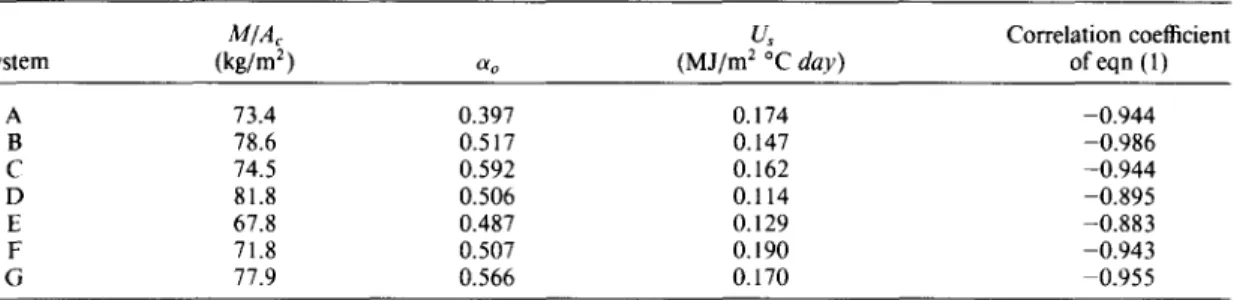
An experiment with seven thermosyphon solar wa- ter heaters, i.e., Systems A, B, C, D, E, F, and G used by Huang and Du[l], were carried out in the present study. The outdoor tests were performed automatically by the expert system developed previously[l]. The testing procedure follows Standard CNS B7277 [2] with the following operating conditions:
1. Period of day for daily efficiency test: nine hours with symmetry to the solar n o o n time.
2. Ht >- 7 M J / m 2 d a y for each test day.
3. Daily-mean wind speed during tests ~ -< 3 m/s for each test day.
T , - ~ a
4. - 0 . 5 -< -< 2.0°C m 2 d a y / M J . H,
5. At least ten test points, which satisfy the above test- ing conditions, have to be taken•
The parameters ao a n d Us, obtained from linear regression analysis of the test data using eqn (1) are listed in Table 1. The correlation coefficients of eqn ( 1 ) are well shown and the system efficiency model was validated. The proportional constant, b, the correction factor, CF, a n d the characteristic system efficiency n* were further calculated. The results are listed in Table 2. The correlation coefficients presented in Table 2 are very close to 1.0 a n d thus eqn (3) is shown to be valid. To further verify the suitability of the correction method for the rating of thermosyphon solar water heaters, a large n u m b e r of field test data to check
Table 1. Fitting of test results for the system eificiency model, eqn (1)
M/Ac Us Correlation coetficient
System (kg/m 2) ao (MJ/m 2 °C day) of eqn (1)
A 73.4 0.397 0.174 -0.944 B 78.6 0.517 0.147 -0.986 C 74.5 0.592 0.162 -0.944 D 81.8 0.506 0.114 -0.895 E 67.8 0.487 0.129 -0.883 F 71.8 0.507 0.190 -0.943 G 77.9 0.566 0.170 0.955
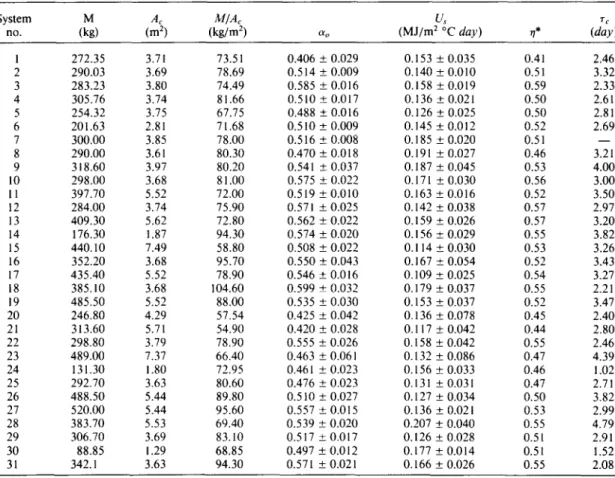
whether n* is independent of M/Ac, is required. Thirty- one commercially available solar water heaters have been tested and analyzed. The results are summarized in Table 3. Figure 1 shows that ao increases with in- creasing M/A~ ratio, as was expected by eqn (2). The effect o f M/Ac is not very clear for Us, as shown in Fig. 2. Figure 3 shows that the system characteristic effi- ciency r/* is independent of the M/Ac ratio indeed. This indicates that the performance rating of solar water heaters by using the n* value will not be biased by the variation of the M/Ac ratio, and thus can be c o m m o n l y trusted.
Table 3 also presents the test results of the cooling time constant r~, which can be used to rate the per- formance during no-radiation or cooling-loss periods. Here, rc is defined as
MCp
T c - ( 1 0 )
(UA)L
which is derived by a first-order system cooling model[ 1 ]:
MCp dTt(t) _ (UA)L[T(t) - 7~] (11)
dt
where Tt is the bulk temperature o f water in the tank;
(UA)L is the total heat loss coefficient of the system
(including tank, collector, and connecting p i p e s ) ; / ~ is the mean ambient temperature during the no-radiation test period. Therefore, rc represents the time at which the difference between the hot water temperature in the tank and the m e a n ambient temperature drops to 36.8% of its initial temperature difference, i.e., Tt(O)
- 7~,. Table 3 shows that rc, for most solar water heat-
ers, exceeds 2 days.
A criterion of~* > 0.5 during energy-collecting pe- riods has been adopted by the Taiwan G o v e r n m e n t in early 1989 as a necessary condition for the acceptance of the subsidy program. By this criterion, 7 out o f 31 systems tested in the present study were not allowed to accept subsidy. In addition to the performance cri- teflon during energy-collecting periods, r~ >__ 2.0 days will be suggested in the future as an additional criterion for performance during no-radiation or cooling-loss periods in order to make the rating m o r e complete. If both the criteria of ~* and rc were obeyed, then eight systems will not pass the test.
4. DISCUSSION AND CONCLUSIONS
In the present study, a m e t h o d of performance rat- ing for different solar water heaters was derived. The outdoor test procedure basically follows the Taiwanese Standard B7277[ 1,2]. In addition, a system character- istic efficiency, r/~*, which is defined as the ao value corrected at M/A¢ = 75 kg/m 2, was further derived, so that 7/* is independent of M/At. Then, 7/* can be eval- uated by linear regression analysis o f test data using eqn (3) in conjunction with eqns (2) and (7). F r o m the tests of 31 solar water heaters, it was found that 7/* is indeed independent o f M/Ac and thus can be used to rate the thermal performance o f different thermosy- phon solar water heaters during energy-collecting pe- riods. The present rating m e t h o d has been used for more than three years during the subsidy program, and is now widely accepted by Taiwanese solar industry.
A criterion of 7/* ~ 0.5 during energy-collecting pe- riods has been adopted by the Taiwan G o v e r n m e n t in
Table 2. Fitting of test results for eqn (3)
M/Ac Correlation coetficient Correction factor
System (kg/m 2) b/Cp of eqn (3) ao CF ~ *~ A 73.4 0.342 0.978 0.397 1.005 0.399 B 78.6 0.517 0.969 0.517 0.991 0.512 C 74.5 0.504 0.938 0.592 1.001 0.593 D 81.8 0.506 0.977 0.506 0.986 0.499 E 67.8 0.467 0.982 0.487 1.021 0.498 F 71.8 0.517 0.980 0.507 1.014 0.514 G 77.9 0.566 0.979 0.566 0.989 0.560 C v = 0.004184 MJ/kg °C; b = dimensionless.
Table 3. Test results for 31 commercially available solar systems
System M Ac M/A~ U~ %
no. (kg) (m 2) (kg/m 2) do ( M J / m 2 °C day) ~* (day)
1 272.35 3.71 73.51 0.406 + 0.029 0.153 _+ 0.035 0.41 2.46 2 290.03 3.69 78.69 0.514 _+ 0.009 0.140 _+ 0.010 0.51 3.32 3 283.23 3.80 74.49 0.585 +_ 0.016 0.158 _+ 0.019 0.59 2.33 4 305.76 3.74 81.66 0.510 _+ 0.017 0.136 _+ 0.021 0.50 2.61 5 254.32 3.75 67.75 0.488 _+ 0.016 0.126 _+ 0.025 0.50 2.81 6 201.63 2.81 71.68 0.510 _+ 0.009 0.145 + 0.012 0.52 2.69 7 300.00 3.85 78.00 0.516 +_ 0.008 0.185 + 0.020 0.51 - - 8 290.00 3.61 80.30 0.470 +_ 0.018 0.191 + 0.027 0.46 3.21 9 318.60 3.97 80.20 0.541 +_ 0.037 0.187 + 0.045 0.53 4.00 10 298.00 3.68 81.00 0.575 _+ 0.022 0.171 +_ 0.030 0.56 3.00 11 397.70 5.52 72.00 0.519 _+ 0.010 0.163 _+ 0.016 0.52 3.50 12 284.00 3.74 75.90 0.571 + 0.025 0.142 +_ 0.038 0.57 2.97 13 409.30 5.62 72.80 0.562 _+ 0.022 0.159 _+ 0.026 0.57 3.20 14 176.30 1.87 94.30 0.574 + 0.020 0.156 _ 0.029 0.55 3.82 15 440.10 7.49 58.80 0.508 _+ 0.022 0.114 _+_ 0.030 0.53 3.26 16 352.20 3.68 95.70 0.550 _+ 0.043 0.167 _+ 0.054 0.52 3.43 17 435.40 5.52 78.90 0.546 + 0.016 0.109 _+ 0.025 0.54 3.27 18 385.10 3.68 104.60 0.599 + 0.032 0.179 _+ 0.037 0.55 2.21 19 485.50 5.52 88.00 0.535 -+ 0.030 0.153 _+ 0.037 0.52 3.47 20 246.80 4.29 57.54 0.425 + 0.042 0.136 _+ 0.078 0.45 2.40 21 313.60 5.71 54.90 0.420 -+ 0.028 0.117 +_ 0.042 0.44 2.80 22 298.80 3.79 78.90 0.555 +- 0.026 0.158 +_ 0.042 0.55 2.46 23 489.00 7.37 66.40 0.463 +_ 0.061 0.132 _+ 0.086 0.47 4.39 24 131.30 1.80 72.95 0.461 +_ 0.023 0.156 _+ 0.033 0.46 1.02 25 292.70 3.63 80.60 0.476 + 0.023 0.131 + 0.031 0.47 2.71 26 488.50 5.44 89.80 0.510 -+ 0.027 0.127 _+ 0.034 0.50 3.82 27 520.00 5.44 95.60 0.557 + 0.015 0.136 _+ 0.021 0.53 2.99 28 383.70 5.53 69.40 0.539 _+ 0.020 0.207 _+ 0.040 0.55 4.79 29 306.70 3.69 83.10 0.517 _+ 0.017 0.126 + 0.028 0.51 2.91 30 88.85 1.29 68.85 0.497 _+ 0.012 0.177 _+ 0.014 0.51 1.52 31 342.1 3.63 94.30 0.571 _+ 0.021 0.166 _+ 0.026 0.55 2.08
early 1989 as a n e c e s s a r y c o n d i t i o n for the a c c e p t a n c e o f the subsidy p r o g r a m . I n a d d i t i o n to the p e r f o r m a n c e criterion d u r i n g energy-collecting periods, rc >- 2.0 days
will be suggested as a n a d d i t i o n a l c r i t e r i o n for p e r f o r -
m a n c e d u r i n g n o - r a d i a t i o n o r c o o l i n g - l o s s p e r i o d s , in o r d e r to m a k e the r a t i n g m o r e c o m p l e t e . It is n o t e d t h a t S y s t e m B p r e s e n t e d in T a b l e s 1 a n d 2, a n d S y s t e m N o . 2 in T a b l e 3 are o f a close-type I 0 . 9 0.8 0 . 7 0 . 6 0.5 0.4 0.3 0 . 2 O.I 0 50 o t e s t r e s u l t s - - f i t t e d e q u a t i o n : O~ o = 0.3075 + 0.0027 M/Ac o o o o o o ~ o _ _ _ _ o ~ 6 o o o o o o J J J i i 6 0 70 80 90 100 b i / A e , k g / m 2
Fig. 1. Variation of C~o with M/Ac.
0.3 o 0.25 0.2 0.15 O.l 0.05 0 50
- - average value (0.1515 MJ/m2°C day)
o 8 o o ° ~ n o o o o o o o o o 60 70 80 90
M/Ae,
k g / m 2Fig. 2. Variation of Us with M/A~. O O O n O 100 10 o ) n o ¢ ) ¢0 e~ r..) l 0.9 0.8 0.7 0.6 0.5 0.4 0.3 0.2 O.l 50 60 - - average value (0.5145) o o o o o IB o o r l l n o ~ u ~ o u o o c9 o o i i 70 80 M/Ae, k g / m 2
Fig. 3. Variation ofo? with M/Ac. o
o
i i
90 100 llO
design (with a heat exchanger in the tank), a n d no a b n o r m a l test results were found. T h e testing m e t h o d p r e s e n t e d i n [ 1 ] a n d S t a n d a r d C N S B727712]are t h u s s h o w n to be applicable to close-type t h e r m o s y p h o n water heaters with a heat exchanger in the tank. T h e results obtained from a recent test for a storage-collector type solar water heater (similar to t h e r m o s y p h o n i c wa- ter heaters in design principle) also reveals that the S t a n d a r d C N S B7277 is applicable too.
Acknowledgment--This study was supported by the Energy
Commission, the Ministry of Economic Affairs, Taiwan, R.O.C., through Grant No. 772J 1,782J 1,792J6.
NOMENCLATURE
Ac collector area, m 2
b empirical constant defined in eqn (3) Cp heat capacity of water, 0.004184 MJ/kg °C Hr daily total solar irradiation upon collector slope, J/m 2
day
Ir solar irradiation incident upon collector slope, W/m 2 M total mass of water in the thermosyphon system, kg To ambient temperature, °C
Ta daily average ambient temperature, °C Ti daily initial tank temperature, °C T s daily final tank temperature, °C T, water temperature in tank, °C
t, initial time, s
us (UAk Ote Og o ,7" T c
overall system loss coefficient during energy-collecting periods, MJ/m 2 °C day
overall system loss coefficient during no-radiation pe- riods, MJ/m 2 °C
effective solar absorptance, dimensionless
overall solar absorptance defined in eqn (1), dimen- sionless
daily system efficiency, dimensionless system characteristic efficiency, dimensionless cooling time constant during no-radiation periods, day
REFERENCES
1. B. J. Huang and S. C. Du, A performance test method of solar thermosyphon systems, ASME J Solar Energy Eng. 113, 172-179 (1991).
2. CNS Standard B7277, No. 12558, Method of tesl for solar water heating systems, Central Bureau of Standard, Min-
istry of Economic Affairs, Taipei, Taiwan (1989). (in Chinese)
3. R. Kubler, M. Ernst, and N. Fisch, Short term test for solar domestic hot water systems--Experimental results and long term performance predictions, Proceedings of ISES Solar Worm Congress 1987, September 13-18,
1987, Hamburg, Germany. In: Advances in Solar Energy,
Vol. 1, Pergamon Press, Oxford, pp. 732-736 (1988). 4. J. Adnot, B. Bourges, and L. Kadi, The input/output
method for SDHWS characterization, Proceedings of ISES Solar World Congress 1987, September 13-18,
1987, Hamburg, Germany. In: Advances in Solar Energy,