A Trade History of Taiwan
Tsong-Min Wu∗
2004.11.29
Taiwan is one of the most dynamic economies in the world. In the beginning of the 21th century, if you buy a high-end notebook computer in the U.S., chances are good that it is made in Taiwan. Trade is important to Taiwan, not only today, but since four hundreds years ago.
1 The Dutch and the Ch’ing era
Before the 17th century, little is known about Taiwan. When the Dutch established set- tlements on the west coast in 1624, there were some Chinese and Japanese staying on the island, but the main residents were the aborigines, who engaged in hunting and fishing.
The Dutch soon realized that the island’s deer hide and sugar were profitable tradable goods. In 1633–60, annual export of deer hide averaged 71,915 pieces, mostly to Japan.
Taiwan also exported sugar to Japan and Persia. To boost sugar production, the Dutch imported farmers from China during the farming seasons to help cane plantation.
The Dutch was ousted by Cheng Ch’eng-kung (Koxinga) in 1662, the Cheng’s regime was then succeeded by the Ch’ing dynasty in 1683. The next year, the Ch’ing court lifted the ban on international trade, and Amoy was designated as the only entrep ˆot. Amoy is located in the southeastern part of the China mainland, just across the Taiwan Strait from Taiwan. So although the Ching’s policy shut down the door for direct international trade, Taiwan’s sugar and deer hide continued to be exported through Amoy (Ng, 1983).
As a new territory of China, Taiwan had plenty of fields, but relatively small popula- tion, and Chinese were attracted to Taiwan to cultivate land. As more and more Chinese came, deers disappeared from the plains. Consequently, the deer hide export decreased and the livelihood of the aborigines affected. In the same time, there was a boom in the
∗Department of Economics, National Taiwan University. I am grateful to Tain-Jy Chen, Hui-wen Koo, and Kelly Olds for helpful comments.
rice export. During the 18th and 19th centuries, there were recurrent food shortages in the southeastern provinces of China, and the rice export help to alleviate the problem.
From the late 17th to the mid-19th century, Taiwan traded only with the mainland.
During the time, China was a stagnant traditional economy. Its long-run GDP per head was conjectured to be zero (Maddison, 1998). Had China been a growing economy, Taiwan probably would have benefited more from the trade. After the first Opium War of 1839–
42, China was forced to open five ports for international trade. In 1860 Taiwan’s Tamshui and Takao (Kaoshiung) were also open for trade. So after almost two hundred years of closeness, Taiwan once again joined the international market. Within only a few years, a new industry was established in northern Taiwan.
Beginning in the mid-18th century, tea was the most important export from China (Gardella, 1994). Most of the tea was produced in northern Fukien, but the booming tea industry had no effect on Taiwan, even though before 1886, Taiwan was a prefecture of the Fukien province. After opening to trade, a Scotch merchant named John Dodd discovered that northern Taiwan was suitable for tea growing, and began to build a tea industry there.
In 1865, tea export from Tamshui valued 180,859 pounds. Twenty years later, the export value reached 16,237,179 pounds, about 90 times of 1865. At the end of the 19th century, tea became the primary export from Taiwan, surpassing sugar and rice. As for import, opium was the most important, which sometimes accounted for more than 60% of the total import.
2 The Japanese era
Taiwan was ceded to Japan after the Sino-Japanese War of 1894. Under the Japanese rule, the traditional economy was quickly modernized. The modernization started with in- frastructure constructions. A north-south railway was built in 1898–1907, and the Keelung and Kaoshiung ports were dredged. Upon the completion of the projects, export goods produced on the western coast were transported to either Keelung or Kaoshiung by rail- way, and then shipped to Japan by big steam ships. The transportation system not only enhanced external trade, domestic trade was boosted as well.
The colonial government initialized other reforms. For example, an island-wide cen- sus and a cadastral survey were done in 1898–1904, which was followed by a land reform.
The reforms increased the efficiency of tax collection, thus enabling the government to re- duce the land tax rate. As a result of these reforms, Taiwan proved to be an attractive spot to the Japanese investors. In the 1900s, several Japanese companies setup modern-style
0 10 20 30 40 50
1903 1908 1913 1918 1923 1928 1933 1938 1943 1948 1953 1958 1963 1968 1973 1978 1983 1988 1993 1998
%
export/GDP
import/GDP
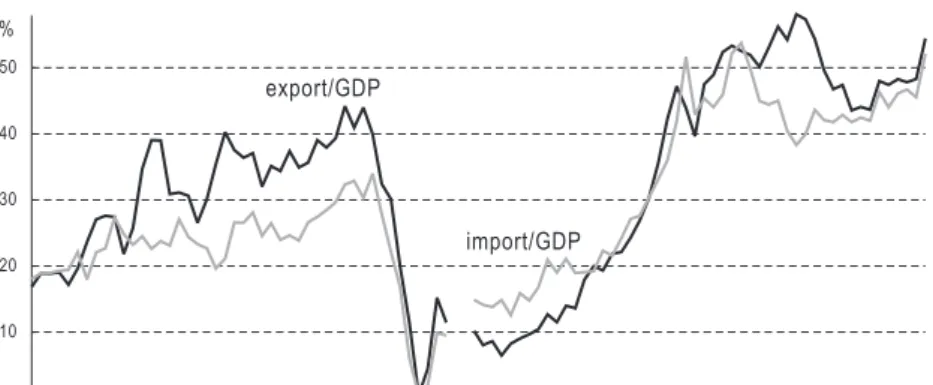
Figure 1: Taiwan’s export and import: 1903–2000
Source: For 1951–2000, the ratios are from official national income sta- tistics. The export and import data, 1903–48, are from Taiwan Provincial Government (1950), p. 1, no data are available for 1949 and 1950. GDP data: 1903–36 are from the gross domestic expenditure estimate in Mi- zoguchi and Umemura (1988), p. 232; 1937–50 from Kuo et al. (1997).
sugar mills in Taiwan. Within a few years, sugar surpassed tea and rice to become the most important export. In 1890, Taiwan exported 43,282 tons of sugar. It increased more than fourfold to 187,105 tons in 1910.
Taiwan also exported rice to Japan. In 1910, rice’s share to the total export was 11.7%, while the share of sugar was 58.9%. In the mid-1920s, a new breed of rice, called Ponlai, was developed in Taiwan, which fit the taste of the Japanese very well. Within only a few years, Ponlai rice export rose sharply. In 1935, sugar’s share of total export was 43.2%, and rice’s share increased to 30.1%. Geographically, Taiwan is located to the south of Japan, and the subtropical weather is suitable for agriculture. Within the Japanese empire, Taiwan’s economy was developed to be more agriculture-oriented. This was reflected in the trade pattern between Taiwan and Japan. Taiwan sold mainly agricultural products to Japan, and bought industrial products from Japan.
As shown in figure 1, up to the end of the 1930s, export (and import) to GDP ratio shows a clear upward trend. The downward trend in the 1940s was caused by the war.
When Taiwan became a colony of Japan in 1895, Japan itself was a more advanced econ- omy. By trading with Japan, Taiwan had the opportunities to learn better technologies and institutions from Japan, and this enabled it to produce goods of higher quality. The development of Ponlai rice was just one example.
3 After 1945
At the end of the World War II, the allies handed Taiwan over to the Kuomintang (KMT) in the mainland. During the Japanese colonial period, Taiwan traded mainly with Japan, and now the mainland would become its main market. Unfortunately, only four years later, the KMT was defeated by the Communist. The KMT lost the China, and Taiwan lost the mainland market. Starting 1950, Taiwan had to compete directly with the rest of the world. In the end, this proves to be good because the economy becomes more competitive than ever, but in the beginning, the difficulty was formidable. And the economic policies taken by the KMT makes the situation even worse.
In the early 1950s, the government adopted the import-substitution policy to encour- age producing goods for domestic demand. To prevent competition from abroad, heavy tariffs were levied on many imports and a multiple exchange rates system was setup. The KMT thought that control and regulation was the only way to solve the economic prob- lems, but the policies actually had a detrimental effect on the economy (Ho, 1978, pp. 186–
223). What came to the rescue was the U.S. aid to Taiwan, which was initialized by the U.S. after the outbreak of the Korean War on June 25, 1950. Initially, the U.S. aid help to secure Taiwan’s future, but the focus of the program later changed to development. Besides financing infrastructure constructions, the U.S. aid program encouraged deregulation and promoted the notion of the market mechanism (Jacoby, 1966).
In the late 1950s, upon the proposition and pressure from the U.S. aid program, the import-substitution policy was replaced by export expansion policy. The multiple ex- change rate system was dismantled, and the currency was devalued to be closer to the equilibrium level. The government adopted a series of tax incentive measures to boost export (Jenkins et al., 2003). As it turns out, export expansion becomes the fundamental economic policy until today, although the specific policies adopted evolved over time.
As the government tried hard to boost export, high tariff protection and import re- strictions remained. It was not until the mid-1980s that tariff was reduced, and real dereg- ulation was pursued. Whether the government intervention policy was the key to Tai- wan’s development remains an open question. What is clear is that the export sector did show a dramatic increase starting early 1960s, as shown in figure 1. The content of export changed over time, however. Agriculture goods accounted for as much as 90% of exports in the mid-1950s, but less than 2% in 2001. Textiles and clothing accounted for 17% of ex- ports in 1986, it decreased to 6.9% in 2001. In contrast, the share of information products increased from 5.1% in 1986 to 20.9% in 2001.
Before late 1960s, most of the exports were sold to Japan. Since Taiwan was a colony of Japan, this is as expected. Then the U.S. became the principal market of Taiwan’s exports.
In the 1980s, 41.7% of Taiwan’s exports were sold in the U.S., while only 8.5% was sold to China’s mainland. In 2002, however, China’s share soared to 31.2%, surpassing the U.S. to become the most important export market. Since the KMT retreated to Taiwan in 1949, China continued to claim its sovereignty over the island, while Taiwan maintained that it is an independent country. The rise of China in the world economy has made the scenario more complicated. Given that China is the largest market in the world, it can be expected that the trade relationship between Taiwan and China would become more close. How does Taiwan manage to live with a thriving Chinese economy is the most challenging task facing the policy makers of Taiwan in the future.
References
Gardella, Robert (1994), Harvesting Mountains: Fujian and the China Tea Trade, 1757–
1937, Berkeley and Los Angeles: University of California Press.
Ho, Samuel P.S. (1978), Economic Development of Taiwan, 1860-1970, New Haven: Yale University Press.
Jacoby, Neil (1966), U.S. Aid to Taiwan, New York: Fredric A. Prager Publishers.
Jenkins, Glenn R., Kuo, Chun-Yan, and Sun, Keh-Nan (2003), Taxation and Economic De- velopment in Taiwan, Cambridge, MA: Harvard University Press.
Kuo, Fong-Yew, Tsui, Chou-Yin, Lin, Ming-Tzu, and Jong, Grace (1997), “The estimation of the gross domestic product in taiwan”, Taiwan Economic Review, 25(2), 207–76.
Maddison, Angus (1998), Chinese Economic Performance in the Long Run, Paris: Develop- ment Centre of the OECD.
Mizoguchi, Toshiyuki and Umemura, Mataji (1988), Basic Economic Statistics of Former Japanese Colonies, 1895–1938, Tokyo: Toyo Keizai Shinposha.
Ng, Chin-Keong (1983), Trade and Society: The Amoy Network on the China Coast, 1683–
1735, Kent Ridge: Singapore: Singapore University Press.
Taiwan Provincial Government (1950), Taiwan Trade Statistics for the Last Fifty Three Years, Taipei: Taiwan Provincial Government.
TaiwanTrade.ctx