Penguin enhancement and B \K
decays in perturbative QCD
Yong-Yeon Keum*
Institute of Physics, Academia Sinica, Taipei, Taiwan and Theory Group, KEK, Tsukuba, Ibaraki 305-0801, Japan
Hsiang-nan Li†
Theory Group, KEK, Tsukuba, Ibaraki 305-0801, Japan
and Department of Physics, National Cheng-Kung University, Tainan, Taiwan 701, Republic of China A. I. Sanda‡
Department of Physics, Nagoya University, Nagoya 464-01, Japan 共Received 25 April 2000; published 2 February 2001兲
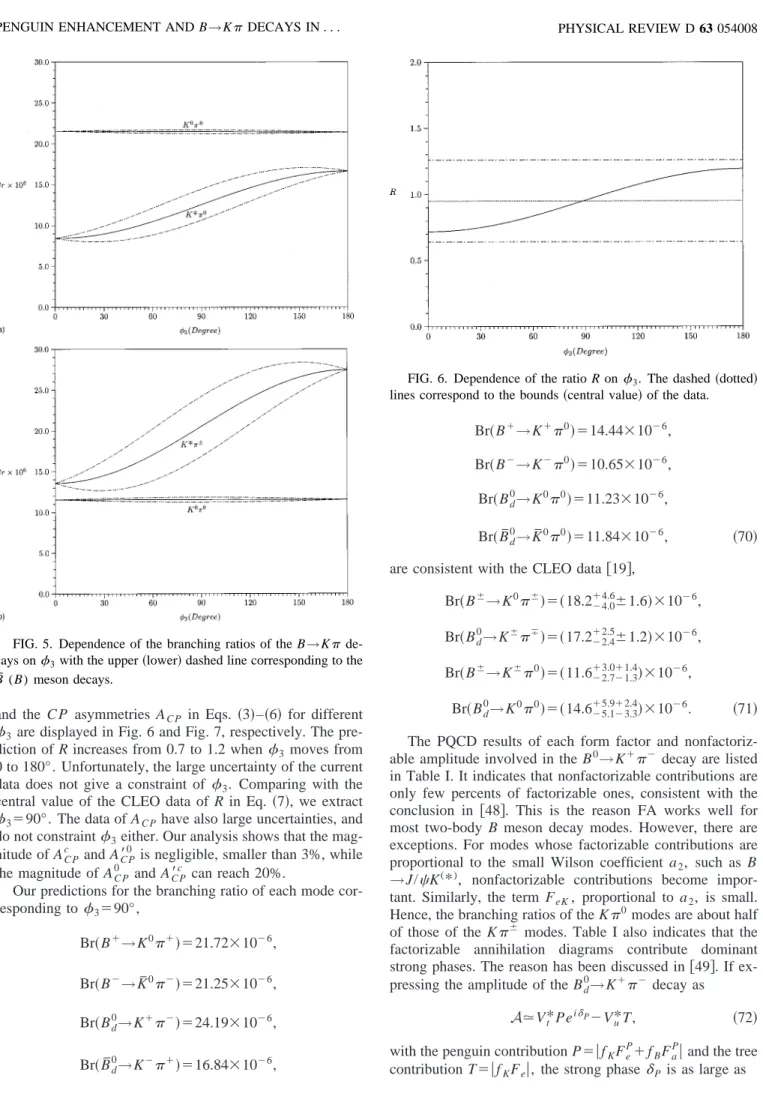
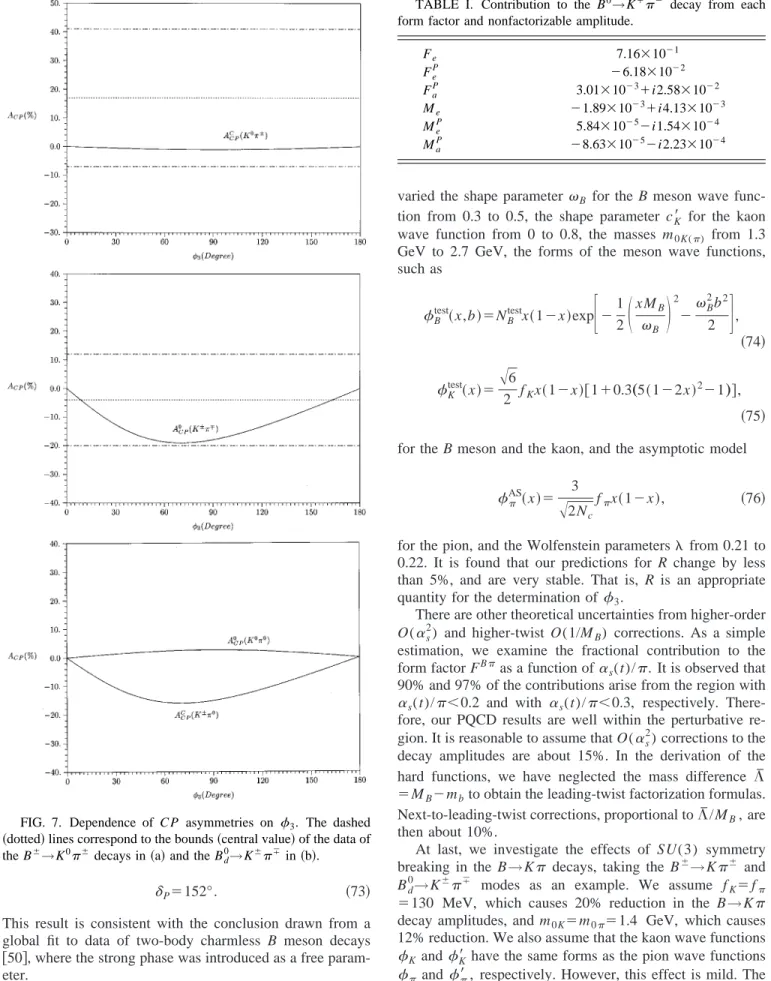
We compute the branching ratios of B→K decays in the framework of the perturbative QCD factorization theorem. Decay amplitudes are classified into the topologies of tree, penguin, and annihilation amplitudes, all of which contain both factorizable and nonfactorizable contributions. These contributions are expressed as the convolutions of hard b quark decay amplitudes with universal meson wave functions. It is shown that 共1兲 matrix elements of penguin operators are dynamically enhanced compared to those employed in the factoriza- tion assumption, 共2兲 annihilation diagrams are not negligible, contrary to common belief, 共3兲 annihilation diagrams contribute large strong phases, and 共4兲 the uncertainty of the current data of the ratio R⫽Br(Bd 0
→K⫾⫿)/Br(B⫾→K0⫾) and of C P asymmetries is too large to give a constraint of the unitarity angle3. Assuming3⫽90° which is extracted from the best fit to the data of R, predictions for the branching ratios of the four B→K modes are consistent with data.
DOI: 10.1103/PhysRevD.63.054008 PACS number共s兲: 13.25.Hw, 11.10.Hi, 12.38.Bx, 13.25.Ft
I. INTRODUCTION
B factories at KEK and SLAC are taking data to probe the origin of C P violation. Within the Kobayashi-Maskawa 共KM兲 ansatz 关1兴, CP violation is organized in the form of a unitarity triangle shown in Fig. 1. The angle 1 can be ex- tracted from the C P asymmetry in the B→J/KS decays, which arises from the B-B¯ mixing. Because of the similar mechanism of C P asymmetry, the decays B0→⫹⫺ are appropriate for the extraction of the angle 2. However, these modes contain penguin contributions such that the ex- traction suffers large uncertainty. Additional measurements of the decays B⫾→⫾0 and B0→00 and the use of isospin symmetry may resolve the uncertainties 关2兴. It has been proposed that the angle3 can be determined from the decays B→K, 关3–6兴. Contributions to these modes involve interference between penguin and tree amplitudes, and relevant strong phases have been formulated in terms of several independent parameters. Progress can be made along this direction, if one learns to compute nonleptonic two-body decay amplitudes including strong phases.
The conventional approach to exclusive nonleptonic B meson decays relies on the factorization assumption 共FA兲 关7兴, in which nonfactorizable and annihilation contributions are neglected and final-state-interaction共FSI兲 effects are as- sumed to be absent. That is, this approach requires simplify-
ing assumptions. Though analyses are easier under this as- sumption, estimations of many important ingredients, such as tree and penguin 共including electroweak penguin兲 contribu- tions, and strong phases are not reliable. Moreover, it suffers the problem of scale dependence 关8兴. It is also difficult to resolve some controversies in the FA approach, such as the branching ratios of the B→J/K(*) decays关9兴.
Perturbative QCD 共PQCD兲 factorization theorem for ex- clusive heavy-meson decays关10兴 has been proved some time ago, and applied to the semileptonic B→D(*)()l¯ decays 关11,12兴, the nonleptonic B→D(*)() decays 关9,13兴, the penguin-induced radiative B→K*␥ decay 关14,15兴 and the charmless B→decay关16兴. PQCD is a method to separate hard components from a QCD process, which can be treated by perturbation theory. Nonperturbative components are or- ganized in the form of hadron wave functions, which can be extracted from experimental data. Here we shall extend the PQCD formalism to more challenging charmless decays such as B→K, . It will be shown that the difficulties en- countered in the FA approach can be resolved in the PQCD formalism.
*Email address: [email protected]
†Email address: [email protected]
‡Email address: [email protected] FIG. 1. Unitarity triangle and the definition of the anglesi.
In this paper we shall evaluate the branching ratios of the following modes:
B⫾→K0⫾, Bd
0→K⫾⫿, B⫾→K⫾0, Bd
0→K00. 共1兲
Contributions from various topologies, such as tree, penguin, and annihilation, including both factorizable and nonfactor- izable contributions, can all be calculated. That is, FA is in fact not necessary. It has been argued that annihilation dia- grams should be included in order to retain the covariance of decay amplitudes in the light-cone Fock representation关17兴.
In our approach strong phases arise from nonpinched singu- larities of quark and gluon propagators in nonfactorizable and annihilation diagrams. As explicitly shown in Sec. VII, strong phases from the Bander-Silverman-Soni 共BSS兲 mechanism 关18兴, which is a source of strong phases in the FA approach, are of next-to-leading order and negligible.
As an application, we derive the ratio R and the C P asym- metries defined by
R⫽Br共Bd
0→K⫾⫿兲
Br共B⫾→K0⫾兲, 共2兲
AC P0 ⫽Br共B¯d
0→K⫺⫹兲⫺Br共Bd
0→K⫹⫺兲 Br共B¯d
0→K⫺⫹兲⫹Br共Bd
0→K⫹⫺兲, 共3兲
AC Pc ⫽Br共B⫺→K0⫺兲⫺Br共B⫹→K0⫹兲
Br共B⫺→K0⫺兲⫹Br共B⫹→K0⫹兲, 共4兲
AC P⬘0⫽Br共B¯d
0→K00兲⫺Br共Bd
0→K¯00兲 Br共B¯d
0→K00兲⫹Br共Bd
0→K¯00兲, 共5兲
AC P⬘c⫽Br共B⫺→K⫺0兲⫺Br共B⫹→K⫹0兲
Br共B⫺→K⫺0兲⫹Br共B⫹→K⫹0兲, 共6兲 as functions of the unitarity angle3using PQCD factoriza- tion theorem. In the above expressions Br(Bd0→K⫾⫿) rep- resents the C P average of the branching ratios Br(Bd0
→K⫹⫺) and Br(B¯d
0→K⫺⫹), and the definition of Br(B⫾→K0⫾) is similar. It will be shown that the uncer- tainty in the data for R, AC P0 , and AC Pc 关19,20兴,
R⫽0.95⫾0.30, AC P
0 ⫽⫺0.04⫾0.16, AC P
c ⫽0.17⫾0.24, 共7兲 is still too large to provide useful information of3. Using the central values of the CLEO data for R, we obtain 3
⫽90°.
An essential difference between the FA and PQCD ap- proaches is that the hard scale at which Wilson coefficients are evaluated is chosen arbitrarily as mb or mb/2 in the former, mb being the b quark mass, but dynamically deter- mined in the latter. It has been shown that choosing this dynamically determined scale minimizes higher-order cor-
rections to exclusive QCD processes 关24兴. We observe that this choice leads to an enhancement of penguin contributions by nearly 50% compared to those in the FA approach. As elaborated in Sec. V, this penguin enhancement is crucial for the explanation of the data of all B→K, modes using a smaller angle 3⬃90°. Note that an angle 3 larger than 110° must be adopted in order to explain the above data in the FA approach 关21兴.
Recently, Beneke et al. proposed an alternative approach to exclusive nonleptonic B meson decays 关22兴. In this for- malism factorizable contributions 共transition form factors兲, assumed to be dominated by soft dynamics, are not calcu- lable and treated as nonperturbative inputs. Nonfactorizable contributions, being infrared safe, are evaluated in the PQCD framework. Annihilation contributions are still neglected.
Therefore, this approach can be regarded as a mixture of the FA and PQCD ones. The comparison among the above ap- proaches will be made briefly in Sec. VII. For a detailed comparison, including predictions which can be distin- guished experimentally in the future, refer to关23兴.
PQCD factorization theorem for exclusive nonleptonic B meson decays are reviewed in Sec. II. The factorization for- mulas for various B→K decay modes are derived in Sec.
III. The numerical analysis, including the determination of meson wave functions, is performed in Sec. IV. We empha- size the importance of the penguin enhancement in the PQCD approach in Sec. V. FSI effects are discussed in Sec.
VI. The PQCD approach is compared with other approaches in Sec. VII. Section VIII is the conclusion.
II. FACTORIZATION THEOREM IN BRIEF We first sketch the rough idea of PQCD factorization theorem and of its application to two-body B meson decays.
Take the B→transition form factor in the fast recoil region of the pion as an example 关11兴. Obviously, this process in- volves two scales: the b quark mass mb, which provides the large energy release to the fast pion, and the QCD scale
⌳QCD, which is associated with bound-state mesons. There- fore, the B→ transition form factor contains both pertur- bative and nonperturbative dynamics.
In perturbation theory nonperturbative dynamics is re- flected by infrared divergences in radiative corrections. It has been shown order by order that these infrared divergences can be separated and absorbed into a B meson wave function or a pion wave function 关11兴. A formal definition of the meson wave functions as matrix elements of nonlocal opera- tors can be constructed, which, if evaluated perturbatively, reproduces the infrared divergences. Certainly, one cannot derive a wave function using a perturbative method, but has to parametrize it as a parton model, which describes how a parton 共valence quark, if a leading-twist wave function is referred兲 shares meson momentum. The meson wave func- tions, characterized by ⌳QCD, must be determined by non- perturbative means, such as lattice gauge theory and QCD sum rules, or extracted from experimental data. In Sec. IV we shall make explicit the determination of the B meson, kaon, and pion wave functions from currently available data and phenomenological arguments. In the practical calcula-
tion below, small parton transverse momenta kT are in- cluded, and the characteristic scale is replaced by 1/b with b being a variable conjugate to kT.
After absorbing infrared divergences into the meson wave functions, the remaining part of radiative corrections is infra- red finite. This part, called a hard amplitude, can be evalu- ated perturbatively in terms of Feynman diagrams with four on-shell external quarks, one of which is the b quark. Note that the b quark carries various momenta, whose distribution is described by the parton model introduced above. The analysis of next-to-leading-order corrections to the pion form factor关24兴 has suggested that the characteristic scale should be chosen as the virtuality t of internal particles, which is of order mb, in order to minimize higher-order corrections to the hard amplitudes. This scale reflects the specific dynamics of a decay mode.
The B→ transition form factor is then expressed as the convolution of three factors: the B meson and pion wave functions, and the hard b quark decay amplitude. This is so called factorization theorem. Note that the separation of non- perturbative and perturbative dynamics is quite arbitrary.
This arbitrariness implies that a renormalization-group共RG兲 improvement of the factorization formula for the B→tran- sition form factor can be implemented. The RG evolution from the all-order summation of large logarithmic correc- tions to the above convolution factors, along with Sudakov resummation关25兴, will be made explicit below.
A salient feature of PQCD factorization theorem is the universality of nonperturbative wave functions. Briefly speaking, the infrared divergences associated with the B me- son are process-independent, and the formal definition of the B meson wave function in terms of matrix elements of non- local operators is universal for all B meson decay modes. It is not difficult to understand this universality: infrared diver- gences correspond to long-distance effects, while the hard b quark decay occurs in a very short space-time. It is natural that these two dramatically different subprocesses decouple from each other. That is, the long-distance dynamics is in- sensitive to specific decays of the b quark with large energy release. Because of universality, a B meson wave function extracted from some decay modes can be employed to make predictions for other modes. This is the reason PQCD factor- ization theorem possesses a predictive power. We emphasize that PQCD is a theory, instead of a model, since higher-order and higher-twist contributions can be included systemati- cally. The model independence of PQCD predictions can be achieved, once wave functions are determined precisely.
PQCD factorization theorem for nonleptonic B meson de- cays, such as B→K() and B→D(*)(), is similar, though more complicated. These decays involve three scales:
the W boson mass MW, at which the matching conditions of the effective weak Hamiltonian to the full Hamiltonian are defined, the typical scale t共of order mb), and the factoriza- tion scale 1/b 共of order ⌳QCD) introduced above. The dy- namics below 1/b is regarded as being completely nonper- turbative, and parametrized into meson wave functions
(x,b), x being the momentum fraction. Above the factor- ization scale, decay dynamics involves two characteristic scales, MWand t, differing from the case of the B→ tran-
sition form factor, and further factorization is necessary.
Radiative corrections produce two types of large loga- rithms: ln(MW/t) and ln(tb). The former are summed by RG equations to give the evolution from MWdown to t described by the Wilson coefficients C(t), while the latter are summed to give the evolution from t to 1/b. The matching between the full Hamiltonian and the effective Hamiltonian in the above three-scale factorization theorem is similar to that in the standard effective field theory. The difference is that dia- grams in the full theory contain not only W boson emissions but hard gluon emissions from spectator quarks关8兴. One can show that the effective operators, in the presence of the hard gluons from spectators, still form a complete basis, and that the Wilson coefficients derived in the three-scale factoriza- tion theorem are the same as those derived in the standard effective theory.
Because of the inclusion of parton transverse momenta, double logarithms ln2(Pb) from the overlap of two types of infrared divergences, collinear and soft, are generated in ra- diative corrections to meson wave functions 关25兴, where P denotes the dominant light-cone component of a meson mo- mentum. The resummation 关25,26兴 of these double loga- rithms leads to a Sudakov form factor exp关⫺s(P,b)兴, which suppresses the long-distance contributions from the large b region, and vanishes as b⫽1/⌳QCD. This factor guarantees the applicability of PQCD to exclusive decays around the energy scale of the b quark mass关11兴. For a detailed deriva- tion of the relevant Sudakov form factors, we refer the read- ers to 关11,12兴. With all the large logarithms organized, the remaining finite contributions are absorbed into the hard b quark decay amplitude H(t). In the case of nonleptonic de- cays H(t) contains all possible diagrams with six on-shell quarks.
A three-scale factorization formula for exclusive nonlep- tonic B meson decays possesses the typical expression, C共t兲丢H共t兲丢共x,b兲
丢exp冋⫺s共P,b兲⫺2冕1/bt d¯¯ ␥„␣s共¯兲…册, 共8兲
where the exponential involving the quark anomalous dimen- sion ␥⫽⫺␣s/ describes the evolution from t to 1/b men- tioned above. Note that Eq.共8兲 is a convolution relation, with internal parton kinematics x and b integrated out. The hard scale t, related to the virtuality of internal particles in hard amplitudes, depends on x and b. All the convolution factors, except for the wave functions(x,b), are calculable in per- turbation theory. The wave functions, though not calculable, are universal. If choosing t as the b quark mass mb, the Wilson coefficient C(mb) is a constant, and Eq. 共8兲 reduces to the simple product of the Wilson coefficient and a had- ronic matrix element.
III. B\K AMPLITUDES
The effective Hamiltonian for the flavor-changing b→s transition is given by关27兴
Heff⫽GF
冑2 q兺⫽u,cVq冋C1共兲O1(q)共兲⫹C2共兲O2(q)共兲
⫹i兺⫽3 10
Ci共兲Oi共兲册, 共9兲
with the Cabibbo-Kobayashi-Maskawa 共CKM兲 matrix ele- ments Vq⫽Vqs*Vqb and the operators
O1(q)⫽共s¯iqj兲V⫺A共q¯jbi兲V⫺A,
O2(q)⫽共s¯iqi兲V⫺A共q¯jbj兲V⫺A,
O3⫽共s¯ibi兲V⫺A兺q 共q¯jqj兲V⫺A,
O4⫽共s¯ibj兲V⫺A兺q 共q¯jqi兲V⫺A,
O5⫽共s¯ibi兲V⫺A兺q 共q¯jqj兲V⫹A,
O6⫽共s¯ibj兲V⫺A兺q 共q¯jqi兲V⫹A,
O7⫽3
2共s¯ibi兲V⫺A兺q eq共q¯jqj兲V⫹A,
O8⫽3
2共s¯ibj兲V⫺A兺q eq共q¯jqi兲V⫹A,
O9⫽3
2共s¯ibi兲V⫺A兺q eq共q¯jqj兲V⫺A,
O10⫽3
2共s¯ibj兲V⫺A兺q eq共q¯jqi兲V⫺A,
共10兲
i, j being the color indices. Using the unitarity condition, the Cabibbo-Kobayashi-Maskawa 共CKM兲 matrix elements for the penguin operators O3-O10 can also be expressed as Vu
⫹Vc⫽⫺Vt. We define the angle3 via
Vub⫽兩Vub兩exp共⫺i3兲. 共11兲
Here we adopt the Wolfenstein parametrization for the CKM matrix up toO(3):
冉VVVudcdtd VVVuscsts VVVubcbtb冊
⫽冉 A3共1⫺1⫺⫺22⫺i兲 ⫺A1⫺222 A3A共1⫺in兲2 冊. 共12兲
A recent analysis of quark-mixing matrix yields 关28兴
⫽0.2196⫾0.0023,
A⫽0.819⫾0.035,
Rb⬅冑2⫹2⫽0.41⫾0.07. 共13兲 For the B⫾→K0⫾decays, the operators O1,2(u)contribute via an annihilation topology, and O1,2(c) do not contribute at leading order of ␣s. The absorptive part of the charm quark loop integral computed by BSS is thus of higher order.
O3,4,5,6 contribute via tree and annihilation topologies, and the tree topology involves the B→ form factor. O3,5gives both factorizable and nonfactorizable 共color-suppressed兲 contributions, while O4,6 gives only factorizable ones be- cause of the color flow. The contributions from O7,8,9,10are the same as O3,4,5,6 except for an additional factor (3/2)eq with the light quark q⫽d in the tree topology and with q
⫽u in the annihilation topology. For the Bd
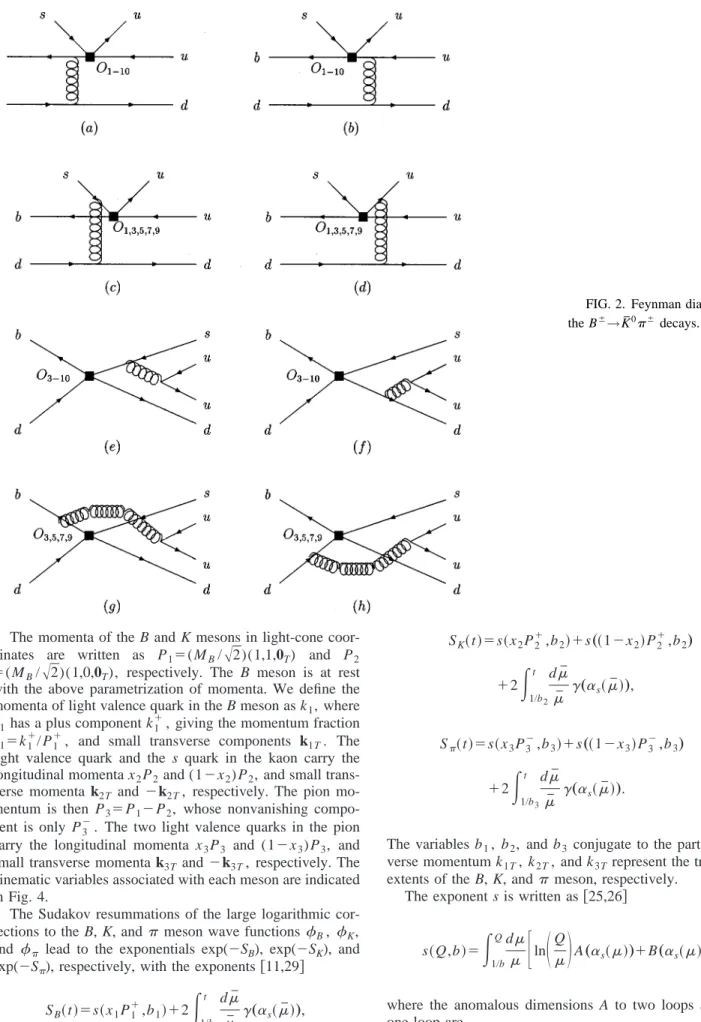
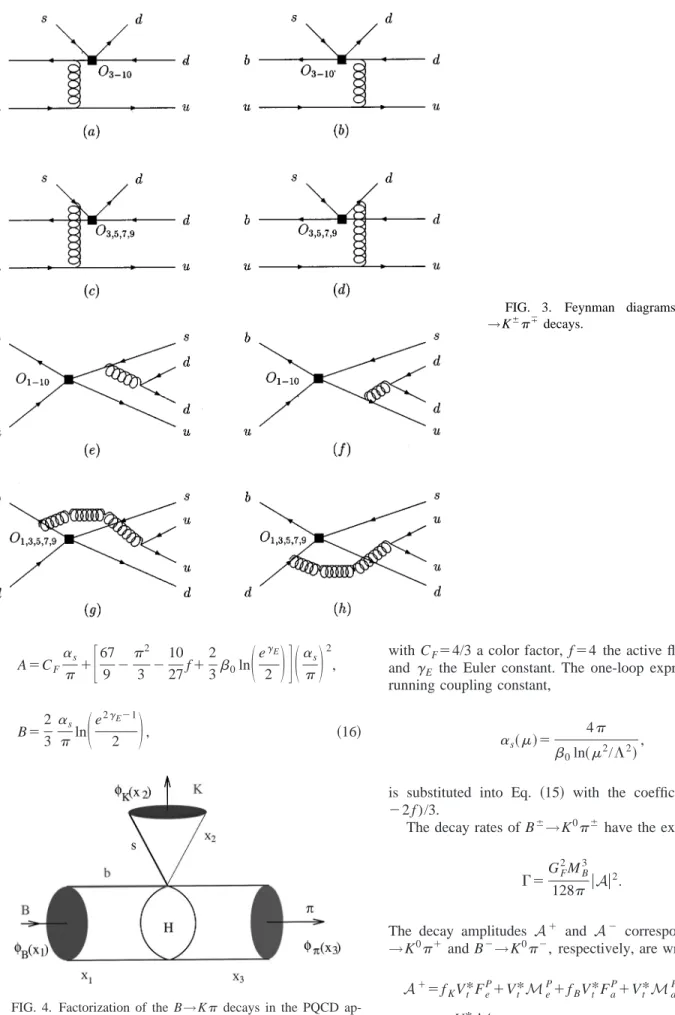
0→K⫾⫿ de- cays, the operators O1,2(u) contribute via a tree topology, and O1,2(c) do not contribute at leading order of ␣s. The penguin operators contribute in the same way as in the B⫾→K0⫾ decays but with the light quark q⫽u in the tree topology and with q⫽d in the annihilation topology. The lowest-order hard b quark decay amplitudes are summarized in Fig. 2 for Bd0→K⫿⫾ decays and in Fig. 3 for B⫾→K¯0⫾decays.
For the B⫾→K⫾0 decays, the operators O1,2(u)contribute via tree and annihilation topologies, where the tree topology involves both the B→ and B→K form factors. The pen- guin operators also contribute via tree and annihilation to- pologies with the light quark q⫽u in the annihilation topol- ogy. The tree topology involves both the B→ form factor with q⫽u and the B→K form factor, to which only the electroweak penguins with q⫽u and d contribute. For the Bd0→K00 decays, the operators O1,2(u)contribute via the tree topology, which involves only the B→K form factor. The penguin operators contribute via tree and annihilation topolo- gies with the light quark q⫽d in the annihilation topology.
The tree topology involves both the B→ form factor with q⫽d and the B→K form factor, to which only the elec- troweak penguins with q⫽u and d contribute. Their lowest- order diagrams for the hard b quark decay amplitudes are basically similar to those in Figs. 2 and 3.
The momenta of the B and K mesons in light-cone coor- dinates are written as P1⫽(MB/冑2)(1,1,0T) and P2
⫽(MB/冑2)(1,0,0T), respectively. The B meson is at rest with the above parametrization of momenta. We define the momenta of light valence quark in the B meson as k1, where k1 has a plus component k1⫹, giving the momentum fraction x1⫽k1⫹/ P1⫹, and small transverse components k1T. The light valence quark and the s quark in the kaon carry the longitudinal momenta x2P2 and (1⫺x2) P2, and small trans- verse momenta k2T and⫺k2T, respectively. The pion mo- mentum is then P3⫽P1⫺P2, whose nonvanishing compo- nent is only P3⫺. The two light valence quarks in the pion carry the longitudinal momenta x3P3 and (1⫺x3) P3, and small transverse momenta k3T and⫺k3T, respectively. The kinematic variables associated with each meson are indicated in Fig. 4.
The Sudakov resummations of the large logarithmic cor- rections to the B, K, and meson wave functions B, K, and lead to the exponentials exp(⫺SB), exp(⫺SK), and exp(⫺S), respectively, with the exponents关11,29兴
SB共t兲⫽s共x1P1⫹,b1兲⫹2冕1/b1 t d¯
¯ ␥„␣s共¯兲…,
SK共t兲⫽s共x2P2⫹,b2兲⫹s„共1⫺x2兲P2⫹,b2…
⫹2冕1/b2 t d¯
¯ ␥„␣s共¯兲…,
S共t兲⫽s共x3P3⫺,b3兲⫹s„共1⫺x3兲P3⫺,b3…
⫹2冕1/b3 t d¯
¯ ␥„␣s共¯兲…. 共14兲 The variables b1, b2, and b3 conjugate to the parton trans- verse momentum k1T, k2T, and k3T represent the transverse extents of the B, K, and meson, respectively.
The exponent s is written as关25,26兴
s共Q,b兲⫽冕1/b Qd
冋ln冉Q冊A„␣s共兲…⫹B„␣s共兲…册, 共15兲
where the anomalous dimensions A to two loops and B to one loop are
FIG. 2. Feynman diagrams for the B⫾→K¯0⫾decays.
A⫽CF
␣s
⫹冋679 ⫺32⫺1027f⫹230ln冉e2␥E冊册冉␣s冊2,
B⫽2 3
␣s
ln冉e2␥2E⫺1冊, 共16兲
with CF⫽4/3 a color factor, f ⫽4 the active flavor number, and ␥E the Euler constant. The one-loop expression of the running coupling constant,
␣s共兲⫽ 4
0ln共2/⌳2兲, 共17兲
is substituted into Eq. 共15兲 with the coefficient 0⫽(33
⫺2 f )/3.
The decay rates of B⫾→K0⫾have the expressions
⌫⫽GF2MB3
128 兩A兩2. 共18兲
The decay amplitudes A⫹ and A⫺ corresponding to B⫹
→K0⫹ and B⫺→K0⫺, respectively, are written as A⫹⫽ fKVt*FeP⫹Vt*MeP⫹ fBVt*FaP⫹Vt*MaP⫺ fBVu*Fa
⫺Vu*Ma, 共19兲
FIG. 3. Feynman diagrams for the Bd0
→K⫾⫿decays.
FIG. 4. Factorization of the B→K decays in the PQCD ap- proach.
A⫺⫽ fKVtFeP⫹VtMe
P⫹ fBVtFaP⫹VtMa
P⫺ fBVuFa
⫺VuMa, 共20兲
with the B meson共kaon兲 decay constant fB(K). The notations F represent factorizable contributions共form factors兲, and M represent nonfactorizable 共color-suppressed兲 contributions.
The subscripts a and e denote the annihilation and tree to- pologies, respectively. The superscript P denotes contribu- tions from the penguin operators. Fa, associated with the timelike K→ form factor, andMa are from the operators O1,2(u).
The decay rates of Bd0→K⫾⫿ have the similar expres- sions with amplitudes
A⫽ fKVt*FeP⫹Vt*MeP⫹ fBVt*FaP⫹Vt*MaP⫺ fKVu*Fe
⫺Vu*Me, 共21兲
A¯⫽ fKVtFeP⫹VtMe
P⫹ fBVtFaP⫹VtMa
P⫺ fKVuFe
⫺VuMe, 共22兲
for Bd0→K⫹⫺ and B¯d
0→K⫺⫹, respectively. The nota- tions are similar to those in Eqs. 共19兲 and 共20兲. Fe, associ- ated with the B→ form factor, andMe are from the op- erators O1,2(u).
The decay amplitudes for B⫾→K⫾0 are given by
冑2A⬘⫹⫽ fKVt*FeP⫹Vt*MeP⫹ fBVt*FaP⫹Vt*MaP
⫹ fVt*FeKP ⫹Vt*MeKP ⫺ fKVu*Fe⫺Vu*Me
⫺ fBVu*Fa⫺Vu*Ma⫺ fVu*FeK⫺Vu*MeK, 共23兲
冑2A⬘⫺⫽ fKVtFeP⫹VtMe
P⫹ fBVtFaP⫹VtMa
P⫹ fVtFeKP
⫹VtMeK
P ⫺ fKVuFe⫺VuMe⫺ fBVuFa
⫺VuMa⫺ fVuFeK⫺VuMeK, 共24兲
which correspond to B⫹→K⫹0 and B⫺→K⫺0, respec- tively. The factorizable contribution FeKP (FeK) is associated with the B→K form factor from the penguin 共tree兲 operators, andMeK
P (MeK) is the corresponding nonfactorizable con- tribution.
Similarly, the decay rates of Bd0→K00are obtained from the amplitudes
冑2A⬘⫽ fKVt*FeP⫹Vt*MeP⫹ fBVt*FaP⫹Vt*MaP⫹ fVt*FeKP
⫹Vt*MeKP ⫺ fVu*FeK⫺Vu*MeK, 共25兲
冑2A¯⬘⫽ fKVtFe
P⫹VtMe
P⫹ fBVtFaP⫹VtMa
P⫹ fVtFeKP
⫹VtMeK
P ⫺ fVuFeK⫺VuMeK, 共26兲
for Bd0→K00 and B¯d
0→K¯00, respectively.
Basically, one needs to derive the factorization formulas only for the tree and annihilation topologies. Wilson coeffi- cients corresponding to different operators are then inserted into the factorization formulas. The form factors are written as
FeP⫽Fe4 P ⫹Fe6
P ,
Fe4P⫽16CFMB2冕01dx1dx3冕0⬁b1db1b3db3B共x1,b1兲兵关共1⫹x3兲共x3兲⫹r共1⫺2x3兲⬘共x3兲兴Ee4共te(1)兲he共x1,x3,b1,b3兲
⫹2r⬘共x3兲Ee4共te
(2)兲he共x3,x1,b3,b1兲其, 共27兲
Fe6P⫽32CFMB2冕0 1
dx1dx3冕0
⬁
b1db1b3db3B共x1,b1兲rK兵关共x3兲⫹r共2⫹x3兲⬘共x3兲兴Ee6共te
(1)兲he共x1,x3,b1,b3兲
⫹关x1共x3兲⫹2r共1⫺x1兲⬘共x3兲兴Ee6共te
(2)兲he共x3,x1,b3,b1兲其, 共28兲
FaP⫽Fa4 P ⫹Fa6
P ,
Fa4P ⫽16CFMB2冕0 1
dx2dx3冕0
⬁
b2db2b3db3兵关⫺x3K共x2兲共x3兲⫺2rrK共1⫹x3兲
⫻K⬘共x2兲⬘共x3兲兴Ea4共ta
(1)兲ha共x2,x3,b2,b3兲⫹关x2K共x2兲共x3兲⫹2rrK共1⫹x2兲K⬘共x2兲⬘共x3兲兴
⫻Ea4共ta
(2)兲ha共x3,x2,b3,b2兲其, 共29兲