國立臺灣大學工學院土木工程學系 碩士論文
Department of Civil Engineering College of Engineering National Taiwan University
Master Thesis
商辦大樓採用半透明式太陽能光電玻璃之可行性分析- 以越南河內為例。
The feasibility of applying semi-transparent
photovoltaic panel glasses into office building in Hanoi, Vietnam
武德盛 Vu, Duc Thinh 指導 : 郭斯傑 教授 Advisor: Prof. Guo, Sy-Jye
中華民國 107 年 6 月
ACKNOWLEDGMENTS
First and foremost, it is my great pleasure to have Professor Sy-Jye, Guo as my advisor.
It is undoubtedly that my thesis would not have been completed without his wise advices and supports.
I also would like to express my sincere gratitude to the other professors of the faculty of Construction Engineering Management (CEM) of National Taiwan University, Professor Shih-Ping, Ho, Professor Po-Han, Chen, and Professor Ying-Chieh, Chan for their enthusiasm and kindness during the time of studying my Master degree in Vietnam and Taiwan.
My special thanks are extended to the staff members of Department of Civil Engineering of National Taiwan University for always being friendly, kind, and enthusiastic to me and the other Vietnamese students.
I also wish all the best to my Taiwanese friends who helped and encouraged me a lot during the time studying in Taiwan. Although it is just a short time but all the memories, the experience that they and the other Taiwanese have given to me are so memorable and beautiful.
Last but not least, I could not have come this far without my beloved family. Without their loves in the hardest times in my life, I could not have had what I have either in the past or in the future.
ABSTRACT
Vietnam, a tropical country in southeast asia which has been developping at a remarkable pace and being one of the most fastest growing countries in recent years. However, along with the boom of economy, the need of energy consumption for it has also increased rapidly. It affects a lot to the economy and the environment due to Vietnam has been producing electricity mostly from fossil fuels, those non renewable resources which contribute the most to the pollution and also the climate change.
Nevertheless, Vietnam is blessed with huge potential in terms of renewable energy development. Vietnam has a lot of rooms to apply technologies of producing power from solar radiation, wind. Besides, it is crucial to reduce the energy consumption of the economy in order to maximize the benefit and help the economy growing faster. In terms of the buildings, the development of the technology of generating power from solar radiation has opened the doors for new applications, new ideas for both the designers and the managers. The study discusses the feasibility of applying semi-transparent photovoltaic glasses, a new technology which has been researched in recent years into the facades of an office building in Hanoi, capital of Vietnam. It allows visible light from outside comes into the building while generating power from solar radiation and blocking a part of the heat transfered from the environment.
In summary, the cost of operating the building has not been considered properly in Vietnam. Most of people focus on the initial cost of building the construction while the operation cost, which affects a lot to the financial issue has not received much attention of the designers and the managers. The study is expected to point out the benefit of the new technology to encourage people to follow in order to give a hand to reduce the energy consumption of the Vietnamese economy.
TABLE OF CONTENTS
ACKNOWLEDGMENTS ... i
ABSTRACT ... ii
TABLE OF CONTENTS ... iii
GLOSSARY OF TERMS AND ABBREVIATIONS ... v
LIST OF FIGURES ... vii
LIST OF TABLES ... viii
CHAPTER I: INTRODUCTION ... 1
1.1 RESEARCH BACKGROUND ... 1
1.2 PROBLEM STATEMENT ... 4
1.3 RESEARCH OBJECTIVES ... 5
1.4 SCOPE AND LIMITATIONS ... 6
1.5 RESEARCH METHODOLOGY ... 7
1.6 EXPECTED RESULTS ... 8
CHAPTER II: LITERATURE REVIEW ... 9
2.1 OVERVIEW OF THE ENERGY SECTOR OF VIETNAM ... 9
2.2 ENERGY CONSUMPTION OF OFFICE BUILDING... 11
2.3 THE IMPACT OF WINDOW ON ENERGY CONSUMPTION OF OFFICE BUILDING... 13
2.4 THE POTENTIAL OF SOLAR ENERGY IN VIETNAM ... 15
2.5 BRIEF INTRODUCTION ABOUT REVIT ARCHITECTURE ... 17
2.6 BRIEF INTRODUCTION ABOUT DESIGNBUILDER ... 17
2.7 BRIEF INTRODUCTION OF STPV IN THE MARKET... 18
2.8 BRIEF REVIEW ABOUT THE PREVIOUS STUDIES ... 19
CHAPTER III: SIMULATING THE EFFECTS OF SEMI-TRANSPARENT SOLAR GLASSES ON VCCI BUILDING AND VALIDATING THE RESULTS BY THE PRACTICAL DATA ... 21
3.1 BASIC DATA INFORMATION OF THE CASE STUDY BUILDING ... 21
3.2 BASIC DATA INFORMATION OF WEATHER IN HANOI ... 29
3.3 CASE STUDY STPV PANELS ... 30
3.4 SIMULATING VCCI TOWER IN REVIT 2016 ... 33
3.4.1 Building information ... 33
3.4.2 Simulating the building ... 33
3.5 SIMULATING THE MODEL IN DESIGNBUILDER AND ADJUSTING THE
OUTPUT RESULTS ... 34
3.5.1 Gathering practical data of energy consumption of VCCI Tower ... 34
3.5.2 Importing Revit model into DesignBuilder ... 35
3.5.3 Running and adjusting the simulation... 37
3.5.4 Simulating the performance of BriteSolar’s product on the energy balance of VCCI Tower ... 39
CHAPTER IV: ANALYZING THE FEASIBILITY OF APPLYING STPV GLASS INTO THE BUILDING ... 42
4.1. GATHERING INPUT PRICES ... 42
4.1.1. Double glazing ... 42
4.1.2. BriteSolar panel ... 42
4.1.3. Inverter ... 42
4.1.4. Cost of energy ... 44
4.1.5. Calculating the costs ... 46
4.2. CALCULATING THE NET PRESENT VALUES OF TWO ALTERNATIVES.. 47
Choosing the interest rate ... 47
Financial result of applying double glazing units ... 48
Financial result of applying BriteSolar panels ... 49
CHAPTER V: CONCLUSION AND RECOMMENDATIONS ... 51
5.1 CONCLUSION ... 51
5.2 RECOMMENDATIONS ... 51
REFERENCES ... 53
GLOSSARY OF TERMS AND ABBREVIATIONS
GDP Gross Domestic Product
ADB Asian Development Bank
U.S. EIA United State Energy Information Administration Mtoe Millions tonnes of oil equivalent
STPV Semi-transparent Photovoltaic
TWh terawatt-hour
GW gigawatt
MWh megawatt-hour
kWh kilowatt-hour
VND Vietnam Dong
USD United State Dollar
Btu British thermal unit
UNDP United Nations Development Program
SEC Specific Energy Consumption
VT Visual Transmittance
SHGC Solar Heat Gain Coefficient
LR Light Reflectance
TSC Total Shading Coefficient
U value Thermal Transmittance
WWR Window-to-Wall Ratio
MoIT Ministry of Industry and Trade
GHI Global Horizontal Irradiation
DNI Direct Normal Irradiation
BIM Building Information Modeling
HVAC Heating, Ventilation, and Air Conditioning
UV Ultra Violet
NIR Near-Infrared Reflectance
VCCI Vietnam Chamber of Commerce and Industry
IBMS Intergrated Building Management System
VRF Variable Refrigerant Flow
DSM Dye Sensitized Module
LIST OF FIGURES
Figure 1.1: Sustainable development ... 1
Figure 1.2: Renewable energy ... 2
Figure 1.3: Maps of solar resource and potential in Vietnam ... 3
Figure 1.4: U.S. Electricity Consumption by Sector ... 4
Figure 2.1: Planned Power Generation Capacity Mix in 2015, 2020, 2025, and 2030 ... 10
Figure 2.2: Primary energy end use in US commercial and residential buildings in 2010. (Source: US EIA, 2011; 2012) ... 14
Figure 2.3: Map of annual average of daily GHI and DNI (kWh.m-2.day-1) in Vietnam ... 16
Figure 3.1: The VCCI Tower ... 21
Figure 3.2: VCCI Tower's facade ... 22
Figure 3.3: Information about VCCI Tower ... 24
Figure 3.4: Elevation drawing... 25
Figure 3.5: Section drawing ... 26
Figure 3.6: First floor (lobby) ... 27
Figure 3.7: Typical floor ... 28
Figure 3.8: BriteSolar Dye Sensitized Solar Panel ... 31
Figure 3.9: The Solar Transmittance (SHGC) ... 32
Figure 3.10: Using Revit 2016 to build VCCI Tower model ... 34
Figure 3.11: Importing Revit model into DesignBuilder ... 36
Figure 3.12: The visualization of the model in DesignBuilder ... 37
Figure 3.13: Input values of double glazing ... 38
Figure 3.14: Adjusting the properties of BriteSolar STPV panel ... 40
Figure 4.1: Map of solar photovoltaic on grid system ... 43
Figure 4.2: The operating schedule of equipment in VCCI Tower (100% from 6h to 20h) .. 44
Figure 4.3: The schedule of number people inside the building by time ... 45
Figure 4.4: Cash flow diagram of VCCI Tower with double glazing units ... 49
Figure 4.5: Cash flow diagram of VCCI Tower with STPV glasses ... 50
LIST OF TABLES
Table 2.1: Energy demand: Actual (2005-2014) and Projected (2015-2030) ... 9
Table 2.2: Estimated building stock in Vietnam ... 12
Table 2.3: Average SEC of Commercial and High-rise Residential Buildings in Vietnam ... 13
Table 3.1: The average temperatures of Hanoi in 12 months (number 20) ... 29
Table 3.2: STPV properties ... 33
Table 3.3: BriteSolar's STPV glass properties………....45
Table 3.4: The average monthly data of energy consumption of VCCI Tower during the period of 2008-2014 ... 35
Table 3.5: Simulation results of double glazing units ... 39
Table 3.6: Energy generated by BriteSolar glass ... 40
Table 3.7: The energy consumption of VCCI Tower with BriteSolar glass ... 41
Table 4.1: Vietnam Electricity tariff (2018) ... 44
Table 4.2: Interest rates in Vietnam (updated April 2018) ... 48
CHAPTER I: INTRODUCTION
1.1 RESEARCH BACKGROUND
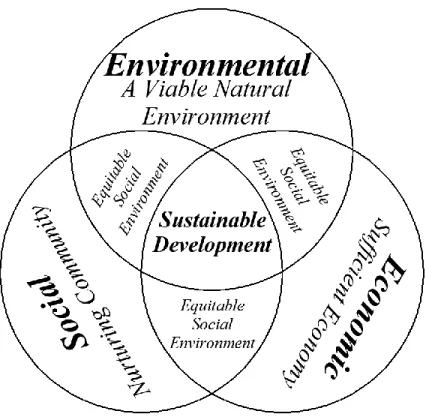
It is undoubtedly that energy has an important role in economic growth and social development. Utilizing and controlling the total energy demand is the priority of any country and it is the pivotal mission especially with developing countries. Sustainable development is the key of successful stories. It requires the harmonious combination between economic, social and environmental factors, it is shown in Figure 1.1.
Figure 1.1: Sustainable development
Energy is indispensable for social activities, growing economy and it also affects a lot to the environment. Providing the energy needed with acceptable cost along with reducing the total energy demand certainly is a huge challenge but it will bring a lot of benefit to those countries.
In the case of Vietnam, a tropical country in South East Asia which is considered as a developing country with 202.6 billion USD Gross Domestic Product (GDP) in 2016 according to World Bank. Vietnam has not had any nuclear power plant. In order to provide energy needed for social and economic activities, electricity has been generated mostly from fossil fuels and hydraulic power. However, it impacts significantly to the environment of this country and being one of the main reasons of the pollution and natural disasters such as drought, flood, resource depletion, etc.
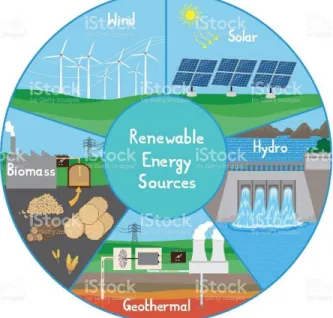
Furthermore, it is also the main factor causing the global warming by producing carbon dioxide (CO2) which penetrates the ozone layer and let more sunshine to the surface of the Earth and also the Arctic sea ice loss. In 2012, the share of total national primary energy by fuel type was coal (26%), crude oil and petroleum products (27%), gas (14%), hydropower generation (8%), and noncommercial energy (25%). (ADB, 2015). It raises the need of using renewable energy such as solar power, wind power, bioenergy, etc. (Figure 1.2)
Figure 1.2: Renewable energy
Fortunately, Vietnam seems like a good candidate for renewable energy projects.
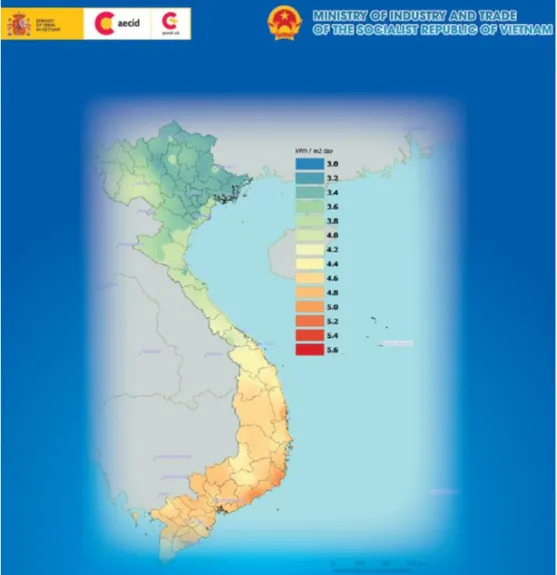
According to the Ministry of Industry and Trade (MoIT) of Vietnam, with a coastline of 3260 km and solar energy intensity on the average is 5kWh/m2, the intensity is lower in the North at about 4kWh/m2 due to the annual winter-spring cloudy and drizzle sky. It has a huge potential in applying wind and solar technologies (Figure 1.3). The duration on which the average sunshine is at 150 kcal/m2 is between 2000-5000 hours per year.
Figure 1.3: Maps of solar resource and potential in Vietnam (Source: MoiT, 2014, retrieved from https://bit.ly/2yywDj1)
1.2 PROBLEM STATEMENT
Alongside increasing electricity generated from renewable resources, reducing the total consumption by applying new technologies also are the priority of Vietnam government in order to control the stability in energy using. Beside applying updated technologies and machines in industry aspect, making policies about the standards for using electricity in public areas, and propagandizing about saving energy to the people, there still have problems with the buildings.
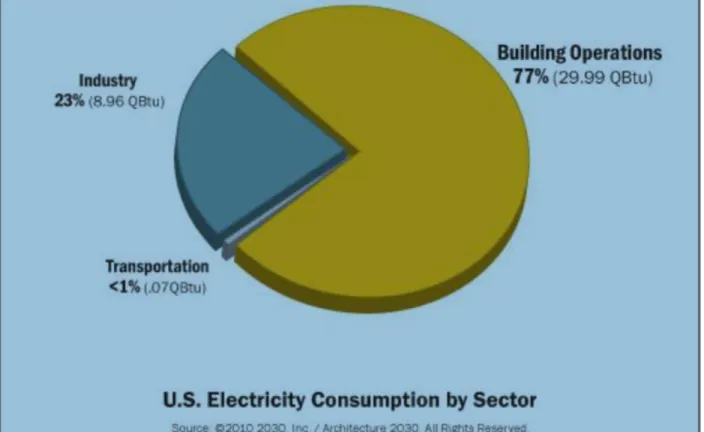
According to U.S. Energy Information Administration (EIA), in terms of electricity, building operation is responsible for 77% of all power plant-generated electricity. (Figure 1.4).
Figure 1.4: U.S. Electricity Consumption by Sector (Source: U.S. EIA)
Also according to ADB in 2012, the total final energy consumption in Viet Nam was 49.3 Mtoe (Millions tonnes of oil equivalent), including 14.0 Mtoe of noncommercial energy, and 8 where share by sector as follows: residential (33%), transport (24%), service (3%), industrial (39%), and agriculture (1%). (ADB, 2015).
Due to the Building Operations Sector has significantly impacted on total energy consumption, it could be a huge benefit if we can utilize their facades and rooftops to generate electricity. Experts also predict that unless commercial property owners or management companies begin to seriously implement sustainability technologies into the designs of office buildings and other similar structures, then energy consumption and operational prices will continue to rise.
1.3 RESEARCH OBJECTIVES
It is obviously that with the ability of generating electricity from solar radiation and partly preventing the heat transfer from non-visible light, the Semi-Transparent Photovoltaic (STPV) glass would have contributed to the energy balance of the building, especially office building. Due to the fact that it has been produced in mass production scale, it is viable to coat the entire office building with this product. In this research, it is expected to meet 2 objectives: analyzing energy saving and calculating the estimated amount of money saving from it.
Firstly, it is necessary to specified the amount of money spent for energy used by the building during its life cycle of 50 years with the regular double glazing coated its facades.
Secondly, it is undoubtedly that analyzing the amount of electricity saving of a representative office building in Vietnam by applying STPV glasses instead of regular glasses is essential that have to be identified. This kind of technique has been researched for years and its
efficiency has been improved. Though, the outcome which takes the role of the input for the next step is expected to have relative impact to the energy balance of the building.
Thirdly, in order to have a clear view for people who are considering about this product, the benefit of applying it to the building during its life cycle of about 50 years has to be indentified by calculating the estimated amount of money can be saved. Since the price of this kind of glass has been dramatically reduced in recent years, it is potential to have a worthy outcome.
Finally, the total costs of installing and operating regular double glazing and STPV glass will be compared during 50 years to find out which alternative is better to invest. In the case of applying STPV is still costlier than the double glazing, the boundary price of it will be determined to start having benefit since the price of this technology is going down and the efficiency is increased by the time.
1.4 SCOPE AND LIMITATIONS
Due to this technology has been developed, it has been just a few companies around the world which are providing the STPV panels, the research will study on a specific product with its current price.
It also aims only to the cost analysis, will not consider to the technique, give any solution or recommendation about further improvement of the properties of this type of product.
The case study of this research is located in Hanoi, Vietnam, a tropical country which has high level of humidity and high average temperature with a huge amount of sunshine year-round.
The result can only be applied in the other regions with the same weather conditions.
Due to the time limitation of study, the building is in Vietnam and the technology is new, this research is not able to build and collect data from a real model then all the results are just estimated.
The estimated cost of the product may not be accurate since the suppliers provide only the ex-works price. It will not include the shipping cost of the product to Vietnam. The study will try to estimate the final cost of the product in calculating the benefit so all the results are just relative.
1.5 RESEARCH METHODOLOGY
Choosing Hanoi to be analyzed due to the amount of sunshine increases from the North to the South which is nearer the Equator than the North of Vietnam. If the result is positive then it can be applied in any region in Vietnam. If it is negative then further research to the buildings in the South of Vietnam are needed in order to conclude whether it is not feasible to apply in Vietnam.
Firstly, it is obviously that creating a simulated model of a real office building in Hanoi is very important with this study. It will be built by using Revit.
Secondly, the required documents will be collected such as the reports about the practical data of total amount of energy of that building applying regular glasses in a year, the weather data of Hanoi, the sunlight data of Hanoi and other relevant information which serve as the inputs for DesignBuilder to calculate the total energy demand of that building. It can be said that the precision of the outcome result mostly depends on this step.
Thirdly, it will check the simulated results and adjust to make them as close as the practical data. The method is to keep the other inputs except the properties of STPV glasses as constants.
The next is collecting data of the properties and cost information of STPV glass to calculate the amount of money saving in one life cycle of the building, about 50 years.
Finally, if the results are positive, this study will recalculate and point out the boundary price the product should have in order to start having benefit from applying it.
1.6 EXPECTED RESULTS
The study aims to have the relative amount of money saving by coating the office building facades with STPV glasses instead of regular glasses.
It is believed to be a reference to people who have a clear view about the potential of applying this product, to be a proof of its benefit and to encourage people to apply it.
CHAPTER II: LITERATURE REVIEW
2.1 OVERVIEW OF THE ENERGY SECTOR OF VIETNAM
Vietnam has been among Asia’s fastest growing economies. Vietnamese economy has been experiencing fast economic growth since the 2000s. It means the increasing of demand for electricity and other forms of end-use energies.
According to ADB, during 2005-2014, the electricity demand of Vietnam grew at an average annual pace of 12.1%, from 45.6 terawatt-hours (TWh) to 128.4 TWh, peak demand increased from 9.5 gigawatts (GW) to 22.2 GW. Per capita electricity consumption increased from 156 kilowatt-hours (kWh) in 1995 to 983 kWh in 2010 and to 1415 kWh in 2014. The installed and operating generation capacity of Vietnam increases at an average annual growth of 12.6%, from 11.6 GW in 2005 to 34.1 GW in 2014. The proportion of the power consumption by sector in 2014 was 53.9% for industrial, 35.6% for residential, 4.8% for commercial, 1.5% for agriculture and 4.3% for other sectors.
It was also estimated to grow at an average of 10.5% per annum during 2016-2020 and 8.0% during 2021-2030. Electricity consumption is projected to reach 234.6 TWh in 2020 and 506 TWh by 2030. The peak demand is estimated to reach 42.2 GW by 2020 and 90.7 GW by 2030 (Table 2.1).
Table 2.1: Energy demand: Actual (2005-2014) and Projected (2015-2030)
(Source: Government of Vietnam, 2015. Revised Power Development Plan 2011-2020. Hanoi)
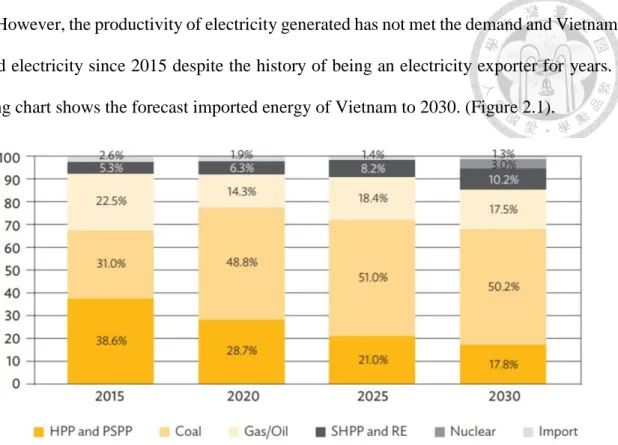
However, the productivity of electricity generated has not met the demand and Vietnam has imported electricity since 2015 despite the history of being an electricity exporter for years. The following chart shows the forecast imported energy of Vietnam to 2030. (Figure 2.1).
Figure 2.1: Planned Power Generation Capacity Mix in 2015, 2020, 2025, and 2030 (Source: Asian Development Bank based on the statistics of Government of Vietnam, 2015.
Revised Power Development Plan 2011-2020)
The other problem is the fossil fuels will keep being the main sources for generating power.
The fact is those are non-renewable resources and if Vietnam does not take any action to solve this situation, they will be depleted one day and it will ruin the Vietnamese economy. According to ADB, Vietnam was exporting coal until 2015, it has turned out to a net importer of coal. The forecasted total investment required for the development of the coal subsector is VND 109,156 billion ($5 billion) during 2016-2020 and VND 373,237 billion during 2021-2030 ($17 billion).
As a result, Vietnam government has considered the developing of power infrastructure in an inclusive, economically and environmentally sustainable manner to meet the rapidly growing
demand for electricity is a key priority. Besides, they also aim to enhancing energy efficiency in generation and consumption (supply-side and demand-side management). They are focusing on increasing the effect of producing electricity, decreasing the portion of fossil fuel and hydropower as they are harmful for the environment, increasing the involvement of renewable energy, and reducing the electricity demand by applying updated technologies, making policies about saving energy.
2.2 ENERGY CONSUMPTION OF OFFICE BUILDING
According to the US Energy Information Administration, commercial buildings (office spaces, retail structures and educational facilities) represent approximately one-fifth of the United State’s energy consumption. Despite the fact that office buildings just have the second largest amount of buildings and floor space, they consume the most energy. That type of building accounts for 19% of all commercial energy consumption, equivalent to almost 1 quadrillion British thermal units (Btu). The average individual office building uses 1.4 billion Btu a year. These structures have an energy intensity of 97.2 thousand Btu per square foot, which is larger than the average for all commercial structures at 90.5 thousand Btu per square foot. The larger the office building is, the bigger the energy consumption for it is. However, those bigger office buildings pay less per unit of energy than the smaller buildings due to the higher consumption and package rates offered by utility companies.
Also from this source, a typical office building spends $1.51 per square foot on average, which is more than the national average for energy used in commercial buildings at $1.19 per square foot.
There is just a few reports about the energy consumption of different type of buildings in Vietnam. According to United Nations Development Program (UNDP), office building compared with hotel and shopping center is the building type which has the largest floor area. In 2010, it has 1.6 million square meter while hotel has 15 thousand rooms and shopping center has nearly 1 million square meter in total. This trend has happened as the result of 2.8 million square meter for office building, 21 thousand rooms for hotel and 1.8 million square meter for shopping center in 2014 and it seems to keep happening in the future as Vietnam has been growing. It is shown in Table 2.2.
Table 2.2: Estimated building stock in Vietnam
(Source: Estimations by the Project Preparation Team based on reports published by CBRE, Colliers and Savills)
It is unsurprised that office building total area increased at a high pace of approximately 14% per year, nearly doubled from 1.6 million to 2.8 million in 4 years due to Vietnam has been considered as a developing country. However, the energy consumption of this type of building requires a huge amount of money. Also from this report, the Specific Energy Consumption (SEC) of some types of buildings are shown as Table 2.3.
Table 2.3: Average SEC of Commercial and High-rise Residential Buildings in Vietnam
With 164 kWh/m2/year and 2,211,000 square meter area in 2012, office building takes an account of 362.6 million kWh for energy consumption and it keeps increasing due to the expansion of total office area and more facilities will be applied in the building such as new computers, more air conditionings, etc.
In the current situation of Vietnam has been an importer of coal and electricity to supply its growing economy, the cost for energy could have impacted a lot to it. Finding ways to reduce and save energy consumption is as very important as increasing the productivity of energy generating, and due to the office building take responsibility for a huge amount of energy, it is needed to be managed and operated well.
2.3 THE IMPACT OF WINDOW ON ENERGY CONSUMPTION OF OFFICE BUILDING
Due to the properties of office building such as operating in day time (around 8am to 8pm), having a clear view from inside to outside to avoid tiredness for the staff members, its facades have to be covered by a large area of glasses which take the role of windows for the whole building.
Windows play an important part in the energy balance of the building. They also presents as a shield for the inside area from rain, wind, dust, and noise from outside. Windows is considered the weakest thermal link in a building envelope for heat gain in summer and heat loss in winter. It has the greatest effect on heat flow than walls, ceilings, and floors of the building, especially in the office building. Thus, it has been considered as one of the most important elements that impact to the building energy consumption. Besides, the transparency of the glasses also affects the internal light of the building, which also impacts to the energy consumption.
According to US EIA, the lighting, space heating and space cooling take 50% in total of the energy consumption of commercial building, which takes 19% of the total energy consumption of the US economy (Figure 2.2).
Figure 2.2: Primary energy end use in US commercial and residential buildings in 2010.
(Source: US EIA, 2011; 2012)
The workability of the glass windows is decided by the properties of the type of glasses. It has some physical coefficients such as Visual transmittance (VT), Solar heat gain coefficient (SHGC), Light reflectance (LR), Total Shading Coefficient (TSC), Thermal transmittance (U value), etc. The energy consumption of the building also be strongly affected by the Window-to- wall ratio (WWR). Among all the type of building, office building has the largest façade area covering all sides which serves as a huge window for the building.
2.4 THE POTENTIAL OF SOLAR ENERGY IN VIETNAM
According to a survey published by MoIT of Vietnam in 2014, Vietnam is located in South East Asia, extending between latitudes 9oN and 23oN. Vietnamese climate is dominated by the tropical monsoon, with high heat and humidity. It already has a large and extensive database of sunshine duration measurements by the Vietnamese National Hydro-Meteorological Service from 171 stations distributed along the country from 1983 to 2012. In terms of solar radiation ground measurements, there are 14 automatic stations. (MoIT, 2014).
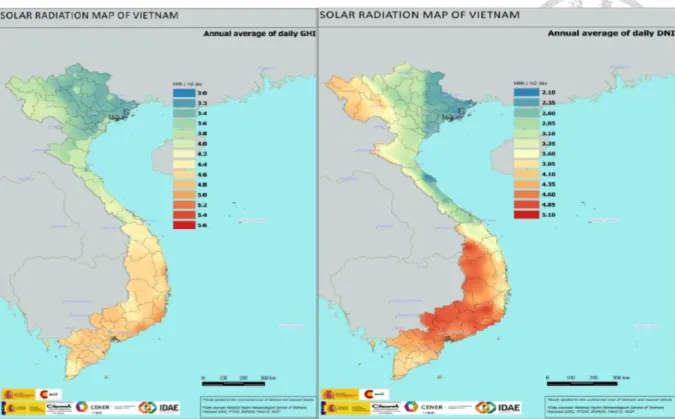
The results of the Global Horizontal Irradiation (GHI) and Direct Normal Irradiation (DNI) which relatively indicate the total amount of shortwave radiation received from above by a surface horizontal to the ground and the amount of solar radiation received per unit area by a surface that is always held perpendicular to the sunrays are shown in Figure 2.3
Figure 2.3: Map of annual average of daily GHI and DNI (kWh.m-2.day-1) in Vietnam (Source: MoiT, 2014, retrieved from https://bit.ly/2yywDj1)
The maps reveal that the annual average of daily GHI reaches around 3.4kWh.m-2.day-1 in the north, 3.8 kWh.m-2.day-1 in the north central coast, and 4.8 kWh.m-2.day-1 in the south, central highlands and south central coast. Relatively with DNI at 2.5 kWh.m-2.day-1 in the north and central coast and 4.2 kWh.m-2.day-1 in the south central coast and south of the country. Besides, the cost of solar components is cheaper and cheaper, from $3.5 in 5 years ago to about $0.5 now, and also the next generations have higher efficiencies, it has been considered to be the reliable resource to generate power to replace the fossil fuel. Vietnamese government has given policies about developing the infrastructure, technology of generating power from renewable energy, especially solar power and aims to make developing it to be the strategic priority.
2.5 BRIEF INTRODUCTION ABOUT REVIT ARCHITECTURE
Revit is a Building Information Modeling (BIM) application software. It can help users to create a virtual building and its components in 3D with all of its properties from 2D drafting elements, and extract any data from it as the BIM enable users to communicate model created by Revit to other applications such as structural analysis, energy analysis, etc.
Revit Architecture is a software for architects and engineers to create the building plan.
Unlike other 3D drawing softwares, it does not create building by extruding a box or other shapes which makes it be difficult to control the draw by joining, trimming segments, etc, Revit Architecture users just have to create the plan step by step from the practical work, start from drawing columns, floors, beams and then link them together. While creating the building plan, users can also add or adjust the properties of its components such as columns, beams, floors, windows by adding Revit families and then varying their coefficients in order to create the model.
These values combine with the environment data like weather, temperature, will significant impact to the result of the performance of model in the energy analysis softwares such as Energy Plus, DesignBuilder, eQuest.
2.6 BRIEF INTRODUCTION ABOUT DESIGNBUILDER
DesignBuilder, besides so many other softwares that could simulate the performance of a building with variety of parameters, for example: WWR, climate, HVAC equipment, etc, as simulated tool in a lot of studies due to its functions and advantages compared with the others. It is a unique tool for creating and assessing building designs, combines rapid building modelling and ease of use with “state of the art” dynamic energy simulation. Some typical uses are:
Evaluating a range of façade options for the effect on overheating, energy use and visual
Checking for optimal use of natural light. Modelling lighting control sustems and calculating savings in electric lighting.
Calculation of temperature, velocity and pressure distribution in and around buildings using CFD.
Visualisation of site layouts and solar shading.
Thermal simulation of naturally ventilated buildings.
HVAC design including heating and cooling equipment sizing.
Communication aid at design meetings.
Teaching building energy simulation.
Its innovative productivity features allow even complex buildings to be modelled rapidly by non-expert users.
2.7 BRIEF INTRODUCTION OF STPV IN THE MARKET
The technology of generating electricity from solar power through the photovoltaic panel has been developed for years and it has archived some remarkable goals. However, the most popular use of it has just been applying on the roof or on the ground in an open area due to the fact that those panels are totally opaque and do not let visible light pass through. In recent years, scientists have developed next generations of it by inventing new photovoltaic panels which are quite transparent to let the light pass through while still remains the ability of generating electricity.
Due to the target of the study is about the benefit of applying STPV to the office building, the cost of the product is the most important factor. There are 3 companies that are considered to be the supplier, they are Ubiquitous Energy, Brite Solar, and Polysolar.
The first is Ubiquitous Energy, a Silicon Valley technology company leading the
the world’s first truly transparent solar technology. Its products come in a variety of color tint possibilities including neutral color with transparencies between 50-80%. The electricity production capacity of a 1 square meter window coated with ClearView Power is about 50W in full sun. It also provides low emissivity and high solar control by selectively absorbing just the Ultra Violet (UV) and Near-Infrared Reflectance (NIR) light. The product is about $75 per 1 square meter.
The second is Brite Solar, a company in Greece which was founded in 2009 to develop a third generation dye sensitized solar cell for greenhouse applications. Its product has more than 70% transparent in the visible spectrum, 3-4 times more thermally insulating than dual pane windows. The cost of the product is about €50 per 1 square meter.
The last is Polysolar, a world leading Cambridge (UK) based developer and producer of innovative, low-cost, solar photovoltaic glass for the architectural market. They are providing STPV panels which is up to 50% transparency with the price of €200-€210 per standard module of 1,200x600x6.8mm.
2.8 BRIEF REVIEW ABOUT THE PREVIOUS STUDIES
Chen et al, 2012 used Solar Energy Research Institute of Singapore (SERIS)’s calorimetric hot box and solar simulator to present the sensitivity of SHGC of the STPV glazing in the tropical region of Singapore. The results indicated that SHGC is sensitive to spectral mismatch and absorber reflection but not to outdoor side temperature and solar irradiance. The double-glazed STPV glazing has a significant smaller SHGC value than laminate STPV glazing due to its low-e coatings. The values of SHGC also decreased dramatically along with the changes of incidence angle with more than 20% reduction from 45⸰ to 70⸰ but only 5% from 0⸰ to 45⸰. Olivieri et al, 2015 pointed the need of determining g-value of the STPV glazing in order to design the optimal
building solution since it is frequently unavailable in the data sheet of the STPV product. The authors used the indoor testing facility (g-box) to characterize the g-value of STPV elements with low uncertainty. The results showed that the g-value of the same element could vary up to 11%
moving from the short circuit to the maximum power point condition. Olivieri et al, 2014 have experimentally characterized the glazing solutions. Five different commercial STPV elements (transparencies are between 0% and 40%) have been analyzed with a reference glass in a simulated region of Madrid. The study showed that with the small façade openings, Window to Wall Ratio (WWR) is less or equal than 22%, the best performing STPV element has 5,5% energy saving potential than the regular glass. However, with at least 33% WWR for intermediate and large façade openings, the STPV solutions have promising results, the energy saving varies from 18%
with 33% WWR to 59% with 88% WWR higher than regular glass.
Kuo H.J, Hsieh S.H, Guo R.C, Chan C.C, 2016 studied on the reliability of BIM based energy analysis at the conceptual design stage. They built a model of the BIPV Experiment Demonstration House in the Industrial Technology Research Institute (ITRI, Taiwan) in Revit and then simulated the energy performance of it in EnergyPlus. After that, they compared the actual measured data of electricity produced by the real model with the simulated results. The results showed that the accuracy of BIM-based energy analysis of BIPV buildings in electricity production simulation is verified. It could be used in the very first phase of design to estimate the energy performance of the building.
CHAPTER III: SIMULATING THE EFFECTS OF SEMI-TRANSPARENT SOLAR GLASSES ON VCCI BUILDING AND VALIDATING THE
RESULTS BY THE PRACTICAL DATA
3.1 BASIC DATA INFORMATION OF THE CASE STUDY BUILDING
VCCI Tower is a 23-storey building located in Dao Duy Anh street, in a crowed area near the centre of Hanoi where has a lot of office buildings. It is the headquarter of Vietnam Chamber of Commerce and Industry (VCCI), a national organization which assembles and represents business community, employers and business associations of all economic sectors in Vietnam.
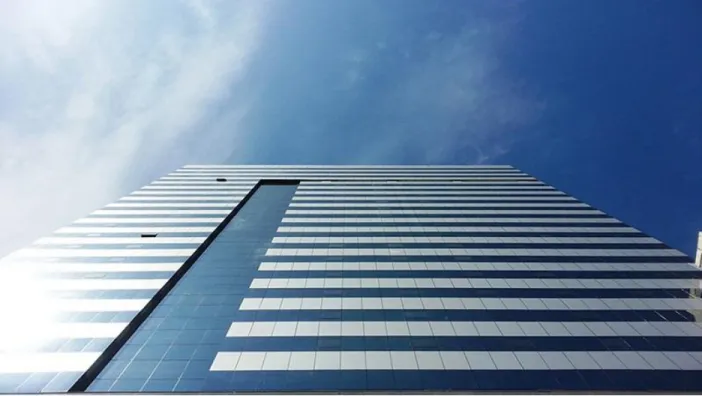
Several meetings between the Presidents/Prime Ministers over the world and seminars, big events of the business community of Vietnam and other nations have been held in this building. (Figure 3.1 and Figure 3.2)
Figure 3.2: VCCI Tower's facade
The building has 23 floors and 4 basements. The 1st floor is the lobby, event and conference room are in the 2th to 5th floors. From the 6th floor to 23th are the office renting area.
It has been applied Integrated Building Management System (IBMS), a computer-based control system installed in buildings that controls and monitors the building’s mechanical and electrical equipment such as ventilation, lighting, power systems, fire systems, and security systems. The building has a Variable Refrigerant Flow (VRF) system, a multi-split type air conditioner which uses variable refrigerant flow control with the ability of maintaining individual zone control in each room and floor. Inside the building, 10 high-speed elevators and 2 escalators have been installed. VCCI Tower also has 7,000 kVA of reserve generating capacity with 100%
back up full equipment.
VCCI Tower has the total area of 39,000 m2 which has 28,000 m2 office area and the rest is the meeting and event area. It has 9,000 m2 basement area which serve as the parking area of approximately 200 cars and 600 motorbikes. The building facades are coated by the vacuum insulated glazing which reduces the heat and the noise from outside the building more effectively than the regular glasses. Marble and granite are used as the finishing materials of the building.
(Figure 3.3).
Some of the drawings of this building are shown from Figure 3.4 to 3.7.
Figure 3.4: Elevation drawing
3.2 BASIC DATA INFORMATION OF WEATHER IN HANOI
The case study building VCCI is located in Hanoi, capital of Vietnam. Sitting in the North of Vietnam which has 4 different seasons (spring, summer, autumn, and winter), Hanoi has a humid tropical climate. During summer, it is very hot with plenty of rain while winter are cool and relatively dry. The average temperature of Hanoi is 23.6⸰C, the hottest month is July with 29.2⸰C in average while January is the coldest month with 16.4⸰C (Vietnam Institute for Building Science and Technology, 2009). The average temperatures of 12 months in Hanoi are listed in Table 3.1.
Table 3.1: The average temperatures of Hanoi in 12 months (number 20) Trạm: Station Tháng: Month Năm: Year
All the numbers are the pratical average values of temperature of
every month and year.
3.3 CASE STUDY STPV PANELS
Among 3 suppliers than were mentioned above, the offered prices of those 3 suppliers were $75 for each square meter from Ubiquitous, €50 for each square meter from BriteSolar, and €200 for each 0.72 square meter from PolySolar. It can easily be seen that PolySolar is not supposed to be the chosen since its price is very high compared to other competitors.
About Ubiquitous, although its price is good and its product has potential but they have not produced it in mass scale yet. They have prepared to open producing it in mass scale in the 3rd quarter of this year, 2018. So the study will choose the product from BriteSolar to calculate.
BriteSolar is a Greece company providing solar products. Their priority is to emerge in China market, followed by Spain, Holland, Japan, South Korea, and North America. They have factories in China producing their products. The data sheet of the case STPV panel is shown in Figure 3.8 below:
Figure 3.8: BriteSolar Dye Sensitized Solar Panel
However, the detailed information about its Solar Heat Gain coefficient (SHGC or g value or solar transmittance) and the U value are not provided by the company. These are the critical factors in simulating the energy performance of the product.
U value is defined as the rate of transfer of heat through a structure (which can be a single material or a composite), a building part (such as a wall or window), or a given thickness of a material (such as insulation). The lower the U value indicating the better insulating properties of the materials. The units of measurement is W/m²K.
SHGC (or g value or solar transmittance) is defined as the fraction of incident solar radiation admitted through a window, both directly transmitted and absorbed and
subsequently released inward. SHGC is expressed as a number between 0 and 1. The lower a window's SHGC, the less solar heat it transmits. (Figure 3.9).
Figure 3.9: The Solar Transmittance (SHGC)
(Source: Efficient Windows Collaborative, 2011-2018, retrieved from http://www.commercialwindows.org/shgc.php)
Due to the fact that the supplier did not provide the detail information about the properties of the product, those values are necessary to be predicted based on the similar products provided in the market at the same time. According to PolySolar due to the other products that are provided by them has the U value less than 1 with double glazed units, it is reasonable to predict that the U value and SHGC of the case study product are relatively similar to PolySolar’s product. Cornaro et al., 2017 study on the performance of 4 different STPV panels (Table 3.2).
Table 3.2: STPV properties
(Source: Cornaro, C., Basciano, G., Puggioni, V.A., and Pierro, M., 2017, retrieved from http://www.mdpi.com/2075-5309/7/1/9)
The study was published in the last year, 2017 and also experimented on 2 Dye Sensitized Module (DSM). Due to the information from Polysolar, it is highly likely that DSM-B model with 0.84 W/m2.K of U value, 0.15 SHGC, and 3% efficiency has the most similar information with the BriteSolar’s product. Then the case study product has:
Table 3.3: BriteSolar's STPV glass properties.
U value SHGC VT Efficiency
0.84 W/m2.K 0.15 70% 3%
3.4 SIMULATING VCCI TOWER IN REVIT 2016
3.4.1 Building information
VCCI Tower has 23 floors and 2 basements with the heights vary from 3 m for the ground floor and the mezzanine, 4.5 m for the 2nd floor to 5th floor, and 3.45 m each floor from the 6th to 23rd. Each floor has an area of 1,820 m2 with 52 m length and 35 m with.It has 220 mm brick external wall with alluminum along with double glazing with the Window to Wall Ratio (WWR) of 60%. The building faces southeast orientation with a small building next to it.
The model of VCCI Tower has been built based on its practical geometrical measurements and it is shown in Figure 3.10 below:
Figure 3.10: Using Revit 2016 to build VCCI Tower model
3.5 SIMULATING THE MODEL IN DESIGNBUILDER AND ADJUSTING THE OUTPUT RESULTS
3.5.1 Gathering practical data of energy consumption of VCCI Tower
According to a report of Ministry of Construction of Vietnam which was published in July 2014, the actual data of energy consumption for VCCI Tower was gathered during the period of 2008 to 2014. It was chosen to represent the typical office building in Vietnam due to it was designed with proper materials with the climate of Vietnam such as alluminum ceiling tiles, natural marble and granite with high aesthetic finish and long durability. Its
top to utilize the area for rent and help the owner to divide rooms to meet customers’ demands much easier. This trend of design has become more and more popular in Vietnam.
The results of the total energy consumption by sectors of VCCI Tower has been shown in the Table 3.3 below.
Table 3.4: The average monthly data of energy consumption of VCCI Tower during the period of 2008-2014
(Source: Trinh, H.V., Tran, T.V., 2014, retrieved from https://bit.ly/2tvTwxx)
According to the report, VCCI Tower is a multi-store office building with different materials and variety U values and SHGC. The external wall with alluminum outside has 2.2 W/m2.K of U value, the concrete has 1.86 W/m2.K, and the double glazing has 5.9 W/m2.K of U value and 0.52 SHGC.
3.5.2 Importing Revit model into DesignBuilder
The Revit model of the building was imported into DesignBuilder to run the simulation. After adjusting the thermal properties of the materials, the result of the model and its visualization are shown in Figure 3.11 and 3.12 below:
Figure 3.11: Importing Revit model into DesignBuilder
Figure 3.12: The visualization of the model in DesignBuilder 3.5.3 Running and adjusting the simulation
The study will focus on 4 criterias of the energy consumption data which are Chillers energy (Cooling energy), Total lights energy, Total equipment energy, and Total Fans interior. They take account of 84% the total end used energy every year:
Chillers energy (Cooling energy): 1018.7 MWh
Total lights energy: 1499.4 MWh
Total equipment energy: 1275.5 MWh
Total Fans interior: 3933.2 MWh
Figure 3.13: Input values of double glazing The simulation results are shown in the following Table 3.4:
Table 3.5: Simulation results of double glazing units
The total energies for cooling is 970.233 MWh, for interior lighting is 1479.746 MWh, for equipment is 1261.153 MWh, and for fans is 3858.921 MWh. Compared with the actual data of 1018.7 MWh (cooling), 1499.4 MWh (lighting), 1275.5 MWh (equipment), and 3933.2 MWh (fans). The results are quite accurate to the practical data.
3.5.4 Simulating the performance of BriteSolar’s product on the energy balance of VCCI Tower
Since there is no real model about the building, the method is to keep every properties of the simulation as constants (cooling temperature, heating temperature, floor area per person, metabolic, schedules, etc) and change only the properties of glass to take the simulated results of energy performance of BriteSolar’s STPV panel. That is believed to be
Figure 3.14: Adjusting the properties of BriteSolar STPV panel
The results of the energy consumption and energy generated while applying BriteSolar’s glass are shown in Table 3.5 and Table 3.6.
Table 3.6: Energy generated by BriteSolar glass
Table 3.7: The energy consumption of VCCI Tower with BriteSolar glass
The figures indicate that cooling energy decreases from 1018.7 MWh to 834.624 MWh (decreased 18.07%), interior lighting energy increases from 1499.4 MWh to 1644.162 MWh (increased 8.8%), fans energy slightly decreases from 3933.2 MWh to 3855.735 MWh (decreased 1.97%) due to the changes in U value, SHGC and Visible Transmittance. Only equipment remains the same since the schedule and number of equipment do not change.
Besides, the solar panels do generate 143.08 MWh every year.
CHAPTER IV: ANALYZING THE FEASIBILITY OF APPLYING STPV GLASS INTO THE BUILDING
4.1. GATHERING INPUT PRICES
4.1.1. Double glazing
The building was coated with the double glazing which is common in Vietnam. The price before tax of this type of glass is VND 650,000/m2 ($28.55/m2). Its durability is 25 years. With the total area of 8413.935 m2, the total cost for double glazing is $240,217.844.
4.1.2. BriteSolar panel
BriteSolar is providing STPV glass with a cost of €50/m2 ($58.55/m2). The transport price from China to Vietnam is VND 16,000/kg ($0.7/m2). The government does not give any other tax on it except VAT of 10%. Since the total area applying BriteSolar panels is 8413.935 m2 then the total price of STPV panels before tax is $498,525.65.
Since the durability of this product is guaranteed to have at least 90% after the first 10 years and at least 80% after the next 15 years then the life cycle of this product is considered as 25 years.
4.1.3. Inverter
After STPV panels convert solar radiation to electricity, it will have to go through an inverter which is an electronic device that changes the direct current to the alternative current to fit with the grid or the facilities inside the building. Since this is a large building and the price of battery is high so it is not supposed to be installed in this system. The best choice is
Due to the total amount of electricity generated by STPV panels in VCCI Tower is 143.08 MWh then we have to choose inverters which have at least 143.08 MWh of capacity in total. The peak sun hours during a day that STPV can generate power in north Vietnam is from 9h30 to 14h30, 5 hours.
The proper inverter would have at least 110 kW in capacity since the total power it can convert for 1 year with 80% efficiency is: 110 x 5(peak hours) x 0.8 x 365 (days) = 160.6 MWh.
In Vietnamese market, there are variety of type of inverters with a range of capacity.
One inverter of the model ABB ACS550-01-195A-4 110kW with a price of VND 94,322,288 ($4143.3) would be enough for the system.
The durability of this type of inverter is 5 years.
4.1.4. Cost of energy
The price of electricity in Vietnam for office building in 2018 is shown in Table 4.1:
Table 4.1: Vietnam Electricity tariff (2018) From 6 kV to 22 kV (per kWh)
Normal hour VND 2,426 (US$ 0.106)
Off-peak hour VND 1,428 (US$ 0.063)
Peak hour VND 4,061 (US$ 0.178)
The peak time is from 9h30 to 11h30 and from 17h to 20h. Off-peak time is during the midnight and the left is normal hours.
According to the report, the equipment has been used 100% from 6h to 20h every except Sunday, holidays (Figure 4.2) then the average amount of electricity for equipment in 1 hour is A (kWh). The total amount of energy for equipment in 1 day is 14A (kWh).
Figure 4.2: The operating schedule of equipment in VCCI Tower (100% from 6h to 20h)
It can easily be seen that 100% of the equipment of this building work during the peak hour of 9h30 to 11h30 and 17h to 20h. The other time is in normal hour. In conclusion, equipment use 5A kWh in peak time and 9A kWh in normal time.
The energy for cooling, lighting, and fan varies by the number of people inside the building. From the report, it is shown that there is 50% people from 8h, it goes to 100% from 8h30 to 12h, then 75% staffs will have lunch outside until 13h they will come back and work until 17h. People start leaving the building from 17h to 20h. (Figure 4.3).
Figure 4.3: The schedule of number people inside the building by time (Source: Trinh, H.V., Tran, T.V., 2014, retrieved from https://bit.ly/2tvTwxx)
Assume B (kWh) is the average amount of energy for cooling, lighting, and fans in 1h with 100% of people inside the building then the average amounts of electricity by time
(Number of people in the building) x (Number of hours)
8h-8h30: 0.5B x 0.5 = 0.25B (normal)
8h30-9h30: B x 1 = B (normal)
9h30-11h30: B x 2 = 2B (peak)
11h30-12h: 0.5B x 1 = 0.5B (normal)
12h-13h: 0.25B x 1 = 0.25B (normal)
13h-17h: B x 4 = 4B (normal)
17h-18h: 0.5B x 1 = 0.5B (peak)
18h-19h: 0.3B x 1 = 0.3B (peak)
19h-20h: 0.2B x 1 = 0.2B (peak)
Then the total amount of energy for cooling, lighting, and fans in 1 day is 9B (kWh) includung 3B peak hour and 6B normal hour. In summary, 1/3 of the energy consumption in a year is in peak hour and 2/3 left is in normal hour.
In terms of the power generated by the STPV panels, they can only generate power during the time of 9h30 to 14h30 (5 peak sun hours) in a day on average. As we know, 9h30 to 11h30 is the peak hours and the rest is normal hours so 2/5 of the power generated by STPV glass is in peak hour and the other 3/5 is in normal hour.
4.1.5. Calculating the costs
The costs were calculated in the previous parts:
- The price of double glazing units was shown in 4.1.1, page 53: $240,217.844 - The price of BriteSolar’s glass was shown in 4.1.2, page 53: $498,525.65
Besides, the costs of energy consumption by applying double glazing units, BriteSolar glasses in a year and the amount of money that can be sold from generating power by STPV panels in a year are indicated below by multiplying the amount of energy consumption by the unti price of electricity in peak hours and normal hours:
- The price of energy consumption by applying double glazing units in a year:
(5
14 x 1,275,500 + 1,018,700+1,499,400+3,933,200
3 ) x 4061 + [9
14 x 1,275,500 + 2
3 x(1,018,700 + 1,499,400 + 3,933,200)] x 2426 = VND 23,005,980,000 = $1,010,585.55
- The price of energy consumption by applying BriteSolar glasses in a year:
(5
14 x 1,275,500 + 834,624+1,644,162+3,855,735
3 ) x 4061 + [9
14 x 1,275,500 + 2
3 x (834,624+1,644,162+3,855,735)] x 2426 = VND 22,659,030,000 = $995,345.05
- The amount of money saved by generated power from STPV panels in a year:
2
5 x 143,080 x 4061 + 3
5 x 143,080 x 2426 = VND 440,686,400 = $19,358.07
Due to the efficiency of it decreases by time and it is guaranteed to have at least 90%
efficiency after the first 10 years and 80% efficiency after the next 15 years (year 25) then it will be divided into 2 periods of the first 10 years and the next 15 years to calculate. It is assumed that the efficiency decreases gradually during those periods.
During the first period of 10 years, it decreases 10% then every year it decreases 1%
which is 1.4308 MWh. It costs VND 4,406,864 = $193.58.
During the next 15 years, it decreases 10% then every year it decreases 0.67% which is 0.8585 MWh. It costs VND 2,644,180 = $ 116.15
4.2. CALCULATING THE NET PRESENT VALUES OF TWO ALTERNATIVES Choosing the interest rate
The calculations are based on the case that all of the costs will be paid by the owner’s money, there is no loan from bank in this study. The chosen interest rate would be at least the same as the interest rate that the banks are offering to people who save money in it. The newest interest rates that are given by a variety of banks in Vietnam are shown in Table 4.2.
Table 4.2: Interest rates in Vietnam (updated April 2018) (Source: https://bit.ly/2KcagEu)
According to the table, the average of interest rates is 7 % while Eximbank is giving the highest interest rate of 8%. It is reasonable to take the interest rate of 10% (8% + 2% for risk) in this study.
Financial result of applying double glazing units
For 25 years life span of double glazing, the owner has to pay the cost of buying
Figure 4.4: Cash flow diagram of VCCI Tower with double glazing units
Then the net present value of the alternative of applying double glazing glasses is:
NPVDG25 = -240,217.844 - 1,010,585.55 (1+0.1)
25−1
0.1(1+0.1)25 = - $9,413,343.32
For all the life cycle of the building (50 years), with 25 years durability of double glazing, it has to replace all the double glazing once at the end of year 25, it is assumed that all the prices and performances remain the same, the net present value would be:
NPVDG50 = -9,413,343.32 - 9,413,343.32 x 1
(1+0.1)25 = - $10,282,157.2 Financial result of applying BriteSolar panels
For 25 years life span of STPV glass, the owner has to buy the STPV glasses and inverter first and then reinvest inverter every 5 years due to its life cycle of 5 years. The owner also has to pay the bills for the power consumption of the building and take profit from selling electricity generated by the STPV glasses.
Figure 4.5: Cash flow diagram of VCCI Tower with STPV glasses Then the net present value of the alternative of applying BriteSolar glasses is:
NPVSTPV25 = -498,525.65 - 4143.3 - 995,345.05 (1+0.1)
25−1
0.1(1+0.1)25 – 4143.3 x [ 1
(1+0.1)5 +
1
(1+0.1)10 + 1
(1+0.1)15 + 1
(1+0.1)20] + 19,358.07 (1+0.1)
10−1
0.1(1+0.1)10 - 193.58
0.1 [(1+0.1)
10−1
0.1(1+0.1)10− 10
(1+0.1)10] +
[17,422.263 (1+0.1)
15−1
0.1(1+0.1)15 - 116.15
0.1 [(1+0.1)
15−1
0.1(1+0.1)15− 15
(1+0.1)15]] x 1
(1+0.1)10 = - $9,379,425.7
For all the life cycle of the building (50 years), with 25 years durability of STPV glass, it has to replace all the STPV panels once at the end of year 25, assume that all the prices and performances remain the same, the net present value would be:
NPVSTPV50 = -9,379,425.7 - 9,379,425.7 x 1
(1+0.1)25 = - $10,245,109.2
CHAPTER V: CONCLUSION AND RECOMMENDATIONS
5.1 CONCLUSION
The study estimated the energy performance of an office building in Hanoi called VCCI Tower in a year applying semi-transparent photovoltaic panel glasses. The case study STPV panels have 70% transparency, U value of 0.84 W/m2.K, SHGC of 0.52, and 3%
efficiency. The results show that it is potential to have at least $37,048 saving money, from
$10,282,157.2 of the net present value of applying double glazing units in 50 years to
$10,245,109.2 of the net present value of applying STPV panels. Although the amount of money saving is still low but the technologies of inverter and STPV glass have still been developed. In the future, it is undoubtedly that there will be more supplier with a variety of products that have higher and higher efficiencies and the costs will certainly be lower and lower. Even in this study, PolySolar and Ubiquitous confirmed that their current products can already achieve up to 12% (4 times higher than the case study product).
Besides, the results also prove that this kind of technology is suitable to be applied in all the region of Vietnam since the amount of solar radiation in the north region, where VCCI Tower is located is lowest among 3 parts of Vietnam, lower than central and southern parts.
The field of energy consumption for the building has not been considered properly by both the designers and the owners. They have been giving their attentions on the initial phase of building the construction. However, operating the building in its entire life cycle are so important and it should not be skipped.
5.2
RECOMMENDATIONS
It is obviously that the technology of semi-transparent photovoltaic glass has high potential to be applied in the building. Among with the process of developing it has been continuing, the efficiency, the U value, the SHGC, and also the visible transmittance will be improved in the future. Recently, scientists have invented the next generation of photovoltaic glass which is called the fully-transparent photovoltaic glasses with remarkable efficiency performance. It looks totally similar to regular glass and can be applied to the facades of the building to generate power. Furthermore, scientists believe that it can be replaced the screen of mobile phone with its amazing capabilities. That kind of technology has still not been provided in the market and only be produced in small scale for experimental purposes at the moment but it has certainly opened the door for further studies about the potential of generating solar power on the building. It could help decreasing not only the power consumption, the money but also giving a hand to reduce the greenhouse effect which has caused a lot of natural disasters such as flood, drought, typhoon, etc.
Besides, in order to achive the best effectiveness of applying this kind of technology to the building, it is essential to find the proper WWR and the way to design the area of STPV panels in the facades of the building in different directions.
REFERENCES
1. Bouvard, O., Vanzo, S., Schuler, A., 2015. Experimental Determination of Optical and Thermal Properties of Semi-transparent Photovoltaic Modules Based on Dye-sensitized Solar Cells. Energy Procedia, Volume 78, pp. 453-458.
2. Chen, F., Wittkopf, S.K., Poh, K.N., and Du, H., 2012. Solar heat gain coefficient measurement of semi-transparent photovoltaic modules with indoor calorimetric hot box and solar simulator. Energy and Buildings, Volume 53, pp. 74-84.
3. Cornaro, C., Basciano, G., Puggioni, V.A., and Pierro, M., 2017. Energy Saving Assessment of Semi-Transparent Photovoltaic Modules Intergrated into NZEB.
4. Fung, T.Y.Y., Yang, H., 2008. Study on thermal performance of semi-transparent building- integrated photovoltaic glazings. Energy and Buildings, 40(3), pp. 341-350.
5. Kuo, H.J., Hsieh, S.H., Guo, R.C., Chan, C.C, 2016. A verification study for energy analysis of BIPV buildings with BIM. Energy and Buildings, Volume 130, pp. 676-691.
6. Le, H.N., 2011. Simulation of the impact of window-related designs on energy consumption in office buildings using eQUEST, s.l.: s.n.
7. Le, N.H., 2012. Study on Double-Skin Facade (DSF) Design for Office Buildings, s.l.: s.n.
8. Mai, P.K., 2013. Energy Efficiency of Double-Glazed Windows and Their Effects on Window-to-Wall Ratio, s.l.: s.n.
9. Miyazaki, T., Akisawa, A., Kashiwagi, T., 2005. Energy savings of office buildings by the use of semi-transparent solar cells for windows. Renewable Energy, 30(3), pp. 281-304.
10. Olivieri, L., 2016. Performance of Semi-transparent Photovoltaic Façades. Nano and Biotech Based Materials for Energy Building Efficiency, pp. 279-320.
11. Olivieri, L., Caamano-Martin, E., Moralejo-Vazquez, F.J., Martin-Chivelet, N., Olivieri, F., Neila-Gonzalez, F.J., 2014. Energy saving potential of semi-transparent photovoltaic elements for building integration. Energy, Volume 76, pp. 572-583.
12. Olivieri, L., Frontini, F., Polo-Lopez, C., Pahud, D., Caamano-Martin, E., 2015. G-value indoor characterization of semi-transparent photovoltaic elements for building integration:
New equipment and methodology. Energy and Buildings, Volume 101, pp. 84-94.
13. Polo, J. et al., 2014. Maps of solar resource and potential in Vietnam, Hanoi: Ministry of Industry and Trade of The Socialist Republic of Vietnam.
14. Traverse, C.J., Pandey, R., Barr, M.C., and Lunt, R.R, 2017. Emergence of highly transparent photovoltaics for distributed applications. Nature Energy.
15. Wang, M., Peng, J., Li, N., Lu, L., Yang, H., 2017. Experimental Study on Thermal Performance of Semi-transparent PV Window in Winter in Hong Kong. Energy Procedia, Volume 105, pp. 864-868.