行政院國家科學委員會補助專題研究計畫成果報告
※※※※※※※※※※※※※※※※※※※※※※※※
※ ※
※ ※
※ ※
※※※※※※※※※※※※※※※※※※※※※※※※
計畫類別:þ個別型計畫 □整合型計畫 計畫編號:NSC 90-2213-E-011-033
執行期限:90 年 8 月 1 日至 91 年 7 月 31 日 計畫主持人:陳金蓮 教授
共同主持人:
計畫參與人員:辛華昀 國立台灣科技大學 資訊工程技術研究所 王順德 國立台灣科技大學 電子工程技術研究所 許俊彥 國立台灣科技大學 資訊工程技術研究所 吳毅賢 國立台灣科技大學 電子工程技術研究所 胡建志 國立台灣科技大學 電子工程技術研究所 廖英宏 國立台灣科技大學 電子工程技術研究所
本成果報告包括以下應繳交之附件:
□赴國外出差或研習心得報告一份
□赴大陸地區出差或研習心得報告一份
□出席國際學術會議心得報告及發表之論文各一份
□國際合作研究計畫國外研究報告書一份
執行單位:國立台灣科技大學 電子工程技術研究所
中 華 民 國 91 年 11 月 22 日 差異性服務網際網路中實現多媒體應用之服務品質保證
QoS Guarantee for Multimedia Application in a
Diff-Serv Internet
行政院國家科學委員會專題研究計畫成果報告
差異性服務網際網路中實現多媒體應用之服務品質保證 QoS Guar antee for Multimedia Application in a Diff-Ser v Inter net
計畫編號: NSC 90-2213-E-011-033 執行期限: 90年 8 月 1 日 至 91 年 7 月 31 日
主持人: 陳金蓮 教授 國立臺灣科技大學 電子工程技術研究所 計畫參與人員: 辛華昀 國立臺灣科技大學 資訊工程技術研究所 王順德 國立臺灣科技大學 電子工程技術研究所 許俊彥 國立臺灣科技大學 資訊工程技術研究所 吳毅賢 國立臺灣科技大學 電子工程技術研究所 胡建志 國立臺灣科技大學 電子工程技術研究所 廖英宏 國立臺灣科技大學 電子工程技術研究所
一﹑中文摘要
差異性服務網際網路中,提供具服務品質保證 的多媒體應用服務需求已日益增多,尤其在第三代 無線通訊網路中更加急切。這些應用服務在傳輸服 務的規劃中,必須能提供各種服務品質控制所需之 相關資訊,包括最小傳輸率、可限定延遲以及公平 分享的可用頻寬。本計畫提出一種以封包相繼到達 時間 (Packet Interarrival Time) 為基礎的傳輸率排程 法 (Rate Scheduling),可以有效消弭延遲跳動 (Delay Jitter) 與突發式 (Burst) 封包串流 (Packet Streams) 傳 遞。另外在排程機制中設計時槽視窗法 (Time-Slot Windowing),藉以提供更平順的相繼式封包 (Packet- by-Packet) 傳輸服務,使其更適合應用於多媒體串流 (Multimedia Streaming) 應用服務中。研究成果亦驗 證了建議方法之可信度與系統實作方法的簡易度。
關鍵詞: 傳輸率排程法,時槽視窗法,多媒體串流,
封包相繼到達時間,相繼式封包傳遞
Abstr act
The needs of guaranteed-QoS applications are urgently expected for multimedia services, The purpose of this project is to propose an interarrival-time based rate scheduling algorithm to reduce the burstiness of the traffic streams and to eliminate the delay jitter in wireless multimedia communications. A time-slot windowing scheme is designed in the proposed
scheduling algorithm to further improve the rate smoothness, interdeparture delay and bandwidth utilization. It is shown that an implementation having reduced complexity of designing the weighted-fair- queueing (WFQ) based algorithm can be achieved, it also exhibits good efficiency relative to the packet-by- packet transmission and conformance to the smoothness for multimedia streaming applications.
Key words:
Rate Scheduling, Time-Slot Windowing, Interarrival- Time-based WFQ, Media Streaming, Packet-by-Packet Transmission .
二﹑緣由與目的
多媒體服務需求已隨著網際網路寬頻化與無線 化技術的提昇而變得對人類有更多開拓的應用價 值;尤其在第三代無線通訊網路規劃與佈建,更使 得 UMTS 及 IMT-2000 的互容與整合不脛而走。由 於網際網路的使用群已習慣於沿用已久的網際網路 通訊協定 (Internet Protocol, IP),故而第三代無線通 訊網路系統亦提出架構於完全網際通訊協定 (All-IP) 的網路通訊基礎上[1]-[3]。提供高傳輸率服務乃是 第三代無線通訊網路的服務目標,各種高承載量的 多媒體應用服務將可獲致高效能的頻寬與差異性服 務品質之保證。例如,多媒體視訊會議與多媒體串 流應用服務的使用者,將可順利地在第三代無線通 訊網路得到高畫質與優質音樂的呈現效果。
如何順暢地提供多媒體視訊會議與多媒體串流
應用服務於第三代無線通訊網路中,其實際的無線 傳輸行動串流 (Mobile Streams) [4] 之實作,仍須面 臨既有存取網路 (Access Network) [5] 中提供相繼式 封包傳遞服務效能之挑戰。因此,如何提供一個有 效的相繼式封包傳遞排程機制即是本計畫研究之主 題;通用型處理分享 (Generalized Processor Sharing) 技術已有許多研究報告[6]-[10],但因其對相繼式封 包傳遞的系統實作上仍有其困難度之存在。故在本 計畫中進行研究以封包相繼到達時間為基礎的傳輸 排程法 (Interarrival-Time Based WFQ,
it
WFQ),並設 計時槽視窗法來提供具平順化的 (Smooth) 相繼式封 包傳遞服務,以及驗證其在系統實作方面的可行 性。三﹑結果與討論
1. The System Model
We consider a packet-based wireless multimedia network with mobile terminals (MT), base station (BS) and GPRS nodes (i.e. serving GPRS support node (SGSN) and gateway GPRS support node (GGSN)) connected to the access network. The traffic is generated by MTs with UMTS specified traffic classes including the conversational real-time (CRT), the streaming real- time (SRT), the interactive best-effort (IBE) and the background best-effort (BBE) [3]. Each MT is serviced by a BS which performs the rate scheduling function for either uplink (from a MT to a BS) or downlink (from a BS to a MT). To achieve the goal of rate scheduling for the multimedia transmissions, it should be noted that an efficient service discipline must be considered not only the BSs, but also GPRS nodes and switching nodes in the network.
2τ
(a) time interval of 2τ τ(b) time interval of τ τ
30 ms
10 ms
125 ms
(c) time interval of 10ms
Figure 1. Service discipline with different intervals 1.1 Concept of Rate Scheduling
Before presenting the proposed rate scheduler, we first describe the concept for service discipline with different service time intervals. As shown in Figure 1(a), the packets of each traffic class are scheduled sequentially in a batch within a time interval of 2
τ
inlength. The system the target throughput may not be attainable if smaller interarrival time less than 2
τ
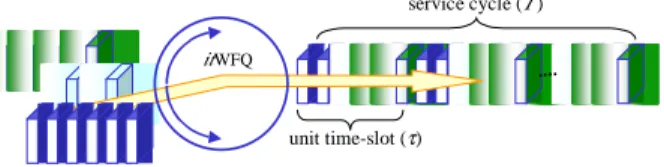
is provided as shown in Figure 1(b). Figure 1(c) shows that the packets of each traffic class can be scheduled with specified interarrival time of 10ms. It is obvious that different service disciplines at the previous node will lead to different interarrival time distributions, which directly determine the departure pattern over the output link. If the packets scheduled by the server can be well adjusted based on specific performance criteria such as different interarrival times, then the system can effectively satisfy the requirement for different traffic classes.unit time-slot (τ)
service cycle (T) itWFQ
Figure 2. The
it
WFQ model 1.2 Time-Slot Windowing SchemeThe time-slot windowing scheme composed of the service cycle and the unit time-slot windows is used to schedule the packets at the node. While the later appears no integrals, the former accumulates the fractions of packetization at each unit time-slot. That means the rate scheduler depletes all complete packets at each unit time-slot and accumulates the fractions to form a complete packet for next depletion We now define the
it
WFQ model as shown in Figure 2, the granularity of scheduling for a service cycleT
is the unit time-slotτ
so that the packet scheduled at any instant of each service cycle can be synchronized with the time of service to the real-clock instant. Each service cycle, which is the servicing time of rate scheduling, consists of several unit time-slots in order to minimize context-switching overhead. During each service cycle when there are exactlyN
non-empty queues, theit
WFQ server servicesN
packets at the head of the queues simultaneously in proportion to their service shares. The packets must be depleted completely with their packet framing since regardless of encapsulating uncompleted framing packet is impractical to the implementation of the rate scheduler in the node. Based on the above definitions, theit
WFQ works as follows:(a) The weight of each traffic class is initialized with the value corresponding to their packet interarrival time so that the traffic class with higher priority (i.e. CRT, SRT and IBE traffic classes) can have more shared bandwidth than the traffic class with lower priority (i.e. BBE traffic
(b) The service cycle is defined and considered for minimizing the overhead of context switching time; the weight of scheduling the packets for each traffic class is updated per unit time-slot.
(c) The packets are chosen from the head of the queue of each traffic class and transmitted with the normal weight plus the offset of integral loss at previous unit time-slots.
The packets in the lower priority queues are allowed to retain the earliest packets with the weight of unallocated bandwidth which are released from rate scheduling of the higher priority queues.
2. The Modeling of itWFQ
Consider that the requirement of
K
traffic classes can be stated by using the following parameters,t
k to define the packet interarrival time to be scheduled byit
WFQ,b
k to denote the guaranteed bandwidth andr
k to denote the estimate target rate of being scheduled for traffic classk
that it can be obtained through the integral results of rate scheduling. LetC
denote the link capacity,φ
k be the weight of the rate scheduling at each unit time- slotτ
for classk
, and we haveC b t
k kk
τ
φ =
,k
= 1, 2, ..,K
. (3-1) The target rater
k at each unit time-slotτ
is performed in proportion to the weightφ
k. Through the implementation of an admission control check, the estimated maximum target rate must be constrained such as. and ,
1
r C
C r
K
k k
k k
≤
=
∑
=φ
(3-2)A significant observation from a practical implementation is that the service discipline performs packet-by-packet scheduling. The weight
ψ
k for traffic classk
is calculated by obtaining the integral part of packet-by-packet transmission over the output link. LetL
k be the average packet length of the traffic classk
and we havek k
k k
k
f
L b t ⋅
=
ψ
, and (3-3)
=
k k k
L C t
f τ
τ
1 (3-4)
where nis the maximum integer greater than or equal to n and
f
k is the fraction of the weighted share caused by packet-by-packet sizing and time-slot windowing in terms ofL
k andτ
respectively. The allocated bandwidth can be shared fairly among all the traffic classes by having each packet-transmission request during each unit time-slot in a round robin fashion, and then the backlogsare transmitted in any free or unallocated bandwidth.
The fraction of unused bandwidth for each traffic class at the
c
th unit time-slot isϕ
kc= φ
k− ψ
k and the rest of the accumulative weighted fractionW
Restc which is released from the previous traffic classi
at thec
th unit time-slot is given) (
)
( 1
1
C
L i Q
W
kc i k
k k
c t
Res
= ∑
−=φ − τ
, (3-5)where
Q
kc is the number of packets in the queue of the traffic classk
at thec
th unit time-slot, andQ
kcL
k <τCφ
kwhich means that no more bandwidth allocation is required by queued packets at that unit time-slot. The
−1 c
W
Rest is always distributed to the next unscheduled traffic classes, the weighted offsetW
Offsetc (i
) to the next traffic classi
at thec
th unit time-slot is calculated as. 1
) ) (
( 1
∑
−=1= −
ik k
c Rest i c
Offset
i i W
W φ
φ
(3-6)Finally, we obtain the minimum target rate
γ
kguaranteed to each class
k
as follows
+ +
=
−
−
k c Offset c
k k k
k
L
k W L τ C
(φ ϕ
1 1 ( ))γ τ
, (3-7)where
ϕ
k0=
0andW
Offset0=
0 at initial unit time-slot.Therefore, it is obvious that the low priority traffic classes can completely share all the fractions of unallocated bandwidth which are released from previous higher-priority traffic classes due to the integral loss in the packet-by-packet scheduling.
2.1 Fair Scheduling among Multiple Sessions
In order to provide the fairness property among multiple sessions in each traffic class, per-session queueing and virtual clock scheme are often employed, so that the system encounters the difficulty in both the effort of per-session buffering and the complexity of sorting the virtual time tags are introduced in the system.
Here we propose a packet-counting scheme (PCS) to overcome the difficulty as mentioned above by means of maintaining a set of scheduled sessions to keep and judge the count of packets of the sessions for each traffic class. In practice, the incoming packets are classified into each traffic class queue in the order of receiving the packets, therefore, the PCS approximates this behavior by using the packets in the order of their arriving times in the traffic class queue, and transmitting them in increasing order of their arrival time. By using the PCS, the system only requires the buffer for managing the set,
S
(k
,count
), to count the number of packets in the same session continuously scheduled in [t
,t
+τ
] for the traffic classk
. The number of scheduled packets in the same session is constrained by the integral multiples oft
kfor agiven unit time-slot
τ
and the count will be reset when the scheduled unit time-slots reach to the integral multiples ofτ
for a given packet interarrival timet
k. Although the PCS is employed to provide the simulated per-session queueing, theit
WFQ server still performs the fairness of rate scheduling in round-robin manner.Let
r
k,i be the floor rate andφ
k,ibe the weight of sessioni
within the traffic classk
, then we haveC
r
k,i= φ
k,i , andφ
k= ∑
in=k1φ
k,i (3-8) wheren
kdenotes the number of sessions multiplexed in the traffic classk
andN = ∑
Kk=n
k1 . All sessions in the same traffic class
k
could have the availability of extra bandwidth from other traffic classes when it is unused that may be immediately returned to the owner in the next unit time-slot. LetF
k denote the unused bandwidth, and then the target rateγ
k,i for sessioni
multiplexed in the traffic classk
can be given∑
∈Θ+
=
) '
( ,
, ,
,
τ
φ φ φ
γ
j kj
i k k i
k i k
C F
, (3-9)where
F
k= φ
kC − ∑
j∈Θ(τ')φ
k,jC
andΘ
(τ
') denotes the set of session which are backlogged at timeτ
' (i.e.τ
' =τ
/n
k). The round-robin weighted queueing can provide fair scheduling to all sessions in each traffic class and an effective mechanism is required to service all sessions of each traffic class within a unit time-slot. In a practical implementation, theit
WFQ algorithm is possible to be applied hierarchically for sharing the link bandwidth to the sessions of each traffic class. In the upper level, the bandwidth sharing is coordinated with group allocation and the weights represent the aggregate rate requirements of each traffic class. In the lower level, all sessions are scheduled with the weight according to their fair portion of the link bandwidth on a small time scale (i.e. the time intervalτ
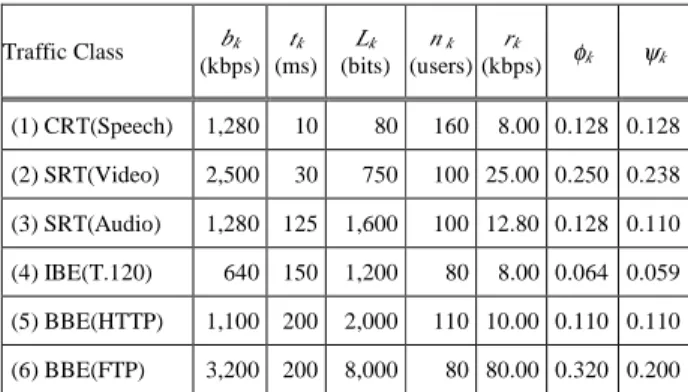
'). Regarding these weights, the unused bandwidth released from idle sessions is accumulated and allocated to those backlogged sessions within the same traffic class. Assume that there have 6 traffic classes in the system with interarrival time constraints 10, 30, 125, 150, 100 and 200ms, and their service priorities are from 1 to 6, respectively as depicted in Table 1. Since the scheduled unit time-slots are harmonic numbers, the rate scheduler for each traffic class will have no jitter and meet the interarrival time constraint in the successive node of running init
WFQ operation.2.2 Delay Analysis
In this section, the delay property of
it
WFQ is analyzed. Taking account into a packet arriving the server at timet
, the service delay for this packet issum of floor rates equals the link capacity. If all sessions are backlogged, the optimal delay bound can be easily obtained [6] by summing the fluid-flow service delay and the time to transmit a maximum size packet at link capacity
.
Table 1. The example of traffic specifications
Traffic Class bk
(kbps) tk
(ms) Lk
(bits) n k
(users) rk
(kbps) φk ψk
(1) CRT(Speech) 1,280 10 80 160 8.00 0.128 0.128 (2) SRT(Video) 2,500 30 750 100 25.00 0.250 0.238 (3) SRT(Audio) 1,280 125 1,600 100 12.80 0.128 0.110 (4) IBE(T.120) 640 150 1,200 80 8.00 0.064 0.059 (5) BBE(HTTP) 1,100 200 2,000 110 10.00 0.110 0.110 (6) BBE(FTP) 3,200 200 8,000 80 80.00 0.320 0.200
However the traffic often behaves in various manners, some sessions may obtain different rate allocations for subsequent packets while the sessions cease to backlog before being serviced. Therefore, the worst-case delay bound is studied. Assume that any session
i
-1 is no more backlogs when sessioni
begin to be serviced, the maximum backlogs,Q
k,l, in the independent sessionl
of traffic classk
is bounded by(
k j kj)
klj kj
i k i k l k l
k C C L
Q (') , ,
) '
( ,
, , , ,
1
+ −
=
∑
∈Θ∑
∈Θττ
φ φ φ
γ φ
γ ,(3-10)
where
L
k,l is the average packet length of the traffic classK
in the sessionl
. For each sessioni
, we have∑
∈Θ−
≥ φ
(τ')φ
,φ
kC
kC
j kjC
andi j (τ')
φ
k,jφ
k,∑
∈Θ≥
. (3-11)Then
( C )
Q L
ki kl k
l k l
k
γ φ
γ +
≤
,, , ,
, (3-12)
hence, the maximum delay
D
k for traffic classk
to service the maximizedQ
k,lwould be given by( )
(
1)
.1 ,
1 ,
+ +
= + +
≤ +
≤
∑
∑
=
=
k k
k k
k n
i ki k
k k k
k n
i kl
k
L n n
C L C
n C D Q
k k
τ γ
φ φ γ τ γ
τ φ
(3-13)
2.3 Jitter Analysis
The delay jitter is regulated based on packet schedule time
S
defined as follows:S
k,1 =A
k,1,S
k,n = max(A
k,n-1+t
k+L
k/C
,A
k,n), whereA
k,n denotes the arrival time of then
th packet of the traffic classk
andL
/C
is aterm used to provide the packet transmission rate. Delay jitter is controlled with respect to the schedule time of the previous packet in the same session.
t
k is the packet interarrival time specified by the QoS requirement to hold packets in buffer so that minimum interdeparture time will be bounded onτ ⋅ t
k/ τ
. In general, the traffic arrivals are shaped by means of time-slot windowing so that the burstiness of the packet arrival is smoothed by time-slot windowing and additional buffer space is needed in the node. In the contrary, the late packet arrivals will cause the delay jitter due to consuming empty packets at the expected schedule time. We begin here to derive an analytic approximation for the probability of late packet. The analysis assumes that the traffic classes are with Poisson distribution. If a packet arrives late, it experienced a delay exceeding a unit time- slot entering into the buffer. The number of arrivals in any interval of timet
is Poisson distributed, thus the probability distribution of the packet arrivals with mean arrival rateλ
is given! ) exp(
) ) ( (
k n
k
n
t n t
X P
k
λ
λ −
=
=
, (3-14)where the average number of arrivals within an interval
t
in length isλt
, mean arrival rateλ
is equal tob
k/L
k and the integeri
, 0≤ i ≤ n
k, represents the number of arrival packets within a maximum numbern
k of sessions for the traffic classk.
Regarding the result of Poisson process, the packet interarrival times are independent and exponentially distributed with parameterλ
, the intervalt
k=
τ
-φ
kτ
have the probability distribution )exp(
1 )
(
t t t
P
k≤ = − − λ
. The interdeparture delay will be introduced due to that the late packets arriving at the interval [0,τ
-φ
kτ
] will be queued until next service interval and we have. )) exp(
1 )(
(
)) 0 ( 1 )(
(
0 0
dt t t
dt X P t LP
k k
k
∫
∫
−
−
−
−
−
=
=
−
−
=
τ ψ τ
τ ψ τ
λ τ
τ
(3-15) Thus, the delay jitter
J
k that results from the interdeparture delay with late packets staying in the queue of traffic classk
must be bounded by
k/
( k)k
t LP
J ≤ τ τ +
. (3-16)3. Simulation Results
The results present better smoothness and jitter performance for all departures of 6 traffic classes. By showing the results obtained from executing the
it
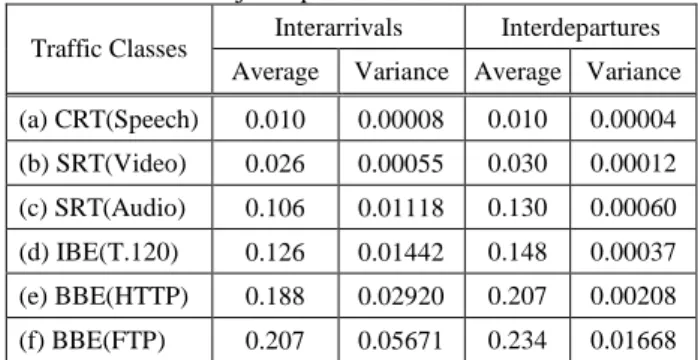
WFQ algorithm for scheduling the traffic classes with 10- minute startup latency. Table 2 demonstrates the interdeparture times over all traffic classes by running theit
WFQ rate scheduler at BS.Table 2. The jitter performance traced at BS Interarrivals Interdepartures Traffic Classes
Average Variance Average Variance (a) CRT(Speech) 0.010 0.00008 0.010 0.00004 (b) SRT(Video) 0.026 0.00055 0.030 0.00012 (c) SRT(Audio) 0.106 0.01118 0.130 0.00060 (d) IBE(T.120) 0.126 0.01442 0.148 0.00037 (e) BBE(HTTP) 0.188 0.02920 0.207 0.00208 (f) BBE(FTP) 0.207 0.05671 0.234 0.01668 The figure visually demonstrates that the obvious reduction of interdeparture variability achieved by
it
WFQ with time-slot windowing scheme and the jitter variance is also improved, e.g. the variance is reduced from 0.00055 to 0.00012 for the video traffic class.The key issue in the design of the time-slot windowing scheme is the right choice for unit time-slot to minimize the variance of interdeparture times. A further increase to the value of unit time-slot will yield larger variance of interdepature times. Among the valuable results observed, the variance of interdeparture times is significantly sensitive to the choice for unit time-slot. In other words, given the interarrival time for each traffic class, the unit time-slot can be chosen from the greatest common divisor (GCD) of the interarrival times of all traffic classes. Here we investigate the selection of the unit time-slot with respect to varying interdeparture delay by setting
τ
at 10, 20, 50 and 100ms.Unit time-slot
τ
= 10ms is the best choice for the simulation work since 10ms is the GCD of the interarrival times. In general, the complexity of a GPS- related scheduler often consists of the complexity in sorting the timestamps and in computing the system- potential function. The complexity of sorting the timestamps is typically measured as ofO
(logN
) [11],[12], whereN
is the number of scheduled sessions.Several techniques have been proposed to reduce the cost of the sorting structure in the case of software [13],[14] and hardware implementations [15]. A common measure used to characterize the complexity is the algorithmic complexity that the number of operations is required in the worst case to perform the corresponding task. In this project, the packet-counting scheme is proposed to overcome the complexity in sorting the timestamp and to offer the lower computational complexity in the order of
O
(logn
k), wheren
k is the number of scheduled sessions of traffic classk
and smaller thanN
, the number of all sessions in the system. On the other hands, the per-session-priority queueing effort is also deducted from the system by aggregating the packets of all sessions into the queue of each traffic class. Therefore, the buffer can more efficiently share among all sessions in the system.四﹑計畫成果自評
在本計畫中,我們已針對第三代無線網路提供 行動串流應用服務進行研究,並設計了一個具有相 繼式封包傳遞服務特性的傳輸排程機制以及時槽視 窗法的設計。同時我們亦針對設計內容進行分析與 演算法的實作,並依據各種效能分析特性需求,對 模擬網路中各個傳輸點進行效能量測。在前述結果 (Table 2) 中,明顯地看出所有封包相繼傳遞時距已 完全得到改善,且各封包相繼傳遞差距變異值皆已 降至 0.02 以下。本計畫研究成果同時也驗證了演算 法在系統實作上的簡易度,且其在系統實作中可以 大幅度降低系統記憶容量與系統運算時效的需求。
五﹑參考文獻
[1] R. Koodli and M. Puuskari, “Supporting Packet-Data QoS in Next-Generation Cellular Networks” IEEE Commun. Magazine, pp. 180 ~ 188, Feb. 2001.
[2] Sudhir Dixit, Yile Guo, and Zoe Antoniou, Nokia,
“Resource Management and Quality of Service in Third- Generation Wireless Networks” IEEE Commun.
Magazine, pp. 125 ~ 133, Feb. 2001.
[3] 3GPP TS 23.107 V4.0.0 (2000-12), “3rd Generation Partnership Project; Technical Specification Group Services and System Aspects; QoS Concept and Architecture”, Technical Specification (Release 4), Dec.
2000.
[4] J. Rexford, S. Sen, and A. Basso, “A Smoothing Proxy Service for Variable-Bit-Rate Streaming Video,” Proc.
IEEE Global Telecommunications Conf., IEEE Press, Piscataway, N.J., pp. 1823 ~1829, 1999.
[5] P. P. Dang and P.M. Chau, “Image Encryption for Secure Internet Multimedia Applications,” IEEE Trans.
Consumer Electronics, pp. 395-403, Aug. 2000.
[6] A. K. Parekh and R. G. Gallager, “A generalized
processor sharing approach to flow control in integrated services net-works: the single-node case,” IEEE/ACM Trans. on Networking, vol. 1, no. 3, pp. 344 ~357, June 1993.
[7] A. K. Parekh, “A generalized processor sharing approach to flow control in integrated services networks,” Ph.D.
dissertation, MIT, Cambridge,MA, Feb. 1992.
[8] A. Parekh and R. Gallager, “A generalized processor sharing approach to flow control - The single node case”, IEEE/ACM Trans. Networking, vol. 1, pp. 344 ~357, June 1993.
[9] J. C. R. Bennett and H. Zhang, “Hierarchical packet fair queueing algorithms, in Proc. ACM-SIGCOMM‘96, Palo Alto, CA, pp. 143 ~156, 1996.
[10] S. Floyd, and V. Jacobson, “Link-sharing and resource management models for packet networks,” IEEE/ACM Trans. on Networking, vol.3, no.4, pp. 365 ~86, Aug.
1995.
[11] D. Stiliadis and A. Varma, “Design and Analysis of Frame-based Fair Queueing: A New Traffic Scheduling Algorithm for Packet-Switched Networks:’ Proceedings of ACM SIGMETRICS, pp. 104-115, May 1996.
[12] S. J. Golestani, “A self-clocked fair queueing scheme for broadband applications,” in Proc. IEEE INFOCOMM’94, Toronto, Canada, pp. 636–646, June 1994.
[13] P. Van Erode Boas, R. Kaas and E. Zi.jlstra, “Design and Implementation of an Efficient Priority Queue,”
Mathematical Systems Theory, Vol. 10, pp. 99–127, 1977.
[14] S. Suri, G, Varghese and G. Chandranmenon, “Leap Forward Virtual Clock: A New Fair Queueing Scheme with Guaranteed Delays and Throughput Fairness”, Proceedings of IEEE INFOCOM ’97, April 1997.
[15] Donpaul C. Stephens, Jon C. R. Bennett and Hui Zhang,
“Implementing Scheduling Algorithms in High-Speed Networks”, IEEE Journal on Selected Area in Commu., Vol. 17, No. 6, pp. 1145 – 1158, June 1999.