行政院國家科學委員會專題研究計畫 成果報告
痙攣型腦性麻痺兒於懸吊式跑步機的步行訓練:量化分析懸
吊系統體重支撐之效應
計畫類別: 個別型計畫 計畫編號: NSC93-2213-E-006-047- 執行期間: 93 年 08 月 01 日至 94 年 12 月 31 日 執行單位: 國立成功大學物理治療學系 計畫主持人: 成戎珠 共同主持人: 蘇芳慶,林啟禎 計畫參與人員: 郭雅芳 報告類型: 精簡報告 報告附件: 出席國際會議研究心得報告及發表論文 處理方式: 本計畫可公開查詢中 華 民 國 95 年 4 月 11 日
行政院國家科學委員會補助專題研究計畫
■ 成 果 報 告
□期中進度報告
痙攣型腦性麻痺兒於懸吊式跑步機的步行訓練:量化分析
懸吊系統體重支撐之效應
計畫類別:■ 個別型計畫 □ 整合型計畫
計畫編號:NSC 93-2213-E-006-047-
執行期間: 93 年 08 月 01 日至 94 年 12 月 31 日
計畫主持人:成戎珠
共同主持人:蘇芳慶、林啟禎
計畫參與人員:郭雅芳
成果報告類型(依經費核定清單規定繳交):■精簡報告 □完整報告
本成果報告包括以下應繳交之附件:
□赴國外出差或研習心得報告一份
□赴大陸地區出差或研習心得報告一份
■出席國際學術會議心得報告及發表之論文各一份
□國際合作研究計畫國外研究報告書一份
處理方式:除產學合作研究計畫、提升產業技術及人才培育研究計畫、
列管計畫及下列情形者外,得立即公開查詢
□涉及專利或其他智慧財產權,□一年□二年後可公開查詢
Abstract
Background and Purpose: The purpose of this study was to investigate the effects of different
combinations of body weight support (BWS) and treadmill speeds (TS) on gait temporal distance parameters and ground reaction force (GRF) profile in children with spastic cerebral palsy (CP).
Methods: Nine children with spastic CP (5 boys and 4girls; age: 8.4 ± 1.8 years; body
height:1.24 ± 0.1 m ; body weight: 23.3 ± 7.7 kg) and 14 non-disabled children (9 boys and 5 girls; age: 9 ± 1.7 years; body height: 1.4 ± 0.13 m; body weight: 31.3 ± 9.7 kg) participated in the study. Temporal distance parameters and GRF data were collected with Kistler Gaitway Treadmill System. Each participant performed 2 trials under 12 conditions with a combination of 4 BWS (0, 10%, 20%, and 30% of body weight) and 3 TS (fast: 130% of preferred speed, preferred: self-selected speed (100%), slow: 70% of preferred speed). Two-way analysis of variance was used to compare the main effects of group and condition and their interaction on the gait variables. Friedman test was used to compare the effect of BWS and TS on the gait variables. Results: Children with CP showed significantly different of all dependent variables than nondisabled children in all conditions of the combination of BWS and TS. Children with CP showed longer gait cycle time, shorter stride length, fewer cadence, lower peak forces than non-disabled children. Nondisabled children showed statistically significant decreases in the stance phase and double limb support and increases in single limb support, 1st peak and 2nd peak of GRF with increased BWS independent from TS. Independent from BWS, the nondisabled children showed increases in cadence and stride length but decreases in single limb support, and the stance phase with increased TS. However, children with CP showed varied patterns.
Conclusions: The results of the current study demonstrate that certain gait parameters were
sensitive to the changes of BWS and others were sensitive to the changes of TS. And Children with CP showed different effect of the combination of BWS and TS. However, due to the big variation of the result of children with CP, the optimal combination of BWS and TS are still unclear. Therefore, it is still necessary to find the optimal combination for individual child with CP.
Background and Purpose
The contemporary approach to clinical assessment and intervention for individuals with disability in control of posture and movement is a task-oriented approach (Stranger & Oresic 2003). In such approach, the treatment focuses on developing functional goal-oriented tasks. Task owns the characteristics of specificity and training effect also demonstrates the characteristics of specificity (Schmidt, 1988; Winstein, 1989, 1991). Therefore the task-specific requirements are keys to developing treatment techniques. In the past decade, treadmill with suspension system has been applied to gait training in patients with hemiplegia (Hesse et al., 1994, 1995; Miller et al., 2002;Waagfjord, et al., 1990), paraplegia (Behrman & Harkema 2000; Visintin & Barbeau 1994; Wernig et al., 1992), cerebral palsy (CP) (Richard et al., 1997; Schindl et al., 2000), and children with Down Syndrome (Ulrich, et al., 2001). Promising results have been reported in literature. Our previous study also showed significant effect of body weight support treadmill gait training in children with CP (Cherng et al., 2005).
However, from literature review of treadmill combined with suspension system gait training, we have noted that the suspension weights applied to subjects during treadmill gait training are various, ranging from 0% body weight to 40%. (Behrman & Harkema 2000; Hesse et al., 1999; Richards et al., 1997; Schindl et al., 2000; Visintin & Barbeau 1994; Werning et al., 1992, 1998). The criteria for setting the suspension weight are either undocumented, or based on experimenter’s subjective observation of the subject’s performance. The settings of the suspension weight in the studies of Hesse et al. (1999) and Schindl et al. (2000) were based on a therapist’s observation that the suspension weight should be enough to avoid collapse of the affected side at single limb support phase. However, the suspension weights in the other studies were based on the weight needed at time of double limb support (Behrman & Harkema 2000; McNevin et al, 2000). And some researchers chose the suspension weight needed at the time of heel contact as their criteria (Finch & Barbeau 1986; Visintin & Barbeau 1994; Werning et al., 1992, 1998). The ultimate suspension weight is unknown. Limited reports have examined the effect of different combinations of body weight suspension and treadmill speed on gait in children with CP.
Therefore the purpose of this study is to quantitatively analyze the effect of different body weight suspension on gait performance in children with spastic CP.
Method
Subjects
A total of 23 children participated in the study. Nine children with spastic CP (5 boys and 4girls; age: 8.4 ± 1.8 years; body height:1.24 ± 0.1 m ; body weight: 23.3 ± 7.7 kg) and 14 non-disabled children (9 boys and 5 girls; age: 9 ± 1.7 years; body height: 1.4 ± 0.13 m; body
Equipment
Treadmill
Gaitway Instrumented treadmill system (HP cosmos, Germany) with two built-in force plates (Kistler, Switzerland) was used for this study. The treadmill is capable of very slow speeds with a minimum speed of 0.1 m/s and able to increase its speed with an increment of 0.1 m/s. In additions, two force plates are embedded inside the treadmill belt.
Suspension System
A commercial available suspension system (Lite Gait, Scottsdale, AZ) was used for this study. The Lite Gait suspension system composed of several parts including yoke, overhead straps, an adjustable harness, base and actuator. A custom-designed load cells cable, which is build into the system, is able to measure the force (weight) of suspension. The sensitivity of the force measurement is 0.1 kg. A harness was provided to subjects for weight suspension and safety.
Procedures
All participants were measured with body weight and body height before the test. Children with CP were further measured with muscle tone, range of motion, gross motor function measure and Gross Motor Function Classification System (Palisano et al., 1997). All participants performed 2 trials under 12 conditions with a combination of 4 body weight support (BWS) (0, 10%, 20%, and 30% of body weight) and 3 treadmill speed (TS) (fast: 130% of preferred speed, preferred: self-selected speed (100%), slow: 70% of preferred speed). They all started with 0% BWS, and then 30% BWS, then 20% BWS and the last 10% BWS. The sequence of TS was randomly selected.
Statistical Analysis
The dependent variables interested in the study were gait cycle time, stride length, cadence, the first ground reaction peak force, the second ground reaction force and the absolute symmetrical index (ASI) of above variables. The ASI was calculated as ∣2*(Xr-Xl) / (Xr+Xl)*100%∣ (Herzog, 1989; Diop, 2004). Two-way analysis of variance was used to compare the main effects of group and condition and their interaction on the gait variables. Then Friedman test was separately used for children with CP and non-disabled children to examine the effects of different BWS and TS combination protocol on above dependent variables. We also used the Kruskal Wallis Test to compare the differences of dependent variables among children with CP (paretic side, non-paretic side) and nondisabled children.
Results and Discussion
The analysis of two-way ANOVA showed a significant effect of group, effect of test condition and their interactions. Children with CP showed longer gait cycle time, shorter stride length, fewer cadence, lower peak forces than non-disabled children. As the ASI indices of gait variables concerned, the children with CP had higher SI, which represented less symmetry. All the ASI indices of gait variables in non-disabled children were lower than 10%, which is within normal limits as reported in previous literature(Giakas, 1997).
The Friedman test of the dependent gait variables in non-disabled children showed that independent from TS, the gait parameters showed statistically significant decreases in the stance
phase and double limb support and increases in single limb support, 1st peak and 2nd peak of GRF with increased BWS. Independent from BWS, the gait parameters showed increases in cadence and stride length but decreases in single limb support, and the stance phase with increased TS.
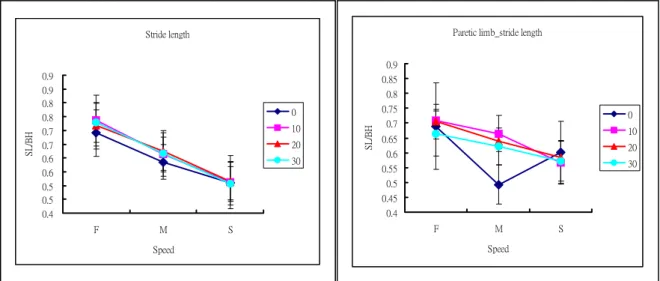
Figure 1 and 2 presented the comparison of gait cycle and stride length between children with CP and nondisabled children under different combination of BWS and TS. The figure showed that nondisabled children had a linear trend of change of gait cycle time and stride length with the change of TS. However, the trend was not observed in the group of children with CP. The change of gait variables was variable in the group of children with CP.
The results of the current study demonstrate that certain gait parameters were sensitive to the changes of BWS and others were sensitive to the changes of TS. And Children with CP showed different effect of the combination of BWS and TS. However, due to the big variation of the result of children with CP, the optimal combination of BWS and TS are still unclear. Therefore, it is still necessary to find the optimal combination for individual child with CP.
References
Behrman AL, Harkema SJ. Locomotor training after human spinal cord injury: A series of case study. Phys Ther 2000; 80:688-700.
Cherng RJ, Liu CF, Liu TH, Hong RB, Su FC. Effects of gait training with treadmill and suspension in children with spastic cerebral palsy. XXth Congress of the International Society of Biomechanics, July 31-August 5, 2005, Cleveland, Ohio, U.S.A.
Finch L, Barbeau H. Hemiplegic gait: new treatment strategies. Physiother Can. 1986; 38 (1): 36-40.
Hesse S, Bertelt C, Jahnke MT, et al. Treadmill training with partial body weight support compared with physiotherapy in nonambulatory hemiparetic patients. Stroke
1995;26:976-981.
Hesse S, Bertelt C, Schaffrin A, et al. Restoration of gait in nonambulation hemiparetic patients by treadmill training with partial body weight support. Arch Phys Med Rehabil 1994; 75:1087-93.
Miller EW, Quinn ME, Seddon PG. Body weight support treadmill and overground ambulation training for two patients with chronic disability secondary to stroke. Phys Ther
2002;82:53-61.
Palisano R, Rosenbaum P, Walter S, et al. Development and reliability of a system to classify gross motor function in children with cerebral palsy. Dev Med Child Neurol 1997;39(4):214-23.
Stranger M, Oresic S. Rehabilitation approaches for children with cerebral palsy: overview. J
Child Neurol 2003;18:S79-S88.
Ulrich DA, Ulrich B, Angulo-Kinzler RM, et al. Treadmill training of infants with Down Syndrome: evidence-based developmental outcomes. Pediatrics 2001;108:1-7.
Visintin M, Barbeau H. The effects of parallel bars, body weight support and speed on the modulation of the locomotor pattern of spastic paretic gait: A preliminary communication. Paraplegia 1994;32:540-553.
Waagfjord JW, Levangie PK, Certo CME. Effects of treadmill training on gait in a hemiparetic patient. Phys Ther 1990;70:549-560.
Wernig A, Müller S, Laufband locomotion with body weight support improved walking in persons with severe spinal cord injuries. Paraplegia 1992; 30: 229-238.
Wernig A, Nanassy A, Müller S. Maintenance of locomotor abilities following Laufband (treadmill) therapy in para-and tetraplegic persons: follow-up studies. Spinal Cord 1998; 36: 744-749.
Winstein CJ, Gradner ER, McNeal DR, et al. Standing balance training: effects on balance and locomotion in hemiparetic adult. Arch Phys Med Rehabil 1989;70:755-762.
Winstein CJ. Designing practice for motor learning: clinical implications. In Lister MJ (ed). II Step: Contemporary Management of Motor Control Problems. Washington, DC:
Foundation for Physical Therapy Inc. 1991;65-76.
Self Evaluation
We have presented a part of the current research result as a platform presentation in the 52th Conference of the Association of Physical Therapy, R.O.C., March 25-26, 2006, Taipei, Taiwan (Appendix). The most difficulty part of executing the project was subject recruitment. Due to the study design and the equipment limitation, children with CP have to able to step on each of the two force plates of treadmill. Otherwise, the trial was deemed a failure. Therefore, limited children with CP are capable to do this or have enough endurance to finish the study for about 1.5 to 2.0 hours. However, we have still tried our best to recruit subjects with CP, even from the neighboring cities, such as Kaoshiung. We will submit a paper to an international journal for publication after we have finished the whole manuscript writing.
Paretic limb_Gait cycle 0.8 1.3 1.8 2.3 2.8 F M S Speed Se c 0 10 20 30 Gait cycle (ms) 0.8 1.3 1.8 2.3 2.8 F M S Speed S ec onds 0 10 20 30
Figure 1. The mean gait cycle time (speed) in two groups of children under different combinations of body weight support and treadmill speed.
Paretic limb_stride length
0.4 0.45 0.5 0.55 0.6 0.65 0.7 0.75 0.8 0.85 0.9 F M S Speed SL /B H 0 10 20 30 Stride length 0.4 0.5 0.5 0.6 0.6 0.7 0.7 0.8 0.8 0.9 0.9 F M S Speed SL /B H 0 10 20 30
Figure 2. The mean stride length in two groups of children under different combinations of body weight support and treadmill speed.
Appendix
不同體重懸吊支撐與跑步機速度之組合參數對兒童步態參數的影響
The Effects of Different Combinations of Body Weight Support and Treadmill
Speed on Gait Parameters in Children
郭雅芳1
成戎珠1* 蘇芳慶2
Ya-Fang Kuo1 Rong-Ju Cherng1* Fong-Chin Su2
1成功大學醫學院物理治療學系
Department of Physical Therapy, College of Medicine, National Cheng Kung University, Tainan, Taiwan
2成功大學工學院醫學工程研究所
Institute of Biomedical Engineering, College of Engineering, National Cheng Kung University, Tainan, Taiwan
Background and Purpose: The purpose of this study was to investigate the effects of different
combinations of body weight support (BWS) and treadmill speeds (TS) on gait temporal distance parameters and ground reaction force (GRF) profile in children. Methods: Fourteen children (9 boys and 5 girls; mean age: 9±1.7 years; body height: 1.4±0.13 m; body weight: 31.3±9.7 kg) participated in the study. Temporal distance parameters and GRF data were collected with Kistler Gaitway Treadmill System. Participants performed 2 trials under 12 conditions with a
combination of 4 BWS (0, 10%, 20%, and 30% of body weight) and 3 TS (fast: 130% of
preferred speed, preferred: self-selected speed (100%), slow: 70% of preferred speed). Friedman test was used to compare the effects of BWS and TS on the gait variables. Results: Independent from TS, the gait parameters showed statistically significant decreases in the stance phase and double limb support and increases in single limb support, 1st peak and 2nd peak of GRF with increased BWS. Independent from BWS, the gait parameters showed increases in cadence and stride length but decreases in single limb support, and the stance phase with increased TS.
Conclusions: The results suggest that the certain gait parameters were sensitive to the changes of
BWS and others were sensitive to the changes of TS. Clinical Relevance: The data may be used as reference information for studying the effect of treadmill gait training with body weight suspension in clinical children.