Modern Chinese Philosophy
Edited by
John Makeham, Australian National University
VOLUME 1
The titles published in this series are listed at brill.nl/mcp.
The Discovery of Chinese Logic
By
Joachim Kurtz
LEIDEN • BOSTON 2011
Library of Congress Cataloging-in-Publication Data Kurtz, Joachim.
The discovery of Chinese logic / by Joachim Kurtz.
p. cm. — (Modern Chinese philosophy, ISSN 1875-9386 ; v. 1) Includes bibliographical references and index.
ISBN 978-90-04-17338-5 (hardback : alk. paper) 1. Logic—China—History. I. Title.
II. Series.
BC39.5.C47K87 2011 160.951—dc23
2011018902
ISSN 1875-9386 ISBN 978 90 04 17338 5
Copyright 2011 by Koninklijke Brill NV, Leiden, The Netherlands.
Koninklijke Brill NV incorporates the imprints Brill, Global Oriental, Hotei Publishing, IDC Publishers, Martinus Nijhoff Publishers and VSP.
All rights reserved. No part of this publication may be reproduced, translated, stored in a retrieval system, or transmitted in any form or by any means, electronic, mechanical, photocopying, recording or otherwise, without prior written permission from the publisher.
Authorization to photocopy items for internal or personal use is granted by Koninklijke Brill NV provided that the appropriate fees are paid directly to The Copyright Clearance Center, 222 Rosewood Drive, Suite 910, Danvers, MA 01923, USA.
Fees are subject to change.
List of Illustrations ... vii
List of Tables ... ix
Preface ... xi
Introduction ... 1
1. “Chinese Logic” and Logic in China ... 2
2. The Argument ... 6
3. Discovery and Translation ... 9
Chapter One First Encounters: Jesuit Logica in the Late Ming and Early Qing ... 21
1. Logic in Jesuit Education ... 22
2. Accommodation and Translation ... 25
3. Logic in Early Jesuit Writings ... 29
4. Logic as the Patterns of Names ... 43
5. Logic as a Syllogistic Trap ... 65
Chapter Two Haphazard Overtures: Logic in Nineteenth-Century Protestant Writings ... 89
1. Protestant Authors and Western Knowledge ... 89
2. The New Organon and Old Ways of Argumentation ... 95
3. Logic as the Science of Debate ... 104
4. Logic as the Science of Discerning Truth ... 118
5. Logic as the Science of Reason ... 125
Chapter Three Great Expectations: Yan Fu and the Discovery of European Logic ... 147
1. The Quest for Certainty ... 148
2. Logic as the Science of Sciences ... 149
3. Logic as a New Style of Reasoning ... 154
4. Yan Fu as a Translator of Logic ... 169
5. Logic in the Margins ... 186
Chapter Four Spreading the Word: Logic in Late Qing
Education and Popular Discourse ... 193
1. Logic in the New School Curricula ... 194
2. Logic in New-Style Textbooks ... 203
3. Logic in Symbols, Charts, and Diagrams ... 226
4. New Terms for Telling the Truth ... 245
5. Luoji, or What’s in a Name? ... 257
Chapter Five Heritage Unearthed: The Discovery of Chinese Logic ... 277
1. All Hail the Pioneers! ... 278
2. Chinese Logic as Classical Philology ... 289
3. Chinese Logic as Buddhist Dialectic ... 301
4. Chinese Logic as European Logic ... 313
5. Chinese Logic as an Archival Curiosity ... 327
Epilogue ... 339
1. Translation and Rupture ... 340
2. From Discovery to Invention ... 344
3. De-modernizing Chinese Logic ... 360
Appendix ... 367
A. Textbooks on Logic Adapted from Japanese, 1902–1911 ... 367
B. Logical Terms in Early-Twentieth-Century Textbooks ... 370
Bibliography ... 425
1. Primary Sources ... 425
2. Secondary Sources ... 439
Index ... 463
4.1 Fan Diji, Lunlixue wenda, 1903 (1) ... 230
4.2 Fan Diji, Lunlixue wenda, 1903 (2) ... 230
4.3 Yang Yinhang, Mingxue, 1903 (1) ... 232
4.4 Yang Yinhang, Mingxue, 1903 (2) ... 232
4.5 Hu Maoru, Lunlixue, 1906 ... 233
4.6 Guo Yaogeng, Zuixin lunlixue gangyao, 1909 ... 233
4.7 Lin Kepei, Lunlixue tongyi, 1909 ... 234
4.8 Qian Jiazhi, Mingxue, 1910 (1) ... 236
4.9 Qian Jiazhi, Mingxue, 1910 (2) ... 236
4.10 Zhou Dunyi, Taiji tu, 11th cent. ... 236
4.11 Tian Wuzhao, Lunlixue gangyao, 1903 ... 238
4.12 Lunlixue biaojie, 1911/1912 ... 238
4.13 Fan Diji, Lunlixue wenda, 1903 (3) ... 240
4.14 Fan Diji, Lunlixue wenda, 1903 (4) ... 240
4.15 Chen Wen, Mingxue jiaokeshu, 1911 ... 241
4.16 Lunlixue chubu, 1907 ... 241
4.17 Qian Jiazhi, Mingxue, 1910 (3) ... 242
4.18 Yang Yinhang, Mingxue, 1903 (3) ... 243
4.19 Wang Bo, Yanji tu, 13th cent. ... 244
4.20 Xu Qian, Du Sishu congshuo, 14th cent. ... 244
4.21 Tang Zuwu, Lunlixue poujie tushuo, 1906 ... 246
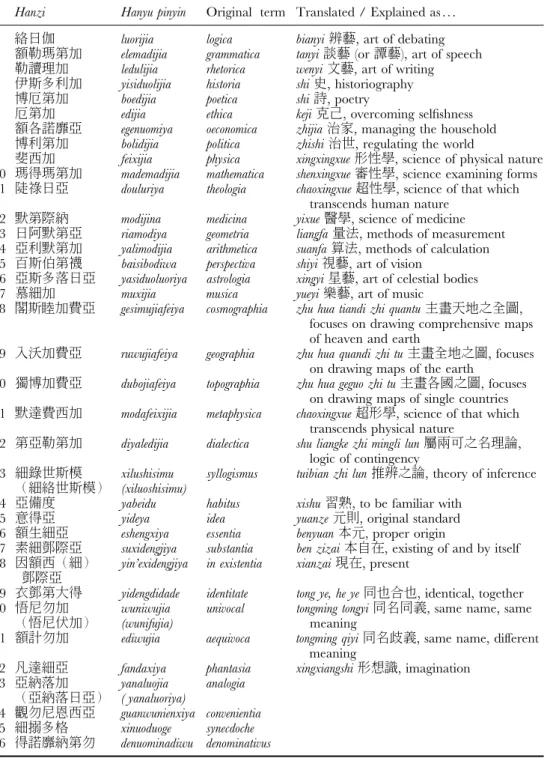
1.1 Phonemic Loans in the Mingli tan (1631/1639) ... 53 1.2 Terms Related to Predicables in the Mingli tan
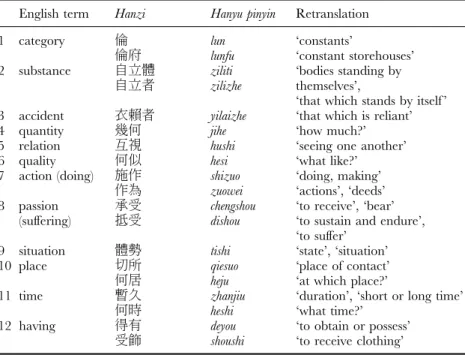
(1631/39) ... 56 1.3 Terms Related to Categories in the Mingli tan
(1631/39) ... 56 1.4 Basic Logical Terms in the Mingli tan (1631/39) ... 57 1.5 Terms Related to the Syllogism in the Qionglixue
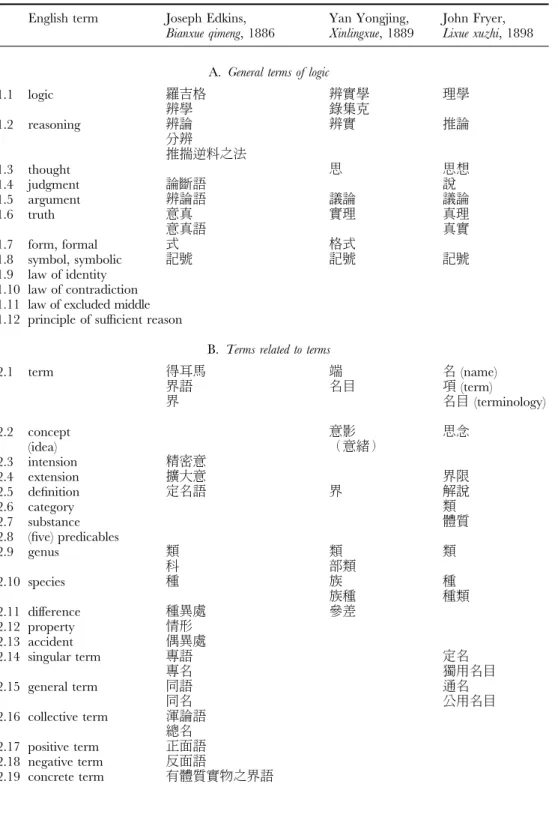
(1683) ... 80 2.1 Logical Terms in Nineteenth-Century Protestant
Works ... 141 3.1 Logical Terms in Yan Fu’s Translations ... 177 4.1 Terms for Logical Notions in Translations from
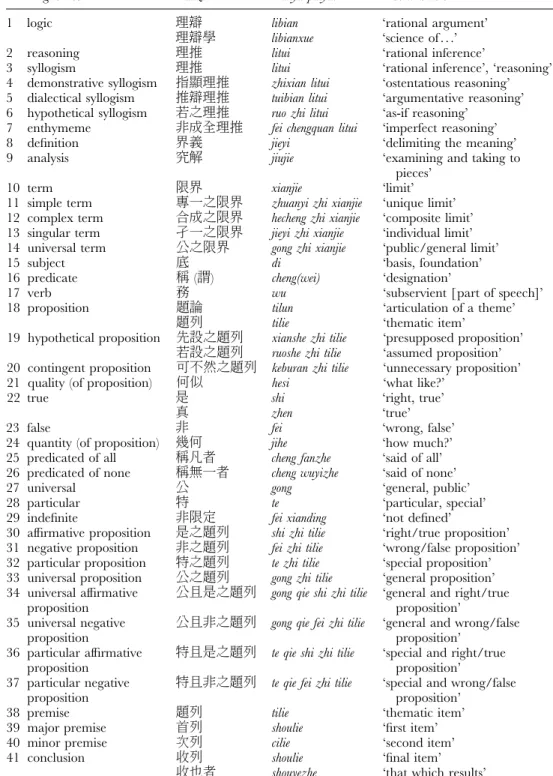
Japanese, 1902–1911 ... 254 4.2 Chinese Translations of “Logic”: A Chronological
Overview, 1623–1921 ... 263 B.1 Logical Terms in Early-Twentieth-Century
Textbooks (1) ... 372 B.2 Logical Terms in Early-Twentieth-Century
Textbooks (2) ... 377 B.3 Logical Terms in Early-Twentieth-Century
Textbooks (3) ... 382 B.4 Logical Terms in Early-Twentieth-Century
Textbooks (4) ... 386 B.5 Logical Terms in Early-Twentieth-Century
Textbooks (5) ... 391 B.6 Logical Terms in Early-Twentieth-Century
Textbooks (6) ... 396 B.7 Logical Terms in Early-Twentieth-Century
Textbooks (7) ... 402 B.8 Logical Terms in Early-Twentieth-Century
Textbooks (8) ... 407 B.9 Logical Terms in Japanese and Chinese Dictionaries ... 412 B.10 Logical Terms in Modern Chinese Dictionaries ... 418
Like many books, or so I try to convince myself, this study was begun with a far more grandiose design in mind than its author was even- tually able to realize. Puzzled by the ease and certainty with which traditional Chinese thought has come to be interpreted in modern terms—as if equivalences between ancient Chinese notions and the lat- est catchwords of contemporary academe could be taken for granted, or needed to be defended at all cost in order to preserve the dignity of Chinese civilization—I set out to reconstruct the history of one dis- cursive field in which this practice appears to be especially hazardous:
the discourse on “Chinese logic” that emerged in the early years of the twentieth century and has since produced a vast array of literature, and sustained quite a few academic careers, in China and abroad.
My initial idea was to present the tale of this discourse along the metaphorical lines of a biography. Starting naturally, it would seem, with a brief announcement of its birth shortly before the year 1900, I wanted to trace the adventures of Chinese logic throughout the twen- tieth century, recounting along the way adolescent uncertainties in the era of the New Culture Movement circa 1920; an ensuing period of maturation, oscillating between frantic study and wild speculation, that earned the subject academic respectability and culminated in the publication of the first histories of Chinese logical thought; further on through worrisome decades of adulthood, clouded by the vicissi- tudes of war, revolution, and ideological pressures that posed constant threats to the integrity of the field and the individuals involved in its maintenance; and ending, finally, with the comparatively calm period of respite, or retirement, that the discourse of Chinese logic, like many other academic pursuits, has been enjoying in mainland China and other parts of the Sinophone world during the past twenty years.
Yet, the more I read of the voluminous literature on Chinese logic produced over the course of the twentieth century, in Chinese and other languages, the more it seemed to me that the most intriguing question to be asked about this discourse was not so much how it grew and developed, but how it came into existence in the first place.
The following chapters are an attempt to answer this much more modest but, as I hope to show, no less intricate question. Rather than
narrating the biography of Chinese logic, as I initially imagined, their aim is to reconstruct the extended prenatal labors and birth travails of a discourse that remained all but inconceivable until the end of the nineteenth century but is today customarily presented as reaching back more than two millennia.
In the course of my struggles with the tangled genealogy of Chinese logic, I was able to rely on the inspiration and help of more teachers, colleagues, and friends than I could possibly mention here. Without the unfailing support, encouragement, and trust of Michael Lackner, who first directed my attention to the complex interplay of history and language, none of the following chapters would have seen the light of day. I am no less grateful to Erling von Mende for his sustained reassurance and quite a few gentle admonitions, imparted even across transcontinental divides. The critical eyes of Viviane Alleton were indispensable in preventing more linguistic blunders in the following pages than I feel comfortable to admit. At a crucial stage, Joshua A.
Fogel provided invaluable opportunities to discuss my coarse ideas with some of the finest scholars in our field, and Joan Judge did her best to instruct me, with uncertain success, about the uses and limits of theory in analyses of late imperial Chinese texts. Iwo Amelung, my friend and colleague at Göttingen, Berlin, and Erlangen, has helped me in so many respects with this and other projects that I cannot think of a single aspect for which to thank him most.
Substantial parts of this book were written during visiting assignments at two institutions that provide ideal working conditions for historians of knowledge. The Institute for Advanced Study in Princeton, where I was able to spend the academic year 2002–2003, offered monastic seclusion when needed and opportunities for critical dialogue when- ever solitude failed to usher in enlightenment. I will always cherish the comraderie and friendship of my fellows there, including, besides Josh and Joan, Hugh Shapiro, Hu Ying, and Martin Kern, who among them seemed to know the proper answer to any question—textual, philosophical, or worldly. While at Princeton, I also benefited from the advice of Benjamin A. Elman, who offered constructive criticisms of several aspects of my project. An invitation to work at the Max Planck Institute for the History of Science in Berlin in 2009 enabled me to put the next-to-final touches on this manuscript in the lively atmosphere of this unique center of transdisciplinary inquiry. I am grateful to Jürgen Renn and Lorraine Daston who made my stay in
Dahlem possible, and to my friends Rui Magone, Martina Siebert, and Dagmar Schäfer, who welcomed me in their midst and generously shared their ideas, time, and expertise within the creative hustle that quickly enveloped all of us.
Prior to and in between these two periods of intense writing, parts of this work took shape in the more mundane circumstances of my regular professional life, first at Erlangen and then at Emory Univer- sity. In Erlangen, I enjoyed the support and assistance of Wolfgang Lippert, Yvonne Schulz Zinda, and Liu Yishan. During my time in Atlanta, which turned out to be life-changing in more ways than one, I relearned my trade as a teacher and researcher thanks to the patient guidance of my congenial and resourceful colleagues Cheryl A. Crow- ley, Cai Rong, Li Hong, Eric Reinders, Juliette Stapanian Apkarian, and the inimitable Betty Leathers. I am indebted to the Emory College of Arts and Sciences for its support of all my research endeavors and for granting me a year of sabbatical leave when it was most needed.
Since hardly any of the materials relevant for my topic were easily available, extended periods of research in Asian, North American, and European libraries were vital to the progress and eventual comple- tion of this study. I am sincerely grateful to the organizations that made sojourns in Shanghai, Beijing, Paris, Rome, Princeton, Hong Kong, Taipei, Tōkyō, and Ōsaka possible, most notably the Volks- wagenstiftung, the Deutscher Akademischer Austauschdienst, and the Herodotus Fund of the Institute for Advanced Study, as well as to the individuals without whose hospitality and guidance my travels would have had no avail. In Shanghai, Zhou Zhenhe 周振鶴, Xiong Yuezhi 熊月之, and Zou Zhenhuan 鄒振環 directed me through the labyrinths of many libraries, public and private, and taught me how to read what I would not have found without their help. In Beijing, I am most indebted to my friends Wang Yangzong 王揚宗, Han Qi 韓琦, Tian Miao 田淼, and Su Rongyu 蘇榮譽, who helped in every academic and practical respect. Thanks are also due to Shen Guowei 沈國威 and Uchida Keiichi 内田慶市 in Ōsaka, Benjamin K. T’sou 鄒嘉彥 in Hong Kong, and Nicolas Standaert and Carine Defoort in Leuven.
Over the years I enjoyed opportunities to discuss aspects of my work with critical audiences at many distinguished institutions, and I am grateful to them and the scholars who invited me to present my ideas in their departments, seminars, and workshops, especially Anne Cheng, Yves Chevrier, and Christian Jacob in Paris, Zhang Qing 章清
in Shanghai, Federico Masini in Rome, Frits Staal in Amsterdam, Christian Thiel in Erlangen, Zhang Longxi in Hong Kong, and Peter Zarrow in Taipei. David Wright, Douglas Howland, Catherine Jami, Christoph Harbsmeier, Shigehisa Kuriyama, and Shen Sung-ch’iao 沈松僑 took the pains to comment on individual portions of this man- uscript, and Rachel Weine read and much improved the entire first draft. Finally, thanks are due to Gene McGarry, a copy editor exem- plary in every regard, Jens Cram for his assistance in compiling the index, as well as John Makeham and Albert Hoffstädt for their trust in this project and the saintly patience with which they awaited its completion. Needless to say, I alone am responsible for any remaining omissions and mistakes.
It magnifies their originality to read [ past authors]
in their own terms, rather than tacitly to translate, with inevitable distortions, their unfamiliar preoc- cupations into our own familiar ones.
Lorraine Daston and Peter Galison, Objectivity The philosopher, literary critic, and archaeologist Wang Guowei 王國維 (1877–1927) was the first to characterize the decades surround- ing the turn of the twentieth century as an “age of discovery” ( faxian shidai 發現時代) unparalleled in Chinese history.1 His emphatic assess- ment was justified in more than one sense. Wang himself referred to the disclosure of written and material evidence from China’s distant past which had become available through the unearthing of oracle bones in Henan, bamboo and silk manuscripts in and around Dunhuang, as well as long-lost documents and historical artifacts found at various other places, often at the fringes of the Qing empire. But one could also cite less tangible discoveries to corroborate his appraisal. The renewed encounter with “Western knowledge” (xixue 西學), introduced through translations from European languages or Japanese, provoked a massive expansion of the Chinese terminological and conceptual lexicon and fomented a radical reordering of China’s discursive landscape. Adap- tations of Western-derived terms and notions gradually displaced the conceptual grids that had framed Chinese learned discourses for cen- turies. At the same time, they fueled the discovery, or rediscovery, of unknown or neglected aspects of China’s intellectual past, which were subsequently translated into new historical narratives and exploited in reconstructions of alternative or presumably forgotten traditions.
1 Wang Guowei 王國維, “Zuijin ersanshi nian zhong Zhongguo xin faxian zhi xuewen” 最近二三十年中中國新發現之學問 (Scholarship of new discoveries in China during the past twenty or thirty years), Qinghua zhoukan 350 (1925), reprinted in idem, Wang Guowei wenji 王國維文集 (The works of Wang Guowei), ed. Yao Gan- ming 姚淦銘 and Wang Yan 王燕 (Beijing: Zhongguo wenshi chubanshe, 1997), vol.
4, 33–38; 33.
1. “Chinese Logic” and Logic in China
The emergence of a discourse on “Chinese logic”—a term used throughout this study to denote evidence of explicit logical theoriz- ing in ancient Chinese texts, not of any peculiar Chinese ways of thinking—in the early years of the twentieth century is a paradig- matic case of a discovery of this second kind. Unheard of until the late 1890s, Chinese logic came to claim a history of over two thousand years within less than two decades after the first fragments of ancient Chinese texts were tentatively interpreted in logical terms. Twentieth- century scholarship has since established that explicit reflections on questions similar to those discussed in traditional European logic can be traced back in China at least to the fifth century BC.2 As in ancient Greece and India, Chinese interest in logical problems evolved from meditations on the methodology of debate. The earliest attestations of this interest are found among the “dialecticians” or “debaters” (bianzhe 辯者) who were classified together as a distinctive “School of Names”
(mingjia 名家) around 100 AD by the compilers of the “Bibliographical Record” in the History of the Han ( Hanshu yiwenzhi 漢書藝文志).3 The most important thinkers in this heterogeneous school were Hui Shi 惠施 (ca. 370–310 BC), who formulated ten paradoxes on the infinity of time and space,4 and the infamous Gongsun Long 公孫龍 (ca. 320–
250 BC), who earned his livelihood through the artful defense of the contradictory statement “[a] white horse is not [a] horse” (baima fei ma 白馬非馬) and a number of similarly striking sophisms.5
In an era defined by a crisis of certainty, none of the Hundred Schools (baijia 百家) of classical Chinese philosophy could ignore the
2 For an extensive bibliographical overview, see Anna Ghiglione, “Lo studio della logica cinese pre-Qin nel xx secolo” (unpublished tesi di laurea, University of Venice, 1987), 207–423.
3 Kidder Smith, “Sima Tan and the Invention of Daoism, ‘Legalism’, etcetera,” The Journal of Asian Studies 62, no. 1 (2003): 129–156; 142–144. For a general overview of this school, see, e.g., Angus C. Graham, Disputers of the Dao: Philosophical Argument in Ancient China (LaSalle, Ill.: Open Court, 1989), 370–382.
4 Ibid., 76–82. See also Ralf Moritz, Hui Shi und die Entwicklung des philosophischen Denkens im alten China (Berlin-Ost: Akademie-Verlag, 1973).
5 See, e.g., Christoph Harbsmeier, Language and Logic in Traditional China, vol. 7, pt. 1, of Science and Civilisation in China, ed. Joseph Needham (Cambridge: Cambridge University Press, 1998), 298–321; and Thierry Lucas, “Hui Shih and Kung Sun Lung:
An Approach from Contemporary Logic,” Journal of Chinese Philosophy 20, no. 2 (1993):
211–255.
issues raised by the dialectical skills of the debaters. Problems like the relation between “names” (ming 名) and “objects” (shi 實), criteria of identity and difference, or standards of right/true (shi 是) and wrong/
false ( fei 非) were discussed across all ideological divides.6 The Daoist text Zhuangzi 莊子 (ca. 320 BC, with later additions) accused the dia- lecticians of closing their eyes to the inevitable consequence of their insights, namely, that all debates were futile since human opinions
“leveled out” from the perspective of the Way (dao 道).7 In contrast to this skeptical view, later Mohist thinkers aimed at a positive justification of their school’s ethical and political teachings. The “Mohist Canons”
(Mojing 墨經), also known as the “Dialectical Chapters” (Mobian 墨辯), in the book Mozi 墨子 (late fourth to third century BC)8 contained a series of brief definitions and explanations outlining procedures to check the validity of conflicting assertions, a theory of description, and an inventory of “acceptable” (ke 可) links between consecutive state- ments.9 Xunzi 荀子 (ca. 313–238 BC) appropriated the logical findings of the later Mohists to defend Confucian ideals of state and society in his discursive treatise “On the Correct Use of Names” (Zhengming pian 正名篇),10 and his Legalist disciple Han Feizi 韓非子 (ca. 280–233
BC) exploited the accumulated knowledge on “names and disputation”
(mingbian 名辯) in the formulation of a proto-totalitarian ideology that helped to end the golden age of Chinese philosophical and logical reflection soon after the unification of the empire by the state of Qin in 221 BC.11
After a hiatus of nearly five hundred years, the early interest in logi- cal questions was revitalized during the third and fourth centuries AD by the mystic Xuanxue 玄學 or “School of Dark Learning.” Inspired by the rediscovery of the Mobian and other forgotten texts, Dark Learn- ing thinkers refined the earlier understanding of the relation between
“names” and the “patterns [of things]” (li 理) and analyzed models
6 On ancient notions of “truth” as “thusness,” as well as their verbal expressions and their intimate relation to ethically charged terms such as “right” and “wrong,”
see Harbsmeier, Language and Logic, 193–209.
7 See, e.g., Graham, Disputers of the Dao, 176–186, 199–202.
8 On the textual history of these chapters, see Angus C. Graham, Later Mohist Logic, Ethics and Science ( Hong Kong: The Chinese University Press, 1978), 73–100.
9 Harbsmeier, Language and Logic, 286–348.
10 For an English translation, see John Knoblock, Xunzi: A Translation and Study of the Complete Works (Stanford: Stanford University Press, 1994), vol. 3, chap. 22.
11 Graham, Disputers of the Tao, 267–285.
of persuasive argumentation in scholarly debate.12 In the seventh and eighth centuries, logical thought in China experienced a new height inspired by appropriations of sophisticated forms of Buddhist reason- ing originating from India. In the translations of the traveling monk Xuanzang 玄奘 (600–664) and his followers, treatises discussing the Buddhist hetuvidyā were reformulated into the ingenious system of yinming 因明 ‘knowledge of reasons’ that offered Chinese clerics and literati for the first time formalized schemes to demonstrate the valid- ity of their arguments and, more importantly, refute those of their opponents.13 Yet, even the emergence of yinming did not lead to the formation of a separate division of learning devoted to questions of logical import. Outside Buddhist monasteries, the religious logic of yinming never aroused much interest, and in the nonreligious realm speculations about names and objects, which never shed the stigma of moral volatility with which their inventors had been branded, lost what may have remained of their intellectual appeal in the aftermath of the powerful Confucian revival gaining momentum from the elev- enth century onward.
Although the diverse beginnings of Chinese logical thought were preserved at the fringes of the classical canons, European logic was perceived as an entirely alien area of intellectual inquiry when it ini- tially became known in China during the seventeenth and once again toward the end of the nineteenth century.14 Throughout this period, no Chinese scholar, even among those involved in translations of logi- cal texts, detected any affinity or relation between this esoteric for- eign science and the theoretical insights of the dialecticians and their
12 Useful accounts of these developments are Zhou Wenying 周文英, Zhongguo luoji sixiang shigao 中國邏輯思想史搞 (A draft history of logical thought in China) (Beijing:
Renmin chubanshe, 1979) 89–109; and Wen Gongyi 溫公頤, Zhongguo zhonggu luojishi 中國中古邏輯史 (A history of logic in the Chinese Middle Ages) (Shanghai: Shanghai renmin chubanshe, 1989), 247–270.
13 Uwe Frankenhauser, Die Einführung der buddhistischen Logik in China (Wiesbaden:
Harrassowitz, 1996). See also Harbsmeier, Language and Logic, 358–407.
14 Two early but still useful accounts are Sakade Yoshinobu 坂出祥伸, “Shinmatsu ni okeru Seiō ronrigaku no juyō ni tsuite” 清末に於ける西欧論理学の受容につい て (The reception of European logic in late Qing China), Nippon Chūgoku gakkaihō 12 (1965): 155–163; and Takada Atsushi 高田淳, “Chūgoku kindai no ‘ronri’ kenkyū”
中国近代の“論理”研究 (Studies in “logic” in modern China), Kōza Tōyō shisō 講座東 洋思想 4, Series 2: Chōgoku shisō 中国思想 3 (1967), 215–227. One ironic limitation of both studies is that they ignore the role of Japanese teachers, texts, and terms in the formation of modern Chinese logical discourse and say very little on the issues of translation and appropriation.
intellectual offspring. At the turn of the twentieth century, even special- ized bibliographers of Western knowledge still felt at a loss when forced to address the subject. Writing as late as 1898, Huang Qingcheng 黃慶澄 (1863–1904) placed the only Chinese monograph on logic available at the time in the category of books on “dialects” ( fangyan 方言), that is, foreign languages,15 and Liang Qichao 梁啟超 (1873–1929), who was considered one of the foremost authorities in matters of new knowl- edge, listed the same text as a work “impossible to classify” (wu ke gui lei 無可歸類)—alongside museum guides and cookbooks.16
Yet, less than a decade after such disarming attestations of indif- ference or incomprehension, logic had not only become a mandatory subject in the curricula of Chinese institutions of higher learning but was also cited more or less routinely in academic and political debates.
Freshly minted terms for logical notions had infiltrated scholarly writ- ings to such an extent that literary historians invented the epithet of a “logical style” (luojiwen 邏輯文) to characterize the prose of their most prolific adherents.17 Moreover, several of the most celebrated scholars of the period, among them the just-mentioned Liang Qichao, had begun to embark on explorations into the hitherto unknown ter- ritory of “Chinese logic,” which was conceptualized with surprising confidence in terms that had barely begun to circulate. Some even launched comparative inquiries into the particular characteristics of
“the world’s three great logical traditions,” as they would soon come to be known around the globe, of Europe, India—and China.18
15 Huang Qingcheng 黃慶澄, Zhong-xi putong shumubiao 中西普通書目表 (General Chinese and Western bibliography) (n.p., 1898), 1:7a.
16 Liang Qichao 梁啟超, Xixue shumubiao 西學書目表 (Bibliography of Western knowledge) (Shanghai: Shenshijizhai, 1896), 3:20a. In an accompanying essay, Liang found a no less unusual place for logic in the context of a rather enigmatic Western science “specifically concerned with the functioning of the ‘sinews transmitting the brain’s vital energies’ [that is, nerves]” (zhuanlun naoqiguan wanglai zhi shi 專論腦氣管往 來之事). Liang Qichao 梁啟超, “Du Xixue shu fa” 讀西學書法 ( How to read books on Western knowledge), in idem, Xixue shumubiao, appendix, 1a–18b; 5a.
17 Qian Jibo 錢基博, Xiandai Zhongguo wenxueshi 現代中國文學史 (A literary history of modern China) (Shanghai: Shanghai shudian, 2004), 317–381.
18 See Zeng Xiangyun 曾祥云, Zhongguo jindai bijiao luoji sixiang yanjiu 中國近代比 較邏輯思想研究 (A study of comparative logical thought in modern China) ( Harbin:
Heilongjiang jiaoyu chubanshe, 1992), 29–43.
2. The Argument
The following chapters reconstruct how the abrupt and unexpected discovery of Chinese logic became possible. They argue that the for- mation of a discourse on Chinese logic in the early years of the twen- tieth century must be understood as the result of a dual process of translation that has shaped modern interpretations of China’s intellec- tual past not only in the realm of logic. Like the now equally ubiqui- tous histories of “Chinese philosophy,” “Chinese science,” or “Chinese religion,” for example, accounts of China’s logical heritage depended from the outset on a new language of scholarship that emerged from translations of Western-derived notions and their subsequent natu- ralization in Chinese discourses. The formation of this new language can be traced back to China’s first serious encounter with European ideas in the seventeenth century, but it gained its full force only in the decades around the year 1900 when the symbolic resources on which the imperial Chinese state was built gradually lost their authority.
Once the collapse of the imperial order was imminent, Chinese literati swiftly abandoned their indigenous conceptual tools, turning instead to terms and notions introduced through translations from European languages or Japanese that seemed to promise new epistemic possibili- ties more in tune with the exigencies of a volatile new age.
The application of the new language emerging from this first, inter- cultural process of translation in interpretations of ancient Chinese texts, which became a scholarly fad in the first decade of the twentieth century,19 amounted in many instances to a second, intracultural trans- lation between the new Europeanized idiom and the classical Chinese lexicon. This was undoubtedly the case in the realm of logic. The hundreds of lexical innovations Chinese and foreign translators had to create for their adaptations of logical texts attest that not even the most basic notions of the field had readily identifiable, let alone self- evident, equivalents in the languages of late imperial or ancient China.
Consequently, some ingenuity was required to match the new words established as tentative renditions of logical notions with ancient con- cepts that had been understood in very different terms for centuries.
19 Hao Chang, Chinese Intellectuals in Crisis: Search for Order and Meaning, 1890–1911 (Berkeley and Los Angeles: University of California Press, 1987), 9.
The aim of this study is to reconstruct the history of this twofold process of translation from its earliest anticipations in the seventeenth century to its culmination in the last decade before the fall of the Qing dynasty in 1911. The first two of the following five chapters analyze episodes in the extended prehistory leading up to the almost simul- taneous Chinese discoveries of “European” and “Chinese” logic in the final decades of the imperial era. Chapter 1 documents the futile attempts of seventeenth-century Jesuit missionaries to lure Chinese literati into the Christian faith through a sinicized version of late scho- lastic logica. While not directly contributing to the later age of discov- ery, the Jesuit adaptations of Aristotelian texts and notions are relevant to our problematic because they proved that the conceptual lexicon of European logic could be represented in Chinese terms by sufficiently imaginative translators and, thus, that the transmission of logic was not hampered, as is sometimes suggested, by a general incommensu- rability of Chinese and Western languages or ways of thinking. At the same time, the futility of the Jesuit effort underscored that successful linguistic representation does not necessarily lead to the seamless and immediate naturalization of a hitherto unknown body of knowledge in a new cultural environment. Left outside of any meaningful Chinese context, the Jesuit translations appeared not so much as alluring trea- suries of exquisite Christian scholarship, as their authors intended, but as hermetic textual monstrosities.
The second Chinese encounter with European logic, analyzed in chapter 2, took place in very different circumstances. In the wake of Euro-America’s violent expansion, the Protestant authors selling faith and knowledge to China in the second half of the nineteenth century were in an infinitely stronger position than their Jesuit precursors. Yet very few included logic in their presentations of “useful knowledge,”
and those who did paid little attention to the building of conceptual bridges connecting the subject to contemporary concerns. Moreover, despite the military and economic dominance of the Western powers, the new wave of foreigners from Europe and North America soon learned that their audiences remained highly selective. In contrast to colonized nations in other parts of the globe,20 China’s elites never lost
20 See, e.g., Vicente L. Rafael, Contracting Colonialism: Translation and Christian Conver- sion in Tagalog Society under Early Spanish Rule (Ithaca: Cornell University Press, 1988);
Eric Cheyfitz, The Poetics of Imperialism: Translation and Colonization from “The Tempest”
to “Tarzan” (New York: Oxford University Press, 1991); and Tejaswini Niranjana,
control of the conceptual space in which political and scholarly dis- courses were articulated. Until the turn of the twentieth century, this space remained structured, for better or worse, by a conceptual frame- work that located the sources of truth and authority in the orthodox Confucian canon and left little room for an alien science claiming to determine the validity of all arguments, including those with profound ideological implications, irrespective of their scriptural backing.
Precisely such claims, however, spurred the momentous change in Chinese attitudes toward logic circa 1900 when the authority of the classical canon faded. The psychological shock of China’s defeat in the Sino-Japanese War of 1894–1895 led many concerned scholars to seek alternative sources of certainty that promised to legitimate a new political and symbolic order ensuring China’s survival as a sov- ereign nation. Logic, advertised now as the “science of sciences,” was discovered to be one such legitimating source, thanks in large part to the creativity and persistence of the British-trained reformer Yan Fu 嚴復 (1853–1921). Chapter 3 traces Yan’s activities as a translator who propagated logic as the cornerstone of what he hoped would become something akin to a new style of reasoning against the back- ground of the political and orientational crisis of the fin-de-siècle, and re-evaluates Yan’s contribution to securing a place for the new disci- pline on China’s intellectual map.21
Chapter 4 argues that the integration of logic into the Japanese- inspired education system, which was instituted as part of the Qing administration’s desperate attempt at “Renewing Governance” (xin- zheng 新政) in the first years of the twentieth century,22 was equally important for the domestication of the discipline. Although instruction remained problematic in practice, the incorporation of logic in the curricula of universities and normal schools throughout the country
Siting Translation: History, Post-Structuralism, and the Colonial Context (Berkeley: University of California Press, 1992).
21 On the notion of a “style of reasoning,” see Arnold I. Davidson, “Styles of Rea- soning: From the History of Art to the Epistemology of Science,” in idem, The Emer- gence of Sexuality: Historical Epistemology and the Formation of Concepts (Cambridge: Mass.:
Harvard University Press, 2001), 125–141; idem, “Styles of Reasoning, Conceptual History, and the Emergence of Psychiatry,” in The Disunity of Science: Boundaries, Con- texts, Power, ed. Peter Galison and David J. Stump (Stanford: Stanford University Press, 1995), 75–100; and Ian Hacking, “ ‘Style’ for Historians and Philosophers,” in idem, Historical Ontology (Cambridge, Mass.: Harvard University Press, 2002), 178–199.
22 See Douglas R. Reynolds, China, 1898–1912: The Xinzheng Revolution and Japan (Cambridge, Mass.: Harvard University Press, 1993), 131–150.
fueled the translation of dozens of new textbooks, most of which were adapted from Japan, China’s newly found shortcut to modernity. In these manuals and a host of journal articles promoting the science and its uses, a new vocabulary emerged that was swiftly naturalized in public discourse and exploited, sometimes to quite astonishing effect, in academic, cultural, and political debates.
The rapid naturalization of European logic was a necessary but not yet sufficient condition for the almost simultaneous discovery of explicit logical theorizing in ancient Chinese texts. Further prerequi- sites included the revival of philological interest in “studies of nonca- nonical masters” (zhuzixue 諸子學) and efforts by Japanese scholars who launched the first interpretations of classical Chinese texts in logical terms during the late 1890s. Without the reconstructions of Qing phi- lologists, many fragments that were identified as key documents in the history of Chinese logic would have remained incomprehensible, and without the example of Japanese studies even fewer Chinese scholars might have mustered the courage to claim their cultural legacy. Even so, considerable imagination was required to link freshly imported log- ical notions to ancient Chinese writings in a convincing manner. After reviewing the labors of some early pioneers, chapter 5 analyzes the path-breaking efforts of four prominent scholars—Liu Shipei 劉師培 (1884–1919), Zhang Binglin 章炳麟 (1869–1936), Liang Qichao, and Wang Guowei—to recover ancient China’s logical heritage by trans- lating it into the idiom of the new discipline. Although disagreeing in their interpretative strategies and varying widely in their aims and conclusions, each of these authors made a lasting contribution to the formation of a new conceptual space that later writers were to furnish with the more sophisticated, and much more self-assured, histories of logical thought in China that continue to shape the image of Chinese logic until today. A brief epilogue, finally, discusses how the work of the early discoverers prepared the ground for the successive invention of an unbroken tradition of Chinese logic spanning well over 2,500 years, and reflects on the implications of our findings for interpreta- tions of Chinese logic and intellectual history more generally.
3. Discovery and Translation
Despite its intricate conception, the conventional image of Chinese logic is rarely questioned. Existing studies, if they do not plainly deny that “Chinese logic” indeed needed to be discovered, routinely ignore
the obvious fact that the translation and naturalization of European logic was a necessary condition of the possibility for the discovery of what we have since come to understand as its Chinese counterpart.
One reason for the persistent reluctance seems to be that such an acknowledgment implies a discontinuity—a real and consequential epistemic rupture—between traditional Chinese thought and its mod- ern interpretations that is anathema to a historiography obsessed with the construction of national and cultural continuity. This continuity paradigm is particularly strong in the People’s Republic of China, where it was enshrined as the “correct” view of the history of Chi- nese logic in the 1950s.23 The voluminous literature adhering to this paradigm illustrates that assertions of unbroken continuity from the pre-Qin period through the twentieth century can only be upheld at the expense of philological rigor and historiographical sincerity. Gen- eral histories of Chinese logic, such as the self-proclaimed standard works compiled at the Chinese Academy of Social Sciences under the direction of Li Kuangwu 李匡武, Zhou Yunzhi 周云之, Liu Peiyu 劉培育, and others,24 as well as unequivocally affirmative accounts by veteran historians, such as Wang Dianji 汪奠基, Zhou Wenying 周文英, or, more recently, Sun Zhongyuan 孫中原,25 betray a strik- ing historical disinterest toward the two stages of translation recon- structed in the following chapters. In all these works, the Chinese
23 For a critical account of the emergence of this paradigm, see Lin Mingyun 林銘鈞 and Zeng Xiangyun 曾祥云, Mingbianxue xintan 名辯學新探 (A new explora- tion of the sciences of names and disputation) (Guangzhou: Zhongshan daxue chu- banshe, 2000), 9–18.
24 Li Kuangwu 李匡武 et al., Zhongguo luojishi 中國邏輯史 (A history of Chinese logic), 5 vols. (Lanzhou: Gansu renmin chubanshe, 1989); and Zhou Yunzhi 周云之, Liu Peiyu 劉培育, et al. (eds.), Zhongguo luojishi ziliaoxuan 中國邏輯史資料選 (Selected materials on the history of Chinese logic), 6 vols. (Lanzhou: Gansu renmin chubanshe, 1991). See also Zhou Yunzhi, Zhongguo luojishi 中國邏輯史 (A history of Chinese logic) (Taiyuan: Shanxi jiaoyu chubanshe, 2004).
25 Wang Dianji 汪奠基, Zhongguo luoji sixiangshi fenxi 中國邏輯思想史分析 (Analy- sis of the history of logical thought in China) (Beijing: Zhonghua shuju, 1961); and idem, Zhongguo luoji sixiangshi 中國邏輯思想史 (A history of logical thought in China) (Shanghai: Shanghai renmin chubanshe, 1979); Zhou Wenying 周文英, Zhongguo luoji sixiang shigao 中國邏輯思想史搞 (A draft history of logical thought in China) (Bei- jing: Renmin chubanshe, 1979); Sun Zhongyuan 孫中原, Zhongguo luojishi (Xian-Qin) 中國邏輯史(先秦) (A history of Chinese logic in the pre-Qin period) (Beijing: Zhong- guo renmin daxue chubanshe, 1987); idem, Zhuzi baijia de luoji zhihui 諸子百家的邏 輯智慧 (The logical wisdom of the one hundred noncanonical masters) (Beijing: Jixie gongyi chubanshe, 2004); and idem, Zhongguo luoji yanjiu 中國邏輯研究 (Studies in Chinese logic) (Beijing: Shangwu yinshuguan, 2006).
appropriation of Western logic is treated as a more or less accidental, and at any rate inconsequential, event that did little to alter the course of a self-sufficient tradition, steadily progressing on its own terms since antiquity.26 Even studies specifically dedicated to the history of logic in modern and contemporary China have largely failed to examine the intimate connection between the introduction of European logic and the ensuing discovery, or “rediscovery,” of Chinese logic.27 Neither the new language that made this discovery possible nor the contexts in which it was first applied to ancient Chinese texts are seriously examined. Perhaps embarrassed by the rather far-fetched suggestions of the initial discoverers of Chinese logic, most authors quickly brush over the tentative efforts discussed in this study and focus instead on the much more coherent and purpose-driven works of foreign-trained logicians, such as Hu Shi 胡適 (1891–1962),28 Zhang Shizhao 章士釗
26 Less ideological accounts are provided in two useful textbooks: Yang Peisun 楊沛蓀 (ed.), Zhongguo luoji sixiangshi jiaocheng 中國邏輯思想史教程 (A course in the history of logical thought in China) (Lanzhou: Gansu renmin chubanshe, 1988); and Wen Gongyi 溫公頤 and Cui Qingtian 崔清田, Zhongguo luojishi jiaocheng (xiudingben) 中國邏輯史教程 (修訂本) (A course in the history of logic in China, Revised edition) (Tianjin: Nankai daxue chubanshe, 2001).
27 The most relevant monographs besides volume 4 of Li Kuangwu’s Zhongguo luojishi are Peng Yilian 彭漪漣, Zhongguo jindai luoji sixiangshi lun 中國近代邏輯思想 史論 (Essays in the history of logical thought in modern China) (Shanghai: Shang- hai renmin chubanshe, 1991); Guo Qiao 郭橋, Luoji yu wenhua: Zhongguo jindai shiqi xifang luoji chuanbo yanjiu 邏輯與文化—中國近代時期西方邏輯傳播研究 (Logic and culture: A study of the dissemination of Western logic in modern China) (Beijing:
Renmin chubanshe, 2006); and Zhang Qing 張晴, 20 shiji de Zhongguo luojishi yanjiu 20 世紀的中國邏輯史研究 (Studies in the history of Chinese logic in the twentieth century) (Beijing: Zhongguo shehui kexue chubanshe, 2007). Pertinent articles include Dong Zhitie 董志鐵, “20 shiji Zhongguo mingbian (luoji) yanjiu” 20 世紀中國 名辯(邏輯)研究 (Studies of Chinese logic in the twentieth century), Zhongguo zhexueshi 1 (1995): 111–117; Zhou Wenying 周文英, “Zhongguo chuantong luoji zai jin, xian, dangdai de shenghua yu fazhan” 中國傳統邏輯在近、現、當代的升華與 發展 (The refinement and development of traditional Chinese logic in modern China), Jiangxi jiaoyu xueyuan xuebao 19, no. 1 (1998): 1–6, and 19, no. 2 (1998): 1–8; Zhao Zongkuan 趙總寬 (ed.), Luojixue bainian 邏輯學百年 (A century of studies in logic) (Beijing: Beijing chubanshe, 1999), 5–131; and Sun Zhongyuan 孫中原, “Zhongguo luoji yanjiu bainian lunyao” 中國邏輯研究百年要論 (Essentials of one hundred years of research on logic in China), Dongnan xueshu 1 (2001): 29–39.
28 Hu Shi 胡適, Zhongguo zhexueshi dagang 中國哲學史大綱 (An outline history of Chinese philosophy) (Shanghai: Shangwu yinshuguan, 1919), reprinted in Hu Shi, Hu Shi xueshu wenji: Zhongguo zhexueshi 胡適學術文集:中國哲學史 ( Hu Shi’s collected scholarly works: History of Chinese philosophy), ed. Jiang Yihua 姜義華, 2 vols. (Bei- jing: Zhong hua shuju, 1991), vol. 1, 1–269; and Hu Shih [Hu Shi], The Development of the Logical Method in Ancient China (Shanghai: Yadong tushuguan, 1922).
(1881–1973),29 Guo Zhanbo 郭湛波,30 or Yu Yu 虞愚 (1909–1989),31 written in the aftermath of the New Culture Movement, modern Chi- na’s first “cultural revolution.”32 Only in the last two decades have more historically minded scholars, such as Cui Qingtian 崔清田, Lin Mingyun 林銘鈞, Zeng Xiangyun 曾祥云, and Cheng Zhongtang 程仲棠, begun to critique orthodox interpretations and called for a reassessment of contemporary Chinese studies of the nation’s logical past.33 Yet, because their revisionist “assault,” to use the authors’ own term, on what is by now a comfortably entrenched invented tradi- tion is directed primarily against appropriations of ancient texts in vulgar Marxist or transparently nationalistic terms,34 their studies, too, have focused on more recent developments and rarely touched upon the violent transformation of China’s discursive space in the final decade of the Qing, without which the studies they critique would have remained unthinkable. This neglect, which is shared by the few rel- evant studies in European languages,35 is unfortunate not only because
29 Zhang Shizhao 章士釗, Luoji zhiyao 邏輯指要 (Essentials of logic) (Chongqing:
Shidai jingshenshe, 1943 [1939]), reprinted in idem, Zhang Shizhao quanji 章士釗全 集 (The complete works of Zhang Shizhao), ed. Zhang Hanzhi 章含之 and Bai Ji’an 白吉庵, 10 vols. (Shanghai: Wenhui chubanshe, 2000), vol. 7, 283–609. The first ver- sion of the manuscript was completed in 1917.
30 Guo Zhanbo 郭湛波, Zhongguo bianxueshi 中國辯學史 (A history of Chinese logic) (Shanghai: Zhonghua shuju, 1932).
31 Yu Yu 虞愚, Zhongguo mingxue 中國名學 (Chinese logic) (Nanjing: Zhengzhong shuju, 1937).
32 In Taiwan and Hong Kong, where the division between logicians working on general problems of the discipline and historians of Chinese thought is even stricter, no study has as yet traced the adventures of logic in late imperial China in any detail.
Instead, publishers continue to fill the lacuna with reprints of standard mainland books, e.g., Wang Dianji 王奠基, Zhongguo luoji sixiangshi 中國邏輯思想史 (A history of logical thought in China) (Taibei: Mingwen shuju, 1993 [1979]).
33 See, among other works by the same authors, Cui Qingtian 崔清田, Mingxue yu bianxue 名學與辯學 (The sciences of names and disputation) (Taiyuan: Shanxi jiaoyu chubanshe, 1997); Lin Mingyun and Zeng Xiangyun, Mingbianxue xintan; and Cheng Zhongtang 程仲棠, “Zhongguo gudai luojixue” jiegou “中國古代邏輯學” 解構 (Decon- structing “ancient Chinese logic”) (Beijing: Zhongguo shehui kexue wenxian chuban- she, 2009).
34 Lin Mingyun and Zeng Xiangyun, Mingbianxue xintan, 8–9. See also the discus- sion in Jin Rongdong 晉榮東, Luoji hewei: Dangdai Zhongguo luoji de xiandaixing fansi 邏輯 何為—當代中國邏輯的現代性反思 (Whither logic? Reflections on the modernity of contemporary Chinese logic) (Shanghai: Shanghai guji chubanshe, 2005), 168–172.
35 The most insightful general accounts are Uwe Frankenhauser, “Logik und nationales Selbstverständnis in China zu Beginn des 20. Jahrhunderts,” in Chinesisches Selbstverständnis und kulturelle Identität––“Wenhua Zhongguo,” ed. Christiane Hammer and Bernhard Führer (Dortmund: Projekt Verlag, 1996), 69–80; and idem, Buddhistische Logik, 205–218. Individual aspects of our problematic have also been addressed in
it has left the unwarranted claim of continuity unchallenged but also because the career of logic in modern China, as John Makeham has argued, is indeed a “cornerstone and benchmark” in the establish- ment of modern Chinese philosophy more generally.36 A reconstruc- tion of this career can serve as an exemplary illustration of the drastic epistemic shifts that have shaped contemporary views of China’s intel- lectual history. The genealogy of Chinese logic throws into sharper relief the parallel, and in many instances no less violent, transforma- tions from which discourses on Chinese philosophy and cognate fields have emerged.
A crucial task of genealogical studies of the kind envisioned here is to identify and understand the terms and notions that structure the conceptual space in which an emerging discourse is articulated.37 This general demand applies no less to discursive formations emerging from transcultural interactions. In the case of Chinese logic, virtually all relevant terms and notions, including “Chinese logic” itself, were coined by adaptation from European languages or Japanese before being enlisted to uncover forgotten meanings in ancient Chinese texts.
No genealogy of the field can therefore be complete without a detailed reconstruction of this translation process and its two distinct stages—
the creation of a new Chinese language for logic and its subsequent application in searches for alternative traditions.
In recent historiography, the notion of “translation” has come to be used in a variety of meanings that go far beyond that of “a sim- ple transfer of words from one language to another, on the model of the bilingual dictionary.”38 In part, such wider uses are warranted by advances in translation studies that have demonstrated that the act
Shuo Yu, “L’introduction de la philosophie de la logique en Chine,” Archives europénnes de sociologie 34, no. 1 (1993): 139–151; Robert Wardy, “Chinese Whispers,” Proceedings of the Cambridge Philological Society 38 (1992): 149–170; and idem, Aristotle in China: Lan- guage, Categories, and Translation (Cambridge: Cambridge University Press, 2000). More ambitious but less relevant in our context is Chung-ying Cheng, “Inquiries into Clas- sical Chinese Logic,” Philosophy East and West 15, nos. 3–4 (1965): 195–216, a program- matic outline for a still unwritten new “systematic” history of logic in ancient China.
36 John Makeham [ Mei Yuehan 梅約翰], “Zhuzixue yu lunlixue: Zhongguo zhexue jiangou de jishi yu chidu” 諸子學與論理學:中國哲學建構的基石與尺度 (Masters studies and logic: Cornerstone and benchmark in the establishment of Chinese phi- losophy), Xueshu yuekan 39, no. 4 (2007): 62–67.
37 Davidson, “Emergence of Psychiatry,” 85–94. See also idem, “Styles of Reason- ing,” 134–138.
38 Douglas R. Howland, “The Predicament of Ideas in Culture: Translation and Historiography,” History and Theory 42 (2003): 45–60; 45–46.
of translation involves much more than lexical substitution. Instead, translation must be conceived as “a creative act of generating mean- ing and constructing discourse” in translingual contexts.39 Historical studies aiming to reconstruct acts of translation cannot ignore the specific conditions in which they were produced. Yet, the demand for attention to context does not imply, as claimed by some studies that use translation as a mere metaphor to conceptualize all kinds of transcultural exchanges, that texts and the languages from which they were built are insignificant. In appropriations of knowledge across cul- tural and linguistic boundaries, the texts introducing new ideas have a symptomatic function. They betray singularly detailed evidence of the conceptual dissonances that inevitably arise in the process of appropriation. At the same time, they bear visible marks of the com- plex negotiations between translators, texts, and readers as they try to accommodate or overcome such dissonances and domesticate the new conceptual lexicon.
To exploit such evidence, the present study operates with both a wide, or contextual, and a narrow, nonmetaphorical understanding of translation. Combining the two perspectives forces our inquiry to transgress conventional disciplinary boundaries. Although mainly inspired by recent studies in historical epistemology and the tran- scultural history of concepts,40 the following chapters also draw on insights in translation studies and historical semantics when probing the invention of the new logical lexicon, and borrow freely from the sociology of science, missionary studies, and the history of print culture to trace the agents, networks, and media on which the circulation of logical knowledge depended. While providing “thick layers of plushy context”41 wherever possible, this study insists on reserving ample space for very close, and at times perhaps painfully myopic, read- ings of the texts that made the translation of logic into late imperial
39 Idem, Personal Liberty and Public Good: The Introduction of John Stuart Mill to China and Japan (Toronto: University of Toronto Press, 2005), 21.
40 In addition to the works of Davidson, exemplary studies in historical epistemol- ogy include Lorraine Daston and Peter Galison, Objectivity (New York: Zone Books, 2007); Reviel Netz, The Shaping of Deduction in Greek Mathematics: A Study in Cognitive History (Cambridge: Cambridge University Press, 1999); and Claude Rosental, Weav- ing Self-Evidence: A Sociology of Logic (Princeton: Princeton University Press, 2008). On the history of concepts, or Begriffsgeschichte, see in particular Hans Ulrich Gumprecht, Dimensionen und Grenzen der Begriffsgeschichte (Munich: Wilhelm Fink, 2006).
41 Lorraine Daston, “The Historicity of Science,” in Historicization—Historisierung, ed. Glenn W. Most (Göttingen: Vandenhoeck & Ruprecht, 2001), 201–221; 201.
Chinese discourses possible.42 Even in the narrowest sense of the word, such translations required efforts that had little in common with the consultation of bilingual dictionaries—not least for the simple reason that no dictionaries existed that could have facilitated the adaptation of logical texts in Chinese.43 Instead, they relied on conscious concep- tual acts, involving both translators and their audiences, that linked unfamiliar notions to contemporary concerns in a meaningful manner.
As Peter Ghosh has shown, reconstructions of such conceptual acts, at least in the case of formal sciences such as logic, do not need to ana- lyze the “entire verbal surface” of the translated texts.44 In contrast to scholars examining literary works, historians of knowledge must focus on sample mappings of the new discipline’s conceptual lexicon, not, to be sure, in order to assess the faithfulness of individual translations to their always elusive originals but to track the transformations neces- sary to appropriate unfamiliar notions in a new linguistic, cultural, and ideological environment.
At various points in this study I will document such sample map- pings when discussing the ways in which key terms in the concep- tual lexicon of European logic were adapted in Chinese translations.
The selection of the terms considered in these mappings reflects the changing Gestalt of the discipline. Although some continuity in basic logical terminology is evident, the notions from which Jesuit logica was built in the seventeenth century differed starkly from those structur- ing the varieties of logic that reached China in the decades around 1900. Terms created for central Jesuit-Aristotelian concepts, such as the “five predicables” and the “ten categories” (see chapter 1, Tables 1.1–1.5), were soon excluded from logical reflection. Although not at all uniform in either structure or outlook, the translations produced between 1860 and 1911 displayed much greater coherence. It was therefore possible to scan the texts discussed in chapters 2 to 4 for
42 For some good examples of intentionally myopic readings of translations in the European context similar to those envisaged here, see Michèle Goyens, Pieter de Leemans, and An Smets (eds.), Science Translated: Latin Vernacular Translations of Scientific Treatises in Medieval Europe (Leuven: Leuven University Press, 2008).
43 See Guowei Shen, “The Creation of Technical Terms in English-Chinese Dic- tionaries from the Nineteenth Century,” in New Terms for New Ideas: Western Knowl- edge and Lexical Change in Late Imperial China, ed. Michael Lackner, Iwo Amelung, and Joachim Kurtz (Leiden: Brill, 2001), 287–304.
44 Peter Ghosh, “Translation as a Conceptual Act,” Max Weber Studies 2, no. 1 (2001): 59–63.
a sample of 129 English terms crucial to the types of logic shaping the discipline’s image in late Qing China (see Tables 2.1, 3.1, 4.1, and B.1–10). For the sake of clarity these terms have been arranged within each table in five sets corresponding to the five sections typically found in introductions to logic published in this period. Set A includes general terms of the field, such as “logic,” “reasoning,” “thought,”
“judgment,” and “argument,” which would customarily be discussed in introductory chapters, as well as terms for the “laws of thought.”
Set B contains lexical items related to terms and their properties, such as “term,” “concept” or “idea,” “intension,” “extension,” and “defi- nition,” as well as items describing different kinds of terms, such as
“singular” and “general,” “positive” and “negative,” or “abstract” and
“concrete term.” Set C includes terms related to propositions and their constituent parts, such as “subject,” “predicate,” and “copula”; the names of various kinds of propositions; and some terms describing conversions. Set D is devoted to inferences, syllogisms, and the falla- cies of reasoning. Set E, finally, brings together a somewhat eclectic selection of terms related to discussions of the methodology of scientific inquiry. Not all texts from this period offered equivalents for all terms examined in these five sets, while in many instances more than one rendition was suggested for a single English term of departure.
Altogether, the sample mappings compiled for this study document roughly four thousand examples of the ways in which the conceptual lexicon of European logic was adapted in late imperial China. Dia- chronic linguists could very well exploit this extensive collection of semiotic shells to refine the typologies of modern Chinese loanwords or supplement our incomplete inventory of neologisms coined in the late imperial period. From our perspective, however, such concerns are of limited interest. The value of lexical innovations does not derive from any inherent qualities or deficits of the individual choices. In the framework of established academic disciplines, technical terms are no more than arbitrary signifiers whose meanings are defined by experts in specialized debate.45 What makes this database valuable to histo- rians of knowledge is that lexical innovations offer leads as to how different authors and readers, operating at different times, in different circumstances, and with different agendas, related the new conceptual
45 See Viviane Alleton, “Chinese Terminologies: On Preconceptions,” in Lackner et al., New Terms for New Ideas, 15–34.
lexicon to the existing vocabulary, and how their joint efforts recon- figured relevant semantic fields. Especially in the early stages of the adaptation process, stories of the invention, adoption, or rejection of terminological suggestions reveal uniquely specific insights into con- ceptual changes inspired by the appropriation of new ideas. In that brief, transitory moment, the terms created or redefined to convey new notions are more often than not the only concrete interface between the contexts of departure and arrival, and as such their analysis is indispensable to our understanding of both.
Much to their detriment, historians of logic and other fields have neglected investigations of the lexical innovations that prepared, accompanied, and reflected epistemic transitions in late imperial and early Republican China. Starting with the clear-sighted works of Ada H. Mateer and Evan Morgan,46 studies of the new terms in which Chinese discourses have come to be expressed since the late Qing period have been the exclusive domain of linguists for most of the past century.47 Early exceptions to this rule included pioneering stud- ies by Yu-ning Li and Wolfgang Lippert, who probed the histories of Chinese and Japanese Marxist terminologies to understand the early reception of socialist ideas in East Asia.48 More recently, Lydia Liu has explored the role of “translingual practices,” that is, translations in a very wide sense, in modern Chinese literary, cultural, political, and legal discourses.49 Studies by Meng Yue and Larissa Heinrich have
46 See Ada Haven Mateer, New Terms for New Ideas: A Study of the Chinese Newspaper (Shanghai: Presbyterian Mission Press, 1922 [1913]); and Evan Morgan, Chinese New Terms and Expressions (Shanghai: Kelly & Walsh, 1913).
47 Of greatest interest from a historical point of view are the diachronic studies by Federico Masini, The Formation of Modern Chinese Lexicon and Its Evolution toward a National Language: The Period from 1840 to 1898 (Berkeley: Journal of Chinese Linguis- tics Monograph Series, 1993); and Shen Guowei 沈國威, Kindai Nitchū goi kōryūshi:
Shin Kango no seisei to juyō 近代日中語彙交流史ー新漢語の生成と受容 (A history of lexical exchanges between China and Japan in the modern era: The formation and reception of new Chinese words) (Tōkyō: Kasama shoin, 1994; new and revised ed., 2008).
48 Yu-ning Li, The Introduction of Socialism into China (New York: Columbia University Press, 1971); and Wolfgang Lippert, Entstehung und Funktion einiger chinesischer marxistischer Termini. Der lexikalisch-begriffliche Aspekt der Rezeption des Marxismus in Japan und China (Wiesbaden: Franz Steiner, 1979).
49 Lydia H. Liu, Translingual Practice: Literature, National Culture, and Translated Moder- nity—China, 1900–1937 (Stanford: Stanford University Press, 1995); and idem, The Clash of Empires: The Invention of China in Modern World Making (Cambridge, Mass.: Har- vard University Press, 2004). See also the essays in idem (ed.), Tokens of Exchange: The Problem of Translation in Global Circulations (Durham: Duke University Press, 1999).