行政院國家科學委員會專題研究計畫 成果報告
高錳鋼中波來體組織的 M23C6 及 M3C 碳化物研究 研究成果報告(精簡版)
計 畫 類 別 : 個別型
計 畫 編 號 : NSC 98-2221-E-011-039-
執 行 期 間 : 98 年 08 月 01 日至 99 年 07 月 31 日 執 行 單 位 : 國立臺灣科技大學機械工程系
計 畫 主 持 人 : 鄭偉鈞
計畫參與人員: 碩士班研究生-兼任助理人員:莊瑾山 碩士班研究生-兼任助理人員:蘇文淵 碩士班研究生-兼任助理人員:黃祥銘 碩士班研究生-兼任助理人員:吳立韋
處 理 方 式 : 本計畫可公開查詢
中 華 民 國 99 年 11 月 25 日
The co-existence of two different pearlites from two separate eutectoid reactions in high manganese steel
Wei-Chun Cheng*, Jung Chang, Yu-Cheng Li
Department of Mechanical Engineering, National Taiwan University of Science and Technology, 43 Keelung Road, Section 4, Taipei, 106, TAIWAN
*Corresponding author
E-mail address:[email protected] Tel: 886-2-27376241.
Abstract
We discovered two different pearlites after two separate eutectoid reactions in a Fe-20.0 Mn-0.50 C (wt%) steel. The pearlites are lamellae of ferrite + M3C and lamellae of ferrite + M23C6, respectively. The steel was processed under solution heat treatment at 1373 K and isothermal holding at temperatures from 1073 to 773 K.
The constituent phase of the steel is single austenite at temperatures between 1373 and 1023 K. M3C and M23C6 carbides precipitate at the austenitic grain boundaries of the steel at temperatures below 973 K. In addition, at temperatures below 873 K, two pearlites appear in the austenitic matrix simultaneously after two separate eutectoid reactions. The eutectoid reactions are as follows: austenite ferrite + M3C and austenite ferrite + M23C6. The austenite decomposed into two different pearlitic systems of lamellae, i.e. one system of lamellae of ferrite and M3C and the other system of lamellae of ferrite and M23C6. Therefore, we found the co-existence of two different pearlites in the high manganese steel.
Key words: M23C6carbide, high manganese steel, eutectoid reaction, pearlite.
Introduction
Phase transformation products in steels during cooling from high temperatures include Widmanstatten plate, massive, and martensitic phases which form in the austenitic matrix [1]. In phase transformations of the steels during isothermal annealing at low temperatures, various carbides, such as MC, M3C, M5C2, M7C3 and M23C6, precipitate in alloy steels [2-16]. The M3C carbide, named cementite, with an orthorhombic crystal structure is the most well-known carbide in steels.
When steels containing about 0.77 wt% C is cooled below the eutectoid temperature, the austenite phase becomes simultaneously supersaturated with
respect to ferrite and cementite phases and the eutectoid reaction takes place, i.e.
+ Fe3C. The product phases, called peatlite, comprise lamellae of cementite
embedded in the ferritic grains. Pearlite ordinarily grows as grains or colonies in the iron-carbon system. The colonies nucleate most easily at the grain boundaries of the original austenitic grains [1]. The orientation of the lamellae is identical within each colony. The orientation relationships between the ferrite and M3C carbide have been
well documented as in the following. Bagaryatsky’s orientation relationship between the ferrite () and M3C (C) is [110]// [100]C, [111]// [010]C, and (112)// (001)C.
Isaichev’s orientation relationship is [111]// [010] and (011)// (103) . The lattice
parameters of M3C carbide are adopted as a = 0.4524, b = 0.5089, and c = 0.6743 nm [12].
Another pearlite with the lamellae of ferrite and M23C6 carbide has been found in the Cr and Mn-Al steels [6,14]. The lamellar M23C6 plates replaced the M3C plates and embedded in the ferritic grains of the pearlite. Thus, another eutectoid reaction features the decomposition of the austenite into ferrite and M23C6
carbide, i.e. + M23C6 in the alloy steels. A well-known K-S orientation relationship exists between the layer ferrite and M23C6 (C6) grains, i.e. (110)//
(111)C6 and [111]// [011]C6. The close packed planes of the ferrite are parallel to the closest packed planes of the FCC M23C6 carbide, and the closest packed direction of ferrite is parallel to that of M23C6carbide [14].
When steels containing more or less carbon than the eutectoid composition are cooled slowly or isothermally held below the eutectoid temperature, the formation of pearlite is usually preceded by the precipitation of proeutectoid cementite or ferrite, respectively, at the austenitic grain boundaries prior to the eutectoid reaction [1]. In the eutectoid reaction of high manganese steels, the partitioning of Mn and C solutes has been discovered in the pearlitic lamellae. The M3C carbide contains a high concentration of Mn and C, and the ferrite has a low concentration of Mn and C [15-16].
We also discovered another eutectoid reaction in an Fe-13.4 Mn-3.0 Al-0.63 C (wt%) steel after it was solution heat treated at 1373 K and isothermally held at temperatures below 923 K. The austenite decomposed into lamellae of ferrite and M23C6carbide after the eutectoid reaction. The morphology of the lamellae of ferrite and M23C6carbide is similar to that of pearlite in steels. The eutectoid reaction of the Mn-Al steel features:γ→ α + M23C6[14]. The eutectoid reaction of the Mn-Al steel is most probably originated from the high manganese steels as the Al content is not huge. Thus, it is worth investigating the high manganese steel system to search for the origin of the eutectoid reaction.
Experimental procedures
Slabs with the composition of Fe-20.0 Mn-0.50 C (wt%) were initially prepared by induction melting. Commercial 1020 steel, carbon and electrolytic manganese were melted together and cast into 3-kg ingots. After being homogenized at 1473 K for 4 h under a protective argon atmosphere, the ingots were hot forged, cold rolled to plates with a thickness of 2 mm, and cut into pieces of 10 x 15 mm.
The steel plates were heated at 1373 K for 1 h in a protective argon atmosphere, and quenched in water at room temperature for solution heat treatment. The as-quenched specimens were isothermally held at low temperatures ranging from 1073 to 773 K
for 100 h.
Samples were sectioned, mechanically polished and etched in a 5% nital solution for observation in an optical microscope. Some of the samples were also examined by X-ray diffraction (XRD) in a RIGAKU DMAX-B x-ray diffractometer operated at a maximum power of 12 kW. Samples used for observation in a transmission electron microscope (TEM) were mechanically polished into thin foils about 80 m in thickness, punched into circles with a diameter of 3 mm, and then electro-polished using a twin jet polisher in a 10% HClO4 and 90% CH3COOH solution. The TEM samples were examined in a JEOL JEM 2010 transmission electron microscope equipped with a Link ISIS 300 Energy Dispersive X-ray analyzer (EDS) operated at 200 kV.
Results and discussion
Figure 1(a) shows an optical micrograph (OM) of the high manganese steel after being heated at 1373 K and quenched in water at room temperature. There are lots of irregularly long and thin plates distributed in the matrix. The XRD analysis of the steel with the same heat treatment as Fig. 1(a) is shown in Fig. 1(b). Some peaks, with Miller indexes underlined, come from FCC phase and the others from HCP phase. Thus, we confirmed that the matrix is FCC, austenite, and the irregular plate
is HCP. The HCP phase is the well-known -martensite in high manganese steel [17,18].
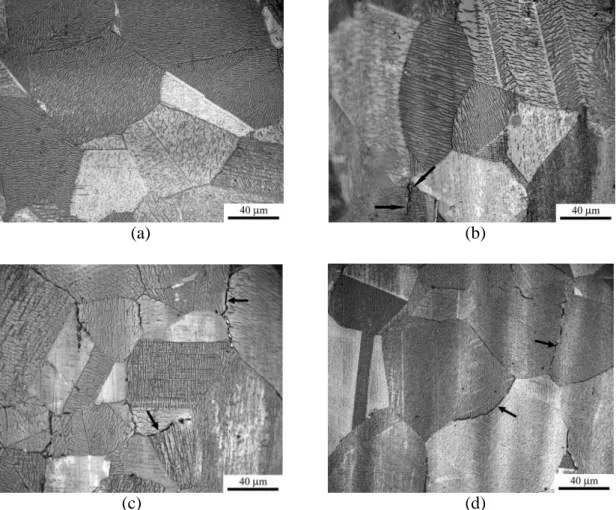
Figure 2 illustrates the OMs of the steel after being solution heat treated and isothermally held at low temperatures ranging from 1023 to 873 K. Fig. 2(a) shows the microstructure of the steel in which the austenitic grains are full of martensitic plates. Note that the morphology of the steel at 1023 K in Fig. 2(a) is similar to that in Fig. 1(a). The microstructures of the steel are the same at 1373 and 1073 K. Thus, the constituent phase of the steel is single austenite at temperatures from 1373 to 1023 K. However, for steel isothermally held at temperatures below 973 K, low-temperature phases precipitate at the austenitic grain boundaries as indicated by the arrows on the OMs shown in Figs. 2(b) to (d). Due to the small amount of grain boundary precipitates, the XRD signals from the precipitates are too weak to analyze, and are not shown here.
We utilized the TEM to identify the crystal structures of the grain boundary precipitates. The TEM study is shown in Fig. 3 for steel after isothermal heat treatment at 973 K. The BF in Fig. 3(a) shows two grains of the precipitate at the austenitic grain boundary, where stands for the austenite, and Fig. 3(b) is the corresponding SAD taken from the precipitate. By tilting the specimen to some other zone-axes of the precipitate, we demonstrated that the crystal structure of the
precipitate in Fig. 3(a) is the orthorhombic M3C carbide, the well-known cementite.
The zone-axis of the cementite as the SAD shows in Fig. 3(b) is along the [100]
direction. The lattice constants of the orthorhombic M3C carbide are a = 0.458, b = 0.510, and c = 0.668 nm. Besides the M3C carbide, we further verified that another precipitate has the crystal structure of FCC, and is confirmed as the FCC M23C6
carbide. Fig. 3(c) shows the M23C6carbide appears at the austenitic grain boundary of the steel. The accompanying SAD from the [011] M23C6 carbide and its neighboring [011] austenitic matrix is shown in Fig. 3(d). The lattice constant of the FCC M23C6 carbide is a = 1.040 nm. Note that a cubic to cubic orientation relationship exists between the M23C6 carbide and the austenitic matrix in the SAD.
This orientation relationship is frequently discovered for the precipitation of the M23C6carbide in the austenitic steels, such as Cr steels [6]. We further found that the grain size of the M23C6 carbide is, on average, much bigger than that of the M3C carbide from the TEM observation.
No precipitates appear in the austenite at 1073 K as shown in Fig. 2(a), and only a small number of grain boundary precipitates distributed at the austenitic grain boundary of the steel at 973 K as the OM shows in Fig. 2(b). The upper temperature limit for the formation of M3C and M23C6carbides at the austenitic grain boundaries is just above 973 K. Therefore, we concluded that the grain boundary precipitates
are M3C and M23C6 carbides at temperatures below 973 K. The M3C and M23C6
carbides co-exist in the austenite of the high manganese steel. The coexistence of M3C and M23C6 carbides in alloy steels is well documented in binary Mn-C and ternary Fe-Mn-C systems [11,13]
We further analyzed the samples after the isothermal holding at temperatures below 823 K. Some of the studies for the steel in the OM and XRD are shown in Fig.
4. Figs. 4(a) and (b) show the analyses for the steel isothermally held at a temperature of 823 K. The other analyses of the steel with the isothermal holding at 773 K are illustrated in Figs. 4(c) and (d). The morphology of the product phases from the OM observation in Figs. 4(a) and (c) is different from that in Figs. 2(b) to (d). The size of the low-temperature phase is much bigger than that of grain boundary precipitates shown in Fig. 2. Thus, the other phases appear in the austenitic matrix. Though quite a few low-temperature phases appear along the austenitic grain boundaries of the high manganese steel as the OMs show in Figs.
4(a) and (c), we still could not make a useful analysis of the crystal structures of the product phases from the XRD shown in Figs. 4(b) and (d). The signals from the low-temperature phases are too weak to distinguish in the XRD. Thus, we also further performed the study in the TEM.
The TEM analysis of the steel after the isothermal holding at 823 K is shown
in Fig. 5. Fig. 5(a) is the BF showing the lamellar structure of the low-temperature phases. After analyzing the SADs of the lamellar phases, we confirmed that the lamellae are the conventional pearlite comprising ferrite and M3C carbide. Fig. 5(b) is the accompanying SAD from the [113 ] ferrite and [100] M3C carbide. Note that a new orientation relationship between the ferrite and M3C carbide has been discovered as follows: (110)// (031)C and [113 ]// [100]C. This orientation relationship between the ferrite and the cementite in steels has never been previously reported in the literature. Thus, it is a new orientation relationship between the ferrite and the cementite, and suggests another way for the accommodation of M3C carbide embedded in ferritic grains of the pearlitic colonies.
Besides the conventional pearlite comprising ferrite and M3C, we discovered another new pearlite in the high manganese steel. Fig. 5(c) shows the BF of the new pearlite comprising lamellae of the ferrite and M23C6 carbide, and Fig. 5(d) is the accompanying SAD from the [111] ferrite and [011] M23C6 carbide. Note that an orientation relationship exists between the BCC ferrite and FCC M23C6carbide, i.e.
(110)// (111)C6 and [111]// [011]C6. It is the well-known K-S orientation relationship between BCC and FCC crystals [1,14]. The lamellae of the product ferrite and M23C6 phases in the high manganese steel are the new pearlite which is similar to the conventional pearlite in steels. In the following text, we use M3C
pearlite to note the conventional pearlite of ferrite and M3C, and M23C6 pearlite to stand for the new pearlite of ferrite and M23C6.
It is noteworthy that not only the lamellae of these two pearlites are similar, but also the ferritic layers are the same. In addition, the sheets of the carbides in the pearlites have similar morphologies. Thus, it is difficult to distinguish between the lamellar grains of the M23C6 and M3C carbides from the observation of the morphology in either the OM or TEM. The major difference between these two carbides in the pearlites is the crystal structure. However, the signals of the FCC M23C6 and orthorhombic M3C phases in the XRD are too weak to identify.
Furthermore, some of the signals from both pearlitic carbides are overlapped in the XRD. This makes the analysis more difficult. Thus, the appropriate method to differentiate between these two pearlitic carbide grains located in these two pearlites is the SAD analysis in the TEM. The SADs of the cubic M23C6carbide in the M23C6
pearlite are distinguished from those of the orthorhombic M3C carbide in the M3C pearlite. In addition, after finishing the identification of both lamellar carbide grains, we discovered that another characteristic of the M23C6 pearlite is that the thickness of the M23C6plates in the M23C6pearlite is greater than that of the M3C plates in the M3C pearlite. The grain size of the M23C6carbide is also bigger than that of the M3C carbide precipitating at the austenitic grain boundary of the steel at temperatures
higher than the eutectoid temperatures, for example, for the M3C and M23C6carbides shown in Fig. 3.
From the preceding analyses, we concluded that after the isothermal holding of the steel at temperatures below 873 K, two different pearlitic systems form in the austenitic matrix; i.e. one system of lamellae of ferrite and M23C6 carbide, and the other system of lamellae of ferrite and M3C carbide. The BF in Fig. 5(e) illustrates the co-existence of these two different pearlites in the same austenitic grain. The micrograph in Fig. 5(e) is assembled from several BFs showing various pearlites in one austenitic grain. One of the M23C6 pearlites is located at the left side and the M3C pearlite is at the right side of the micrograph as the labels show in Fig. 5(e). In the central region of the micrograph in Fig. 5(e), an unidentified pearlite exists.
Since the unidentified pearlite contains the carbide with roughly the same size as that of M23C6 pearlite at the left side of the micrograph in Fig. 5(e), it is most likely the M23C6pearlite.
During the isothermal holding of the steel at temperatures below 873 K, some austenite in the high manganese steel decomposed into ferrite and M23C6
carbide. This is characteristic of the different eutectoid transformation as follows:
+ M23C6. So far, no study we are aware of in the literature reports the different
eutectoid transformation in high manganese steels. This eutectoid reaction has only
been found in the Cr and Mn-Al steels [6,14]. The eutectoid reaction takes place neighboring the phase region of the conventional eutectoid reaction for the decomposition of austenite into M3C pearlite. Thus, two separate eutectoid reactions takes place in the austenitic matrix and produce the co-existence of two different pearlites. These two separate eutectoid reactions involve the replacement of of the austenite by (1) lamellae of ferrite and M3C carbide, the M3C pearlite, and (2) lamellae of ferrite and M23C6 carbide, the M23C6 pearlite. The product phases nucleated and grew at the austenitic grain boundaries, formed pearlitic lamellae, and advanced into the austenitic matrix. The austenite was a stable phase at high temperature and became a meta-stable supersaturated solid solution at low temperatures. It decomposed into either (1) the ferrite and M3C carbide or (2) the ferrite and M23C6carbide under the isothermal heat treatment at temperatures below 873 K. The ferrite, M3C and M23C6carbides are stable phases at low temperatures.
According to the series of isothermal heat treatments for the steel at low temperatures, we determined the upper temperature limits for the precipitation of the grain boundary M3C and M23C6carbides and the eutectoid reactions for the pearlites.
As in the OMs shown in Fig. 2, the upper temperature limit for the precipitation of grain boundary M3C and M23C6 carbides is just above 973 K. From Figs, 5(a) and (c), the upper temperature limit for the eutectoid reactions is between 873 and 823 K
for the high manganese steel. No evidence for the precipitation of the proeutectoid ferrite has been found in the high manganese steel prior to the eutectoid transformation. Instead of the ferritic precipitate, two different carbides precipitate at the austenitic grain boundaries of the high manganese steel at temperatures above the eutectoid temperature as shown in Figs. 2(b) to (d). Since the M3C and M23C6
are proeutectoid carbides prior to the eutectoid reactions, the specimen steel belongs to the hypereutectoid group of steels. The reason for the change in the carbon concentration of the eutectoid reaction might be the high alloy concentration of Mn in the steel.
We analyzed the chemical compositions (wt%) of the constituent phases which include carbides at 873 K and pearlites at 823 K by means of EDS equipment in the TEM. Due to carbon contamination on the surface area of the TEM specimen, all the carbon signals shown in the EDS are neglected. The chemical compositions of both carbides in the steel at 873 K are as follows. The M23C6is Fe-33.6 Mn, and the M3C is Fe-26.9 Mn. The chemical compositions of the constituent phases in the pearlites of the steel at 823 K are as follows. Ferrite is Fe-3.2 Mn, M23C6is Fe-38.6 Mn, and M3C is Fe-30.7 Mn. The ferritic grains in both pearlites contain similar low Mn contents. Mn is an austenite stabilizer; therefore, it is reasonable that the composition of the ferrite in the lamellae is low in Mn. Note that the metallic
element concentration of Mn in the M23C6carbide is higher than that of M3C carbide.
It is consistent with the prediction of the phase diagram in the binary Mn-C alloy system [12]. The M23C6carbide is located on the higher Mn side of the Mn-C binary phase diagram. The Mn solute atoms play an important role in stabilizing the M23C6
carbide in M23C6 pearlite of the high manganese steel. In addition, the concentrations of the M3C and M23C6carbides are high in carbon as indicated by the EDS, not shown here. Thus, the concentration of the M23C6 carbide is high in both Mn and C, and the same as the M3C carbide. During the growth of the pearlites, Mn and C atoms diffuse from the austenitic matrix to the M3C and M23C6 carbides, separately. Most of the carbon and manganese atoms in the austenite diffuse to the M3C and M23C6 carbides. Thus, the partitioning of Mn and C is distinct in the pearlitic systems of both lamellae of ferrite + M23C6 and lamellae of ferrite + M3C [15,16].
Conclusions
We have studied the phase transformation of the Fe-20.0 Mn-0.50 C steel after isothermal holding at various low temperatures. The steel received a solution heat treatment at 1373 K and the following isothermal holding at temperatures from 1073 to 773 K. The constituent phase of the steel at temperatures from 1373 to 1023
K is single austenite. The microstructure of the steel in the as-quenched condition is the austenite with the martensitic plates. M3C and M23C6 carbides precipitate at the austenitic grain boundaries simultaneously at temperatures below 973 K. The grain size of the M23C6carbide is usually much bigger than that of the M3C carbide. The upper temperature limit for the precipitation of these two carbides is just above 973 K.
Two pearlites form after two separate eutectoid reactions in the austenitic matrix at the same time at temperatures below 873 K. The eutectoid reactions are as follows: + M3C and + M23C6. The austenite decomposed into two different pearlitic systems, i.e. one system of lamellae of ferrite + M3C and the other system of lamellae of ferrite + M23C6. The morphologies of both pearlites are similar.
The lamellae of the product ferrite and M23C6phases in the high manganese steel are the new pearlite which is similar to the conventional pearlite in steel. Therefore, we found the co-existence of two different pearlites from separate eutectoid reactions in the high manganese steel.
From the M3C pearlite, a new orientation relationship was discovered
between the ferrite and M3C carbide, i.e. (110)// (031)C and [113 ]// [100]C. This orientation relationship between the ferrite and the cementite has, previously, never been reported in the literature. Thus, it is a new orientation relationship between the
ferrite and the cementite, and suggests another way for the accommodation of M3C carbide embedded in ferritic grains of the pearlitic colonies. Besides the new orientation relationship between the ferrite and M3C in the M3C pearlite, we discovered an orientation relationship which exists between the ferrite and M23C6in
the M23C6 pearlite, i.e. (110)// (111)C6 and [111]// [011]C6. It is the well-known K-S orientation relationship between BCC and FCC crystals.
Acknowledgement
The authors are pleased to acknowledge financial support for this paper by the National Science Council, Taiwan, under Grant No. NSC-98-2221-E-011-039.
References
[1] Porter DA, Easterling KE, Sherif MY. Phase Transformations in Metals and Alloys, forth ed. New York: CRC Press Taylor & Francis Group; 2009.
[2] Lewis MH, Hattersley B. Acta Metall 1965;13:1159.
[3] Singhal LK, Martin JW. Acta Metall 1968;16:1159.
[4] Weiss B, Stickler R. Metall Trans 1972;3:851.
[5] Campbell K, Honeycombe RWK. Metal Sci 1974;8:197.
[6] Howell PR, Bee JV, Honeycombe RWK. Metall Trans A 1979;10A:1213.
[7] Kuo KH, Jia CL. Acta Metall 1985;33(6):991.
[8] Vyrostkova A, Kroupa A, Janovec J, Svoboda M. Acta Mater 1998;46:31.
[9] Janovec J, Svoboda M, Vyrostkova A, Kroupa A. Mater Sci Eng A 2005;402:288.
[10] Goldschmidt HJ. Interstitial Alloys, New York: Plenum Press; 1967.
[11] Baker H. ASM handbook (3): Alloy Phase Diagrams, Materials Park, OH: ASM International; 1992.
[12] Zhou DS, Shiflet GJ. Metall Trans A 1992;23A:1259.
[13] Hillert M, Waldenstrom M. Metall Trans A 1977;8A:5.
[14] Cheng WC, Hwang SM. Submitted to Metall Mater Trans.
[15] Hutchinson CR, Shiflet GJ. Scripta Mater 2004;50:1.
[16] Hutchinson CR, Hackenberg RE, Shiflet GJ. Acta Mater 2004;52:3565.
[17] Remy L. Metall trans A 1977;8A;253.
[18] Tavares SSM, Lafuente A, Miraglia S, Fruchart D. J Mater Sci 2002;37;1645.
Figure captions
Fig. 1. (a) The OM and (b) XRD analysis for the Fe-20.0 Mn-0.50 C steel after being quenched from 1373 K. The Miller indexes with the underlines belong to FCC matrix in (b).
Fig. 2. The OMs of the steel after the solution heat treatment at 1373 K and isothermal holding at various low temperatures for 100 h. The temperatures are indicated as follows: (a) 1023, (b) 973, (c) 923 and (d) 873 K. Low temperature phases precipitate at the austenitic grain boundaries as indicated by the arrows in (b), (c) and (d).
Fig. 3. The TEM analysis of the low-temperature phases precipitating at the austenitic grain boundaries of the steel under the isothermal heat treatment at 973 K. (a) The BF showing the M3C carbide. (b) The SAD from the [100] M3C carbide. (c) The BF of the M23C6carbide, and (d) the accompanying SAD from the [011] M23C6carbide and [011] austenitic matrix. (C: M3C; C6: M23C6).
Fig. 4. (a) The OM and (b) XRD of the steel isothermally helded at 823 K for 100 h.
(c) The OM and (d) XRD of the steel at 773 K.
Fig. 5. The TEM analysis for the steel isothermally held at 823 K. (a) The BF showing the pearlite of ferrite () and M3C carbide. (b) The accompanying SAD from the [113 ] ferrite and [100] M3C carbide. (c) The BF of the pearlite consisting of ferrite and M23C6 carbide, and (d) the accompanying SAD from the [111] ferrite and [011]
M23C6 carbide. (e) The co-existence of two different pearlites in the same austenitic matrix.
(a) (b)
Fig. 1. (a) The OM and (b) XRD analysis for the Fe-20.0 Mn-0.50 C steel after being quenched from 1373 K. The Miller indexes with the underlines belong to FCC matrix in (b).
(a) (b)
(c) (d)
Fig. 2. The OMs of the steel after the solution heat treatment at 1373 K and isothermal holding at various low temperatures for 100 h. The temperatures are indicated as follows: (a) 1023, (b) 973, (c) 923 and (d) 873 K. Low temperature phases precipitate at the austenitic grain boundaries as indicated by the arrows in (b), (c) and (d).
(a) (b)
(c) (d)
Fig. 3. The TEM analysis of the low-temperature phases precipitating at the austenitic grain boundaries of the steel under the isothermal heat treatment at 973 K. (a) The BF showing the M3C carbide. (b) The SAD from the [100] M3C carbide. (c) The BF of the M23C6carbide, and (d) the accompanying SAD from the [011] M23C6carbide and [011] austenitic matrix. (C: M3C; C6: M23C6).
(a) (b)
(c) (d)
Fig. 4. (a) The OM and (b) XRD of the steel heated at 823 K for 100 h. (c) The OM and (d) XRD of the steel at 773 K.
(a) (b)
(c) (d)
(e)
Fig. 5. The TEM analysis for the steel isothermally held at 823 K. (a) The BF showing the pearlite of ferrite () and M3C carbide. (b) The accompanying SAD from the [113 ] ferrite and [100] M3C carbide. (c) The BF of the pearlite consisting of ferrite and M23C6 carbide, and (d) the accompanying SAD from the [111] ferrite and [011]
M23C6 carbide. (e) The co-existence of two different pearlites in the same austenitic matrix.
國科會補助計畫衍生研發成果推廣資料表
日期:2010/11/25
國科會補助計畫
計畫名稱: 高錳鋼中波來體組織的M23C6及M3C碳化物研究 計畫主持人: 鄭偉鈞
計畫編號: 98-2221-E-011-039- 學門領域: 鋼鐵材料
無研發成果推廣資料
98 年度專題研究計畫研究成果彙整表
計畫主持人:鄭偉鈞 計畫編號:98-2221-E-011-039- 計畫名稱:高錳鋼中波來體組織的 M23C6 及 M3C 碳化物研究
量化
成果項目 實際已達成
數(被接受 或已發表)
預期總達成 數(含實際已
達成數)
本計畫實 際貢獻百
分比
單位
備 註 ( 質 化 說 明:如 數 個 計 畫 共 同 成 果、成 果 列 為 該 期 刊 之 封 面 故 事 ...
等)
期刊論文 0 0 100%
研究報告/技術報告 0 0 100%
研討會論文 0 0 100%
論文著作 篇
專書 0 0 100%
申請中件數 0 0 100%
專利 已獲得件數 0 0 100% 件
件數 0 0 100% 件
技術移轉
權利金 0 0 100% 千元
碩士生 4 0 100%
博士生 0 0 100%
博士後研究員 0 0 100%
國內
參與計畫人力
(本國籍)
專任助理 0 0 100%
人次
期刊論文 0 3 100%
研究報告/技術報告 0 0 100%
研討會論文 0 0 100%
論文著作 篇
專書 0 0 100% 章/本
申請中件數 0 0 100%
專利 已獲得件數 0 0 100% 件
件數 0 0 100% 件
技術移轉
權利金 0 0 100% 千元
碩士生 0 0 100%
博士生 0 0 100%
博士後研究員 0 0 100%
國外
參與計畫人力
(外國籍)
專任助理 0 0 100%
人次
其他成果
(
無法以量化表達之成果如辦理學術活動、獲 得獎項、重要國際合 作、研究成果國際影響 力及其他協助產業技 術發展之具體效益事 項等,請以文字敘述填 列。)
無
成果項目 量化 名稱或內容性質簡述
測驗工具(含質性與量性) 0
課程/模組 0
電腦及網路系統或工具 0
教材 0
舉辦之活動/競賽 0
研討會/工作坊 0
電子報、網站 0
科 教 處 計 畫 加 填 項
目 計畫成果推廣之參與(閱聽)人數 0
國科會補助專題研究計畫成果報告自評表
請就研究內容與原計畫相符程度、達成預期目標情況、研究成果之學術或應用價 值(簡要敘述成果所代表之意義、價值、影響或進一步發展之可能性) 、是否適 合在學術期刊發表或申請專利、主要發現或其他有關價值等,作一綜合評估。
1. 請就研究內容與原計畫相符程度、達成預期目標情況作一綜合評估
■達成目標
□未達成目標(請說明,以 100 字為限)
□實驗失敗
□因故實驗中斷
□其他原因 說明:
2. 研究成果在學術期刊發表或申請專利等情形:
論文:□已發表 ■未發表之文稿 □撰寫中 □無 專利:□已獲得 □申請中 ■無
技轉:□已技轉 □洽談中 ■無 其他:(以 100 字為限)
已經投稿至 Acta Materialia, the top one Journal in the field of Materials Science.
3. 請依學術成就、技術創新、社會影響等方面,評估研究成果之學術或應用價 值(簡要敘述成果所代表之意義、價值、影響或進一步發展之可能性)(以 500 字為限)
We discovered two different pearlites after two separate eutectoid reactions in a Fe-20.0 Mn-0.50 C (wt%) steel. The pearlites are lamellae of ferrite + M3C and lamellae of ferrite + M23C6, respectively.