Soochow University
Global Business Program, School of Business Thesis
Location Strategy of Manufacturing Companies in China
By Alison (Li-Tzu) Chien 簡立慈 Advisor: Dr. Chen, Huei-Fang 陳惠芳 博士
January 2014
Location Strategy of Manufacturing Companies in China
A Thesis Submitted to Soochow University
in partial Fulfillment of the Requirements for the Degree of
Master of Business Administration In
Global Business Program
By Li-Tzu, Chien
Global Business program, School of business, Soochow University January 2014
Abstract
After the labor shortage issue occurred in the East costal area of China, Multinational Corporations that aimed at labor forces incentive and built their manufacturing department in China before had found out the motive no longer available. Therefore, companies need to come up with corresponding strategies for new situation.
This study first classified companies into two categories by strategies it adopted – stay-in China strategy and movement strategy. By asking “why”, “where” and “how”
(Meijboom and Vos 1997) questions and applying Enright’s location theory (2009), the research built the framework of researching and understood the relationship between factors that companies concerned and following strategies companies adopted. Qualitative interviews were used to gather information and seven companies were taken the interview. After adopting strategies, companies used the performance evaluation method that generated by National Association of Accounting to evaluate results.
An extra type of strategy that some companies adopted, mix strategy, was been found after interviewing. Results of interviews showed that corporations used different strategies due to their own concerns but localization would be the mutual goal for all companies. Lastly, some research limitations and future study suggestions are discussed.
Key words: Labor Shortage, Location Strategy, Manufacturing Industry, Stay in China Strategy, Movement strategy, Mix strategy
ii
Acknowledgement
Studying abroad and completing thesis at the same time is never an easy option.
Thanks to my thesis advisor – Dr. Huei-Fang, Chen, I cannot do this without your guidance.
During the writing process, I was confused by much stuff including the analysis of huge information and the format of writing. Thanks Dr. Chen for always replying my email speedily and patiently. Without giving me answer directly, professor provided me chance to learn and generate my own ideas freely. I enjoyed the process working with you a lot.
Thanks to my parents for your continuously supports and tolerances. Not many people can have the chance to study abroad and to experience different parts of the world. Dad, thanks for introducing me to managers in manufacturing companies while I need interview objectives. Mom, thanks for encouraging me while I felt lonely and tired in a foreign place. I am so lucky to have such strong mental supports from you two.
Last but not least, thanks to many people that help me a lot on the road of completing this research, your kindness is my biggest power. Thanks to Professor Roan and Serena Chiang, I am lucky to join GBP family and got so many warm supports from you; thanks to Professor Chen and Professor Ku, your advices during oral defense were valuable to me;
thanks to Vivian Wang, Duncan Lin, Gillian Chen and Irene Yen for helping me gather needed information from library while I was in U.S., I will never forget your kindness.
Li-tzu, Chien January 2014
Abstract
After the labor shortage issue occurred in the East costal area of China, Multinational Corporations that aimed at labor forces incentive and built their manufacturing department in China before had found out the motive no longer available. Therefore, companies need to come up with corresponding strategies for new situation.
This study first classified companies into two categories by strategies it adopted – stay-in China strategy and movement strategy. By asking “why”, “where” and “how”
(Meijboom and Vos 1997) questions and applying Enright’s location theory (2009), the research built the framework of researching and understood the relationship between factors that companies concerned and following strategies companies adopted. Qualitative interviews were used to gather information and seven companies were taken the interview. After adopting strategies, companies used the performance evaluation method that generated by National Association of Accounting to evaluate results.
An extra type of strategy that some companies adopted, mix strategy, was been found after interviewing. Results of interviews showed that corporations used different strategies due to their own concerns but localization would be the mutual goal for all companies. Lastly, some research limitations and future study suggestions are discussed.
Key words: Labor Shortage, Location Strategy, Manufacturing Industry, Stay in China Strategy, Movement strategy, Mix strategy
ii
Acknowledgement
Studying abroad and completing thesis at the same time is never an easy option.
Thanks to my thesis advisor – Dr. Huei-Fang, Chen, I cannot do this without your guidance.
During the writing process, I was confused by much stuff including the analysis of huge information and the format of writing. Thanks Dr. Chen for always replying my email speedily and patiently. Without giving me answer directly, professor provided me chance to learn and generate my own ideas freely. I enjoyed the process working with you a lot.
Thanks to my parents for your continuously supports and tolerances. Not many people can have the chance to study abroad and to experience different parts of the world. Dad, thanks for introducing me to managers in manufacturing companies while I need interview objectives. Mom, thanks for encouraging me while I felt lonely and tired in a foreign place. I am so lucky to have such strong mental supports from you two.
Last but not least, thanks to many people that help me a lot on the road of completing this research, your kindness is my biggest power. Thanks to Professor Roan and Serena Chiang, I am lucky to join GBP family and got so many warm supports from you; thanks to Professor Chen and Professor Ku, your advices during oral defense were valuable to me;
thanks to Vivian Wang, Duncan Lin, Gillian Chen and Irene Yen for helping me gather needed information from library while I was in U.S., I will never forget your kindness.
Li-tzu, Chien January 2014
iii
Table of Contents
Abstract ... i
Acknowledgement ...ii
Table of Contents ... iii
List of Tables ... v
List of Figures ... vi
Chapter I: Introduction ... 1
1.1 Research Background ... 1
1.2 Research Motives ... 2
1.3 Research Objectives ... 4
Chapter II: Literature Review ... 5
2.1 International Business ... 5
2.2 Determinants of location strategy ... 6
2.3 Performance Evaluation ... 7
Chapter III: Methodology ... 8
3.1 Research Framework ... 8
3.2 Interview ... 9
3.2.1 Premises of interview ... 9
3.2.2 Research Subjects ... 10
3.2.3 Sample Questionnaire ... 10
Chapter IV: Empirical Results ... 13
4.1 Research Subjects ... 15
4.2 Three Types of Business Strategies ... 19
4.2.1 Stay in China Strategy ... 19
4.2.2 Movement Strategy ... 21
4.2.3 Mix Strategies ... 22
4.3 Performance Evaluation ... 23
Chapter V: Conclusion ... 25
5.1 Major Conclusion ... 25
5.2 Contributions ... 25
5.3 Research Limitation and Suggestion ... 26
Appendix 1 ... 28
iv
Appendix 2 ... 30 References ... 35
v
List of Tables
Table 1 Characteristic of Different Firm Activities... 2
Table 2 Features that influence different corporate activities ... 6
Table 3 Questionnaire for companies that stayed in China ... 10
Table 4 Questionnaire for companies that adopted movement strategy ... 11
Table 5 Questionnaire for companies which adopted mix strategy ... 14
Table 6 Comparing Three Different Strategies ... 16
vi
List of Figures
Figure 1 Research Framework ... 9 Figure 2 Revised Research Framework ... 14
1
Chapter I: Introduction
1.1 Research Background
With 1.3 billion people, China was known as “world factory” of Multinational Corporations (MNEs) with abundant labor forces for the past three decades, especially rural surplus labor (Huang and Jiang, 2010). However, the labor structure changed after the rapidly growth of economy in China. Migrants from inland cities that were working in East costal areas now tend to move back to their hometown since the working condition and wage level are rising in second-tier cities (Pan and Liao, 2011). Manufacturing activities in coastal area needed to offer higher salaries for motivating workers to move away from their hometown to East coast. After a decade of 20% wage increases, cheap labor advantage is no longer existing here (Chu, 2013). The Nobel-Prize winner Sir Arthur Lewis called the situation, which workers are not willing to move to cities and companies need to pay more to deal with labor shortage issue, the Lewis Turning Point (S.A.C., 2013). This transition in costal areas not only influenced local industry, but also gave pressure to MNEs that seeks cheap labor incentive in China. Located manufacturing department in China no longer make MNE profitable and MNEs needs to come up with new strategies to keep growing.
This labor shortage issue had huge impact to traditional manufacturing industry that needs larger amounts of workers than any other industries, such as furniture industry.
Although basic wage has been raised and conditions of hiring workers has been relaxed, labor shortage rate of furniture industry in this area still reached thirty percent in 2011 (Chen, 2011).
Companies had to delay the payment of celeries after big holiday to make sure that workers would come back to their position after vacation. Furniture companies that located their manufacturing department in China have been struggled and tried to seek new routes.
After China’s role as factory to the world changed, MNEs tried to adopt different strategies to overcome difficulties (Silva, 2012). Some companies decided to follow same business model and move to other developing countries in Asia for seeking low labor costs and sufficient workforces compared to China, including Indonesia, Vietnam and Malaysia;
while others decided to stay in China due to market size, market growth and infrastructure incentives (Enright, 2009).
2
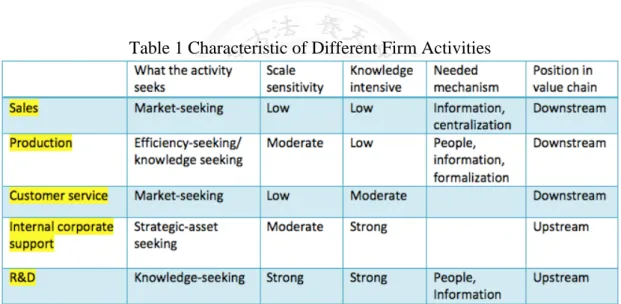
Different concerns lead to different decisions companies made to react to the labor shortage. As Enright (2009) mentioned, MNEs’ manufacturing active in Asia-Pacific countries have significant differences in terms of location decisions for different corporate activities. The factors that influenced companies’ moving decisions after labor shortage were not only microelements like firm size and international experience; but macro elements, such as the market size and government policy of host countries, as well. Focus on either micro or macro factors may not be sufficient to thoroughly understand the relationship between labor shortage trend and the manufacturing decisions that companies made. Besides, which business activities do companies focus is also a variable when companies make location decisions. Companies put emphasis on sales activity may have features of market-seeking and low scale sensitivity; while companies expect to launch production activity in host countries would have features of knowledge seeking and moderate scale sensitivity (Enright, 2009).
Table 1 Characteristic of Different Firm Activities
Source: Enright 2009
1.2 Research Motives
There have been considerable amount of researches discussing the labor shortage of manufacturing industry in China these years. Within those researches, comprehensive topics had been included, such as what are the causes and effects of losing competitiveness in labor- seeking activities by adopting Dual Economical Model (Pan and Liao, 2011) or if China reached its turning point or not by adopting Lewis turning Point Theory (Huang and Jiang, 2010). However, little researches had been conducted to explore companies’ following
3
corresponding global strategies after the labor shortage phenomenon happened and the worldwide situation. How companies made their manufacturing decisions and which elements did they consider the most would bring practical explications for MNEs seeking expansion in their global manufacturing strategy in developing countries. Moreover, comparing determinants and the different outcomes between “companies still decided to stay in China but changed business strategy” and “companies decided to move outside of China to nearby Asian countries seeking cheap labor incentives” would broaden our knowledge concerning the location strategy of MNEs.
4
1.3 Research Objectives
Through interviewing MNEs which offshoring their manufacturing department in China for more than eight years, the present paper would like to know what were those companies’
responses to the labor shortage trend and what were the following outcomes. With collecting all necessary information, this paper would like to answer these questions:
1. Understand the key factors that companies took into consideration when making location strategies.
2. Describe the following business strategies companies adopted after labor shortage occurred.
3. Compared the similarities and differences between companies with each business strategy.
5
Chapter II: Literature Review
2.1 International Business
When MNEs is thinking to serve foreign markets, different entry modes, such as franchising, export and Foreign Direct Investment (FDI) can be considered (Buckley and Casson, 1998). As Meijboom and Vos (1997) elaborated in their paper, companies should consider many “why”, “where” and “how” factors while making decisions for international expansion.
Take FDI activity for example, the firm must first did a lot researches beforehand about the business climate while making location decisions (where). The firm then decided to build its own facilities in host countries based on specific reasons (Why). At the same time, the firm should consider why choosing FDI instead of exporting or franchising (How)? These three questions correlate tightly with each other and cannot be thinking apart while making international manufacturing strategies (Meijboom and Vos, 1997).
As Dunning (1993) claimed in his Eclectic Paradigm of International Production, firms will engage in international activities on the basis of ownership-specific, location- specific advantages and internalization-incentive. Ownership-specific advantage can refer to intangible assets that give companies competitive advantages to make companies decide to stay or move. This advantage can be related to “Why” question in Meijboom and Vos’s theory (1997). Location advantage can be related to attractive inputs in terms of price or productivity (Where); while internalization incentive can be related to extending of value- added activities, such as know-how and managerial style (How). Dunning stated that these three dimensions should interrelate with each other when discussing new locations. The final decision on where a firm should locate its production will depend on the character of its ownership advantages and the extent to which one location helps to internalize its origin advantages better than another.
6
2.2 Determinants of location strategy
As Enright (2009) mentioned, when features such as activities, nations and firms interacted with each other and jointly provide sources of advantage for MNEs, it would influence the making of location strategies for FDI activity and other foreign market entry strategies in different corporate activities.
Corporate activities, including sales, customer services, production, international corporate support, and R&D, are not only different from each other in functional sides, but also different in terms of position, scale sensitivity, knowledge and integration modes (as summarized in table 1).
Features that provided by host countries also related to FDI activities in three aspects:
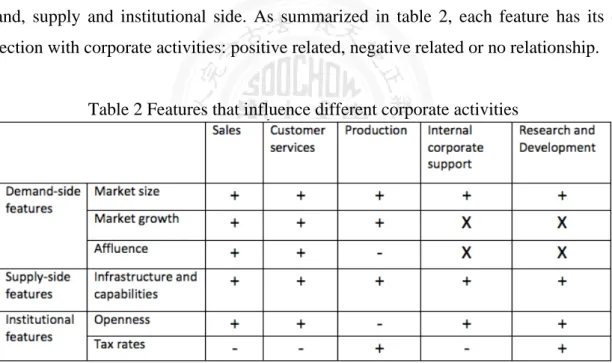
demand, supply and institutional side. As summarized in table 2, each feature has its own connection with corporate activities: positive related, negative related or no relationship.
Table 2 Features that influence different corporate activities
Note: + : positive related; - : negative related; x : no related.
Source: Enright 2009
Demand-side features include market size, market growth and affluence. Market size has significant positive relationship with all kinds of corporate activities; while market growth has positive relationship with sales, customer services and product but no relationship with internal support and R&D department. Corporate support or R&D activities usually lag market development, market growth does not have obvious influence to them. Affluence
7
usually has negative relationship with production activities since the higher level of development, the bigger possibility that wage rates would be higher.
Supply-side feature focus on local infrastructure and capabilities. Since qualified infrastructure should facilitate the conduction of business, infrastructure has positive relationship with all corporate activities. Local capabilities should be attractive to inward investment activities as well; such as technological capabilities would be a big incentive for knowledge-seeking activities.
Institutional features also influence FDI activities in host countries, including economic openness and tax rates. Openness of an economy usually is positively related with all investment activities except production. If a company decided to expand into a close economy, it should build its own production line inside the country. In other words, if a country has greater openness, it would have negative relationship with production activities since it is not necessary for company to invest in production in this country.
2.3 Performance Evaluation
After new location strategies have been adopted, companies should their own way to measure performances and make changes in timely manner. Performance is the proof if the firm reached its expected outcome or not (Kaufamn 1988).
Performance can be accessed in different perspective. Generally speaking, the evaluation of performances can be divided into two categories: subjective and objective (Bandura 1997). Subjective evaluation includes non-financial elements like quality of products or R&D capability, while objective evaluation includes financial assessment like R.O.I or cash flow. According to National Association of Accounting (NAA) (1986), the adoption of measuring methods, the most important, should be verified depending on environmental differences. NAA suggested companies should classify themselves into four different time periods while measuring performances: introduction, growth, maturity and decline. MNEs should have different way of measuring for different stages. During introduction period, the measuring of performance should depend on non-financial elements.
How to win market share by limited resources is more important than how much the cash flow is. During growth and maturity period, company should pay attention to long-term
8
financial index, including R.O.I. and asset management efficiency. In this case, the firm can make sure income and spending are even and investors have coincidence to the company.
Then at the decline stage, cash flow is the most crucial element to the survival of the company.
Chapter III: Methodology
3.1 Research Framework
The present paper will put focus mainly on how companies reacted to the labor shortage phenomenon. After noticing the issue, companies with different backgrounds that have specific concerns would make their own location strategies. The paper will discuss those elements and the influences of different factors. Next, strategies after entry modes been adopted and measurements of performance for each company will be mentioned.
9
Figure 1 Research Framework
This paper is going to discuss the location and manufacturing strategies after a specific phenomenon by asking why, where and how questions. The outcomes for these questions usually need time to figure out. Since the labor shortage phenomenon did not occur for a long time, there are no researches that are detailed and strong enough to elaborate following activities. Therefore, the paper will use qualitative method to deeply interview company managers and gain latest information. Sample questions include: how the labor-shortage phenomenon influenced the company, what are the company’s reactions and what is the outcome of the action.
The paper expects MNEs desired to think new ways and solve the problem. The factors mentioned in literature review that influenced location strategies would affect not only why company chose one country, but also why company gave up other options. After making decisions, the paper assumed to classify respondents into two categories: companies stayed in China but adopted new strategies, and companies decided to move outside of China to seek other incentives. The paper will then ask companies about their entry mode or transformation strategies after choosing locations. At the end of the interview, researcher will address how companies measure their performances after adopting new manufacturing strategies.
3.2 Interview
3.2.1 Premises of interview
The needed information of this paper will be gathered from conducting secondary research and interviewing companies individually. Since the topic of this paper is operating- oriented, levels of interviewees would be managers in companies. Managers of manufacturing depart were targets of interviews. The firm-specific features of interviewees are considered to be controllable premises in the paper:
1. Company that had build their manufacturing department in East costal China due to labor incentive for more than eight years.
2. Headquarter of the company is located outside of China.
10
3. Company that had influenced by the labor shortage phenomenon in China in terms of financial influence or human resources influence.
3.2.2 Research Subjects
Due to the two different styles of companies this paper assumed, two different interviews questionnaires would be created.
Here are seven participants of this interview: LEEFU WOOD PRODUCTS Co., LTD, Golden Home Elegance, Mingxia Arts And Crafts (shanghai) Co., Ltd, Hero Way Furniture Company, AFC mfg., Ruifeng Furniture Company, Shingmark Wooden.
Chinese questionnaires would be used if interviewees felt more comfortable with Mandarin interview (see Appendix 1). After gathering all needed information, the paper will compare the differences between three interviewee groups about how they make strategy, the final results and current situation.
3.2.3 Sample Questionnaire
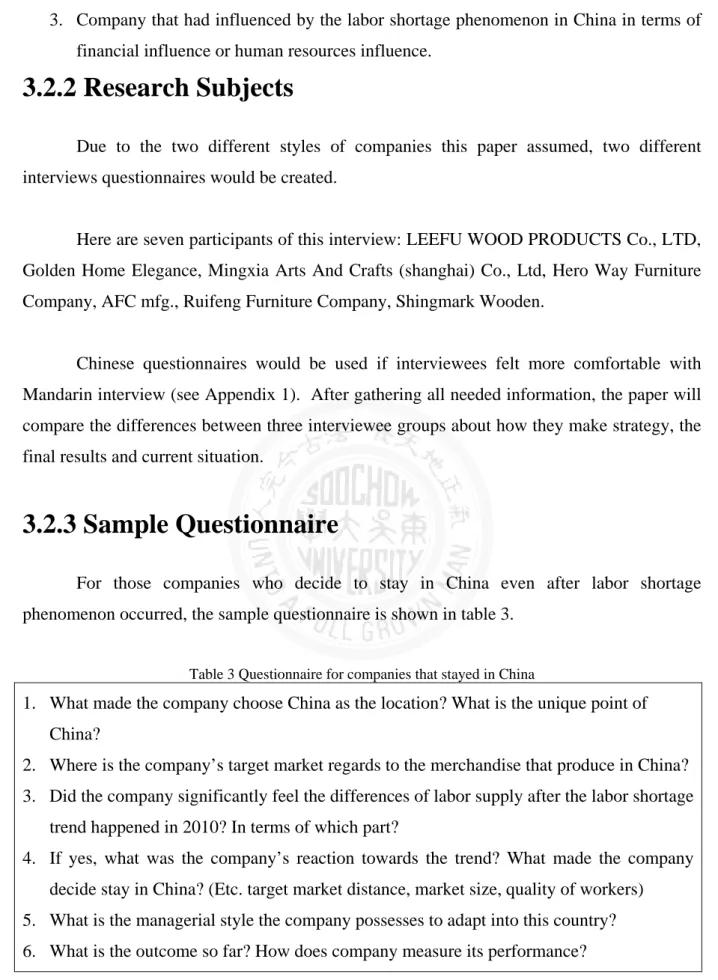
For those companies who decide to stay in China even after labor shortage phenomenon occurred, the sample questionnaire is shown in table 3.
Table 3 Questionnaire for companies that stayed in China
1. What made the company choose China as the location? What is the unique point of China?
2. Where is the company’s target market regards to the merchandise that produce in China?
3. Did the company significantly feel the differences of labor supply after the labor shortage trend happened in 2010? In terms of which part?
4. If yes, what was the company’s reaction towards the trend? What made the company decide stay in China? (Etc. target market distance, market size, quality of workers) 5. What is the managerial style the company possesses to adapt into this country?
6. What is the outcome so far? How does company measure its performance?
11
The goal of this questionnaire is to figure out correlation between factors Enright mentioned and location strategy. Did companies make changes based on human resources management, financial conditions, or operation management? After figuring out the causes, what new strategies did they adopt to meet the new trend? What was the effect of new strategies? During interviews, possible following questions that out of the scope of sample questionnaire would be asked based on respondents’ answers.
For those companies that determined to move outside of China after labor shortages, mainly moving to Southeast Asian countries including Cambodia and Indonesia due to labor incentives (Huang 2012), another questionnaire will be designed with part of questions are same as the questions that designed for companies stayed in China and part of questions are modified due to different situations. Sample questionnaire is showed in table 4.
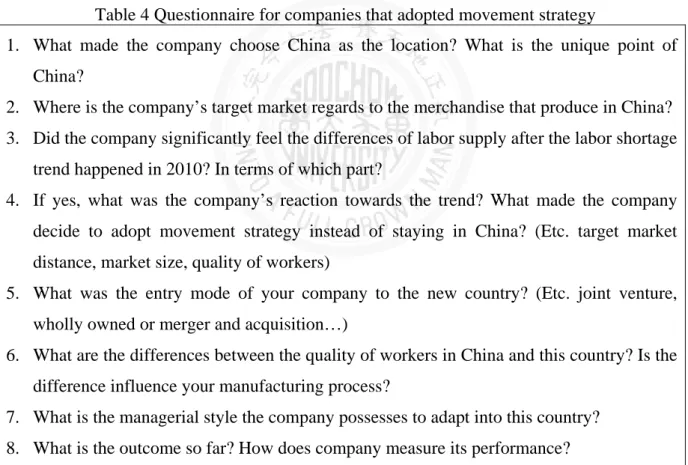
Table 4 Questionnaire for companies that adopted movement strategy
1. What made the company choose China as the location? What is the unique point of China?
2. Where is the company’s target market regards to the merchandise that produce in China?
3. Did the company significantly feel the differences of labor supply after the labor shortage trend happened in 2010? In terms of which part?
4. If yes, what was the company’s reaction towards the trend? What made the company decide to adopt movement strategy instead of staying in China? (Etc. target market distance, market size, quality of workers)
5. What was the entry mode of your company to the new country? (Etc. joint venture, wholly owned or merger and acquisition…)
6. What are the differences between the quality of workers in China and this country? Is the difference influence your manufacturing process?
7. What is the managerial style the company possesses to adapt into this country?
8. What is the outcome so far? How does company measure its performance?
Due to this questionnaire, the consequence between labor shortage trend and movement actions can be known. After moving out of China, the adapting strategy including managing style and manufacturing strategy and following outcome are also addressed in this questionnaire. Also, following questions that out of the scope of this questionnaire might be asked based on interviewee’s responses.
12
After interviewing with target companies, this research expects to gain information that meet the setting of the research framework. Factors that affect companies’ decisions can pretty much cover the factors that companies put into consideration in real situations. This research can make a comparison based on the interview and understand the key elements and changes that companies focus after making the location strategies. The take-away from this paper do not only understand the factors, but also integrate the sequences.
13
Chapter IV: Empirical Results
In this chapter, the results of interviews for individual companies will be introduced and analyzed. At first, the paper will briefly introduced backgrounds of interviewees.
Background information of seven different companies, such as registered capital, numbers of employees or target market, may lead to different business strategies. After that, the paper will classify seven interviewees into three types of development after labor shortage phenomenon. “Why” the company chose one type instead of others, “where” is the new location, and “how” the company is going to adapt into new environment will be elaborated here. When talk about “where” dimension, key determinants of location decisions for each type will be specially analyzed here, including factors for move-in and move-out activities. In addition, similarities and differences of companies in the same type will be compared. Last but not least, the paper will talk about which period of development for each company is now.
Different measurement method should be used depending on different stage of firms.
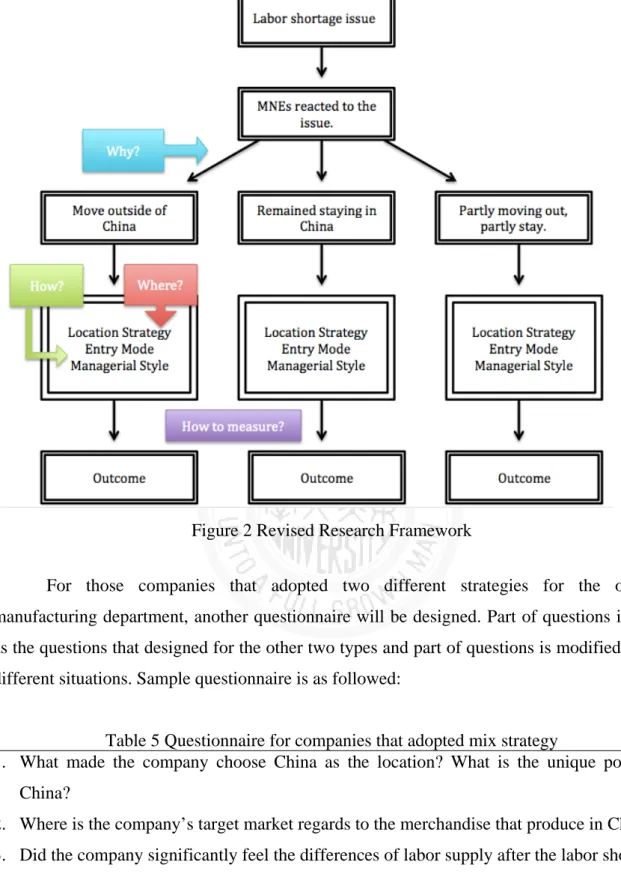
After interviewing with research objects, the paper found out that there is an extra business strategy, which is out of the scope of research framework before. MNEs who adopted the third type of business strategy had separate tactics for different departments. For example, companies may have one strategy for manufacturing department and another strategy for sales department. As shown in figure 2, a revised research framework should be built for the new founded mix strategy. Also, a specific questionnaire as shown in table 5 should be made for companies that adopted this new type of strategy. Same as other types, the interview would be conducted in Mandarin if research objects were not comfortable with English interview.
14
Figure 2 Revised Research Framework
For those companies that adopted two different strategies for the original manufacturing department, another questionnaire will be designed. Part of questions is same as the questions that designed for the other two types and part of questions is modified due to different situations. Sample questionnaire is as followed:
Table 5 Questionnaire for companies that adopted mix strategy
1. What made the company choose China as the location? What is the unique point of China?
2. Where is the company’s target market regards to the merchandise that produce in China?
3. Did the company significantly feel the differences of labor supply after the labor shortage trend happened in 2010? In terms of which part?
4. If yes, what was the company’s reaction towards the trend? What made the company decide to adopt mix strategy? (Etc. target market distance, market size, quality of workers)
15
5. How did the company decide new business location?
6. What is the managerial style the company possesses to adapt into this country?
7. What is the outcome so far? How does company measure its performance?
As for this questionnaire, which different factors companies had considered would be revealed. What kind of companies will choose this kind of mode and will two different strategies resulted in different impact for the companies are also interesting issues.
4.1 Research Subjects
In this present paper, seven companies were conducted the interview. All companies met the conditions of building manufacturing department in China, having headquarter outside of China and being influenced by labor shortage phenomenon. Due to the constraints of reality, interviewed enterprises all belong to furniture-related industry.
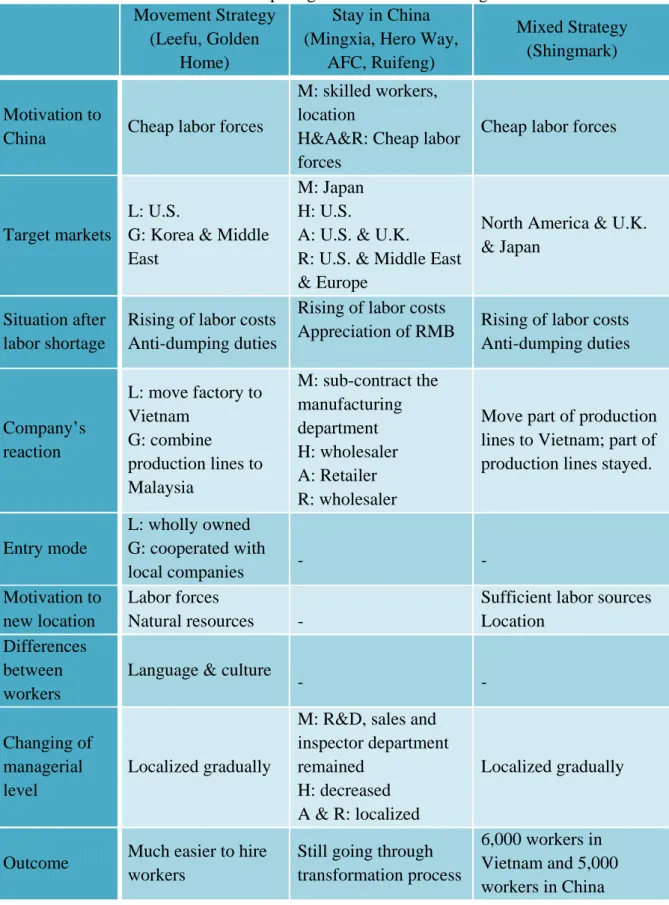
Table 4-1 and following information introduced the backgrounds of interviewed companies, which were classified into three different categories. There are some similarities and differences of answers among companies that resulted in different business strategies.
Completed questionnaire for each business strategies can be found in Appendix 2.
16
Table 6 Comparing Three Different Strategies Movement Strategy
(Leefu, Golden Home)
Stay in China (Mingxia, Hero Way,
AFC, Ruifeng)
Mixed Strategy (Shingmark)
Motivation to
China Cheap labor forces
M: skilled workers, location
H&A&R: Cheap labor forces
Cheap labor forces
Target markets
L: U.S.
G: Korea & Middle East
M: Japan H: U.S.
A: U.S. & U.K.
R: U.S. & Middle East
& Europe
North America & U.K.
& Japan
Situation after labor shortage
Rising of labor costs Anti-dumping duties
Rising of labor costs
Appreciation of RMB Rising of labor costs Anti-dumping duties
Company’s reaction
L: move factory to Vietnam
G: combine
production lines to Malaysia
M: sub-contract the manufacturing department H: wholesaler A: Retailer R: wholesaler
Move part of production lines to Vietnam; part of production lines stayed.
Entry mode
L: wholly owned G: cooperated with
local companies - -
Motivation to new location
Labor forces
Natural resources -
Sufficient labor sources Location
Differences between workers
Language & culture
- -
Changing of managerial level
Localized gradually
M: R&D, sales and inspector department remained
H: decreased A & R: localized
Localized gradually
Outcome Much easier to hire workers
Still going through transformation process
6,000 workers in Vietnam and 5,000 workers in China
LEEFU WOOD PRODUCTS CO., LTD
Headquarter: Taiwan
Factory of China was founded in 1994
17
Factory of Vietnam was founded in 2008
Mainly produce wooden furniture
Registered capital: $1.6 million U.S. dollars
Workers in the factory of China: 2,000
Workers in the factory of Vietnam: 1,500
Target market: U.S.
Golden Home Elegance
Headquarter: U.S.A.
Factory of China was founded in 2005
Factory of Malaysia was founded in 2001
Shut down Chinese factory and move to Malaysia: 2007
Produced all kinds of furniture, including house and office furniture
Workers in the factory of China were 80.
Workers in the factory of Malaysian were 100.
Target market: U.S.
Mingxia Arts And Crafts (shanghai) Co., Ltd.
Headquarter: Taiwan
Factory of China was founded in 1994.
Mainly produced building materials of temple, housing decoration and lacquer ware.
Registered capital: $600,000 U.S. Dollars
Workers in factory before transformation were 300 people.
Employees in sales department in Shanghai now are 20 people.
Target market: Japan
Hero Way Furniture Company
Headquarter: Taiwan
Factory of China was founded in 1994.
Mainly produced wooden housing furniture.
Workers in factory before transformation: 2,000
Target market: was U.S. market; now domestic market
18
Started the transformation from 2011 AFC mfg.
Headquarter: Taiwan
Factory of China was founded in 1992.
Mainly produced leather furniture, like sofa.
Registered capital: around $3.3 Million U.S. dollars
The number of labor workers in factory was 200; the number changed to 60 after transformation.
Target market: was U.S.; changed to domestic market after transformation.
Started transformation from 2012.
Ruifeng Furniture Company
Headquarter: Hong Kong
Factory of China was founded in 1990.
Mainly produced wooden furniture.
Workers in factory before transformation: 6,000
Workers in factory after transformation: 1,000
Target market: was Middle East, U.S., Europe; is domestic market now
Started transformation: 2009
Shingmark Wooden
Headquarter: Taiwan
Factory of China was founded in 1995.
Factory of Vietnam was founded in 2007.
Mainly produced wooden and iron furniture.
Registered capital: $36 Million U.S. dollars
The number of workers in factory of China was 15,000, now is around 5,000 people after transformation.
The number of workers in factory of Vietnam is around 6,000.
Target market: North America, Japan and U.K.
19
4.2 Three Types of Business Strategies
After the labor shortage phenomenon occurred in China, many MNEs noticed the situation and seek alternatives to survive. After having deep conversation with managers of MNEs, the present paper classified those companies into three different types based on their after-ward business strategies.
4.2.1 Stay in China Strategy
Four among seven interviewed companies decided to stay in China after labor shortage occurred, which has the highest ratio among research objects.
1. Why?
All four companies moved their manufacturing department into China at the beginning of 1990’s. After the Reform and Opening happened in China in 90’s, Deng Xiaoping advocated that China had to improve economy situation by well using its sufficient labor sources to increase exporting (Yue, 2013). During this time, the government reduced limitation and welcomed FDI to come into China. All these four companies decided to enter China based on this historical factor.
In Enright’s thesis - “The Location of Activities of Manufacturing… (2009)”, he mentioned that the factor “openness” of a country will have negative influence to production activity since it is not necessary to for MNEs to invest in production line in this country if its openness is high. However, what happened in China was that, advantages of openness and cheap labor existed simultaneously. Companies came to this country for both incentives. To be clear, the advantage of cheap labor in such a communist country like China existed only under the premise of openness. Therefore, the factor “openness” definitely had positive relationship with production activity of MNEs at that time. The insufficient part of Enright’s theory should be modified.
Except labor incentive, Mingxia Arts and Crafts Co. chose China because of its local capabilities. According to Enright’s theory, local capabilities would have positive relationship with production activity. To Aim at Japan market and produced high quality products for
20
Japanese customers, Mingxia chose Shanghai as the manufacturing location for its sufficient skilled workers and logistics advantage.
As Enright (2009) mentioned, “affluence” would have negative influence with production activity. According to the interview with AFC mfg., the wages of workers in costal areas increased 25% - 30% generally after the wages in second-tier cities raised and workers were not willing leave their hometown. All four companies found out that the increase of salaries were not affordable and decided to make some changes to manufacturing departments.
2. Where?
Four companies out of seven decided to stay in China after labor shortage phenomenon occurred. Within seven research objects, these four companies decided to make reaction towards labor issue slightly later than the other three companies – all companies started transformation after 2008. Besides, except Mingxia, one of target markets for other three companies was U.S. Household furniture sales are closely related to real estate sales.
The house prices fell sharply from 1% to 5% in the U.S., triggering downslide in 2008 (Gale Group, 2014). In the other side, Chinese furniture market still has vast room to expand. From 2004 to 2011, the sales value of wholesalers and retailers above a certain scale in the industry grew at an annual average rate of 31% (Wong, 2013). Market growth has positive relation with production activity (Enright, 2009); hence companies decided to give up U.S. market and aim at domestic market for transformation.
3. How?
To aim at domestic market, all Hero Way, AFC and Ruifeng transformed their companies from manufacturers to sellers by creating their own brands. Since the advantage of cheap labor did not exist any more, Hero Way and AFC both imported goods from U.S. and U.K. brands. Although the furniture of those brands is still manufacturing in factories located in Southeast Asia, the situation is completely reversed. Ruifeng is still selling furniture that produced by its factory located in China but planned to deduct the ratio gradually. Besides importing goods, as a retailor for U.K. brand currently, AFC planned to build connection with customers first and create its own brand that position in high-end furniture in the near future.
In this way, it can provide high quality goods that produce in its own factory to the brand. The
21
features of producing high quality goods are that lower needed amounts can be produce by fewer amounts of workers. The firm can eliminate inappropriate workers at the same time in this situation. All three companies decreased the amount of managers during transformation, while AFC and Ruifeng localized the hiring of managers gradually instead of using managerial personnel from Taiwan and Hong Kong.
As the only company that did not change target market in this category, Mingxia decided to shut down its manufacturing department and sub-contract producing activity to factories in Anhui province. The firm believed the new strategy would be a cheaper option than manufacture by themselves. Only R&D, sales and inspector department remained in Shanghai area.
4.2.2 Movement Strategy
After the labor shortage phenomenon occurred in China, large portion of companies decided to move its manufacturing department outside of China. Generally, Southeast Asian countries with labor incentives and similar culture, like Vietnam, Malaysia or Indonesia, would be MNEs’ top choices. Two out of seven interviewed companies adopted the movement strategy.
1. Why?
Besides the rising wages of workers in China, companies decided to move out due to government policy. The Anti-Dumping Duties made by US.S government was another reason that push MNEs out of China. American Furniture Manufacturers Committee made the low antidumping duty of 216.01% on Chinese wooden bedroom furniture shipped to the United States from 2003 (Koenig, 2013). Since the major target market for Leefu and Golden Home are both U.S. market, the duty seems unacceptable especially after rising of labor costs. Total costs are unaffordable for both companies. In Enright’s theory (2009), he only mentioned about the influence of corporate tax rate to production activity. Without taking negative influence resulted from special duty between countries, his theory seems insufficient.
2. Where?
22
Local capabilities were the major reason for Leefu to choose Vietnam and for Golden Home to choose Malaysia as new locations for their factories. As Enright (2009) mentioned, local capabilities has positive relationship with production activities.
Besides comparatively cheap labor forces, Vietnam has geographic advantage. Since Vietnam is located close to countries with rich natural resources, like Thailand and Cambodia, it is easier for Leefu to obtain cheap wooden materials.
Malaysia is attractive to companies for its own rich natural resources. Golden Home shut down its factory in China and combined production lines to its factory in Malaysia. The rich resource of rubber wood, one of the most important materials for furniture, is the biggest incentive. Although most of workers in Malaysia are Bengali due to religious reason, which may result in negative influence to production activity due to language and cultural factors, the company still thought positive influence brought by natural resources is bigger than negative power and is willing to move.
3. How?
At the beginning, both companies faced cultural and language issues when they move to new countries. They have to pay extra costs for hiring translators to help Chinese and Taiwanese managers to communicate with local workers. Both companies used Mandarin- speaking managers at the beginning but started to hire local managers gradually.
While entering new countries, Golden Home decided to cooperate with local Malaysian companies. It is easier to deal with government officials if the company has local capital in it.
4.2.3 Mix Strategies
The third strategy which be figured out after interviewing is comparatively rare among research objects. Only one among seven companies belongs to this category. Company that plan to adopt this strategy may have larger-scale of business than companies in other categories since the capital and resources that adopted two strategies needed is bigger.
23
Actually, Shingmark had the highest registered capital and largest amounts of workers among seven companies.
1. Why?
Same as companies mentioned before, rising labor costs is also the biggest reason for Shingmark decided to make reaction after labor shortage occurred. Plus, since the Anti- dumping Duty was mainly applicable to the wooden furniture made in China, the firm moved its wooden furniture-manufacturing department to Vietnam and remained iron furniture manufacturing department in China.
2. Where?
Compared to Malaysia, Shingmark thought there are more sufficient labor forces in Vietnam. The positive labor capability has positive influence to production activities (Enright 2009). Also, shingmark thought the political risk was too high in Indonesia, which may bring negative impact to production activities. The firm decided to choose Vietnam as the new location.
3. How?
Shingmark separated the manufacturing department into two parts: Vietnam and China.
Factories located in Vietnam are mainly producing wooden furniture and lumber which are the materials for furniture; while factories located in China are mainly manufacturing iron furniture. The lumber, which produced in Vietnam, would be provided to factories in China as materials of wooden furniture. Shingmark started to produce from materials to final goods by themselves.
4.3 Performance Evaluation
As NAA stated, companies should measure its performance based on different stages that companies are in now. The labor shortage phenomenon occurred less than ten years till now; most of companies considered themselves still in “introduction” stage and used subjective evaluation.
24
AFC mfg. stated its performance as “poor than expected.” After two years of transformation, the balances of payments are surplus in retail store in Beijing but still are deficit in two stores of Guangzhou. Managers of AFC claimed that, since manufacturing and retailing are completely different business even in the same industry, the company is still going through stage of exploration.
Leefu and Golden Home believed that they solve the labor shortage issue completely and became more profitable after moving to other countries. Since the economy condition and interest rate issue in Vietnam, it was easier for factories with foreign capital to hire workers.
Leefu thought it is more profitable to adopt movement strategy even though language issue existed. Golden Home believed that the movement strategy improved its competitiveness after reaching nature resources in Malaysia.
25
Chapter V: Conclusion
5.1 Major Conclusion
The present paper investigated determents of location strategy for each company and their follow-up business strategies. MNEs made different strategic decisions based on different factors. Companies that decided to stay in China made their decisions mainly because of market issue, while companies that decided to moved their manufacturing department outside of China due to host countries capabilities factors. A new type found during interviewing, companies that had ability to adopt different strategies for different departments, decided to adopt the strategy based on strengths of host countries. In general, the present paper believed that the most important reason for all research objectives to make location decisions would be the potential growth of host countries. Companies stated different countries as different potential from their own points of view, but all mainly focus on the economic potential of one country to decide whether they would like to change target market or remain the same, following strategies would be made afterward.
A point that all companies in three types had in common is that, companies started to localize the managerial level after adopting new strategies. Although companies trusted managers from original countries more at the beginning, they realized that localized personnel is a must step. To reduce costs and to close cultural gap, hiring local managers is inevitable and is one of the key step to success.
5.2 Contributions
1. In Practice
Before the present research, companies when facing irresistible phenomenon in host country could consider only two types of business strategies – stay in host country or move to other countries with similar incentives. However, people realize that a third possibility can be considered after the paper. Companies can adopt different strategies for different department based on the strength, weakness and government policy of different countries. To maximize benefits, the mix strategy maybe the best choice.
26
2. In Academy
In Enright’s thesis, he mentioned about the relationship between features of host countries and corporate activities. However, there are insufficient with his theory about production activity. Enright mentioned that openness would have negative relationship with production activity since it brings more option to MNEs, but he didn’t put other factors that correlate to openness feature into consideration. The present paper found out that, if the factor, such as cheap labor forces, was derived from the openness of host country, it made lead to positive relationship with production activity. It depends on how strong the attractiveness is. In addition to that, Enright ignored some points to the institutional features.
In his thesis, he only mentioned about that corporate tax rates would have no relationship or positive relationship with production activity. It is obvious that Enright did not put the tax rate or duty that other countries made specifically to host country into consideration. From interviews, the paper found out that the Anti-dumping Duties has been actually influenced the willingness of company building factories in China. Thus, extra factors the paper found out during research helped to fill a vacancy in Enright’s thesis.
5.3 Research Limitation and Suggestion
The biggest limitation the research faced is the quantity and diversity of interviewed objectives. All seven interviewed companies of this paper are manufacturing products that belong to furniture industry or furniture-related industry. Thus, some factors that mentioned in the paper, such as Anti-dumping Duty or wooden resources, may not consider being crucial factors to other industries while manufacturing. Also, there are only seven interviews be conducted due to time restraint. It may not be convincing enough to describe some new findings.
In the future study, people should increase the number and diversity of interviewed objects. At least five companies for each categories of business strategy should be conducted.
Also, other industries of manufacturing companies should be included, such as clothing, food processing or automobile industry. Plus, if people would like to do more research on Enright’s theory, other emerging market should be involved. There must be other factors that happened specifically in other emerging markets that influence corporate activities. For example, many
27
U.S. and Canada based companies moved their manufacturing department outside of China after labor shortage to Latin America countries. Situations in these emerging markets should be discussed.
28
Appendix 1
Below are the three sample mandarin questionnaires:
- Questionnaires for companies that decided to stay in China after labor shortage phenomenon occurred.
1. 什麼原因促使貴公司選擇中國為生產地點?
2. 針對生產於中國的商品,貴公司預計將其銷往何處?
3. 在 2010 年這波勞工短缺的情況發生後,貴公司為何決定要做出對應策略?
4. 請問貴公司的策略爲何?為什麼仍舊決定留在中國?(例如:與目標客戶間的距 離,市場規模,勞工水準)
5. 貴公司在管理模式上有任何的改變嗎?
6. 新策略執行後的結果為何?貴公司如何評估其績效?
- Questionnaire for companies that determined to move outside of China after labor shortages occurred.
1. 什麼原因促使貴公司選擇中國為生產地點?
2. 針對生產於中國的商品,貴公司預計將其銷往何處?
3. 在 2010 年這波勞工短缺的情況發生後,貴公司有強烈感受到任何的改變嗎?
4. 如果有的話,請問貴公司的反應為何?是什麼原因促使貴公司決定將生產部門離 開中國遷往其他國家?(例如:與目標客戶間的距離,市場規模,勞工水準)
5. 貴公司進入此國家的策略為何? (例如:合資,獨資或併購…)
6. 請問中國勞工素質和此國的勞工素質有何不同?此差距對於貴公司的生產過程有 無影響?
7. 請問貴公司在此國家是採取何種管理模式?
8. 新策略執行後的結果為何?貴公司如何評估其績效?
29
- Questionnaires for companies that adapted mix strategies.
1. 什麼原因促使貴公司選擇中國為生產地點?
2. 針對生產於中國的商品,貴公司預計將其銷往何處?
3. 在 2010 年這波勞工短缺的情況發生後,貴公司為何決定要做出對應策略?
4. 請問貴公司的反應為何?影響決策的因素爲何? (例如:與目標客戶間的距離,
市場規模,勞工水準)
5. 請問貴公司是如何決定新的事業地點?
6. 貴公司在管理模式上有任何的改變嗎?
7. 新策略執行後的結果為何?貴公司如何評估其績效?
30
Appendix 2
Completed answers for interviews.
- Companies that decided to stay in China after labor shortage phenomenon occurred.
1. What made the company choose China as the location of building manufacturing department?
Mingxia: there are more skilled workers in Shanghai than any other cities in China;
Shanghai is closer to its target market – Japan.
Hero Way & Ruifeng & AFC: cheap labor forces
2. Where was the company’s target market regards to the merchandise produced in China?
Mingxia: Japan Hero Way: U.S.
AFC: U.S. and U.K.
Ruifeng: U.S., Middle East and Europe
3. Did the company significantly feel the differences of labor supply after the labor shortage trend happened in 2010? In terms of which part?
Mingxia: the costs of human resources became too high to affordable; after one-child policy, fewer and fewer young people are willing to take long-term training in factory, the problem of lacking skilled workers occurred.
Hero Way: rising of labor wages and exchange rate of RMB resulted in deficit.
Ruifeng: labor cost was too high to afford.
AFC: after the increasing of wages and the rising of exchange rate of RMB, the competitiveness of costs were low compared to other companies. Besides, the economy of U.S. became worse year by year. The company decided to aim at domestic market instead of U.S. market after transformation.
4. If yes, what was the company’s reaction towards the trend? What made the company decide to stay in China instead of moving out? (Etc. target market distance, market size, quality of workers)
Mingxia: To reduce costs, company decided to shut down its own factory and use sub- contract strategy to outsource manufacturing department to other factories with lower costs in Anhui province. Only sales department remained in Shanghai.
Hero Way: the company shut down manufacturing department and uses it as warehouse for imported goods. As a wholesaler, Hero Way started to import furniture
31
from well-known brands in U.S. to China and changed its target market from U.S.
market to domestic market.
AFC: the company started to do factory transformation since 2012. AFC changed the target market from U.S. to domestic market. In addition, the company decided to lower the amount of production and increase types of products it made. Because of reducing demands of domestic market and the strategy of lowering production, the company then could reduce the amount of workers in factory and keep appropriate workers only.
In addition to that, AFC tried to transform its company from manufacturer to retailors.
The company franchised a British brand into China and just opened its own stores in Beijing and Guangzhou; store in Wuhan will open in February 2014. After building connection with local customers, AFC plans to open its own brand and provide furniture that is made by AFC factory.
AFC chose the location based on the potential of cities. There are sufficient amount of potential customers in Beijing and Guangzhou. Shanghai has enough spending power but the furniture retailing market was already too competitive.
Ruifeng: Ruigeng transformed from manufacturer to wholesaler and started its own brand from 2009. It currently aims at domestic market to reduce amounts of producing and thus reduce the amounts of workers in factory gradually.
5. Did the company make any changes of managerial level?
Mingxia: only employees in R&D, sales and inspector departments be remained, other employees be laid off.
Hero Way: the amount of employees decreased dramatically after transformation, including the amount of managerial level workers.
AFC: increase sales and R&D people and higher local employees. The amount of managers has been shrinking.
Reifung: mainly use Chinese managers in the factory after transformation. The company tried to transfer some managers to the retail stores but still in progress.
6. What is the outcome? How does company measure its performance?
Mingxia & Hero Way: transformation period is still not long enough to tell the outcome.
32
AFC: the company is still going through adaption process now since the market climate, sales channel, design of products and manufacturing are totally different from before.
Ruifeng: there are still around 1,000 workers in factory.
- Companies that determined to move outside of China after labor shortages occurred.
1. What made the company choose China as the location of building manufacturing department?
Leefu & Golden Home: cheap labor forces
2. Where is the company’s target market regards to the merchandise that produce in China?
Leefu: U.S.
Golden Home: mainly sell to Korea and Middle East countries
3. Did the company significantly feel the differences of labor supply after the labor shortage trend happened in 2010? In terms of which part?
Leefu: yes, the rising of labor wages
Golden Home: the costs of labor forces increased dramatically and it was unaffordable to our company
4. If yes, what was the company’s reaction towards the trend? What made the company decide to adopt movement strategy instead of staying in China? (Etc. target market distance, market size, quality of workers)
Leefu: the company decided to move the manufacturing department outside of China to the suburbs area of Ho Chi Minh City, Vietnam.
Besides comparatively cheap labor resources, Vietnam has geographic advantage.
Since Vietnam is close to Thailand and Cambodia, it’s easy for furniture manufacturer to obtain cheap wood materials. In addition, made-in-China wooden bedroom furniture would have anti-dumping duties when export to the United States (Karen 2013). To avoid rising costs and anti-dumping duties, Leefu decided to move its factory outside of China.
Golden Home: the company originally had two factories in Asia, one in China, another one in Malaysia. Aimed at rich rubber wood resources, Golden Home decided to shut down the factory in China and move all production lines to Malacca region of Malaysia. To be frank, costs of hiring Malaysian and Chinese workers are similar. Due
33
to religious factor, Malaysian government imported many Islam workers from nearby countries, such as Bangladeshi workers. Thus, language and cultural issues occurred.
Rich natural resources of Malaysia are the only incentive for Golden Home to move to the country.
5. What was the entry mode of your company to the new country? (Etc. joint venture, wholly owned or merger and acquisition…)
Leefu: wholly owned
Golden Hone: cooperated with local companies to make things going more smoothly and efficiently, such as dealing with government officials.
6. What are the differences between the quality of workers in China and this country? Is the difference influence your manufacturing process?
Leefu: language problem made managers harder to communicate with local workers;
the company needs to hire translators, which means extra costs. Plus ethnic feature, the efficiency of Vietnamese workers is lower than Chinese workers.
Golden Home: there’s no big difference between Chinese and local Malaysian workers. However, since there are many foreign Islam workers from nearby countries, language and cultural issues occurred between Mandarin speaking managers and workers.
7. What is the managerial style the company possesses to adapt into this country?
Leefu: the company used Chinese and Taiwanese managers at the beginning. However, when time goes by, the company aimed to localized and promote local managers gradually.
Golden Home: localized – use Malaysian managers gradually
8. What is the outcome so far? How does company measure its performance?
Leefu: the downturn of economy trend and high interest rates made many local factories shut down in Vietnam this year. Relatively speaking, it’s easier for foreign companies with solid structure and sufficient capital to hire local workers in this situation. Therefore, although cultural and language problems existed, it’s still more profitable than build factory in China.
Golden Home: although domestic workers are also insufficient, labor shortage problems have been solved since there are many foreign workers in Malaysia
- Companies that adapted mix strategies
34
1. What made the company choose China as the location of building manufacturing department?
Shingmark: cheap labor
2. Where is the company’s target market regards to the merchandise that produce in China?
Shingmark: U.S., Canada, U.K. and Japan
3. Did the company significantly feel the differences of labor supply after the labor shortage trend happened in 2010? In terms of which part?
Shingmark: costs of labor resources had been increased continuously; the anti- dumping duties are applicable to wooden furniture that exported from China to U.S.
4. If yes, what was the company’s reaction towards the trend? What made the company decide to adopt mix strategy? (Etc. target market distance, market size, quality of workers)
Shingmark: company decided to move part of the production line to Vietnam.
Since the supply capacity of raw materials are low in Vietnam, factories located in Vietnam are mainly producing wooden furniture and lumber which is the materials for furniture; while factories located in China are mainly manufacturing iron furniture and partly wooden furniture. The lumber, which produced in Vietnam, would also be provided to factories in China as materials of wooden furniture. Shingmark started to produce from materials to final goods by themselves.
5. How did the company decide new business location?
Shingmark: besides cheap labor, the location of Vietnam is the biggest incentive for us.
It is easy to get natural resources from nearby countries like Burma or Cambodia.
Compared to Malaysia, Vietnam has more labor forces; compared to Indonesia, political environment is stable in Vietnam. (Indonesia is full of natural resources but the political risk is too high.)
6. What is the managerial style the company possesses to adapt into this country?
Shingmark: at the beginning, we mainly used Chinese and Taiwanese managers to supervise the factory in Vietnam. When time goes by, the company decided to localized and hire Vietnamese manager.
7. What is the outcome so far? How does company measure its performance?
Shingmark: currently around 6,000 workers worked in factory of Vietnam and around 5,000 workers in factory of China.
35
References
1. Buckley, P. J. & Casson, M. C. 1998. Analyzing Foreign Market Entry Strategies:
Expanding the Internalization Approach. Journal of International Business Approach, Third Quarter 1998; 29, 3; ABI/INFORM Global pg. 539.
2. Chen, C. 2011. Developing trend of furniture industry in China and coping strategies of Taiwanese companies. Woodworking & Furniture Digest.
3. Chu, K. 2013. China Manufacturers Survive by Moving to Asian Neighbors. THE WALL STREET JOURNAL.
4. Chu, K. 2013. China: A Billion Strong but Short on Workers. THE WALL STREET JOURNAL.
5. Daniels, J., Radebaugh, L., & Sullivan. D. 2013. International Business: Environments and Operations. 14th ed. Upper Saddle River, NJ: Prentice Hall, 696-700.
6. Enright, M.J. 2009. The Location of Activities of Manufacturing Multinationals in the Asia-Pacific. Journal of International Business Studies, 40: 819-839.
7. Dunning, J. H. 1993. Multinational Enterprises and the Global Economy. Addison-Wesley, Wokingham.
8. Gale Group, 2014. Wood Office Furniture. Market Report, Web.
9. Huang, D. S. 2012. Inward FDI and Economic Development in Southeast Asia. Taiwan Journal of Southeast Asia Studies, 9(1): 25-54.
10. Huang Y. & Jiang T. 2010. What Does the Lewis Turning Point Mean for China? A Computable General Equilibrium Analysis. Working paper series.
11. Kaufman, R. Sep. 1988. Preparing Useful Performance Indicators. Training and Development Journal, 42, 9; ABI/INFORM Global pg. 80.
12. Koenig, K. 2013. Chinese Bedroom Furniture Assessed 216% Antidumping Duty.
Woodworking network. Web.
13. Meijboom, B. & Vos, B. 1997. International manufacturing and location decisions:
balancing configuration and co-ordination aspects. International Journal of Operations &
Production Management. Vol. 17 No. 8, pp. 790-805.
14. National Association of Accountants. 1986. SMA 4D - Measuring entity performance.
Management Accounting: 53-58.
15. Pan, C. M. & Liao, W. J. 2011. A Review of Dual Development Strategies in China – An Analysis of the Rural Labor Shortage. Prospect Quarterly, 12(4).
36
16. S., A. C. 2013. China Approaching the Turning Point. The Economist. The Economist Newspaper.
17. Silva, J. D. 2013. The War for Talent in China. IVEY Business Journal.
18. Wong, B. 2013. China’s Furniture Market. China Trade Research. Web.
19. Yue, J. Y. 2013. Opening logic of Developmentalism. Twenty-First Century. Vol. 137, pg.
84–93.