[2016] Vol.5 NTUT J. of Intell. Prop. L. & Mgmt.
11
R&D Cost Allocation and Income Sharing for
Industry-University Cooperation in Open Innovation Context
Bao xinzhong,* Dong yuhuan* * & Wang yan* * * ABSTRACT
Open innovation is one of the effective modes to promote the transfer of universities research result of intellectual property into the enterprises demand side of intellectual property. Solving the cooperation mechanism and income distribution problems of demander and provider of intellectual property is the key to guarantee long-term steady development of open intellectual property innovation. This paper studies the cooperation mechanism problems of
university and enterprise based on game theory with income distribution model as analysis thought. The study result shows: the demander of intellectual property promises to higher Transfer payment proportion to provider of intellectual property in contract form, which can increase the overall return of open innovation; university and enterprise should prefer collaborative
innovation, because the intellectual property rights innovation scale of the demander and provider of intellectual property when carrying out cooperative game is greater than that when carrying out non-cooperative game; reasonable distribution can be carried out for excess earnings produced from cooperation innovation based on Rubinstein subgame perfect equilibrium result.
Keywords: intellectual property, open innovation, cost allocation, income distribution, cooperative game
*Professor, Master tutor, Management College, Beijing Union University, Beijing,100101,China.
* *Postgraduate, Management College, Beijing Union University, Beijing, 100101, China.
* * * Postgraduate, Management College, Beijing Union University, Beijing, 100101, China.
[2016] Vol.5 NTUT J. of Intell. Prop. L. & Mgmt.
12
I. Introduction
The modern enterprise operating environment is increasingly presenting the dynamic nonlinear characteristics, which enables innovation research to show new open patterns by constantly breaking through enterprises boundary, and the traditional innovation model faces enormous challenges such as ever-accelerating innovation cycle, huge R&D investment, and inefficient intellectual property transfer. Given new innovation management theory and tool demand, international innovation research develops to the trends of globalization, R&D outsourcing, early integration with supplier, user innovation, etc., and all of these trends share the characteristics of open innovation. Henry Chesbrough firstly put forward the concept of "open innovation", he pointed out that an organization should not only make use of existing knowledge and creativity inside it, but also draw lessons from knowledge and creativity outside it to improve its core competence and enhance its innovation performance.1 Basically, knowledge supply comes from independent creation, external purchase and external cooperation. In the network environment, the intenser the enterprise competition, the higher the implementation cost of project, the longer time used, the higher the technical advancement, the more inclined it is to obtain knowledge from outside. Compared with closed innovation, open innovation can shorten innovation cycle, speed up the pace of innovation, reduce innovation risk and innovation cost, and increase innovation efficiency, in the intense competitive wave of globalization, open innovation is the necessary choice for organizational innovation. From the point of view of innovation resources, there are two basic paradigms of open innovation of organization, i.e.
outside-inside "internally oriented innovation" and inside-outside "externally oriented innovation". The internally oriented innovation emphasizes that the organization should search and acquire innovation resources outside of the organization, while the externally oriented innovation emphasizes that the organization focuses on pushing innovation resources of the organization to outside of the organization to rapidly realize the market value of innovation.
Enkel, Gassmann and Chesbrough put forward the "mixed open innovation"
based on such two basic paradigms of internally oriented innovation and externally oriented innovation, i.e.2 3 the organization combines innovation resource spillover and innovation resource acquisition to create value with
1 Henry W. Chesbrough,OPEN INNOVATION:THE NEW IMPERATIVE FOR CREATING AND
PROFITING FROM TECHNOLOGY 8(2003).
2 Ellen Enkel, Oliver Gassmann & Henry Chesbrough, Open R&D and Open Innovation:
Exploring the Phenomenon,39R&DMANAGEMENT 311,311-316(2009).
3 Henry Chesbrough & Adrienne Kardon Crowther, Beyond High-tech: Early Adopters of Open Innovation in Other Industries, 36 R&DMANAGEMENT 229 (2006).
[2016] Vol.5 NTUT J. of Intell. Prop. L. & Mgmt.
13
complementary collaborator in ways of cooperation, alliance, etc.
Many scholars conducted study of open innovation in three aspects including industry source, organizational form and innovation performance. The study of open innovation is initially mainly conducted related to information technology industry, especially open source and open standard, at present, related study has broken the limit of high-technology industry and developed to multi-industry. On this basis, Rigby and Zook proposed to judge whether the enterprise and its industry are suitable for adopting the open innovation model from five indexes including innovation density, capital source, correlation, generality and market fluctuation.4
Saguy think collaboration and cooperation innovation ecosystem stakeholders is crucial.5 The organizational form of open innovation can be summarized into five types: Cooperate with lead user and supplier; purchase patent and ownership of technology; investment to participate in projects of research institute; set up research alliance; set up joint venture. The study conducted by Christensen showed that the selection of organizational form adopted by open innovation depends on three conditions, i.e. position of organization in innovation system, maturity stage of technology regime and value proposition pursued by enterprise.6 Hippel, Hertel, West and Hemnann conducted study of open innovation strategy team of enterprises;7 Simard and West held that weak tie is the more organic organizational form for open innovation after distinguishing different ways of contact;8 Gassmann conducted study of principle that should be followed by organizational form of open innovation;9 Hienerth conducted analysis of causes for successful adoption of organizational form of open innovation by only few enterprises at present.10 In respect of open innovation performance, many systematic empirical studies pointed out that rational allocation of resources by open innovation can
4 Darrell Rigby & Chris Zook, Open-Market Innovation, 10 HARVARD BUSINESS REVIEW 80, 80 (2006).
5 I. Sam Saguy, Challenges and opportunities in food engineering: Modeling, virtualization, open innovation and social responsibility, 176JOURNAL OF FOOD ENGINEERING 2, 2-8 (2016).
6 Jens Frøslev Christensen, Michael Holm Olesen & Jonas Sorth Kjær, The Industrial Dynamics of Open Innovation Evidence from the Transformation of Consumer Electronics, 34 RESEARCH POLICY 1533, 1533 (2005).
7 Georg von Krogh & Eric von Hippel, Special Issue on Open Source Software Development, 32 RESEARCH POLICY 1149, 1149 (2003).
8 Caroline Simard & Joel West, KNOWLEDGE NETWORKS AND THE GEOGRAPHIC LOCUS OF INNOVATION 220-240 (2008).
9 Oliver Gassmann, Opening up the Innovation Process: towards an Agenda, 36 R&D MANAGEMENT 223, 223-226 (2006).
10 Christoph Hienerth, The Commercialization of User Innovations: The Development of the Rodeo Kayak Industry, 36R&DMANAGEMENT 273, 273-294 (2006).
[2016] Vol.5 NTUT J. of Intell. Prop. L. & Mgmt.
14
improve enterprises' innovation performance. Laursen and Salter studied the influence of openness on innovation performance from two measurement indexes of breadth and depth, holding that there is an inverted U shape curvilinear relationship between them.11 Cooke explored the new model between relationship between open innovation and regional intellectual capacity and cluster.12Also some scholars hold different views, Ajay, the results also show that "open innovation" might prevent intellectual property across organizational boundaries, have a negative impact. Gambardella.13 Alfonso study in an open innovation relations has an important asset will enjoy bargaining power, and on the other side of the hinders the investment cooperation.14
As the research on open innovation moves along, doubts on sustainability of open innovation appear. Granstrand found that intellectual property allocation problem in the open innovation is more and more prominent.15 Hagedoorn found that in a highly open environment, enterprises by intellectual property rights protection to ensure that their own innovation ability.16 Joel West raised questions on open innovation of enterprises of open-source software: Why companies are still willing to contribute their own intellectual property rights and resources for innovation, though they know such innovation is advantageous to others even competitors? How to encourage external innovators to maintain continuous innovation?17 Rene further discussed the different types of R&D cooperation’s value to use and value creation for the influence of the ownership of intellectual property rights.18 Reinhard P and Martin Schreier
11 Keld Laursen & Ammon Salter, Open for Innovation: The Role of Openness in Explaining Innovation Performance among UK Manufacturing Firms, 27 STRATEGIC MANAGEMENT
JOURNAL 131, 131-150 (2006).
12 Phil Cooke, Regionally Asymmetric Knowledge Capabilities and Open Innovation: Exploring
‘Globalisation 2 ’-A new Model of Industry Organization, 34 RESEARCH POLICY 1128, 1128 (2005).
13 Ajay Bhaskarabhatla & Deepak Hegde, An Organizational Perspective on Patenting and Open Innovation. Bhaskarabhatla, 25ORGANIZATION SCIENCE 1744, 1744-1763 (2014).
14 Alfonso Gambardella & Panico Claudio, On the management of open innovation, 43 RESEARCH POLICY 903, 903-913 (2014).
15 Ove Granstrand & Marcus Holgersson, The Challenge of Closing Open Innovation The Intellectual Property Disassembly Problem, 57 RESEARCH-TECHNOLOGY MANAGEMENT 19, 19-25 (2014).
16 Hagedoorn John & Zobel Ann-Kristin, The Future Of Three-Dimensional Printing:
Intellectual Property Or Intellectual Confinement?, 27 TECHNOLOGY ANALYSIS &STRATEGIC
MANAGEMENT 1050, 1050-1067 (2015).
17 Joel West & Scott Gallagher, Challenges of Open Innovation: The Paradox of Firm Investment In Open-Source Software, 36R&DMANAGEMENT 319, 319-331 (2006).
18 Rene Belderbosa et al., Co-Ownership of Intellectual Property: Exploring The
Value-Appropriation And Value-Creation Implications of Co-Patenting With Different Partners,
[2016] Vol.5 NTUT J. of Intell. Prop. L. & Mgmt.
15
studied how to make use of toolkit to encourage more users to participate in the innovation continuously. 19 Therefore, to establish effective cooperation mechanism between open innovation participants is crucial, research and development cost allocation and cooperation profit distribution are the most key and the most prominent and contradictory problem in cooperation mechanism, how to design reasonable research and development cost allocation and cooperation profit distribution scheme becomes the key to success of open innovation model. S. Siegel Donald pointed out that unreasonable design of profit distribution system is one of primary obstacles influencing technology transfer between universities and enterprises. 20 Deborah H, conducted comparative analysis of university - enterprise R&D alliance of the United States, Japan and France in chemical engineering field, and found that common value rule of alliance member, distribution of results such as patent and dissertation are important factors to success of alliance. The intellectual property relationship and its benefit mechanism in open innovation need to be determined in terms of changes to technology, limitation of law and distribution of economic income.21Therefore, the formation, classification, definition and interests allocation mechanism of property rights in the process of analysis of technological innovation need to adopt comprehensive technical, economic and legal analysis method (TEL analysis frame). Henkel, Joachim finded giving up the intellectual property rights in open innovation would help the business development of the enterprise. It also encourages the enterprise initiative to undertake interest allocation in the open innovation.22
Relatively, there are few scholars conducting study on cooperation mechanism among main bodies participating in open innovation, so how to design reasonable research and development cost allocation and cooperation profit distribution scheme to ensure the stability of the cooperation among main bodies participating in open innovation can not only enrich the open innovation theory, but also will be great importance for application of this theory in practice. Taking open innovation cooperation between university-enterprise as 43 RESEARCH POLICY 841, 841-852 (2014).
19 Reinhard Prügl & Martin Schreier, Learning from Leading-Edge Customers at The Sims:
Opening Up The Innovation Process Using Toolkits, 36R&DMANAGEMENT 237, 237-250 (2006).
20 Donald S. Siegel et al., Commercial Knowledge Transfers from Universities to Firms:
Improving the Effectiveness of University-Industry Collaboration, 15 JOURNAL OF HIGH
TECHNOLOGY MANAGEMENT RESEARCH 111, 111-133 (2003).
21 Deborah H. et al., Sticky Issues for Corporate-University R&D Alliances, 105 CHEMICAL ENGINEERING 39, 39-42 (1998).
22 Joachim Henkel, Simone Schöberl & Oliver Alexy, The Emergence of Openness: How and Why Firms Adopt Selective Revealing in Open Innovation, 43RESEARCH POLICY 879, 879-890 (2014).
[2016] Vol.5 NTUT J. of Intell. Prop. L. & Mgmt.
16
an example, this paper explores how to design reasonable research and development cost allocation and cooperation profit distribution scheme to push sustained and stable open innovation cooperation. On basis of pertinent literatures, Part 2 proposes the rules of the game between university and enterprise in open innovation cooperation; Part 3 conducts cooperative game analysis and non-cooperative game analysis for cooperation between the two parties; Part 4 presents the residual income distribution model of open innovation, and conducts calculation example analysis.
II. Rules of game of university-enterprise cooperation mechanism in open innovation
A. University-enterprise cooperation mechanism in open innovation
From the perspective of intellectual property rights transfer, in cooperation mechanism in open innovation cooperation mode enterprise and university realize platform operation such as resource integration, information sharing, risk sharing, intellectual property support and fund circulation, pursue the realize the cooperation mechanism enables maximization of the overall interests, produce greater competitive advantage, improve the economic benefit and service level of various main bodies, thus enabling the intellectual property incubating to become the "bridge" for communicating all kinds of innovation main bodies and factor markets, facilitating transfer of system knowledge and transfer among various links of longitudinal movement of intellectual property. From the perspective of cooperation mechanism, its application in open innovation facilitates the market-oriented operation mechanism and safeguard measures of intellectual property transfer; profit distribution will influence the internal cost and future operating conditions of various main bodies, guide the benign development of open innovation cooperative relationship, and stabilize the application of open innovation model in intellectual property transfer.
The determination of the cooperation mechanism not only refers to intellectual property rights cooperated, but also includes products and profits produced in this process, as well as distribution of interests like risk and cost produced during cooperation among enterprises represented by direct economic value in various main bodies, how to deal with benefit and cost allocation properly is very important.
Game theory has important application in research on cooperation mechanism, it is to study the decision and the decision's equilibrium when decision-makers' actions act on each other. It holds that economy is a whole, interpersonal choice interact with each other, persisting in the principle of fairness and rationality is the result of gaming among cooperating parties, game
[2016] Vol.5 NTUT J. of Intell. Prop. L. & Mgmt.
17
is mainly divided into cooperation game and non-cooperation game. Where, cooperative game is the best way to solve cooperation bodies' benefit distribution, which can take into consideration of both individual rationality and overall rationality, expects every mediator is able to communicate and collaborate with each other to allow the overall interests being greater than sum of incomes produced from separate operation of internal enterprises, meanwhile, realize respective benefit maximization and maintaining stable relationship of cooperating parties; non-cooperative game emphasizes the individual rationality, which needs to seek to keep benefit equilibrium of cooperating parties to realize the optimal cooperation mechanisms of members in intellectual property incubating.
From the perspectives of game theory, the operation process of intellectual property incubating model can be decomposed into two steps: the first step is to determine a profit distribution scheme (coefficient) as deemed reasonable by two parties, which is a cooperative game process; the second step is that two parties determine their contribution level to virtual enterprise under defined profit distribution coefficient, respectively to maximize their own net income, which is a non-cooperative game process.
B. Rules of game of university-enterprise cooperation in open innovation The rules of game of open innovation refer to participants, actions of participants and results of such actions in cooperative game. This paper studies the university-enterprise cooperation, participants in open innovation refer to enterprise as demander of intellectual property rights innovation and university as provider of intellectual property rights innovation. So this paper considers the enterprise (hereinafter collectively referred to as "demander of intellectual property rights") as demander of intellectual property rights innovation as one party, and university (hereinafter collectively referred to as provider of intellectual property rights") as provider of intellectual property rights innovation as the other party. The actions of demander of intellectual property rights innovation and provider of intellectual property rights innovation refer to two parties' decision variables in a certain time point of game, generally,
a represents the specific action of i participant, i Ai
ai represents the collection of all actions for i to select. In game theory, the actions of both game participants may be discrete or continuous. In the selection of open innovation model in this paper, the actions of game participants are discrete, while the actions of profit distribution are continuous.The strategies in game refer to rules of action of game participants with given information set, which require game participants to select different actions
[2016] Vol.5 NTUT J. of Intell. Prop. L. & Mgmt.
18
in different situations. si represents the specific strategy of participant i, the collection of all strategies of participant i is called set of strategy, recorded as
i
iS s ,i N . Every game participant can select one strategy, and the vector
1 2 n
s , ,,s s ... s composed of all strategies is called a set of strategy, where sirepresents the strategy selected by participant i. In open innovation model, the cooperative parties have their respective strategy in cooperation, and always wish to realize the maximum of their own profit under their respective strategy that they select. If the strategy spaces of demander of intellectual property and provider of intellectual property are S , , respectively, then, all strategy a Sb spaces of open innovation can be represented as
i ,
S i
a b
S
,it can be found that with the increase of their respective strategy of demander of intellectual property and provider of intellectual property, the strategy spaces of the whole cooperative intellectual property rights innovation will have greater increase. If the demander of intellectual property and provider of intellectual property consider from the perspectives of maximization of the overall interests of alliance, then, both parties will negotiate jointly to adopt a certain strategy to improve the overall interests of alliance instead of considering strategy that can maximize their individual interests.III. Game analysis of university-enterprise cooperation mechanism in open innovation
A. Assumptions of the study
Now the university-enterprise cooperation mechanism in open innovation is analyzed from the perspectives of the framework of static game.
During research and development and creation of intellectual property, the provider of intellectual property needs to bear more research and development failure risk of intellectual property. So the undertaking of research and development failure risk by the provider of intellectual property must be considered in cooperation mechanism model. Besides, the innovation ability of the provider of intellectual property is very important to rapid market respond of the demander of intellectual property. When the demander of intellectual property is very dependent on innovative demand of intellectual property, the enterprise as demander of intellectual property rights may provide a certain percentage of intellectual property rights innovation cost for the provider of intellectual property to promote the development of intellectual property, improve the quality of intellectual property innovation, and shorten the
[2016] Vol.5 NTUT J. of Intell. Prop. L. & Mgmt.
19
development period of intellectual property by the provider of intellectual property. So this paper introduces the intellectual property rights innovation cost allocation ratio of the demander of intellectual property so as to stimulate the enthusiasm of the provider of intellectual property for intellectual property innovation.
Suppose the demander of intellectual property manufactures products to meet market demand D, and the unit cost of products isc . If the provider of m intellectual property reduces rm (rm cm) the internal production cost of unit product of the demander of intellectual property by means of intellectual property innovation, the intellectual property innovation cost is
1 2
2I
, where I is the constant that can be estimated, is the coefficient of effort level of the provider of intellectual property in intellectual property innovation. Huge investment is required to input one new intellectual property into actual production, so the provider of intellectual property may lack stimulation for intellectual property innovation due to huge cost of investment. So the demander of intellectual property needs to adopt price subsidy and transferring payment system to stimulate the provider of intellectual property to carry out intellectual property innovation. Basic assumptions of the model are as follows:
1. In cooperation of the demander of intellectual property and provider of intellectual property, the demander of intellectual property is one party, while the provider of intellectual property is the other party.
2. Market structure is perfectly competitive market, market demand D is the production capacity of enterprise as the demander of intellectual property, here, assume D remains constant.
3. Price p of unit product is determined by overall market supply and demand, here, assume p remains constant.
4.The investment cost for the provider of intellectual property to carry out intellectual property innovation is
I 2
2 1
, where I is an investment cost constant of the provider of intellectual property that can be estimated, is the coefficient of effort level of the provider of intellectual property in intellectual property innovation.
5. The price subsidy of unit product for the provider of intellectual property by the demander of intellectual property is rs ,r is price subsidy factor. s
6.If the intellectual property innovation work of the provider of intellectual property is completed successfully, then the demander of intellectual property will give it a certain intellectual property innovation subsidy. Here, suppose the
[2016] Vol.5 NTUT J. of Intell. Prop. L. & Mgmt.
20
intellectual property innovation subsidy factor paid to the provider of intellectual property by the demander of intellectual property is t.
7. If the provider of intellectual property reduces the internal production cost of unit product of the demander of intellectual property by means of intellectual property innovationrm. The higher the effort level of the provider of intellectual property in intellectual property innovation, the more amount of reduction of unit cost of product of the demander of intellectual property.
A, B and C represent the net income of the demander of intellectual property, net income of the provider of intellectual property and total net income of cooperation innovation. Based on the above assumptions, one group of expression can be obtained as follows:
Net income of the demander of intellectual property:
*1 2m m s 2
AD pc r r t I
(1) Net income of the provider of intellectual property:
1
*1 22 B Drs t I
(2) Total net income of cooperation innovation:
1 22
m m
C A B D pc r I
(3)
B. Equilibrium analysis under non-cooperation game
When the demander and the provider of intellectual property are conducted non-cooperative game, the relevant decision behavior of each party conforms to the principle of economic rationality, that is to say, each party of the industry-university-research cooperation are all "the exterior and economic men", they always adopt the most favorable strategies to themselves, i.e. the priority of individual rationality.
Here suppose the demander of the intellectual property as the initiator of the open innovation of intellectual property, and the provider of intellectual property as the responder of the cooperation. Sequential non-cooperative game model can be established according to this assumption. The demander of the intellectual property promises to provide the cost of intellectual property innovation to the provider of intellectual property, the proportion of transfer payment is t, and confirm that the subsidy factor of price isr . After the s observation of t, the provider of intellectual property can rechoose. The solution to this non-cooperative game is named the Stackelberg equilibrium.
Then backward induction is used, firstly find the reaction function of the
[2016] Vol.5 NTUT J. of Intell. Prop. L. & Mgmt.
21
second stage of this game. The provider of intellectual property chooses the effort levelof intellectual property innovation, then use formula (2) to take first derivative with respect to and make it 0, it can get as follows:
1
0s
dB Dr t I
d
Then it can be obtained:
1Drt Is
(4)
Due toddt
1Drt Is
0, which proves that the effort level of innovation effort innovation developed by the provider of intellectual property shows positive correlation with the proportion of transfer payment t provided by the demander of intellectual property, the bigger t is, the more investment in intellectual property innovation by the provider of intellectual property is.Hence, to stimulate investment in intellectual property innovation, the demander of the intellectual property can promise higher proportion of transfer payment for the provider of intellectual property through contract form and thus further lower the production cost of unit product of the demander of the intellectual property.
Then the revenue of the demander of the intellectual property can be obtained, plug formula (4) into formula (1), get:
2
2 2 2
2
*1 2
1 2 1
m m s
m s s s
m
A D p c r r t I
D r r r D r t
D p c
t I I t
(5) To maximum the income of the demander of intellectual property, take first derivative with respect to t in formula (5) and make it 0, i.e.
2 2 2
2 3
1 0
1 2 1
m s s s
D r r r D r t
dA
dt t I I t
Then the optimum subsidy coefficient of intellectual property innovation of the demander of intellectual property can be get:
* 2 3 3
2 2
m s
m s
m s
r r
t r r
r r
(6) Plug formula (6) into formula (4), can get:
* 2
2
m s
D r r
I(7)
[2016] Vol.5 NTUT J. of Intell. Prop. L. & Mgmt.
22
Thus, when the demander and the provider of intellectual property are conducted non-cooperative game, the result of Stackelberg equilibrium is:
*, *
22m 3s ,
22m s
m s
D r r
r r
t r r I
Thereby, when the demander and the provider of intellectual property are conducted non-cooperative game, the revenue of the provider and the demander of intellectual property and the total revenue of open innovationA*、 、B* C*are:
* * * * *2
2 2 2
2
*1 2 2 4
2 8
m m s
m s
m s m s
m
A D p c r r t I
D r r
D r r r r
D p c
I I
(8)
2
2
* * * 1 *2 2 2 2
1 2 2 8
s m s s m s
s
D r r r D r r r
B Dr t I
I I
(9)
* * * 2
2 2 2
1 2
2 2
2 8
m m
m m s m s
m
C A B D p c r I
D r r r D r r
D p c
I I
(10)
C. Equilibrium analysis under cooperative game
Equilibrium analysis under cooperative game refers to the demander and the provider of intellectual property pursue overall benefit maximization of both sides as a goal to confirm t and under the condition of collaboration, the cooperative game model is established as follows:
1 2maxt C A B D p cm rm 2 I
, (11)
To maximum the whole profits of both sides, it can take first-order partial derivative with respect to this model, and make it 0, i.e.
m 0 C Dr I
It can be obtained:
* Drm
I (12) When the demander and the provider of intellectual property are conducted
cooperative game, the Pareto optimal solution is
*,Drm t I
, in this case, the income of the demander of intellectual property and the university research
[2016] Vol.5 NTUT J. of Intell. Prop. L. & Mgmt.
23
party and the total incomeA B C*、 、 of both sides are: * *
* * * *2
2 2 2 2
*1 2
2
m m s
m s m m
m
A D p c r r t I
D r r r tD r
D p c
I I
(13)
2 2
2 2* * 1 *1 * 1
2 2
s m m s
t D r D r r
B Dr t I
I I
(14)
2
2 2* * 1 *
2 2
m
m m m
C D p c r I D p c D r
I
(15) When the demander and the provider of intellectual property are conducted collaboration, Pareto optimal is not always feasible, neither of the demander and the provider of intellectual property will accept lower income than under the condition of non-cooperative game. Thereby, when the demander and the provider of intellectual property are conducted collaboration, the scheme of effective Pareto optimal shall meet that the net income of each side shall be equal or greater than in non-cooperative game, namely must meet:
*, *
*, * | * *, * *, *
*, * *
N t t A t A B t B
Thus * * 2
1 * 2 34 22 0
m m s s
D t r r r r
A A A
I
(16)
2 * 2 2
* *
1 1
2 0
2
m s m s
D r r t r r
B B B
I
(17) From formula (16) and (17) we can get:
2 2
1 * 3
1 1
2 4
s s s s
m m m m
r r r r
r r t r r
Thus, when the demander and the provider of intellectual property are conducted cooperative game, the equilibrium solution to cooperative game is as follows:
*, * *, * |1 s 12 s 2 * 1 s 34 s 2 * mm m m m
r r r r Dr
N t t t
r r r r I
,
Under given conditions, it is obvious thatN
t,
is not null, so when the demander and provider of intellectual property are conducted collaboration,[2016] Vol.5 NTUT J. of Intell. Prop. L. & Mgmt.
24
effective pareto optimal is always existing. On this occasion, the demander and provider of intellectual property can get more net income than the condition of on-cooperative game, thus can get the residual income of cooperation alliance upon the effective Pareto optimal:
2 2
* *
8 D rs
C C C
I
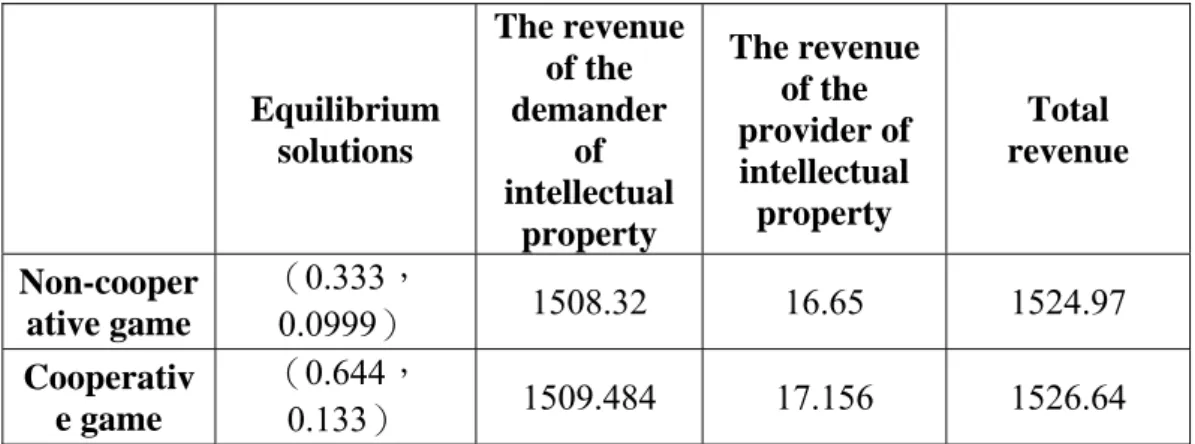
(18) Conclusions can be reached through the above research, when the demander and provider of intellectual property are conducted cooperative game, the scale of intellectual property innovation is greater than non-cooperative game, because when both sides are conducted collaboration, the net income of both sides and the total revenue of cooperation is obviously greater than the result of non-cooperative game. When the demander and provider of intellectual property are conducted collaboration, the system always exist effective Pareto optimal. So the demander and provider of intellectual property generally prefer to collaboration instead of non-collaborative way.
Since cooperation alliance residual income is produced during the cooperation of the demander and provider of intellectual property, then the research into how to distribute the residual income between the demander and provider of intellectual property has very important practical significance.
When the demander and the provider of intellectual property are conducted cooperation as rational individuals, they all want to get more residual income.
Thus, the demander of intellectual property expects smaller subsidy coefficient of intellectual property innovation, but the provider of intellectual property innovation expects bigger subsidy coefficient. To confirm reasonable proportion of transfer payment, the bargain model of Rubinstein is used for computing.
The bargain model of Rubinstein certifies the unique existence of the result of subgame perfect equilibrium in infinite alternating-offer game: 2
1 2
1
r 1
.
Of which1,2represents the discount factor (negotiation ability) of the provider and the demander of intellectual property respectively. In other words, in given situation, the cooperating party with higher negotiation ability can get bigger share. The negotiation ability depends on the market position and negotiation cost of the demander and the provider of intellectual property.
When1,2is known, the system residual income obtained by the demander and the provider of intellectual property is as follows:
2 2 2
*
1 2
1 8 1
D rs
A r C
I
[2016] Vol.5 NTUT J. of Intell. Prop. L. & Mgmt.
25
*
2
1
2 21 2
1 1
8 1
D rs
B r C
I
The subsidy coefficient of intellectual property innovation of effective Pareto optimal is:
2 2
2 1
*
max * min *
1 2
1 1
1 2 4 1
s s s
m m m
r r r
A B
t t t
r r r
Z Z
Wherein:
2
2 2 2 2
* *
max min
3 1 1
1 , 1
4 2 2 2
s s s s m
m m m m
r r r r D r
t t Z I
r r r r I
,
When the cooperative game is conducted between the demander and the provider of intellectual property, the equilibrium solution of cooperative game is:
* * 2
2
1
2 *1 2
1 1
, 1
2 4 1
s s s m
m m m
r r r Dr
t r r r I
,
Suppose that the negotiation ability1of the demander of intellectual property remains unchanged, but the negotiation ability of the provider of intellectual property increases to2*(2* 2), then the subsidy coefficient of intellectual property innovation of effective Pareto optimal ist**, which can be achieved through computing:
** *
t =t
2 * 2 * 2
2 2 1
2 1 2 1
* *
1 2 1 2 1 2 1 2
1 1 1
4 1 0
4 1 4 1 1
s s
m m
r r
r r
Thus t**t* , i.e. when the negotiating ability of the provider of intellectual property increases, the subsidy coefficient of intellectual property innovation of effective Pareto optimality increase, then the provider of the intellectual property can get more residual income.
Similarly, suppose that the negotiation ability of the provider of intellectual property remains unchanged, 2but the negotiation ability of the demander increases to 1*(1* 1) then:
** *
t =t
2 * 2 * 2
2 1 2 1 1 1 2 2
* *
1 2 1 2 1 2 1 2
1 1
4 1 0
4 1 4 1 1
s s
m m
r r
r r
Thus t**t* , i.e. when the negotiating ability of the demander of
[2016] Vol.5 NTUT J. of Intell. Prop. L. & Mgmt.
26
intellectual property increases, the subsidy coefficient of intellectual property innovation of effective Pareto optimality decreases, then the demander of the intellectual property can get more residual income.
Thus, conclusion can be reached, the distribution of the residual income mainly depends on the negotiation ability of the provider and demander of the intellectual property, the higher the negotiation ability, the more the residual income.
IV. The application of cooperative game equilibrium solution in the design of open and cooperative cooperation mechanism
A. Estimation of model parameters
1.The estimation of innovation cost I of intellectual property
As the universities and scientific research institutions of the provider of intellectual property innovation, material resource, information resource with certain value and human resource with high intelligence are needed in the development process of intellectual property. Thus, the innovation cost of intellectual property is divided in two parts here: i.e. the input cost of material and information resource and the input cost of human resource. Of which, the input cost of material and information resource can be deemed as two parts, one is fixed cost, the other one is time variable cost, which means that it is concerned with the development time of intellectual property innovation. While the input cost of human resource can be deemed as relating to the length of development time of intellectual property innovation.
Here, consider the fixed cost of material and information of the provider of intellectual property innovation in the development process of the intellectual property is C , and the variable cost per unit in innovation with regard to the k length of development time is AVC, the variable cost per unit in innovation can be estimated by the following formula:
I H
AVC AVC AC
Of which AVC is innovative variable cost per unit, AVC is variable cost I of material information resources per unit, AC is human resources cost per H unit.
AVCI includes information design cost per unit and the cost of designing and seeking effective information, intellectual property cost per unit and the cost of collecting and processing and the cost of information resource and human resource per unit.
ACH includes the cost achieved per unit: recruiting cost, selection cost,
[2016] Vol.5 NTUT J. of Intell. Prop. L. & Mgmt.
27
hiring and placement cost. Development cost per unit is orientation cost and training cost, usage cost per unit is reward paid by enterprise but not including bonus.
After the confirmation of innovative variable cost per unit, suppose T as total time devoted by universities or scientific research institution of the provider of intellectual property in intellectual property innovation, C as k fixed cost of material and information resources innovation, thus the estimation formula of innovation cost I of intellectual property can be conformed as follows:
* *
k k I H
I C AVC T C AVC AC T 2. Confirmation of1,2the coefficient of negotiation ability
When cooperation is conducted between the demander and the provider of intellectual property, to get more residual income, the demander of intellectual property expects smaller subsidy coefficient in intellectual property innovation, but the provider of intellectual property expects bigger subsidy coefficient in intellectual property innovation. In a given situation, the one with stronger negotiation ability get the bigger share of the residual income, so the confirmation of the negotiation ability seem to be of vital importance. In this paper, fuzzy comprehensive evaluation method is used to confirm the coefficient of negotiating ability of both sides, the negotiation ability depends on factors of the demander and the provider of intellectual property such as the degree of risk appetite, market position, negotiation cost, operational and financial status, etc.
According to what is mentioned above, the evaluation factor set is:
The degree of risk appetite, Market position, Negotiation cost , Financial
A status
Firstly, the analytic hierarchy process can be used to determine the weight of each evaluation index inA integrated with the judgment of the expert for the relative importance of each evaluation factor, the quoting of scale criterion of 1-9 has respectively established factor level of evaluation for the judgment matrix of overall evaluation level and the corresponding evaluation factor of each index in index level of evaluation. Suppose that the corresponding weight vector set W
w w w w1, 2, ,3 4
and the evaluation set of each factor are V
Low relatively low ordinary relatively, , , high high,
, the values V given to each factor in the evaluation set isV
0.1,0.3,0.5,0.7,0.9
.To get the degree of membership of each index with respect to the coefficient of negotiation ability between the provider and the demander of intellectual property, 10 experts are invited to score four indexes respectively in
[2016] Vol.5 NTUT J. of Intell. Prop. L. & Mgmt.
28
the coefficient of negotiating ability of the provider and the demander of intellectual property. The evaluation set of each factor in the coefficient of negotiation ability is established and the evaluation results of all experts are counted, then single factor can be assessed and fuzzy relation synthetical matrix can be established, i.e. ensure the degree of membership of evaluation target for fuzzy subset from single factor and then get fuzzy relation matrix. The four fuzzy vectors in fuzzy relation matrix that affect the negotiation ability are Arisk appetite, Amarket position, Anegotiation cost, A financial situation. Then fuzzy relation matrix is:
11 12 13 14 15
21 22 23 24 25
31 32 33 34 35
41 42 43 44 45
The degree of risk appetite Market position Negotiation cost Financial status
W r r r r r
W r r r r r
R W r r r r r
r r r r r
W
Later computing evaluation vector:
11 12 13 14 15
21 22 23 24 25
1 2 3 4 1 2 3 4 5
31 32 33 34 35
41 42 43 44 45
, , , , , , ,
r r r r r
r r r r r
C W R w w w w c c c c c
r r r r r
r r r r r
Thus obtaining the coefficient of negotiating ability:
1 2 3 4 5
1 2 3 4 50.1 0.3
, , , , 0.5 0.1 0.3 0.5 0.7 0.9
0.7 0.9
C VT c c c c c c c c c c
Now the solution to negotiation ability coefficient will be studied, as stated before, the evaluation factor of model is
The degree of risk appetite, Market position, Negotiation cost Financial st, s
A atu .
Firstly, the analytic hierarchy process (AHP) will be used to ensure the weight of each evaluation index in A. The importance scale of pairwise comparison on four indexes obtains according to the experts questionnaire of feedback, which can compute the weight of four indexes such as the degree of risk appetite, market position, negotiation cost and the operational and financial status:
1, , ,2 3 4
[0.5174,0.3038 0.1176 0.0612]W w w w w , ,
Secondly, according to the degree of membership of evaluation index in