
A Comparison of Intelligent Admission Control Schemes for Next Generation Wireless Systems using Genetic Algorithms, Simulated Annealing and Tabu Search
6
0
0
全文
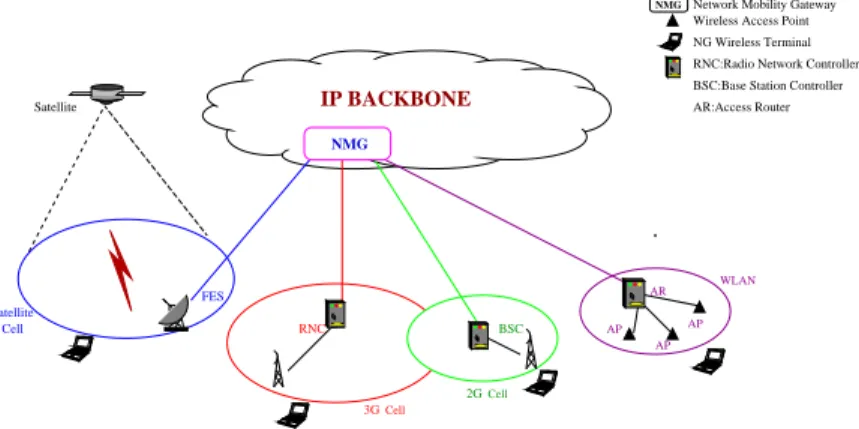
(2) Int. Computer Symposium, Dec. 15-17, 2004, Taipei, Taiwan.. (GAC) provides a unified solution using one of these artificial intelligence techniques, genetic algorithms (GAs) [7]. However, this scheme can also be improved using different other artificial intelligent techniques in terms of handoff latency, cost and providing certain level of QoS requirements. In this paper, genetic algorithms, simulated annealing and tabu search algorithms are applied to the Call Admission Control (CAC) scheme for NGWS named as GAC, SA CAC and TS CAC respectively in order to optimize the scheme. The proposed CAC scheme achieves high network utilization, minimum cost and handoff latency. To fulfill this objective, the bandwidth and power requirements of the channel, as well as the signaling and switching parameters of the wireless architecture are captured in the handoff algorithm. These parameters are fed into a cost function developed based on the Markov Decision Process, which is then optimized using GAs, SA and TS. As a result, the algorithm determines which network architecture the mobile terminal would complete handoff with respect to the minimum cost. Performance analysis is provided to assess the efficiency of the proposed scheme and the performance comparisons with these different artificial intelligence techniques. Simulation results also show a significant improvement in handoff latencies and costs over the heuristic approach and other call admission control (CAC) schemes. The remainder of the paper is organized as follows: The overall system solution and the description of the artificial intelligence techniques applied are given in Section 2. The performance of the scheme along with the effects of the GAC, SA CAC and TS CAC algorithms on the network performance and latency are then discussed in Section 3. Conclusions are provided in Section 4.. 2. System Solution and Techniques 2.1 System Solution Dynamic factors should be considered for effective network resources usage. There are different constraints such as bandwidth, latency and power consumption of the network. Let each state in the final action of the Markov Decision Process (MDP) [12] represent different wireless network architecture. The collection of these states consists different wireless architectures. Cost f unction ⇒ (Real Cost)N = F(BwN , P wN , SigN , SwN ) (1) where Bw is bandwidth of the network, Pw is the power consumption of the network, Sig is the signaling to set-up a handoff, Sw is the switching, rerouting of traffic during the handoff, and N is the index,. N = 1...n where n is the number of different wireless architectures. Each parameter in the cost function depends on a wireless network architecture in the system. Final optimality equations are derived from this cost function according to MDP theory [7] for modeling of the system. Finally they are optimized using using the genetic algorithms, simulated annealing and tabu search in order to determine the final handoff decision. Different wireless network architectures (i.e. 3Gpico, 3G-micro, 3G-macro, Satellite-LEO, SatelliteGEO and WLAN) should be networked to each other in order to realize the inter-system handoff in the NGWS. The wireless systems, heterogeneous architectures are connected to one another through a third party interconnection gateway system such as proposed in [3]. As given in the literature, gateway architecture, Network Mobility Gateway (NMG) proposed in [3] is also an example architectural element of the NGWS in our paper.NMG gateway sits in the Internet as shown in Fig. 1. NMG is responsible to manage the handoffs among these different wireless network systems. The unified CAC scheme, which is optimized with an efficient artificial intelligence technique, is deployed in NMG to manage all handoff management issues. For the inter-system mobility management, all of the controllers of the network architectures, base transceiver station (BTS), access point (AP), radio network controller (RNC) and fixed earth station (FES) are involved. These controllers propagate their system control and signaling messages through NMG. NMG propagates the messages needed for the functioning of the algorithm to GAC, SA CAC and TS CAC itself. These messages consist of all the information of the wireless system related to the mobility management. This information is used by these schemes to evaluate the minimum total cost for each available wireless system at the same area of the corresponding mobile terminal. Then, the scheme determines which cell and which network architecture has the minimum total cost. The objective of using one of these artificial intelligence techniques is to find the minimum cost for the wireless network system to provide maximum network utilization and minimum handoff latency and to fulfill QoS requirements. The CAC scheme then informs NMG about the handoff decision. Accept or reject action is then deployed after the propagation of the decision to NMG.. 2.2 Genetic Algorithms Genetic Algorithms are directed random search techniques used to look for parameters that provide the optimal solution to a problem. They are based on the principles of evolution and natural genetics. As an optimization method, GAs have major differ-. 69.
(3) Int. Computer Symposium, Dec. 15-17, 2004, Taipei, Taiwan.. NMG. Network Mobility Gateway Wireless Access Point NG Wireless Terminal RNC:Radio Network Controller BSC:Base Station Controller. IP BACKBONE. Satellite. AR:Access Router. NMG. WLAN AR. FES Satellite Cell. RNC. BSC. AP. AP AP. 2G Cell 3G Cell. Figure 1: Next Generation Wireless System Architecture.. Get Minimum Handoff Cost for Each Cell. Give Handoff Decision. End. False. TS_CAC Start. Init Solution Set Evaluate Result Tabu List=0. Iter 1 < # of Cells Iter < Stopping Criteria 2. Generate Neighbors. Evaluate Neighbors. True. Neighbor<Current Result Neighbor NotIn TabuList. No. Yes. Result=Neighbor Neighbor In TabuList. Figure 2: TS CAC operation flowchart. evaluates its cost function for optimization. If the cost function for the neighboring value is reduced, the search moves to that point as a new solution and the process is repeated. However, if the cost function increases, the move to the neighbor point is not necessarily rejected; there is a small probability, p, that the search will move to the neighbor point and continue. The algorithm stops if there is no significant change in the cost function after number 2.3 Simulated Annealing of steps. The completed SA CAC flow-chart showing The simulated annealing (SA) algorithm is de- the detailed operation of the scheme is presented in veloped based on the annealing technique of the [8]. metals in chemistry. The implementation of CAC algorithm using simulated annealing (SA CAC) is 2.4 Tabu Search based on simple ”stepped geometric decrease” type algorithm. Simulated annealing is a method of local Tabu Search (TS) is a local search technique searching algorithm, which sample the whole domain based on the general tenets of intelligent problem and improve the solution by recombination of the solving. It is developed for combinatorial optimizapopulation in some form. Hence, the simulated tion problems and has been applied to a variety of annealing algorithm converges in faster manner areas. The algorithm has the ability to overcome the for the optimization problems [11]. The simulated main drawback of the most of the other local search annealing algorithm first randomly initializes a set of algorithms, to avoid the local optima. There are solution. Then, it considers a neighboring value and two main parameters in the algorithm, the tabu list. ences and advantages over the other optimization algorithms [6]. The notion of genetic algorithms is the survival of the fittest of the nature. This implies that the ‘fitter’ individuals are more likely to survive and have a chance of passing their features to the next generation. The overall operation of GAC scheme is given in [7].. 70.
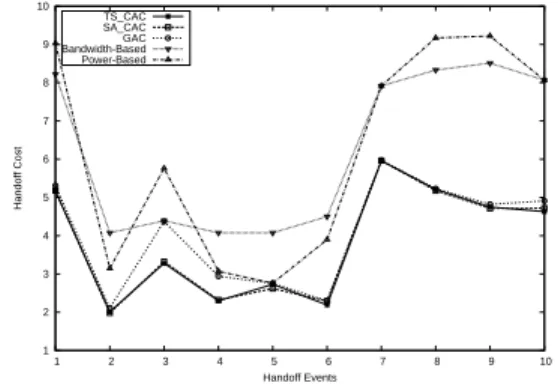
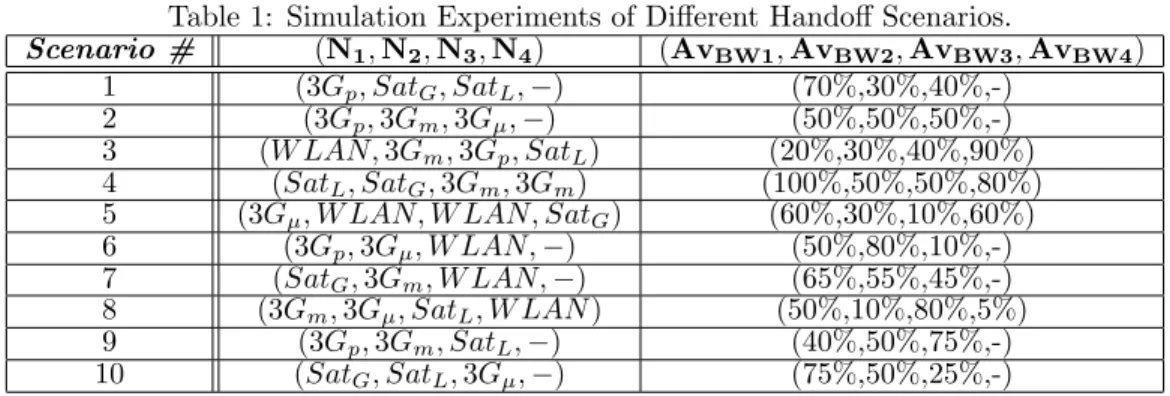
(4) Int. Computer Symposium, Dec. 15-17, 2004, Taipei, Taiwan.. 3. Performance Analysis. 10 TS_CAC SA_CAC GAC Heuristic 8. 6 Latency (s). restrictions and the level of the current solution. The tabu list acts as a temporary memory, which keeps the attributes of the previous solution sets during the iterations [5]. The algorithm first generates initial solution set and evaluates the result for this set. Then it randomly selects a set of neighbor solution set from the overall search space. According to the evaluation of this neighbor set, TS sorts these results. The best neighbor obtained from the sorting is determined as the new solution if it is not in the tabu list and added to the tabu list for the next iteration. Finally, according to a specific stopping criteria, the algorithm finds the best solution. For CAC scheme, the operational flowchart of TS is given in Fig. 2.. 4. 2. 0 1. 3. 4. 5. 6. 7. 8. 9. 10. Handoff Events. Figure 3: CAC latency experienced with the GAC, SA CAC and TS CAC schemes and heuristic algorithm for varying handoff scenarios.. This section demonstrates the performance of GAC, SA CAC and TS CAC schemes with some simulations and comparison with other algorithms. The performance is compared with the heuristic algorithm and other previously proposed CAC schemes.. 10 TS_CAC SA_CAC GAC Bandwidth-Based Power-Based. 9. 8. 7 Handoff Cost. In order to investigate the performance, CAC schemes are deployed for various handoff scenarios. These scenarios are shown in Table 1. The GAC simulation experiments are performed with crossover probability, Xover = 0.7 and mutation probability, M ut = 0.001 unless otherwise specified. For SA CAC, simulation experiments are performed with the initial temperature, T = 50, temperature decrease factor, a = 0.9, number of steps for each iteration, L = 100, number of steps for the stopping criteria, st = 10 and the percentage decrease, ϕ = 0.1 unless otherwise specified. The other parameter values related to the final optimality function which determine the final cost coefficient values are shown in Table 2. SatL represents Satellite LEO, SatG represents Satellite GEO, 3Gp represents 3G pico, 3Gp represents 3Gµ micro, 3Gm represents 3G macro and WLAN represent wireless LAN networks in the table. These values are also used in the simulations of previously proposed wireless schemes [13], [15].The simulation experiments demonstrate the performance analysis of the schemes with respect to handoff latency, cost and QoS. The first simulation is designed to show the handoff latency performance of the compared schemes over heuristic based CAC scheme for various handoff scenarios in different wireless system architectures. As shown in Fig. 3, GAC, SA CAC and TS CAC algorithms improves the handoff latency significantly compared to the heuristic approach. However, when we compare the three algorithms, GAC using genetic algorithms has the worst latency results than the others. The best handoff latency performance is achieved with The second SA CAC using simulated annealing. simulation is designed to show how the compared. 2. 6. 5. 4. 3. 2. 1 1. 2. 3. 4. 5 6 Handoff Events. 7. 8. 9. 10. Figure 4: Handoff cost experienced with the GAC, SA CAC, TS CAC, bandwidth-based and powerbased schemes for varying handoff scenarios. schemes utilizing network resources efficiently and finds the minimum handoff cost over other proposed admission control schemes. For this case, the compared schemes are also compared with different admission control algorithms based on available bandwidth and power consumption [2], [9]. The handoff cost also demonstrates the network resource usage while determining which wireless network architecture the mobile terminal should perform the handoff. As shown in Fig. 4, for each handoff scenario, the total handoff cost using the GAC, SA CAC and TS CAC schemes are much less than other algorithms. However, again for the comparison between GAC, SA CAC and TS CAC schemes, GAC using genetic algorithms have the slightly worse cost results than the other two. For this experiment CAC scheme using simulated annealing algorithm and tabu search algorithm have very similar final cost results. Another critical requirement for NGWS is to provide a certain QoS level for the mobile terminal. This includes a successful connection admission percent-. 71.
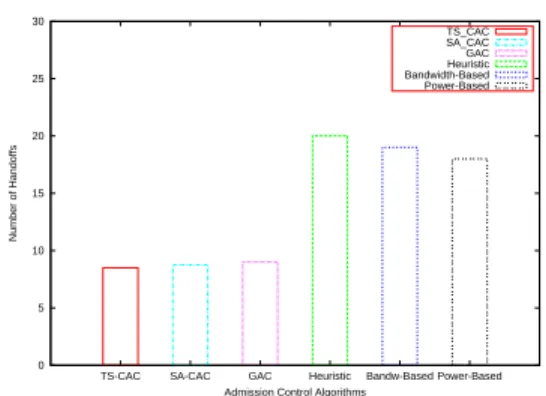
(5) Int. Computer Symposium, Dec. 15-17, 2004, Taipei, Taiwan.. Table 1: Simulation Experiments of Different Handoff Scenarios. (AvBW1 , AvBW2 , AvBW3 , AvBW4 ) (N1 , N2 , N3 , N4 ) Scenario # (70%,30%,40%,-) (3Gp , SatG , SatL , −) 1 (50%,50%,50%,-) (3Gp , 3Gm , 3Gµ , −) 2 (20%,30%,40%,90%) (W LAN, 3Gm , 3Gp , SatL ) 3 (100%,50%,50%,80%) (SatL , SatG , 3Gm , 3Gm ) 4 (60%,30%,10%,60%) (3Gµ , W LAN, W LAN, SatG ) 5 (50%,80%,10%,-) (3Gp , 3Gµ , W LAN, −) 6 (65%,55%,45%,-) (SatG , 3Gm , W LAN, −) 7 (50%,10%,80%,5%) (3Gm , 3Gµ , SatL , W LAN ) 8 (40%,50%,75%,-) (3Gp , 3Gm , SatL , −) 9 (75%,50%,25%,-) (SatG , SatL , 3Gµ , −) 10. Table 2: Cost coefficient parameters used for the final optimality equation. WLAN 3Gm 3Gµ 3Gp SatG SatL Coeff. (1,5) (1,5) (1,5) (1,5) (1,5) (1,5) csig (0.01,0.05) (0.01,0.05) (0.01,0.05) (0.04,0.25) (2,10) (2,10) cpw (W) 1 (0.01,0.5) (7.5,45) (4.3,7.5) (0.6,4.3) ) (1.5,45) (7.5,45) cbw ( bw (1,5) (1,5) (1,5) (1,5) (1,5) (1,5) csw. 100 TS_CAC SA_CAC GAC Bandwidth-Based Power-Based 80. Admission Percentage(%). age for a large number of terminals. This experiment is designed to illustrate how the schemes provides the required QoS level for different types of wireless network architectures and for an increasing number of terminals. For this experiment, it is assumed that there are five different cells in the coverage area of the mobile terminal. These are 3Gp , 3Gµ , SatL , W LAN and SatG with 100% available capacity at the start of the simulation and available for the mobile terminals. The results are shown in Fig. 5. In each iteration, the number of mobile terminals is increased by 50. As demonstrated in Fig. 5, the scheme using genetic algorithms, simulated annealing and tabu search algorithms are able to accommodate a higher number of MTs with greater admission percentages over other algorithms. It is expected that as the number of roaming MTs increase, the percentage will decrease. However, even under such circumstances, both schemes using the artificial intelligence techniques still improve the admission percentage compared to other schemes. The results slightly change among these optimization techniques. In the last experiment, the number of handoffs are compared with heuristic, power-based, and bandwidth-based CAC algorithms for a number of MTs roaming in the same overlapped coverage area. It is assumed that there are two overlapped cells for different wireless network architectures, 3Gp and W LAN with the same resources and the same. 60. 40. 20. 0 50. 100. 150. 200. 250 300 350 Number of Mobile Terminals. 400. 450. 500. Figure 5: Connection admission percentage experienced with the GAC, SA CAC, TS CAC, bandwidthbased and power-based schemes for varying number of mobile terminals. available bandwidths. As shown in Fig. 6, GAC, SA CAC and TS CAC schemes outperforms other CAC algorithms with less number of handoffs. For this case CAC scheme using tabu search has slightly less number of handoffs compared to the other CAC schemes using genetic algorithms and simulated annealing technique.. 4. Conclusions. 72. GAC, SA CAC and TS CAC schemes provides.
(6) Int. Computer Symposium, Dec. 15-17, 2004, Taipei, Taiwan.. [3] BRAIN architecture specifications and models, BRAIN functionality and protocol specification, IST-1999-100050 BRAIN, D2.2.. 30 TS_CAC SA_CAC GAC Heuristic Bandwidth-Based Power-Based. 25. [4] J. Evans and D. Everitt, “Effective bandwidthbased admission control for multiservice cdma cellular networks,” IEEE Trans. Vehic. Tech., vol.1, p.36-46, January 1998.. Number of Handoffs. 20. 15. 10. [5] F. Glover and M. Laguna, “Tabu Search:,” Kluwer Academic Publishers, 1997.. 5. [6] D. Goldberg, “Genetic Algorithms in Search, Optimization, and Machine Learning,” Seventh printing, Number ISBN 0-262-13316-4(HB), 2001.. 0 TS-CAC. SA-CAC. GAC Heuristic Bandw-Based Power-Based Admission Control Algorithms. Figure 6: The number of handoffs experienced with GAC,TS CAC, SA CAC, heuristic, bandwidth and [7] D. Karabudak, C. C. Hung and B. Bing, “A Call Admission Control Scheme using Genetic Algopower-based schemes for mobile terminals in overrithms,“ ACM Symposium on Applied Computing lapped coverage areas. (SAC), March 2004. a single solution to address the heterogeneous architectures in the Next Generation Wireless System. In order to develop a system solution, a Markov Decision model is deployed to derive the necessary equations for the best network performance with minimum cost. Then, a variety of fast, reliable and accurate artificial intelligence techniques, genetic algorithms, simulated annealing and tabu search algorithms are used to optimize these equations and to provide high network utilization, minimum cost, minimum handoff latency and required QoS level with better performance than the other admission control schemes. Experimental results show that GAC, SA CAC and TS CAC schemes achieve efficient resource utilization and low handoff latencies and costs in different heterogeneous wireless architectures. Besides, the performance comparisons among these three different optimization techniques are also presented. The schemes using simulated annealing and tabu search are shown to significantly improve resource utilization with very low handoff latency and very low cost over the scheme using genetic algorithms and especially over different previously proposed admission control schemes.. References. [8] D. Karabudak, C. C. Hung and B. Bing, “A Novel and Intelligent Call Admission Control Scheme using Simulated Annealing,“ Intelligent Systems Design and Applications (ISDA), August 2004. [9] J. Knutsson, P. Butovitsch,M. Persson and R. D. Yates, “Downlink admission control strategies for CDMA systems in a Manhattan environment,” IEEE 48th Vehic. Tech. Conf., vol.2, p.1453-1457, May 1998. [10] P. J. M. van Laarhoven, “Theoretical and Computational Aspects of Simulated Annealing,” Centre for Mathematics and Computer Science, 1988. [11] D. T. Pham and D. Karaboga, “Intelligent Optimisation Techniques: Genetic Algorithm, Tabu Search, Simulated Annealing and Neural Networks,” Springer, 2000. [12] M. L.Puterman, “Markov Decision Processes: Discrete Stochastic Dynamic Programming,” Wiley, New York, 1994. [13] V. W. S. Wong, M. E. Lewis and V. C. M. Leung, “Stochastic Control of Path Optimization for Inter-Switch Handoffs in Wireless ATM Networks,” IEEE/ACM Trans.on Networking, Vol. 9, No. 3,pp.336-350 June 2001. [1] I. F. Akyildiz, J. McNair, J. Ho, H. Uzunalioglu, [14] J. D. A. Zhu and J. Hu, “Adaptive call admission control for multi-class cdma cellular sysand W. Wang, “Mobility Management in Next tems,” Fifth Asia-Pacific Conf. Comm. Fourth Generation Wireless Systems,” Proceedings of the Optoelect. Comm. Conf., vol.1, pp.533-536, 1999. IEEE, Vol. 87, No. 8, pp. 1347-1384, August 1999. [2] O. Baldo, L. K. Thong, and A. H. Aghvami, “Per- [15] M. M. Zonoozi and P. Dassanayake, “User Mobility Modeling and Characterization of Mobility formance of distributed call admission control for Patterns,” IEEE J. Select. Areas Commun., Vol. multimedia high speed wireless/mobile ATM net15, No. 7, pp.1239-1252, September 1997. works,” IEEE International Conf. on Comm., ICC 99, vol.3. ,pp. 1982 -1986, June 1999.. 73.
(7)
數據
相關文件
Programming languages can be used to create programs that control the behavior of a. machine and/or to express algorithms precisely.” -
important to not just have intuition (building), but know definition (building block).. More on
Know how to implement the data structure using computer programs... What are we
• Recorded video will be available on NTU COOL after the class..
—we cannot teach all, but with reading you can learn all 3-6: 3 hour teaching, 6 hour reading/writing after class as important as writing assignments:. some may show up
Good Data Structure Needs Proper Accessing Algorithms: get, insert. rule of thumb for speed: often-get
Sharma (1999), “An Intergrated Machine Vision Based System for Solving the Non-Covex Cutting Stock Problem Using Genetic Algorithms,” Journal of Manufacturing Systems, Vol..
Gen, "Minmax earliness/tardiness scheduling in identical parallel machine system using genetic algorithms," Computers & Industrial Engineering, vol. Cheng,
