J. Phys. Chem. 1988,92,4753-4758 4753
Theory of Differential Line Broadening in Coupled Spin Systems in Macromolecules and
Molecular Aggregates. Applications to the Study
of Micellar Systems
Lian-Pin Hwang,* Pei-kin Wang,
Department of Chemistry, National Taiwan University, Taipei, Taiwan, ROC, and Institute of Atomic and Molecular Science, Academia Sinica, Nankang, Taipei, Taiwan, ROC
and
Tuck
C.
Wong*
Department of Chemistry, University of Missouri, Columbia, Missouri 6521 1 (Received: July 9, 1987; In Final Form: February 19, 1988)
The theory of differential line broadening (DLB) in spin-coupled multiplets in molecular systems where there is a slow isotropic overall reorientation and a fast internal motion has been derived on the basis of the solution of the stochastic Liouville equation. The most prominent example is the proton-coupled methyl 13C multiplet. From the line-width differences between various components of the multiplet, the correlation time for the slow overall reorientation and the chemical shift anisotropy can be determined. Applications to the study of the molecular dynamics of the sodium deoxycholate/water micellar system and a viscoelastic micellar system are illustrated. The results show that the DLB effect is a useful tool complementary to multifield relaxation time and nuclear Overhauser effect studies in the investigation of molecular dynamics.
Introduction I3C spin-lattice relaxation time ( T I ) and nuclear Overhauser effect
Differential line broadening (DLB) of nuclear magnetic reso- nance ( N M R ) lines in coupled spin 1/2-spin systems was first discussed by Shimizu many years ago.' The difference in the spin-spin relaxation times of different components in the multiplet can be attributed to the interference between the dipole-dipole (DD) and the chemical shift anisotropy (CSA) relaxation mechanisms. Such effects has since been observed in 19F-'H system,2 in 31P-19E
system^,^,^
in 15N-'Hsystem^,^
in I3C-lH A detailed review of relaxation in coupled spin systems has been presented by Vold and Vold.Io Farrar et al? have recently outlined the conditions under which the DLB effect is likely to be observed. Recently, the DLB effect in proton-coupled methyl I3C mul- tiplets in two types of systems-niicellar aggregates and methyl I3C-enriched transfer RNA-has been observed in our labora- tory." In both of these systems, the dynamics of the molecules has to be described by more than one motion. Frequently, a model that consists of a slow ( o o T c2
'
1
)
overall isotropic molecular (oraggregate) reorientation and a fast (woTc
<<
1) internal motionfor the segment of the molecule of interest'&l3 is applicable to these systems.
In
this paper, a'derivation of this DLB effect in terms of such a dynamic model based on the solution of the stochastic Liouville equation (SLE) is presented. The line-width differences for a viscoelastic micellar system and for the sodium deoxy- cholate/water system are combined with magnetic field dependent in a 31P-1H system,8 and in a 'H-lH ~ y s t e m . ~(1) Shimizu, H. J . Chem. Phys. 1964, 40, 3357.
(2) Mackor, E. L.; MacLean, C. Prog. N M R Spectrosc. 1967, 3, 129. (3) Withers, S. G.; Madsen, N.' B.; Sykes, B. D. J . Magn. Reson. 1985,
61, 545.
(4) Farrar, T. C.; Quintero-Arcaya, R. A. Chem. Phys. Lett. 1985, 122, 41. Farrar, T. C.; Quintero-Arcaya, R. A. J. Phys. Chem. 1987, 91, 3224.
( 5 ) Rueterjans, H.; Kaun, E.; Hull, W. E.; Limbach, H. H. Nucleic Acids Res. 1982, 10, 7027. Gueron, M.; Leroy, J. L.; Griffey, R. H. J . A m . Chem.
SOC. 1984, 105, 7262.
(6) Macura, S.; Brown, L. R. J . Magn. Reson. 1985, 62, 328. (7) Farrar, T. C.; Adams, B. R.; Grey, G. C.; Quintero-Arcaya, R. A.; Zuo, (8) Lunsford, J. H.; Rothwell, W. P.; Shen, W. J . A m . Chem. SOC. 1985, Q. J . A m . Chem. SOC. 1986, 108, 8190.
107. 1540.
.
- - -..
(9) Anet, F. A. L. J . A m . Chem. SOC. 1986, 108, 7102.
(10) Vold, R. L.; Vold, R. R. Prog. N M R Spectrosc. 1978, 12, 79. (1 1) Gracz, H.; Agris, P., private communication.
(12) Wennerstrbm, H.; Lindman, B.; Soderman, 0.; Drakenberg, T.; Ro- (13) Lipari, G.; Szabo, A. J . A m . Chem. SOC. 1982, 104, 4546, 4559. senholm, J. B. J . Am. Chem. SOC. 1979, 101, 6860.
(NOE) measurements to deduce t h e dynamic and order param- eters of the surfactants in these systems. The possible applications of the measurements of this DLB effect for the determination of the dynamics of molecules in those types of systems- macromolecules and molecular aggregates-are also discussed. Theory
For a complex molecule, internal rotation of the methyl group and overall reorientation of the molecule are present simultane- ously. The spin relaxation of the methyl I3C may be due to a composite of different magnetic interactions modulated by these The magnetic interactions consist of mainly the chemical shift anisotropy (CSA) interactions and the dipolar interactions with protons. In the presence of a strong, externally applied magnetic field, Bo, the spin Hamiltonian is given by
H = Ho
+
Hd = H z+
HCsA+
Hd H z = -wCIZ - wHSZ+
JIZSZ(1)
( 2 )
where
It includes the Zeeman terms for 13C ( I spin) and protons (S spin) in a methyl group as well as the first-order correction of the spin-spin coupling between them. The interaction of chemical shift anisotropy is given byI4
HCSA = FD6:d(Q)zZ
-
(3/8>"2fl-D6~l(Q>1++
D h ~ ~ l ( Q ) z - ~ (3) where F = ' / 3 ( ~ l l-
uI)ol in which ull and ui are the parallel and perpendicular principal values of the CSA tensor, which is assumed to have cylindrical symmetry in the present case. The principal axis of the CSA tensor is considered to be coincident with the C3 axis of the methyl group, which is chosen as the molecule-fixed frame. The D g L ( 0 ) are Wigner rotation matrix elements15 that express the transformation from the molecule-fixed (x',y ',z9
to the laboratory ( x , y , z ) axis sytem, where Q represents the Euler angles relating one axis system to the other. The dipolar Ham- iltonian depends on the orientation Q and the internal rotation coordinates (a,&O). Here a is the rotating angle of the methyl group, and /3 is a fixed angle between the methyl C3 axis and the (14) Abragam, A. The Principles of Nuclear Magnetism; Oxford Univ- (1 5) Brink, D. M.; Satchler, G. R. Angular Momentum; Oxford University ersity Press: Oxford, 1961, Chapter 8 .Press: Oxford, 1968.
0022-3654/88/2092-4753$01.50/0 0 1988 American Chemical Society
Downloaded by NATIONAL TAIWAN UNIV on September 3, 2009 | http://pubs.acs.org
4754 The Journal of Physical Chemistry, Voi. 92, No. 16, 1988 Hwang et al. C-H direction. The dipolar interaction Hamiltonian may be
written as the scalar product of two tensor^,'^^'^ i.e. Hd(fl,a) = ZD$:d(CY,P,O) D$(Q)Ap =
P.4
c
e x p ( i w ) d$?d(P) D$$(Q)A, (4)PI4
where is the reduced Wigner rotational matrix element, and where for the dipolar interaction of nuclear I and S’, A, is
given by
A2 = -D’Z+S’+ Ai = D’(ZzS’+
+
Z+S’z) A0 = -(6)-1/2D’(4ZzS’z-
Z+S’- - IS’+)A-1 = Ai* A-2 = A2* (5)
where S’ = denotes the spin quantum number for one proton spin only. D‘ = (3/2)’/2yIys,h/r3, and r is the bond length of C-H. Here the effects of cross relaxation among protons in the methyl group are not included in the treatment of dipolar re- laxation between I3C and ‘H. In the present approach, we started from the stochastic Liouville equation (SLE) and considered the overall reorientation and internal rotation as independent motions, i.e.
(6) where p is the spin density matrix in a state (R,cY).
f,
andf,
are the diffusion operators-for internal rotation and overall re- orientation, respectively.&
and&
are the Liouville operators corresponding toHo
and Hd, respectively. Since the internalrotational mode is considered a priori to be much faster than the overall reorientation, CY is a fast variable for the internal motion,
which may be considered to be independent of the overall re- orientation. Thus, we may introduce a coarse graining in time such that the spin density is averaged over a period much longer than the correlation time of the internal rotation but still small compared to the correlation time of the overall reorientation. Then, we followed the approach of Hwang16 to reduce the S L E by averaging over the fast variable and treating the dipolar in- teraction as a perturbation. This then gives
;T(R,~) = [-ice’,,
+
i ’ , ~
-f,
- ~ / T ~ ( R ) I ~ ( R , ~ ) (7) where the reduced density matrix u is-defined as the density matrix p averaged over CY isotropically. L’,, is the Liouville operator corresponding to the averaged dipolar Hamiltonian:p(~,cu,t) =
{+(io
+
i d ) -f , -
f , ) p ( ~ , a , t )ffb
= ( H d ( n , f f ) ) a = sC,dh$(P)FDh:j(n)Ap (8)Sc3 is the order parameter for the C3 axis of the methyl group and is defined as
( 9 )
where 8 is the angle between the C3 axis and the director of the
?ggregate. The averaging is over the fast internal motion a . l 2 9 I 3
Lt0 is the Liouville operator corresponding to the averaged Ho in which the CSA interaction is averaged by the fast motion a. Thus, the molecular orientation-dependent spinspin relaxation rate, at the instant of molecular orientation specified by the Euler angle R, due to the modulation of the dipolar interaction by the internal rotation is given by
s,
= 1/2(3 cos2e
- l ) ,1
/
T 2 ( Q ) = X+
YD&fd(R) (10) whereX = NyC2yH2h2S’(S’
+
1 ) P [ 2 sinZ ( 2 p ) ~ ~+
sin4 (p)72] (11) Y = NyczyHzhZS’(S’+
l)r”[sin2 ( 2 / 3 ) ~ ~-
sin4 (P)72]/4 (12) N = 3 denotes the number of protons in a methyl group. The motional narrowing condition for internal rotation was invoked in the derivation. rl and 7 2 are the correlation times for internal(16) Hwang, L. P. Mol. Phys. 1983, 49, 1314.
rotation, with 7 2 = 7’/4 for the Brownian model and 7 2 = for
120’ jump model. The derivation is similar to the work of Donskaya in his treatment of Tl process for proton-proton dipolar relaxation due to internal rotation.” In the next section, 72, the correlation time for the fast methyl reorientation is used instead of T~ If the C3 axis of the methyl group coincides with the director,
then these two correlation times are equivalent.
The reduced stochastic equation may be solved by the eigen- function expansion method of Freed et a1.’* in their treatment of slow-motion line shape. For three proton spins in a methyl group, there are eight possible spin states. They may be separated into a quartet (S = 3 / 2 ) and two doublets (S = 1/2).19 Therefore,
the proton-coupled 13C spectrum may be treated as a superposition of individual spectra from the coupling of 13C with one S = 3 / 2
spin and two S = 1 / 2 spins separately. Furthermore, the motionally
narrowed results of the reduced stochastic equation may be ob- tained by retaining the second-order terms in the interactions. The perturbation method for solving the SLE in the study of ESR line widths has previously been discussed in several works.’8,20,21 Analogously, we may derive a modified motional narrowing line-width equation for proton-coupled I3C spectra to include the effects of CSA and dipolar interactions as well as their cross effect by means of a perturbation analysis of the slow-motion equations.Is If overall reorientational diffusion is assumed to be isotropic and Brownian, the results may be expressed by
1/T2(m,,7) = a
+
bm,+
cm? (13) wherea = a ‘ + X
+
T ~ { ( S , ~ F ~ - P ) / 5+
3Sc~FzUo/20+
S(S+
1)D2(P
+
U-/3+
2U+)/5) (14)with
Here T~ is the correlation time of the overall reorientational motion
and is equivalent to 7; used in the subsequent sections. m, is the
magnetic spin quantum number with the total spin quantum number defined by S as before. We also limit ourselves to the square term of m, and neglect the small contribution from higher m, terms. a’is the residual line width (in rad/s) that is attributable to spin-rotation interactions and other ‘unspecified relaxation mechanisms such as long-range intramolecular or intermolecular dipole-dipole relaxation. The order parameter S represents the order parameter for the C-H interatomic vector. Usually, this order parameter is related to Sc3 by the following relation:
The product FSc3 in eq 15 thus represents the residual CSA as a result of averaging by the fast motion, assuming cylindrical symmetry with respect to the C, axis of the methyl group.
It should be pointed out that the SLE approach used in this work is an alternative to the well-known Redfield approach,22 which has been used in several other studies relating to DLB.4~5~7~23
(17) Donskaya, I. S. Mol. Phys. 1975, 29, 1361.
(18) Freed, J. H.; Bruno, G. V.; Polnaszek, C. F. J . Phys. Chem. 1971.75, 3385. Polnaszek, C. F.; Bruno, G. V.; Freed, J. H. J . Chem. Phys. 1973,58, (19) Carrington, A,; McLachlan, A. D. Introduction to Magnetic Reso- nance; Harper and Row: New York, 1967; Chapter 4.
(20) Freed, J. H. J . Phys. Chem. 1974, 78, 11 55.
(21) Hwang, J. S.; Mason, R. P.; Hwang, L. P.; Freed, J. H. J . Phys. Chem. 1975, 79, 489.
(22) Redfield, A. G. Advances in Magnetic Resonance; Waugh, J. S . , Ed.;
Academic: New York, 1965; Vol. 1
(23) Prestegard, J . H.; Grant, D. M. J . A m . Chem. SOC. 1978, 100, 4664. 3185.
Downloaded by NATIONAL TAIWAN UNIV on September 3, 2009 | http://pubs.acs.org
Coupled Spin Systems in Macromolecules The Journal of Physical Chemistry, Vol. 92, No. 16. 1988 4755 TABLE I: Line-Width Differences of the Methyl I3C Multiplet in the
N-Methyl Group in CTAB in CTAB/Nasal Viscoelastic Solutions and the Slow Correlation Time and Chemical Shift Anisotropy Calculated from These Line-Width Differences
temp, A V ( - ] / ~ , ~ / ~ ) , ~ A Y ( ~ / ~ , ~ / ~ ) , Au,bsC sample OC H z Hz S PPm Id 38 10.0 f 2.5 I 42 7.5 f 1.0 21.1 f 3.0 2.2 f 0.5 -75 f 18 I 47 6.0 f 0.8 20.4 f 2.0 2.1
+
0.4 -65+
12 I 52 4.6 f 0.5 18.5 f 1.5 1.8 f 0.25 -57*
7 I 56 4.0 f 0.3 15.0 f 1.0 1.5 & 0.15 -60 f 6 IId 50 6.8 f 0.5 23.8 f 1.0 2.4 k 0.16 -64 f 6 I1 55 6.0 f 0.5 19.6 f 2.0 2.0 f 0.3 -67 f 10Av(ml,m2) is defined as Avl12(ml)
-
A Y , / ~ ( ~ ~ ) , and Au1/2 is the full width of the transition at half-height. All Av were measured a t Bo = 7.0 T. bThe calculations were based on S = 0.037 (and S , = 0.11) as determined from 2 H splittings in the liquid crystalline phases (see text). The order parameters are temperature and concentration dependent. However, these dependences over a narrow temperature and concen- tration range are quite small and were neglected in the present calcu- lation. Since both the quadrupolar coupling constant for the C-D bond and the C-H dipolar interaction have to be used in the calculation, the value of the ratio of these two parameters according to ref 51 was used. C A u = u,, - ul. dSample I is 16.5 m M CTAB and 14.6 m M Nasal in D 2 0 / H 2 0 ; sample I1 is 17.0 m M CTAB and 18.3 m M Nasal inExperimental Section
Hexadecyltrimethylammonium BromidelSodium Salicylate/ Water Viscoelastic Micelles. Viscoelastic micellar solutions24 were prepared by dissolving appropriate amounts of hexadecyltri- methylammonium bromide (CTAB) and sodium salicylate (Nasal) in a mixture of H 2 0 and DzO (7:3 v/v), the latter being needed to provide the field-frequency lock in the N M R measurements. The concentrations of CTAB and Nasal were in the range of 13-20 m M and are listed in Table I. Prior to the addition of Nasal, the viscosity of the dilute CTAB solution was very low, typical of dilute aqueous micellar solutions. Upon the addition of about equimolar of Nasal and rigorous mixing, viscoelastic behavior of the resulting solutions becomes obvious.24 CTAB (95%) and Nasal (99%) were purchased from Aldrich Chemicals. Both were used as received without further purification. Samples of “normal” micellar solutions of CTAB in DzO with and without a cosur- factant, pentanol, were also prepared for comparison. The I3C line widths of the N(CH3)3 multiplets were measured for these solutions.
I3C N M R measurements on the viscoelastic micelles were made
on a Nicolet NT-300 spectrometer operating at 75.4 M H z and
on a Bruker AM-400 spectrometer operating a t 100.5 MHz. Line-width measurements were made only at 75.4 MHz. In both cases, a 20-mm probe was used. The 7r/2 pulses for the two spectrometers are 45 and 28 ps, respectively. The coupled I3C spectra were taken with the inversely gated decoupling scheme. The spin-lattice relaxation time, TI, was measured by using the fast inversion recovery (FIRFT) method,25 where the delay time between acquisitions was set to 1-2 times the estimated TI. NOE was measured by the “dynamic NOE” method.26 T1 was also obtained from such measurements. The Tl values obtained from these two techniques are consistent with each other within ex- perimental error.
Sodium Deoxycholate/ Water Micelles. Sodium deoxycholate was purchased from Sigma Chemical Co. and was used as received without further purification. The sample used for this study was 75 mM sodium deoxycholate in 0.1 M N a 2 C 0 , solution in DzO. For this system, I3C measurements were made on a Nicolet NT-300 and Bruker AM-400, AM-300, MSL-200, and MSL-90 spectrometers. In the measurement on the NT-300 spectrometer, a 20-mm probe was used. In other cases, 10-mm probes were used. D20/H2O.
(24) ~- , Ulmius. - ...-., J.: . ., Wennerstrom. H.; Johanson, L. ... - .. .~~., B.-A,; Lindblom, G.; Gravsholt, S. J . Phys. Chem. 1979, 83, 2232.
(25) Canet, D.; Levy, G. C.; Peat, I. R. J . Magn. Reson. 1975, 18, 199. (26) Freeman, R.; Hill, H. D. W.; Kaptein, R. J . Magn. Reson. 1972, 7, 327.
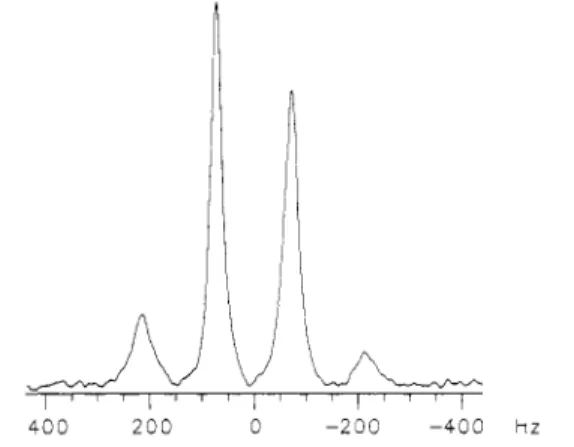
400 200 0 -230 - 4 0 0 h z
Figure 1. Proton-coupled I3C spectrum of the N-methyl group of CTAB in a CTAB/Nasal viscoelastic micellar solution (sample I) at 52 OC. The spectrum was taken a t 75.5 M H z (Bo = 7.0 T).
The experimental techniques used to obtain the coupled 13C spectra, T1, and NOE were similar to those utilized for the vis- coelastic micellar system.
Results
Differential Line Broadening. CTABINasall Water Viscoe- lastic Micellar System. From the proton-coupled I3C spectra of the CTAB/Nasal viscoelastic solutions, the line-width differences between the various components of the proton-coupled multiplet of the N-methyl carbon in CTAB was clearly observed (Figure
1). Since ‘JCH is known to be positive, the downfield outer line in the quartet corresponds to the m, = 3/z proton spin state, and
the downfield inner line corresponds to the m, =
l/z
state, etc. The broadness and the marginal signal-to-noise ratio of the outer lines made the measurement of their line widths more difficult. In all cases, the line width of the upper-field outer line (m, = -3/z) could not be measured to a satisfactory degree. However, the difference between the widths of the outer lines and those of the inner lines and the difference between the widths of the two inner lines are quite obvious. On the other hand, the multiplet for the terminal methyl group on the C16 chain of CTAB showed marginal DLB only a t the lower end of the temperature range under study (-38-42 “C). Apparently, the much smaller order parameter for the terminal methyl group and the expected smaller CSA of the C-methyl I3C (as compared to N - m e t h ~ l ) ~ ’ rendered the DLB too small to be detected. Although the exact temperature range of which the CTAB/Nasal solutions exhibit viscoelastic properties has not been investigated in this study, it was observed that the solutions remained viscoelastic up to a t least 56 OC, and DLB persisted up to this temperature. For the normal micellar solutions of CTAB in D 2 0 with and without pentanol, no DLB was detected even at lowered temperature (-5 “C). The line widths in general are affected by magnetic field inhomogeneity, temperature fluctuations in long-term signal averaging, and the necessary line broadening during data processing for the purpose of increasing the signal-to-noise ratio. For the N-methyl signals in the present case, the line widths are further affected by scalar relaxation due to the fast relaxation of the adjacent 14N nucleus and, in the coupled spectrum, by the unresolved long-range 3JcH, which is estimated to be 3-4 H z . ~ * From the typical magnitude of 15N-13C scalar coupling constants and the TI of I4N in similar systems,29 the scalar relaxation due to I4N is estimated to contribute ap- proximately 2 Hz to the line widths. However, all the contributions described here contribute equally to all the components of the multiplet. Therefore in Table I, only the differences in the line widths are reported. The m,-dependent terms ( b and c in eq 13)can be directly deduced from these differences, while the m,-in- dependent contributions are cancelled.30 It can easily be shown
(27) Veeman, W. S. Prog. N M R Spectrosc. 1984, 16, 193. (28) Hansen, P. E. Prgg. N M R Spectrosc. 1981, 14, 175. (29) Henriksson, U.; Odberg, L. Finn. Chem. Lett. 1982, 127.
(30) In fact, the a term for the quartet and the two doublets in the proton spin states is slight1 different (eq 14). However, this difference is negligibly small for i o
-
10-r
s or longer.Downloaded by NATIONAL TAIWAN UNIV on September 3, 2009 | http://pubs.acs.org
4156 The Journal of Physical Chemistry, Vol. 92, No. 16, 1988 Hwang et al. TABLE 11: I3C T1 (in seconds) and NOE for the N-Methyl Group of
CTAB in the CTAB/Nasal Viscoelastic Micellar Solutions at Two Magnetic Fields (7.0 and 9.4 T)
7.0 T 9.4 T temp, sample" OC Tl 1 TI 9 I 42 0.619 1.27 0.753 1.52 I 47 0.721 1.38 0.841 1.60 I 52 0.802 1.47 0.915 1.69 I1 50 0.672 1.56 I1 55 0.747 1.60
"Samples I and I1 are as denoted in Table I.
TABLE III: Experimental 13C TI and NOE at Several Magnetic Fields for CIS, C2,, and CI9 of Sodium Deoxycholate in a 50 mM Micellar Solution at 25 "C magn field Bn. T C no. T I . s n 9.4 CIS 0.84 1.12 c19 0.76 1.10 c19 0.61 1.02 c21 0.36 1.01 C2l 0.56 1.37 7.0 C18 0.71 0.96 C21 0.50 1.18 4.7 C18 0.51 0.74 c19 0.39 0.78 2.1 C18 0.19" 0.71 c21 0.16" 0.91 C19 0.18" 0.75
"The null-point method was used in these measurements. that the line-width difference between the m, =
lines, Av ( - i / 2 , i / 2 ) (in hertz), is given by
and m, = (19) rAv(-XlY2) = 1/T2(-Y2)
-
1/T2(Y2) = -br A v ( 3 / , Y 2 ) = b
+
2cSimilarly, A v ( ~ / ~ , ' / ~ ) is given by
(20) While the b term arises from the interference between the DD and CSA relaxation mechanisms (eq 15), the c term is dependent only on the DD relaxation (eq 16). For 7,"
-
lo-* s, the spectral densities, V,, U,, and P are negligibly small (-0.01) a t Bo i= 7T. Since the dipolar interaction between the I3C and the protons can be easily estimated, the determination of the b and c terms provides a convenient way to obtain direct information on the values of 7," and the CSA.
Sodium Deoxycholate/ Water Micellar System. The magnitude
of DLB for the methyl (C18 and CZl) 13C multiplets was an order of magnitude smaller than that observed in the N-methyl multiplet in CTAB in the viscoelastic micelles described in the preceding section. In fact, the line-width difference between the two inner lines, A v ( - ~ / ~ , ~ / ~ ) , was too small to be measured. However, the differences between the widths of the m, = * 3 / 2 and the m, = & I / , can be used for the same purpose. The combined difference
between the widths of the two outer lines and those of the two inner lines is equal to a-'(4c) (eq 13). The values of c for CI8
and C21 thus determined are given in Table IV. The coupled I3C signals for methyl C I 9 was not well resolved from the other methylene signals. Therefore, the DLB for methyl C19 could not be determined.
I3C TI and NOE at Several Magnetic Fields. The I'C T I and
NOE measured at several magnetic fields (2.1-9.4 T) for both systems exhibit a strong magnetic field dependence (Tables I1 and 111), which is characteristic of mast of the micellar solutions studied at different magnetic f i e l d ~ ~ ~ , ~ ~ and of many macromolecules such as proteins33 and nucleic acids.34 The field dependence of the (31) For example: Lindman, B.; Ahnas, T.; Saderman, 0.; Walderhaug, H . ; Rapacki, K.; Stilbs, P. Faraday Discuss. Chem. SOC. 1983, 7 6 , 317. (32) (a) Walderhaug, H.; Siiderman, 0.; Stilbs, P. J . Phys. Chem. 1984, 88, 1655. (b) Saderman, 0.; Henriksson, U.; Olsson, U. J . Phys. Chem. 1987,
91, 116.
TABLE IV: Order Parameter, S, and Correlation Times 7," and
72
Derived from the Analysis of
Calculated and Experimental DLB Effects
TI and NOE Results and the C no. S T,S, ns 7cf, ps p l d (1 s-1 p p t l
"
s-10.21 f 0.01 10 f 1 3.7 f 0.5 3.6 f 1 CZl 0.22 f 0.01 4.3 f 0.56 20 f 1 4.0 f 0.5 2.5 f 1 Cig 0.23 f 0.01 12 f 2 3.8 f 0.5 c a Calculated for and measured at Bo = 7.0 T. 72 is the same for all the methyl groups according to the model. 'Not measurable due to overlap with other signals.
relaxation times and NOE has been treated by Wennerstrom et al.12 in the "two-step" model and by Lipari and Szaboi3 in the "model free" approach. Similar forms of the two-step spectral densities have also been suggested by Freed and co-workers for anisotropic systems.35 In these models, the dynamics of the molecular aggregates or the macromolecules is described by an isotropic slow reorientation of the whole molecule (or aggregate) and a fast, and slightly anisotropic, internal reorientation of the segment of the molecule of interest. In the case of molecular aggregates, such as micelles, the slow isotropic motion also contains the contribution from diffusion of molecules along the surface of the aggregates. The formalisms thus allow the determination of the correlation times of the two motions and an order parameter that describes the time-averaged angular restriction of the fast internal motion. The I3C TI and NOE according to these models are given by12,13
(TJ1 =
Here, Y~ and yc represent the magnetogyric ratios of proton and carbon, respectively, r denotes the C-H bond distance, which is assumed to be 1.09 8, in the present calculation, and
vi
is the NOE.The J(w) values are the various reduced spectral densities, wC and wH are the Larmor frequencies of carbon and proton at the actual magnetic field, and h is the reduced Planck's constant. Ni is the
number of protons directly bonded to carbon i .
The reduced spectral densities, J ( w ) , in these models are given by
Here 7: is the correlation time for the slow isotropic motion; 7,f
is the corrleation time for the fast local motion, which has to be sufficiently fast to fall in the extreme narrowing limit ( w ~ T ~
<<
1) for the models to be valid. S is the order parameter for the C-H bonds. In eq 21 and 22, the DD relaxation between the 13C and the attached proton nuclei is assumed to be the only significant mechanism. From the magnitude of the CSA determined in this study (see the next section), it is estimated that the CSA con- tribution to the spin-lattice relaxation is still relatively minor (1-2%) even a t Bo = 9.4 T. Therefore, the use of eq 21 and 22 is valid.
Determination of 7:,
~ c f ,
and S . Thus in studies involving the13C Ti and NOE of a number of carbon segments a t several magnetic fields, the individual 7: and the order parameter, S, for
each segment, and a common slow correlation time, 72, can be determined from the experimental data by least-squares analysis. Alternatively, if the slow correlation time can be determined from
(33) For example: Henry, G. D.; Weiner, J. H.; Sykes, B. D. Biochemistry (34) For example: Schmidt, P. G.; Sierzputowska-Gracz, H.; Agris, P. F. (35) Polnaszek, C. F.; Freed, J. H. J . Phys. Chem. 1975, 79, 2283. Freed,
1986, 25, 590.
Biochemistry 1987, 26, 8529.
J. H . J . Chem. Phys. 1977, 66, 4183.
Downloaded by NATIONAL TAIWAN UNIV on September 3, 2009 | http://pubs.acs.org
Coupled Spin Systems in Macromolecules
independent means, the other two parameters,
~ c f
and S, can be extracted from T I a t two magnetic fields or from T I and N O E at a single magnetic field, assuming the two-step model (eq 23) is applicable. However, it is prudent, in most cases, to use data at more than one or two magnetic fields to ascertain whether the model is valid or not for the system under investigation.The I3C TI and NOE data for the sodium deoxycholate micellar solution spanned a magnetic field range of 2.1-9.4 T. Thus, by use of a least-squares routine, the correlation times and the order parameter for methyl carbons 18, 19, and 21 were determined from the data presented in Table 111. The correlation times and order parameter (Table IV) were then used in turn to calculate the b and c terms in the DLB equations, utilizing the relationship between S and Sc3 (eq 18). Good agreement between the values of the c terms thus calculated and the experimental values was obtained (Table IV). The calculation also showed that the b term for all the methyls is indeed too small (-0.3 s-l) to be observed.
The good agreement between the TI and NOE results on one hand and the DLB results on the other strongly indicates that the two-step model is applicable to the sodium deoxycholate micellar system. In such cases, the DLB and the multifield relaxation and N O E results can be combined to make a more unambiguous determination of the order parameter and the correlation times. Previous studies of the deoxycholate system indicated that the surfactant forms spherical micelles.36 The derived T: indicated
that the aggregates are relatively small. These properties probably account for the applicability of the two-step model for this system. The present results are in close agreement with a recent work based
on ‘H two-quantum relaxation of the methyl signals.37 In the present study, the order parameters for all the methyl C-H were found to be approximately 0.2, which implies that the order pa- rameter S, for these methyl groups should be about 0.6. That is, there is rather limited wobbling motion for these methyl C3 axes, which are attached to a rather rigid steroid backbone. However, in ref 37, Sc3 was found to be close to 1 for all the methyls. Otherwise, the agreement between the results of ref 37 and the present work, particularly in the slow correlation time, is very good.
The results for the CTAB/Nasal viscoelastic micellar system presented a rather different picture. The I3C TI and N O E data were limited to only two magnetic fields, Le., 7.0 and 9.4 T. From the magnetic field dependence of the TI and NOE, a “slow” motion faster than s was predicted on the basis of the two-step model. Least-squares analysis of the T , and N O E data showed that T: should be (2.0-2.5) X s for the two samples studied at several temperatures. However, the resultant order parameter for the N-methyl C-H, S, was found to range from 0.25 to 0.39. These values for S are unreasonably high and are contradictory to the observed order parameter for the C-D bonds in C,N(CD3)3 in lamellar and hexagonal liquid crystalline phases.38 In these phases, the order parameters ScD, which should be practically equivalent to SCH (and S in the present case), was generally found to be -0.037 f 0.005. If this value is used for S, then Sc, is -0.1 1. From the experimental DLB results, the slow correlation time, T:, was found to be 1.5-2.4 p s , which is 2 orders of mag- nitude longer than that suggested by the I3C TI and NOE results. However, the results determined from DLB assuming S -0.037 are consistent with the results of several other investigations.
1. From ‘H line-shape measurements, Olsson et al.39 concluded that the T: for viscoelastic micelles based on CTAB was in the
microsecond range for concentrations corresponding to those in this work.
2. The CSA thus determined (from the experimental values of the b term) assuming S = 0.037 and Sc3 = 0.11 was approx- imately -60 ppm. Thus, Sc3Au i= 6 ppm, a value consistent with
the observed residual CSA for the N-methyl I3C in CTAB in hexagonal and lamellar liquid crystal phases.40
(36) Small, D. M. The Bile Acids; Plenum: New York, 1971. (37) Kay, L. E.; Prestegard, J. H. J . A m . Chem. SOC. 1987, 109, 3829.
( 3 8 ) Olsson, U.; SZiderman, O., unpublished results.
(39) Olsson, U.; Siiderman, 0.; Guering, P. J . Phys. Chem. 1986,90,5223.
(40) Henriksson, U.; Klasson, T. Finn. Chem. Lett. 1982, 139.
The Journal of Physical Chemistry, Vol. 92, No. 16, 1988 4757 3. The observed DLB for the I3C multiplet of the N-methyl group in CTAB was about 20 Hz for A v ( ~ / ~ , ’ / ~ ) in the viscoelastic solutions (Table I) but was not measurable (<0.3 Hz) in the “normal” micellar solutions. Since the order parameters, which reflect only the effects of the fast local motion, should be similar in these two types of solutions, there is then a difference of at least 2 orders of magnitude between the slow correlation times for the two types of systems. According to previous studies of the normal micellar systems of dodecyl- and hexadecyltrimethylammonium chlorides (DOTAC and CTAC),32 the slow correlation time for such micellar aggregates was found to be (1 5 3 ) X s by I3C
multifield relaxation experiments and (4-8) X s by a 2H
mulifield study. Therefore, 7,” for the viscoelastic micelles should
be longer than low7 s. The value of (2.0-2.5) X s for T: for
the viscoelastic system as suggested by the I3C TI and N O E data based on the two-step model is clearly too short to account for the difference in the observed DLB in the two systems.
On the basis of the above comparisons, it was concluded that the calculation of T: from DLB based on the value of S taken
from ’H splittings of the N-methyl deuterons of CTAB (N-methyl deuteriated) in liquid crystalline phases was correct. Then the discrepancy between the DLB results, which primarily arise from the spectral densities a t zero frequency, and the I3C TI and N O E results, which sample the spectral density a t Larmor frequencies of 108-109 Hz, is due to the existence of motion(s) of an inter- mediate (10-7-10-8 s) time scale. In other words, the simple “two-step” model cannot be used to described the dynamics of the CTAB/Nasal viscoelastic micellar system. The intermediate motion(s) causes the field dependence of the 13C TI and N O E (a single slow motion with a correlation time of 10” s would have resulted in field-independent I3C TI and N O E a t the magnetic fields of our measurements), while the DLB measures the effects of the slowest motion (in this case >lo” s). The existence of complex motions and the breakdown of the simple “two-step” model for this system are hardly s ~ r p r i s i n g , ~ ~ since the system has been shown to form rodlike micelles that are probably quite f l e ~ i b l e . ’ ~ - ~ ~ Furthermore, many recent studies utilizing I3C T I
and N O E and 2 H T I and T2 measurements demonstrated that there are many surfactant systems that exhibit more complicated dynamics than that described by the “two-step” m ~ d e l . ~ ’ . ~ ~ A DLB and I3C TI investigation of the cubic liquid crystal phase (Z2) of DOTAC/water system43 also revealed discrepancies be- tween the DLB and the I3C T I results if the two-step model is
applied. The existence of more complicated motion(s) in this system was confirmed by 2H T I and T2 results.44
Since the correlation time for the slowest motion (- 10” s) for the CTAB/Nasal system was determined from DLB, it is in principle possible to use an extension of the “two-step” model to evaluate the correlation times for the fast internal motion and the intermediate motion@). Such attempts have been made for several isotropic surfactant systems where more than one “slow” motions were implicated, for example, a “three-step” model of the form42 J(o) =
(25) In the first equation, rCi stands for the correlation time for the intermediate motion, and SI and S2 are the order parameters after averaging over the fast motion and the intermediate motion, (41) SZiderman, 0.; Walderhaug, H.; Henriksson, U.; Stilbs, P. J . Phys. Chem. 1985,89, 3693. Nery, H.; Siiderman, 0.; Canet, D.; Walderhaug, H.; Lindman, B. J . Phys. Chem. 1986, 90, 5802.
(42) Carnali, J.; Lindman, B.; Soderman, 0.; Walderhaug, H. Langmuir
1986, 2 , 5 1 .
(43) Wong, T. C., unpublished results.
(44) Henriksson, U.; Stilbs, P.; Soderman, O., unpublished results.
Downloaded by NATIONAL TAIWAN UNIV on September 3, 2009 | http://pubs.acs.org
4758
respectively. In the second equation, the spectral density for the slow motions is the specific result of the solution of the rotational diffusion equation for a symmetric top,45 where 7L and 7 s are
correlation times for the rotation about the long axis of the rod and the end-over-end rotation, respectively. The end-over-end tumbling generally occurs a t the slowest time scale. However, since there was no direct knowledge of the spectral densities a t the intermediate frequencies and since the motion(s) of the vis- coelastic micellar aggregates in this frequency range are likely to be rather complex, we do not feel that a quantitative evaluation of the correlation times based on the present data is worthwhile. The results of the calculation for the CTAB/Nasal viscoelastic system assuming S = 0.037 is given in Table I. The chemical shift anisotropy for the N-methyl 13C calculated from the b term was found to lie within the range -56 to -75 ppm. However, since the measurements a t the higher temperature range (47-56 "C) are more reliable, the more reliable value of the CSA should range from -56 to -65 ppm. The deduced value of the CSA of about -60 ppm for the N-methyl 13C is quite large compared with those of C-methyl groups (typically from -20 to -40 ppm) but is of approximately the same magnitude of those of 0-methyl groups (typically from -50 to -80 p ~ m ) . ~ ~
The DLB enables one to determine the sign of the CSA provided the absolute sign of lJcH is k n ~ w n . ' * ~ ~ ~ ~ ~ The negative sign of ull
-
ui determined in this study is consistent with those of the C-methyl and Omethyl 13C?7 It has been shown that the chemical shielding tensors of some methyl 13C, particularly those of 0-methyl groups, deviate slightly from cylindrical symmetry.27 In such cases, then, uli - uL should be replaced by ull
-
1/2(u,,+
ubb), where a and b denote the two principal axes of the CSA tensor perpendicular to the parallel axis. If the CSA of the methyl 13C is known from an independent measurement, the consistency of the calculation described above and the value of72
can be checked and ascertained. In the present case, the CSA of the N-methyl group is not known. Because of the complications caused by the quadrupole moment of the neighboring 14N, as far as we know, no information on the CSA of N-methyl carbon is available in the literature.Discussions
In this work, the theory of differential line broadening of the methyl multiplet in systems where there is a slow overall reori- entation and fast, and slightly anisotropic, internal motions has been derived on the basis of the solution of the stochastic Liouville equation. Several important categories of systems-molecular aggregates such as micelles, microemulsions, and vesicles, and biomacromolecules such as nucleic acids and proteins-fall into this category. Indeed, DLB in the methyl group has so far been observed, in addition to the present study of micellar solutions, in transfer RNA" and in a cubic liquid crystal p h a ~ e . 4 ~ The DLB in a methyl group is unique in that it is in principle possible to determine both the slow correlation time and the chemical shift anisotropy from the differences between the various lines of the multiplet. In practice, the applicability of this effect can be determined only with further work on other real systems.
The determination of the 72 from DLB is particularly useful
in the study of the dynamics of macromolecules and molecular aggregates. It can provide an independent comparison with the
The Journal of Physical Chemistry, Vol. 92, No. 14, 1988 Hwang et al.
values determined from multifield Tl and N O E studies. In the two systems studied in this work, it is demonstrated that the DLB results can be combined with the multifield T 1 and N O E mea- surements to determine the correlation times and order parameters for systems to which the two-step model is applicable. On the other hand, the DLB techniques can also be used as a diagnosis for the breakdown of the two-step model in more complex systems, such as in the viscoelastic micelles. In such a case, DLB provides the measurement of the slowest correlation time, which is fre- quently inaccessible from measurements at higher frequencies. For methyl groups of known 13C CSA, the various line-width differences can be used to provide a further check of the internal consistency of the value of
72
determined (the b and c terms). In studies in which the molecular dynamics in the main objective of the investigation, this is probably the preferred approach. On the other hand, in a situation where the CSA is not known or cannot be independently measured, as in the present case, the DLB provides a reasonable way to estimate the CSA.Recently, there have been revived interests in the differential relaxation rates in coupled spin
system^.^-',^'
Higher magnetic fields used in N M R and the increasing size of the molecules studied increase dramatically the likelihood of observing this type of phenomenon. A study closely related to DLB by Jaccard et al. demonstrated the observation of longitudinal two-spin order 2ZzSz due to the interference between CSA and dipolar inter- actions.& Differential relaxation rates not only provide valuable information on the molecular dynamics and chemical shift an- isotropy as demonstrated in this and several previous work3-' but also are responsible for some of the previously unexpected ob- servations in two-dimensional (2D) N M R spectroscopy of mac- romolecules in which the rate of the molecular reorientation is not in the extreme narrowing limit. Prominent examples are the appearance of isolated methyl signals in multiple-quantum filtered 2D experiment^)^*^^-^^ and relaxation-allowed coherence transfer between spins not scalarly coupled to each other.50 Therefore, it appears that relaxation in coupled spin systems will attract much further research effort.Acknowledgment. This work is partially supported by an N I H
Biomedical Research Support Grant. The NT-300 spectrometer at the University of Missouri was purchased through a grant from the National Science Foundation (PCM-8115599). The use of the 400-MHz spectrometer at the N M R F A M a t the University of Wisconsin, Madison, is gratefully acknowledged. T.C.W. would like to thank Dr. Hanna Gracz for communicating the observation of DLB in transfer R N A to him and Professor T. C. Farrar for stimulating discussions. L.P.H. thanks the National Science Council of the Republic of China for a Travelling Grant and the University of Missouri for hospitality during his stay. Dr. Olle Soderman's valuable suggestions concerning the viscoelastic micelles are greatly acknowledged.
Registry No. Nasal, 54-21-7; CTAB, 57-09-0; sodium deoxycholate, 302-95-4.
(45) Huntress, W. T. Adv. Magn. Reson. 1970, 4, I .
(46) Jaccard, G.; Wimperis, S.; Bodenhausen, G. Chem. Phys. Lett. 1987,
(47) Muller, N.; Bodenhausen, G.; Wuthrich, K.; Emst, R. R. J . Magn. (48) Muller, N.; Emst, R. R.; Wuthrich, K. J . Am. Chem. SOC. 1986,108,
(49) Rance, M.; Wright, P. E. Chem. Phys. Lett. 1986, 124, 572.
(50) Wimperis, S.; Bodenhausen, G. Chem. Phys. Lett. 1987, 140, 41.
( 5 1 ) S d e r m a n , 0. J . Magn. Reson. 1986, 68, 296.
138, 601.
Reson. 1985, 65, 531.
6482.
Downloaded by NATIONAL TAIWAN UNIV on September 3, 2009 | http://pubs.acs.org