LETTER 1243
Microwave-Assisted Benzimidazole Cyclization by Bismuth Chloride
Microwave-Assisted Benzimidazole Cyclization by Bismuth ChlorideYuh-Sheng Su, Chung-Ming Sun*
Department of Applied Chemistry, National Chiao Tung University, Hsinchu 300, Taiwan Fax +886(3)5723764; E-mail: [email protected]
Received 1 March 2005
SYNLETT 2005, No. 8, pp 1243–124617.05.2005 Advanced online publication: 21.04.2005 DOI: 10.1055/s-2005-865240; Art ID: U05505ST © Georg Thieme Verlag Stuttgart · New York
Abstract: We have developed a multi-step, microwave-assisted
method for the bismuth chloride catalyzed synthesis of 1,2-disubsti-tuted benzimidazoles. Biologically interesting benzimidazoles were readily assembled using a SNAr reaction, reduction, and finally a bismuth(III)-mediated cyclization under microwave irradiation. The desired products were then liberated from the soluble matrix in excellent yield and purity after cleavage. Each step of the synthetic sequence was performed under microwave conditions.
Key words: bismuth chloride, combinatorial chemistry,
liquid-phase method, microwave assisted synthesis, scaffold
In recent years, design and synthesis of pharmacologically relevant heterocyclic molecules by combinatorial tech-niques has caught the imagination of medicinal chemists.1
The application of microwave irradiation to combinatorial chemistry results in a powerful tool accelerating the pace of library synthesis.2 A domestic microwave oven is most
often used in synthesis because of its low cost and ready availability. However, specially fabricated mono-mode microwave reactors provide homogeneous heating, tem-perature control, and more importantly improved safety features. The major aim of this integrated technology is to exploit the high degree of molecular diversity and as well as utilize high-throughput organic synthesis to rapidly ac-cess the greatly expanded library of drug-like compounds without the need for tedious or time-consuming process-es.3 Convergent, polymer-supported microwave synthesis
of discrete chemical entities provides an attractive lead optimization method for the refinement of biological activity. The use of soluble polymer support in combina-torial synthetic methodologies facilitates library synthesis and overcomes the difficulties associated with solid phase reactions.4 Soluble polymer supported reactions are easily
monitored by conventional analytical methods.5
The benzimidazole moiety is found in various synthetic pharmaceuticals displaying a broad spectrum of biologi-cal activity including anti-ulcer, anti-tumor and anti-viral effects.6 Therefore, a general method to rapidly synthesize
benzimidazoles would be greatly advantageous and warrants further investigation. Although a number of solid-phase approaches for benzimidazole synthesis have been reported,7 bismuth chloride catalyzed benzimidazole
cyclization on soluble polymer support by microwave irradiation is unknown.8
The first step of this convergent synthesis toward the tar-geted compounds involved the ligation of 4-fluoro-3-ni-trobenzoic acid to the polymer support HO-PEG-OH 1 using microwave-assisted dehydrative esterification in dichloromethane (Scheme 1). The PEG-bound ortho-ni-tro aryl fluoride 2 was subjected to aromatic nucleophilic substitution with various primary amines, resulting in a diverse range of polymer-bound aryl amines. The 1H
NMR spectrum showed the conversion of 2 to 3 was complete in five minutes under microwave irradiation (Figure 1). Polymer immobilized o-nitrophenylamino ester 3 was treated with a suspension of Zn/NH4Cl in
methanol for six minutes under microwave irradiation to afford the corresponding immobilized diamine 4.9 All
in-termediates were synthesized successfully by multi-step microwave irradiation in an open vessel system. We did not find any cleavage of O–C=O bond during the harsh MW irradiation.
The next key step is the ring closure of PEG-bound o-phe-nylenediamine 4. Recently, there have been many reports on the applications of a remarkable Lewis acid catalyst BiCl3 in a range of organic transformations.12–15 Most
bis-muth compounds are ecologically friendly, widely used in medicine, inexpensive, and easy to handle. Also, these compounds are crystalline and relatively non-toxic and non-carcinogenic.
To the best of our knowledge, there is no report to de-scribe bismuth chloride promoted benzimidazole forma-tion. In our preliminary study, the cyclization of polymer-bound diamines did not occur with isothiocyanates and bismuth chloride in a one-pot reaction. However, we real-ized that benzimidazoles were obtained when the diamine moiety was first converted to its thiourea derivative fol-lowed by intramolecular cyclization. Reaction of 4 with alkyl and aryl isothiocyanates gave N,N¢-disubstituted thiourea 5 in three hours by conventional heating in meth-anol, but the same reactions were completed in 15 minutes under microwave irradiation. No undesired dithiourea formation was observed after cleavage of intermediates 5 under both types of reaction conditions. The conversion of diamines to the thiourea derivative by using isothiocyan-ates can be done in two ways (Scheme 2). Either it can be performed before the reduction of the nitro group or after reduction to the amine moiety, neither affected the forma-tion of thiourea. The presence of a strong electron-with-drawing group on the benzene ring did not inhibit the reactivity of the secondary amine. Both of these products can be cleaved to deliver the same compound 9.
1244 Y.-S. Su, C.-M. Sun LETTER
Synlett 2005, No. 8, 1243– 1246 © Thieme Stuttgart · New York
Figure 1 shows how conventional 1H NMR spectroscopy
was used to monitor the preparation of benzimidazoles on the soluble polymer support. With this non-destructive monitoring method, each intermediate could be investi-gated thoroughly using standard 1H NMR spectroscopy.
The intramolecular cyclization was then performed using BiCl3 and triethylamine in chloroform to form
1,2-disub-stituted benzimidazoles 6. The bismuth chloride can be easily removed by filtration using celite, before continu-ing with the work-up, precipitation, and washcontinu-ing of the polymer-bound intermediate. The same reaction was car-ried out under microwave irradiation and the reaction time was reduced to four minutes without cleaving the polymer support.10 In the absence of microwave irradiation it took
two hours to complete the reaction by conventional heat-ing. After washing the precipitate with diethyl ether and ethanol, desired products 7 are liberated from the support by using sodium methoxide/methanol. This transforma-tion, monitored by TLC, was complete in eight minutes
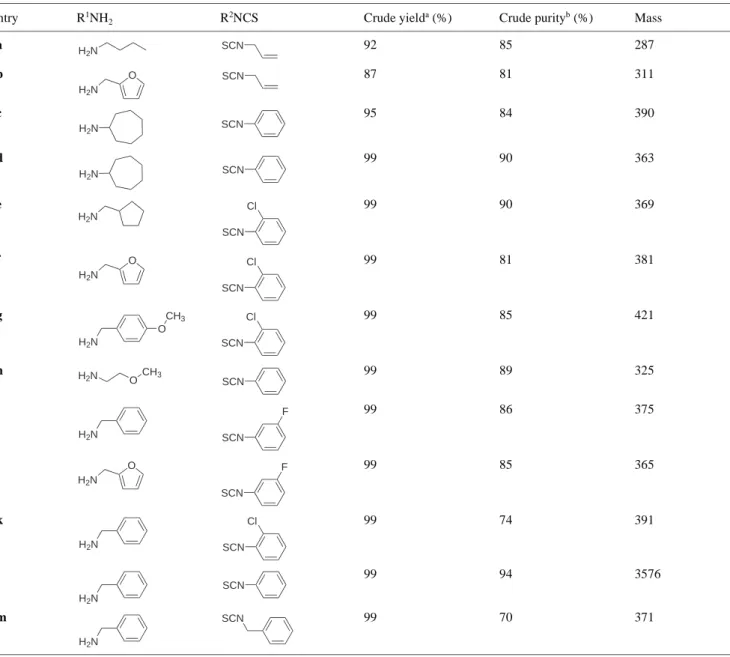
under microwave irradiation. The structure, yield, and pu-rity obtained for a diverse set of compounds are summa-rized in Table 1. Each crude product was analyzed by HPLC, which showed around 70–94% purity.
In conclusion, we have successfully demonstrated a novel bismuth(III)-catalyzed liquid phase synthesis of benzimi-dazoles. In each step of the reaction sequence, the immo-bilized intermediates were purified by simple precipitation and washing after microwave heating in an open-vessel system.11 Crude products are usually
ob-tained in high purity and high yields just by simple work-up after microwave irradiation. Synthesis and screening of focused combinatorial libraries based on pharmacophoric scaffolds may lead to the discovery of interesting biolog-ical activities.
Acknowledgment
We thank the National Science Council of Taiwan for general financial support.
Scheme 1 Reagents and reaction conditions: (a) 4-fluoro-3-nitrobenzoic acid, DCC, cat. DMAP, CH2Cl2, MW (300 W), 5 min; (b) R1NH2, CH2Cl2, MW (300 W), 5 min; (c) Zn, NH4Cl, CH3OH, MW (100 W), 6 min; (d) R2NCS, Et3N, CH3OH, MW (200 W), 15 min; (e) BiCl3, Et3N, CHCl3, MW (200 W), 4 min; (f) CH3ONa, CH3OH, MW (100 W), 8 min.
HO OH O O F NO2 O O NHR1 NO2 O O NHR1 NH2 O O N NH2 H3C O O N N N R1 R2 H O O N N N R1 R2 H PEG (f) 1 2 3 (PEG-6000) 4 (a) (b) (c) (d) 2 2 2 PEG PEG PEG PEG 6 2 7 (e) 5 2 PEG NH R2 S R1
Scheme 2 Different routes used for the preparation of the thiourea derivative.
O O NHR1 NO2 O O NHR1 NH2 Zn, NH4Cl O O N NO2 R1 S N R2 H O O N NH2 R1 S N R2 H Zn, NH4Cl CH3ONa O O N NH2 R1 S N R2 H H3C O O NH2 NR 1 S HN R2 CH3ONa R2-N=C=S R2-N=C=S 9 PEG 3 4 2 2 PEG 5 2 PEG 8 2 PEG 5 2 PEG CH2Cl2 MeOH CH2Cl2 MeOH MeOH MeOH
LETTER Microwave-Assisted Benzimidazole Cyclization by Bismuth Chloride 1245
Synlett 2005, No. 8, 1243 – 1246 © Thieme Stuttgart · New York References
(1) (a) Dolle, R. E. Mol. Diversity 1996, 2, 223. (b) Dolle, R. E.; Nelson, K. H. J. Comb. Chem. 1999, 1, 235. (c) Dolle, R. E. J. Comb. Chem. 2000, 2, 383. (d) Dolle, R. E. J. Comb. Chem. 2001, 3, 477. (e) Dolle, R. E. J. Comb. Chem. 2003, 5, 693. (f) Dolle, R. E. J. Comb. Chem. 2004, 6, 623.
(2) Microwave-assisted combinatorial synthesis: (a) Lew, A.; Krutzik, P. O.; Hart, M. E.; Chamberlin, R. A. J. Comb. Chem. 2002, 4, 95. (b) Al-Obeidi, F.; Austin, R. E.; Okonya, J. F.; Bond, D. R. S. Mini-Rev. Med. Chem. 2003, 3, 459. (c) Blackwell, H. E. Org. Biomol. Chem. 2003, 1, 1251. (d) Swamy, K. M. K.; Yeh, W. B.; Lin, M. J.; Sun, C. M. Curr. Med. Chem. 2003, 10, 2403. (e) Kappe, C. O. Angew. Chem. Int. Ed. 2004, 43, 6250.
(3) (a) Larhed, M.; Hallberg, A. Drug Discov. Today 2001, 6, 406. (b) Wathey, B.; Tierney, J.; Lidström, P.; Westman, J. Drug Discov. Today 2002, 7, 373.
(4) Reviews see: (a) Sun, C. M. Comb. Chem. High Throughput Screening 1999, 2, 299. (b) Toy, P. H.; Janda, K. D. Acc.
Chem. Res. 2000, 33, 546. (c) Sun, C. M. Soluble Polymer-Supported Synthesis of Heterocyclic Libraries, In
‘Combinatorial Chemistry Methods and Protocols’ Methods in Molecular Biology Series; Bellavance, L., Ed.; Humana Press Inc.: New Jersey, 2002, Chap. 10, 345–371. (5) The progress of the liquid-phase synthesis reaction was
monitored by regular 1H NMR spectroscopy: (a) Shey, J. Y.; Sun, C. M. Tetrahedron Lett. 2002, 43, 1725. (b) Yeh, W. B.; Lin, M. J.; Lee, M. J.; Sun, C. M. Mol. Diversity 2003, 7, 185.
(6) (a) Preston, P. N. Chem. Rev. 1974, 279. (b) Cedillo-Rivera, R.; Munoz, O. J. Med. Microbiol. 1992, 37, 221. (c) Chavaz, B.; Cedillo-Rivera, R.; Martinez-Palomo, A. J. Protozool. 1992, 39, 510. (d) Fears, S. D.; O’Jare, J. Antimicrob. Agents Chemother. 1998, 32, 114. (e) Gabrial, N. V.; Roberto, C.; Alicia, H. C.; Liian, Y.; Francisco, H. L.; Juan, V.; Raul, M.; Rafael, C.; Manuel, H.; Rafael, C. Bioorg. Med. Chem. Lett. 2001, 11, 187.
Table 1 Bismuth Chloride Catalyzed Cyclization toward Benzimidazoles 7
Entry R1NH
2 R2NCS Crude yielda (%) Crude purityb (%) Mass
7a 92 85 287 7b 87 81 311 7c 95 84 390 7d 99 90 363 7e 99 90 369 7f 99 81 381 7g 99 85 421 7h 99 89 325 7i 99 86 375 7j 99 85 365 7k 99 74 391 7l 99 94 3576 7m 99 70 371
a Determined based on weight of crude sample.
b Purity determined by HPLC analysis of crude products. Products show satisfactory 1H NMR spectra and MS data.
H2N SCN O H2N SCN H2N SCN H2N SCN H2N SCN Cl O H2N SCN Cl H2N O CH3 SCN Cl CH3 O H2N SCN H2N SCN F O H2N SCN F H2N SCN Cl H2N SCN H2N SCN
1246 Y.-S. Su, C.-M. Sun LETTER
Synlett 2005, No. 8, 1243– 1246 © Thieme Stuttgart · New York (7) (a) Phillips, G. B.; Wei, G. P. Tetrahedron Lett. 1996, 37,
4887. (b) Phillips, G. B.; Wei, G. P. Tetrahedron Lett. 1998, 39, 179. (c) Lee, J.; Gauthier, D.; Rivero, R. A. Tetrahedron Lett. 1998, 39, 201. (d) Smith, J. M.; Gard, J.; Cummings, W.; Kanizsai, A.; Krch ák, V. J. Comb. Chem. 1999, 1, 368. (e) Tumelty, D.; Cao, K.; Holmes, C. P. Org. Lett. 2001, 83. (8) Combinatorial soluble polymer synthesis of heterocyclic
libraries has been demonstrated in our laboratory: (a) Chang, W. J.; Yeh, W. B.; Sun, C. M. Synlett 2003, 1688. (b) Lin, M.-J.; Sun, C. M. Synlett 2004, 663. (c) Tung, C. L.; Sun, C. M. Tetrahedron Lett. 2004, 45, 1159. (d) Yeh, W. B.; Lin, M. J.; Sun, C. M. Comb. Chem. High Throughput Screening 2004, 7, 251. (e) Yeh, W. B.; Sun, C. M. J. Comb. Chem. 2004, 6, 279. (f) Su, Y. S.; Lin, M. J.; Sun, C. M. Tetrahedron Lett. 2005, 46, 177. (9) Morita, S.; Kitano, K.; Matsubara, J.; Ohtani, T.; Kawano,
Y.; Otsubo, K.; Uchida, M. Tetrahedron 1998, 54, 4811. (10) The control reaction was also performed under normal
thermal heating in refluxing chloroform (pre-heated oil bath)
for four minutes, using identical stoichiometry. However, after cleavage we obtained only the unreacted compound 4. The same reaction reached completion in two hours by conventional heating. Similar enhancement through microwave irradiation was also observed during the cleavage step. Compared to conventional thermal hearting, microwave irradiation decreased the reaction time on the support from several hours to several minutes.
(11) All the microwave assisted polymer-supported reactions described here were performed in a CEM Discover Microwave System at a frequency of 2450 Hz (0–300 W). (12) Leonard, N. M.; Wieland, L. C.; Mohan, R. S. Tetrahedron
2002, 58, 8373.
(13) Mohammedadpoor-Baltrok, I.; Aliyan, H.; Khosropour, A. R. Tetrahedron 2001, 57, 5857.
(14) Sabiyha, G.; Venkata Reddy, E.; Maruthi, C. H.; Yadav, J. S. Tetrahedron Lett. 2002, 43, 1573.
(15) Sabiyha, G.; Venkata Reddy, E.; Swapna, R.; Reddy, N. M.; Yadav, J. S. Synlett 2004, 1276.
Figure 1 1H NMR monitoring of a stepwise benzimidazole formation.