Soft x-ray absorption spectroscopy studies of (110) YBa 2 Cu 3 O 6.9 thin film
S. J. Liu, J. Y. Juang, K. H. Wu, T. M. Uen, Y. S. Gou, J. M. Chen, and J.-Y. Lin
Citation: Journal of Applied Physics 93, 2834 (2003); doi: 10.1063/1.1544072 View online: http://dx.doi.org/10.1063/1.1544072
View Table of Contents: http://scitation.aip.org/content/aip/journal/jap/93/5?ver=pdfcov
Published by the AIP Publishing
Articles you may be interested in
Control of hole distribution through isovalent R -cation substitution in Cu 2 Ba 2 R Cu 2 O 8 superconductors
Appl. Phys. Lett. 90, 032511 (2007); 10.1063/1.2431458
Microwave impedance of YBa 2 Cu 3 O 7 high-temperature superconductor films in a magnetic field
Low Temp. Phys. 31, 254 (2005); 10.1063/1.1884427
Charge redistribution in YBa 2 Cu 3 O 7d probed by Raman spectroscopy: CuO 2 - plane phonon as a probe of carrier dynamics in the CuO 2 plane
Appl. Phys. Lett. 81, 4988 (2002); 10.1063/1.1529082
Optical evidence for compatibility of antiferromagnetism and superconductivity in YBa 2 Cu 3 O 6+x
Low Temp. Phys. 26, 809 (2000); 10.1063/1.1330540
Relationship between electrical transport and hole concentration in YBa 2 Cu 3 O 7x ultrathin films probed by electric fields
J. Appl. Phys. 81, 3237 (1997); 10.1063/1.364156
Soft x-ray absorption spectroscopy studies of
„
110
…
YBa
2Cu
3O
6.9thin film
S. J. Liu, J. Y. Juang, K. H. Wu, T. M. Uen, and Y. S. Gou
Department of Electrophysics, National Chiao Tung University, Hsinchu, Taiwan J. M. Chena)
Synchrotron Radiation Research Center, Hsinchu, Taiwan J.-Y. Lin
Institute of Physics, National Chiao Tung University, Hsinchu, Taiwan 共Received 25 March 2002; accepted 15 December 2002兲
Unoccupied states of the共110兲 YBa2Cu3O6.9共YBCO兲 thin films were investigated by the E储ab and
E储c polarized O 1s x-ray absorption near edge structure共XANES兲 spectroscopy. With correction of
the self-absorption effect, the E储ab O 1s XANES spectra of the共110兲 YBCO films obtained from
the normal incidence geometry and grazing incidence geometry are very similar. After the self-absorption correction, the E储c spectrum of the 共110兲 YBCO film obtained from the normal
incidence geometry is almost identical to that of the 共001兲 YBCO film obtained from the grazing incidence geometry. Hole distribution over the different oxygen sites has been derived. The hole number in the apical sites in some thin films obtained in the present investigation is larger than that from the previous x-ray absorption studies of single crystals and from the theoretical calculations. The comparison of the XANES spectra between the 共001兲 and 共110兲 YBCO thin films is also presented. © 2003 American Institute of Physics. 关DOI: 10.1063/1.1544072兴
I. INTRODUCTION
It has been well established that one of the key param-eters controlling the superconducting transition temperature (Tc) value of the p-type superconducting cuprates is the
car-rier concentration in the CuO2 planes. 1
Tc as a function of
hole concentration in the CuO2 planes is found to follow a parabolic curve for many hole-doped high-Tc cuprate superconductors.2Also several theories for high-Tc cuprates
suggest that the apical O 2 pzorbital plays an important role
on superconductivity.3– 6For example, the presence of apical oxygen atoms makes the CuO2 plane easier to dope with holes.6The significance of apical O 2 pzstates in determining the nature and dispersion of quasiparticle states of hole-doped cuprates has been proposed.7 Also Di Castro et al. have explained the depression of Tc above a certain dopant
concentration by the occupancy of holes on Cu 3d3z2– r2 and
apical O 2 pz hybrids.
8
Thus, hole carriers in the apical oxy-gen sites are proposed to have a negative influence on the superconductivity in the layered cuprates. In contrast, based on the polarization-dependent O 1s and Cu 2p x-ray absorp-tion measurements on the Y1⫺xCaxBazCu3O7⫺y single crys-tals by Merz et al., it was concluded that the maximum achievable Tcin p-type cuprates is governed by not only the planar hole concentration but also the number of holes on the apical site.9In other words, to obtain the maximum Tc, the
optimally doped planes and the optimum hole number in the apical sites are equally important. It is therefore essential to accurately probe the hole count in the apical oxygen sites in the high-Tccuprates to develop a comprehensive
understand-ing of the superconductunderstand-ing properties.
It is well-known that the x-ray absorption near edge structure共XANES兲 measurement is a powerful tool to inves-tigate the unoccupied共hole兲 states in high-Tccuprates.
9–15 In particular, polarized O K-edge XANES spectrum is capable of giving information about the hole carriers on the specific sites. Due to the anisotropy of YBa2Cu3O6.9共YBCO兲, E储ab and E储c O 1s XANES spectra can provide the distribution of
hole carriers over the different oxygen sites. E represents the electric field vector of the linearly polarized synchrotron light. Knowledge of hole distribution on the different sites is indispensable to investigate the effects of, for example, Ca and Pr substitution in YBCO.9,10 However, there is a large discrepancy for the hole number in the apical oxygen sites in the YBCO single crystals in the literature 共for example,
napex⫽0.2 in Ref. 16 and napex⫽0.27 in Ref. 9兲.
The in-plane c-axis-aligned YBCO thin films exhibit the
c axis lying in the surface plane and make a longer
super-conducting coherence length accessible for the fabrication of Josephson tunneling junctions. Due to the significance of fabricating planar tunneling junctions, the growth of the 共100兲 and 共110兲 YBCO thin films has recently attracted great attention. Several groups have successfully grown the共100兲 and共110兲 YBCO thin films in spite of containing some im-purity phases such as共103兲.17 Using the well-oriented共110兲 YBCO thin film with the c axis aligning along the substrate plane, both the E储c and E储ab absorption spectra can be
mea-sured from the normal incidence geometry. Furthermore, in the E储c geometry, the E储ab spectra can also be obtained by
the grazing incidence geometry.
In this study, unoccupied states of the well-oriented 共001兲 and 共110兲 YBCO thin films were investigated by the
E储c and E储ab O 1s x-ray absorption spectra. The
distribu-tion of hole carriers on the different oxygen sites was
mea-a兲Electronic mail: [email protected]
2834
0021-8979/2003/93(5)/2834/5/$20.00 © 2003 American Institute of Physics
sured and compared with results from both the previous x-ray absorption studies of single crystals and theoretical cal-culations. The comparison of the absorption spectra between the 共001兲 and 共110兲 YBCO thin films related to their super-conducting properties is also discussed.
II. EXPERIMENTS
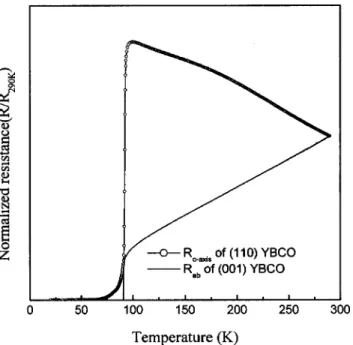
The well-oriented共110兲 YBCO thin film was deposited on the共110兲 SrTiO3surface with the PrBa2Cu3O7⫺y layer as a buffer layer by the pulsed laser deposition 共PLD兲 method. The detailed deposition conditions and the sample character-ization will be described elsewhere.18 The well-oriented 共001兲 YBCO thin film was deposited on 共100兲 SrTiO3 sub-strate by PLD. The normalized resistance vs. temperature of both samples is shown in Fig. 1. Both samples show decent
Tc of 89 K and similar electric transport properties. The
thickness of the two films is estimated to be about 3000– 4000 Å which is thick enough to avoid the contribution from the buffer layer and the oxide substrate. The x-ray absorption experiments were performed at the high-energy spherical grating monochromator 共HSGM兲 beamline of the
Synchro-tron Radiation Research Center in Taiwan. The photon en-ergy was calibrated using the known O K-edge absorption peaks of CuO. The energy resolution of the monochromator was set to ⬃0.2 eV for the O K-edge range. The incident photon flux (I0) was monitored simultaneously by a Au-coated mesh located after the exit slit of the monochromator. All the absorption measurements were normalized to I0. Fig-ure 2 shows the geometry arrangements of the incident lin-early polarized x-ray and thin films. Figures 2共a兲 and 2共b兲 for the E储c and E储ab geometries correspond to a
normal-incident alignment with the polarization vector of normal-incident synchrotron light parallel and perpendicular to the c axis of thin films, respectively. For the E储c geometry, the sample
FIG. 1. Normalized resistance (R/R290 K) vs T of共a兲 the well-oriented 共110兲
YBCO and共b兲 共001兲 YBCO.
FIG. 2. The geometry arrangement of the incident polarized x-ray and well-oriented 共110兲 YBO thin films for the 共a兲 E储ab, 共b兲 E储c, and 共c兲 I(␣) spectra, respectively. E represents the electric field vector of the linearly polarized synchrotron light.
FIG. 3. 共a兲 E储c and共b兲 E储ab O 1s XANES spectra of the well-oriented
共110兲 YBCO thin films. The spectra before and after the self-absorption correction are depicted.
2835
J. Appl. Phys., Vol. 93, No. 5, 1 March 2003 Liuet al.
was rotated with␣⫽60° and 75° 共␣is the angle between the incident synchrotron beam and the surface normal兲 to obtain the polarized x-ray absorption spectra I(␣) 关Fig. 2共c兲兴. Ac-cording to
I共␣兲⫽IE储ccos2共␣兲⫹IE储absin2共␣兲 共1兲
the E储ab spectra were deduced.
X-ray absorption spectra were recorded by a bulk-sensitive x-ray-fluorescence-yield 共XFY兲 mode. However, for concentrated samples, the XFY spectra exhibit the con-siderable distortions due to the self-absorption effect. More-over, these distortions vary with the experimental geometry arrangements and cannot be neglected to obtain the correct absorption spectra. The experimental XFY XANES spectra
were corrected for the self-absorption effect by
employing19,20 IF共E兲 I0共E兲⬀ X共E兲 total共E兲 cos␣ ⫹ total共EF兲 cos , 共2兲
where E and EF are the energy of the incident x ray and the
fluorescence, respectively. IF(E) is the intensity of the
fluo-rescence detected. I0(E) denotes the intensity of the incom-ing x ray.x(E) is the absorption coefficient associated with the production of a core hole in the investigated level X.is the angle between the sample normal and the outgoing fluo-rescence toward the detector. total(E) denotes the absorp-tion coefficients of all elements in the sample. The spectra were normalized to the tabulated standard absorption cross section21in the energy range from 600 to 620 eV. The axis of the fluorescence detector was oriented at 45° with respect to the incident photon beam. In this geometry, for ␣⫽60° and 75°, ⫽15° and 30°, respectively. The x-ray absorption measurements were performed at room temperature.
III. RESULTS AND DISCUSSION
In Fig. 3, the E储c and E储ab O 1s XANES spectra of the
共110兲 YBCO thin film obtained from the normal incidence geometry are reproduced before and after the self-absorption correction. The absorption features of the SrTiO3 substrate are not observed in Fig. 3, as demonstrated in Ref. 22. This ensures that the observed spectra reflect only the bulk prop-erties of YBCO. As shown in Fig. 3共a兲, the pre-edge peak at ⬃528 eV in the E储c spectrum of the共110兲 YBCO thin film is
assigned to the O 2 pz hole states in the apical oxygen sites.
For the E储ab spectra in Fig. 3共b兲, the absorption feature at
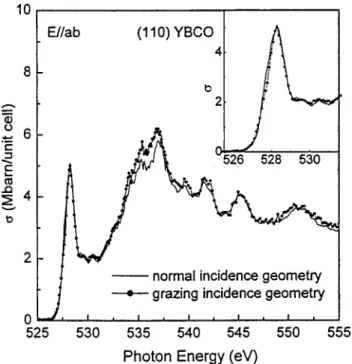
FIG. 4. Comparison of the E储ab O 1s XANES spectra of the共110兲 YBCO
thin film obtained from the normal incidence geometry and grazing inci-dence geometry. The pre-edge spectra are presented in the insets.
FIG. 5. 共a兲 Comparison of the E储c spectrum of the共110兲 YBCO thin film
measured from the normal incidence geometry and the E储c spectrum of the
共001兲 YBCO film obtained from the grazing incidence geometry. 共b兲 E储ab
O 1s XANES spectra of the共001兲 and 共110兲 YBCO.
⬃528.4 eV is ascribed to the hole states in the CuO2 plane 共i.e., the Zhang–Rice states兲, while the shoulder at ⬃527.8 eV corresponds to the unoccupied states in the CuO chain.1,9 The peak at⬃529.5 eV is associated with the upper Hubbard band. It is clearly seen from Fig. 3 that the distortion of the XFY spectra due to the self-absorption effect cannot be ig-nored. Thus, the self-absorption correction is crucial for quantitative analyses to obtain the number of hole carriers on the specific sites.
Figure 4 presents the E储ab O 1s XANES spectra of the
共110兲 YBCO thin film obtained from the normal incidence geometry关in Fig. 2共a兲 geometry兴 and grazing incidence ge-ometry关in Fig. 2共c兲 geometry兴. As noted, after correction of the self-absorption effect, the XFY spectra obtained from different incident geometries become much closer to each other, while the pre-edge region shows only a slight differ-ence, as shown in inset of Fig. 4共a兲. This clearly confirms that the technique of the self-absorption correction can be successfully used for complex XANES spectra of high-Tc
cuprates.
In Fig. 5共a兲, the E储c O K-edge XANES spectra of both
the 共110兲 and 共001兲 YBCO thin films are depicted. The former is measured from the normal incidence geometry, while the latter is obtained from the grazing incidence geom-etry. As noted, after the self-absorption correction, the E储c
spectra of both thin films with different orientations are al-most the same, although the pre-edge region shows a slight difference. In general, the purity of the共110兲 thin films can-not reach 100%.19The共103兲 impurity phase could lead to a difference in the E储c spectra of both films with different
orientations. The similarity of the E储c spectra of the共001兲
and共110兲 thin films infers that the 共110兲 YBCO thin film we prepared is rather pure with respect to the orientation. Figure 5共b兲 shows the E储ab O K-edge XANES spectra of both the
well-oriented 共001兲 and 共110兲 YBCO thin films obtained from the normal incidence geometry. As noted, there is a small difference in the E储ab spectra of the 共001兲 and 共110兲
YBCO thin films for the energy range above the edge, while the pre-edge region of these two films is very similar. Al-though hole number in the apical sites of the共001兲 and 共110兲 YBCO thin films shows a slight difference 关see Fig. 5共a兲兴, planar hole concentration for both films is almost identical
关see Fig. 5共b兲兴. Tc is considered to be determined
predomi-nantly by the hole number in the CuO2 planes. Accordingly, the similarity of the pre-edge E储ab spectra of two thin films
is associated with their nearly identical Tc’s as shown in Fig.
1.
The hole number on the different oxygen sites of the 共001兲 and 共110兲 YBCO thin films, derived from the inte-grated cross section of the pre-edge absorption peaks, is listed in Table I. The hole fractions were compared with those from the previous XANES studies of single crystals as well as calculated values and results from the nuclear
mag-netic resonance 共NMR兲 investigations coupled with
electrical-field gradient calculations,23 as listed in Table I. 2naband nchain, obtained from the O 1s E储ab XANES spec-tra, represent the total amount of holes in the CuO2 planes and in the CuO chains, respectively. Due to the randomness of the a and b axis arrangement of the YBCO thin film, unlike the single crystal, the contribution from the O共2兲 and O共3兲 in the CuO2 planes cannot be distinguished. napex, ob-tained from the E储c XANES spectra, corresponds to the hole
content in the apical O sites. ntotalis the total hole number of all the O sites in an unit cell. The total hole number per unit cell is assumed to be 0.9, since the oxygen content of the two YBCO thin films under studied is estimated to be 6.9. As noted from Table I, the hole number in the apical sites in the present investigation is sometimes larger than that from the previous x-ray absorption studies of single crystals共Ref. 16兲 and from the theoretical calculations. Within the errors, the values of napexfor 共001兲 thin film 共our work兲 and Ref. 9 are in good agreement. However, the napex value of the 共110兲 YBCO film 共our work兲 is larger than one obtained from re-cent XANES studies in the YBCO single crystals 共Ref. 9兲. Since the number of apical holes in some YBCO films is larger than those in single crystals, in principle this differ-ence could manifest itself in properties such as anisotropy and interlayer coupling. Further investigations of c-axis transport and optical properties in the YBCO thin films are desirable.24 On the other hand, the 2nab values of two films are slightly smaller than one in single crystals. As expected, the Tc 共⬃89 K兲 of thin films is slightly smaller than that of single crystals共⬃92 K兲. The Tc deviations between present thin films and single crystals may be due to the variations in
TABLE I. Hole distribution on the different oxygen sites of the well-oriented共001兲 and 共110兲 YBCO thin films as obtained by present experiments. Hole number, naband nchain, are analyzed by fitting the E//ab XANES
spectra to a sum of Gaussian. napexis obtained from the E//c XANES spectra. For comparison, the results of
previous XANES measurements by Merz et al.共XASI兲 共Ref. 9兲, Nu¨cker et al. 共XAS2兲 共Ref. 1兲, Krol et al.,
共XAS3兲 共Ref. 16兲, of band-structure calculations 共BSC兲 共Ref. 25兲, of calculations using three-band model 共3BM兲 with local-density approximation 共Ref. 26兲, and NMR results coupled with calculations of the
electric-field gradients共EFG兲 共Ref. 23兲 are listed. Estimated error for the n values ⫾0.02. The oxygen content (Ototal)
for different samples is included.
Site 110a 001b XAS1 XAS2 XAS3 BSC 3BM EFG
nchain 0.19 0.21 0.24 0.34 0.27 0.17 0.22 0.30 2nab 0.38 0.39 0.40 0.40 0.52 0.60 0.76 0.50 napex 0.33 0.30 0.27 0.26 0.20 0.20 0.24 0.28 ntotal 0.90 0.90 0.91 1.00 0.99 Ototal 6.90 6.90 6.91 7.0 6.99 a共110兲 YBCO. b共001兲 YBCO. 2837
J. Appl. Phys., Vol. 93, No. 5, 1 March 2003 Liuet al.
the crystal/film growth processes. However, the overall quan-titative consistency of hole distribution and the similarity of the absorption spectra between the epitaxial thin films 共this work兲 and single crystals 共Ref. 9兲 are especially noteworthy. This suggests that the similar XANES studies can be con-ducted using the high-quality epitaxial thin films, which in some cases are more convenient to fabricate.
IV. CONCLUSION
In conclusion, using the共110兲 YBCO thin film, the E储c
O 1s XANES spectra of YBCO was measured from the nor-mal incidence geometry. With correction of self-absorption effect, the E储ab O 1s XANES spectra of the same共110兲 film
obtained from the normal incidence and grazing incidence geometries are very similar. After the self-absorption correc-tion, the E储c spectrum of 共110兲 YBCO thin film measured
from the normal incidence geometry is almost identical to that of the 共001兲 YBCO films obtained from the grazing in-cidence geometry. Hole distribution over the different oxy-gen sites on the 共001兲 and 共110兲 YBCO thin films has been derived. The hole number in the apical sites in some films obtained in the present investigation is larger than that ob-tained from the previous XANES studies of single crystals and from the theoretical calculations.
1N. Nu¨cker et al., Phys. Rev. B 51, 8529共1995兲.
2J. L. Tallon, C. Bernhard, H. Shaked, R. L. Hitterman, and J. D. Jorgensen,
Phys. Rev. B 51, 12911共1995兲.
3
E. Kaldis, P. Fischer, A. W. Hewat, E. A. Hewat, J. Karpinski, and S. Rusiecki, Physica C 159, 668共1989兲.
4C. Murayama, N. Moˆri, S. Yomo, H. Takagi, S. Uchida, and Y. Tokura,
Nature共London兲 339, 293 共1989兲.
5
H. Matsukawa and H. Fukuyama, J. Phys. Soc. Jpn. 59, 1723共1990兲.
6J. B. Torrance et al., Phys. Rev. B 40, 8872共1989兲. 7
J. B. Grant and A. K. McMahan, Phys. Rev. B 46, 8840共1990兲.
8C. Di Castra, L. F. Feiner, and M. Gilli, Phys. Rev. Lett. 66, 3209共1991兲. 9
M. Merz et al., Phys. Rev. Lett. 80, 5192共1998兲.
10M. Merz et al., Phys. Rev. B 55, 9160共1997兲.
11J. M. Chen, R. S. Liu, J. G. Lin, C. Y. Huang, and J. C. Ho, Phys. Rev. B
55, 14586共1997兲.
12E. Pellegrin et al., Phys. Rev. B 47, 3354共1993兲. 13
C. T. Chen, L. H. Tjeng, J. Kwo, H. L. Kao, P. Rudolf, F. Sette, and R. M. Fleming, Phys. Rev. Lett. 69, 2543共1992兲.
14
J.-H. Park, C. T. Chen, S.-W. Cheong, W. Bao, G. Meigs, V. Chakarian, and Y. U. Idzerda, Phys. Rev. Lett. 76, 4215共1996兲.
15
D. D. Sarma, O. Rader, T. Kachel, A. Chainani, M. Mathew, K. Holldack, W. Gudat, and W. Eberhardt, Phys. Rev. B 49, 14238共1994兲.
16A. Krol et al., Phys. Rev. B 45, 2581共1995兲.
17For examples, S. Misat, P. J. King, D. Fuchs, J. C. Villegier, R. P.
Cam-pion, and P. S. Czerwinka, Physica C 331, 241共2000兲.
18
S. P. Chen, J. Y. Juang, K. H. Wu, T. M. Uen, Y. S. Gou共unpublished兲.
19L. Tro¨ger, D. Arvanitis, K. Baberschke, H. Michaelis, U. Grimm, and E.
Zschech, Phys. Rev. B 46, 3283共1992兲.
20C. H. Booth, F. Bridges, J. B. Boyce, T. Claeson, B. M. Lairson, R. Liang,
and D. A. Bonn, Phys. Rev. B 54, 9542共1996兲.
21J. J. Yeh and I. Lindau, At. Data Nucl. Data Tables 32, 1共1995兲. 22S. Gerhold, C. A. Kuntscher, M. Merz, N. Nu¨cker, S. Schupper, W. H.
Tang, and J. Gao, Phys. Status Solidi B 215, 578共1999兲.
23H. Alloul, T. Ohno, and P. Mendels, Phys. Rev. Lett. 63, 1700共1989兲. 24
S. L. Cooper and K. E. Gray, in Physical Properties of High Temperature
Superconductors, edited by D. M. Ginsberg共World Scientific, Singapore,
1983兲, Vol. 4, p. 61.
25W. M. Temmerman, Z. Szotec, and G. Y. Guo, J. Phys. C 21, L867共1988兲. 26
A. M. Ole´s and W. Grzelka, Phys. Rev. B 44, 9531共1991兲.