
國家主導的綠色城市發展以中新天津生態城為例 - 政大學術集成
151
0
0
全文
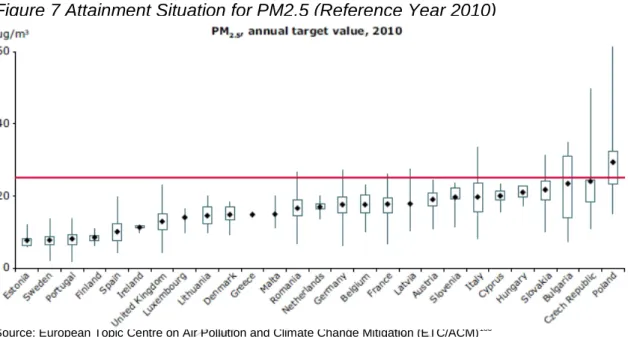
(2) Acknowledgements This report represents the master thesis concluding my Master of Arts in the Department of Political Science at the Faculty of Social Science at the National Chengchi University, Taipei, Taiwan. I would like to express my sincere gratitude to my supervisor Tang Ching-Ping and thank for the guidance and support during the process and editing of my thesis. Furthermore I appreciate the support and possibility to conduct a field research on the site at the Sino-Singapore Tianjin Eco-City in August 2013. Many thanks also to my respondents and sources in the eco-city, without their. 政 治 大 Finally I would like to thank my family and friends, who have encouraged and 立 supported me unconditionally during the development of my thesis. Without help I would not have been able to obtain firsthand information.. ‧ 國. 學. their support and advice it would not have been possible to follow this long path of study. I’m glad and thankful for all of you.. ‧. n. er. io. sit. y. Nat. al. Ch. engchi. i n U. v. ii.
(3) Abstract There are consistently clear signals and calls for a more sustainable living worldwide. China is making enormous efforts by building eco-cities from scratch. This study focuses on the question why the Sino-Singapore Tianjin Eco-City project is more likely to be developed and constructed in China and whether or not this project is scalable and transferable. The governmental joint-venture is a unique project and becomes the world’s largest eco-city, proving that an ecocity development from scratch can be accomplished. In order to analyze the feasibility of such a project it’s necessary to examine the. 治 政 大 of citizens and their leadership on the development process, and integration 立 daily-life experience. appropriateness of indicator system, the influence of the Chinese state. ‧ 國. 學. On site research and inquiries and indicator analysis reveal that the eco-city has achieved most goals. However this study indicates that Chinese governments. ‧. should provide environmental education to enhance eco-awareness. Lastly, it’s. sit. y. Nat. necessary to strive for higher and better monitored indicator targets similar to Western constructions, and integration of citizens in order to ensure that the. io. al. n. real estate project.. er. eco-city’s ambitious goals can reflect actual circumstances instead of a mere. Ch. engchi. i n U. v. iii.
(4) 摘要 適合全球可持續性的居住環境已經是一個明顯且也不斷的被提出的發展目標,而 中國大陸也在打造全新生態城的發展面向上有著極大的努力與成果。本研究欲探 討的問題有二:一、為何中新天津生態城(Sino-Singapore Tianjin Eco-City)的 發展模式可以在中國大陸運行並且建構?二、此種發展模式是否可以擴散到中國 其它的地區?本文認為,政府運用合資企業的建設模式使得打造全世界最具規模 的生態城得以實現,成就了此一指標性的計畫。 為了要分析此計畫的可行性,必須要檢視適合的指標系統(indicator system), 探討整合市民的生活經驗與中國中央政府對於計畫發展過程的影響是否對建構全 新生態城的可行性有所影響。. 立. 政 治 大. 經過實地訪查後,本文發現中新天津生態城確實在多數面向上達到了指標系統的發展目. ‧ 國. 學. 標。本研究指出中國政府在提高生態意識的建設上應該提供更多的環境生態教育。最後, 本文認為中國大陸在生態城的指標上,必須要建立起可以與西方相同標準的評估方式,. ‧. 以達到有效的監控。並且整合市民們的經驗,確保發展生態城的目標可以有效反應在現 實的環境上,而不是只是另一個土地開發的計畫。. n. er. io. sit. y. Nat. al. Ch. engchi. i n U. v. iv.
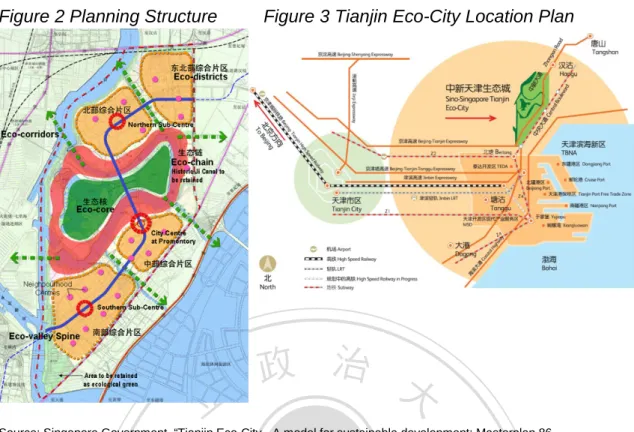
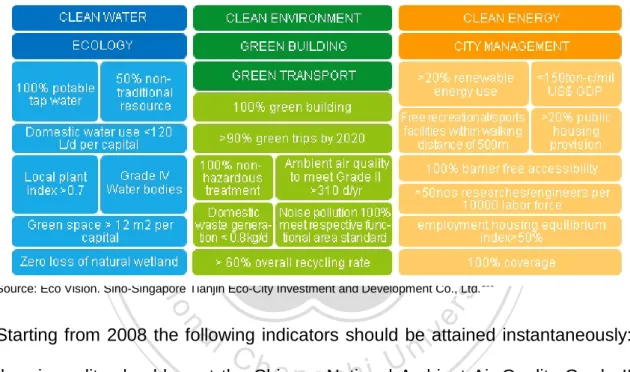
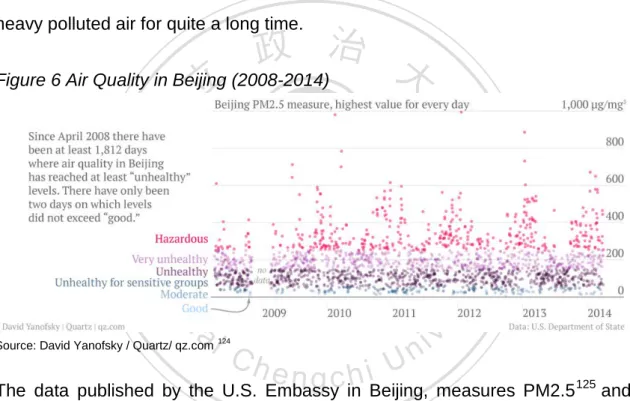
(5) List of Figures Figure 1 Methodology Scheme ................................................................................................ 9 Figure 2 Planning Structure Figure 3 Tianjin Eco-City Location Plan ........................... 43 Figure 4 SSTEC Three-Tiered Pattern (Eco-Cells, Communities, Districts) ................... 44 Figure 5 KPI Framework (Quantitative Indicators) .............................................................. 49 Figure 6 Air Quality in Beijing (2008-2014) .......................................................................... 61 Figure 7 Attainment Situation for PM2.5 (Reference Year 2010) ..................................... 66 Figure 8 Reasons for Living in the SSTEC ......................................................................... 103 Figure 9 Duration of Living in the SSTEC ........................................................................... 105 Figure 10 Possible Improvements in the SSTEC .............................................................. 106 Figure 11 Option to Advance opinion/suggestions............................................................ 112. 政 治 大. Figure 12 Current Status of Population in the Residential Areas ................................... 113. 立. ‧. ‧ 國. 學. n. er. io. sit. y. Nat. al. Ch. engchi. i n U. v. v.
(6) List of Tables Table 1 China's New Strategy for Emerging Industries ...................................................... 31 Table 2 China's National Ambient Air Quality Standards (1996, 2012) ........................... 63 Table 3 Comparison of Water Quality Standards ................................................................ 71 Table 4Comparison of SSTEC GBES and National GBES (Residential Buildings) ...... 80 Table 5 Comparison of some of the Qualitative Indicators ................................................ 95. 立. 政 治 大. ‧. ‧ 國. 學. n. er. io. sit. y. Nat. al. Ch. engchi. i n U. v. vi.
(7) Abbreviations Communist Party of China. CPC. Eco-City Administrative Committee. ECAC. European Environment Agency. EEA. European Union. EU. Green Building Evaluation Standard. GBES. Greenhouse Gas. GHG. Gross Domestic Product. GDP. Institute for Global Environmental Strategies. IGES. Intergovernmental Panel on Climate Change. IPCC. Joint Council for Bilateral Cooperation. JCBC. Joint Steering Council. JSC. 政 治 大. 立 Key Performance Indicator. Joint Working Committee. JWC KPI. ‧ 國. 學. Ministry of Environmental Protection Ministry of Housing and Urban-Rural Development. ‧. Ministry of National Development National People’s Congress. y. Nat. Nongovernmental Organization. MEP MoHURD MND NPC NGO. People’s Republic of China. PRC. er. al. n. People's Action Party. sit. OECD. io. Organisation for Economic Co-operation and Development. Research and Development. Ch. Sino-Singapore Tianjin Eco-City. engchi. i n U. v. PAP R&D SSTEC. State-Owned Enterprise. SOE. Tianjin Binhai New Area. TBNA. Tianjin Eco-City Investment and Development Co. Ltd. TECID. Township and Village Enterprises. TVE. United Nations. UN. vii.
(8) List of Contents. Acknowledgements ................................................................................................................... ii Abstract .....................................................................................................................................iii 摘要 ...........................................................................................................................................iv List of Figures ............................................................................................................................ v List of Tables ..............................................................................................................................vi Abbreviations ........................................................................................................................... vii Chapter 1: Introduction .............................................................................................................. 1 1.1. Background: Recent Development .......................................................................... 1. 1.2. Purpose of Study ........................................................................................................ 6. Timeframe .......................................................................................................... 12. 學. 1.3.1. ‧ 國. 1.3. 政 治 大 Methodology ................................................................................................................ 7 立. Chapter 2: Sustainable Development and State Capitalism .............................................. 13 History of Chinese Eco-Cities ................................................................................. 13. 2.2. Singapore’s Involvement ......................................................................................... 15. y. al. v i n Ch The Roots of China’s State Capitalism ......................................................... 24 engchi U Current Chinese State Capitalism.................................................................. 26. State Capitalism ........................................................................................................ 24. n. 2.4. Spatial Planning in China ................................................................................ 20. io. 2.3.1. sit. Spatial Planning and Sustainability........................................................................ 19. er. 2.3. Singapore’s History .......................................................................................... 17. Nat. 2.2.1. ‧. 2.1. 2.4.1 2.4.2. Chapter 3: The Chinese Eco-Cities ....................................................................................... 29 3.1. Definition of an Eco-City .......................................................................................... 29. 3.2. Chinese Eco-Cities: An Overview .......................................................................... 31. 3.2.1. Dongtan Eco-city .............................................................................................. 34. 3.2.2. Rizhao ................................................................................................................ 35. 3.2.3. Caofeidian International Eco-City................................................................... 35. 3.3. Sino-Singapore Tianjin Eco-City ............................................................................ 36. 3.3.1. Political and Managing Framework ................................................................ 36. 3.3.2. Location .............................................................................................................. 39. 3.3.3. Spatial (Infra)structure ..................................................................................... 42. 3.3.4. Involved Investors and Other Actors ............................................................. 45 viii.
(9) 3.3.5. Indicator System ............................................................................................... 47. Chapter 4: Analysis .................................................................................................................. 54 4.1. Location ...................................................................................................................... 54. 4.2. Transportation and Traffic ....................................................................................... 56. 4.3. Indicator Analysis...................................................................................................... 58. 4.3.1. Water Processing ............................................................................................. 58. 4.3.2. Ambient Air Quality........................................................................................... 60. 4.3.2.1 Recent Air Quality Problems ............................................................................. 61 4.3.2.2 Air Quality Comparison ...................................................................................... 62 4.3.2.3 Ambient Air Quality in the Tianjin Eco-City ..................................................... 66 4.3.2.4. Indoor Air Quality .......................................................................................... 68. 政 治 大. 4.3.3. Water Quality..................................................................................................... 69. 4.3.4. Green Buildings ................................................................................................ 75. 4.3.5.. Renewable Energy ........................................................................................... 83. 立. Summary of Indicator System Analysis................................................................. 88. 4.5. Housing Situation ..................................................................................................... 95. 4.6. State-Capitalism and the Eco-City ....................................................................... 100. 4.7. Integration ................................................................................................................ 102. 4.8. Personal Impression of the on-site Visit in the Tianjin Eco-City ...................... 116. ‧. ‧ 國. 學. 4.4. sit. y. Nat. Chapter 5: Conclusion ........................................................................................................... 119. io. Timeframe and Location ........................................................................................ 119. 5.2. Technology and Construction ............................................................................... 120. 5.3. Society ...................................................................................................................... 123. 5.4. Political Implications ............................................................................................... 124. 5.5. Limitations ................................................................................................................ 125. 5.6. Future Prospects .................................................................................................... 126. n. al. er. 5.1. Ch. engchi. i n U. v. Reference ............................................................................................................................ 130 Appendix .............................................................................................................................. 140. ix.
(10) Chapter 1: Introduction Climate change and change in living conditions, over-population and increasing urbanization are factors which should lead and demand for stronger implementation of sustainable development. Consequently many designers, engineers, academics and government officials gradually shift from traditional city 1 development towards one of a more sustainable city. They compile and make use of appropriate concepts and. 政 治 大. approaches in order to find a “harmonious” balance between urbanization,. 立. sustainable development, economical aspects and the environment.. ‧ 國. 學. 1.1. Background: Recent Development. ‧. The IPCC released Fifth Assessment Report (AR5) states clearer than before. Nat. sit. y. that it’s not too late to prevent the negative effects of climate change. The report. n. al. er. io. draws a quite dramatic scenario in which a temperature rise of about 3.7° to. i n U. v. 4.8°C might be possible. 2 The possible risks might affect whole eco systems,. Ch. engchi. settlement areas at the costs, disturbance or loss of biodiversity as well as a threat to maintain food security worldwide. The report states that only 20 countries are account for about 75% of the worldwide CO2 emissions, only five countries for about half of the emissions, including China. As a result that all countries have important roles to play, the mitigation efforts which are needed. 1. cf. Southall, Aidan. The city in time and space. Cambridge [England], New York: Cambridge University Press, 1998, 125ff.. 2. IPCC, ed. Climate Change 2014: Mitigation of Climate Change: Contribution of Working Group III to the Fifth Assessment Report of the Intergovernmental Panel on Climate Change. With the assistance of Edenhofer, O et al. Cambridge, United Kingdom and New York, NY, USA: Cambridge University Press, 2014. http://mitigation2014.org/report/final-draft/ (accessed May 5, 2014).. 1.
(11) rely on a few countries to make the most impact, excluding themselves would have dramatic impacts on the global economy, eco-systems. The report clarifies, that it is necessary to take initial steps before 2020; otherwise climate change’s negative impact might involve severe risks. If we do not take actions global temperatures are expected to rise to hazardous level for the biosphere. Heat waves, failed harvest, acid rain and ocean acidification, rising sea levels are just a few of the possible consequences if humanity does not take counter-measures.. 政 治 大. "This report makes very clear we face an issue of global willpower, not capacity",. 立. says U.S. Secretary of State John Kerry 3 in a statement after the publication of. ‧ 國. 學. the report.. ‧. Consumption-based GHG emissions increased in the major economies in the. sit. y. Nat. world from 1990 to 2009, 0.1%-0.2% for the EU27, whereas in China this value. io. al. er. ranges from 4.8% to 6.0% p.a. 4. While resource productivity showing a small but still constant growth and especially industrial countries’ economic activities. n. v i n C h of dematerialization. register an increase in the process This caused a global engchi U trend of slowing down resource consumption; however there is still a very high variation between different countries’ individual process of dematerialization. Some countries’ varying factor can be up to ten times greater than the one of other countries.. 3. 4. U.S. Department of State. “Release of Intergovernmental Panel on Climate Change Working Group 3 Report: Remarks by Secretary Kerry: April 2014.”. http://www.state.gov/secretary/remarks/2014/04/224755.htm (accessed April 26, 2014).. Peters, G. P., J. C. Minx, C. L. Weber, and O. Edenhofer. “Growth in emission transfers via international trade from 1990 to 2008.” Proceedings of the National Academy of Sciences 108, no. 21 (2011): 8903– 8908.. 2.
(12) Dematerialization matters enormously for the human environment. Lower materials intensity of the economy could reduce the amount of garbage produced, limit human 5 exposures to hazardous materials, and conserve landscapes.. The Asia-Pacific area especially has to improve its efficiency in order to establish equilibrium with other countries in the world in terms of productivity and resource-saving management and be sufficient competitive. The region has to use three times more resources to produce $1 of GDP than the rest of the world. 6 According to scholars about 70 percent of the worldwide energy-related. 政 治 大. greenhouse gases are emitted by cities. 7 As a result it is important to shift the. 立. focus of sustainable development to the cities and urban areas and their growth.. ‧ 國. 學. “The future will be predominantly urban, and the most immediate environmental. ‧. concerns of most people will be urban ones”. 8. sit. y. Nat. In 1900 less than ten per cent of the global population lived in cities, whereas by. n. al. er. io. the year 2000 the number has dramatically increased and half of the world’s. i n U. v. population is located in urban areas. In the case of China, its urban population. Ch. engchi. counts for about 660 million people or 50 per cent of its total population. 9 There. 5. Wernick, Iddo K., Robert Herman, Shekhar Govind, and Jesse H. Ausubel. “Materialization and dematerialization: measures and trends.” Daedalus, no. 3 (1996): 171–198, 172. 6 Rankine, Hitomi. “Why account for environmental change?”, 4. http://www.unescap.org/sites/default/files/2-ESCAP_0.pdf (accessed April 24, 2014). 7. Chien, Shiuh-Shen. “Chinese eco-cities: A perspective of land-speculation-oriented local entrepreneurialism.” China Information 27, no. 2 (2013): 173–196, 173. 8 Brundtland, Gro H. Our common future. New York: Oxford University Press, 1987. 9 Roberts, Peter, Joe Ravetz, and Clive George. Environment and the city. 1st ed. Routledge introductions to environment series. London u.a: Routledge, 2009, 15. United Nations. “World Urbanization Prospects: The 2011 Revision.”. http://esa.un.org/unup/CDROM/WUP2011-F03-Urban_Population.xls (accessed May 10, 2014).. 3.
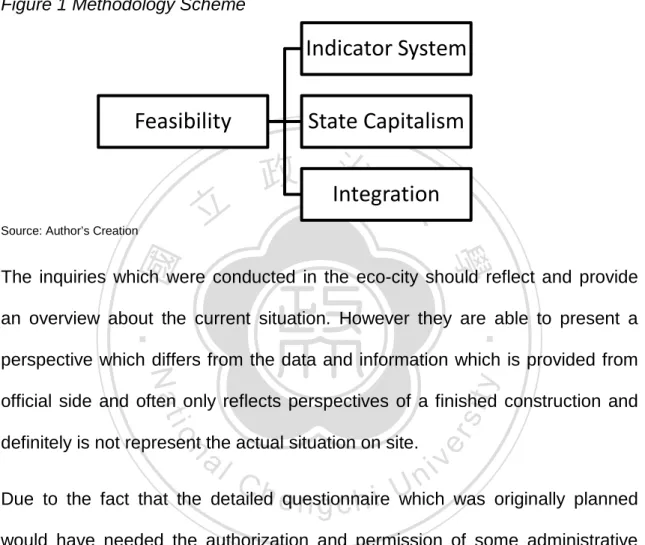
(13) is good reason to assume that in the next 20 years the population in Chinese cities will increase approximately by 350 million inhabitants. 10 In the year 2011 China’s emitted amount of carbon dioxide (CO2) emissions represented 28 percent of the worldwide global CO2 emissions, and the urbanization rate and trend is not stagnating at all. Recent studies confirm a continual upward tendency.. 11. 12. China’s ongoing impressive economic. development stands contrary towards the fact that China’s government is almost daily facing and managing new arising or reintroduced threats as well as. 政 治 大 stability, urbanization and立 also increasing concerns about the environment and. problems in areas of maintenance of economic growth, social harmony and. ‧ 國. 學. its protection.. China was one of the earliest countries in the developing world to announce the. ‧. research, possible adoption and the implementation of a sustainable. y. Nat. sit. development strategy. China has been paying attention to the idea of ecological. er. io. principles in the planning and construction of cities since the late 1980s 13.. al. n. v i n Different countries have beenCseeking sustainable paths that will allow h e n various gchi U them to concurrently make (interrelated) social, economic and environmental causes. 10. 11. subject. of. discussion.. Officials. of. the. Chinese. government,. Baeumler, Axel, Ede Ijjasz-Vasquez, and Shomik Mehndiratta. “Sustainable Low-Carbon Cities in China: Why it Matters and What Can be Done.” In Sustainable Low-Carbon City Development in China. Edited by Axel Baeumler, Ede Ijjasz-Vasquez and Shomik Mehndiratta, xxxix–lxvii. The World Bank, 2012, xxxix.. The pure increase of over 800 million tons of carbon dioxide emissions in 2011 is equal to the total amount of Germany’s whole year emissions. The data also reveals that in the same year Chinese emission per person of 6.6 tons of CO2 were almost equal to the average amount for citizen in the European Union (7.3 tons). 12 Le Quéré et al. “The global carbon budget 1959–2011.” Earth System Science Data Discussions 5, no. 2 (2012): 165-185, 177. 13 Yip, Stanley C. T. “Planning for Eco-Cities in China: Visions, Approaches and Challenges.” Dalian, China, 2008, 3. Li, Yifei, James Shepherd, Jennifer Layke, and Julia Currie. “Essential Buildings: The Emergence of “LowCarbon Cities” in Post-Industrial Urban China.”. http://www.colliers.com/enus/~/media/files/global/researchreports/emergenceoflowcarboncities.ashx (accessed July 2, 2013).. 4.
(14) environmental research experts, as well as citizen or non-governmental organizations and enterprises have recognized and indirectly admitted the fact that the environmental issue is giving rise to problems and threats concerning the above-mentioned issues and apprehensions. Hence, it can’t be ignored anymore. To revisit the issue of China’s method of dealing with environmental problems and protection, it’s important to indicate that the charge on the environment and the resulting negative consequences have been gradually noticed throughout. 政 治 大 started and is undertaking 立several ecological national projects and international the whole country, in society and in government. The Chinese government has. ‧ 國. 學. cooperation in order to promote sustainability and environmental development nationwide and even across the nation’s border. 14 In order to counteract. ‧. environmental issues and threats, China has concentrated its attention on. sit. y. Nat. sustainable development in urban regions and especially on the construction. n. al. planning of the Chinese Communist Party.. Ch. engchi. er. io. and implementation of ecological cities. This plays a decisive role in the. i n U. v. The concept of eco-cities has a growing number of proponents in developed and developing countries looking to effectuate and adapt environmental policies.. 15. A global research and survey study on eco-cities which was. conducted with the help of the International Eco-Cities Initiative categorized eco-cities into three types: ‘new development’, ‘expansion of urban area’ or. 14. Bosshard, Peter. “China’s Environmental Footprint in Africa.” Working Papers in African Studies, no. 01 (2008): 2–19. 15 Joss, S., D. Tomozeiu, and R. Cowley. “"Eco-Cities - a global survey: eco-city profiles".”. http://www.westminster.ac.uk/__data/assets/pdf_file/0011/119909/pdf_research_ecocities_GlobalSurvey-updated.pdf (accessed June 28, 2013), 1 ff. Lye, Liang F., and Gang Chen. Towards a liveable and sustainable urban environment: Eco-cities in East Asia. Singapore, Hackensack, NJ: World Scientific, 2010.. 5.
(15) ‘retro-fit development’. More than half of all new developed ecological cities are constructed in the Asia and Australasia regions. 16 Due to this and the fact that China is one of the biggest emitters of CO2, the concept of eco-cities in China should gain more attention. 1.2. Purpose of Study. The main emphasis of the research will concentrate on the ability to create a feasible eco-city from a scratch. To evaluate with what characteristics the. 政 治 大 a one-time occurrence or possible to be scalable and carried out in other 立. Chinese authorities are developing this project and whether or not this project is. ‧ 國. 學. regions in China or abroad. Therefore the focus will be shifted to the SinoSingapore Tianjin Eco-City (SSTEC), a joint-venture eco-city project by the. Nat. y. ‧. Chinese government and the Singaporean government.. er. io. sit. The aim of this study will be to introduce and examine the Sino-Singapore Tianjin Eco-City and its capability to create effective cooperative joint-venture. If. al. n. v i n the project may serve as a model development in the field of C h for further (global) engchi U. eco-cities, hinges on the question regarding the willingness to cooperate (on a national and international basis) during all phrases of planning and realization of the project. Additionally it is important to find out if the construction of a city from scratch is a better concept and appropriate for sustainable development. Foreign concepts most of the time follow a different strategy that does not construct new cities but rather extends and modernizes and renews them.. 16. Joss, Tomozeiu, Cowley, Eco-Cities, 2.. 6.
(16) This work does not judge whether or not either one of the construction concepts is inferior towards the other one but rather focusses on the question why the Chinese prefer to develop these construction projects and build whole new cities and why this concept is more visible in China than in other regions of the world.. 1.3. Methodology. Recent studies on ecological cities in China have one thing in common; they mainly present the eco-city’s possible future perspective and result. Introducing. 治 政 and comparing cities’ improvement towards their 大 current situation of city 立 development in China. The question of whether the development of an eco-city ‧ 國. 學. from scratch is a sustainable development itself is not an issue. Research on. ‧. eco-cities should put more emphasis on the eco-cities’ development and its clout on socio-economic and ecological environment.. sit. y. Nat. n. al. er. io. The purpose of the study is to evaluating the likeliness and feasibility of the. v. planning, construction and implementation process of the Tianjin Eco-city and to. Ch. engchi. i n U. comprehend why the city is developed at the current location in China. Why are the SSTEC and its concept more likely to be implemented and constructed in the People’s Republic of China than in the Western hemisphere? In order to get a better overview of this project and it’s feasibility it is necessary to define variables which are helpful for the analysis of the research. The dependent variable should indicate the feasibility of the development of the SSTEC as a whole new city in China.. 7.
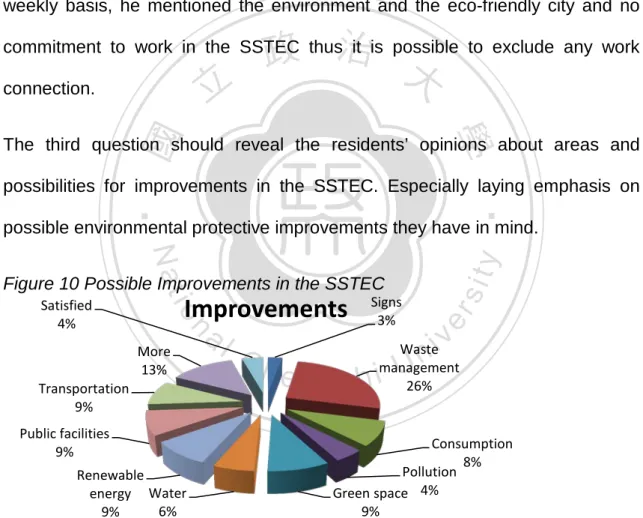
(17) There might be many different factors and aspects which are influencing or could influence the feasible outcome of the development of the eco-city, so it might be possible to select several different influential coefficients. Yet the research is just concentrating on some of them to get a more clear and detailed overview instead of a broad perspective which may address more different aspects but probably less specific and supportive content. This study will describe the terminology of Chinese state capitalism and its specific characteristics and influence and foster the development of the Tianjin. 政 治 大 the Chinese authorities 立 can draw on the mechanism of defining necessary. Eco-City. With support of the (unique) available possibilities and measurements. ‧ 國. 學. ecological standards and targets by themselves. If needed it is possible to alter and stretch requirements in either one direction: in order to improve the. ‧. standards and set higher target objectives or to reduce and adjust and achieve. y. sit. n. al. er. io. circumstances.. Nat. conditions which are more appropriate, feasible and comply with Chinese. Ch. i n U. v. The analysis of the used indicators in the eco-city might give a clearer view of. engchi. whether or not the used indicators for the eco-city are comparable on a national and international level and their possible influence on further research and development in the section of sustainable development. Furthermore another variable may be represented by the involvement process of the citizens in the eco-city and by ascertaining in how far this development might represent a pioneer project in this field of cooperation in China. This kind of integration process especially by including and involving citizen and possibly other (independent) actors could raise the opportunity to revisit certain weaknesses and enhance strong points in the construction process of the eco8.
(18) city 17 . Such an integrated approach may help to prevent critical detriment towards socio-economic aspects and the environment, support to classify and dissect the trajectories and lead to problem-solving measurements in a very early stage. Figure 1 Methodology Scheme. Indicator System Feasibility. 立. Source: Author’s Creation. State Capitalism. 治 政 Integration 大. ‧ 國. 學. The inquiries which were conducted in the eco-city should reflect and provide. ‧. an overview about the current situation. However they are able to present a perspective which differs from the data and information which is provided from. y. Nat. definitely is not represent the actual situation on site.. n. al. Ch. engchi. er. io. sit. official side and often only reflects perspectives of a finished construction and. i n U. v. Due to the fact that the detailed questionnaire which was originally planned would have needed the authorization and permission of some administrative bodies in the eco-city and possibly might have been declined, I decided to do a rather simplified version of questions to ask the citizens in the city about their impression and opinions towards the eco-city.. 17. Baeumler, Axel et al., Ed. Sustainable Low-Carbon City Development in China. The World Bank, 2012, ix.. van Dijk, M.P. “Chinese eco-cities, an integrated sectoral approach or an eco-cities approach?” Sixth Urban Research Symposium, 2012, 1-5.. Miller, Donald, and Gert d. Roo. Integrating city planning and environmental improvement: Practicable strategies for sustainable urban development. 2nd ed. Urban planning and environment. Aldershot, Hants, England, Brookfield, Vt: Ashgate, 2004.. 9.
(19) A total amount of 50 participants were questioned for this survey. I’m aware of the fact that the answers of the participants are only able to represent their subjective view of the eco-city and its development and therefore only vaguely serve as a representative survey for the whole eco-city. Nonetheless it makes it possible to observe some tendencies and interesting points of view of the project, which might be regarded as an evaluation of the on-site situation and circumstances of living in the Tianjin Eco-city at the time of August 2013. It should be mentioned that both inquiries by the staff at the Office for. 政 治 大 are working and living in立 the eco-city were handled with care and precaution. Environmental Affairs, the districts and other working facilities and citizens who. ‧ 國. 學. Several questioned persons were asking me if these inquiries would serve as an interview and survey. If that were the case they would decline to answer or. ‧. even mentioned to call the manager or other person responsible in dealing with. sit. y. Nat. an interrogator or this particular situation. This behavior is in consistent with. al. n. study.. er. io. some of the facts which will be mentioned later by referring to limitations of the. Ch. engchi. i n U. v. To obtain and gather information or doing an official survey by any institution always necessitates backup and authorization. The on the spot behavior suggests that it is not advisable for those people to give statements or interviews or even answer surveys. To contravene and act contrary to those probably unofficial “directives” might cause personal problems for both the respondent and the interrogator. The following explanation of the asked questions verifies that the inquiries to residents on the spot were made on a non-political basis which wouldn’t cause any problems.. 10.
(20) The participants were asked five different questions which were designed to cover essential factors of their living experience in the city. The first question should give some indication of the purpose of living and settling in the eco-city. Second, since when had the person moved into their residence? Next up was questioning whether or not there was scope for further improvements and what could be enhanced or optimized in order to guarantee the best possible outcome for the eco-city. The fourth question should clarify whether it would be possible for the residents to express their concerns and if they have the opportunity to raise questions and put forward their opinions. At the time of the. 治 政 survey the living situations and actual amount of大 permanent residents in the 立 eco-city was unclear, that was one of the reasons to include the fifth question. ‧ 國. 學. The purpose of the last question was to find out whether or not the residential. ‧. complex was adequately occupied and inhabited, which could provide. sit. y. Nat. information of the living and real estate situation in the eco-city at that time.. n. al. er. io. Some might argue that the last question is rather irrelevant in order to obtain a. i n U. v. valid objective view and opinion about the Tianjin Eco-city, but due to the fact. Ch. engchi. that it wasn’t possible to obtain current information about the housing occupancy in the eco-city it is interesting to see the housing situation from actual residents’ point of view instead of someone who is just stating data, especially due to the fact that several media reports are stating different numbers of residents which are not compatible with information provided in an self-conducted inquiry. Particularly when discussing the possibilities of scalable and exportable functionality beyond the Chinese boarders it might be an interesting approach. A successfully implementation of a grassroots participation or involvement of 11.
(21) residents participation could drastically improve the prestige and possibilities for other cities or regions to adopt the Tianjin Eco-City’s concept, implementation methods and acknowledging the expertise and evolvement of the project. 1.3.1 Timeframe. The Sino-Singapore Tianjin Eco-City is a project which is still under construction and just small parts of the whole city have been finished so far. The construction of the so-called start-up area has been completed whereas the. 政 治 大 eco-city is not finished yet, it is still possible to analyze the current process and 立 Eco-Business Park only partly has been built yet. Even though the rest of the. ‧ 國. 學. make predictions at the present stage. The construction of the city is organized in three development phases, of which solely the first phase has been. ‧. completed yet. As for now, the planned timeframe and calculations have been. n. al. er. io. strict planning and development conditions will be kept.. sit. y. Nat. respected. Nonetheless, further research is necessary in order to make sure the. Ch. engchi. i n U. v. 12.
(22) Chapter 2: Sustainable Development and State Capitalism “Sustainable development is development that meets the needs of the present without compromising the ability of future generations to meet their own needs”. 18 Sustainable development in our case applied to urban areas has to consider a well-balanced interaction and integration of environmental, economic and social factors. On the environmental level it is necessary to lower negative impacts on the environment, widen responsible use of resources, and raise environmental quality and safety. In order to provide sustainable development,. 政 治 大. the economy should strengthen and focus on long-term resilience, employment,. 立. competitiveness, fair distribution of resources, and the society should support. ‧ 國. 學. an equal distribution of resources among the people and make its contribution in accordance with enhancing health, security, education, cohesion, diversity. ‧. and quality of life in general. 19. sit. y. Nat. io. n. al. er. To succeed a city should meet the following three criteria:. i n U. v. provide a healthy living and working environment for inhabitants; furnish safe water, sanitary conditions, rubbish collection and disposal, drains, paved roads and other essential infrastructure for health and economic development; and remain in an 20 ecologically-balanced relationship with local and global ecosystems.. 2.1. Ch. engchi. History of Chinese Eco-Cities. Why is there a need for eco-cities in China at all? Looking back at Chinese history, cities used to be quite more ecological and environmentally friendly than recently. What has caused this change? Traditional Chinese philosophy, e.g. Fengshui and Daoism influenced city and settlement planning in an 18 19 20. Brundtland, Our common future. Roberts, Ravetz, George, Environment and the city, 18.. Satterthwaite, David. “Sustainable Cities or Cities that Contribute to Sustainable Development?” Urban Studies 34, no. 10 (1997): 1667–1691, 1670.. 13.
(23) environmental way which limited expanding industrial activities. Mao’s remodeling plans for cities in China caused the destruction of many traditional buildings and an approximation towards Western cities, thereby neglecting environmental concerns. 21 In 1985 the People’s Republic of China (PRC) had 297 cities, about 20 years later the size has more than doubled and increased to a total amount of 655 cities in the year 2007. Where there were only 50 cities with a population above 1 million in 1984, nowadays (2007) this sum has climbed up to 118 and 13 cities. 政 治 大. have a population above 4 million. 22. 立. Since Deng Xiao-ping started the economic reforms in the late 1970s China has. ‧ 國. 學. moved to the next period of large-scale spatial transformation projects. China started with development zones ( 開 發 區 ) in the 1980s, in the 1990s they. ‧. continued to build college towns (大學城), and since the 2000s eco-cities (生態. y. Nat. n. al. er. io. sit. 城) have become the main goal of the next round of transformation. 23. i n U. v. As a pioneer in the development of eco-cities in China, in 1986 the city of Yichun ( 伊 春 ). 24. Ch. engchi. in the Jiangxi province was the first to proposed eco-city. construction plans and test constructions. This was just the beginning which led to a rapid rise of cities proposing eco-cities development target goals. In the year 2011, 230 of the 287 prefecture-level cities (地級市) 25 (including the 11. 21. Chien, Chinese eco-cities, 177. Kasperczyk, N., U. Gehrlein, and M. Neef. “Comparative study of models and approaches of „Ecoprovinces an Eco-cities”.”, 2. 23 Chien, Chinese eco-cities, 174. 24 Huang, Guang-yu 黄光宇. “Zhongguo shengtai chengshi guihua yu jianshe jinzhan 中國生態城市規劃 與建設進展 [Evolution of Eco-city in China].” Urban Environment & Urban Ecology 2001, Vol. 14, No. 3: 6–8, 7. 25 Profectural-level cities are large and medium-size cities located between the status of a province and above a county. The governments of those cities are responsible and report on their work to the people’s congresses and their standing committees at the same level. 22. 14.
(24) direct-controlled-municipalities) put forward plans to reach and develop ecocities. Of those cities, 46.3% propose the establishment of “low-carbon cities”. Altogether, cities that have plans to implement either one or both developments (eco-cities or low-carbon cities) already sum up to 259 cities, representing 90.2% of all prefecture-level cities. 26 Because the number of cities has been rising and overcrowded and metropolitan areas become more common in recent years, prefecture-level cities and above currently account for more than 50 percent of the nation’s. 政 治 大. energy consumption, and for the CO2 production about 60 percent. 27. 立. Up to now most prefecture-level cities have stressed the development of eco-. ‧ 國. 學. city construction. This shows the willingness to build eco-friendly areas even though the incentives might differ from the ones in the western civilization.. ‧. Further and more detailed explanation will follow in later analysis.. sit. y. Nat. io. al. er. In 2010 the number of eco-cities had increased up to more than 230. Reports. n. published in 2011 state that about 80 percent of the prefecture-level cities. Ch. initiated at least one eco-city project. 28. 2.2. engchi. i n U. v. Singapore’s Involvement. Why is Singapore an ideal partner for this joint-venture project? What are the qualifications that which explicitly have convinced the Chinese government to start this project as a joint-venture, rather than an own project with just one China Internet Information Center. “China's Political System: VI. The Local Administrative System.” Accessed April 20, 2014. http://www.china.org.cn/english/Political/28842.htm. 26. 27. Li, Jingyuan, Weiping Sun, and Liu, Juke李景源, 孫偉平, 劉舉科. Zhongguo sheng tai cheng shi jian she fa zhan bao gao (2012) 中國生態城市建設發展報告 [The report on the development of China's eco-cities]. Di yi ban. Beijing: Shehui kexue wenxian chubanshe, 2012, 27.. Qiu, Baoxing 仇保興. “Cong lüse jianzhu dao ditan shengtaicheng 從綠色建築到低碳生態城 [From green building to low carbon eco-city].” Chengshi fazhan yanjiu 城市發展研究 2009, no. 16 (7): 1–11. 28 Chien, Eco-cities, 177.. 15.
(25) state mainly involved in the designing, constructing and implementing process? Either way it probably would have been possible to attract other foreign and national companies to share their knowledge and expertise for this undertaking. What where the incentives to include the Singaporean government in the whole process? In order to better understand this whole construction and working process it is necessary to get greater comprehension about the development of Singapore and specifically its construction and building sector. Singapore’s contribution towards investment in economic and environmental. 政 治 大. development isn’t something which just started in recent years. Deng Xiaoping’s. 立. open door and reform policy initiated foreign investment in China, and. ‧ 國. 學. Singapore was one of the first investors who thereby followed a strategy of long-term investments.. ‧ sit. y. Nat. Singapore sometimes is regarded as a representative model state because of. io. al. er. its flourishing and rapid economic and social development. Consequently it is. n. referred as a prestige project due to its unique combination of effective state. Ch. engchi. entrepreneurialism and the creating of a. iv n sustainable U. environment and. infrastructure. The limited available space and size as a city state and island country might also positively support this development. As sustainability is differently described and applied, it is quite vague to speak from factors which are only applicable to green technology or environmental factors. Howsoever Singapore managed to develop a field of innovations in the sector of urban conditions, constructions and lifestyles. Singapore has been quite successful in realizing several projects, such as the “garden city”, or. 16.
(26) subsidized housing, industrial estates, water resource management or waste (disposal) management and residences. 29 2.2.1 Singapore’s History. Since Singapore’s independence in 1965 some scholars feared that this cause unstable conditions due since then the country is governed by an one-ruling party system, a rather absolute authoritarian regime. This quite often has led to economic disruptions and corruptions in countries of the Third World. But Singapore’s success is stable and built on the government’s ability to suppress. 政 治 大. corruption, create an understanding of “national success”, transform civil. 立. services into agencies of development, and attract FDI by focusing on an. ‧ 國. 學. export-oriented industrialization. 30. ‧. Furthermore the land acquisition by the legislature, and the regulated and. sit. y. Nat. planned transportation infrastructure, all helped to maintain and improve. io. n. al. er. standards and competitiveness, with a strict budget covering the expenses.. i n U. v. Singapore’s expertise and know-how helped the country to promote and spread. Ch. engchi. their ideas on a more global scale, hence its one goal:. to share Singapore’s experience in public reforms and good governance with governments around the world to promote good governance and generate goodwill and cooperation across international borders.. 31. 29. Ong, Aihwa. “Introduction Worlding Cities, or the Art of Being Global.” In Worlding cities: Asian experiments and the art of being global. Edited by Ananya Roy and Aihwa Ong, 1–26. Chichester, West Sussex, Malden, MA: Wiley-Blackwell, 2011, 14. 30 Huat, Chua B. “Singapore as Model: Planning Innovations, Knowledge Experts.” In Worlding cities: Asian experiments and the art of being global. Edited by Ananya Roy and Aihwa Ong, 27–54. Chichester, West Sussex, Malden, MA: Wiley-Blackwell, 2011, 30. 31 Huat, Singapore as Model, 32. 17.
(27) Singapore’s bonds with China have been established at a quite early stage. Since 1992 municipal officers have been attending a special training program to learn the know-how and practices in city government in Singapore. The same applies for the state level with exchanges between the PAP and the CPC on a higher level basis. 32 In the early 1990s Deng Xiaoping already mentioned that not only does Singapore have a good social order, furthermore it has a strict management, experience to learn from in order to improve and surpass Singapore’s. 政 治 大. achievements. 33 then. China’s. 立 government. officials. have. undertaken. several. 學. ‧ 國. Since. measurements to replicate and transfer some of Singapore’s successful innovations and construction projects. Best known projects which besides. ‧. initiated joint-ventures between the Singaporean and Chinese government are. y. Nat. al. er. io. under construction Sino-Singapore Tianjin Eco-City.. sit. the Suchou Industrial Park started in 1992 and the initiated and still currently. n. v i n C Singapore’s China is keen to get a share of h e n g c hexpertise i U – referring to it frequently – particularly in constructing green buildings and green technologies, water treatment, public housing, waste management and other sectors which have enough scope for development. 34 Even though this work is specializing on analyzing environmental structures and the support by Singapore, certain similarities between the both countries. 32. 33. Goh, Chin L. “Young PAP 'school' takes a leaf from Communist youth.” The Straits Times, March 2, 2009, 25.. Kristof, Nicholas D. “THE WORLD; China Sees Singapore As a Model for Progress.” The New York Times, August 9, 1992. http://www.nytimes.com/1992/08/09/weekinreview/the-world-china-sees-singaporeas-a-model-for-progress.html (accessed April 23, 2014). 34 Lye and Chen, Eco-cities in East Asia, 35.. 18.
(28) identities and also the governmental structures cannot be denied. Singapore’s well-constructed and coordinated projects and control all rely on the one-partystate construction, similar to the Chinese government. State supervised and planned, the cooperation between both countries is of avail and of possible success due to its similar structures and adaptability to each other. The compatibility and cooperation between both countries will be discussed and analyzed in a later chapter. 2.3. Spatial Planning and Sustainability. 政 治 大 In 1992, the year of the United Nations Conference on Environment and 立. ‧ 國. 學. Development also called Earth Summit, the authors of the article Sustainable Cities are questioning that an environmental inspired approach would have. ‧. similar support and work and be applicable towards developing countries in. sit. y. Nat. terms of sustainability. Furthermore they mention that whether or not someone. io. al. er. is able to have access to resources is not important but rather “economic or. v. n. political factors which prevent poorer groups from obtaining them and from. Ch. organizing to demand them.” 35. engchi. i n U. Looking back as such statements it is true that some countries and regions are still lacking a political foundation and will as well as economic aid. Nevertheless more and more countries worldwide have slowly realized that economic growth is accompanied by an exploitation of the environment and the natural habitat. In order to make spatial planning become more sustainable, it is necessary to build indicators which create at least national standards and guidelines in order 35. Keiner, Marco. “Advancing Sustainable Development and its Implementation Through Spatial Planning.” In The future of sustainability. Edited by Marco Keiner, 211–29. Dordrecht: Springer, 2006, 221.. 19.
(29) to achieve a better orientation and concentration of the planning goals and trajectories. To follow a similar idea which Singapore is promoting through their housing program, it might be possible to make spatial planning more efficient in terms of creating a more environmentally friendly livelihood for humans and infrastructure. 2.3.1 Spatial Planning in China. Should China’s environmental ambitions be considered as praiseworthy conduct or are they ‘nothing but hot air’? Some scholars are still suspicious. 政 治 大. about the new trend and tendency towards environmental protection, high. 立. investments in green-technology and construction of eco-cities. For some of. ‧ 國. 學. them the “primary concern is economic growth rather than environmental. ‧. concerns”. 36. sit. y. Nat. Whether or not those efforts have either the intension to consistently reduce. io. al. er. negative impacts on the environment or solely create economic benefits and. v. n. growth, the fact is that the urbanization rate in China has already reached 50. Ch. engchi. i n U. percent and is steadily growing with an assumed rate of up to 70 percent until 2050. 37 Therefore it is necessary to find appropriate strategies and solutions. Sigmar Gabriel, Germany’s Vice Chancellor and Federal Minister for Economic Affairs and Energy, on a visit in China recently called the purpose of investing in sustainable and environmentally friendly development a “matter of survival” for the Chinese economy. 38. 36. Li, Essential Buildings, 5. Li, H., and L. Yu. “Chinese Eco-city Indicator Construction.” Urban Studies 2011, no. 18 (7): 81–86, 83. 38 Bundesministerium für Wirtschaft und Energie. “Gabriel wirbt für verstärkte Zusammenarbeit im Umwelt- und Energiebereich mit China.”. http://www.bmwi.de/DE/Themen/aussenwirtschaft,did=635842.html (accessed May 25, 2014). 37. 20.
(30) I wouldn’t go so far to say that it is a question of survival, but I have to admit that environmental problems in that region and especially in China cause severe health, environmental, social and economic problems; hence the mitigation of those ascendancies might also be seen as a chance for growth and improvement of the living standards. Traditional spatial (city) planning is focusing more on scales and masses with targeted measures on the development of the society, the economy and the natural, constructed and social environments in a certain region/area. The. 政 治 大. European Regional/Spatial Planning Charter from 1983 defines spatial planning. 立. as. ‧ 國. 學. geographical expression to the economic, social, cultural and ecological policies of society. It is … an administrative technique and a policy … directed towards a balanced. ‧. regional development and the physical organisation of space according to an overall 39. sit. y. Nat. strategy.. n. al. er. io. But it is important to widen this perspective and include factors which are taking. i n U. v. the use of resources and the use of energy, water, air, food etc. into account, to. Ch. engchi. conserve and maintain a stable equilibrium within and for the environment under the principles of an ecologic and responsible sharing and usage. There are many challenges when urbanization is taking place; hence it is required to prevent bureaucratic obstacles which meet the requirements, especially the nature of social-ecological diversity. Besides spatial proximity between communities, cities, city regions, the striking distance between citizens, the local government and the government has to stand the expectations in order to provide the above mentioned needs. Otherwise the project might be 39. Salvemini, Mauro, and Tomas Mildorf. “PLAN4ALL: The way INSPIRE Contributes to European Spatial Planning (170), 1.”. http://www.gsdi.org/gsdiconf/gsdi12/papers/170.pdf.. 21.
(31) successful on paper (meeting the environmental and economic demands), but the false front could cause more problems, resulting in a hostile environment for the people in the region, which are not gaining any profit of the planning program. Involvement and indirect participation was the successful path for the Singaporean development, this first has to be proven right in the case of China. Conventional Chinese city planning standards and requirements are regularized in the nation’s statutory Regulatory Plan. Because this plan has a limited scope (building coverage and height, plot ratio, green space coverage etc.). 40. it is. 政 治 大. doubtful that they might be applied towards the construction of eco-cities.. 立. It is necessary to analyze China’s national environmental standards as well as. ‧ 國. 學. the compiled performance indicators which are applied to construct eco-cities. Every eco-city, whether constructed in China or somewhere else in the world. ‧. has to meet different demands in order to fulfill its own needs or those who have. y. Nat. al. er. io. sit. been obligatorily prescribed by any national agency or ministry.. n. Urban and ecological sustainability might be set as a “place-dependent concept”. 41. Ch. engchi. , but the different concepts of. iv n low-carbon U. cities, eco-cities,. sustainable-cities or zero-carbon cities, all lack an international fixed definition. Eco-cities most often also meet the standards of low-carbon cities. To meet vague principles of guideline, the eco-city has at least to achieve “economic viability, environmental sustainability and social equity”. 42 Sustainability in Chinese cities wouldn’t be so hard to achieve, because providing a more efficient and sustainable substructure is not an issue. The. 40 41. 42. Yip, Planning for Eco-Cities in China, 5.. Pow, C. P., and H. Neo. “Seeing Red Over Green: Contesting Urban Sustainabilities in China.” Urban Studies 50, no. 11 (2013): 2256–2274, 2259.. ibid 2259.. 22.
(32) main issues are habits and customs and securing livelihoods. The way and process of how cities have developed during time is one of the main reasons that cities’ ability and need to develop sustainability has quite gone astray. It is the unsustainable lifestyles 43 (which in some terms is an imitation of some western habits and lifestyle, which also needed a long time to appeal to somebody’s conscience to change one’s own behavior) that is preventing a faster change and higher efficiency in moving Chinese cities to be managed and facilitated in a more sustainable way.. 政 治 大 change and producing success 立 in terms of sustainability is the responsibility of. Heikkila takes the line that one of the most important coefficients for making a. ‧ 國. 學. governments to take the lead, where policy intervention is inevitable. 44 There are several ideas and intentions on how to follow the suggestions and. ‧. improve the sustainability ratio in cities, regions and countries. The purpose of. y. Nat. io. sit. an urban sustainable development shouldn’t be the sole construction of an eco-. n. al. er. city or a sustainable city, the attention should be shifted towards the objective of. Ch. i n U. v. cities that are providing and advancing sustainable development within their own possibilities. 45. engchi. There is no right or wrong when it comes to analyzing possible projects and approaches in strengthening China’s ecological strategy towards a more sustainable, eco-friendly future.. 43. For example the fact to keep electronic devices (e.g. air conditioning system) until it really has to be replaced, otherwise it doesn’t matter how high the energy-consumption of an old device is as long as it is working it won’t be replaced. 44. Heikkila, E. J. “Three Questions Regarding Urbanization in China.” Journal of Planning Education and Research 27, no. 1 (2007): 65–81, 66ff. 45 Hardoy, Jorge E., Diana Mitlin, and David Satterthwaite. Environmental problems in an urbanizing world: Finding solutions for cities in Africa, Asia, and Latin America. Sterling, VA: Earthscan Publications, 2001, 360.. 23.
(33) 2.4. State Capitalism. It is necessary to understand the concept of state capitalism and its influence on the development and construction of projects in order to evaluate the development of the eco-cities in China in general and especially the building of the SSTEC. 2.4.1 The Roots of China’s State Capitalism. 政 治 大 Chinese social structure and the introduction of a capitalistic system. During the 立. It needs some explanations in order to gain a clearer comprehension of the. ‧ 國. 學. transition from the beginning of the 20th century until now China has undergone very impressive changes, both in terms of social and economic terms. Under. ‧. the rule of the Communist Party China (CPC) and Mao Zedong (毛澤東) typical. Nat. sit. y. Chinese traditions and structures have been erased or pushed into the. n. al. er. io. background. Where at the beginning of the 20th century still some kind of clan. i n U. v. rule and the tradition of clan ties were strong and prevailing, nowadays we don’t. Ch. engchi. see this kind of “family rule” (Jia tianxia 家 天 下 ). Instead of patrimonial bureaucracy the party bureaucracy has taken over and the country is governed by a single-ruling party (Dang tianxia 黨 天 下 ). 46 The socialistic system of planned economy was prevailing during the time of Mao’s rule over China. Furthermore he introduced the system of communes, which were responsible for the shift of traditional communities in villages into factory-like production units. Under the rule of Mao China was following a planned economy, even 46. Ku, Chung-hwa. “The "Spirit" of Capitalism in China: Contemporary Meanings of Weber's Thought.” In Chinese capitalisms: Historical emergence and political implications. Edited by Yin-wah Chu, 19–46. International political economy series. Basingstoke, Hampshire [England], New York: Palgrave Macmillan, 2010, 29.. 24.
(34) compared to Western counterparts rather more backward in development, but still with an average growth rate of four to five percent in most years after 1949 47 with a slowdown starting in the 1960’s which paved the way for the events to follow. But does the change towards the logical of capitalism in terms of the market in Chinese while at the same time adhering ideologically to the concept of socialism means that China completely shifted towards the idea of Western capitalism? Certainly not, the Chinese capitalism has some Chinese. 政 治 大. characteristics which distinguish it to the Western concept of capitalism.. 立. Deng Xiaoping (鄧小平) and his pragmatism and opening policy and reform. ‧ 國. 學. finally introduced the slowly transformation towards a more capitalistic market. ‧. orientation. Max Weber once stated that the Chinese might assimilate western capitalism 48, but the opposite occurred, institutional changes like “law, finance,. y. Nat. er. io. sit. monetary systems, trade, and organization of the enterprise” 49 were introduced. China is gradually improving its market mechanisms, i.e. enhancement of its. n. al. Ch. i n U. v. legal system, forwarding technological innovations and acquiring more know-. engchi. how and knowledge. But at the same time the ruling party its political regime and authority is still rather traditional and antagonistic to any change.. 47. Whyte, M. K. “A Sociological Perspective on China's Development Record.” paper presented at the conference Rule and Reform in the Giants: China and India Compared, Harvard University, 2007, 11,13. 48 Weber, Max. The Religion of China. New York: The Free Press, 1951, 248. 49. Ku, Spirit of Capitalism in China, 30.. 25.
(35) 2.4.2 Current Chinese State Capitalism. Some people argue that China didn’t adapt a Western way of capitalism, furthermore referring to a rather hybrid system. “China is both far away from socialism and far away from capitalism”. 50 There are some reasons why the Chinese system of capitalism still has special socialistic characteristics. Even though the in 2007 the Chinese Property Law has officially be passed by in the National People’s Congress (NPC) 51 , the. 政 治 大 the terms of property and whether or not they are classified as private. The 立. recognition of people’s private property it is still sometimes rather vague about. ‧ 國. 學. state’s involvement in enterprises’ business and the whole market processes are two constants which are interrelated, resulting in the possibilities for the. ‧. state to intervene and also control the distribution of projects, work flow and. io. sit. y. Nat. monitoring.. n. al. er. The property law in China was passed in 2007 in order to prevent further cases. Ch. i n U. v. of infringe and of land property, but the scope of this law has been restricted for. engchi. limitations in favor of the state. The issue of property rights issue is also one of political relations. Not only property law but also the state-owned enterprises (SOE) have an actual higher share of in the so-called private sector than official statements reveal or suggest. According to Huang Yasheng ( 黃 亞 生 ) 52 calculations made by the Organisation for Economic Co-operation and. 50. McNally, Christopher A., ed. “Conclusion : capitalism in the dragon's lair.” In China's emergent political economy: Capitalism in the dragon's lair. Edited by Christopher A. McNally, 228–44. Routledge studies in the growth economies of Asia 75. London, New York: Routledge, 2008, 231. 51 Zhonghua renmin gongheguo wuquanfa 中華人民共和國物權法 [Property Law of the People's Republic of 52. China]. 2007. http://www.gov.cn/flfg/2007-03/19/content_554452.htm (accessed June 14, 2014).. Head of the China Lab at the MIT Sloan School of Management and professor at the MIT. 26.
(36) Development (OECD) assume a private sector that accounts for 70 percent 53 of China’s GDP (2003) are not reflecting reality. The Chinese state is directly involved in drafting and implementing a framework for regulations and at the same time “remains directly involved in guiding transactions at the firm level”. 54. , it doesn’t surprise that many CEO’s. simultaneously hold positions in the CPC. It seems that the private and public ownership of some enterprises are following the lead of a converged guidance by the ruling party.. 政 治 大. But there is no doubt that the private owned enterprises, private property are. 立. becoming more present during the time and market institutions’ involvement. ‧ 國. 學. more relevant.. ‧. In order to understand the current situation and status of China’s state. sit. y. Nat. capitalism it is important to examine China’s “post-communist capitalism”. The. io. er. first phase (1978-89) of capitalism was introduced through Deng Xiaoping and. al. represents a rather “entrepreneurial capitalism” approach, including traditional. n. v i n C hmarket exchange, family production and those with e n g c h i U reduction of the rural-urban. income gap. Especially the Township and Village Enterprises (TVE) is representative for this epoch. The second phase may be categorized as “politicized capitalism” and characterizes the social and economic development between 1989 and 2003. Also called “state-led” capitalist development (Huang) its focus was huge amounts. of. investments. and. export-oriented. industrialization.. Causing. 53. Huang, Y. Capitalism with Chinese Characteristics: Entrepreneurship and the State. New York: Cambridge University Press, 2008, 277. 54. Nee, Victor, and Sonja Opper. “On Politicized Capitalism.” In On capitalism. Edited by Victor Nee and Richard Swedberg, 93–127. Stanford, Calif: Stanford University Press, 2007, 106.. 27.
(37) investments equal to 50 percent of the GDP, but at the same time the share of labor in GDP as well as the income of households declined a growth of inequalities between rural and urban regions and restructured welfare provisions, especially in the fields of education and health care. The last and newest phase of Chinese characteristics in capitalism is attributed with the term of “corporatist capitalism”. In 2002 with the takeover of a new political leadership new concepts and thinking were introduced. Previous government and President Jiang Zemin (江澤民) a politician from the elitist. 政 治 大. faction were replaced by President Hu Jintao (胡錦濤) also elitist and populist. 立. and then Premier Wen Jiabao (溫家寶). A new way of power-sharing was. ‧ 國. 學. established which was continued for all major positions and carried on with the. ‧. new leadership of President Xi Jinping (習近平) and Premier Li Keqiang (李克強) started in 2012. 55. sit. y. Nat. al. er. io. To put it simply the elitists may be regarded as promoter of a rather growth-,. v. n. export-oriented concept, while the populist section represents social harmony,. Ch. engchi. i n U. questions of inequalities, social equity and improvement of living conditions through welfare programs. Only time can tell whether or not the concept of state-capitalism will transform to a different form of capitalism in China in the future, but it seems that the current system and concept will prevail for at least one decade. The following Chapter will introduce China’s eco-cities characters, differences and present the basis of the research the Sino-Singaporean Tianjin Eco-City. 55. Szelényi, Iván. “Capitlism in China? Comparative Perspectives.” In Chinese capitalisms: Historical emergence and political implications. Edited by Yin-wah Chu, 199–223. Basingstoke, Hampshire [England], New York: Palgrave Macmillan, 2010, 218-220.. 28.
(38) Chapter 3: The Chinese Eco-Cities There have been many different concepts and approaches towards eco-cities. So what is an eco-city and where do the differences with other sustainable city complexes or constructions (low-carbon city, sustainable city) lie? 3.1. Definition of an Eco-City. Rodney R. White defines the eco-city as “a city that provides an acceptable standard of living for its human occupants without depleting the ecosystems and. 政 治 大. biochemical cycles on which it depends” 56, shifting the focus on the ecological. 立. preservation, preservation and actively support of an eco-system in which it is. ‧ 國. 學. build. He describes eco-cities as the “most durable kind of settlement that humans are capable of building”. 57. ‧. Most eco-city constructions in China can be categorized as “new development”. y. Nat. er. io. sit. projects, whereas especially in Europe and the USA eco-cities are dedicated to as expansion of urban area or retro-fit development projects.. al. n. v i n C h factors in order Eco-cities are dependent on several e n g c h i U to survive (which doesn’t mean that the project has to be successful, but still desirable) and fulfill its criteria. If the social-economic conditions and basis are not matched it is quite unimaginable to have a prosperous and ‘pioneering’ path as an eco-city or even attain prestige as a model city. A certain common sense and perspective towards living in an eco-friendly. environment, someone’s own sustainable behavior and responsibility, as well as input from a wide group of the society and sectors (stakeholders) including the 56. 3. 57. White, Rodney R. Building the ecological city. Cambridge, Boca Raton, FL: Woodhead; CRC Press, 2002, ibid, 11.. 29.
(39) local community might lead to the construction of a successful working eco-city project. Cities which fail to achieve necessary ecological requirements and also don’t meet socio-economic demands may not result in an eco-city. 58 [P]articipation of future residents will be required especially in relation to waste reduction and management, and to their willingness to use public transport or bicycles instead of a car.. 59. In order to obtain a greater improvement in eco-efficiency it requires a fundamental change in culture (behavior), the setup or extending of structure. 政 治 大 and newest). As a result forging of new partnerships and collaboration between 立 (institutions and agencies) and a boost in technology (using the most efficient. ‧ 國. 學. different entities (NGOs, public and private actors, governments) 60 , who probably haven’t cooperated in this setup before would help to affect every part. ‧. of society and assist the possibility of gaining the best result by implementing as. sit. y. Nat. many (human) resources as possible.. n. al. er. io. One of the problematics of this attitude is that many of the eco-cities which are. i n U. v. still under construction don’t meet the socio-economic conditions (e.g. in terms. Ch. engchi. of public environmental awareness) at the present, but might slowly change once the preconditions (strong support and cooperativeness by [governmental] agencies) are provided and people feel the need and develop a consciousness to deal with environmental matters in a different more protective and active way. 58. Wittig, Rüdiger. “Principles for Guiding Eco-City Development.” In Ecology, planning, and management of urban forests: International perspectives. Edited by Margaret M. Carreiro, Yongchang Song and Jianguo Wu, 29–34. Springer series on environmental management. New York: Springer, 2008.. “Eco-Cities – Sharing European and Asian Experiences in Sustainable Urban Management.”, 6.http://www.kas.de/wf/doc/kas_31856-1522-1-30.pdf?131115111336 (accessed June 3, 2014). 59. Ploberger, C. “Local solutions as an element in China's strategy for sustainability?” Local Economy 26, no. 5 (2011): 439–446, 442f. 60 Strigl, Alfred. “Science, Research, Knowledge and Capacity Building.” Environment, Development and Sustainability 5, no. 1 (2003): 255–273. van Dijk, Meine Pieter. “Three Ecological Cities, Examples of Different Approaches in Asia and Europe.” In Eco-city Planning. Edited by Tai-Chee Wong and Belinda Yuen, 31–50. Springer Netherlands, 2011, 47.. 30.
(40) 3.2. Chinese Eco-Cities: An Overview. The new national guideline of the ‘12th Five-Year Plan for National Economic and Social Development’ was passed by China’s National People’s Congress in March 2011, setting up the coming long-term policies and directives. This new plan emphasizes a higher concentration on the decrease of CO2 emissions per unit of GDP by 17 percent for 2015 and also lowering of energy intensity (per unit of GDP) by 16 percent until the same year. 61 Furthermore China’s long term plans include a reduction of carbon intensity of about 40 to 45 percent in. 政 治 大. the year 2020 (compared to 2005). 62 Additionally the Chinese government is. 立. following a new strategic policy for their key industries, replacing old, reputed. ‧ 國. 學. “pillar industries” with new “strategic and emerging” industries.. ‧. Table 1 China's New Strategy for Emerging Industries. n. er. io. sit. y. Nat. al. Ch. engchi. i n U. v. Source: 國務院通過加快培育和發展戰略性新興產業的決定 (“Decision on speeding up the cultivation and development of emerging strategic industries”) 63. Even though these changes are just a guideline and do not comprise any specific obligatory measurements, still they demonstrate China’s recognition of the current (environmental) problems, as well as an orientation towards a more. 61 62. Baeumler, Sustainable Low-Carbon City Development in China, xx.. KPMG China. “China's 12th Five-Year Plan: Energy - April 2011.”. http://www.kpmg.com/CN/en/IssuesAndInsights/ArticlesPublications/Documents/China-12th-FiveYear-Plan-Energy-201104.pdf (accessed June 1, 2014). 63 Guowuyuan tongguo jiakua peiyu he fazhan zhenglve xinxingchanye de jueding 國務院通過加快培育和發 展戰略性新興產業的決定 [Decision on speeding up the cultivation and development of emerging strategic industries]. 2010. http://www.gov.cn/ldhd/2010-09/08/content_1698604.htm (accessed May 23, 2014).. Lewis, Joanna. “Energy and Climate Goals of China's 12th Five-Year Plan.”. http://www.c2es.org/international/key-country-policies/china/energy-climate-goals-twelfth-five-yearplan (accessed June 1, 2014), 3.. 31.
數據
+7


相關文件
ADtek assumes no responsibility for any inaccuracies that may be contained in this document, and make no commitment to update or to keep current the information contained in
ADtek assumes no responsibility for any inaccuracies that may be contained in this document, and make no commitment to update or to keep current the information contained in
Similar to the last school year, schools that have undergone ESR or FI in 2018/19 are generally able to keep pace with trends in education development and cater for students’
- Settings used in films are rarely just backgrounds but are integral to creating atmosphere and building narrative within a film. The film maker may either select an already
Now, nearly all of the current flows through wire S since it has a much lower resistance than the light bulb. The light bulb does not glow because the current flowing through it
These activities provide chances for students to work on their own, to apply their economic concepts, to develop a critical attitude and, above all, to increase the interest of
• Contact with both parents is generally said to be the right of the child, as opposed to the right of the parent. • In other words the child has the right to see and to have a
此計劃主要包含一個以「智慧城市」為主題的專題研習展覽,再附以一系列的活動,其中包
