國立交通大學
外國文學與語言學研究所
碩士論文
中文移動事件中方向標記之限制及語意探討
The Distributional Restrictions and the
Semantic Range of Direction Markers in
Mandarin Motion Event
研 究 生:張瑋芩
指導教授:劉美君 教授
中文移動事件中方向標記之限制及語意探討
The Distributional Restrictions and the Semantic Range of Direction
Markers in Mandarin Motion Event
研 究 生:張瑋芩 Student: Wei-chin Chang
指導教授:劉美君 Advisor: Meichun Liu
國立交通大學
外國語文學系外國文學與語言學碩士班
碩士論文
A Thesis
Submitted to Institute of Foreign Literatures and Linguistics
College of Humanity and Social Science
National Chiao Tung University
in partial Fulfillment of the Requirements
for the Degree of
Master of Arts
July 2013
Hsinchu, Taiwan, Republic of China
中文移動事件中方向標記之限制及語意探討
學生:張瑋芩 指導教授:劉美君 外國語文學系外國文學與語言學碩士班
摘要
本研究以 Liu et al. (2012) 所提出的 Proto-motion Event Schema 為本,探討 中文移動事件中的方向標記之限制及語意探討。根據 Liu et al. (2012) 一文,中 文被視為擁有連動結構(serial verb construction)的語言,中文的移動事件更是 被進一步探討畫分為 Manner、Route、Direction、Endpoint、Deictic,將前人所 謂的 Path 深入細分為 Route、Direction、Endpoint 。換句話說,在一個中文移 動順序中,動詞可能包含一個或以上的語意成分,而由多重動詞組合而成的移動 事件通常會遵循一個由 Manner 到 Route 到 Direction 到 Endpoint 的線性結 構。 因此,本研究致力於探究中文移動動詞中方向標記(面、朝、向、往)的使 用情形。除了從方向標記各自的語法及語意差異深入探討之外,也將其整合 Liu and Chiang (2008) 所提出的「中文動詞語意網」之架構,對方向標記進一步做全 面階層性的分類。 本研究的完成提供了方向標記(面、朝、向、往)與以往不同的分析,彼此 的關係不再只是同義詞,而是各自擁有不同的表現,也對於 Liu et al. (2012) 所 提出的 Proto-motion Event Schema 提供了在方向標記上的解釋。
The Distributional Restrictions and the Semantic Range of Direction Markers in Mandarin Motion Event
Student: Wei-chin Chang Advisor: Dr. Meichun Liu
Graduate Institute of Foreign literatures and Linguistics National Chiao Tung University
Abstract
This paper probes into the the issue of Mandarin motion event by investigating the Direction markers in Proto-motion Event Schema proposed by Liu et al. (2012). According to Liu et al. (2012), Mandarin motion event is considered to be in a sequencial pattern or so-called a serial verb construction. It is defined by Liu et al. (2012) as having the following sequence: Manner, Route, Direction, Endpoint, and Deictic. The old notion of ‘Path’ is further categorized in Liu’s study into Route, Direction, and Endpoint. That is to say, verbs may encompass one or more of the semantic components in a motion sequence. A multi-morpheme motion event normally follows the linear order from Manner to Route to Direction to Endpoint. This study aims to investigate the Direction markers miàn 面, cháo 朝,
xiàng 向, and wǎng 往 in Proto-motion Event Schema proposed by Liu et al. (2012).
It also helps to explain the distinct behaviors of each Direction marker in Mandarin by investigating the syntactic and semantic differences and by the incorporating into a frame based analysis using the hierarchical structure proposed by Liu and Chiang (2008).
By offering the syntactic and semantic variations among each Direction marker, the study not only proposes the distinctions of miàn 面, cháo 朝, xiàng 向,
and wǎng 往, but also helps to expand the explaination of the behaviors of Direction markers in Proto-motion Event Schema.
致謝 從這篇論文的開始到完成,都必須歸功於許多人的鼓勵和幫助,沒有你們, 一個人孤軍奮戰不可能獨立做好這一切。 感謝指導教授劉美君老師總是細心的教導,讓我學習正確的研究態度,使我 在這三年的研究生涯受益良多。而當我遇到瓶頸,美君老師的鼓勵和指導讓我對 研究的熱忱不減反增,並且,老師總是適時的給予指正,讓我的論文在一次次的 修改上有更明確的方向。此外,感謝口試委員鄭縈老師及黃漢君老師在期末忙碌 之餘還抽出時間來檢視我的論文並提出寶貴的建議更提供了不同層面的想法,讓 我的論文架構可以更加完善。 再來,也要感謝交大外文系諸位師長、助理平時對我們的幫忙及照顧,還有 重要的 304 的研究夥伴,佳音學姐、孝勇、俞汶、幸珊、書平、睿良,在每一次 的討論上,大家都慷慨的分享自己的意見,遇到困難時,你們的鼎力相助,總在 我步履蹣跚時願意伸出雙手拉我一把,謝謝你們的陪伴,讓我度過這段有歡笑有 痛苦的時光。感謝在 SOC LAB 614 打工這兩年來認識的每一位同學,因為有你 們,讓我在研究所的日子更加多采多姿。 最後將我最大的感謝獻給我最愛的家人,感謝爸爸張蘊五及媽媽徐淑滿,謝 謝你們總是支持我的決定,做我堅強的後盾,從未給我壓力,讓我無後顧之憂, 安心的完成論文;感謝弟弟張喻荃,總是照顧我的生活並在閒暇之餘帶我到處玩 樂。謝謝我的家人們給予的支持及包容,有你們的愛與關懷讓我覺得自己是最幸 福的人,我愛你們。 這份論文得以順利完成,需要再次感謝曾經陪伴我、協助我的所有人,再次 獻上無盡的感謝,也在此將完成論文的這份喜悅分享給你們。
Table of Contents
Chapter 1 Introduction ... 1
1.1 Background ... 1
1.2 Issue ... 2
1.3 Scope and Goal ... 4
1.4 Organization of the Thesis ... 5
Chapter 2 Literature Review ... 6
2.1 Motion Event ... 6 2.2 Direction Markers ... 9 2.2.1 Prepositions ... 10 2.2.2 Coverbs ... 15 2.2.3 Verbs ... 17 2.3 Summary ... 17
Chapter 3 Data Base, Theoretical Framework, and Methodology ... 18
3.1 Data Base ... 18
3.2 Theoretical Framework ... 18
3.2.1 Frame Semantics ... 18
3.2.2 Deictic-Incorporated Proto-Motion Event Schema ... 19
3.3 Methodology ... 21
Chapter 4 Findings ... 24
4.1 Distributional Patterns ... 24
4.2 Collocational Tendency ... 26
4.2.1 Preverbal vs. postverbal use of Direction markers ... 26
4.2.1.1 Preverbal use of Direction markers ... 28
4.2.1.2 Postverbal use of Direction markers ... 31
4.4 Summary ... 34
Chapter 5 Analysis ... 35
5.1 Conceptual Schema of Direction Markers ... 35
5.2 Synonymous Comparisons... 43
5.2.1 Distinction of 向 NP vs. 往 NP ... 43
5.2.2 Distinction of 往 NP vs. 到 NP ... 46
5.2.3 Distinction of preverbal vs. postverbal use of Direction markers ... 51
5.3 Lexical Status of Direction Markers ... 57
5.4 Frame-based hierarchical structure ... 60
5.4.1 Layer 1: Archiframe (Self-initiated Motion Frame) ... 63
5.4.2 Layer 2: Primary frame ... 65
5.4.2.1 Path Primary Frame ... 66
5.4.3 Layer 3: Basic Frame ... 68
5.4.3.1 Direction Basic Frame ... 69
Chapter 6 Conclusion, Significance, and Future Research ... 71
6.1 Conclusion ... 71
6.2 Significance of the Study ... 72
6.3 Future Research ... 73
References ... 74
List of Tables
TABLE (1):EIGHT POSSIBLE COMBINATIONS PROPOSED BY CHEN AND GUO (2009) ... 7
TABLE (2):FOUR MAJOR CLASSIFICATIONS OF PREPOSITIONS PROPOSED BY XU (1991) ... 14 TABLE (3):THREE GROUPS FOR THE DISTRIBUTIONAL PATTERNS FOR DIRECTION ... 25
TABLE (4):DISTINCTION OF PREVERBAL VS. POSTVERBAL USE OF DIRECTION MARKERS
... 26 TABLE (5):TENDENCIES OF NPS IN PREVERBAL VS. POSTVERBAL STRUCTURE ... 54
List of Diagrams
DIAGRAM (1):SCALE STRUCTURE PROPOSED BY RAPPAPORT HOVAV AND LEVIN (2010)
... 8
DIAGRAM (2):DEICTIC-INCORPORATED PROTO-MOTION EVENT SCHEMA IN MANDARIN PROPOSED BY LIU ET AL.(2012) ... 20
DIAGRAM (3):CONCEPTUAL SCHEMA OF MIÀ N 面 ... 37
DIAGRAM (4):CONCEPTUAL SCMEMA OF CHÁ O朝 ... 38
DIAGRAM (5):CONCEPTUAL SCHEMA OF XIÀ NG向 ... 41
DIAGRAM (6):CONCEPTUAL SCHEMA OF WǍNG往 ... 42
DIAGRAM (7):CONCEPTUAL SCHEMA OF V+ 往 AND V+ 到 (LIN 2007) ... 50
DIAGRAM (8):THE CONCEPTUAL SCHEMA OF THE PMS ... 51
DIAGRAM (9):PREVERBAL VS. POSTVERBAL USE OF DIRECTION MARKERS ... 52
DIAGRAM (10):MOTIONAL DEGREE SCALE OF DIRECITON MARKERS ... 58
DIAGRAM (11):LEXICAL STATUS SCALE OF DIRECTION MARKERS ... 59
DIAGRAM (13):THE CONCEPTUAL SCHEMA OF MOTION... 60
DIAGRAM (14):FRAME RELATION UNDER SELF-INITIATED MOTION FRAME ... 62
DIAGRAM (15):PRIMARY FRAMES UNDER SELF-INITIATED MOTION ARCHIFRAME ... 65
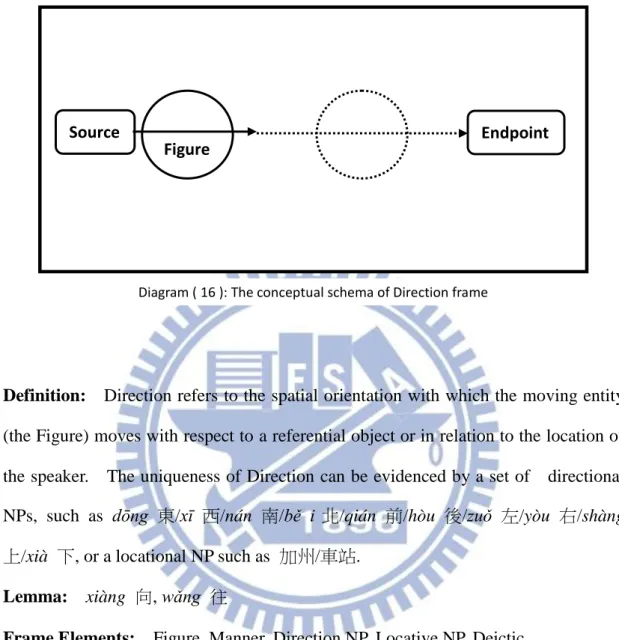
DIAGRAM (16):DIRECTION BASIC FRAME UNDER PATH PRIMARY FRAME ... 68
1
Chapter 1
Introduction
1.1 Background
The concept of motion has always been widely discussed in Linguistics through many decades. And especially, the issue of motion event in Mandarin has been one of the main focuses of modern linguistic discussion since Mandarin has been considered to be an isolating language because it has relatively simple morphology (Li and Thompson 1981, Norman 1988, among others). In FrameNet, an online dictionary providing evidence for the use of English vocabulary (Fillmore 1976), motion has been defined as:
‘Some entity (Theme) starts out in one place (Source) and ends up in some other place (Goal), having covered some space between the two (Path). Alternatively, the Area or Directionin which the Theme moves or the Distance of the movement may be mentioned.’
But in reality studies on motion event in many languages have to cover more than that. There have been plenty of perspectives focusing on the study of motion event and lots of attention has been paid to it. In an earlier study by Talmy (2000), languages around the world can be basically classified into either a satellite-framed language or a verb-framed language. Mandarin, based on Talmy’s theory, has been classified into a satellite-framed language. In his discussion of motion event, Talmy argues that the basic motion event consists of four major
2
components: Motion-Manner, Path, Figure, and Ground.
Motion event in Mandarin has been discussed in great detail in Liu et al. (2012). According to Liu, Mandarin motion event is considered as a sequential pattern and is thus so-called serial verb construction. In Liu et al. (2012), motion is well-defined into such sequence: Manner, Route, Direction, Endpoint, and Deictic. Interestingly, an old notion of ‘Path’ is distinguished in Liu’s study into Route, Direction, and Endpoint. The new and independent meaning for Direction and Endpoint can thus be realized individually in different Mandarin motion events.
In light of the theory of Liu et al. (2012), this study starts with the following research questions: 1) what is the identification of the conceptual component of Direction markers in relation to Mandarin motion event? and 2) how to account for the distributional patterns of each Direction marker based on how they display semantically and syntactically?
1.2 Issue
This paper explores the semantic behavior of Direction markers in the Proto-Motion Event Schema proposed by Liu et al. (2012). The schema integrates and linearizes specific semantic components that are essential for the morphological composition of motion verbs. Based on this conceptual schema, the current study aims to further investigate the distributional patterns in each directional marker.
miàn 面 , xiàng 向 , wǎng 往 , and cháo 朝 are a group of marker
3
each other. In Mandarin, there are some permissible alternations between different directional markers as long as they are compatible in their meanings. The examples are provided as follows:
(1) 你看見竿子[*面/朝/往/向/]你來了
nǐ kàn jiàn gān zi [* miàn/ cháo/ wǎng /xiàng ]nǐ lái le
You see pole face you come ASP. ‘You saw the pole comes toward you.’
(2) 我由窗邊[*面/朝/往/向]外看
wǒ yóu chuāng biān [* miàn/ cháo/ wǎng /xiàng ] wài kàn
I from window-side face outside look ‘I look out through the widow.’
(3) 像往常那樣斜倚著被垛臉[面/朝/*往/*向]門
xiàng wǎng cháng nà yang xié yǐ zhe bèi duǒ [miàn/ cháo/* wǎng /*xiàng ]mén
Like usual lean ASP stove face face door ‘To lean on the stove and face to the door.’
(4) 他的頭髮也是[*面/朝/*往/向]上立著的 (Google, 2013/01/19)
tā de tóu fǎ yě shì [*miàn/ cháo/* wǎng /xiàng ]shàng lì zhe de
3sg hair as-well face up stand ASP DE ‘His hair is standing up as well.’
In addition, among the four markers, only wǎng 往 and xiàng 向 are allowed to put Manner of verbs in front of them, while Manner of verbs have to
4
follow miàn 面 and cháo 朝 as a use of modifier of the location. Meanwhile, only
miàn 面 has the uniqueness to be followed by the static posture verbs such as zuò 坐
and tǎng 躺. Examples are given below:
Manner + 往/向, e.g., 飛往/向 locative NP
(5) 許多夏候鳥正展翅 [飛/Manner] [向/Direction marker] 臺灣
xǔ duō xià hòu niǎo zhèng zhǎn chì fēi xiàng tái wān
Many summer migratory-bird fly face Taiwan ‘Many migratory birds are flying toward Taiwan.’
朝/往/向 locative NP + Manner, e.g., 朝/往/向 locative NP 飛 (6) 鴿子也成群結隊[往/Direction marker]天空[飛/Manner]
gē zi yě chéng qún jié duì wǎng tiān kōng fēi
Pidgin also gathered go-toward sky fly
‘The pidgins gathers together to fly toward the sky.’
1.3 Scope and Goal
The scope of this study is limited to Direction markers in Proto-motion Event Schema proposed by Liu et al. (2012). It aims at investigating markers that introduce directional NP, including miàn 面, cháo 朝, xiàng 向, and wǎng 往. By the observation and investigation, only Direction markers modifying directional NP and the sentence order is in consistence with the motion sequence Manner, Route, Direction, Endpoint, Deictic (Liu et al. 2012) are mainly considered. Only the pure Direction markers which follows the sequence of Proto-motion Event Schema will be further investigated by a frame-based analysis using the hierarchical structure
5
proposed by Liu and Chiang (2008). The markers in question are xiàng 向 and
wǎng 往 in a postverbal sequence.
The purpose of this paper is to investigate the variation of each Direction marker in Mandarin motion event and provide their syntactic and semantic differences in detail and finally incorporate into a frame-based analysis. The following questions will be discussed:
1) What are the distributional patterns of these Direction markers?
2) What is the syntactic and semantic difference between those Direction markers?
3) How can Direction markers fit into a frame-based analysis?
1.4 Organization of the Thesis
This paper is sequenced in such a way where the background information will be introduced in the first chapter, then followed by the review of the literature in the second chapter. The third chapter will illustrate the database, theoretical framework and methodology. The distributional patterns of the markers will be presented in the forth chapter, the findings of which are also what motivate this study. The fifth chapter proposes a frame-based analysis to give a closer look into the near-synonymous Direction markers so as to be wrapped up by the last chapter which points out the theoretical limitations for future study.
6
Chapter 2
Literature Review
2.1 Motion Event
The issue of motion event in Mandarin has been one of the focuses of modern linguistic discussion. According to the definition in FrameNet, it is defined as a situation where some entity (Theme) starts out in one place (Source) and stops at another place (Goal) to create a spatial route between the two places (Path). However, numerous studies on motion event have studied this subject from plenty of perspectives. An earlier study by Talmy (2000) proposed that a language is either a satellite-framed language or a verb-framed language. Mandarin, in his point of view, is classified into a satellite-framed language. There are elements in motion event that can be separated into those within the domain of meaning and those within the domain of surface expression. Talmy argues that the basic motion event consists of four major components: Motion-Manner, Path, Figure, and Ground.
Chen and Guo (2009), adopting from Talmy’s work, provided another point of view of the combination from the semantic components in Mandarin:
(1) Manner: the way in which a figure carries out a motion
(2) Path: the trajectory over which a figure moves, typically with respect to another reference object (i.e., the ground)
(3) Deictic: path relative to the speaker
7
other two elements. Thus, they also proposed the eight possible combinations of patterns with Motion, Path, and Deictic in Mandarin, which are Manner, Path, Deictic, Manner + Path, Manner + Deictic, Path + Deictic, Path + Path, Manner + Path + Deictic. Examples are shown and illustrated below:
Table ( 1 ): Eight possible combinations proposed by Chen and Guo (2009)
Still, a recent study proposed by Rappaport Hovav and Levin (2010) suggests that in the domain of motion events, there is a scale implied in the dimension of a distance, which is from the figure with respect to the ground. A scale consists of a set of contiguous locations forming a path and is instructed with a direction of movement at the same time. The following diagram as proposed by Rappaport Hovav and Levin (2010) classifies the English motion verbs based on the scale structure:
8
Diagram ( 1 ): Scale structure proposed by Rappaport Hovav and Levin (2010)
However, as far as many related studies are concerned, motion in Mandarin is usually considered as a sequential pattern and thus is so-called serial verb construction. Lin (2011) stated that Mandarin allows two or more verbal morphemes to occur together in a sentence as a construction and is commonly expressed as multi-morpheme constructions. For example, in (1), the two verbal morphemes zǒu 走 and huí 回 occurs together to form the construction zǒu huí xué xiào 走回學校.
(1) 我一路茫然地走回學校 (Lin 2011)
wǒ yí lù máng rán de zǒu huí xué xiào
I all-the-way vacantly walk back school ‘I walked back to school vacantly.’
In addition, in Liu et al. (2012), the traditional definition of ‘Path’ in many earlier studies is further discussed and separated into three components: Route (the contour of moving), Direction (spatial orientation), and Endpoint (final point of the contour). Liu proposes that a motion event may be conceptualized into a notion of motional contour or a way of journey. A motion event may consist of a chosen
9
Manner, via a certain Route, in a given Direction, towards a targeted Endpoint and finally approaches the Destination (or Locus), possibly with a further specification of Deictic orientation. The definitions of components in the Proto-Motion Event Schema are illustrated as follows:
(1) Manner: the way the motion is carried out
(2) Route: the contour along which the motion progresses (3) Direction: the particular spatial orientation of the path (4) Endpoint: the projected final point of the path
(5) Deictic: specify the speaker-oriented perspective allowed in Mandarin
An old notion of ‘Path’ is thus distinguished, creating a new and independent meaning for Direction and Endpoint that can be realized individually in different Mandarin motion events.
2.2 Direction Markers
In the recent literatures, the definitions of Direction markers have been treated in many different ways. For example, as many studies have found, many scholars preferred to classify some Direction markers as prepositions (Liu 1996, Xu 1991, Feng 1999). Some others believed that some Direction markers are used as verbs since they believed that all the original meaning starts from verbs (Chao 1968, Wang 2004). Meanwhile, Li and Thompson (1981) provided another explanation for the different behavior of Direction markers as either prepositions or verbs. They are defined as coverbs. Similar to Li and Thompson (1981), in Lu (1999)’s analysis,
10
cháo 朝, xiàng 向, and wǎng 往 are classified clearly into two categories. That is,
they can all be either a verb or a preposition with different meanings and usages. In the category of verb, cháo 朝 is more like xiàng 向 which both means duì zhe 對著 ‘to face toward’ while wǎng 往 is different from the two which means qù 去 ‘go’. However, in the category of preposition, all of them tend to share the similar meaning which points out the direction for the movement and collocate with directional noun and locational noun that are used in front of the main verb. The following sections introduce the different point of views from scholars that take Direction markers in a different perspective including prepositions, coverbs, and verbs.
2.2.1 Prepositions
Many studies regard miàn 面 , cháo 朝 , xiàng 向 , and wǎng 往 as prepositions. Scholars believed that it is not easy to define prepositions since preposition may contain many different meanings in some cases. Some previous studies choose to take Direction markers as prepositions and provide some classifications based on the behaviors of those markers. First, Chao (1968) argued that cháo 朝 and xiàng 向 have the characteristics of both verb and preposition while wǎng 往 is the same as wàng 望 since wǎng 往 should be originated from
wàng 望 in Mainland China Mandarin. In his analysis, he focused more on cháo
朝 and xiàng 向 in the chapter of prepositions in his book such as cháo nán zǒu 朝 南走 ‘walk toward south’, cháo hòu tóu kàn kàn 朝後頭看看 ‘look backward’,
xiàng yòu kàn 向右看 ‘look right’, etc.
11
Liu et al. (1996) regards cháo 朝, xiàng 向 and wăng 往 as spatial prepositions. One of the distinctions suggested by Liu is that prepositions are not allowed to be followed by aspectual markers. However, a closer look into corpus data suggests a different story. While *wăngzhe 往著 is rarely found, cháo 朝 and xiàng 向 with aspectual marker zhe 著 is found in data. What is more, [向 + 著 Aspect] is
commonly found and semantically distinguishable from the use of xiàng 向 alone in marking a direction. It thus indicates that 朝, xiàng 向 and wăng 往, show distinct grammatical and semantic behavior.
Third, the functional differences of xiàng 向, wăng 往, and cháo 朝 as interpreted by Liu (2007) suggested that they are prepositions and are grammaticalized from verbs. In Liu’s point of view, xiàng 向, wăng 往, and cháo 朝 are a group of preposition modifying directions that are semantically distinguishable but still are connected with each other. In Mandarin, there are some permissible alternations between different directional markers as long as they are compatible in their meanings. For instance, xiàng 向, wăng 往, and cháo 朝 can be used as modifiers of motion verbs as illustrated in the following examples (Liu 2007):
(2) 默默地往前走 (Liu 2007)
mò mò de wǎng qián zǒu
Silently WANG front walk ‘Go forward silently.’
12
(3) 朝陳佐千身上細細地灑過了
cháo chén zuǒ qiān shēn shàng xì xì de sǎ guò le
CHAO Chen-Zuoqian body carefully spray ASP. ‘Carefully sprayed toward Chen Zuoqian’s body.’
(4) 將他向天空扔去
jiāng tā xiàng tiān kōng rēng qù
Jiang 3sg XIANG sky throw Deictic ‘Throw him toward the sky.’
The wǎng 往 , cháo 朝 , and xiàng 向 in sentences above can be substituted with each other as modifiers of motion verbs. However, only xiàng 向 and cháo 朝 can modify non-motion verbs but not wǎng 往. Examples are shown below (Liu 2007): (5) 向上豎著 (Liu 2007) xiàng shàng shù zhe XIANG up upright ‘Stand upright.’ (6) 朝著衛生間喊了一聲
cháo zhe wèi sheng jiān hǎn le yì sheng
CHAO Asp. toilet yell Asp. sound ‘Yell toward the toilet.’
13
each other by modifying non-motion verbs but wǎng 往 is not permissible in this case. It can be postulated that the uniqueness of wǎng 往 is the fact that wǎng 往 inherently encodes some kind of movement. However, in Liu’s examples, the definition of motion is unidentified since sǎ 灑 ‘spray’ in (3) cháo chén zuǒ qiān
shēn shàng xì xì di sǎ guò le 朝陳佐千身上細細地灑過了 ‘Carefully sprayed
toward Chen Zuoqian’s body.’ may not be understood as a motion event. Still, the study in Liu (2007) pointed out the distinctions worth noticing between these two Direction markers.
Xu (1991) stated that there are five types of prepositions: 1. Temporal Preposition, 2. Locational Preposition, 3. Causal Preposition, 4. Manner Preposition, and 5. Primary and Secondary Preposition. cháo 朝, xiàng 向, and wǎng 往 are included in the second type. The second type of classification includes zài 在, cóng 從, dào 到, zhí 直, zhí dào 直到, dào dá 到達, shàng 上, xià 下, dǎ 打, dǎ cóng 打從, cháo 朝, cháo zhe 朝著, duì 對, duì zhe 對著, xiàng 向, xiàng zhe 向著,
chōng 衝, shun 順, kào 靠, wǎng 往, wàng 望, tóu 投, yán 沿, jīng 經, jīng guò
經過, āi 挨, jiē 接, jiù 就, jiù zài 就在, gēn suí 跟隨, gēn cóng 跟從, suí cóng 隨 從, …etc. Second, Feng (1999) defined the function of a preposition as introducing a noun or a noun phrase. That is, a preposition is followed closely by a noun. He believed that prepositions share some characteristics of verb. For example, both prepositions and verbs convey actions and both prepositions and verbs carry objects. Such characteristics led prepositions to be called as coverbs. However, Feng chose to simply use the behavior of prepositions and give prepositions four major classifications. Examples are given as follows:
14
a. 目的、原因介詞 為、替、由於、因
b. 範圍、對象介詞 關於、對、至於、連、把、將、被、叫、讓、給、除、比 c. 時間、方位介詞 當在、自、從、自從、往、到、向、朝
d. 方法、手段介詞 用、拿、依照、按照、遵照、憑、通過、經過
Table ( 2 ): Four major classifications of prepositions proposed by Xu (1991)
Feng also believed that the differences between prepositions and verbs are, first, a preposition is not allowed to be with Aspectual markers le 了, zhe 著, guò 過; and second, preposition cannot reduplicate by itself. The difficulty of defining a preposition and a verb as explained by Feng stated that if there is no other verb in a sentence, the preposition becomes a verb. For example, in (1b), the main verb is 去 while dào 到 becomes a preposition. While in (1a), there is no other main verb in the sentence, dào 到 thus becomes the main verb. Example (2) shows the same pattern.
(7) a. 我到過上海 (Verb) (Xu 1991)
wǒ dào guò shàng hǎi
I arrive Asp. Shanghai ‘I have been to Shanghai.’
b. 我到上海去 (Preposition)
wǒ dào shàng hǎi qù
I arrive Shanghai Deictic ‘I went to Shanghai.’
15
(8) a. 大門朝南 (Verb)
dà mén cháo nán
gate face south
‘The gate faces south.’
b. 大門朝南開 (Preposition)
dà mén cháo nán kāi
gate face south open
‘The gate opens facing south.’
However, not all the preposition can be transferred this way into a verb. The explanation is thus not enough to define and demonstrate such similarity between some unique set of words.
2.2.2 Coverbs
Coverbs are group of words derived from verbs. As Yin (2004) stated that most of such grammaticalization observed in Mandarin are said to be one-directional from the major category—verb to the minor category—preposition. In order to define and distinguish these types of deverbalized words, a new term—coverb was created to refer to them. Even though Chao (1968) mentioned the usage of coverbs such as cháo 朝 in two structures, e.g., zhè wū zi cháo dōng 這屋子朝東 ‘the house faces east’ and cháo dōng zǒu 朝東走 ‘walk toward east’, the definition may still need to be clearly identified. The word coverb can be traced back to Defrancis (1946) as adopted by Chao. Li and Thompson (1981) defined Direction markers
16
cháo 朝, xiàng 向, wǎng 往 as coverbs and gave a more detailed explanation to the
word coverb. The function of a coverb to introduce a noun phrase and the phrase formed by the coverb plus the fact that the noun phrase precedes the main verb and follows the subject or the topic (Li and Thompson, 1981) is demonstrated here below:
Subject/topic coverb + noun phrase verb
Examples are provided as follows:
(9) 他朝東站著 (Li and Thompson 1981)
tā cháo dōng zhàn zhe
3sg face east stand DUR ‘He is standing facing east.’
(10) 他朝南拜
tā cháo nán bài
3sg facing south worship ‘He worships facing south.’
Coverbs, based on the definition of Li and Thompson (1981), function as prepositions. That is to say, a coverb and the following noun form a phrase to modify the verb of a sentence. This provides a clear distinction between coverbs and prepositions. The reason to call them coverbs rather than prepositions is that coverbs contain words that are partially like verbs and partially like prepositions. The characteristics of coverbs are inseparable with verbs and prepositions since some of the coverbs are derived from verbal usages (Li and Thompson 1981, Xing 2003,
17
Wang 2004).
2.2.3 Verbs
Wang (2004) regarded wǎng 往 as a verb and compared the semantic behavior of wǎng 往 with other semantic-related verbs including synonyms such as
zhī 之, shì 適, rú 如, and other antonyms in ancient Mandarin. She argued that wǎng 往 semantically encodes the meaning of dào…qù 到…去 ‘go and arrive at
somewhere’. That is, the basic meaning of wǎng 往 includes an unspecified destination. What makes wǎng 往 different from other synonymous verbs is whether the destination is encoded in the verb. Thus, wǎng 往 does not need to be followed by any other destination since it has already been encoded in the verb wǎng 往. In addition, wǎng 往 emphasizes on the approach from the point near the speaker to the point away from the speaker, while rú 如 only emphasize on the destination that follows it.
2.3 Summary
It is believed that xiàng 向, cháo 朝, wǎng 往 have the usage of both verb
and preposition according to the above literatures. Following this consideration, the goal of the study aims to explore the following questions: 1) to identify the conceptual component of Direction markers in relation to the motion event in Mandarin; and 2) to account for the distributional patterns of Direction markers based on how they display semantically and syntactically. The following section introduces the data base used in this study, the theoretical frame work, and the methodology adopted in this paper.
18
Chapter 3
Database, Framework and Methodology 3.1 Data Base
The data used in this study is mainly based on the corpus data from Academia Sinica Balanced Corpus of Modern Mandarin Chinese (Sinica Corpus) (http://db1x.sinica.edu.tw/kiwi/mkiwi/). The second database is Chinese Word Sketch (http://wordsketch.ling.sinica.edu.tw/), a powerful database providing vast amount of data for researchers to investigate the grammatical behavior of each Direction marker. The third database is Google search (http://www.google.com.tw/) and it provides the most up-to-date data that can be found here.
3.2 Theoretical Framework
There are two theoretical frameworks that are adopted in this study. First, Frame Semantics as proposed by Fillmore and Atkins (1992). Second, Deictic-incorporated Proto-motion Event Schema as proposed by Liu et al. (2012). The two theoretical frameworks are adopted to establish a frame-based and corpus-based analysis to the study of Direction markers in Mandarin.
3.2.1 Frame Semantics
Frame Semantics is a research that emphasizes the representation of a word. Fillmore and Atkins (1992) propose that a word links to a categories of experiences. That is to say, a word activates a semantic frame. The earliest notion of Frame
19
Semantics can be found in Fillmore (1968). In Fillmore (1968), he proposed a case frame which means that the most important element of a verb is its semantic roles. The famous example provided in Fillmore and Atkins (1992) is the Commercial Transaction Frame. For example, a commercial transaction frame evokes elements including a buyer, a seller, goods, and money. However, not all these elements are core. Verbs in this group of frame including buy, sell, pay, spend, etc. Different verbs activate different elements in a group. For instance, the verb buy emphasizes the buyers and the goods while sell focuses on the seller and the goods. The concept of Frame Semantics is that knowing a verb of frame means knowing what the elements to take place in a certain situation. That is to say, to describe a verb in an event thoroughly, it is a must to know its grammatical properties, elements of the frame, and which elements are necessary and which are not. Each frame has its own core frame elements and the profiled1 frame elements to help distinguish the syntactic behavior of each verb. By the observation of the syntactic-semantic correlations, the core meaning of each verb can thus be distinguished.
3.2.2 Deictic-Incorporated Proto-Motion Event Schema
In order to account for the previous concerns, the study mainly adopts the Proto-Motion Event Schema by Liu et al. (2012) as a cognitive basis in identifying the
1 Langacker (1988) proposes the conceptual different prominences in the same structure with different
profiled portion. For example, the following diagram includes the base meaning of husband and wife, the profiled meaning of Husband, and the profiled meaning of Wife. As in the diagram, the base meaning of husband and wife is equally the same with a male and a female. The differences show in both Husband and Wife meanings. Male is profiled in Husband while female is profiled in Wife.
Base Husband Wife
20
semantic range of the directional markers miàn 面, cháo 朝, wǎng 往, xiàng 向 in the motion event of Mandarin. The diagram below shows the Proto-Motion Event Schema providing a closer look into the motion event in Mandarin:
Diagram ( 2 ): Deictic-incorporated proto-motion event schema in Mandarin proposed by Liu et al. (2012)
Based on the diagram above, it is noticeable that the definition of ‘Path’ from Talmy (2000) and Chen and Guo (2009) is further dissected into three semantic components: Path, Direction, and Endpoint. For instance, in Mandarin, the three morpheme of the motion sequence yí xiàng dào 移向到 ‘move-toward-to’ thus belong to three separate components—Path, Direction, and Endpoint. However, yí 移, xiàng 向, and dào 到 would be classified into path verbs according to Talmy (2000) and Chen and Guo (2009)’s definitions. Following is an example taken from Liu et al. (2012) showing that there may be three independent semantic components in Mandarin motion event:
21
(11) 小心翼翼地[移] Path [向] Direction [到] Endpoint 男警察那邊 Xiǎoxīnyìyì de yí xiàng dào nán jǐngchá nàbiān
carefully de move face arrive male police there
‘(Someone) carefully moved towards and reached the policeman.’
The example shows the necessity of separating each unique component in Mandarin. Meanwhile, based on the differences in grammatical behavior and collocational constraints as mentioned in the previous chapter, it is clear that the Direction markers are different from each other and each of them serves diverse functions between each other. Thus, it is worth further investigating the different conceptual distinctions of Direction markers.
3.3 Methodology
In order to give a distinct classification and clear-cut definition of each near-synonymous marker in Direction, there are five steps that are conducted in this study:
Step 1: Defining and Finding Direction Markers
To figure out what are included in Direction markers, first, the present study defines the distinct behavior of Direction comparing to other components in motion events. Based on the definition of Liu et al. (2012), a Direction marker introduces a spatial orientation. The uniqueness of Direction can be evidenced by a set of Direction markers such as wǎng 往 and xiàng 向 ‘facing towards’ that take a
22
directional noun, such as dōng 東 /xī 西/nán 南/běi 北/qián 前/hòu 後/zuǒ 左/yòu 右/shàng 上/xià 下, or a specific directional reference, such as dà lĭ táng 大禮堂 (Liu et al. 2012). Thus, markers introducing an spatial orientation should be included in Direction.
Step 2: Collecting the Corpus Data
The corpus data is mainly collected from Sinica Corpus, Chinese Word Sketch, and Google Search to search for the target verbs.
Step 3: Observing and Comparing the Distributional Patterns in Direction Markers
In order to differentiate the core meaning of each Direction marker, the data were under inspection in their 1) distributional patterns, 2) grammatical functions, and 3) semantic range.
Step 4: Analyzing and Classifying the Direction Markers
By utilizing the findings based on the previous investigation, the distinction of each Direction marker is classified by a frame-based analysis adopted from Frame Semantics to figure out the core frame elements and defining pattern of each Direction marker.
23
data focusing on the distributional patterns of directional markers miàn 面, cháo 朝,
wǎng 往, xiàng 向. The corpus data mainly come from Academia Sinica Balanced
Corpus of Modern Chinese, Chinese Gigaword, and Google search. Some preliminary observation has been analyzed and examined in the next section.
24
Chapter 4
Findings
This section provides the syntactic criteria for each Direction marker based on corpus data observations. As defined by Liu et al. (2012), ‘Direction refers to the spatial orientation with which the moving entity (the Figure) moves with respect to a referential object or in relation to the location of the speaker’. A pure Direction marker has to precede a directional NP, in order to highlight the actual Direction. Therefore, nothing can interrupt the sequence between the Direction marker and the Directional NP because pure Direction markers require an immediately directional NP without any intervening element.
4.1 Distributional Patterns
As mentioned before, the Proto-Motion Event Schema is proposed to account for the semantic components in Mandarin motion events and they are sequenced as following: Manner, Path, Direction, Endpoint, and Deictic. The uniqueness of Direction marker is taken into account in this study to find out the distributional pattern of Direction markers in Mandarin. For example, Direction markers such as wǎng 往 and xiàng 向 are normally followed by a directional noun, e.g., dōng 東 ‘east’, xī 西 ‘west’, nán 南 ‘south’, běi 北 ‘north’. This section focuses on discussing the distribution pattern of each Direction marker. The materials used for the observations and analyses made in the paper come mainly from Academia Sinica Balanced Corpus of Modern Chinese, Chinese Word Sketch and Google search.
25
Based on the observations and analyses, four of the Direction markers are allowed to be followed by directional nouns. This uniqueness arouse my interests to figure out the four merkers miàn 面, cháo 朝, xiàng 向, and wǎng 往 since they are all required to be followed by directional nouns. The distributional patterns of miàn 面, cháo 朝, xiàng 向, and wǎng 往 can firstly be divided into three groups: 1) Direction markers used individually, 2) Direction markers used preverbally, and 3) Direction markers used postverbally. Examples are given in the following table:
Direction markers used individually
1 面[北/directionalNP]的房子
2 瓦斯桶開口一定要朝[外/directional NP] 3 由平直的沙灘漸漸向[上/directional NP] 4 你必須要往[西/directional NP]
Direction markers used preverbally
1 凱洛琳側身面[牆/locative NP]躺著 2 他朝[東/directional NP]站著
3 向[前/directional NP]奔馳 4 往[車站/locative NP]走去
Direction markers used postverbally
1 飛向[台灣/locative NP] 2 搬往[雪梨/locative NP]
Table ( 3 ): Three groups for the distributional patterns for Direction
Many studies considered that cháo 朝, wǎng 往, and xiàng 向 belong to the same category. However, a closer look into corpus data suggests that cháo 朝 and
26
miàn 面 share some similarities, while wǎng 往 and xiàng 向 share some others. For
example, both wǎng 往 and xiàng 向 are permitted to follow Manner of motion such as pǎo 跑, fēi 飛, zǒu 走, etc. On the contrary, cháo 朝 and miàn 面 do not have such disposition. The observations and analyses do support the argument that miàn 面 and cháo 朝 are considered to be static-like while wǎng 往 and xiàng 向 tend to be dynamic. For the sake of this study, Direction markers will thus be categorized into two groups. Table (3) shows the distinction and the distributional patterns of
miàn 面, cháo 朝, wǎng 往, and xiàng 向. A detailed discussion will be held in the
next paragraph.
Direction Marker
Preverbal use of Direction Postverbal use of Direction ___ + Directional NP + Verb Verb + ___ + Directional NP
Miàn 面 ✔ ✘
Cháo 朝 ✔ ✘
Xiàng 向 ✔ ✔
Wǎng 往 ✔ ✔
Table ( 4 ): Distinction of preverbal vs. postverbal use of Direction markers
4.2 Collocational Tendency
4.2.1 Preverbal vs. postverbal use of Direction markers
According to the discussion in the previous section, these markers may vary in their distributional patterns. A preverbal structure is allowed to be used with four Direction markers miàn 面, cháo 朝, xiàng 向, and wǎng 往. However, only
27
sentences illustrate the two semantic tendencies:
a. 往/向 + NP + Manner Verb (Preverbal structure) (12) 鴿子也成群結隊[往/Direction marker][天空/ NP] [飛/verb]
gē zi yě chéng qún jié duì wǎng tiān kōng fēi
Pigeon in-crowds WANG sky fly ‘Pigeons flied toward the sky as well.’
b. Manner Verb + 往/向 + NP (Postverbal structure) (13) 許多夏候鳥正展翅 [飛/verb] [向/Direction marker] [臺灣/ NP]
xǔ duō xià hòu niǎo zhèng zhǎn chì fēi xiàng tái wān
Many summer migratory-bird fly toward Taiwan ‘Many migratory birds are flying toward Taiwan.’
Comparing the examples above, as exemplified in (13), the postverbal use in Direction markers does not allow miàn 面 and cháo 朝 to fit in the sentence. Obviously, miàn 面 does not collocate with any motional verb in a sentence. As for
cháo 朝, in the preverbal structure [Direction marker + NP + Manner Verb], the
position of Direction marker is believed to be a coverb as many studies have indicated (Li and Thompson 1981, Huang 1974) since a Direction marker has to be followed by another verb in such structure. Since miàn 面, cháo 朝, xiàng 向, and wǎng 往 are all allowed in preverbal structure, as indicated by Li and Thompson (1981), they may be treated as coverbs. But only xiàng 向 and wǎng 往 can follow a Manner Verb such as fēi xiàng 飛向, fēi wǎng 飛往, etc., xiàng 向, and wǎng 往 in this construction may be considered as serial verb constructions. As Yin (2004) mentioned, coverbs are defined in order to explain a new group of words originated
28
from either serial verb constructions or from other lexical verbs and grammaticalized into a new category—coverb. The core meaning referred to verb should first be identified in order to distinguish those similar markers in Direction. The following section discusses differences of each Direction marker in the two structures.
4.2.1.1 Preverbal use of Direction markers
According to Li and Thompson (1981), Direction markers in the preverbal use structure such as tā cháo nán bài 他朝南拜 ‘He worships facing south.’ is defined as a coverb. The use of miàn 面, cháo 朝, xiàng 向, and wǎng 往 as Direction markers does fit into such structure. Though they all mark a direction and are followed by a directional noun, they are nevertheless not the same semantically.
All these three Direction markers wǎng 往, cháo 朝, and xiàng 向 while modifying a specific direction, the meaning could be either facing or going toward. To be more specific, cháo 朝 and xiàng 向 can be either motional or non-motional but wǎng 往 tends to be only used as a motional marker. For example, wǎng 往 can never be followed by a static verb (such as tǎng 躺, zuò 坐) without any movement. Wǎng 往 tends to collocate with motional Manner verbs such as zǒu 走,
pǎo 跑, fēi 飛, etc. Examples are given below:
(14) 往車站的方向走
wǎng chē zhàn de fang xiàng zǒu
WANG station DE direction walk ‘Go toward the direction of the station.’
29
The position of wǎng 往 in the example above can be replaced by either
cháo 朝 or xiàng 向 without changing the meaning or the structure of the sentences.
Comparing to miàn 面, the major difference is that miàn 面 always collocates with static body postures such as tǎng 躺, zhàn 站, zuò 坐, etc. as shown in the following examples in (15). And if miàn 面 is replaced by wǎng 往, then the whole sentence becomes rather odd.
(15) a. 凱洛琳側身面牆躺著 (Static)
kǎi luò lín cè shēn miàn qiáng tang zhe
Caroline a-side face wall lie ASP
‘Caroline lies down and turns the body to face the wall.’
b. ?凱洛琳側身往牆躺著 (Dynamic)
kǎi luò lín cè shēn wǎng qiáng tang zhe
Caroline a-side go-toward wall lie ASP
The only possibility that wǎng 往 can be used with a static body posture is zhàn 站 such as nǐ wǎng zuǒ biān zhàn 你往左邊站 ‘You move to left.’. Still, semantically it needs to involve a movement since it means that the subject nǐ 你 ‘you’ should move toward left instead of simply face toward left.
From above comparison, of all the four markers modifying directions, even though they can all be followed by directional NPs, as mentioned before, only miàn 面 cannot collocate with motional verbs. Further evidences are given below with Deictic markers lái 來 or qù 去:
30
(16) a. *面這邊來
miàn zhè biān lái
Face here come
b. 颱風將朝台灣來 (Google, 2013,5,11)
tái fēng jiāng cháo tái wān lái
Typhoon will toward Taiwan come ‘The typhoon will head toward Taiwan.’
c. 狼向這邊来了 (Google, 2013,5,11)
láng xiàng zhè biān lái le
Wolf toward this-way come ASP ‘The wolf comes toward here.’
d. 大家往這邊來 (Google, 2013,5,11)
dà jiā wǎng zhè biān lái
Everyone toward here come ‘Everyone comes toward here.’
The above examples again illustrate that the uniqueness of miàn 面 is in its static characteristics. It points out an orientation for the entity to face to the inherent landmark without any possibility to collocate with motional verbs. In this case, miàn 面 will not be further discussed since the behavior of miàn 面 do not fit into the motion event considered in this study.
31
4.2.1.2 Postverbal use of Direction markers
The postverbal use of Direction markers only allows xiàng 向 and wǎng 往 to fit in this structure. According to the Deictic-incorporated Proto-motion Event Schema proposed by Liu et al. (2012), only Manner such as fēi 飛, pǎo 跑, etc. and [Route + Direction] such as sheng 升, tuì 退, etc. can be followed by Direction markers xiàng 向 and wǎng 往 in a postverbal use structure. Examples are provided as follows:
(17) 燕子俯身飛向屋簷
yàn zi fǔ shēn fēi xiàng wū yán
Swallow bend fly XIANG eaves ‘The swallow flies toward the eaves.’
(18) 被迫退向海峽
bèi pò tuì xiàng hǎi xiá
Forced recede XIANG channel
‘(Someone) is forced to recede toward the channel.’
4.3 Collocational tendency between xiàng 向 and wǎng 往
The distinction between xiàng 向 and wǎng 往 has been a long-debated issue (Fang 2004, Xiao 2006, Chao 2002, etc) since they share so many similarities, for example, 1) both of them introduce a directional NP, 2) they are able to fit into both preverbal and postverbal use of Direction. And in many cases, xiàng 向 and
32
wǎng 往 can be replaced by each other as the examples below show:
(19) 一轉身向山坡上方跑去
yì zhuǎn shēn xiàng shān pō shàng fang pǎo qù
Turn XIANG mountain run Deictic
‘Turn around and run toward the mountain.’
(20) 我和同伴飛向臺灣
wǒ hé tong bàn fēi xiàng tái wān
I and companion fly toward Taiwan ‘My companion and I fly toward Taiwan.’
However, though xiàng 向 can be replaced by wǎng 往 without changing any of the meaning, there are quite some distinct usages between xiàng 向 and wǎng 往 as demonstrated in the following examples:
(21) a. 往北 從南往北
wǎng běi cóng nán wǎng běi
WANG north From south WANG north
‘Toward the north.’ ‘From the south toward the north.’
b. 向北 *從南向北
xiàng běi cóng nán xiàng běi
XIANG north From south XIANG north ‘Toward the north.’
33
(22) a. 從理工系館往校本部的路上
cóng lǐ gong xì guan wǎng xiào běn bù de lù shàng
From Engineering-Department-building WANG campus DE road
‘The road from the Engineering Department building toward the campus.’
b. ?從理工系館向校本部的路上
cóng lǐ gong xì guan xiàng xiào běn bù de lù shàng
From Engineering-Department-building XIANG campus DE road
(23) a. 從德州開車往丹佛
cóng dé zhōu kāi chē wǎng dān fó
From Texas drive-car WANG Denver ‘Driving car from Texas to Denver.’
b. ?從德州開車向丹佛
cóng dé zhōu kāi chē xiàng dān fó
From Texas drive-car XIANG Denver
All these examples indicate that the Direction marker wǎng 往 not only can precede a directional NP, it also implies a possible route and thus could collocate with cóng 從 by modifying the source. However, xiàng 向 may not collocate with the source marker cóng 從, and this implies that the basic meaning of xiàng 向 does not include a route from the start point to the endpoint. More detailed comparison will be provided in chapter 5.
34
4.4 Summary
In sum, it is found that the markers miàn 面, cháo 朝, xiàng 向, and wǎng 往 can be classified into two structures: 1) [面/朝/向/往 + NP + V], and 2) [V + 向/ 往 + NP]. The one similarity they all share is that the NP they introduce can all be directional NPs. However, each is different syntactically and semantically. For example, 1) based on the corpus data, miàn 面 never collocates with any motional verb, 2) even though cháo 朝 does either collocate with motional verbs or non-motional verbs, the only permissible structure for cháo 朝 is the preverbal structure [朝 + NP + V], and 3) wǎng 往 implies a possible course enabling it to collocate with a source modifying marker cóng 從, while xiàng 向 may not be able to collocate with cóng 從. This indicates that wǎng 往 may imply a direction together with a route, which permit the sentences like cóng nán wǎng běi 從南往北. But
xiàng 向 does not imply a route (from source to destination) thus xiàng 向 does not
collocate with cóng 從.
In order to define and sort out what Direction markers are in relation to motion event, a frame-based taxonomy is adopted in the following chapter. And based on the hierarchical structure as established in Liu and Chiang (2008), the frame are hierarchically arranged as Archiframe > Primary frame > Basic frame > Microframe.
35
Chapter 5
Analysis
Firstly this chapter provides the copceptual schema of Direction markers from the Proto-motion Event Schema and thento be followed by detailed discussion on the similarities and differences between the synonymous set in Direction markers. Section 5.1 demonstrates the differences of the four Direction markers conceptually. Section 5.2 provides the syntactic and semantic comparisons. Section 5.3 deals with the lexical status scale of Direction markers. Section 5.4 incorporates the conceptual schema of self-initiated motion event into a frame-based analysis by adopting a frame-based hierarchical structure proposed from Liu and Chiang (2008).
5.1 Conceptual Schema of Direction Markers
According to Liu et al. (2012), a motion event involves a journey or contour with a certain Manner, passing through a Route, in a given Direction, toward a chosen Endpoint, and finally approaching the Destination with an optional Deictic oriented center. In such motion sequence, the traditional notion of Path is further categorized into Route, Direction, and Endpoint. The whole picture of the conceptual schema starts with a moving entity (Figure) with a chosen way of movement (Manner). The moving entity may have a non-movement event taking place in a place (Ground), or a motion contour the moving entity may adopt to pass an immediate point (Route NP) with a landmark (Directional NP) and finally reaches its final destination (Locative NP). The speaker-oriented perspective (Deictic) may or may not include in the self-initiated motion event. The following section provides futher discussion about
36
the conceptual schema of the four Direction markers miàn 面, cháo 朝, xiàng 向 and
wǎng 往.
As mentioned in chapter four, miàn 面 does not collocate with motional verbs. As shown in the following example, the major difference is that miàn 面 always collocates with static body postures such as tǎng 躺, zhàn 站, zuò 坐, etc. And if the static verb is replaced by any other motional verb such as pǎo 跑, fēi 飛,
zǒu 走, then the whole sentence becomes rather odd.
(24) a. 凱洛琳側身面牆躺著
kǎi luò lín cè shēn miàn qiáng tǎng zhe
Caroline a-side face wall lie ASP
‘Caroline lies down and turns the body to face the wall.’
b. ?凱洛琳側身面牆走著
kǎi luò lín cè shēn miàn qiáng zǒu zhe
Caroline a-side face wall lie ASP
Thus, miàn 面 itself does not indicate a path. In a commonly used phrase such as 面南, it indicates to face south without any other motional contour. The Figure does not involve any movement as shown below:
37
In diagram (3), the circle represents the entity, which is the Figure with or without movement and the arrow on the circle represents the orientation. In the case of miàn 面, since the Figure does not involve with any movement, there is no any route specified in the schema but only the Figure and its orientation.
As for other Direction markers cháo 朝, xiàng 向 and wǎng 往, it can be found that cháo 朝 and xiàng 向 can be either motional or non-motional but wǎng 往 tends to be only used as a motional marker. The conceptual schema of each of these Direction marker is given below respectively.
Cháo 朝 allows to collocate with not only static body posture verbs which is similar to the usage of miàn 面 but also motional verbs as illustrated in the following examples.
(25) 企鵝直挺挺地朝著同樣的方向站著
Qì é zhí tǐng tǐng dì cháo zhe tóng yàng de fāng xiàng zhàn zhe Penguines straightly face ASP same DE direction stand ASP
‘The penguins are all standing straightly toward the same direction.’
Figure
38
(26) 你看竿子朝你來了
Nǐ kàn gān zǐ cháo nǐ lái le
You see stick toward you come ASP ‘You saw the stick came toward you.’
Thus, in the use of cháo 朝, it not only points out the orientation for the Figure, but may also include a possible path leading the Figure to move toward the direction.
In the above diagram, the circle represents the Figure, the arrow on the circle represents the orientation, and the dotted line with arrow indicates the possible moving contour.
Xiàng 向, however, shares some similarities with cháo 朝 since both xiàng 向 and cháo 朝 can either only point to an orientation without movement or they can also lead to the specified direction on the possible path. Examples are given below:
Figure
39
(27) 像個芭蕾舞員向著舞台下的觀眾
Xiàng ge bā lěi wǔ yuán xiàng zhe wǔ tái xià de guān zhòng Like a balet-dancer face ASP stage down DE audience
‘Like a balet dancer facing the audience down stage.’
(28) 小鳥躍出鳥籠飛向自由天空
Xiǎo niǎo yuè chū niǎo lóng fēi xiàng zì yóu tiān kōng Little bird jump out bird-cage fly toward free sky ‘The bird flied out to the free sky.’
(29) 大家一起向前跑
Dà jiā yì qǐ xiàng qián pǎo
Everyone together toward front run ‘Everyone runs toward front together.’
As examples above indicate, xiàng 向 does not necessarily involve motional verbs. In addition, a huge amount of data suggest that the basic meaning of
xiàng 向 is target oriented and it would be odd if xiàng 向 is replaced by other
Direction markers as exemplified below.
(30) a. 男子向父母要錢不成
Nán zi xiàng fù mǔ yào qián bù chéng
Man toward parients ask-for money fail
40
b. ?男子朝父母要錢不成
Nán zi cháo fù mǔ yào qián bù chéng
Man face parients ask-for money fail
c. *男子往父母要錢不成
Nán zi wǎng fù mǔ yào qián bù chéng
Man go-toward parients ask-for money fail
There are more examples below illustrating the target oriented pattern of 向. In such sentences, xiàng 向 can normally be substituted by duì 對.
(31) 他看到了我,親切地向我微笑
Tā kàn dào le wǒ,qīn qiē dì xiàng wǒ wēi xiào
3sg see ASP me, nicely to me smile ‘He saw me and smiled at me nicely.’
(32) 你向他說話
Nǐ xiàng tā shuō huà
You toward 3sg speak ‘You speak to him.’
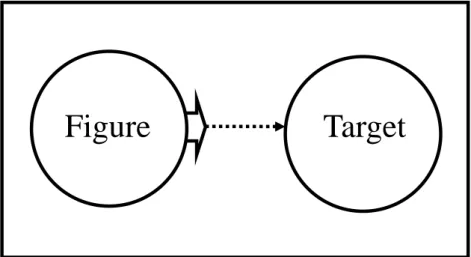
Thus, the basic function of xiàng 向 is to specify the target of the action which is shown by the following diagram.
41
The left circle represents the Figure, the short arrow on the circle is the direction, the dotted line is the possible path, and the right circle is the Target of the Figure’s action.
The last Direction marker wǎng 往 normally implies a path. In other words, the verbs that collocate with wǎng 往 are normally motional and can never be static. Example below shows that the static verb such as tǎng 躺 does not collocate with wǎng 往 since wǎng 往 indicates a path while tǎng 躺 does not.
(33) a. 往門口走去
Wǎng mén kǒu zǒu qù
Go-toward gate walk go ‘Go toward the gate.’
b. *往門口躺去
Wǎng mén kǒu tǎng qù
Go-toward gate lie go
Figure
Target
42
Also, the NP after wǎng 往 is not only a direction but also a destination in following examples.
(34) 我今晚會飛往泰國
Wǒ jīn wǎn huì fēi wǎng tài guó
I tonight will fly go-toward Thai ‘I will fly to Thai tonight.’
(35) 火車開往新竹
Huǒ chē kāi wǎng xīn zhú
Train drive go-toward Hsinchu ‘The train drives toward Hsinchu.’
The examples above indicate that there would be a Figure that goes toward a destination with a path. Just like the following diagram where the left circle represents the Figure, the arrow on the circle represents the direction, the line between the two circles is the path, and the right circle is the final destination of the movement.
Figure
Destination
43
5.2 Synonymous Comparisons
Section 5.2 discusses in detail the similarities and differences between the synonymous set such as in 5.2.1, the differences of [向 + NP] vs. [往 + NP] are discussed; in section 5.2.2, [往 + NP] vs. [到 + NP] is discussed; and section 5.2.3 compares the structure of preverbal use of Direction markers vs. postverbal use of Direction markers.
5.2.1 Distinction of 向 NP vs. 往 NP
This section discusses the distinction of [向 + NP] and [往 + NP], the two seemingly semantic identical structures. In some cases, xiàng 向 and wǎng 往 indeed can be substitude by each other without changing any of the meaning since both xiàng 向 and wǎng 往 indicate the direction for the moving entity (Lu 1999, Chang 2000) as the following examples show:
(36) 許多夏候鳥正展翅飛向臺灣
xǔ duō xià hòu niǎo zhèng zhǎn chì fēi xiàng tái wān
Many summer migratory-bird fly face Taiwan ‘Many migratory birds are flying toward Taiwan.’
(37) 走往教室
zǒu wǎng jiào shì
Go go-toward classroom ‘Go toward the classroom.’
44
There are still some restrictions between the two as demonstrated in the following examples:
(38) a. 往北 從南往北
wǎng běi cóng nán wǎng běi
Go-toward north From south go-toward north ‘Toward the north.’ ‘From the south toward the north.’
b. 向北 *從南向北
xiàng běi cóng nán xiàng běi
face north From south face north ‘Toward the north.’
(39) a. 從理工系館往校本部的路上
cóng lǐ gong xì guan wǎng xiào běn bù de lù shàng
From Engineering-Department-building to-toward campus DE road ‘The road from the Engineering Department building toward the campus.’
b. ?從理工系館向校本部的路上
cóng lǐ gong xì guan xiàng xiào běn bù de lù shàng
From Engineering-Department-building face campus DE road
(40) a. 從德州開車往丹佛
cóng dé zhōu kāi chē wǎng dān fó