This content has been downloaded from IOPscience. Please scroll down to see the full text.
Download details:
IP Address: 140.113.38.11
This content was downloaded on 28/04/2014 at 07:23
Please note that terms and conditions apply.
Field-Emission Properties of Aligned Carbon Nanotubes
View the table of contents for this issue, or go to the journal homepage for more 2000 Jpn. J. Appl. Phys. 39 L925
(http://iopscience.iop.org/1347-4065/39/9A/L925)
Part 2, No. 9A/B, 15 September 2000 c
°2000 The Japan Society of Applied Physics
Field-Emission Properties of Aligned Carbon Nanotubes
Wei-Kai HONG∗, Han-Chang SHIH1, Shang-Hua TSAI1, Chen-Tien SHU1, Fu-Gow TARNTAIRand Huang-Chung CHENG
Department of Electronics Engineering & Institute of Electronics, National Chiao Tung University, 1001 Ta Hsueh Road, Hsinchu 30050, Taiwan, R.O.C.
1Department of Materials Science and Engineering, National Tsing Hua University,
101 Section 2, Kuang Fu Road, Hsinchu 30050, Taiwan, R.O.C. (Received April 24, 2000; accepted for publication July 3, 2000)
Dense, well-separated, and aligned carbon nanotubes have been prepared via bias-enhanced microwave plasma chemical vapor deposition. The turn-on fields defined at the emission current density of 10µA/cm2are about 3.35 V/µm, 2.54 V/µm,
and 3.54 V/µm, for the immersion times in PdCl2 of 1 min, 20 min, and 40 min, respectively. The corresponding emission
current densities are about 0.97 mA/cm2, 4.5 mA/cm2, and 0.44 mA/cm2at the electric field of 5 V/µm. The higher emission
current obtained from the aligned carbon nanotubes for the immersion time of 20 min is ascribed to the denser and sharper nanotubes formed in this condition.
KEYWORDS: field-emission, aligned carbon nanotubes, bias-enhanced microwave plasma chemical vapor deposition
∗E-mail address: [email protected]
L925
Table I. Experimental conditions for aligned carbon nanotubes. No. Immersion times CH4/H2
Microwave
Temperature Pressure Deposition DC bias
in PdCl2 power time A1 1 min 0.5/100 1100 W 600◦C–700◦C 30 Torr 11 min −350 V A2 20 min (sccm) A3 40 min 1. Introduction
Recently, carbon nanotubes have attracted considerable at-tention because of their unique structural and electronic prop-erties1, 2)that can be used in a broad range of potential applica-tions.3–6)One potential application of carbon nanotubes is as field emitters in vacuum microelectronics, owing to their high aspect ratios, high chemical stability, and small tip radii of curvature that can easily emit electrons at a very low electric field.7)Good field-emission properties from multiwalled nan-otubes and single-walled nannan-otubes grown by arc discharge have been reported.8, 9) For display applications, it is neces-sary to produce high-density and vertically aligned nanotube arrays. However, carbon nanotubes produced by arc dis-charge have disordered orientation and it is difficult to align the nanotubes after growth. However, vertically aligned car-bon nanotubes have recently been synthesized by thermal de-composition10, 11)and plasma-enhanced chemical vapor depo-sition of hydrocarbon gas.12, 13) In this letter, a method us-ing microwave plasma chemical vapor deposition (MPCVD) with a DC bias was performed to align the carbon nanotubes. Typically, catalytic metals used for the growth of carbon nan-otubes are Fe, Co, and Ni. On the other hand, Pd has also been found to have good catalytic ability and can be easily deposited on a porous silicon substrate by electrodeless plat-ing.13)These aligned carbon nanotubes catalyzed by Pd show good field-emission properties and superior emission stability compared to the nonaligned carbon nanotubes.
2. Experimental Procedures
The aligned carbon nanotubes were synthesized using a MPCVD system with a negative DC bias. The preparation
procedure is briefly described as follows. The porous silicon layers were first formed on p-type silicon substrates by an-odization. A reductive deposition of nanoparticles of Pd on the porous silicon surface was carried out by immersing the porous silicon specimen into an aqueous solution of PdCl2. Then, carbon nanotubes were grown on Pd-catalyzed sub-strates by MPCVD. The microwave input power was 1100 W and the substrate was heated directly by plasma without other heating sources. A mixture of methane and hydrogen gases was introduced into the chamber. The total pressure was kept at 30 Torr and the flow rates were maintained at 0.5 sccm and 100 sccm for methane and hydrogen, respectively. In this experiment, various times of immersion in PdCl2 including 1 min, 20 min and 40 min were adopted to produce different shapes of carbon nanotubes. The experimental conditions are listed in Table I.
3. Results and Discussion
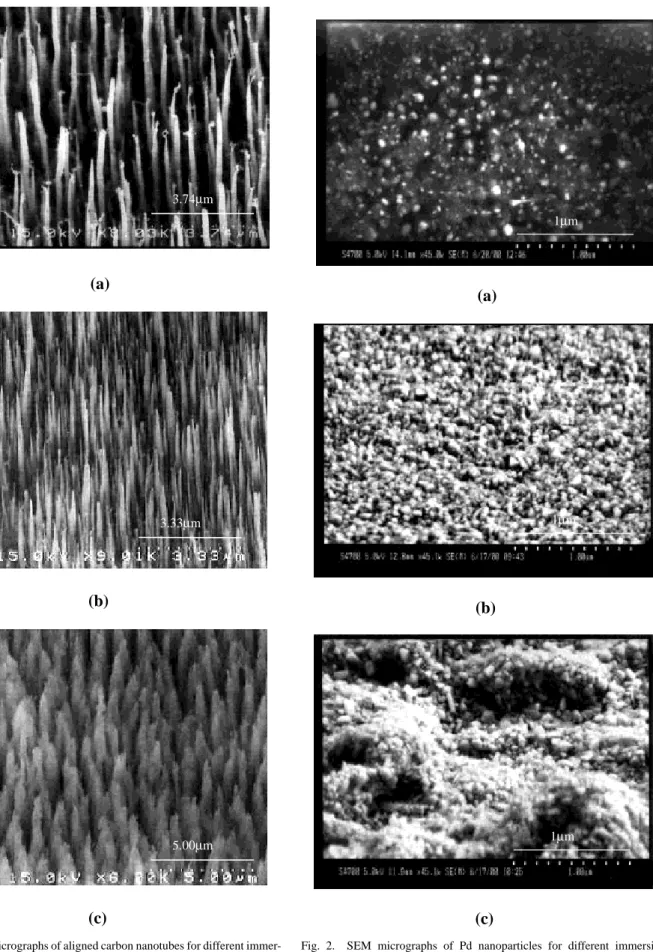
Scanning electron microscopy (SEM) was used to de-termine the morphology of aligned carbon nanotubes. Figure 1(a) shows a SEM micrograph of aligned carbon nan-otubes for the immersion time of 1 min. It can be seen that most nanotubes are approximately perpendicular to the sub-strate and are well separated from each other. These aligned carbon nanotubes are 100 nm to 151 nm in diameter and 3µm to 4µm in length. Most of the aligned carbon nanotubes have closed ends at the tips. Figure 1(b) shows a SEM micro-graph of aligned carbon nanotubes for the immersion time of 20 min. From the SEM micrograph, it can be seen that more densely aligned carbon nanotubes can be obtained by increas-ing the time of immersion in PdCl2. This is attributable to the greater number of catalytic nanoparticles of Pd deposited on
the porous silicon surface. Figure 1(c) shows a SEM micro-graph of aligned carbon nanotubes for the immersion time of 40 min. This SEM micrograph shows carbon nanotubes of a different shape than the prior ones. Figures 2(a), 2(b), and 2(c) show the SEM micrographs of Pd nanoparticles after
im-mersion in PdCl2for 1 min, 20 min, and 40 min, respectively. For the immersion time of 1 min, catalytic nanoparticles of Pd can be dispersed with a low density. The immersion time of 20 min can achieve a higher density and more uniform distri-bution of Pd catalytic nanoparticles. However, the excessive immersion time of 40 min causes the aggregation of the Pd L926 Jpn. J. Appl. Phys. Vol. 39 (2000) Pt. 2, No. 9A/B W.-K. HONGet al.
(a)
3.74µm(b)
3.33µm(c)
5.00µmFig. 1. SEM micrographs of aligned carbon nanotubes for different immer-sion times in PdCl2: (a) 1 min, (b) 20 min, and (c) 40 min.
(a)
1µm(b)
1µm(c)
1µmFig. 2. SEM micrographs of Pd nanoparticles for different immersion times in PdCl2: (a) 1 min, (b) 20 min, and (c) 40 min.
catalytic nanoparticles. This aggregation results in a cluster of carbon nanotubes which causes the blunt morphology of the carbon nanotubes formed in Fig. 1(c).
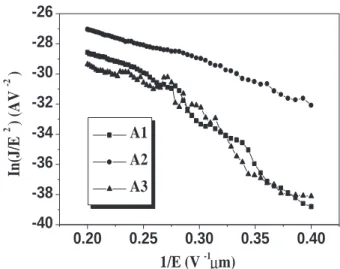
The field-emission properties of these aligned carbon nan-otubes were characterized in a high vacuum environment with a base pressure of about 1× 10⁻⁷Torr. The measurement system is based on Keithley 237 high voltage source units with a IEEE 488 interface. The anode was a graphite plate and the spacing between the emitter and the anode was con-trolled at 220µm. Prior to the electrical measurement, a high constant voltage of 1100 V was applied to the emitters to exhaust the adsorbed molecules and impurities. Figure 3 shows the field-emission properties of the aligned carbon nan-otubes for different immersion times in PdCl2. It can be seen that the aligned carbon nanotubes exhibit high emis-sion current at low electric field. The turn-on fields Eon defined at the emission current density of 10µA/cm2 are about 3.35 V/µm, 2.54 V/µm, and 3.54 V/µm, for immer-sion times in PdCl2 of 1 min, 20 min, and 40 min, respec-tively. The corresponding emission current densities are about 0.97 mA/cm2, 4.5 mA/cm2, and 0.44 mA/cm2 at the electric field of 5 V/µm. The aligned carbon nanotubes for the im-mersion time of 20 min show superior field-emission prop-erties compared to others. This is due to the much more densely aligned carbon nanotubes formed under this condi-tion. On the other hand, the immersion time of 40 min re-sults in relatively poor emission properties. This may be as-cribed to the blunt tip of nanotube emitters obtained under this condition. According to Fowler-Nordheim (FN) theory, the emission current density J can be expressed as a func-tion of the applied electric field E , the local work funcfunc-tion of the tip φ, and the field-enhancement factor β. That is, J∝ (β2E2/φ) × exp(−6.83 × 10⁷× φ3/2/β E). With proper arrangement, a linear relationship between ln(J/E2) and E−1 can be obtained from the above equation. A typical FN plot, ln(J/E2) vs (E−1), is used to verify the field-emission char-acteristics. Figure 4 shows the corresponding FN plots of the aligned carbon nanotubes. Nearly straight lines are observed for all of the samples exhibiting the field-emission phenom-ena. The field-enhancement factorβ can be derived from the slope of the FN plot by assuming a work function of carbon nanotubes of 5 eV. Theβ values for the immersion times in
0 1 2 3 4 5 0.0 1.0m 2.0m 3.0m 4.0m 5.0m Immersion times in PdCl2 A1 = 1 min A2 = 20 min A3 = 40 min Emission current d ensity (A/cm ) 2
Applied electric field (V/ m)
Fig. 3. Field-emission properties of aligned carbon nanotubes for different immersion times in PdCl2.
current density of 4.5 mA/cm2was established at the electric field of 5 V/µm. No obvious degradation of the emission cur-rent density was observed in the stability test. The emission current fluctuation was found to be from −25% to +15%. This is relatively more stable than that of the nonaligned car-bon nanotubes previously reported.14)
4. Conclusions
In summary, the bias-enhanced microwave plasma chem-ical vapor deposition technique was adopted to synthesize aligned carbon nanotubes on Pd-catalyzed porous silicon sub-strates. The turn-on fields Eon defined at the emission cur-rent density of 10µA/cm2 are dependent on the immersion times in PdCl2. The emission current densities are about 0.97 mA/cm2, 4.5 mA/cm2, and 0.44 mA/cm2 at the electric field of 5 V/µm for the immersion times in PdCl2 of 1 min, 20 min, and 40 min, respectively. The lower turn-on field and PdCl2 of 1 min, 20 min, and 40 min are about 3436, 3674, and 2920, respectively. The first two values are close due to the similarly aligned carbon nanotubes formed under the first two preparation conditions. The last value is smaller than the others, which is ascribed to the larger tip radius of emitters. Figure 5 demonstrates the emission current stability of the aligned carbon nanotubes over a period of 2 h. An emission 0 1000 2000 3000 4000 5000 6000 7000 8000 0.0 0.1 0.2 0.3 0.4 0.5 0.6 0.7 0.8 0.9 1.0 1.1 1.2 A2 E = 5 V/ m, J0 = 4.5 mA/cm2 Emission current d ensity ratio (J/J )0 Time (s)
Fig. 5. Emission current stability of aligned carbon nanotubes over a pe-riod of 2 h.
0.20
0.25
0.30
0.35
0.40
-40
-38
-36
-34
-32
-30
-28
-26
A1
A2
A3
2-21/E (V m)
-1In(J/E ) (AV )
Fig. 4. FN plots of aligned carbon nanotubes for different immersion times in PdCl2.
higher emission current density obtained from the aligned car-bon nanotubes for the PdCl2immersion time of 20 min are at-tributed to the denser and sharper nanotubes. Moreover, these aligned carbon nanotubes indicate no obvious degradation of the emission current density over a period of 2 h.
Acknowledgements
This research was supported in part by the National Science Council (NSC) of the Republic of China under Contract NSC-89-2215-E-009-069 and NSC-89-2215-E-009-068. Technical support from the Semiconductor Research Center of National Chiao Tung University and the National Nano Device Labo-ratory of NSC are also acknowledged.
1) C. T. White, D. H. Robertson and J. W. Mintmire: Phys. Rev. B 47 (1993) 5485.
2) J. W. G. Wildoer, L. C. Venema, A. Rinzler, R. E. Smalley and C. Dekker: Nature 391 (1998) 59.
3) A. C. Dillon, K. M. Jones, T. A. Bekkedahl, C. H. Kiang, D. S. Bethune and M. J. Heben: Nature 386 (1997) 377.
4) M. Freemantle: Chem. Eng. News 74 (1996) 62.
5) C. Niu, E. K. Sichel, R. Hoch, D. Moy and H. Tennent: Appl. Phys. Lett. 70 (1997) 1480.
6) G. Che, B. B. Lakshmi, E. R. Fisher and C. R. Martin: Nature 393 (1998) 346.
7) T. W. Ebbesen: Carbon Nanotubes (CRC Press, Boca Raton, 1997). 8) Y. Saito, K. Hamaguchi, T. Nishino, K. Uchida, Y. Tasaka, F. Ikazaki,
M. Yumura, A. Kasuya and Y. Nishina: Nature 389 (1997) 554. 9) J. Bonard, J. Salvetat, T. Stockli, W. A. de Heer, L. Forro and A.
Chatelain: Appl. Phys. Lett. 73 (1998) 918.
10) S. Fan, M. G. Chapline, N. R. Frankin, T. W. Tombler, A. M. Cassell and H. Dai: Science 283 (1999) 512.
11) W. Li, H. Zhang, C. Wang, Y. Zhang, L. Xu, K. Zhu and S. Xie: Appl. Phys. Lett. 70 (1997) 2684.
12) Z. F. Ren, Z. P. Huang, J. W. Xu, J. H. Wang, P. Bush, M. P. Siegal and P. N. Provencio: Science 282 (1998) 1105.
13) S. H. Tsai, C. W. Chao, C. L. Lee and H. C. Shih: Appl. Phys. Lett. 74 (1999) 3462.
14) F. G. Tarntair, L. C. Chen, S. L. Wei, W. K. Hong, K. H. Chen and H. C. Cheng: to be published in J. Vac. Sci. & Technol. B.