Dynamics of twisted nematic liquid crystal pi-cells
Shu-Hsia Chen and Chiu-Lien YangCitation: Applied Physics Letters 80, 3721 (2002); doi: 10.1063/1.1480880
View online: http://dx.doi.org/10.1063/1.1480880
View Table of Contents: http://scitation.aip.org/content/aip/journal/apl/80/20?ver=pdfcov
Published by the AIP Publishing
Articles you may be interested in
Measurement of nematic liquid crystal splay elastic constants by disclination line motion in high pretilt, negative dielectric anisotropy pi-cells
J. Appl. Phys. 112, 103525 (2012); 10.1063/1.4767778
Bistable switching of twist direction in a twisted-nematic liquid crystal cell
Appl. Phys. Lett. 97, 063501 (2010); 10.1063/1.3478842
Heat-driven and electric-field-driven bistable devices using dye-doped nematic liquid crystals
J. Appl. Phys. 107, 123108 (2010); 10.1063/1.3446826
Measurement of the twist elastic constant of nematic liquid crystals using pi-cell devices
J. Appl. Phys. 101, 043108 (2007); 10.1063/1.2432311
High-resolution bistable nematic liquid crystal device realized on orientational surface patterns
Appl. Phys. Lett. 83, 3602 (2003); 10.1063/1.1623011
This article is copyrighted as indicated in the article. Reuse of AIP content is subject to the terms at: http://scitation.aip.org/termsconditions. Downloaded to IP: 140.113.38.11 On: Thu, 01 May 2014 06:19:28
Dynamics of twisted nematic liquid crystal pi-cells
Shu-Hsia Chena)and Chiu-Lien Yang
Institute of Electro-Optical Engineering, National Chiao-Tung University, Hsinchu, Taiwan, Republic of China
共Received 12 April 2001; accepted for publication 22 March 2002兲
A twisted nematic liquid crystal pi-cell with fast optical response time of 2.2 ms was prepared. We investigated the dynamics of this cell and observed the back-flow-induced optical overshoot phenomena both in homeotropic-to-planar state transition and planar-to-homeotropic state transition. We analyzed the behavior of the director and found that there is a tip-over phenomenon when the field is removed from relatively high voltage共⬎6 V兲. More important, the fluid flow effect results in the reverse twist both in the rising process and the decay process. Consequently, the reverse twist increases and decreases the effective phase retardation on the optical rising and decay process, respectively, and thus speeds up the optical response in both stages. © 2002 American Institute of Physics. 关DOI: 10.1063/1.1480880兴
Twisted-nematic共TN兲 liquid crystal cell has been widely used in the active matrix liquid-crystal display technology. Unfortunately, a serious problem with slow response exists in the TN configuration. To overcome the drawback, recently pi-cell1or OCB-cell2has drawn considerable attention. How-ever, a common problem in pi-cell and OCB-cell is that the bend configuration at low driving field is unstable.3 There-fore, in practice, a few minutes of warm-up time period is required for the device using these cells.
Optical bounce in the TN,4,5homogeneous1and CHLC6 cells had been observed in the homeotropic-to-planar state transition. These studies indicate that there is a strong cou-pling between the fluid flow and the director orientation in the homeotropic-to-planar state transition and the back-flow-induced optical bounce slows down the response. In the pi-cell, however, there is no optical bounce observed in the transient transmittance and the torque induced by the flow accelerates the relaxation.7
In this letter, we prepared a twisted pi-cell with fast re-sponse as pi-cell and OCB-cell but without the unstable problem. We studied its dynamic mechanism by Erickson– Leslie theory and calculated the transient director behavior with a numerical method. We found that although the re-sponse of the nematic liquid-crystal 共LC兲 molecules is slow commonly, the flow-induced director configuration together with the optical component arrangement results in its fast optical response.
Samples of twisted pi-cell were assembled with two in-dium tin oxide共ITO兲-coated glass plates. The substrates were coated with a 700– 800 Å thick SE-3310共Nissan Co.兲 align-ment layer, which produces a pretilt angle of 3° for LC mol-ecules after the rubbing process. The S-811 chiral molmol-ecules were doped in the liquid crystal of ZLI-2293共Merck Co.兲 to achieve a left-handed 180°-twist pi-cell共twist from⫽0° at z⫽0 to ⫽⫺180° at z⫽d兲 of 6 m cell gap. To measure the transmittance of this cell, we inserted the LC cell be-tween two crossed polarizers with the rubbing direction x of the front substrate rotated 45° from the transmission axis of
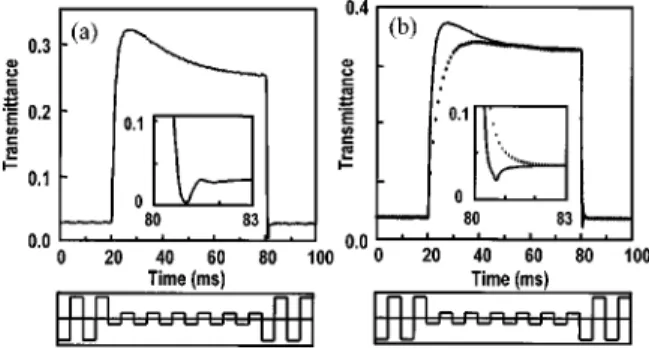
the incident polarizer. The transient transmittance curves were measured by using a LC display panel evaluation de-vice 共LCD-5100兲 from Otsuka Electronics Co. with light propagates in the normal direction z of the substrate plate. A square wave form ac electric field was applied with a fre-quency of 100 Hz. We operated the twisted pi-cell between 10 and 2.6 V since the transmittance–voltage curve of the twisted pi-cell monotonically decay above 2.6 V. The mea-sured results are shown in Fig. 1共a兲. It is obvious that there are optical overshooting phenomena both in the rising period 共a peak兲 and in decay period 共a valley兲. The enlarged valley is shown in the inset of Fig. 1共a兲. The response time 关ton(100% – 10%)⫹toff(0% – 90%)兴 is only 2.2 ms.
It is interesting to analyze the dynamic mechanism of the fast optical response since the characteristic response time of the nematic molecules is much slower. According to the pre-vious studies1,4 – 6 there usually exists a strong coupling be-tween the fluid flow and the director reorientation. Therefore, we used the Ericksen–Leslie–Parodi theory to investigate the flow effect on the transient behavior of the twisted pi-cell during its switching process. As usual,6,8 in our calculation, the fluid flow terms were included but the inertial terms of the directors were neglected. We used our one dimension simulator to calculate the transient director (nx,ny,nz) and
velocity (vx,vy) distributions. Then, the optical
transmit-a兲Electronic mail: [email protected]
FIG. 1. 共a兲 Measured and 共b兲 calculated transient transmittance of the twisted pi-cell under crossed polarizers. The lower diagrams are the applied wave form which was switched from 10 to 2.6 V at 20 ms and persisted to 80 ms, then switched to 10 V at 80 ms. The insets are the enlarged optical valley.
APPLIED PHYSICS LETTERS VOLUME 80, NUMBER 20 20 MAY 2002
3721
0003-6951/2002/80(20)/3721/3/$19.00 © 2002 American Institute of Physics
This article is copyrighted as indicated in the article. Reuse of AIP content is subject to the terms at: http://scitation.aip.org/termsconditions. Downloaded to IP: 140.113.38.11 On: Thu, 01 May 2014 06:19:28
tance was obtained by using Jones matrix method with a wavelength of 589 nm. Table I shows the parameters used in the simulation. Due to lack of the Leslie coefficients of ZLI-2293, these coefficients were taken from the values of MBBA.9We had evaluated some Leslie coefficients of ZLI-2293 from its incomplete shear viscosity coefficients10 that are close to and in the same sign with the values of MBBA. It is appropriate to analyze the transient director behavior by using the complete Leslie coefficients of MBBA. The calcu-lated transmittance is shown in Fig. 1共b兲. The solid curve is the calculated results with the flow, while the dashed line is the calculated results by considering rotation viscosity only without flow. The corresponding director distributions (nx,ny,nz) were transformed to tilt angle ␣共⬅ 90°—polar
angle 兲 and azimuthal angleand shown in Figs. 2 and 4. The typical velocity profiles are shown in Figs. 3共b兲 and 5共b兲 for rising process and decay process, respectively. It is obvi-ous, as shown in Fig. 1, that the behavior of the calculated transient transmittance curve that includes the flow effect agrees with the experimental results qualitatively. The simu-lated optical valley is not as deep as the experimental one. This may be caused by the Leslie coefficients of MBBA being different from the values of ZLI-2293. The flow effect leads the acceleration both in rising and decay optical re-sponse of the twisted pi-cell. In the following, we describe how the change of external field induces the flow and the coupling of the flow to the director orientation and finally the optical signals.
In the rising process of transmittance, the cell has been applied with the high voltage 共10 V兲 for a long time, the directors in its initial static state has a profile as shown in Fig. 2. The external director body force11 G is balanced
with the elastic deformation force. The equilibrium is broken as the voltage switched to 2.6 V so the external director body force changed to G
⬘
. The unbalanced elastic deformation torque due to the change of the applied voltage or the electric field is n⫻(G⬘
⫺G)⫽1ıˆ⫹2ˆ⫽1 2a(Ez
⬘
2 ⫺Ez
2
)sin 2␣关sinıˆ⫺cosˆ兴, where 1 and 2 are the
in-duced torques in ıˆ and ˆ, respectively, Ez and Ez
⬘
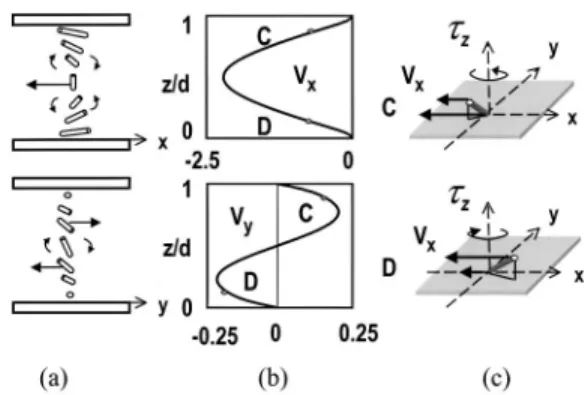
are theelectric fields in kˆ for 10 V and 2.6 V, respectively,␣is the tilt angle 共⫽90°–polar angle, ⫺90°⭐␣⭐90°兲, andis the azimuthal angle of the director. As shown in Fig. 3共a兲, this unbalanced torque rotates the director n 共changing its tilt angle ␣兲 and the rotation acts at its nearby fluid element a stress force via viscous interaction. The fluid element is ac-celerated with the resultant viscous force acting on it. It can be shown that the acceleration is proportional to the gradient of the torque namely ˙x⬀⫺2/z and ˙y⬀1/z. From
the initial configuration depicted in Fig. 2, we can find the extreme positions of 1 and 2, then from the sign of the torque gradient, we can obtain the profile of the velocity and confirm the behavior of the typical simulated curve shown in Fig. 3共b兲. Meanwhile, the gradient of the flow velocity in-duces a viscous intrinsic director body force g
⬘
that imposes a viscous torque n⫻g⬘
⫽xıˆ⫹yˆ⫹zkˆ on the director,where x⫽共␣2⫺␣3兲共nyn˙z⫺nzn˙y兲⫺␣3nxny x z ⫺共␣3ny 2⫺␣ 2nz 2兲y z , y⫽共␣2⫺␣3兲共nzn˙x⫺nxn˙z兲⫹␣3nxny y z ⫺共␣2nz 2⫺␣ 3nx 2兲x z , z⫽共␣2⫺␣3兲共nxn˙y⫺nyn˙x兲 ⫹␣2nz
冉
ny x z ⫺nx y z冊
.FIG. 2. Calculated transient共a兲 tilt angle and 共b兲 twist angle distribution after switching to 2.6 V from 10 V at t⫽0. z is the axis perpendicular to the substrates and d is cell gap. Configuration of the twisted pi-cell共without applied field兲 and the definition of tilt angle ␣ 共⬅90°—polar angle ,
⫺90°⭐␣⭐90°兲 and azimuthal angle of the director orientation are shown above共a兲 and 共b兲.
FIG. 3. 共a兲 Director profile at high voltage 共10 V兲. 共b兲 Calculated flow velocity共mm/s兲 at t⫽0.1 ms after switching to 2.6 V from 10 V at t⫽0. 共c兲 Schematic diagram showing the viscous torques induced by velocity gradi-ent.
TABLE I. The parameters used in the simulation. K11, K22, and K33are
splay, twist, and bend elastic constant, respectively. The six Leslie coeffi-cients are taken from MBBA.
Twist angle ⫺180° Cell gap 5.8m
0 4.1 e 14.1 n0 1.4990 ne 1.6312 K11 12.5 pN K22 7.3 pN K33 17.9 pN Pitch ⫺14.5m ␣1 ⫺21.5 mPa ␣2 ⫺153.4 mPa ␣3 ⫺0.773 mPa ␣4 109.5 mPa ␣5 107.1 mPa ␣6 ⫺47.0 mPa
3722 Appl. Phys. Lett., Vol. 80, No. 20, 20 May 2002 S. Chen and C. Yang
This article is copyrighted as indicated in the article. Reuse of AIP content is subject to the terms at: http://scitation.aip.org/termsconditions. Downloaded to IP: 140.113.38.11 On: Thu, 01 May 2014 06:19:28
The reverse twist of the directors observed in Fig. 2共b兲 is induced byzwhich is negative共positive兲 above 共below兲 the midlayer at the beginning after the voltage has been switched. A schematic diagram is shown in Fig. 3共c兲 for point A. Besides, the viscous torque x at the midlayer is
negative 共since x/z⫽0 and y/z⬎0兲 and that kicks
the director of the midlayer to the other side (⫹y,⫽ ⫹90°) as shown in Fig. 3共c兲. As a result, the tilt angle de-creased 关as in the inset of Fig. 2共a兲兴 and the originally left-handed 180° twist changes into a similarly sharp right-handed 180° twist 关as in Fig. 2共b兲兴 共tip-over phenomenon兲. After some time has elapsed, the torque induced by the flow effect is decreased and is overcome by the elastic torque, the directors start to relax back 共after 1 ms兲. In the relaxation process, the tilt angle in the midplane meets the 90° again at 2.5 ms, meanwhile, the twist profile restores to left-handed. At last, the tilt angle and the twist angle arrive at their stable state at about 30 ms. The rapid relaxing of the director tilt angle in the two intermediates near the surface causes the optical phase retardation increases quickly. At the same time, the induced reverse twist keeps these directors almost paral-lel with x axes that further increase the effectively optical phase retardation. As a result, it speeds up the increasing of the transmittance even over the saturation value and forms an optical peak as shown in Fig. 1. In other words, by switching down the applied voltage, the flow induces a reverse twist in the homeotropic-to-planar state transition that speeds up the optical rising response.
In the decay process of transmittance, similarly, the equi-librium is broken when the voltage switched to 10 V from 2.6 V. As depicted in Fig. 4, The LC molecules stand up 共rotate兲 quickly owing to a much larger electric torque en-countered throughout the cell. The extremes of the electric torque2 are at two intermediates near the substrates where
the tilt angle␣is about 45°, while the minimum of1occurs
at the midlayer. The fluid flow caused by the director rotation thus can be realized and indicated in Fig. 5共b兲. The flow induced torquez of the director is positive共negative兲 above
共below兲 the midlayer as indicated in Fig. 5共c兲. Consequently, as shown in Fig. 4共b兲, the twist orientation first swings to a direction away from its final equilibrium position and that persists up to 0.6 ms. After 0.6 ms, the rotating speed of the director slows down, the flow effect is weak and is overcome by the elastic torque due to the large deformation caused by the reverse twist, then the director twist profile swings back
with a high tilt angle 共Fig. 4兲 and finally the stable twist profile is reached at 8 ms. In the aspect of the optical signal, as the voltage increased, the rapid standing up of the director causes the transmittance decay quickly. In addition, the in-duced reverse twist pushes the directors away from the rub-bing direction x in both areas near the substrates where the tilt angle has large deviation from 90° and contributes mainly to the transmittance. As a result, it reduces the effectively optical phase retardation further and decreases the transmit-tance even lower than the saturation value to form an optical valley as shown in Fig. 1. In conclusion, the flow induces an optical valley and speeds up the optical decay response when the applied voltage is switched up.
In summary, we report a twisted nematic LC pi-cell with fast optical response. It can be applied in light valves and LCDs with true video rate. The field-induced dynamic mechanism of the twisted pi-cell has been studied. A back-flow-induced reverse twist in the homeotropic-to-planar state transition and the planar-to-homeotropic state transition is confirmed to have significant influences on the optical prop-erties. As a result, the flow effect is shown to play a positive role for accelerating the optical response of the twisted pi-cell.
This work was partially supported by the National Sci-ence Council, R.O.C., under Contract No. NSC 89-2112-M-009-046. The authors are indebted to the Picvue Electronics, Ltd. for experimental supports and Professor Jung Y. Huang for useful discussions.
1
P. J. Bos and K. R. Koehler/Beran, Mol. Cryst. Liq. Cryst. 113, 329
共1984兲.
2T. Miyashita, C.-L. Kuo, and T. Uchida, SID ’95共1995兲, p. 797. 3N. Nagae, T. Miyashita, T. Uchida, Proceedings of the IDRC ’00, 26
共2000兲.
4
C. Z. van Doorn, J. Appl. Phys. 46, 3738共1975兲.
5D. W. Berreman, J. Appl. Phys. 46, 3746共1975兲.
6S.-H. Chen and L.-Y. Chen, Appl. Phys. Lett. 75, 3491共1999兲. 7S. Onda, T. Miyashita and T. Uchida, Proceedings of Asia Display ’98,
1988, p. 1055.
8
L.-Y. Chen and S.-H. Chen, SID J. 7, 289共1999兲.
9S. Chandrasekhar, Liquid Crystals, 2nd ed.共Cambridge University Press,
Cambridge, UK, 1992兲.
10D. Armitage and J. Larimer, SID 96 Digest 27, 584共1996兲. 11
H. Kneppe, F. Schneider, and N. K. Sharma, J. Chem. Phys. 77, 3203
共1982兲. FIG. 4. Calculated transient共a兲 tilt angle and 共b兲 twist angle distribution
after switching to 10 V from 2.6 V at t⫽0.
FIG. 5. 共a兲 Director profile at low voltage 共2.6 V兲. 共b兲 Calculated flow velocity共mm/s兲 at t⫽0.1 ms after switching to 10 V from 2.6 V at t⫽0. 共c兲 Schematic diagram showing the viscous torques induced by velocity gradi-ent.
3723
Appl. Phys. Lett., Vol. 80, No. 20, 20 May 2002 S. Chen and C. Yang
This article is copyrighted as indicated in the article. Reuse of AIP content is subject to the terms at: http://scitation.aip.org/termsconditions. Downloaded to IP: 140.113.38.11 On: Thu, 01 May 2014 06:19:28