Electron energy state dependence on the shape and size of semiconductor quantum
dots
Yiming Li, O. Voskoboynikov, C. P. Lee, S. M. Sze, and O. Tretyak
Citation: Journal of Applied Physics 90, 6416 (2001); doi: 10.1063/1.1412578
View online: http://dx.doi.org/10.1063/1.1412578
View Table of Contents: http://scitation.aip.org/content/aip/journal/jap/90/12?ver=pdfcov
Published by the AIP Publishing
Articles you may be interested in
Influence of wetting layers and quantum dot size distribution on intermediate band formation in InAs/GaAs superlattices
J. Appl. Phys. 110, 073105 (2011); 10.1063/1.3631785
Electronic states of InAs/GaAs quantum dots by scanning tunneling spectroscopy
Appl. Phys. Lett. 97, 123110 (2010); 10.1063/1.3491551
Selective manipulation of InAs quantum dot electronic states using a lateral potential confinement layer
Appl. Phys. Lett. 81, 3473 (2002); 10.1063/1.1517710
Staircase-like spectral dependence of ground-state luminescence time constants in high-density InAs/GaAs quantum dots
Appl. Phys. Lett. 78, 3214 (2001); 10.1063/1.1371965
Characterization of electron trap states due to InAs quantum dots in GaAs
Appl. Phys. Lett. 76, 2916 (2000); 10.1063/1.126516
Electron energy state dependence on the shape and size of semiconductor
quantum dots
Yiming Lia)
National Nano Device Laboratories, Hsinchu, 300 Taiwan
O. Voskoboynikov
Department of Electronics Engineering, National Chiao Tung University, Hsinchu 300, Taiwan and Kiev Taras Shevchenko University, Kiev 252030, Ukraine
C. P. Lee and S. M. Sze
Department of Electronics Engineering, National Chiao Tung University, Hsinchu 300, Taiwan
O. Tretyak
Kiev Taras Shevchenko University, Kiev 252030, Ukraine
共Received 20 April 2001; accepted for publication 17 August 2001兲
In this article we present a unified model for studying the effect of the sizes and shapes of small semiconductor quantum dots on the electron and hole energy states. We solved the three-dimensional effective one band Schro¨dinger equation for semiconductor quantum dots with disk, lenticular, and conical shapes. For small InAs/GaAs quantum dots we found a substantial difference in the ground state and first excited state electron energies for dots with the same volume but different shapes. Electron energy dependence on volume is found to be quite different from the commonly quoted V⫺2/3. The exponent can vary over a wide range and depends on the dot shapes. © 2001 American Institute of Physics. 关DOI: 10.1063/1.1412578兴
I. INTRODUCTION
Recent advances in the fabrication of semiconductor quantum dots have generated huge quantities of experimental and theoretical data.1,2The three-dimensional confinement of charge carriers in various structures provides fascinating op-tical and magnetic characteristics for many important device applications. The intensive investigation, to a large part, is driven by the prospect of fabricating a new generation of electronic and photonic devices 共quantum dot lasers for instance兲.2
The spectral broadening in semiconductor quantum dots caused by the nonuniformity in their size and shape is of primary concern for practical laser applications.2–5 Many studies were carried out for fabrication of quantum dots with a small size variation.6 –11The best result so far is achieved in the so-called self-assembled InAs quantum dots grown on GaAs substrate by the Stranski–Krastanow mode. It has been shown experimentally that InAs dots can be designed with sharp electronic multilevel shells12–15 in which the exited state emission is narrower than the ground state emission.3,4 Various experimental results suggest, not yet without a con-troversy, that InAs/GaAs quantum dots can have disk, lens, or cone shapes with a circular top view cross section and a large area-to-height aspect ratio.16 –23Unfortunately, no con-sistent description of the dot shape can be drawn from the literature due to the different conditions used in the dot formation.
The shape of quantum dots is debated intensively in the-oretical works since an accurate calculation 共and explana-tion兲 of the electronic structure depends on the dot shape itself. A wide range of shapes and sizes have been used in the theoretical models to simulate InAs dot properties. Most of them use numerical methods. The commonly used shapes include disk,24,25 lens,26,27 and cone shapes.28,29 Spherical,30–32 pyramidal,33–38 and cubic39,40 shapes were also used. The energy level calculation has been done using the effective-mass approximation with24,25,28,29,32,33,37,40 and without26,27,38,39the coordinate dependence for the effective mass. The multiband k"p method with finite33,34,36 and infinite30,31 confinement potentials, and the pseudopotential method were used in the calculation.35
The diversity in the theoretical model and approach makes it difficult to compare the theoretical results of differ-ent authors and to verify the models on the basis of experi-mental results. A comprehensive analysis of the influence of the dot size and shape on the electron energy states by using a unified model of the semiconductor band structure has not been done yet. While large-scale calculations using compli-cated Hamiltonians have become feasible, the results are not better than those using the input parameters and dot shape models. For instance, the multielectron interaction and other factors in small quantum dots generally affect the electron energy in the order of a few meV. But, at the same time, the variations of the dot size and shape can produce an energy change up to an order of 0.1 eV in the strong confinement region.
In this study we calculate and compare the electron en-ergy spectra for three-dimensional small InAs/GaAs quan-tum dots of four different shapes 共see Fig. 1兲: disk 共DI兲, a兲Also at Microelectronics and Information Systems Research Center,
Na-tional Chiao Tung University, Hsinchu, Taiwan. Author to whom corre-spondence should be addressed; electronic mail: [email protected]
6416
0021-8979/2001/90(12)/6416/5/$18.00 © 2001 American Institute of Physics
ellipsoidal lens共EL兲, cut sphere lens 共CL兲, and conical shape
共CO兲. All of them are cylindrically symmetric 共with the
cir-cular top view cross section兲. We use the effective one elec-tronic band Hamiltonian, the energy and position dependent effective mass approximation, and the Ben Daniel–Duke boundary conditions. To solve the three-dimensional Schro¨-dinger equation we employ a robust numerical scheme by using the finite difference method,41,42a shifted and balanced QR algorithm,43,44and the inverse iteration technique.43,45
We show that the dependence of the electron energy level on the dot volume V can be quite different from the commonly quoted V⫺2/3 rule. It can be formulated as V⫺␥, where the effective exponent ␥ depends on the dot’s shape. The effective exponent is different with respect to the ground state and the exited states.
This article is organized as follows. Section II introduces the theoretical models and the calculation methods. Section III describes the calculated results illustrating the depen-dence of the electron energy level on the dot volume for different dot’s shapes. Section IV draws conclusions.
II. THEORETICAL MODEL AND CALCULATION METHOD
We consider semiconductor quantum dots in the one-band envelope-function formalism for electrons and holes in which the effective Hamiltonian is given by46
Hˆ⫽⫺ប
2
2 ⵜr
冉
1m共E,r兲
冊
ⵜr⫹V共r兲, 共1兲whereⵜrstands for the spatial gradient. The electron effec-tive mass m(E,r), depending on both energy E and position, is taken as 1 me共E,r兲⫽ P2 ប2
冋
2 E⫹Eg共r兲⫺Ec共r兲 ⫹E⫹Eg共r兲⫹⌬共r兲⫺Ec共r兲1册
, 共2兲where V(r)⫽Ec(r) is the confinement potential, Ec(r),
Eg(r), and⌬(r) denote, respectively, the position dependent electron band edge, band gap, and the spin-orbit splitting in the valence band, and P is the momentum matrix element. The hole effective mass mh(r) is assumed to be only position
dependent.
We investigate quantum dots with shapes of DI, EL, CL, and CO with the base共top view兲 radius R0 and height z0 in
the cylindrical coordinates 共R, , z兲. Since the system is cylindrically symmetric, the wave function can be written as
⌿共r兲⫽⌽共R,z兲exp共il兲, 共3兲
where l⫽0,⫾1,⫾2,... is the electron orbital quantum num-ber. The problem remains two dimensional in共R, z兲 coordi-nates: ⫺ ប 2 2mi共E兲
冉
2 R2⫹ RR⫹ 2 z2⫺ l2 R2冊
⌽i共R,z兲 ⫹Vi共R,z兲⌽i共R,z兲⫽E⌽i共R,z兲, 共4兲where V1(R,z)⫽0 (i⫽1) inside and V2(R,z)⫽V0 (i⫽2)
outside the dot. The boundary conditions are
⌽1共R,z兲⫽⌽2共R,z兲, z⫽ fS共R兲, 1 m1共E兲
再
⌽1共R,z兲 R ⫹ d fS dR ⌽1共R,z兲 z冎
冏
z⫽ fS共R兲 ⫽m1 2共E兲再
⌽2共R,z兲 R ⫹ d fS dR ⌽2共R,z兲 z冎
冏
z⫽ fS共R兲 , 共5兲where z⫽ fS(R) (S⫽DI, EL, CL, CO) is the contour of the
structure’s cross section on the 兵R, z其 plane. The structure shape is generated by the rotation of this contour around the
z axis.
Based on the fact that the electron effective mass is a spatial and energy dependent function, the Schro¨dinger equa-tion is a nonlinear equaequa-tion in energy. A computaequa-tional method for such a nonlinear problem has been proposed and successfully implemented for the spin-splitting quantum dot problem by us47 recently. Due to the energy dependence of the electron effective mass, our calculation consists of itera-tion loops to reach a ‘‘self-consistent’’ energy soluitera-tion. In each iteration we use a central difference method with a non-uniform mesh technique41 to discretize the two-dimensional Schro¨dinger equation. The discretized Schro¨dinger equation together with its boundary conditions Eq. 共5兲 leads to the eigenvalue problem
AX⫽X,
where A is the matrix rising from the discretized Schro¨dinger equation and boundary conditions, and X and are the cor-responding eigenvectors 共wave functions兲 and the eigenval-ues共energy levels兲, respectively. Because the matrix A is an energy dependent, five diagonal and nonsymmetric matrix,47 we perform a balancing algorithm to reduce the sensitivity of eigenvalues of the matrix A to small changes in the matrix elements.43 Then the matrix A is transformed into a simpler upper Hessenberg form. The eigenvalues of the upper Hes-FIG. 1. Schematic diagrams for quantum dots of four different shapes:共a兲
DI,共b兲 EL, 共c兲 CL, and 共d兲 CO.
6417
J. Appl. Phys., Vol. 90, No. 12, 15 December 2001 Liet al.
senberg matrix are directly computed with the QR method.43 When the eigenvalues are found, we solve the corresponding eigenvectors with the inverse iteration method.45 In our cal-culation experience, the proposed computational method converges monotonically, and a strict convergence criteria on energies共the maximum norm error is less than 10⫺12eV兲 can be reached by only 12–15 feedback nonlinear iterative loops.
III. CALCULATION RESULTS
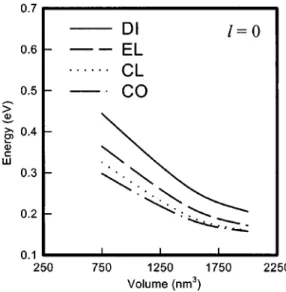
In Fig. 2 we present the calculated electron energy levels for InAs/GaAs quantum dots as functions of the dot volume. The results are plotted relative to the InAs conduction band edge. For InAs, the energy gap E1g is 0.42 eV, spin-orbit⌬1
is 0.42 eV, the value of the nonparabolicity parameter E1 pis
3m0P1 2
/ប2⫽22.2 eV, and m0 is the free electron effective
mass. For GaAs we choose: E2g⫽1.52 eV, ⌬2⫽0.34 eV,
and E2 p⫽24.2 eV. The band offset is taken as Ve0
⫽0.77 eV.46 The base radius of the dots is fixed at R 0
⫽10 nm for all shapes. Notice that the range of the dot
vol-ume and the radius of the base were take from available experimental data.7Our model predicts rather different elec-tron energy dependences on the volume for dots of different shapes. When the dot volume increases the energy states of different shapes converge. The most sensitive to the dot vol-ume variation is the quantum disks and the least is that of the conical shape dots. This is no surprise since the electron wave function is the best confined for the disk geometry when the volume and the radius are fixed. The electron ground state wave functions with a fixed 750 nm3 dot vol-ume for all shapes are plotted in Fig. 3. The wave function shape confirms weaker confinement for conical shaped dots. The first excited state (l⫽1), however, has demonstrated a weaker sensitivity to the dot shape and volume3,4 共see Fig. 4兲. This is because that the electron wave functions of the
FIG. 3. Contour plot of the electron ground state wave functions where the dot volume is fixed at 750 nm3for all shapes. All parameters are the same as in Fig. 2.
FIG. 4. The energy position of the first excited electron states (l⫽1) for the dots with the same parameters of Fig. 2.
FIG. 5. Contour plot of the first excited electron state wave functions where the dot volume is fixed at 750 nm3for all shapes. All parameters are the same as in Fig. 2.
FIG. 2. The electron ground state (l⫽0) energy levels for InAs/GaAs quan-tum dots versus the dot volume. The structure’s base radius is fixed at 10 nm for all shapes. The solid, dash, dot, and dash-dot lines correspond to DI, EL, CL, and CO shapes, respectively.
excited states共see Fig. 5兲 are less confined and, therefore, are less sensitive to the dot shape and size.
To investigate the dependence of electron energy level on the dot volume V more generally we fitted the depen-dence E⬃V⫺␥ to our calculation results. The parameter ␥ obtained by this fitting is presented in Table I for different shapes and base radii of the dots. It is clear from Table I that the parameter is rather different for all dot shapes and can vary widely from the commonly quoted 2/3 value. Based on the calculation we did, the first excited state of a cylindrical dot with R0⫽5 nm has the lowest␥ parameter 0.12. Based
on the wave function confinement discussed above, the larg-est␥parameter was also obtained from the disk shape quan-tum dot. The ground state energy of the disk with R0
⫽15 nm has a ␥ value of 0.76. In contrast to the result of Ref. 32 the geometry variation allows us to obtain a wide range of␥values different from the conventional 2/3.
Using the same calculation method we obtained hole en-ergy states for dots of the same shapes. The hole effective mass was taken as m1h⫽0.4m0 and m2h⫽0.5m0,
46
respec-tively. The hole band offset is taken as Vh0⫽0.33 eV. The
hole energy states were found to be least dependent on the dot shapes. With base radius R0⫽10 nm, the fitted␥ param-eters for those dependencies are presented in Table II. The difference in␥obtained for e0→h0and e1→h0suggests that the transition lines should converge in optical experiments when the size of the dot decreases. A similar tendency has been observed experimentally in InAs quantum dots.4,12
IV. CONCLUSIONS
We have presented a calculational approach to compare the electron energy states for small quantum dots of four different shapes. This simple method with very limited com-putational demands is useful to analyze the dependence of the quantum dot spectra 共ground and excited states兲 on the dot size and shape variations. We found a large 共about 0.1 eV兲 difference in the electron ground state energy of InAs/ GaAs dots with the same volume but different shapes. It is found that the ␥ parameter in the V⫺␥ rule derived from curve fitting deviates from the conventional 2/3 value.
Fur-thermore, it is dependent on dot shape. The excited states as a rule have smaller ␥parameter than the ground states.
In our calculations we also derived hole energy states for the dots and estimated hole–electron transition energies. Our results suggest that the inhomogeneous broadening of ex-cited level transitions is sufficiently less than that for the ground state transitions. Different volume dependence of the energy states for different dot shapes can be useful in tuning the intersublevel energy spacing when we prepare the quan-tum dots with different sizes and shapes.
ACKNOWLEDGMENT
This work was supported in part by the National Science Council of Taiwan under Contract No NSC 90-2215-E009-025.
1
N. N. Ledentsov, V. M. Ustinov, V. A. Schukin, P. S. Kope’v, and Zh. I. Alferov, Semiconductors 32, 343 共1998兲 关Fiz. Tekh. Poluprovodn. 共S.-Peterburg兲 32, 385 共1998兲兴.
2D. Bimberg et al., Thin Solid Films 367, 235共2000兲. 3
R. Leon, S. Fafard, P. G. Piva, S. Rusimov, and Z. Liliental-Weber, Phys. Rev. B 58, R4262共1998兲.
4F. Heinrichsdorff, M. Grundmann, O. Stier, A. Krost, and D. Bimberg, J.
Cryst. Growth 195, 540共1998兲.
5M. Perret, D. Morris, L. Franchomme-Fosse´, R. Coˆte´, S. Fafard, V. Aimez,
and J. Beauvais, Phys. Rev. B 62, 5092共2000兲.
6P. M. Petroff, K. H. Schmidt, G. M. Ribeiro, A. Lorke, and J. Kotthaus,
Jpn. J. Appl. Phys., Part 1 36, 4068共1997兲.
7Y. Ebiko et al., J. Cryst. Growth 201Õ202, 1150 共1999兲. 8
K. Yamaguchi, K. Yujobo, and T. Kaizu, Jpn. J. Appl. Phys., Part 2 39, L1245共2000兲.
9L. G. Wang, P. Kratzer, N. Moll, and M. Scheffler, Phys. Rev. B 62, 1897
共2000兲.
10Q. Xie, J. L. Brown, R. L. Jones, J. E. Van Nostrand, and K. D. Leedy,
Appl. Phys. Lett. 76, 3082共2000兲.
11I. Mukhametzhanov, R. Heitz, J. Zeng, P. Chen, and A. Madhukar, Appl.
Phys. Lett. 73, 1841共1998兲.
12S. Fafard, Z. R. Walilewski, C. Ni. Allen, D. Picard, M. Spanner, J. P.
McCaffrey, and P. G. Piva, Phys. Rev. B 59, 15368共1999兲.
13
J. Oswald, K. Kuldova, J. Zeman, E. Hulicius, S. Jullian, and M. Potem-ski, Mater. Sci. Eng., B 69–70, 318共2000兲.
14S. Fafard, Physica E共Amsterdam兲 8, 107 共2000兲. 15S. Fafard, Appl. Phys. Lett. 76, 2707共2000兲. 16
D. Leonard, K. Pond, and P. M. Petroff, Phys. Rev. B 50, 11687共1994兲.
17
X. Z. Liao, J. Zou, X. F. Duan, D. J. H. Cockayene, R. Leon, and C. Lobo, Phys. Rev. B 58, R4235共1998兲.
18H. Gotoh, H. Ando, H. Kamada, and A. Chaves-Pirso, Appl. Phys. Lett.
72, 1341共1998兲.
19
Z. R. Wasilewski, S. Fafard, and J. P. McCaffrey, J. Cryst. Growth 201Õ
202, 1131共1999兲.
20I. Mukhametzanov, Z. Wei, R. Heitz, and A. Madhukar, Appl. Phys. Lett.
75, 85共1999兲.
21
H. Saito, K. Nishi, and S. Sugou, Appl. Phys. Lett. 74, 1224共1999兲.
22
J. P. McCaffrey, M. D. Robertson, S. Fafard, Z. R. Wasilewski, E. M. Griswold, and L. D. Madsen, J. Appl. Phys. 88, 2272共2000兲.
23P. W. Fry et al., Physica E共Amsterdam兲 9, 106 共2001兲. 24G. Lamouche and Y. Le´pin, Phys. Rev. B 51, 1950共1995兲. 25
F. M. Peeters and V. A. Schweigert, Phys. Rev. B 53, 1468共1996兲.
26A. Wojs, P. Hawrylak, S. Fafard, and L. Jasak, Phys. Rev. B 54, 5604
共1996兲.
27A. H. Rodrı´guez, C. Trallero-Giner, S. E. Ulloa, and J. Marı´n-Antun˜a,
Phys. Rev. B 63, 125319共2001兲.
28
P. Lelong and G. Bastard, Solid State Commun. 98, 819共1996兲.
29D. M. T. Kuo and Y. C. Chang, Phys. Rev. B 61, 11051共2000兲. 30P. C. Sercel and K. J. Vahala, Phys. Rev. B 42, 3690共1990兲. 31Al. L. Rosen and M. Rosen, Phys. Rev. B 58, 7120共1998兲. 32
N. Singh, Ranjan, and V. A. Singh, Int. J. Mod. Phys. 14, 1753共2000兲.
33M. Grudman, O. Stier, and D. Bimberg, Phys. Rev. B 52, 11969共1995兲;
59, 5688共1999兲.
TABLE I. Parameter␥for electron energy levels.
Base radius State 5 nm 10 nm 15 nm l⫽0 兩l兩⫽1 l⫽0 兩l兩⫽1 l⫽0 兩l兩⫽1 DI 0.31 0.12 0.74 0.61 0.76 0.63 EL 0.30 0.12 0.72 0.60 0.74 0.61 CL 0.30 0.12 0.69 0.58 0.70 0.59 CO 0.30 0.12 0.65 0.56 0.66 0.56
TABLE II. Parameter␥for energy of transitions.
Transition e0→h0 e1→h0 DI 0.38 0.36 EL 0.35 0.32 CL 0.31 0.29 CO 0.27 0.26 6419
J. Appl. Phys., Vol. 90, No. 12, 15 December 2001 Liet al.
34M. A. Cusak, P. R. Briddon, and Jaros, Phys. Rev. B 54, R2300共1996兲. 35A. J. Williamson and A. Zunger, Phys. Rev. B 59, 15819共1999兲. 36C. Prior, Phys. Rev. B 60, 2869共1999兲.
37M. Califano and P. Harrison, Phys. Rev. B 61, 10959共2000兲.
38J. Shumway, L. R. C. Fonseca, J. P. Leburton, R. M. Martin, and D. M.
Ceperley, Physica E共Amsterdam兲 8, 260 共2000兲.
39S. S. Li and J. B. Xia, J. Appl. Phys. 84, 3710共1998兲. 40M. Califano and P. Harrison, J. Appl. Phys. 88, 5870共2000兲.
41R. S. Varga, Matrix Iterative Analysis共Prentice-Hall, Englewood Cliffs,
NJ, 1962兲.
42W. F. Ames, Numerical Methods for Partial Differential Equations
共Aca-demic, New York, 1992兲.
43J. H. Wilkinson and C. Reinsch, Linear Algebra II of Handbook for Au-tomatic Computation共Springer, New York, 1971兲.
44D. S. Watkins, J. Comput. Appl. Math. 123, 67共2000兲. 45
I. C. F. Ipsen, SIAM Rev. 39, 254共1997兲.
46
G. Bastard, Wave Mechanics Applied to Semiconductor Heterostructures
共Les Edition de Physique, Les Ulis, 1988兲.
47Y. Li et al., Technical Proceedings of the Fourth International Conference
on Modeling and Simulation of Microsystems, South Carolina, March 2001, pp. 562–566.