Effects of substrate temperature on properties of Alq3 amorphous
layers prepared by vacuum deposition
K. C. Chiu,* Z. A. Jian, Y. Z. Luo, J. M. Chung, S. J. Tang, M. C. Kuo and J. L. Shen
Department of Physics and Center for Membrane Technology,
Chung Yuan Christian University, Chung-Li, Taiwan 32023, ROC
W. C. Chou and C. S. Yang
Department of Electrophysics, National Chiao Tung University,
Hsin-Chu, Taiwan 300, ROC
ABSTRACT
In this report, various organic Alq3 amorphous layers are prepared by vacuum deposition at different substrate temperatures Tsub (from 30 to 180℃). The surface morphology, structural information, electrical and optical properties of these as-deposited layers are investigated by atomic force microscopy, X-ray diffraction, J-E curves, and photoluminescence studies, respectively. Furthermore, a temperature dependence of dark electrical conductivity σ(T) deduced from J-E curves of these organic amorphous layers is presented. Finally, effects from Tsub on the physical properties of these organic Alq3 amorphous layers are discussed and a model based on a thermal interconversion between Alq3 isomers is proposed to explain these experimental results.
Keywords: Organic amorphous layer; Vacuum deposition; Electrical conductivity; Surface morphology; Photoluminescence; Isomeric transformation.
1. INTRODUCTION
Due to the processability advantages offered by organic materials, an intense research effort has been devoted to the preparation of organic thin-film field-effect transistors (OTFTs) during the last two decades [1-10]. The active layer in an OTFT is fabricated of small organic molecules [1-4], conjugated oligomers and polymers [5-10], or organic-inorganic hybrids. The performance of OTFTs involves the intramolecular and intermolecular charge transport mechanisms which are strongly affected by the structural and morphological characteristics of the as-deposited organic layer. Generally, organic layers from small molecules or conjugated oligomers [1-5] are prepared by vacuum deposition on cold substrate. These organic amorphous layers are not macroscopically homogeneous because of growth morphology defects [11]. In addition, during vacuum deposition in mass production, the latent heat released from vaporized molecule to its condensed phase may increase the real temperature of the unheated “cold” substrates (especially when a plastic substrate of poor thermal conductivity is used). From an external control and monitoring of the substrate temperature Tsub, our earlier experimental results indicated that, with slightly increasing
Tsub (up to 60 ~ 90℃) to enhance the surface diffusion energy of the adhered molecules, the as-deposited Alq3 amorphous layers possess smaller surface roughness, larger electrical conductivity, and higher photoluminescence intensity [12]. For molecular C60 polycrystalline films, the effects from Tsub as well as the source temperature Tsou on the size, orientation, and crystallinity of the grains have been markedly observed [13,14]. In the case of oligothiophenes, the effects of Tsub on the structure and morphology of thin organic films have also been analyzed [5]. Thus, a systematic study on the effects from deposition conditions (extending to a wider range of Tsub) to the physical properties of the as-deposited organic layers should be very useful to the design, development, and fabrication of the future OTFTs.
In this report, as an example, various organic Alq3 layers are prepared by vacuum deposition at different Tsub. Alq3 is a stable metal chelate complex that can be sublimed to yield thin films with excellent electron-transport and light-emitting properties; it stands as one of the most successful organic materials used in organic light-emitting diodes OLEDs and hence a great attention has been paid to this organic semiconductor [15-21]. In this work, effects
of Tsub on surface morphology, structural information, electrical and optical properties of these as-deposited Alq3 amorphous layers are investigated by atomic force microscopy (AFM), X-ray diffraction (XRD), current-voltage (I-V) curves, and photoluminescence (PL) studies, respectively. Furthermore, a temperature dependence of dark electrical conductivity σ(T) deduced from I-V curves of these organic amorphous layers is presented. Finally, a model based on a thermal interconversion between Alq3 isomers is proposed to explain these experimental results.
2. EXPERIMENTAL DETAILS
The Alq3 layers used in this work are prepared in a vacuum thermal evaporation chamber. The source powder is first loaded in a boron-nitride crucible. After the vacuum chamber reaches a base pressure of 3×10⁻⁵ Torr, the heating system then turns on. The source temperature Tsou is fixed at 250 ± 5℃. The ITO conducting glass plate is used as a substrate. The distance between source crucible and substrate is approximately 16 cm. The values of Tsub are varied from 30℃ to 180℃ (note that the glass-transition temperature Tg ≅ 175℃ for Alq3). When Tsou and Tsub attain the setting values, the shutter in between source crucible and substrate is then removed to allow vacuum deposition. The typical deposition time is 25 min. The thickness of the as-deposited layers is around 4000 Å. The thickness of the layer is first monitored by a quartz crystal deposition controller in situ, and then it is also corrected by a spectral reflectance method after the sample being removed out of the deposition chamber.
For electrical characterization, a top Au-metal contact with active area of about 4×4 mm2 and thickness of about 1000 Å is fabricated by ion-sputtering. To reduce the thermally driven diffusion of Au atoms into the sample, the experimental parameters of ion-sputtering are controlled such that the temperature of the sample immediately after sputtering is within a reasonable range. For I-V measurements, an electrometer (in a current-voltage mode) is applied to the sandwiched Au/organic-layer/ITO samples. Due to the small resistance for some of the sandwiched organic samples, the small series resistance from the measurement circuit (especially for the sheet resistance from ITO film) has to be taken into account. Then, current density versus electric field (J-E) curves for various organic samples are deduced from I-V curves. With low fields being applied (from 0 to 0.75 MV/m), the J-E curves measured from all the samples exhibit a linear ohmic behavior [11], and hence, the dark electric conductivity σ of the organic Alq3 layer is then estimated. To eliminate effects from water vapor and oxygen gas, the measurements are conducted after the sample being put into a cryostat system under dynamic vacuum for at least 2 h. The data are taken and averaged during the next 10 h to check their stability and reliability at 300 K. The experimental results indicate that after 12 h in dynamic vacuum condition the electrical conductivities σ(T = 300K) for our amorphous layers are found to reach nearly steady state. Then, a temperature dependence (T varies from 300 ~ 40K) of the dark electrical conductivity σ(T) of the amorphous layers is performed.
3. RESULTS AND DISCUSSION
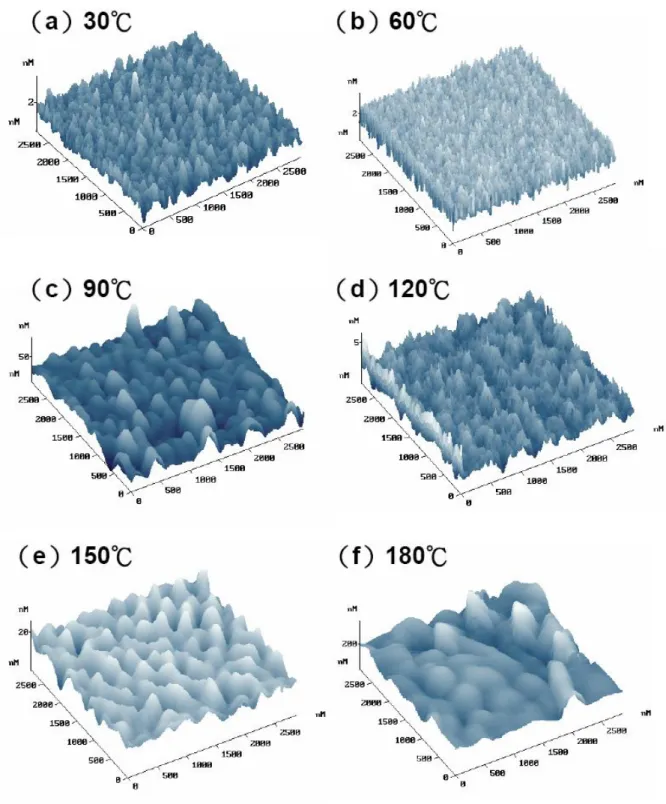
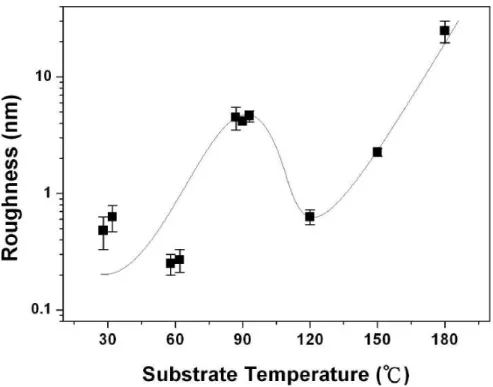
Figure 1 shows the typical AFM pictures for the as-deposited Alq3 layers with respect to different Tsub. The calculated values of root-mean-square roughness (Rrms) are shown in Fig. 2. With slightly increasing Tsub from 30℃ up to 60℃, the as-deposited layers are found to possess flatter surface morphology with smaller Rrms. However, for
Tsub ≒ 90℃, the surface roughness of the amorphous layer reaches a local maximum [12]. Further increase of thermal energy with Tsub ≒ 120℃, the surface roughness of the amorphous layer again possess flatter surface and Rrms reaches a local minimum. Finally, with increasing Tsub from 120℃ up to 180℃, Rrms increases. Also from the XRD patterns, an amorphous character with a broad diffuse peak representing an average nearest-neighbor bond length [11] is shown in Fig. 3 for all of the as-deposited films.
Figure 4 gives the room temperature normalized PL spectra for various Alq3 amorphous layers deposited at different Tsub. The incident pumping light is a beam of wavelength 396 nm from a semiconductor-laser. The luminance intensity from sample deposited at Tsub = 60℃ is much higher (which can be detected directly by the eyes during the experiments) than that from other samples. By comparing Figs. 2 and 4, one can find that the PL intensity peak of the sample is approximately inverse proportional to the roughness of the sample. This finding reveals that the surface morphology of the amorphous layer plays an important role in the luminance efficiency of OLEDs. Then, to investigate the PL intensity peak shift with respect to Tsub, from a Gaussian fit for each curve (but only the points
above 90% of its maximum intensity are taken for fitting due to the asymmetric character), the PL intensity peaks are 532.8 nm (for Tsub = 30℃), 532.0 nm (60℃), 526.4 nm (90℃), 529.0 nm (120℃), 531.2 nm (150℃), and 529.7 nm (180℃), respectively. The average PL intensity peak is about 530 ± 3 nm with half-amplitude bandwidth of 120 nm, which is consistent with the published results [12,16]. In addition, the PL intensity peak is observed to have a small blue-shift for Tsub varying from 30℃ to 90℃.
Under dynamic vacuum condition for at least 12 h, σ(T = 300K) for various samples deposited at different Tsub are shown in Fig. 5. From this figure, one can see that the value of σ(300K) of the as-deposited Alq3 amorphous layers increases with increasing Tsub for Tsub = 30 ~ 90℃, drops down to a local minimum at Tsub ≒ 120℃, and then increases with increasing Tsub again for Tsub = 120 ~ 180℃.
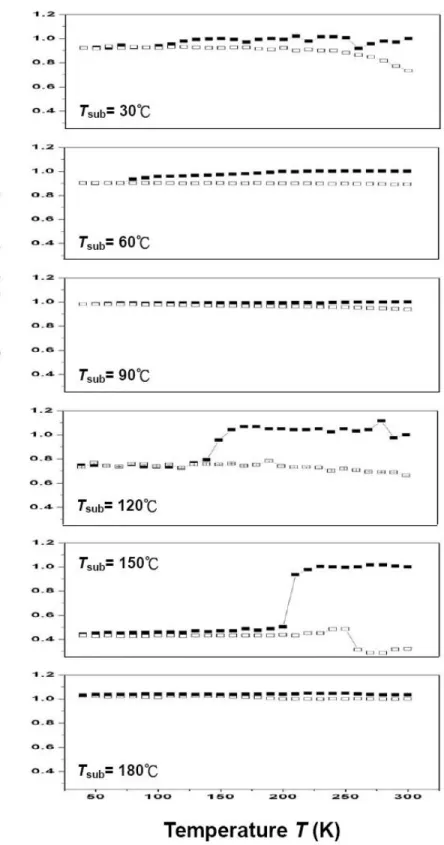
To test the thermal stability of physical properties for various amorphous Alq3 layers deposited at different Tsub, we perform a temperature dependence of dark electrical conductivity, σ(T). As shown in Fig. 6 with back-and-forth temperature scan (T-scan) and with a cooling/heating rate of about 2 K/min, several interesting features are observed. (1) For amorphous Alq3 layers deposited at Tsub = 30℃, the values of σ slightly jump back and forth with decreasing
T. But once reaching to the lowest T of 40K and then with increasing T, for T > 110K σ starts to deviate from its
corresponding value measured at previous T-scan. For T = 300K, the ratio of the second measured value of σ to the first one after a complete T-scan, i.e., σ(T = 300K, 2nd)/σ(T = 300K, 1st), is about 0.73. (2) For amorphous layers deposited at Tsub = 60℃, 90℃, and 180℃, the variation of σ versus T is rather small, and these layers exhibit high thermal stability. The ratios of σ(T = 300K, 2nd)/σ(T = 300K, 1st) for layers deposited at Tsub = 60℃, 90℃, and 180℃ are 0.90, 0.94, and 0.96, respectively. (3) For amorphous layers deposited at Tsub = 120℃ and 150℃, an abrupt decrease during the first decreasing T-scan is observed. Once dropped into the lowest-σ state, σ becomes less sensitively dependent on T. The ratios of σ(T = 300K, 2nd)/σ(T = 300K, 1st) for amorphous layers deposited at Tsub = 120℃ and 150℃ reduce exaggeratedly down to 0.67 and 0.31, respectively. These findings strongly reveal that σ of the amorphous layers deposited at Tsub = 120℃ and 150℃ is under irreversible change with respect to the first cooling-down process.
Above experimental results from Figs. 1-6 clearly show that the physical properties of the as-deposited Alq3 amorphous layers are strongly affected by Tsub, especially for an anomalous Tsub-dependence of physical properties as
Tsub varies from 90℃ to 120℃. To explain these rich behaviors, at first, some important published results about Alq3 molecules and its condensed phases are summarized as in the following. There are two types of geometrical isomers for Alq3, namely, meridional (mer, C1 symmetry) and facial (fac, C3 symmetry); but the possibility of thermal interconversion between the mer and fac isomers when sublimed in high vacuum is still unclear [17]. Though such an isomeric transformation at around 115℃ was inferred from NMR measurements when dimethylsulfoxide was used as the solvent [17, 18]. From a detailed density functional theory study, the mer isomer is calculated to be lower in energy than the fac isomer by 0.17 eV [19]. For crystalline phases, α-Alq3 and β-Alq3 phases are identified as low temperature phases, while γ-Alq3 and δ-Alq3 phases are identified as high temperature phases (above 395℃) [17]. From ordered Alq3 films by molecular beam deposition on cleaved KCl and KBr substrates at room temperature, the growth of mer isomer crystals was suggested [20]. However, the high temperature δ-Alq3 phase being composed of
fac isomers was identified [21].
Then, to explain the experimental results obtained by this work, we propose a model based on that a thermal interconversion between the mer and fac isomers occurs in between 90 ~ 120℃ when sublimed in high vacuum. For
Tsub ≦ 90℃, the vacuum deposition to form the amorphous layer is dominated by irregular stacking of mer Alq3 molecules. For Tsub ≧ 120℃, the vacuum deposition from irregular stacking of fac Alq3 molecules may start to play a significant role.
For Tsub ≦ 90℃, we assume that the vacuum deposition is dominated by irregular stacking of mer Alq3 molecules. With slightly increasing Tsub from 30℃ up to 60℃, the adhered Alq3 molecules gain more surface diffusion energy. This 2D surface-diffusion process leads the as-deposited Alq3 amorphous layers with flatter surface morphology and smaller Rrms as shown in Figs. 1-2. However, for Tsub ≒ 90℃, this higher thermal energy may promote a preferential rearrangement of the short π-π contacts between the ligands of neighboring Alq3 molecules and results some prototypes of α-Alq3 or β-Alq3 crystallines [17,20]. Hence the surface roughness of the amorphous layer reaches a local maximum. For Tsub in between 30 ~ 90℃, the higher Tsub results the closer links between the ligands in mer Alq3 molecules. Therefore, for Alq3 layers deposited at higher Tsub, the easier charge-carrier-hopping leads to a higher value of σ(T = 300K) as shown in Fig. 5; and, the stronger interaction between the ligands in mer Alq3 molecules results a small blue-shift of the PL intensity peak as abovementioned. In addition, from a study of σ(T), this specific
3D stacking structure deposited at Tsub ≒ 90℃ (as comparing to those deposited at Tsub ≒ 30℃ and 60℃) can be rather robust upon cooling down to low temperatures as depicted in Fig. 6.
For Tsub ≧ 120℃, we suggest that the vacuum deposition from irregular stacking of fac Alq3 molecules may start to play a significant role. Since fac isomer has a higher dipole moment than mer isomer, and a stronger dipole-dipole interaction acts as a stabilizing factor in the aggregate phase [19]. As comparing to the amorphous layers deposited at
Tsub = 90℃ which are dominated by mer Alq3 molecules, the amorphous layers deposited at Tsub = 120℃ possess a flatter surface with smaller Rrms. In addition, the fac isomer is reported to act as a trapping state in the electron transport [19]. Thus, the layers deposited at Tsub = 120℃ and 150℃ possess much smaller values of σ(300K) as shown in Fig. 5. Furthermore, the fac isomers in amorphous layers may not be stable below room temperatures. This is deduced from the theoretical calculation [19] and experimental facts [20,21]. Thus, during the first cooling down process, the fac isomers are not stable in their “as-deposited” amorphous states, and hence an abrupt discontinuity as observed in σ(T) due to the conformation instability is resulted as shown in Fig. 6. For the second cooling down process (not shown in Fig. 6), the variation in σ(T) measurement is much less. For Tsub = 180℃ above the glass transition temperature, the as-deposited Alq3 films may become more order. One would expect some crystalline characters to be observed in XRD pattern, but as shown in Fig. 3 an amorphous character is still presented. However, the experimental data from Figs. 1-2 indicate that some larger grains are formed. The values of σ for layers with larger grains (formed at high Tsub and hence with closer separation and stronger interaction between Alq3 molecules) reach maximum values again and are very stable against temperature changes as depicted in Figs. 5-6.
In contrast to inorganic covalent compounds, the effects of Tsub on the physical properties of these as-deposited organic amorphous layers from small molecules exhibit much complex and interesting behaviors. The intrinsic properties of isomeric transformation and complex interactions between ligands of these small organic molecules as well as the molecular dynamics from both bulk diffusion and interface diffusion can play significant roles for organic thin films fabricated by vacuum deposition. Thus, a detailed study on the effects from deposition conditions to the physical properties of these as-deposited organic layers should be very important to the design, development, and fabrication of the future OLEDs and OTFTs.
4. SUMMARY
In this report, various organic Alq3 amorphous layers are prepared by vacuum deposition at different Tsub from 30 ~ 180℃. Then, effects of Tsub on the surface morphology, structural information, electrical and optical properties of the as-deposited Alq3 amorphous layers are investigated. An anomalous Tsub-dependence of physical properties is observed for those Alq3 amorphous layers deposited at Tsub ≦ 90℃ and at Tsub ≧ 120℃, respectively. A model based on that, when Alq3 sublimed in high vacuum, a thermal interconversion between the mer and fac isomers occurs in between 90 ~ 120℃ is proposed to explain these anomalous experimental results. This research also indicates that the intrinsic properties of isomeric transformation and complex interactions between ligands of these small organic molecules as well as the molecular dynamics from both bulk diffusion and interface diffusion can play significant roles for organic thin films fabricated from small organic molecules by vacuum deposition.
ACKNOWLEDGEMENTS
The authors would like to thank the National Science Council (via NSC94-2112-M-033-002) and the Ministry of Education (via the Center-of-Excellence Program on Membrane Technology) of the Republic of China for financially supporting this research.
REFERENCES
[1] R. C. Haddon, A. S. Perel, R. C. Morris, T. T. M. Palstra, A. F. Hebard and R. M. Fleming, “C60 thin film transistors,” Appl. Phys. Lett. 67(1), 121-123 (1995).
[2] Y. Y. Lin, D. J. Gundlach, S. F. Nelson and T. N. Jackson, “Pentacene-based organic thin-film transistors,” IEEE
Trans. Elec. Dev. 44(8), 1325-1331 (1997).
[3] H. E. Katz, A. J. Lovinger, J. Johnson, C. Kloc, T. Siegrist, W. LI, Y. Y. Lin and A. Dodabalapur, “A soluble and air-stable organic semiconductor with high electron mobility,” Nature 404(6777), 478-481 (2000).
[4] D. J. Gundlach, J. A. Nichols, J. Zhou and T. N. Jackson, “Thin-film transistors based on well-ordered thermally evaporated naphthacene films,” Appl. Phys. Lett. 80(16), 2925-2927 (2002).
[5] F. Garnier, “Thin-film transistors based on organic conjugated semiconductors,” Chem. Phys. 227(1-2), 253-262 (1998).
[6] A. Tsumura, H. Koezuka, and T. Ando, “Macromolecular electronic device: field-effect transistor with a polythiophene thin film,” Appl. Phys. Lett. 49(18), 1210-1212 (1986).
[7] J. H. Burroughes, C. A. Jones, and R. H. Friend, “New semiconductor device physics in polymer diodes and transistors,” Nature 335(6186), 137-141 (1988).
[8] C. D. Dimitrakopoulos and P. R. L. Malenfant, “Organic thin film transistors for large area electronics,” Adv.
Mater. 14(2), 99-117 (2002).
[9] A. Pron and P. Rannou, “Processible conjugated polymers: from organic semiconductors to organic metals and superconductors,” Prog. Polym. Sci. 27(1), 135-190 (2002).
[10] K. Bock, “Polymer electronics systems-polytronics,” Proc. IEEE 93(8), 1400-1406 (2005). [11] S. R. Elliott, Physics of Amorphous Materials, 2nd ed., Longman Sci. & Tech., Essex, 1990.
[12] J. M. Chung, Y. Z. Luo, Z. A. Jian, M. C. Kuo, C. S. Yang, W. C. Chou, and K. C. Chiu, “Effects of substrate temperature on the properties of Alq3 amorphous layers prepared by vacuum deposition,” Jpn. J. Appl. Phys. 43(4A), 1631-1632 (2004).
[13] R. S. Chen, Y. J. Lin, Y. C. Su, and K. C. Chiu, “Surface morphology of C60 polycrystalline films from physical vapor deposition,” Thin Solid Films 396(1-2), 103-108 (2001).
[14] W. R. Cheng, S. J. Tang, Y. C. Su, Y. J. Lin, and K. C. Chiu, “Effects of substrate temperature on the growth of C60 polycrystalline films by physical vapor deposition,” J. Cryst. Growth 247(3-4), 401-407 (2003).
[15] Z. H. Kafafi, ed., Organic Electroluminescence, Taylor & Francis Group, London, 2005.
[16] D. S. Qin, D. C. Li, Y. Wang, J. D. Zhang, Z. Y. Xie, G. Wang, L. X. Wang, and D. H. Yan, “Effects of the morphologies and structures of light-emitting layers on the performance of organic electroluminescent devices,” Appl.
Phys. Lett. 78(4), 437-439 (2001).
[17] M. Brinkmann, G. Gadret, M. Muccini, C. Taliani, N. Masciocchi, and A. Sironi, “Correlation between molecular packing and optical properties in different crystalline polymorphs and amorphous thin films of mer-Alq3,” J. Am.
Chem. Soc. 122(21), 5147-5157 (2000).
[18] B. C. Baker and D. T. Sawyer, “Proton nuclear magnetic resonance studies of 8-quinolinol and several of its metal complexes,” Anal. Chem. 40(13), 1945-1951 (1968).
[19] A. Curioni, M. Boero, and W. Andreoni, “Alq3: ab initio calculations of its structural and electronic properties in neutral and charged states,” Chem. Phys. Lett. 294(4-5), 263-271 (1998).
[20] H. Ichikawa, T. Shimada, and A. Koma, “Ordered growth and crystal structure of Alq3 on alkali halide surfaces,”
Jpn. J. Appl. Phy. 40(3A), L225-L227 (2001).
[21] M. Colle, J. Gmeiner, W. Milius, H. Hillebrecht, and W. Brutting, “Preparation and characterization of blue-luminescent Alq3,” Ad. Funct. Mater. 13(2), 108-112 (2003).
(a) 30°C
(c) 90°C
(e) 150°C
(b) 60°C
(d) 120°C
(f) 180°C
0 0 1000 boo N. 2 2500z0
01
lB
2600 B tEB 0 'H l00 — bee0.
0 'H 2E0 ZBBe 158B ZSBB se B 0i5
ISBB — ZSBB ieee+
1o• 1/
/
0.1• I I I I I 30 60 90 120 150180
Substrate Temperature (°C}
0 1029 (degree)
50 20 30 40 I I IFig. 2 Calculated values of Rrms for Alq3 layers with respect to different Tsub.
1.00.8 -0.6 0.4 C C,
-I
C
0.20.0 -400450
500
550600
Wavelength (nm}
650 700Tsub=l2Ot
90 t
180t
1o6.
C)(I)
4S C)V
C
C
C) I o-7•I
I!
4
4
I
30 60 90 120 150Substrate Temperature ("C)
180Fig. 4 Room temperature PL studies for Alq3 layers deposited at different Tsub.
————— ————
Tsub 30t
V
C0
0
V
a) NE
0
2
I
-1 0
o - a o - S o - a I -2 1.0 o - a o - a o -4. 1-2 1.0— o a o a 0_a. -—=========[.]=! ,
T9ub 60t
T9ub DOC — ———— —Tsub 120t
I -2 1.0 o a o a 0_a. -1-2 — 1.00a -o - a o -a.T9ub 150t
——=!
!!!!
—1.0 ———————,r,
o - a o - a 0-4. T&tii,=180t
- -SO 100'50
O0
250 OOTemperature T(K)
Fig. 6 Temperature dependence of normalized conductivity σ(T)/σ(T = 300K) for Alq3 layers deposited at different Tsub. Solid symbols indicate for decreasing T-scan and open symbols for increasing T-scan.