Manufacturing Technique and Property Evaluations of Tubular
PLA/Spandex/Gelatin Composite Braids
Ching-Wen Lou
1, Po-Ching Lu
2, Jin-Jia Hu
3, b, Syue-Wun Fu
3and
Jia-Horng Lin
2, 4, 5, a1Institute of Biomedical Engineering and Materials Science, Central Taiwan University of Science and Technology, Taichung 40601, Taiwan, R.O.C.
2Laboratory of Fiber Application and Manufacturing, Department of Fiber and Composite Materials, Feng Chia University, Taichung City 40724, Taiwan, R.O.C.
3Department of Biomedical Engineering, National Cheng Kung University, Taiwan, R.O.C. 4School of Chinese Medicine, China Medical University, Taichung 40402, Taiwan, R.O.C.
5Department of Fashion Design, Asia University, Taichung 41354, Taiwan, R.O.C. a [email protected], b[email protected]
Keywords: Polylactic acid, biocompatibility, spandex, braids.
Abstract. Polylactic acid (PLA) is a synthetic polymer that has biocompatibility and
biodegradation. This study aims to examine the influence of manufacturing parameters on the physical properties of tubular PLA/Spandex/Gelatin composite braids. PLA fibers and spandex are combined, braided and then immersed in gelatin solution to form tubular PLA/Spandex/Gelatin composite braids. The tensile strength, bursting strength, and porosity of the resulting braids are tested, and the experiment results show that a greater twist per inch (T.P.I.) causes a higher tensile strength and bursting strength, but does not change the porosity distinctively.
Introduction
Polylactic acid (PLA) is a result of polymerization of lactic acid monomers. Based on different enantiomers, PLA can be divided into dextrorotation and levorotation, the crystallinity and thermal properties of both also differ. Due to ease of processing, PLA is commonly made into films [1], nano-fibers [2], microspheres [3], and composites [4]. Also, being biocompatible, biodegradable, and non-toxic, PLA is widely used for drug release, scaffolds, wound dressings, and regeneration of bone tissues. Spandex has been greatly used in women’s undergarments, men’s suits, socks, and elastic clothes. Owing to its extraordinary elasticity and flexibility, the growth rate for the applications of spandex in textile fields is considerably fast [5-7]. This study aims to examine the influence of the parameters─the fineness of PLA fibers, the fineness of spandex, and T.P.I. of PLA/Spandex wrapped yarns─on the bursting strength, tensile strength, and porosity of tubular PLA/Spandex/Gelatin composite braids.
Experimental Materials
a c e
b d f
Spandex (Du Pont, U.S.) has a fineness of 70 denier (D). PLA fiber (Unitika Ltd., Japan) has a fineness of 75 D. Gelatin, type A, is purchased from Sigma-Aldrich Co., LLC., U.S.A.
Preparation of PLA/Spandex Wrapped Yarns
PLA fibers are combined to form 150 D, 225 D, and 300 D plied yarns to serve as the sheaths. Various PET plied yarns are then twisted with 1 or 2 plies of spandex (the core) with T.P.I. of 5, 7, and 9 on a rotor twister, and then hot set at 70 ℃ for 30 minutes to form PLA/Spandex wrapped yarns.
Preparation of Tubular PLA/Spandex/Gelatin Composite Braids
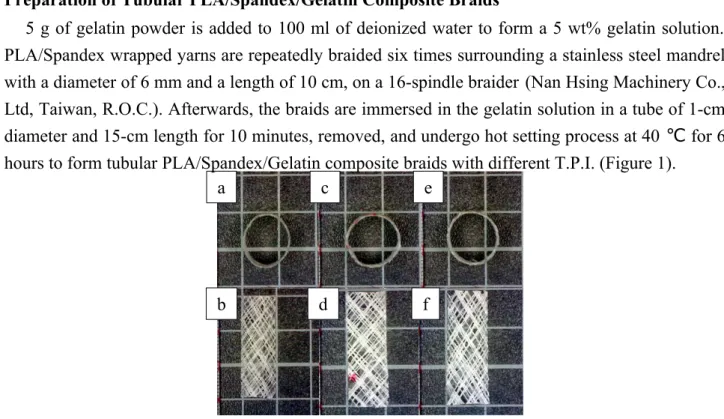
5 g of gelatin powder is added to 100 ml of deionized water to form a 5 wt% gelatin solution. PLA/Spandex wrapped yarns are repeatedly braided six times surrounding a stainless steel mandrel with a diameter of 6 mm and a length of 10 cm, on a 16-spindle braider (Nan Hsing Machinery Co., Ltd, Taiwan, R.O.C.). Afterwards, the braids are immersed in the gelatin solution in a tube of 1-cm diameter and 15-cm length for 10 minutes, removed, and undergo hot setting process at 40 ℃ for 6 hours to form tubular PLA/Spandex/Gelatin composite braids with different T.P.I. (Figure 1).
Figure 1. Cross-sections of tubular PLA/Spandex/Gelatin composite braids made of a) 5, b) 7, and c) 9 twists per inch, and the out layers of tubular PLA/Spandex/Gelatin composite braids made of d) 5, e) 7, and f) 9 twists per inch.
Tests
Bursting Strength
Tubular PLA/Spandex/Gelatin composite braids are cut longitudinally to form 4 cm × 4 cm squares and then tested for bursting strength with a HT-2305 (Hung Ta Instrument Co., Ltd., Taiwan, R.O.C.). The number of samples is 5.
Tensile Strength
Tubular PLA/Spandex/Gelatin composite braids are cut along the longitudinal direction to form 3 cm × 1 cm pieces and then tested for tensile strength with an Instron 5566 (Instron U.S.A.). The distance between two clamps is 1 cm, the tensile speed is 10 mm/min, and the number of samples is 5.
Porosity
Tubular PLA/Spandex/Gelatin composite braids are cut longitudinally to form 3 cm × 1 cm pieces. The thickness of the samples is measured to calculate their volume, and the porosity is counted according to the following equation. The density of PLA fiber and spandex is both 1.25 g/cm3. The number of samples is 5.
a b
a b
where ρ is the sample’s porosity, ms is the sample’s weight, v is the sample’s volume, and ρi is the density of the material.
Results and Discussion
Bursting Strength of Unfolded Tubular PLA/Spandex/Gelatin Composite Braids
Figure 2. Bursting strength of the unfolded tubular PLA/Spandex/Gelatin composite braids, which are made with various combinations of PLA fibers (150 D, 225 D, and 300 D) and Spandex with a fineness of a) 70 D and b) 140 D.
Figure 2 shows that with the same T.P.I., the greater the fineness of PLA fibers, the higher the bursting strength of the unfolded tubular PLA/Spandex/Gelatin composite braids. A high fineness of PLA fibers results in the decrease in the distance between fibers, which in turn heightens the braids’ resistance to bursting strength. Furthermore, the bursting strength is also proportional to T.P.I. The friction force between fibers increase as a result of increased T.P.I., and thereby fortifying the bursting strength
On the contrary, an increasing fineness of spandex causes a decrease in bursting strength. Such a result is because spandex has a low strength, and spandex only can provide the PLA/Spandex wrapped yarns and the tubular braids with good displacement and elasticity. As a result, the fineness of spandex does not influence the bursting strength.
Tensile Strength of Unfolded Tubular PLA/Spandex/Gelatin Composite Braids
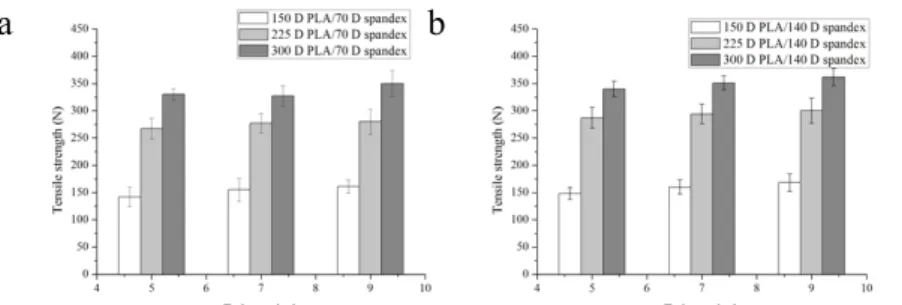
Figure 3. Tensile strength of the unfolded tubular PLA/Spandex/Gelatin composite braids, which are made with various combinations of PLA fibers (150 D, 225 D, and 300 D) and Spandex with a fineness of a) 70 D and b) 140 D.
Figure 3 shows that the tensile strength of the unfolded tubular PLA/Spandex/Gelatin composite braids slightly increases with an increase in T.P.I., but significantly increases with the fineness of PLA fibers. An increase in T.P.I. results in a greater friction between the plied yarns, and a greater fineness of PLA fibers results in a higher density of the composite braids and a greater density of plied yarns, both of which contribute to the tensile strength. Conversely, a greater fineness of spandex does not promote the tensile strength significantly (Figure 3 (b)). Although a greater
fineness of spandex benefits the density and compactness of the composite braids, the spandex has an intrinsic low strength, which is not capable of fortifying the tensile strength.
Porosity of Unfolded Tubular PLA/Spandex/Gelatin Composite Braids
Figure 4. Porosity of the unfolded tubular PLA/Spandex/Gelatin composite braids, which are made with various combinations of PLA fibers (150 D, 225 D, and 300 D) and Spandex with a fineness of a) 70 D and b) 140 D.
Figure 4 shows that porosity of the unfolded tubular PLA/Spandex/Gelatin composite braids remains between 67 % and 78 %, regardless of variations in the fineness of PLA fibers, the fineness of spandex, and T.P.I. Despite that fineness of fibers has an influence on the density of the composite braids as well as the distance between the fibers, an immersion in gelatin solution can fill the pores in the composite braids. As a result, variations in any parameters insignificantly change the porosity.
Conclusion
This study successfully produces tubular PLA/Spandex/Gelatin composite braids with PLA/Spandex wrapped yarns and various manufacturing parameters. The tensile strength and bursting strength of the composite braids are proportional with T.P.I. and the fineness of PLA fibers; however, they are not influenced with the fineness of spandex. Finally, porosity of the composite braids made with various manufacturing parameters is always between 67 and 78 %, and both the fineness of PLA fibers and the fineness of spandex hardly have any influences over the porosity.
Acknowledgement
The authors would especially like to thank National Science Council of the Taiwan, for financially supporting this research under Contract NSC 101-2221-E-006-050.
References
[1] Z.Ö. Erdohan, B. Çam and K.N. Turhan: J. Food. Eng. Vol. 119 (2013), p. 308.
[2] A. Dasari, J. Quirós, B. Herrero, K. Boltes, E. García-Calvo and R. Rosal: J. Membrane. Sci. Vol. 405–406 (2012), p. 134.
[3] M.S. Shive and J.M. Anderson: Adv. Drug. Deliver. Rev. Vol. 28 (1997), p. 5. [4] A. Porras and A. Maranon: Compos. Part B-Eng. Vol. 43 (2012), p. 2782. [5] H. Miller: Int. Fiber J. Vol. 13 (1998), p. 20.